transmission fluid SUBARU OUTBACK 2007 4.G User Guide
[x] Cancel search | Manufacturer: SUBARU, Model Year: 2007, Model line: OUTBACK, Model: SUBARU OUTBACK 2007 4.GPages: 442, PDF Size: 13.39 MB
Page 294 of 442
vehicle and may cause it to stall. Never
attempt to drive through rushing water;
regardless of its depth, it can wash away
the ground from under your tires, resulting
in possible loss of traction and even
vehicle rollover. .Always check your brakes for effec-
tiveness immediately after driving in sand,
mud or water. Do this by driving slowly
and stepping on the brake pedal. Repeat
that process several times to dry out the
brake discs and brake pads. . Do not drive or park over or near
flammable materials such as dry grass or
fallen leaves, as they may burn easily. The
exhaust system is very hot while the
engine is running and right after engine
stops. This could create a fire hazard. . After driving through tall grass, mud,
rocks, sand, rivers, etc., check that there
is no grass, bush, paper, rags, stones,
sand, etc. adhering to or trapped on the
underbody. Clear off any such matter from
the underbody. If the vehicle is used with
these materials trapped or adhering to the
underbody, a mechanical breakdown or
fire could occur. . Secure all cargo carried inside the
vehicle and make certain that it is not
piled higher than the seatbacks. During
sudden stops or jolts, unsecured cargo
could be thrown around in the vehicle and cause injury. Do not pile heavy loads on
the roof. Those loads raise the vehicle
’s
center of gravity and make it more prone
to tip over. . If you must rock the vehicle to free it
from sand or mud, depress the accelerator
pedal slightly and move the selector lever
back and forth between “D ” and “R ”
repeatedly. Do not race the engine. For
the best possible traction, avoid spinning
the wheels when trying to free the vehicle. . When the road surface is extremely
slippery, you can obtain better traction by
starting the vehicle with the transmission
in 2nd than 1st (both for MT and AT). . Never equip your vehicle with tires
larger than those specified in this manual.. Wash the vehicle ’s underbody after off-
road driving. Suspension components are
particularly prone to dirt buildup, so they
need to be washed thoroughly. . Frequent driving of an AWD vehicle
under hard-driving conditions such as
rough roads or off roads will necessitate
more frequent replacement of engine oil,
brake fluid and transmission oil than that
specified in the maintenance schedule
described in the “Warranty and Mainte-
nance Booklet ”.
Remember that damage done to your
SUBARU while operating it off-road and not using common sense precautions
such as those listed above is not eligible
for warranty coverage.
Driving tips
8-7
Page 316 of 442
the trailer and have repairs performed
immediately by the nearest SUBARU
dealer. !Driving on grades
. Before going down a steep hill, slow
down and shift into lower gear (if neces-
sary, use 1st gear) in order to utilize the
engine braking effect and prevent over-
heating of your vehicle ’s brakes. Do not
make sudden downshifts. . When driving uphill in hot weather, the
air conditioner may turn off automatically
to protect the engine from overheating. . When driving uphill in hot weather, pay
attention to the water temperature gauge
pointer (for all vehicles) and AT OIL TEMP
warning light (for AT vehicles) since the
engine and transmission are relatively
prone to overheating under these condi-
tions. If the water temperature gauge
pointer approaches the OVERHEAT zone
or the AT OIL TEMP warning light illumi-
nates, immediately switch off the air
conditioner and stop the vehicle at the
nearest safe place. Refer to the “Engine
overheating ”section in chapter 9, and
“ Warning and indicator lights ”section in
chapter 3. NOTE
With AT vehicles, the temperature of engine coolant is less likely to rise to
the OVERHEAT zone in the
“D ” posi-
tion than in the manual mode position. . If your vehicle has an automatic trans-
mission, avoid using the accelerator pedal
to stay stationary on an uphill slope
instead of using the parking brake or foot
brake. That may cause the transmission
fluid to overheat. ! Parking on a grade
Always block the wheels under both
vehicle and trailer when parking. Apply
the parking brake firmly. You should not
park on a hill or slope. But if parking on a
hill or slope cannot be avoided, you
should take the following steps:
1. Apply the brakes and hold the pedal down.
2. Have someone place wheel blocks
under both the vehicle and trailer wheels.
3. When the wheel blocks are in place,
release the regular brakes slowly until the
blocks absorb the load.
4. Apply the regular brakes and then
apply the parking brake; slowly release
the regular brakes.
5. Shift into 1st or reverse gear (manual
transmission) or “P ” (automatic transmis-
sion) and shut off the engine. Driving tips
8-29
Page 344 of 442
Maintenance schedule....................................... 11-3
Maintenance precautions ................................... 11-3
Before checking or servicing in the engine compartment .................................................... 11-4
When you do checking or servicing in the engine compartment while the engine is running .......... 11-4
Engine hood ....................................................... 11-4
Engine compartment overview .......................... 11-6
2.5-liter non-turbo models ................................... 11-6
2.5-liter turbo models ......................................... 11-7
3.0-liter models .................................................. 11-8
Engine oil ............................................................ 11-9
Checking the oil level ......................................... 11-9
Changing the oil and oil filter ............................ 11-10
Recommended grade and viscosity .................. 11-12
Recommended grade and viscosity under severe driving conditions .......................................... 11-13
Cooling system ................................................ 11-13
Hose and connections ...................................... 11-14
Engine coolant ................................................. 11-14
Air cleaner element .......................................... 11-17
Replacing the air cleaner element ..................... 11-17
Spark plugs ...................................................... 11-20
Recommended spark plugs .............................. 11-20
Drive belts ........................................................ 11-20
2.5-liter models ................................................ 11-20
3.0-liter models ................................................ 11-21
Manual transmission oil .................................. 11-21
Checking the oil level ....................................... 11-21
Recommended grade and viscosity .................. 11-22Automatic transmission fluid
.......................... 11-22
Checking the fluid level .................................... 11-22
Recommended fluid ......................................... 11-23
Front differential gear oil (AT vehicles) .......... 11-24
Checking the oil level ...................................... 11-24
Recommended grade and viscosity .................. 11-25
Rear differential gear oil .................................. 11-25
Checking the gear oil level ............................... 11-25
Recommended grade and viscosity .................. 11-27
Power steering fluid ........................................ 11-28
Checking the fluid level .................................... 11-28
Recommended fluid ......................................... 11-28
Brake fluid ........................................................ 11-29
Checking the fluid level .................................... 11-29
Recommended brake fluid ............................... 11-29
Clutch fluid (MT vehicles) ............................... 11-30
Checking the fluid level .................................... 11-30
Recommended clutch fluid ............................... 11-30
Brake booster .................................................. 11-31
Brake pedal ...................................................... 11-31
Checking the brake pedal free play .................. 11-31
Checking the brake pedal reserve distance ........................................................ 11-31
Clutch pedal (Manual transmission vehicles) ........................................................ 11-32
Checking the clutch function ............................ 11-32
Checking the clutch pedal free play .................. 11-32
Replacement of brake pad and lining ............ 11-32
Breaking-in of new brake pads and linings ........................................................... 11-33Maintenance and service
11
Page 349 of 442
11-6Maintenance and service
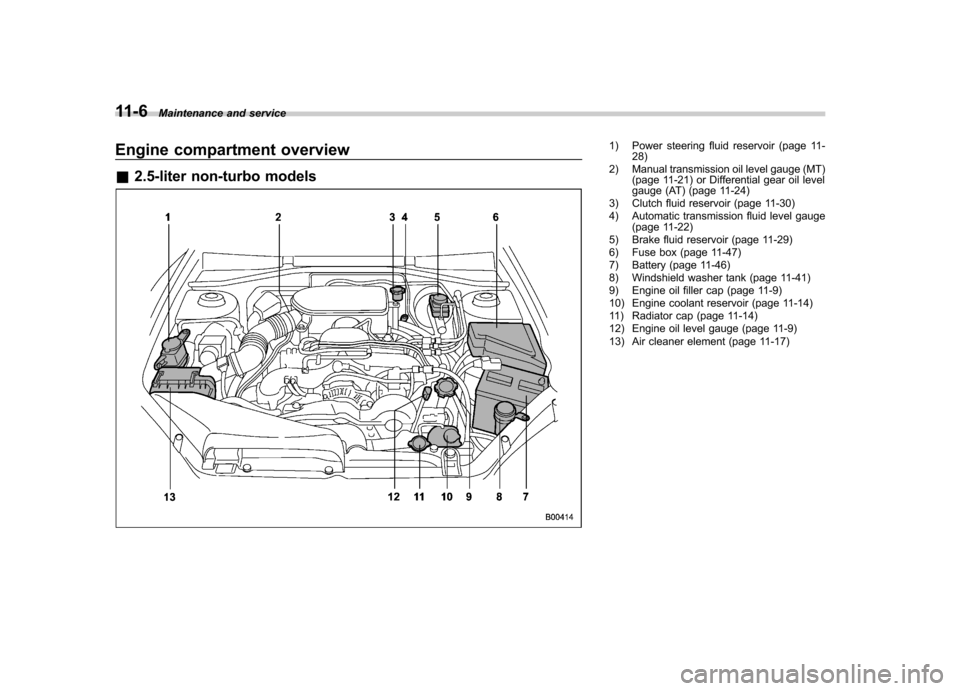
Engine compartment overview &2.5-liter non-turbo models1) Power steering fluid reservoir (page 11-
28)
2) Manual transmission oil level gauge (MT) (page 11-21) or Differential gear oil level
gauge (AT) (page 11-24)
3) Clutch fluid reservoir (page 11-30)
4) Automatic transmission fluid level gauge (page 11-22)
5) Brake fluid reservoir (page 11-29)
6) Fuse box (page 11-47)
7) Battery (page 11-46)
8) Windshield washer tank (page 11-41)
9) Engine oil filler cap (page 11-9)
10) Engine coolant reservoir (page 11-14)
11) Radiator cap (page 11-14)
12) Engine oil level gauge (page 11-9)
13) Air cleaner element (page 11-17)
Page 350 of 442
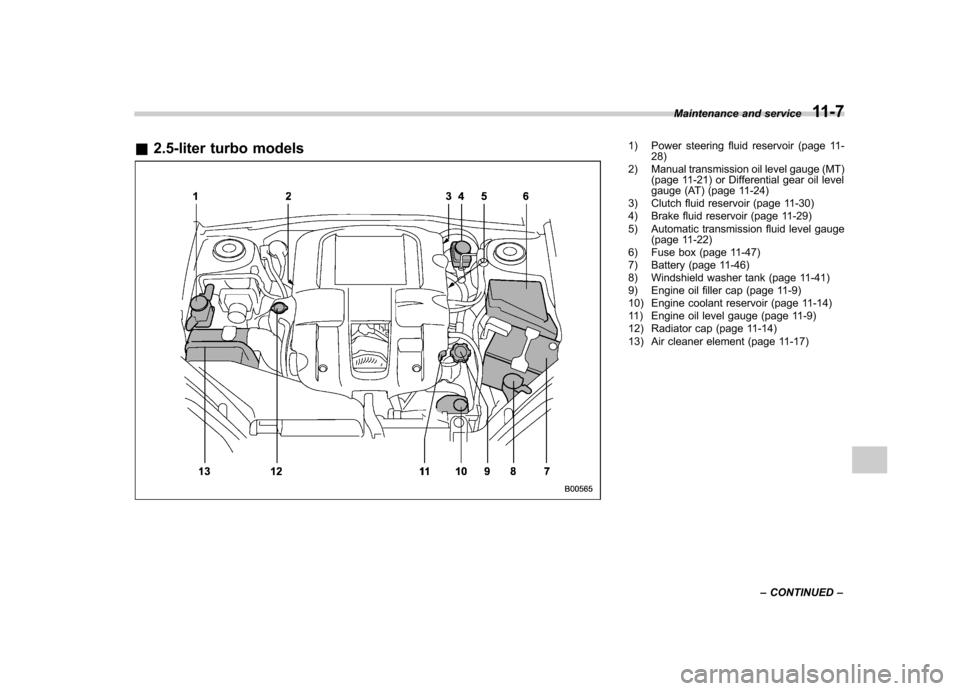
&2.5-liter turbo models1) Power steering fluid reservoir (page 11-
28)
2) Manual transmission oil level gauge (MT) (page 11-21) or Differential gear oil level
gauge (AT) (page 11-24)
3) Clutch fluid reservoir (page 11-30)
4) Brake fluid reservoir (page 11-29)
5) Automatic transmission fluid level gauge (page 11-22)
6) Fuse box (page 11-47)
7) Battery (page 11-46)
8) Windshield washer tank (page 11-41)
9) Engine oil filler cap (page 11-9)
10) Engine coolant reservoir (page 11-14)
11) Engine oil level gauge (page 11-9)
12) Radiator cap (page 11-14)
13) Air cleaner element (page 11-17) Maintenance and service
11-7
– CONTINUED –
Page 351 of 442
11-8Maintenance and service
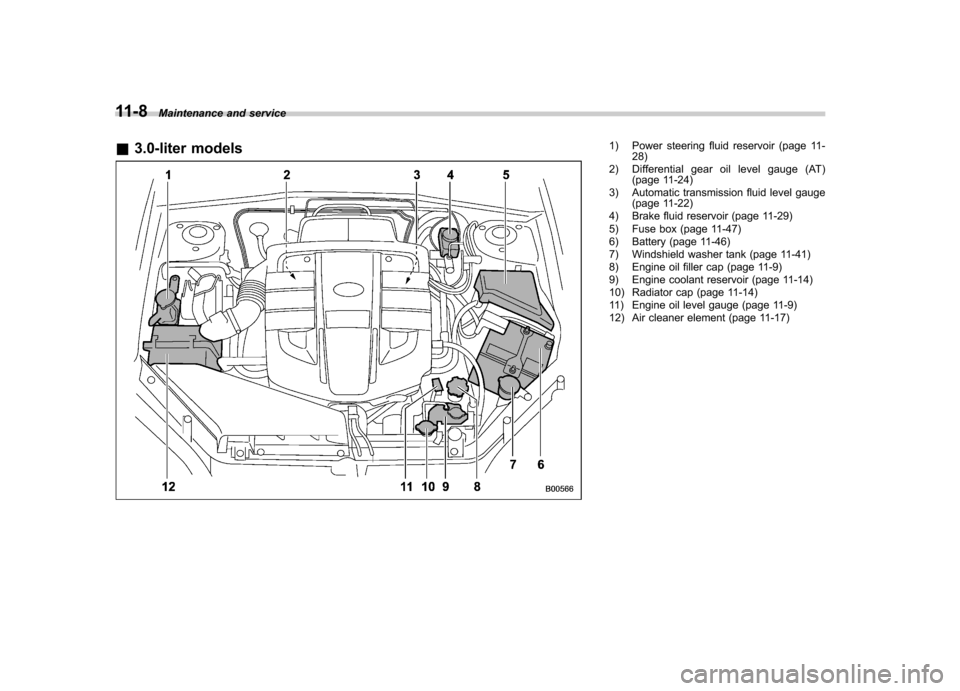
& 3.0-liter models
1) Power steering fluid reservoir (page 11-
28)
2) Differential gear oil level gauge (AT) (page 11-24)
3) Automatic transmission fluid level gauge (page 11-22)
4) Brake fluid reservoir (page 11-29)
5) Fuse box (page 11-47)
6) Battery (page 11-46)
7) Windshield washer tank (page 11-41)
8) Engine oil filler cap (page 11-9)
9) Engine coolant reservoir (page 11-14)
10) Radiator cap (page 11-14)
11) Engine oil level gauge (page 11-9)
12) Air cleaner element (page 11-17)
Page 365 of 442
11-22Maintenance and service
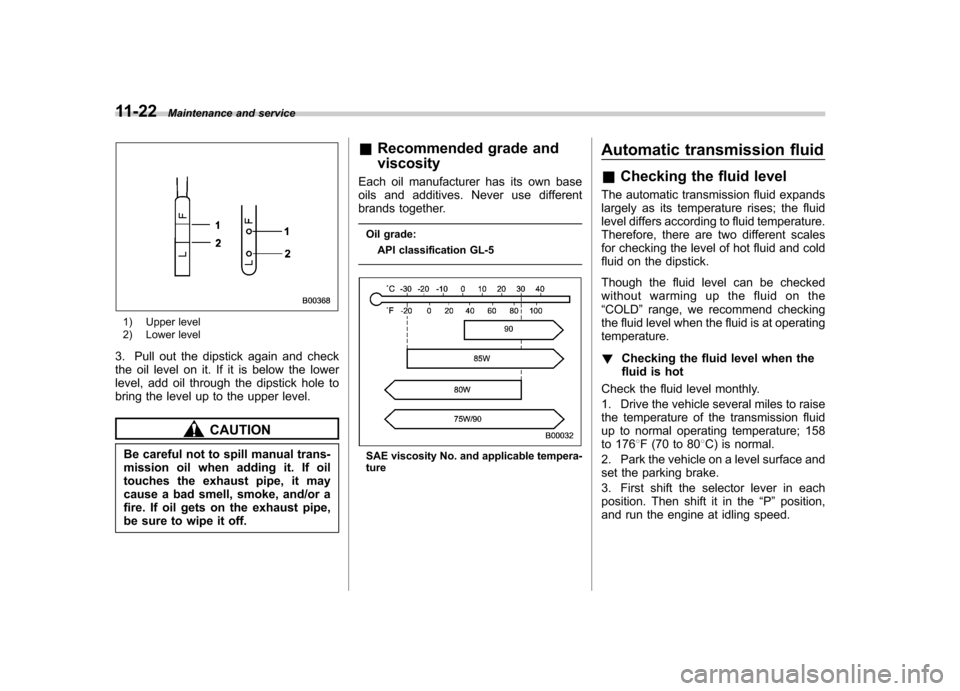
1) Upper level
2) Lower level
3. Pull out the dipstick again and check
the oil level on it. If it is below the lower
level, add oil through the dipstick hole to
bring the level up to the upper level.
CAUTION
Be careful not to spill manual trans-
mission oil when adding it. If oil
touches the exhaust pipe, it may
cause a bad smell, smoke, and/or a
fire. If oil gets on the exhaust pipe,
be sure to wipe it off. &
Recommended grade and viscosity
Each oil manufacturer has its own base
oils and additives. Never use different
brands together.
Oil grade: API classification GL-5
SAE viscosity No. and applicable tempera- ture Automatic transmission fluid &
Checking the fluid level
The automatic transmission fluid expands
largely as its temperature rises; the fluid
level differs according to fluid temperature.
Therefore, there are two different scales
for checking the level of hot fluid and cold
fluid on the dipstick.
Though the fluid level can be checked
without warming up the fluid on the“ COLD ”range, we recommend checking
the fluid level when the fluid is at operatingtemperature. ! Checking the fluid level when the
fluid is hot
Check the fluid level monthly.
1. Drive the vehicle several miles to raise
the temperature of the transmission fluid
up to normal operating temperature; 158
to 176 8F (70 to 80 8C) is normal.
2. Park the vehicle on a level surface and
set the parking brake.
3. First shift the selector lever in each
position. Then shift it in the “P ” position,
and run the engine at idling speed.
Page 366 of 442

4-speed automatic transmission
1) Yellow handle
5-speed automatic transmission
1) Yellow handle
1) HOT range
2) COLD range
3) Upper level
4) Lower level
4. Pull out the dipstick and check the fluid
level on the gauge. If it is below the lower
level on the “HOT ”range, add the recom-
mended automatic transmission fluid up to
the upper level. ! Checking the fluid level when the
fluid is cold
When the fluid level has to be checked
without time to warm up the automatic
transmission, check to see that the fluid
level is between the lower level and upper
level on the “COLD ”range. If it is below
that range, add fluid up to the upper level. Be careful not to overfill.
CAUTION
Be careful not to spill automatic
transmission fluid when adding it.
If automatic transmission fluid
touches the exhaust pipe, it may
cause a bad smell, smoke, and/or a
fire. If automatic transmission fluid
gets on the exhaust pipe, be sure to
wipe it off.
& Recommended fluid
Use one of the following types of auto-
matic transmission fluid. Genuine Subaru Automatic Transmis-
sion Fluid Type-HP
IDEMITSU ATF HP
Castrol Transmax J
Pennzoil ATF-J*
* Available only in the USA (except
Alaska and Hawaii)
NOTE
For 5-speed automatic transmission:
Using any non-specified type of auto-
matic transmission fluid could result in
damage inside the transmission. When
replacing the automatic transmission Maintenance and service
11-23
– CONTINUED –
Page 367 of 442
11-24Maintenance and service
fluid, be sure to use the kind specified.
For 4-speed automatic transmission:
For optimum transmission perfor-
mance, only use the automatic trans-
mission fluid that is recommended and
provided by Subaru.
If the recommended automatic trans-
mission fluid is unavailable, Dexron III
may be temporarily used. If the Dexron
III is used continuously there will be a
noticeable increase in the vibration and
noise from the automatic transmission. Front differential gear oil (AT vehicles) &
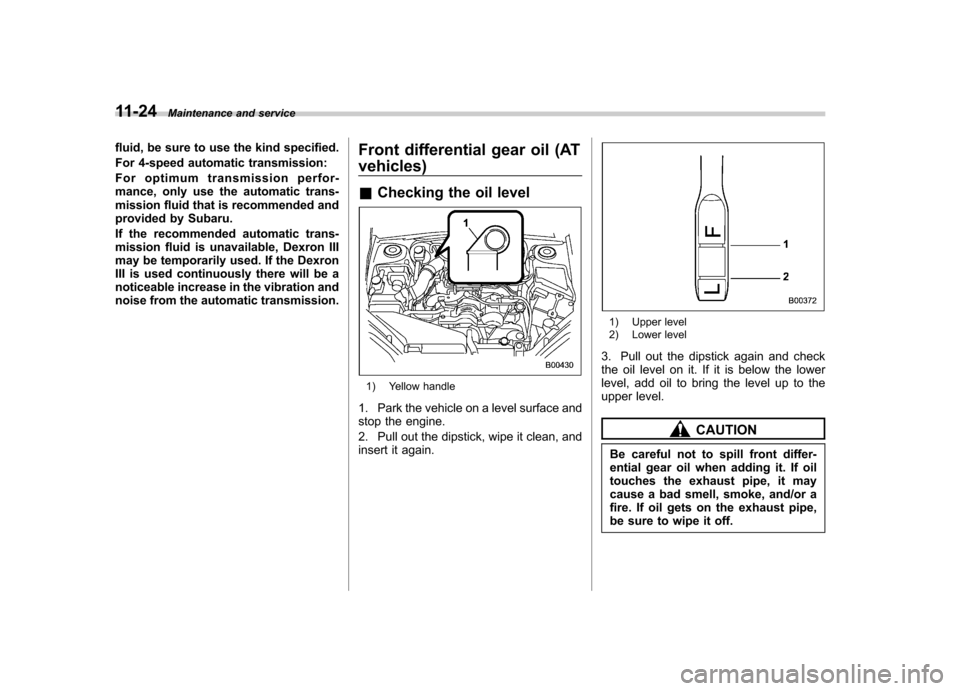
Checking the oil level
1) Yellow handle
1. Park the vehicle on a level surface and
stop the engine.
2. Pull out the dipstick, wipe it clean, and
insert it again.
1) Upper level
2) Lower level
3. Pull out the dipstick again and check
the oil level on it. If it is below the lower
level, add oil to bring the level up to the
upper level.
CAUTION
Be careful not to spill front differ-
ential gear oil when adding it. If oil
touches the exhaust pipe, it may
cause a bad smell, smoke, and/or a
fire. If oil gets on the exhaust pipe,
be sure to wipe it off.
Page 371 of 442

11-28Maintenance and service
Power steering fluid &Checking the fluid level
WARNING
Be careful not to burn yourself
because the fluid may be hot.
CAUTION
. When power steering fluid is
being added, use only clean fluid,
and be careful not to allow any
dirt into the tank. And never use
different brands together.
. Avoid spilling fluid when adding
it in the tank. .
Be careful not to spill power
steering fluid when adding it. If
power steering fluid touches the
exhaust pipe, it may cause a bad
smell, smoke, and/or a fire. If
power steering fluid gets on the
exhaust pipe, be sure to wipe itoff.
The power steering fluid expands greatly
as its temperature rises; the fluid level
differs according to fluid temperature.
Therefore, the reservoir tank has two
different checking ranges for hot and coldfluids.
Check the power steering fluid level
monthly.
1. Park the vehicle on a level surface,
and stop the engine.
2. Check the fluid level of the reservoir tank.
When the fluid is hot after the vehicle has
been run: Check that the oil level isbetween “HOT MIN ”and “HOT MAX ”on
the surface of the reservoir tank.
When the fluid is cool before the vehicle is
run: Check that the oil level is between“ COLD MIN ”and “COLD MAX ”on the
surface of the reservoir tank.
3. If the fluid level is lower than the
applicable “MIN ”line, add the recom- mended fluid as necessary to bring the
level between the
“MIN ”and “MAX ”line.
If the fluid level is extreme low, it may
indicate possible leakage. Consult your
SUBARU dealer for inspection.
& Recommended fluid
Use one of the following types of auto-
matic transmission fluid. “Dexron III ”Type Automatic Transmis-
sion Fluid
Genuine Subaru Automatic Transmis-
sion Fluid Type-HP