child restraint SUBARU OUTBACK 2007 4.G Owner's Manual
[x] Cancel search | Manufacturer: SUBARU, Model Year: 2007, Model line: OUTBACK, Model: SUBARU OUTBACK 2007 4.GPages: 442, PDF Size: 13.39 MB
Page 66 of 442

4. Tighten the top tether securely.
CAUTION
Do not route the top tether over the
head restraint. It may happen that
the top tether cannot be fastened
tightly.
When the child restraint system is to
be secured using the top tether,
pass the top tether under the head
restraint between the head restraint
stay posts. If the top tether still
cannot be fastened tightly, remove
the head restraint.
! Station wagon
1. Remove the head restraint at the seating position where the child restraint
system has been installed with the seat-
belt or lower anchorages; lift up the head
restraint while pressing the release button.
Store the head restraint in the cargo area.
Avoid placing the head restraint in the
passenger compartment to prevent it from
being thrown around in the passenger
compartment in a sudden stop or a sharpturn.
2. Open the cover flaps to use the anchorages.
3. Fasten the top tether hook of the child
restraint system to the appropriate upperanchorage.
4. Tighten the top tether securely.
CAUTION
Always remove the head restraint
when mounting a child restraint
system with a top tether. Otherwise,
it may happen that the top tether
cannot be fastened tightly. Seat, seatbelt and SRS airbags
1-39
Page 68 of 442
injuries. Because the SRS airbag
needs enough space for deploy-
ment, the driver should always
sit upright and well back in the
seat as far from the steering
wheel as practical while still
maintaining full vehicle control
and the front passenger should
move the seat as far back as
possible and sit upright and well
back in the seat.
. Do not place any objects over or
near the SRS airbag cover or
between you and the SRS airbag.
If the SRS airbag deploys, those
objects could interfere with its
proper operation and could be
propelled inside the vehicle and
cause injury.
WARNING
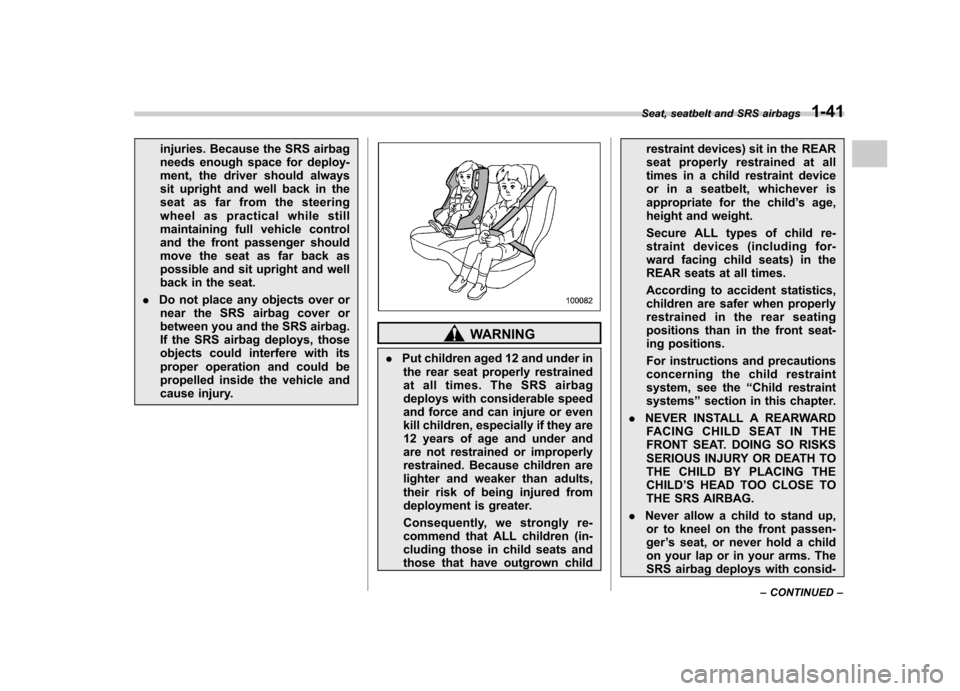
. Put children aged 12 and under in
the rear seat properly restrained
at all times. The SRS airbag
deploys with considerable speed
and force and can injure or even
kill children, especially if they are
12 years of age and under and
are not restrained or improperly
restrained. Because children are
lighter and weaker than adults,
their risk of being injured from
deployment is greater.
Consequently, we strongly re-
commend that ALL children (in-
cluding those in child seats and
those that have outgrown child restraint devices) sit in the REAR
seat properly restrained at all
times in a child restraint device
or in a seatbelt, whichever is
appropriate for the child
’s age,
height and weight.
Secure ALL types of child re-
straint devices (including for-
ward facing child seats) in the
REAR seats at all times.
According to accident statistics,
children are safer when properly
restrained in the rear seating
positions than in the front seat-
ing positions.
For instructions and precautions
concerning the child restraint
system, see the “Child restraint
systems ”section in this chapter.
. NEVER INSTALL A REARWARD
FACING CHILD SEAT IN THE
FRONT SEAT. DOING SO RISKS
SERIOUS INJURY OR DEATH TO
THE CHILD BY PLACING THECHILD ’S HEAD TOO CLOSE TO
THE SRS AIRBAG.
. Never allow a child to stand up,
or to kneel on the front passen-ger ’s seat, or never hold a child
on your lap or in your arms. The
SRS airbag deploys with consid-
Seat, seatbelt and SRS airbags
1-41
– CONTINUED –
Page 72 of 442
&Subaru advanced frontal air-
bag system
Your vehicle is equipped with a Subaru
advanced frontal airbag system that com-
plies with the new advanced frontal airbag
requirements in the amended Federal
Motor Vehicle Safety Standard (FMVSS)
No. 208.
The Subaru advanced frontal airbag sys-
tem automatically determines the deploy-
ment force of the driver ’s SRS frontal
airbag at the time of deployment as well as
whether or not to activate the frontpassenger ’s SRS frontal airbag and, if
activated, the deployment force of the
SRS frontal airbag at the time of deploy-ment.
Your vehicle has warning labels on the driver ’s and front passenger ’s sun visors
beginning with the phrase “EVEN WITH
ADVANCED AIR BAGS ”and a tag
attached to the glove box lid beginning
with the phrase “Even with Advanced Air
Bags ”. Make sure that you carefully read
the instructions on the warning labels and tag.
Always wear your seatbelt. The subaru
advanced frontal airbag system is a
supplemental restraint system and must
be used in combination with a seatbelt. All
occupants should wear a seatbelt or be
seated in an appropriate child restraint system.
The driver
’s SRS frontal airbag is stowed
in the center portion of the steering wheel.
The front passenger ’s SRS frontal airbag
is stowed near the top of the dashboard
under an “SRS AIRBAG ”mark.
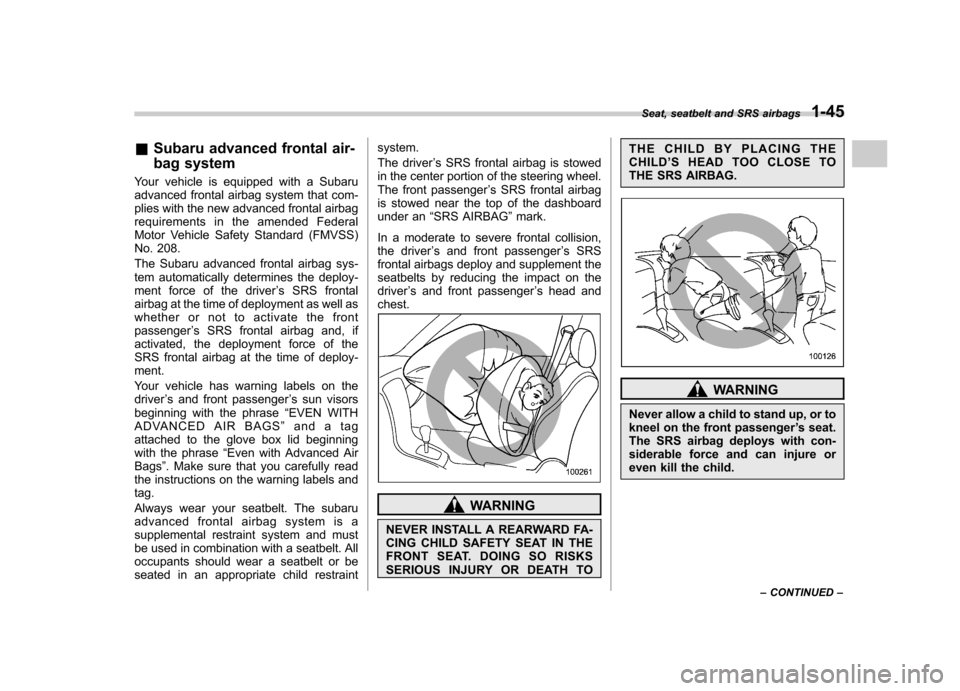
In a moderate to severe frontal collision,
the driver ’s and front passenger ’s SRS
frontal airbags deploy and supplement the
seatbelts by reducing the impact on thedriver ’s and front passenger ’s head and
chest.
WARNING
NEVER INSTALL A REARWARD FA-
CING CHILD SAFETY SEAT IN THE
FRONTSEAT.DOINGSORISKS
SERIOUS INJURY OR DEATH TO THE CHILD BY PLACING THE
CHILD
’S HEAD TOO CLOSE TO
THE SRS AIRBAG.
WARNING
Never allow a child to stand up, or to
kneel on the front passenger ’s seat.
The SRS airbag deploys with con-
siderable force and can injure or
even kill the child. Seat, seatbelt and SRS airbags
1-45
– CONTINUED –
Page 75 of 442

1-48Seat, seatbelt and SRS airbags
. Do not apply any strong impact to the
front passenger ’s seat such as by kicking.
. Do not spill liquid on the front passen-
ger ’s seat. If liquid is spilled, wipe it off
immediately. . Do not remove or disassemble the front
passenger ’s seat.
. Do not install any accessory (such as
an audio amplifier) other than a genuine
SUBARU accessory under the front pas-senger ’s seat.
. Do not place anything (shoes, umbrel-
la, etc.) under the front passenger ’s seat.
. The front passenger ’s seat must not be
used with the head restraint removed. . Do not leave any article including a
child restraint system on the front passen- ger ’s seat or the seatbelt tongue and
buckle engaged when you leave yourvehicle. . Do not place a magnet near the
seatbelt buckle and the seatbelt retractor.. Do not use front seats with their back-
ward-forward position and seatback not
being locked into place securely. If any of
them are not locked securely, adjust them
again. For adjusting procedure, refer tothe “Manual seat ”in the front seats section
in Chapter 1 in this owner ’s manual.
(Models equipped with manual seats only)
If the seatbelt buckle switch and/or front passenger
’s occupant detection system
have failed, the SRS airbag system
warning light will illuminate. Have the
system inspected by your SUBARU deal-
er immediately if the SRS airbag system
warning light comes on.
If your vehicle has sustained impact, this
may affect the proper function of the
Subaru advanced frontal airbag system.
Have your vehicle inspected at your
SUBARU dealer.
NOTE
The front passenger ’s SRS side airbag,
SRS curtain airbag and seatbelt pre-
tensioner are not controlled by the
Subaru advanced frontal airbag sys-tem. !
Passenger ’s frontal airbag ON and
OFF indicators
or: Front passenger ’s frontal airbag
ON indicator
or: Front passenger ’s frontal airbag
OFF indicator
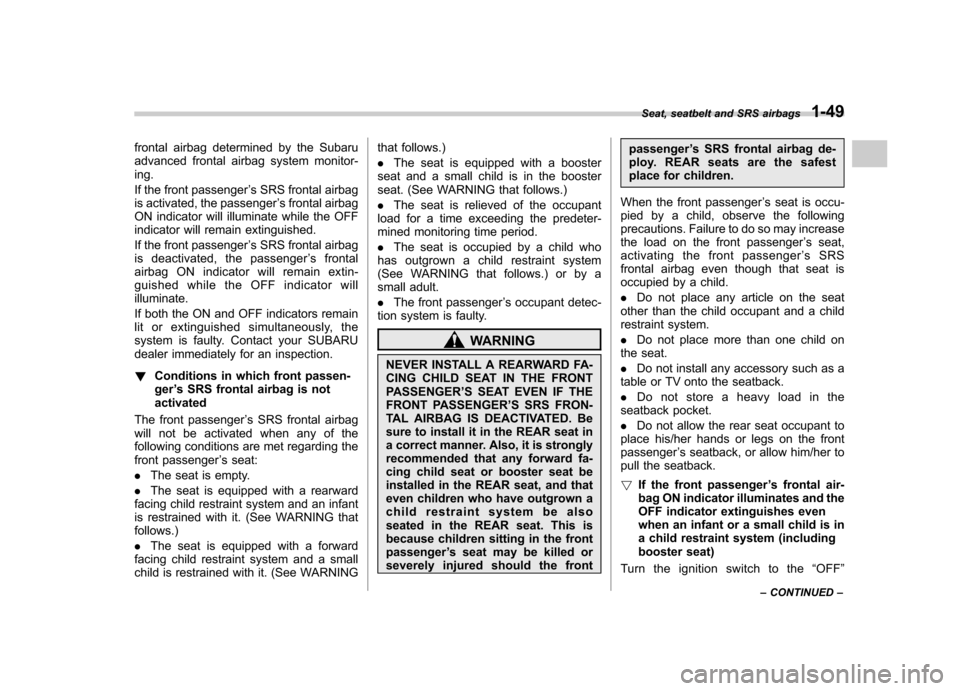
The front passenger ’s frontal airbag ON
and OFF indicators show you the status of
the front passenger ’s SRS frontal airbag.
The indicators are located between the
map lights.
When the ignition switch is turned to the “ ON ”position, both the ON and OFF
indicators illuminate for 6 seconds during
which time the system is checked. Follow-
ing the system check, both indicators
extinguish for 2 seconds. After that, one
of the indicators illuminates depending on
the status of the front passenger ’s SRS
Page 76 of 442
frontal airbag determined by the Subaru
advanced frontal airbag system monitor-ing.
If the front passenger’s SRS frontal airbag
is activated, the passenger ’s frontal airbag
ON indicator will illuminate while the OFF
indicator will remain extinguished.
If the front passenger ’s SRS frontal airbag
is deactivated, the passenger ’s frontal
airbag ON indicator will remain extin-
guished while the OFF indicator willilluminate.
If both the ON and OFF indicators remain
lit or extinguished simultaneously, the
system is faulty. Contact your SUBARU
dealer immediately for an inspection. ! Conditions in which front passen- ger’s SRS frontal airbag is not
activated
The front passenger ’s SRS frontal airbag
will not be activated when any of the
following conditions are met regarding the
front passenger ’s seat:
. The seat is empty.
. The seat is equipped with a rearward
facing child restraint system and an infant
is restrained with it. (See WARNING thatfollows.) . The seat is equipped with a forward
facing child restraint system and a small
child is restrained with it. (See WARNING that follows.) .
The seat is equipped with a booster
seat and a small child is in the booster
seat. (See WARNING that follows.) . The seat is relieved of the occupant
load for a time exceeding the predeter-
mined monitoring time period. . The seat is occupied by a child who
has outgrown a child restraint system
(See WARNING that follows.) or by a
small adult. . The front passenger ’s occupant detec-
tion system is faulty.
WARNING
NEVER INSTALL A REARWARD FA-
CING CHILD SEAT IN THE FRONT
PASSENGER ’S SEAT EVEN IF THE
FRONT PASSENGER ’S SRS FRON-
TAL AIRBAG IS DEACTIVATED. Be
sure to install it in the REAR seat in
a correct manner. Also, it is strongly
recommended that any forward fa-
cing child seat or booster seat be
installed in the REAR seat, and that
even children who have outgrown a
child restraint system be also
seated in the REAR seat. This is
because children sitting in the frontpassenger ’s seat may be killed or
severely injured should the front passenger
’s SRS frontal airbag de-
ploy. REAR seats are the safest
place for children.
When the front passenger ’s seat is occu-
pied by a child, observe the following
precautions. Failure to do so may increase
the load on the front passenger ’s seat,
activating the front passenger ’sSRS
frontal airbag even though that seat is
occupied by a child. . Do not place any article on the seat
other than the child occupant and a child
restraint system. . Do not place more than one child on
the seat.. Do not install any accessory such as a
table or TV onto the seatback.. Do not store a heavy load in the
seatback pocket.. Do not allow the rear seat occupant to
place his/her hands or legs on the front passenger ’s seatback, or allow him/her to
pull the seatback. ! If the front passenger ’s frontal air-
bag ON indicator illuminates and the
OFF indicator extinguishes even
when an infant or a small child is in
a child restraint system (including
booster seat)
Turn the ignition switch to the “OFF ”
Seat, seatbelt and SRS airbags
1-49
– CONTINUED –
Page 77 of 442

1-50Seat, seatbelt and SRS airbags
position if the front passenger ’s frontal
airbag ON indicator illuminates and the
OFF indicator extinguishes even when an
infant or a small child is in a child restraint
system (including booster seat). Remove
the child restraint system from the seat. By
referring to the child restraint manufac-turer ’s recommendations as well as the
child restraint system installation proce-
dures in the “Child restraint systems ”
section in this chapter, correctly install
the child restraint system. Turn the ignition
switch to the “ON ”position and make sure
that the front passenger ’s frontal airbag
ON indicator goes out and the OFF
indicator comes on.
If still the ON indicator remains illuminated
while the OFF indicator extinguishes, take
the following actions. . Ensure that no article is placed on the
seat other than the child restraint system
and the child occupant. . Ensure that there is no article left in the
seatback pocket.. Ensure that the backward-forward po-
sition and seatback of front passenger ’s
seat are locked into place securely by
moving the seat back and forth. (Models
equipped with manual seats only)
If the ON indicator still illuminates while
the OFF indicator extinguishes after taking relevant corrective actions described
above, relocate the child restraint system
to the rear seat and immediately contact
your SUBARU dealer for an inspection.
NOTE
When a child who has outgrown a child
restraint system or a small adult is
seated in the front passenger ’s seat,
the Subaru advanced frontal airbag
system may or may not activate the
front passenger ’s SRS frontal airbag
depending on the occupant ’s seating
posture. If the front passenger ’s SRS
frontal airbag is activated (the ON
indicator illuminates while the OFF
indicator extinguishes), take the follow-
ing actions. . Ensure that no article is placed on
the seat other than the occupant. . Ensure that there is no article left in
the seatback pocket.
If the ON indicator still illuminates while
the OFF indicator extinguishes despite
the fact that the actions noted above
have been taken, seat the child/small
adult in the rear seat and immediately
contact your SUBARU dealer for an
inspection. Even if the system has
passed the dealer inspection, it is
recommended that on subsequent trips
the child/small adult always take the rear seat.
Children who have outgrown a child
restraint system should always wear the
seatbelt irrespective of whether the airbag
is deactivated or activated. !
Conditions in which front passen- ger’s SRS frontal airbag is activated
The front passenger ’s SRS frontal airbag
will be activated for deployment upon
impact when any of the following condi-
tions is met regarding the front passen-ger ’s seat.
. When the seat is occupied by an adult.
. When a heavy article is placed on the
seat.
When the front passenger ’s seat is occu-
pied by an adult, observe the following
precautions. Failure to do so may lessen
the load on the front passenger ’s seat,
deactivating the front passenger ’s SRS
frontal airbag despite the fact that the seat
is occupied by an adult. . Do not allow the rear seat occupant to
lift the front passenger ’s seat cushion
using his/her feet.. Do not place any article under the front
passenger ’s seat, or squeeze any article
from behind and under the seat. This may
lift the seat cushion. . Do not squeeze any article between
Page 97 of 442
2-6Keys and doors
&Locking and unlocking from
the inside
WARNING
Keep all doors locked when you
drive, especially when small chil-
dren are in your vehicle.
Along with the proper use of seat-
belts and child restraints, locking
the doors reduces the chance of
being thrown out of the vehicle in anaccident.
It also helps prevent passengers
from falling out if a door is acciden-
tally opened, and intruders from
unexpectedly opening doors and
entering your vehicle.
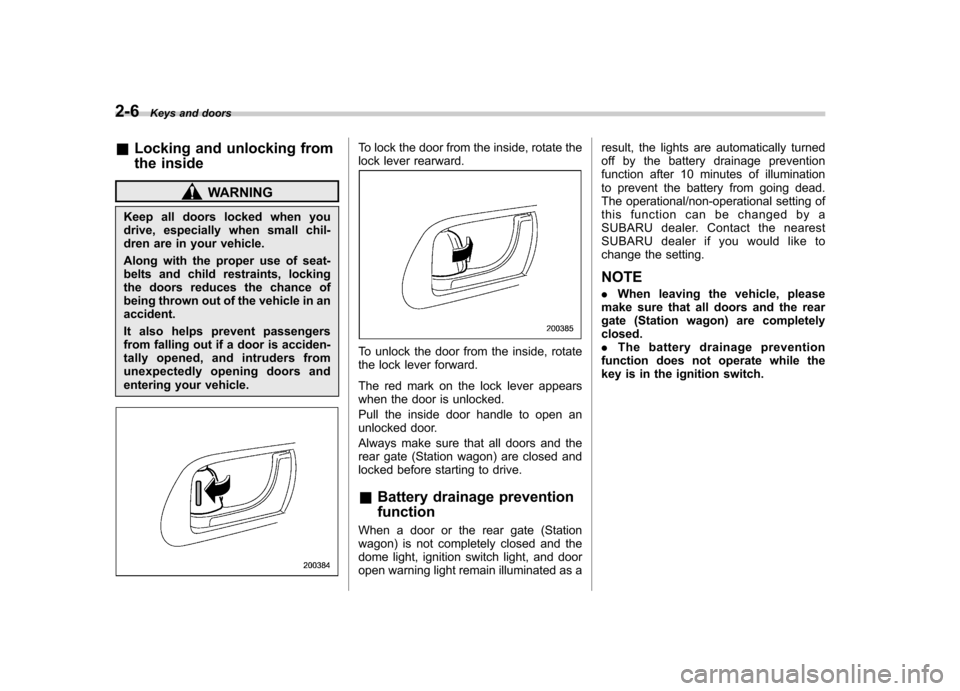
To lock the door from the inside, rotate the
lock lever rearward.
To unlock the door from the inside, rotate
the lock lever forward.
The red mark on the lock lever appears
when the door is unlocked.
Pull the inside door handle to open an
unlocked door.
Always make sure that all doors and the
rear gate (Station wagon) are closed and
locked before starting to drive. & Battery drainage prevention function
When a door or the rear gate (Station
wagon) is not completely closed and the
dome light, ignition switch light, and door
open warning light remain illuminated as a result, the lights are automatically turned
off by the battery drainage prevention
function after 10 minutes of illumination
to prevent the battery from going dead.
The operational/non-operational setting of
this function can be changed by a
SUBARU dealer. Contact the nearest
SUBARU dealer if you would like to
change the setting. NOTE .
When leaving the vehicle, please
make sure that all doors and the rear
gate (Station wagon) are completelyclosed.. The battery drainage prevention
function does not operate while the
key is in the ignition switch.
Page 145 of 442
3-24Instruments and controls
.Do not install any accessory such as a
table or TV onto the seatback. . Do not store a heavy load in the
seatback pocket.. Do not allow the rear seat occupant to
place his/her hands or legs on the front passenger ’s seatback, or allow him/her to
pull the seatback. . Do not use front seats with their back-
ward-forward position and seatback not
being locked into place securely. If any of
them are not locked securely, adjust them
again. For adjusting procedure, refer tothe “Manual seat ”in the front seats section
in chapter 1 in this owner ’s manual.
(Models equipped with manual seats only)
If the seatbelt warning device for the front passenger ’s seat does not function cor-
rectly (e.g., it is activated even when the
front passenger ’s seat is empty or it is
deactivated even when the front passen-
ger has not fastened his/her seatbelt),
take the following actions. . Ensure that no article is placed on the
seat other than a child restraint system
and its child occupant. . Ensure that there is no article left in the
seatback pocket.. Ensure that the backward-forward po-
sition and seatback of front passenger ’s
seat are locked into place securely by moving the seat back and forth. (Models
equipped with manual seats only)
If still the seatbelt warning device for front passenger
’s seat does not function cor-
rectly after taking relevant corrective ac-
tions described above, immediately
contact your SUBARU dealer for aninspection.
& SRS airbag system
warning light
When the ignition switch is turned to the “ON ”position, the SRS airbag system
warning light will come on for approxi-
mately seven seconds and go out. This
shows the SRS frontal airbag and SRS
side airbag and SRS curtain airbag and
seatbelt pretensioners are in normal op-eration.
WARNING
If the warning light exhibits any of
the following conditions, there may
be a malfunction in the seatbelt
pretensioners and/or SRS airbag
system. Immediately take your vehi-
cle to your nearest SUBARU dealer
to have the system checked. Unless
checked and properly repaired, the
seatbelt pretensioners and/or SRS airbags will operate improperly (e.g.
SRS airbags may inflate in a very
minor collision or not inflate in a
severe collision), which may in-
crease the risk of injury. .
Flashing or flickering of the warn-
ing light
. No illumination of the warning
light when the ignition switch is
first turned to the “ON ”position
. Continuous illumination of the
warning light
. Illumination of the warning light
while driving
Page 425 of 442
13-10Consumer information and Reporting safety defects
2. Calculate the available load capa-
city.
3. The result of step 2 shows that a
further 172 lbs (78 kg) of cargo can be
carried.
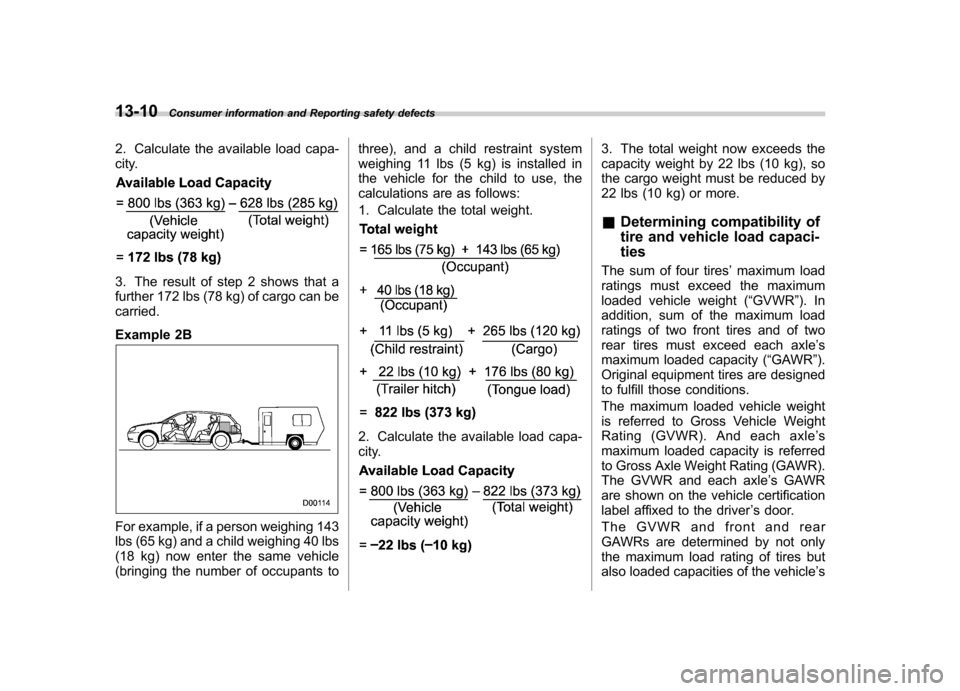
Example 2B
For example, if a person weighing 143
lbs (65 kg) and a child weighing 40 lbs
(18 kg) now enter the same vehicle
(bringing the number of occupants to three), and a child restraint system
weighing 11 lbs (5 kg) is installed in
the vehicle for the child to use, the
calculations are as follows:
1. Calculate the total weight.
2. Calculate the available load capa-
city.
3. The total weight now exceeds the
capacity weight by 22 lbs (10 kg), so
the cargo weight must be reduced by
22 lbs (10 kg) or more. &
Determining compatibility of
tire and vehicle load capaci- ties
The sum of four tires ’maximum load
ratings must exceed the maximum
loaded vehicle weight ( “GVWR ”). In
addition, sum of the maximum load
ratings of two front tires and of two
rear tires must exceed each axle ’s
maximum loaded capacity ( “GAWR ”).
Original equipment tires are designed
to fulfill those conditions.
The maximum loaded vehicle weight
is referred to Gross Vehicle Weight
Rating (GVWR). And each axle ’s
maximum loaded capacity is referred
to Gross Axle Weight Rating (GAWR).
The GVWR and each axle ’sGAWR
are shown on the vehicle certification
label affixed to the driver ’s door.
The GVWR and front and rear
GAWRs are determined by not only
the maximum load rating of tires but
also loaded capacities of the vehicle ’s
Page 432 of 442

Tie-down hooks..................................................... 6-16
Catalytic converter ....................................................... 8-3
Center
Console .................................................................. 6-5
Ventilators ............................................................... 4-3
Center and side ventilators ............................................ 4-3
Changing Flat tire ................................................................... 9-4
Oil and oil filter ..................................................... 11-10
Charge warning light .................................................. 3-26
CHECK ENGINE warning light/Malfunction indicator lamp ...................................................................... 3-25
Checking
Brake pedal free play ............................................ 11-31
Brake pedal reserve distance ................................. 11-31
Clutch function ...................................................... 11-32
Clutch pedal free play ............................................ 11-32
Engine oil level ...................................................... 11-9
Fluid level ............................... 11-22, 11-28, 11-29, 11-30
Gear oil level ........................................................ 11-25
Child restraint systems ............................................... 1-27
Installation with A/ELR seatbelt ................................ 1-30
Lower and tether anchorages .................................. 1-35
Child safety .................................................................... 5
Locks ................................................................... 2-19
Chime Key ........................................................................ 3-5 Seatbelt ........................................................ 1-14, 3-22
Cleaning
Aluminum wheels ................................................... 10-3
Interior .................................................................. 10-5 Ventilator grille
....................................................... 4-12
Climate control system Automatic ............................................................... 4-8
Manual ................................................................... 4-3
Clock ........................................................................ 3-34
Clutch Fluid ................................................................... 11-30
Pedal .................................................................. 11-32
Coat hook. ................................................................. 6-10
Cooling system ........................................................ 11-13
Corrosion protection ............................................ 8-10, 10-4
Cruise control ............................................................ 7-46
Set indicator light .................................................... 3-33
Cruise control indicator light ......................................... 3-33
Cup holder ................................................................. 6-7
Front passenger ’s.................................................... 6-8
Rear passenger ’s .................................................... 6-8
D
Daytime running light system ....................................... 3-40
Differential gear oil
Front ................................................................... 11-24
Rear ................................................................... 11-25
Dimensions ................................................................ 12-2
Disarming the system ................................................. 2-17
Disc brake pad wear warning indicators ........................ 7-34
Dome light ......................................................... 6-2, 11-56
Door
Locks ..................................................................... 2-5
Door open warning light .............................................. 3-29
Drive belts ............................................................... 11-20 Index
14-3