odometer SUBARU OUTBACK 2007 4.G Owners Manual
[x] Cancel search | Manufacturer: SUBARU, Model Year: 2007, Model line: OUTBACK, Model: SUBARU OUTBACK 2007 4.GPages: 442, PDF Size: 13.39 MB
Page 21 of 442

18 !U.S.-spec. vehicles (Non-turbo models)
1) Temperature gauge (page 3-21)
2) Tachometer (page 3-20)
3) Speedometer (page 3-18)
4) Fuel gauge (page 3-20)
5) Trip meter A/B selection and trip meter
reset knob (page 3-19)
6) Trip meter and odometer (page 3-19)
7) Selector lever position indicator (page 3-32)
8) Gear position indicator (page 3-32)
Page 23 of 442

20 !Canada-spec. vehicles (Non-turbo models)
1) Temperature gauge (page 3-21)
2) Tachometer (page 3-20)
3) Speedometer (page 3-18)
4) Fuel gauge (page 3-20)
5) Trip meter A/B selection and trip meter
reset knob (page 3-19)
6) Trip meter and odometer (page 3-19)
7) Selector lever position indicator (page 3-32)
8) Gear position indicator (page 3-32)
Page 106 of 442

.Opening a door, the rear gate or trunk
lid . Physical impact to the vehicle, such as
forced entry (only vehicles with shock
sensors (dealer option)) & Activating and deactivating
the alarm system
To change the setting of your vehicle ’s
alarm system for activation or deactiva-
tion, do the following.
1. Disarm the alarm system (see “Dis-
arming the system ”in this section).
2. Sit in the driver ’s seat and shut all
doors (and the rear gate if your vehicle is a
Station wagon).
3. Turn the ignition switch to the “ON ”
position.
4. Hold down the UNLOCK side of the driver ’s power door locking switch, open
the driver ’s door within the following 1
second, and wait 10 seconds without
releasing the switch. The setting will then
be changed as follows:
If the system was previously activated:
For non-turbo models, the odometer/trip
meter screen displays “AL oF ”, and for
turbo models, the multi-information displayshows “Security alarm: OFF ”and the horn
sounds twice, indicating that the system is
now deactivated. If the system was previously deactivated:
For non-turbo models, the odometer/trip
meter screen displays
“AL on ”, and for
turbo models, the multi-information displayshows “Security alarm: ON ”and the horn
sounds once, indicating that the system is
now deactivated.
NOTE
You may have the above setting
change done by your SUBARU dealer. & If you have accidentally trig-
gered the alarm system
! To stop the alarm
Do any of the following operations: . Insert the key in the door lock of the
driver ’s door and turn it to the unlock
position.. Press any button on the remote trans-
mitter.. Turn the ignition switch to the “ON ”
position.
& Arming the system
! To arm the system using remote transmitter
1. Close all windows and the moonroof (if
so equipped). 2. Remove the key from the ignitionswitch.
3. Open the doors and get out of the vehicle.
4. Make sure that the engine hood (and
the trunk lid on the Sedan) are locked.
5. Close all doors (and the rear gate on
the Station wagon).
: Press to Arm the system.: Press to Disarm the system.
Keys and doors
2-15
– CONTINUED –
Page 122 of 442

Ignition switch..................................................... 3-3
LOCK .................................................................. 3-3
ACC.................................................................... 3-4
ON...................................................................... 3-4
START ................................................................ 3-4
Key reminder chime ............................................ 3-5
Ignition switch light ............................................. 3-5
Hazard warning flasher ....................................... 3-5
Meters and gauges (Turbo models) ................... 3-5
Combination meter illumination ........................... 3-5
Speedometer ....................................................... 3-6
Tachometer ......................................................... 3-6
Fuel gauge .......................................................... 3-6
Temperature gauge ............................................. 3-7
ECO gauge ......................................................... 3-8
Multi-information display (Turbo models) .......... 3-8
Odometer and trip meter ..................................... 3-9
Current and average fuel consumption ............... 3-10
Outside temperature and journey time ................ 3-11
Driving range on remaining fuel .......................... 3-13
Clock (Vehicle with Navigation System) ............... 3-14
SI-DRIVE display ................................................ 3-14
Warning messages and driver ’s
information ...................................................... 3-15
Meters and gauges (Non-turbo models) ........... 3-18
Combination meter illumination .......................... 3-18
Canceling the function for meter/gauge needle movement upon turning on the ignition switch .............................................................. 3-18
Speedometer ...................................................... 3-18
Odometer ........................................................... 3-19 Double trip meter
............................................... 3-19
Tachometer ....................................................... 3-20
Fuel gauge ........................................................ 3-20
Temperature gauge ............................................ 3-21
Warning and indicator lights ............................. 3-22
Seatbelt warning light and chime ....................... 3-22
SRS airbag system warning light ........................ 3-24
Front passenger ’s frontal airbag ON and OFF
indicators ........................................................ 3-25
CHECK ENGINE warning light/Malfunction indicator lamp ................................................. 3-25
Charge warning light .......................................... 3-26
Oil pressure warning light .................................. 3-26
AT OIL TEMPerature warning light (AT vehicles) .................................................... 3-26
Low tire pressure warning light (if equipped) .................................................... 3-26
ABS warning light .............................................. 3-28
Brake system warning light ................................ 3-28
Low fuel warning light ....................................... 3-29
Door open warning light .................................... 3-29
All-Wheel Drive warning light (AT vehicles) .................................................... 3-30
Vehicle Dynamics Control operation indicator light (if equipped). ............................................ 3-30
Vehicle Dynamics Control warning light (if equipped)/Vehicle Dynamics Control OFF
indicator light (if equipped) .............................. 3-30
Security indicator light ....................................... 3-31
SPORT mode indicator light (if equipped) ........... 3-32
Shift-up indicator light (MT vehicles) (if equipped) .................................................... 3-32
Instruments and controls
3
Page 130 of 442
*: Only for vehicles equipped with a
navigation system&
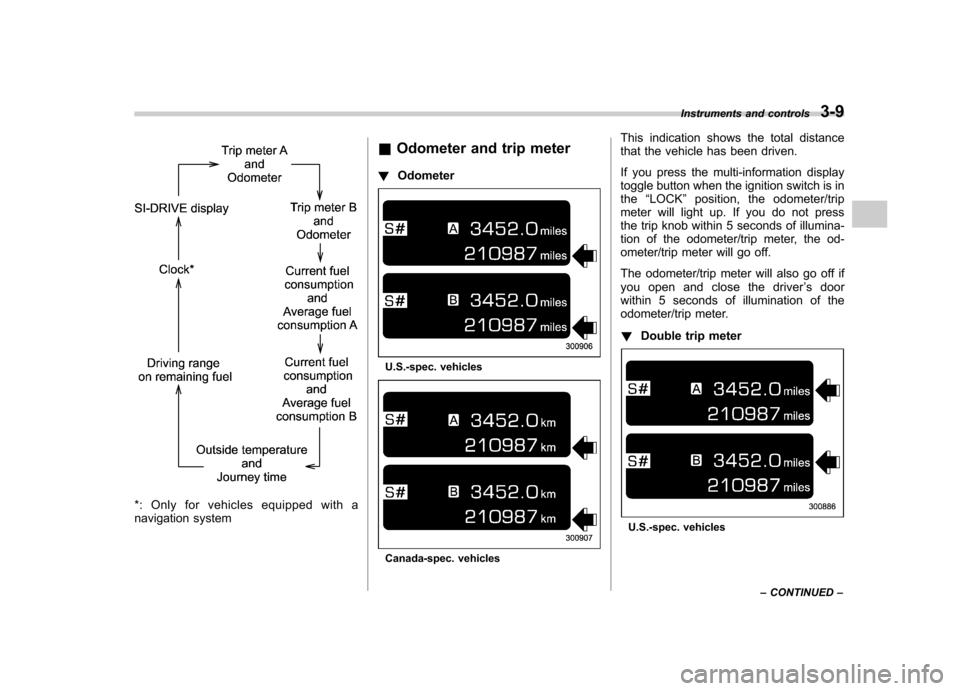
Odometer and trip meter
! Odometer
U.S.-spec. vehicles
Canada-spec. vehicles This indication shows the total distance
that the vehicle has been driven.
If you press the multi-information display
toggle button when the ignition switch is in
the
“LOCK ”position, the odometer/trip
meter will light up. If you do not press
the trip knob within 5 seconds of illumina-
tion of the odometer/trip meter, the od-
ometer/trip meter will go off.
The odometer/trip meter will also go off if
you open and close the driver ’s door
within 5 seconds of illumination of the
odometer/trip meter. ! Double trip meter
U.S.-spec. vehicles Instruments and controls
3-9
– CONTINUED –
Page 131 of 442

3-10Instruments and controls
Canada-spec. vehicles
This indication shows the distance that the
vehicle has been driven since you last set
it to zero.
To set the trip meter to zero, select the A
trip or B trip meter by pushing the multi-
information display toggle button and keep
the knob pushed for more than 0.8second.
If you press the multi-information display
toggle button when the ignition switch is in
the “LOCK ”position, the odometer/trip
meter will light up. It is possible to set
the trip meter to zero while the odometer/
trip meter is lit up. If you do not press the
trip knob within 5 seconds of illumination
of the odometer/trip meter, the odometer/
trip meter will go off. Also, if you open and
close the driver ’s door within 5 seconds of illumination of the odometer/trip meter, the
odometer/trip meter will go off.
NOTE
If the connection between the combina-
tion meter and battery is broken for any
reason such as vehicle maintenance or
fuse replacement, the data recorded on
the trip meter will be lost. & Current and average fuel consumption
U.S.-spec. vehicles
Canada-spec. vehicles
1) Current fuel consumption
2) Average fuel consumption
Current fuel consumption shows the rate
of fuel consumption at the present mo-
ment. Average fuel consumption shows
the average rate of fuel consumption since
the trip meter was last reset.
When the vehicle speed is less than
approximately 6 mph (9.5 km/h), the
current fuel consumption is not displayed.
The displayed number with “A ” is the
average fuel consumption corresponding
to the A trip meter indication, and the
displayed number with “B ” is the average
fuel consumption corresponding to the B
trip meter indication.
When either of the trip meter indications is
reset, the corresponding average fuel
Page 140 of 442

&Odometer
This meter displays the odometer when
the ignition switch is in the “LOCK ”, “ACC ”
or “ON ”position.
The odometer shows the total distance
that the vehicle has been driven.
If you press the trip knob when the ignition
switch is in the “LOCK ”position, the
odometer/trip meter will light up. If you
do not press the trip knob within 10
seconds of illumination of the odometer/
trip meter, the odometer/trip meter will go
off.
Also, if you open and close the driver ’s
door within 10 seconds of illumination of
the odometer/trip meter, the odometer/trip
meter will go off. &
Double trip meterThis meter displays the two trip meters
when the ignition switch is in the “LOCK ”,
“ ACC ”or “ON ”position.
The trip meter shows the distance that the
vehicle has been driven since you last set
it to zero.
To change the mode indication, briefly
push the knob.
Each press of the knob changes the mode
indication alternately.
To set the trip meter to zero, select the A
trip or B trip meter by pushing the knob
and keep the knob pushed for more than 2seconds.
If you press the trip knob when the ignition
switch is in the “LOCK ”position, the
odometer/trip meter will light up. It is
possible switch between the A trip meter
and B trip meter indications while the
odometer/trip meter is lit up. If you do not
press the trip knob within 10 seconds of
illumination of the odometer/trip meter, the
odometer/trip meter will go off.
Also, if you open and close the driver ’s
door within 10 seconds of illumination of
the odometer/trip meter, the odometer/trip
meter will go off.
CAUTION
To ensure safety, do not attempt to
change the function of the indicator
during driving, as an accident couldresult.
NOTE
If the connection between the combina-
tion meter and battery is broken for any
reason such as vehicle maintenance or
fuse replacement, the data recorded on
the trip meter will be lost. Instruments and controls
3-19
– CONTINUED –
Page 292 of 442
Driving tips for AWD vehicles
WARNING
. Always maintain a safe driving
speed according to the road and
weather conditions in order to
avoid having an accident on a
sharp turn, during sudden brak-
ing or under other similar condi-tions.
. Always use the utmost care in
driving –overconfidence be-
cause you are driving an All-
Wheel Drive vehicle could easily
lead to a serious accident.
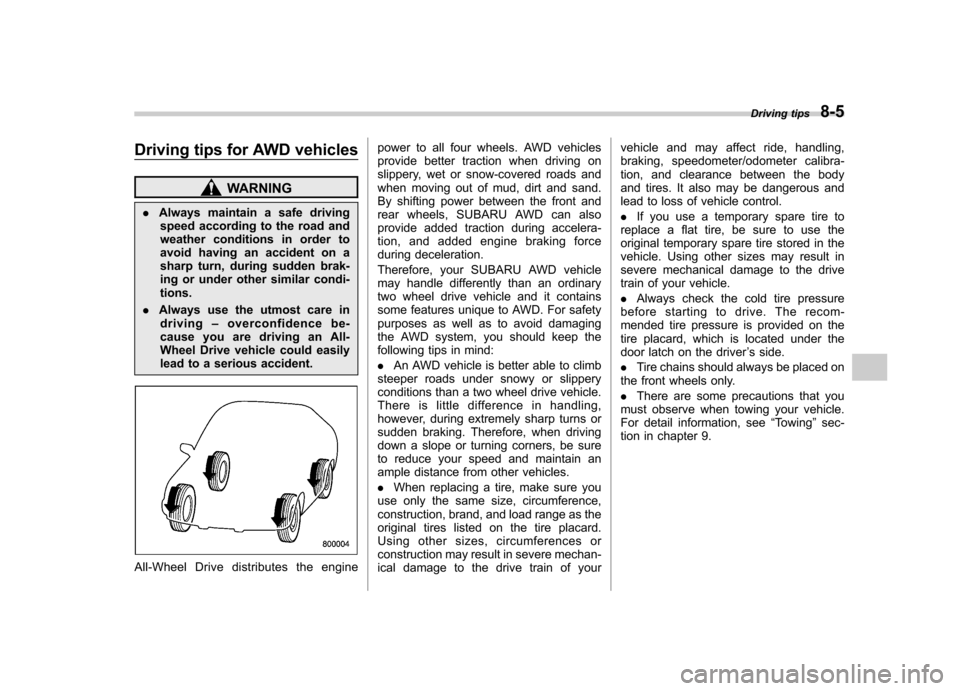
All-Wheel Drive distributes the engine power to all four wheels. AWD vehicles
provide better traction when driving on
slippery, wet or snow-covered roads and
when moving out of mud, dirt and sand.
By shifting power between the front and
rear wheels, SUBARU AWD can also
provide added traction during accelera-
tion, and added engine braking force
during deceleration.
Therefore, your SUBARU AWD vehicle
may handle differently than an ordinary
two wheel drive vehicle and it contains
some features unique to AWD. For safety
purposes as well as to avoid damaging
the AWD system, you should keep the
following tips in mind: .
An AWD vehicle is better able to climb
steeper roads under snowy or slippery
conditions than a two wheel drive vehicle.
There is little difference in handling,
however, during extremely sharp turns or
sudden braking. Therefore, when driving
down a slope or turning corners, be sure
to reduce your speed and maintain an
ample distance from other vehicles. . When replacing a tire, make sure you
use only the same size, circumference,
construction, brand, and load range as the
original tires listed on the tire placard.
Using other sizes, circumferences or
construction may result in severe mechan-
ical damage to the drive train of your vehicle and may affect ride, handling,
braking, speedometer/odometer calibra-
tion, and clearance between the body
and tires. It also may be dangerous and
lead to loss of vehicle control. .
If you use a temporary spare tire to
replace a flat tire, be sure to use the
original temporary spare tire stored in the
vehicle. Using other sizes may result in
severe mechanical damage to the drive
train of your vehicle. . Always check the cold tire pressure
before starting to drive. The recom-
mended tire pressure is provided on the
tire placard, which is located under the
door latch on the driver ’s side.
. Tire chains should always be placed on
the front wheels only. . There are some precautions that you
must observe when towing your vehicle.
For detail information, see “Towing ”sec-
tion in chapter 9. Driving tips
8-5
Page 297 of 442
8-10Driving tips
!Wiper operation when snowing
Before driving in cold weather, make sure
the wiper blades are not frozen to the
windshield or rear window. If the wiper
blades are frozen to the windshield or rear
window, use the defroster with the airflow
control button/dial in the “
”position and
the temperature control dial set for max-
imum warmth until the wiper blades are
completely thawed out. If your vehicle is
equipped with a wiper deicer, it is helpful
to thaw the windshield wiper blades. To
thaw out the rear wiper blade, use the rear
window defogger.
When driving in snow, if frozen snow starts
to stick on the surface of the windshield
despite wiper operation, use the defroster
with the airflow control button/dial in “
”
and the temperature control dial set for
maximum warmth. After the windshield
gets warmed enough to melt the frozen
snow on it, wash it away using the
windshield washer.
Snow stuck on the wiper arm prevents the
wiper from working effectively. If snow is
stuck on the wiper arm, pull off the road to
a safe place, then remove it. If you stop
the vehicle at road side, use the hazard
warning flasher to alert other drivers.
We recommend use of non-freezing type
wiper blades (winter blades) during the seasons you could have snow and sub-
zero temperatures. Blades of this type
give superior wiping performance in
snowy conditions. Be sure to use blades
that are suitable for your vehicle.
CAUTION
During high-speed driving, non-
freezing type wiper blades may not
perform as well as standard wiper
blades. If this happens, reduce the
vehicle speed.
NOTE
When the season requiring non-freez-
ing type wiper blades is over, replace
them with standard wiper blades. & Corrosion protection
Refer to the “Corrosion protection ”section
(chapter 10).
& Snow tires
! All models except OUTBACK or
2.5GT spec.B
WARNING
. When replacing original tires with winter (snow) tires, make sure
you use only the same size,
construction and load range as
the original tires listed on the tire
placard. Using other sizes and
construction may affect speed-
ometer/odometer calibration and
clearance between the body and
tires. It also may be dangerous
and lead to loss of vehicle con-trol.
. You must install four winter tires
that are of the same size, circum-
ferences, construction, brand,
andloadrange.Mixingother
sizes, circumferences or con-
structions may result in severe
mechanical damage to the drive
train of your vehicle and may
affect ride, handling, braking and
speedometer/odometer calibra-
tion. It also may be dangerous
and lead to loss of vehicle con-trol.
. Do not use a combination of
radial, belted bias or bias tires
since it may cause dangerous
handling characteristics and lead
to an accident.
Your vehicle is equipped with “all season
tires ”which are designed to provide an
Page 298 of 442
adequate measure of traction, handling
and braking performance in year-round
driving. In winter, it may be possible to
enhance performance through use of tires
designed specifically for winter drivingconditions.
If you choose to install winter tires on your
vehicle, be sure to use the correct tire size
and type. You must install four winter tires
that are of the same size, construction,
brand and load range and you should
never mix radial, belted bias or bias tires
since this may result in dangerous hand-
ling characteristics. When you choose a
tire, make sure that there is enough
clearance between the tire and vehicle
body.
Remember to drive with care at all times
regardless of the type of tires on yourvehicle. !OUTBACK models
WARNING
. When replacing original tires with
winter (snow) tires, make sure
you use only the same size and
construction as recommended.
Using other sizes or construction
may affect speedometer/od-
ometer calibration and clearance between the body and tires. It
also may be dangerous and lead
to loss of vehicle control.
. You must install four winter tires
that are of the same size, circum-
ferences, construction, brand,
andloadrange.Mixingother
sizes, circumferences or con-
structions may result in severe
mechanical damage to the drive
train of your vehicle and may
affect ride, handling, braking and
speedometer/odometer calibra-
tion. It also may be dangerous
and lead to loss of vehicle con-trol.
. Do not use a combination of
radial, belted bias or bias tires
since it may cause dangerous
handling characteristics and lead
to an accident.
Your vehicle is equipped with “all season
tires ”which are designed to provide an
adequate measure of traction, handling
and braking performance in year-round
driving. In winter, it may be possible to
enhance performance through use of tires
designed specifically for winter drivingconditions.
If you choose to install winter tires on your
vehicle, be sure to use the correct tire size and type. You must install four winter tires
that are of the same size, construction,
brand and load range and you should
never mix radial, belted bias or bias tires
since this may result in dangerous hand-
ling characteristics. When you choose a
tire, make sure that there is enough
clearance between the tire and vehicle
body.
Remember to drive with care at all times
regardless of the type of tires on yourvehicle.
Your OUTBACK comes with P225/
60R16 or P225/55R17
“all season tires ”
as original equipment. You should be
aware that some winter tires with that
same size designation may actually be
too large for the vehicle and may cause
rubbing on sharp turns. Listed below is
the winter tire size that we recommend.
Recommended winter (snow) tire size 2.5-liter non-turbo models: P225/60R16
or P215/60R16 Studless
All models other than 2.5-liter non-turbo
models: P215/55R17, P225/60R16 or
P215/60R16 Studless Driving tips
8-11
– CONTINUED –