tow SUBARU OUTBACK 2008 4.G Workshop Manual
[x] Cancel search | Manufacturer: SUBARU, Model Year: 2008, Model line: OUTBACK, Model: SUBARU OUTBACK 2008 4.GPages: 444, PDF Size: 14.1 MB
Page 340 of 444

9-20In case of emergency
For how to use the jack, refer to “Flat
tires ”.
& Other maintenance tools
In addition to a jack and a jack handle, the
tool bucket on your vehicle contains the
following maintenance tools.
Screwdriver
Towing hook
Wheel nut wrench
Page 351 of 444
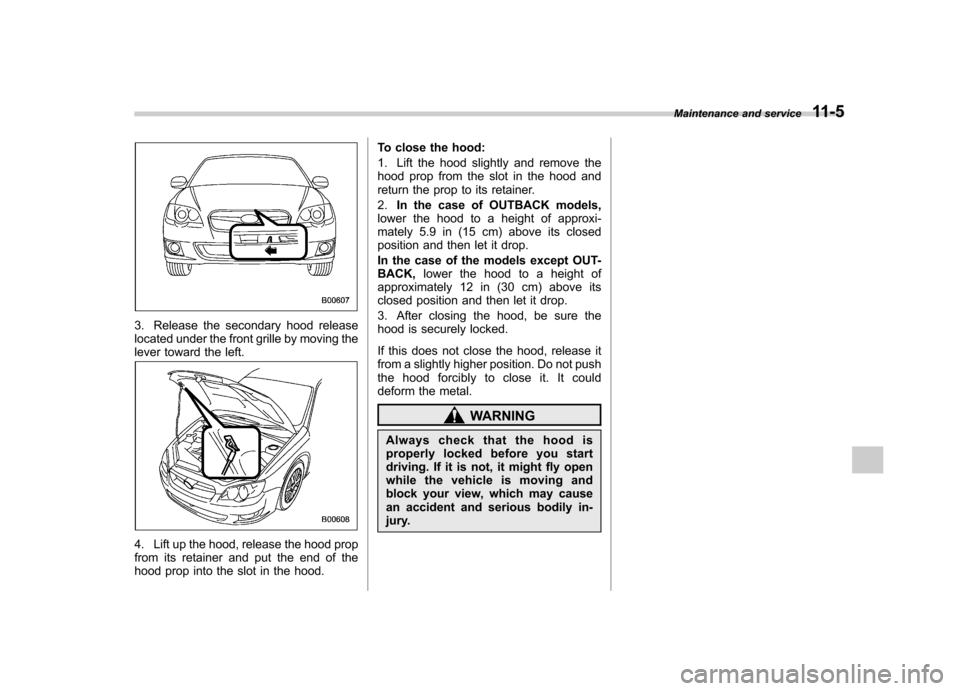
3. Release the secondary hood release
located under the front grille by moving the
lever toward the left.
4. Lift up the hood, release the hood prop
from its retainer and put the end of the
hood prop into the slot in the hood.To close the hood:
1. Lift the hood slightly and remove the
hood prop from the slot in the hood and
return the prop to its retainer. 2.
In the case of OUTBACK models,
lower the hood to a height of approxi-
mately 5.9 in (15 cm) above its closed
position and then let it drop.
In the case of the models except OUT- BACK, lower the hood to a height of
approximately 12 in (30 cm) above its
closed position and then let it drop.
3. After closing the hood, be sure the
hood is securely locked.
If this does not close the hood, release it
from a slightly higher position. Do not push
the hood forcibly to close it. It could
deform the metal.
WARNING
Always check that the hood is
properly locked before you start
driving. If it is not, it might fly open
while the vehicle is moving and
block your view, which may cause
an accident and serious bodily in-
jury. Maintenance and service
11-5
Page 359 of 444
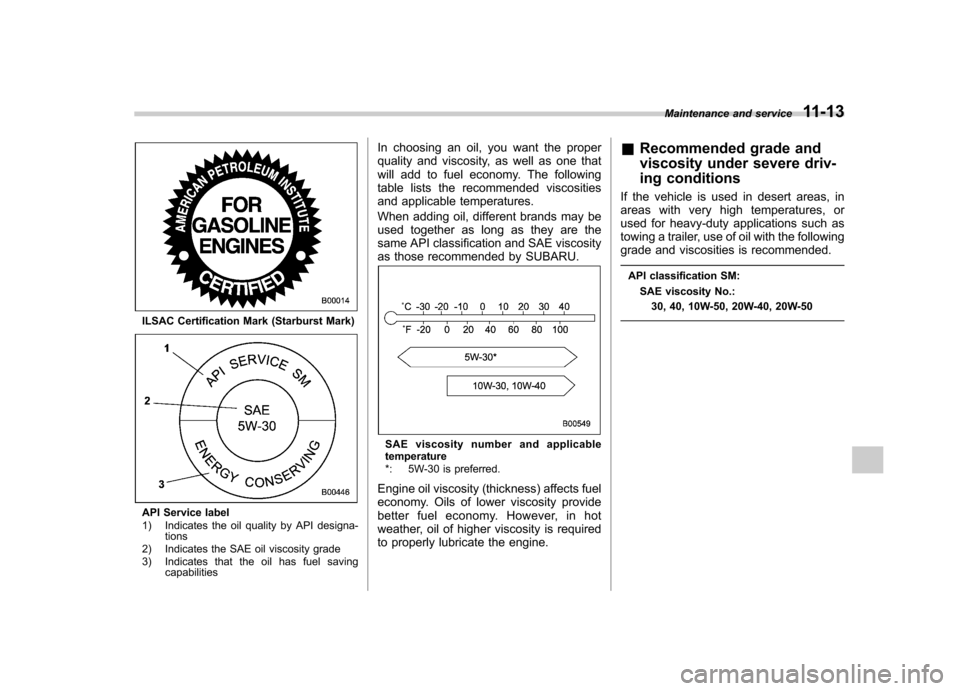
ILSAC Certification Mark (Starburst Mark)
API Service label
1) Indicates the oil quality by API designa-tions
2) Indicates the SAE oil viscosity grade
3) Indicates that the oil has fuel saving capabilities In choosing an oil, you want the proper
quality and viscosity, as well as one that
will add to fuel economy. The following
table lists the recommended viscosities
and applicable temperatures.
When adding oil, different brands may be
used together as long as they are the
same API classification and SAE viscosity
as those recommended by SUBARU.
SAE viscosity number and applicable
temperature
*: 5W-30 is preferred.
Engine oil viscosity (thickness) affects fuel
economy. Oils of lower viscosity provide
better fuel economy. However, in hot
weather, oil of higher viscosity is required
to properly lubricate the engine. &
Recommended grade and
viscosity under severe driv-
ing conditions
If the vehicle is used in desert areas, in
areas with very high temperatures, or
used for heavy-duty applications such as
towing a trailer, use of oil with the following
grade and viscosities is recommended.
API classification SM: SAE viscosity No.:30, 40, 10W-50, 20W-40, 20W-50 Maintenance and service
11-13
Page 391 of 444

&Rear window wiper blade assembly
1. Raise the wiper arm off the rear
window.
2. Turn the wiper blade assembly coun- terclockwise.
3. Pull the wiper blade assembly toward
you to remove it from the wiper arm. &
Rear window wiper blade rubber
1. Pull out the end of the blade rubber
assembly to unlock it from the plasticsupport.
Maintenance and service 11-45
– CONTINUED –
Page 394 of 444
11-48Maintenance and service
Fuses
CAUTION
Never replace a fuse with one hav-
ing a higher rating or with material
other than a fuse because serious
damage or a fire could result.
The fuses are designed to melt during an
overload to prevent damage to the wiring
harness and electrical equipment. The
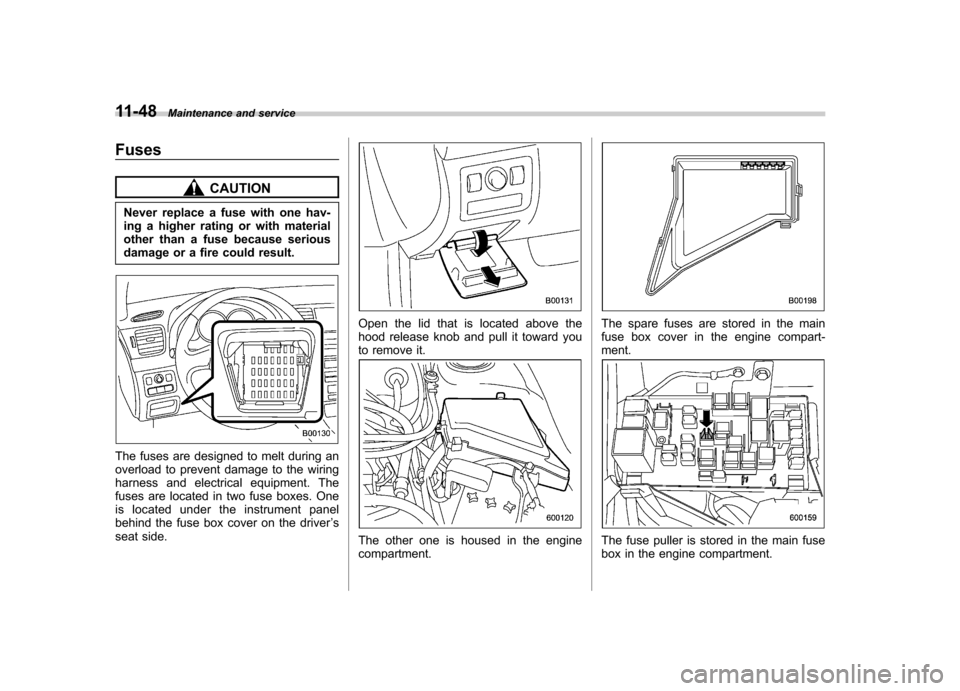
fuses are located in two fuse boxes. One
is located under the instrument panel
behind the fuse box cover on the driver ’s
seat side.
Open the lid that is located above the
hood release knob and pull it toward you
to remove it.
The other one is housed in the engine compartment.
The spare fuses are stored in the main
fuse box cover in the engine compart-ment.
The fuse puller is stored in the main fuse
box in the engine compartment.
Page 411 of 444

&Tires
Tire size P205/55R16
89H P225/60R16
97H P205/50R17
88V 215/45R17
91W P225/55R17
95V 215/45R18
89Y P215/45R18
89W
Wheel size 16 66.5JJ 17 67JJ 18 67JJ
Pressure Front 32 psi
(220 kPa,
2.2 kgf/cm
2) 32 psi
(220 kPa,
2.2 kgf/cm2) 33 psi
(230 kPa,
2.3 kgf/cm2) 35 psi
(240 kPa,
2.4 kgf/cm2) 32 psi
(220 kPa,
2.2 kgf/cm2) 33 psi
(230 kPa,
2.3 kgf/cm2)
Rear 30 psi
(210 kPa,
2.1 kgf/cm
2) 30 psi
(210 kPa,
2.1 kgf/cm2) 32 psi
(220 kPa,
2.2 kgf/cm2) 33 psi
(230 kPa,
2.3 kgf/cm2) 30 psi
(210 kPa,
2.1 kgf/cm2) 32 psi
(220 kPa,
2.2 kgf/cm2)
Rear at
trailer tow- ing –
32 psi
(220 kPa,
2.2 kgf/cm
2) –
32 psi
(220 kPa,
2.2 kgf/cm2) –
Temporary
spare tire Size T135/80R16 T155/70D17 T135/80R16 T135/70D17 T155/70D17 T155/70D17 Pressure
60 psi (420 kPa, 4.2 kgf/cm
2)
& Wheel alignment
Item Legacy OUTBACK
Sedan Station wagon Station wagon
Toe Front 0 in (0 mm)
Rear 0 in (0 mm)
Camber Front 0815 ’ 0840 ’
Rear 0840 ’ 0830 ’
0810 ’Specifications
12-5
Page 422 of 444

&Recommended tire inflation pressure
! Recommended cold tire inflation pressure
Recommended cold tire inflation pressure for your vehicle ’s tires is as follows,
Tire size P205/
55R16 89H P225/
60R16 97H P205/
50R17 88V 215/45R17
91W P225/
55R17 95V 215/45R18
89Y P215/
45R18 89W
Wheel size 16 66.5JJ 17 67JJ 18 67JJ
Pres- sure Front
32 psi
(220 kPa, 2.2 kgf/
cm
2) 32 psi
(220 kPa, 2.2 kgf/
cm2) 33 psi
(230 kPa, 2.3 kgf/
cm2) 35 psi
(240 kPa, 2.4 kgf/
cm2) 32 psi
(220 kPa, 2.2 kgf/
cm2) 33 psi
(230 kPa,
2.3 kgf/cm2)
Rear 30 psi
(210 kPa,
2.1 kgf/ cm
2) 30 psi
(210 kPa,
2.1 kgf/ cm2) 32 psi
(220 kPa,
2.2 kgf/ cm2) 33 psi
(230 kPa,
2.3 kgf/ cm2) 30 psi
(210 kPa,
2.1 kgf/ cm2) 32 psi
(220 kPa,
2.2 kgf/cm2)
Rear attrailer towing –
32 psi
(220 kPa,
2.2 kgf/
cm
2) –
32 psi
(220 kPa,
2.2 kgf/ cm2) –
Tempor-ary spare tire Size
T135/
80R16 T155/
70D17 T135/
80R16 T135/
70D17 T155/
70D17 T155/70D17
Pres- sure 60 psi (420 kPa, 4.2 kgf/cm
2)
Consumer information and Reporting safety defects
13-5
– CONTINUED –
Page 425 of 444
13-8Consumer information and Reporting safety defects
tires every 7,500 miles (12,000 km).
Rotating the tires involves switch-
ing the front and rear tires on the
right-hand side of the vehicle and
similarly switching the front and
rear tires on the left-hand side of
the vehicle. (Each tire must be kept
on its original side of the vehicle.)
Replace any damaged or unevenly
worn tire at the time of rotation.
After tire rotation, adjust the tire
pressures and make sure the wheel
nuts are correctly tightened. A
tightening torque specification and
a tightening sequence specification
for the wheel nuts can be found“ Flat tires
”section in chapter 9.
& Vehicle load limit –how to
determine
The load capacity of your vehicle is
determined by weight, not by avail-
able cargo space. The load limit of
your vehicle is shown on the
vehicle placard attached to the
driver ’s side B-pillar. Locate the
statement “The combined weight of occupants and cargo should
never exceed XXX kg or XXX lbs
”
on your vehicle ’s placard.
Thevehicleplacardalsoshows
seating capacity of your vehicle.
The total load capacity includes the
total weight of driver and all pas-
sengers and their belongings, any
cargo, any optional equipment such
as a trailer hitch, roof rack or bike
carrier, etc., and the tongue load of
a trailer. Therefore cargo capacity
can be calculated by the followingmethod.
Cargo capacity = Load limit (total
weight of occupants + total weight
of optional equipment + tongue
load of a trailer (if applicable))
For towing capacity information and
weight limits, refer to “Trailer towing
”
section in chapter 8. ! Calculating total and load ca-
pacities varying seating con-
figurations
Calculate the available load capa-
city as shown in the following examples:
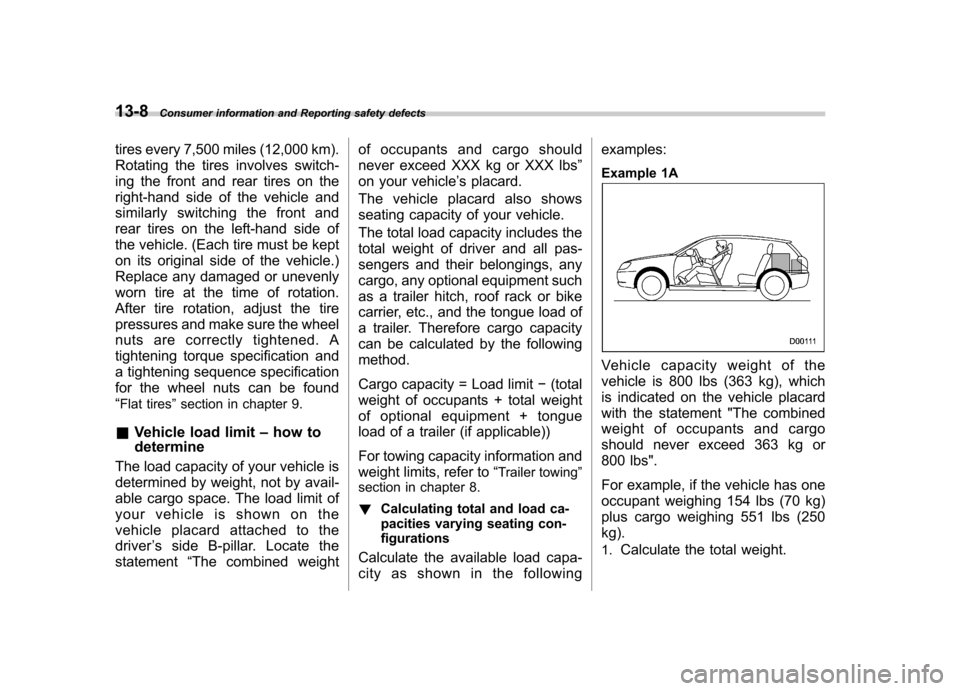
Example 1A
Vehicle capacity weight of the
vehicle is 800 lbs (363 kg), which
is indicated on the vehicle placard
with the statement "The combined
weight of occupants and cargo
should never exceed 363 kg or
800 lbs".
For example, if the vehicle has one
occupant weighing 154 lbs (70 kg)
plus cargo weighing 551 lbs (250kg). 1.
Calculate the total weight.
Page 429 of 444

13-12Consumer information and Reporting safety defects
available amount of cargo and
luggage load capacity. For exam-
ple, if the “XXX ”amount equals
1,400 lbs (635kg). and there will be
five- 150 lbs (68 kg) passengers in
your vehicle, the amount of avail-
able cargo and luggage load capa-
city is 650 lbs. (1,400 750 (5 6
150) = 650 lbs.)
5. Determine the combined weight
of luggage and cargo being loaded
on the vehicle. That weight may not
safely exceed the available cargo
and luggage load capacity calcu-
lated in Step 4. 6. If your vehicle will be towing a
trailer, load from your trailer will be
transferred to your vehicle. Consult
this manual to determine how this
reduces the available cargo and
luggage load capacity of your ve-hicle. Uniform tire quality grading standards
This information indicates the rela-
tive performance of passenger car
tires in the area of treadwear,
traction, and temperature resis-
tance. This is to aid the consumer
in making an informed choice in the
purchase of tires.
Quality grades can be found where
applicable on the tire sidewall be-
tween tread shoulder and maxi-
mum section width. For example:
Treadwear 200 Traction AA Tem-
perature A
The quality grades apply to new
pneumatic tires for use on passen-
ger cars. However, they do not
apply to deep tread, winter type
snow tires, space-saver or tempor-
ary use spare tires, tires with
nominal rim diameters of 12 inches
or less, or to some limited produc-
tion tires.
All passenger car tires must con-form to Federal Safety Require-
ments in addition to these grades. &
Treadwear
The treadwear grade is a compara-
tive rating based on the wear rate of
the tire when tested under con-
trolled conditions on a specified
government test course.
For example, a tire graded 150
would wear one and one-half (1-1/
2) times as well on the government
course as a tire graded 100. The
relative performance of tires de-
pends upon the actual conditions
of their use, however, and may
depart significantly from the norm
due to variations in driving habits,
service practices and differences in
road characteristics and climate. & Traction AA, A, B, C
The traction grades, from highest to
lowest, are AA, A, B and C. Those
grades represent the tire ’s ability to
stop on wet pavement as measured
under controlled conditions on spe-
Page 439 of 444

14-8Index
Safety Precautions when driving ............................................. 4
Symbol ...................................................................... 2
Warnings ................................................................... 2
Seat Fabric ................................................................... 10-5
Heater .................................................................... 1-8
Memory function ...................................................... 1-5
Seat height adjustment ................................................. 1-4
Seatbelt ......................................................................... 4
Maintenance .......................................................... 1-23
Pretensioners ........................................................ 1-24
Safety tips ............................................................. 1-13
Warning light and chime ................................. 1-15, 3-29
Seatbelts .................................................................. 1-13
Security ID plate .......................................................... 2-3
Selector lever .................................................... 7-18, 7-25
Position indicator ................................................... 3-39
Shift lock release ............................................... 7-23, 7-29
Shift-up indicator light ................................................. 3-38
Shock sensors ........................................................... 2-19
Shopping bag hook .................................................... 6-11
SI-DRIVE mode ......................................................... 7-30
Snow tires ................................................................. 8-11
Snowy and icy roads .................................................... 8-9
Sounding a panic alarm .............................................. 2-10
Spark plugs .............................................................. 11-20
Specifications ............................................................ 12-2
Speedometer ....................................................... 3-6, 3-24
SPORT mode indicator light ........................................ 3-38 SRS
Curtain airbag ........................................................ 1-55
Frontal airbag ......................................................... 1-45
Side airbag ............................................................ 1-55
SRS airbag (Supplemental Restraint System airbag)... 4, 1-40
SRS airbag system Monitors ................................................................ 1-61
Servicing ............................................................... 1-63
Warning light .......................................................... 3-30
Starting the engine ...................................................... 7-9
State emission testing (U.S. only) .................................. 7-7
Steering wheel Power ................................................................... 7-33
Tilt/telescopic ......................................................... 3-58
Stopping the engine .................................................... 7-10
Storage compartment ................................................... 6-4
Stowage boxes .......................................................... 6-15
Sun shade ......................................................... 2-28, 2-30
Sun visors .................................................................. 6-3
Supplemental Restraint System airbag (SRS) ................ 1-40
Synthetic leather upholstery ......................................... 10-5
T
Tachometer ......................................................... 3-6, 3-26
Temperature gauge ...................................... 3-7, 3-12, 3-27
Temperature warning light (AT OIL TEMP) ..................... 3-32
Temporary spare tire .................................................... 9-2
Tie-down hooks .......................................................... 9-14
Tire Chains .................................................................. 8-13
Inspection ............................................................ 11-36