roof SUBARU OUTBACK 2009 5.G Owner's Manual
[x] Cancel search | Manufacturer: SUBARU, Model Year: 2009, Model line: OUTBACK, Model: SUBARU OUTBACK 2009 5.GPages: 447, PDF Size: 14.26 MB
Page 310 of 447
8-14Driving tips
possible.
. When you carry something inside
the vehicle, secure it whenever
you can to prevent it from being
thrown around inside the vehicle
during sudden stops, sharp turns
or in an accident.
. Do not pile heavy loads on the
roof. These loads raise the vehi-cle ’s center of gravity and make it
more prone to tip over.
. Secure lengthy items properly to
prevent them from shooting for-
ward and causing serious injury
during a sudden stop.
. Never exceed the maximum load
limit. If you do, some parts on
your vehicle can break, or it can
change the way your vehicle
handles. This could result in loss
of control and cause personal
injury. Also, overloading can
shorten the life of your vehicle. .
Do not place anything on the rear
shelf behind the rear seatback
(for Sedan) or the extended lug-
gage cover (for Station wagon).
Such items could tumble forward
in the event of a sudden stop or a
collision. This could cause ser-
ious injury.
CAUTION
Do not carry spray cans, containers
with flammable or corrosive liquids
or any other dangerous items inside
the vehicle.
NOTE
For better fuel economy, do not carry
unneeded cargo. &
Vehicle capacity weight
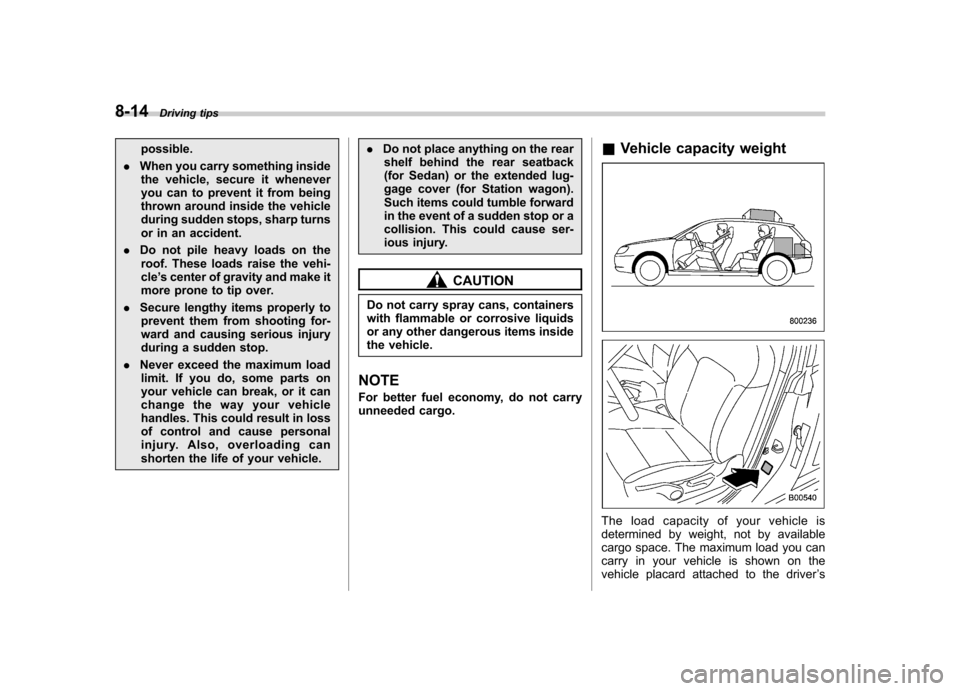
The load capacity of your vehicle is
determined by weight, not by available
cargo space. The maximum load you can
carry in your vehicle is shown on the
vehicle placard attached to the driver ’s
Page 311 of 447
side door pillar. It includes the total weight
of the driver and all passengers and their
belongings, any optional equipment such
as a trailer hitch, roof rack or bike carrier,
etc., and the tongue load of a trailer. &GVWR and GAWR (Gross
Vehicle Weight Rating and
Gross Axle Weight Rating)
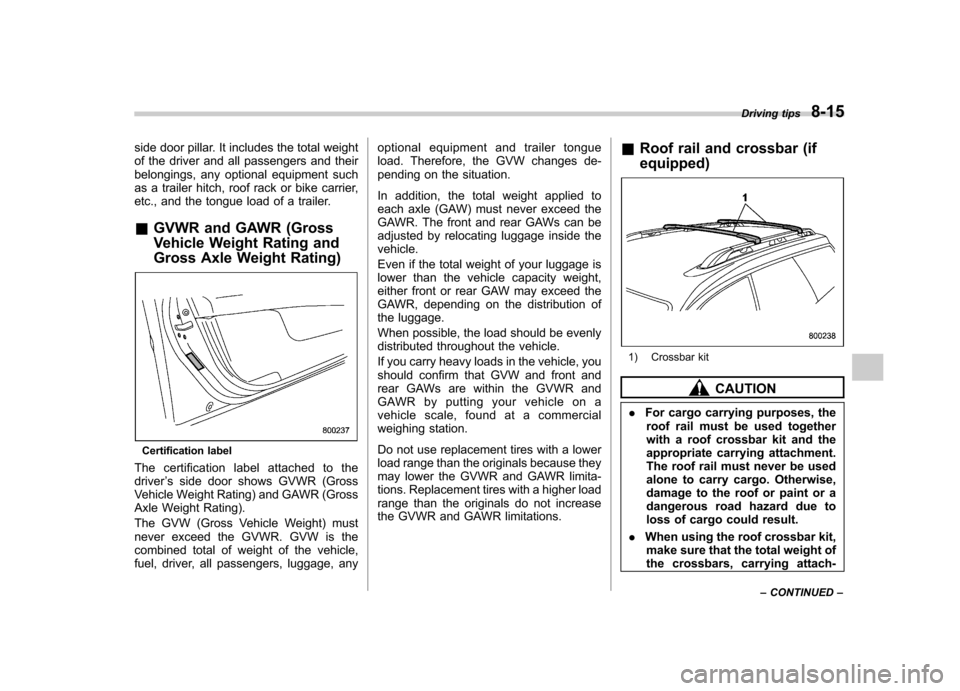
Certification label
The certification label attached to the driver ’s side door shows GVWR (Gross
Vehicle Weight Rating) and GAWR (Gross
Axle Weight Rating).
The GVW (Gross Vehicle Weight) must
never exceed the GVWR. GVW is the
combined total of weight of the vehicle,
fuel, driver, all passengers, luggage, any optional equipment and trailer tongue
load. Therefore, the GVW changes de-
pending on the situation.
In addition, the total weight applied to
each axle (GAW) must never exceed the
GAWR. The front and rear GAWs can be
adjusted by relocating luggage inside thevehicle.
Even if the total weight of your luggage is
lower than the vehicle capacity weight,
either front or rear GAW may exceed the
GAWR, depending on the distribution of
the luggage.
When possible, the load should be evenly
distributed throughout the vehicle.
If you carry heavy loads in the vehicle, you
should confirm that GVW and front and
rear GAWs are within the GVWR and
GAWR by putting your vehicle on a
vehicle scale, found at a commercial
weighing station.
Do not use replacement tires with a lower
load range than the originals because they
may lower the GVWR and GAWR limita-
tions. Replacement tires with a higher load
range than the originals do not increase
the GVWR and GAWR limitations.
&
Roof rail and crossbar (if equipped)
1) Crossbar kit
CAUTION
. For cargo carrying purposes, the
roof rail must be used together
with a roof crossbar kit and the
appropriate carrying attachment.
The roof rail must never be used
alone to carry cargo. Otherwise,
damage to the roof or paint or a
dangerous road hazard due to
loss of cargo could result.
. When using the roof crossbar kit,
make sure that the total weight of
the crossbars, carrying attach- Driving tips
8-15
– CONTINUED –
Page 312 of 447

8-16Driving tips
ment and cargo does not exceed
the maximum load limit. Over-
loading may cause damage to
the vehicle and create a safetyhazard.
The roof rail is not designed to carry cargo
by itself. Cargo can be carried after
securing the roof crossbar kit to the roof
rail and installing the appropriate carrying
attachment. When installing the roof
crossbar kit, follow the manufacturer ’s
instructions.
When you carry cargo on the roof using
the roof crossbar kit and a carrying
attachment, never exceed the maximum
load limit explained in the following. You
should also be careful that your vehicle
does not exceed the Gross Vehicle Weight
Rating (GVWR) and front and rear Gross
Axle Weight Rating (GAWR). Refer to the“ Loading your vehicle ”section in this
chapter for information on loading cargo
into or onto your vehicle. The maximum
load limit of the cargo, crossbars and
carrying attachment must not exceed 100
lbs (45 kg) . Place the heaviest load at the
bottom, nearest the roof, and evenly
distribute the cargo. Always properly
secure all cargo. !
Installing carrying attachments on
the crossbars
When installing any carrying attachment
such as a bike carrier, ski carrier, kayak
carrier, cargo basket, etc. on the cross-
bars, follow the manufacturer ’s instruc-
tions and make sure that the attachment is
securely fixed to the crossbars. Use only
attachments designed specifically for the
crossbars. A set of the crossbars is
designed to carry loads (cargo and attach-
ment) of not more than 100 lbs (45 kg).
Before operating the vehicle, make sure
that the cargo is properly secured on theattachment.
NOTE
Remember that the vehicle ’s center of
gravity is altered with the weight of the
load on the roof, thus affecting the
driving characteristics.
Drive carefully. Avoid rapid starts, hard
cornering and abrupt stops. Crosswind
effects will be increased. ! Removal and installation of the crossbars
The crossbars can be removed when you
do not use the roof to carry cargo. !
To remove the crossbar
1. Loosen and remove the T-30 torx®
head screw from the top of each crossbar
end support.
Loosen the lower clamps.
Page 313 of 447
2. Carefully raise the crossbar from roof rails. !To install the front crossbar
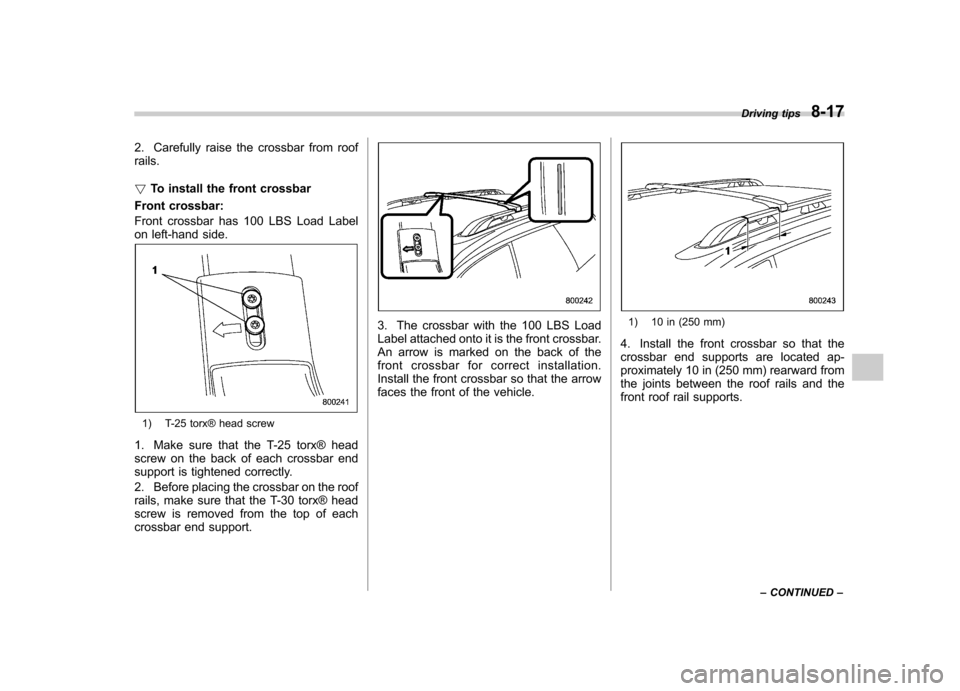
Front crossbar:
Front crossbar has 100 LBS Load Label
on left-hand side.
1) T-25 torx® head screw
1. Make sure that the T-25 torx® head
screw on the back of each crossbar end
support is tightened correctly.
2. Before placing the crossbar on the roof
rails, make sure that the T-30 torx® head
screw is removed from the top of each
crossbar end support.
3. The crossbar with the 100 LBS Load
Label attached onto it is the front crossbar.
An arrow is marked on the back of the
front crossbar for correct installation.
Install the front crossbar so that the arrow
faces the front of the vehicle.1) 10 in (250 mm)
4. Install the front crossbar so that the
crossbar end supports are located ap-
proximately 10 in (250 mm) rearward from
the joints between the roof rails and the
front roof rail supports. Driving tips
8-17
– CONTINUED –
Page 314 of 447

8-18Driving tips
1) Lower clamp
2) T-30 torx® head screw
5. Tighten the lower clamps onto the
crossbar. Using a torque wrench, loosely
tighten the T-30 torx® head screws. NOTE
It may be necessary to squeeze the
lower clamp and the end support
together to compress the pads and
gain a better alignment of the pieces
while trying to start the screw. Use care
not to crossthread the screw in theinsert.6. Adjust the alignment of the crossbar
on the roof rails, and if available, use a T-
30 torx® bit and torque wrench and tighten
the T-30 torx® head screws to 30 to 35
lbf·in (3.4 to 4.0 N·m, 0.35 to 0.41 kgf·m) of
torque (or tighten securely with the torx®
wrench provided). Rear crossbar:1) Zero gap
Install the rear cross bar so that the rear
edges of both crossbar end supports are
aligned (zero gap) with the front edges of
both rear roof rail supports.
Install the rear crossbar in the same
manner as the front crossbar.
CAUTION
Do not carry cargo on the roof when
the crossbars are removed. Lug-
gage on the roof will be thrown
forward or backward in sudden
stops or rapid accelerations, result-
ing in a dangerous road hazard.
Page 315 of 447
NOTE
Before each use of the roof crossbar,
make sure the four T-30 crossbar
clamp screws have been checked,
and retightened if necessary to 35 lbf·in
(4.0 N·m, 0.41 kgf·m), as outlined in
Step #5 above.Trailer hitch (if equipped)
WARNING
. Never exceed the maximum
weight specified for the trailer
hitch. Exceeding the maximum
weight could cause an accident
resulting in serious personal in-
juries. Permissible trailer weight
changes depending on the situa-
tion. Refer to the next section“ Trailer towing ”for possible re-
commendations and limitations.
. Trailer brakes are required when
the towing load exceeds 1,000
lbs (453 kg). Be sure your trailer
has safety chains and that each
chain will hold the trailer ’s max-
imum gross weight. Towing trai-
lers without safety chains could
create a traffic safety hazard if
the trailer separates from the
hitch due to coupling damage or
hitch ball damage.
. Be sure to check the hitch pin
and safety pin for positive lock-
ing placement before towing a
trailer. If the ball mount comes off
the hitch receiver, the trailer
could get loose and create a traffic safety hazard.
. Use only the ball mount supplied
with this hitch. Use the hitch only
as a weight carrying hitch. Do not
use with any type of weight
distributing hitch.
The trailer hitch is designed to tow a Class
1 rated load. The maximum gross trailer
weight and maximum gross tongue weight
are indicated in the following table. Maximum
gross trailerweightMaximum
gross tongueweight
3.0 L models 3,000 lbs
(1,360 kg) 200 lbs
(90 kg)
All models
other than 3.0
L models 2,700 lbs
(1,224 kg)
When you tow a trailer, refer to “Trailer
towing ”later in this section. Driving tips
8-19
– CONTINUED –
Page 331 of 447

9-6In case of emergency
4. Take out the jack and tool bucket.
1) Wheel nut wrench
2) Jack
5. Take the wheel nut wrench and jack
out of the tool bucket.
6. Turn the attaching bolt counterclock-
wise, then take the spare tire out.
Station wagon:
1. Open the lid and hang the hook
provided on the under side of the lid on the rear edge of the roof to keep the lidopen.
2. Remove the left-hand part of the lid
and take out the jack handle.
3. Take out the storage tray.
Page 415 of 447
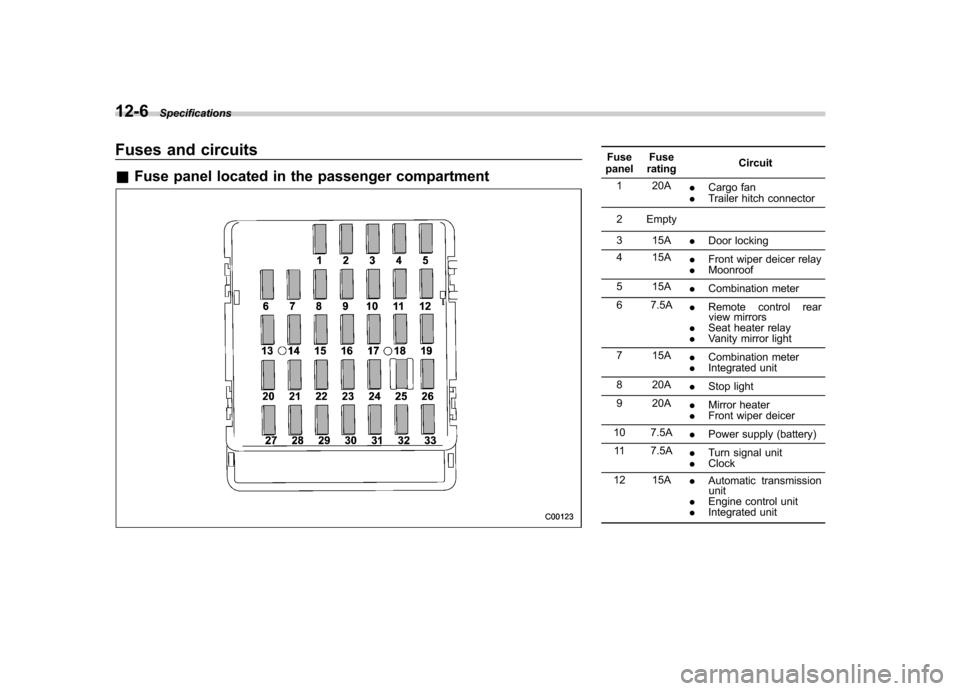
12-6Specifications
Fuses and circuits &Fuse panel located in the passenger compartmentFuse
panel Fuse
rating Circuit
1 20A .Cargo fan
. Trailer hitch connector
2 Empty
3 15A .Door locking
4 15A .Front wiper deicer relay
. Moonroof
5 15A .Combination meter
6 7.5A .Remote control rear
view mirrors
. Seat heater relay
. Vanity mirror light
7 15A .Combination meter
. Integrated unit
8 20A .Stop light
9 20A .Mirror heater
. Front wiper deicer
10 7.5A .Power supply (battery)
11 7.5A .Turn signal unit
. Clock
12 15A .Automatic transmission
unit
. Engine control unit
. Integrated unit
Page 428 of 447
13-8Consumer information and Reporting safety defects
tires every 7,500 miles (12,000 km).
Rotating the tires involves switch-
ing the front and rear tires on the
right-hand side of the vehicle and
similarly switching the front and
rear tires on the left-hand side of
the vehicle. (Each tire must be kept
on its original side of the vehicle.)
Replace any damaged or unevenly
worn tire at the time of rotation.
After tire rotation, adjust the tire
pressures and make sure the wheel
nuts are correctly tightened. A
tightening torque specification and
a tightening sequence specification
for the wheel nuts can be found“ Flat tires
”section in chapter 9.
& Vehicle load limit –how to
determine
The load capacity of your vehicle is
determined by weight, not by avail-
able cargo space. The load limit of
your vehicle is shown on the
vehicle placard attached to the
driver ’s side B-pillar. Locate the
statement “The combined weight of occupants and cargo should
never exceed XXX kg or XXX lbs
”
on your vehicle ’s placard.
Thevehicleplacardalsoshows
seating capacity of your vehicle.
The total load capacity includes the
total weight of driver and all pas-
sengers and their belongings, any
cargo, any optional equipment such
as a trailer hitch, roof rack or bike
carrier, etc., and the tongue load of
a trailer. Therefore cargo capacity
can be calculated by the followingmethod.
Cargo capacity = Load limit (total
weight of occupants + total weight
of optional equipment + tongue
load of a trailer (if applicable))
For towing capacity information and
weight limits, refer to the “Trailer
towing ”section in chapter 8.
! Calculating total and load ca-
pacities varying seating con-
figurations
Calculate the available load capa-
city as shown in the following examples:
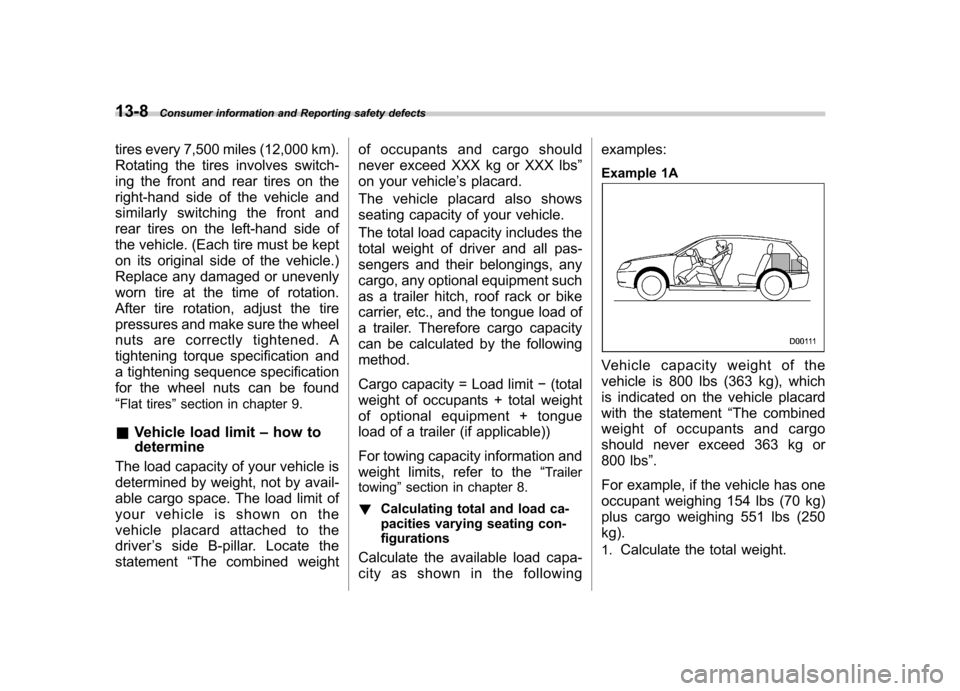
Example 1A
Vehicle capacity weight of the
vehicle is 800 lbs (363 kg), which
is indicated on the vehicle placard
with the statement
“The combined
weight of occupants and cargo
should never exceed 363 kg or
800 lbs ”.
For example, if the vehicle has one
occupant weighing 154 lbs (70 kg)
plus cargo weighing 551 lbs (250kg). 1. Calculate the total weight.
Page 440 of 447

14-6Index
Jump starting. ............................................................ 9-10
K Key Number .................................................................. 2-2
Reminder chime. ...................................................... 3-5
Replacement ........................................................... 2-4
Keyless entry system ................................................... 2-8
Keys .......................................................................... 2-2
L
Leather seat materials ................................................ 10-5
License plate light ..................................................... 11-56
Light Back-up (Sedan) ................................................... 11-53
Back-up (Station wagon) ........................................ 11-56
Brake/Tail (Station wagon) ...................................... 11-54
Brake/Tail and rear side marker (Sedan) .................. 11-53
Cargo area .................................................... 6-2, 11-59
Control switch ........................................................ 3-46
Dome ........................................................... 6-2, 11-57
Door step ............................................................. 11-58
Front fog ............................................................... 3-49
High mount stop ................................................... 11-59
Ignition switch .......................................................... 3-5
License plate ........................................................ 11-56
Map ............................................................. 6-3, 11-57
Rear combination .................................................. 11-53
Rear side marker (Station wagon) ........................... 11-54
Trunk ................................................................... 11-59
Vanity mirror .................................................. 6-5, 11-58 Limited slip differential (LSD).
....................................... 7-33
Loading your vehicle ................................................... 8-13
Low fuel warning light .................................. 3-7, 3-27, 3-36
Low tire pressure warning light ..................................... 3-33
Lower and tether anchorage ........................................ 1-35
LSD (Limited slip differential) ........................................ 7-33
Lumbar support ........................................................... 1-8
M
Main fuse ................................................................ 11-49
Maintenance
Precautions ........................................................... 11-3
Schedule ............................................................... 11-3
Seatbelt. ................................................................ 1-23
Tools ..................................................................... 9-18
Malfunction indicator lamp (check engine warning light)... 3-31Manual
Climate control system ............................................. 4-3
Mode ............................................................ 7-21, 7-27
Seat ....................................................................... 1-3
Transmission oil ................................................... 11-21
Transmission-5 speeds ........................................... 7-15
Transmission-6 speeds ........................................... 7-17
Map light ........................................................... 6-3, 11-57
Maximum load limits ................................................... 8-22
Meters and gauges .............................................. 3-5, 3-24
Mirrors ...................................................................... 3-56
Moonroof ................................................................... 2-28
Multi-information display ............................................... 3-9