airbag off SUBARU OUTBACK 2010 5.G Owner's Manual
[x] Cancel search | Manufacturer: SUBARU, Model Year: 2010, Model line: OUTBACK, Model: SUBARU OUTBACK 2010 5.GPages: 448, PDF Size: 7.36 MB
Page 130 of 448
3-12Instruments and controls
&Front passenger ’s frontal
airbag ON and OFF indica- tors
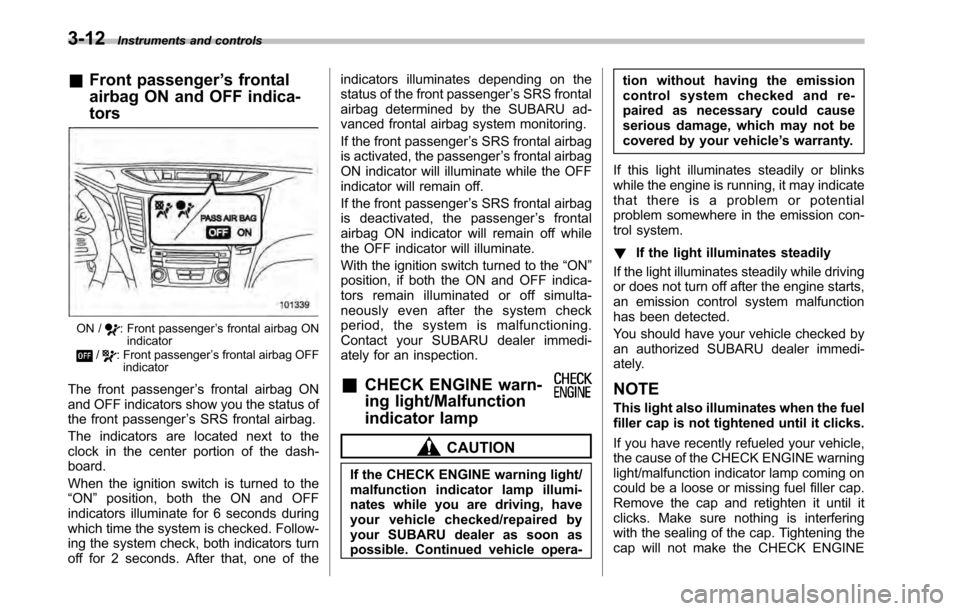
ON /: Front passenger ’s frontal airbag ON
indicator
/: Front passenger ’s frontal airbag OFF
indicator
The front passenger ’s frontal airbag ON
and OFF indicators show you the status of
the front passenger ’s SRS frontal airbag.
The indicators are located next to the
clock in the center portion of the dash-board.
When the ignition switch is turned to the “ ON ”position, both the ON and OFF
indicators illuminate for 6 seconds during
which time the system is checked. Follow-
ing the system check, both indicators turn
off for 2 seconds. After that, one of the indicators illuminates depending on the
status of the front passenger
’s SRS frontal
airbag determined by the SUBARU ad-
vanced frontal airbag system monitoring.
If the front passenger ’s SRS frontal airbag
is activated, the passenger ’s frontal airbag
ON indicator will illuminate while the OFF
indicator will remain off.
If the front passenger ’s SRS frontal airbag
is deactivated, the passenger ’sfrontal
airbag ON indicator will remain off while
the OFF indicator will illuminate.
With the ignition switch turned to the “ON ”
position, if both the ON and OFF indica-
tors remain illuminated or off simulta-
neously even after the system check
period, the system is malfunctioning.
Contact your SUBARU dealer immedi-
ately for an inspection.
& CHECK ENGINE warn-
ing light/Malfunction
indicator lamp
CAUTION
If the CHECK ENGINE warning light/
malfunction indicator lamp illumi-
nates while you are driving, have
your vehicle checked/repaired by
your SUBARU dealer as soon as
possible. Continued vehicle opera- tion without having the emission
control system checked and re-
paired as necessary could cause
serious damage, which may not be
covered by your vehicle
’s warranty.
If this light illuminates steadily or blinks
while the engine is running, it may indicate
that there is a problem or potential
problem somewhere in the emission con-
trol system. ! If the light illuminates steadily
If the light illuminates steadily while driving
or does not turn off after the engine starts,
an emission control system malfunction
has been detected.
You should have your vehicle checked by
an authorized SUBARU dealer immedi-
ately.
NOTE
This light also illuminates when the fuel
filler cap is not tightened until it clicks.
If you have recently refueled your vehicle,
the cause of the CHECK ENGINE warning
light/malfunction indicator lamp coming on
could be a loose or missing fuel filler cap.
Remove the cap and retighten it until it
clicks. Make sure nothing is interfering
with the sealing of the cap. Tightening the
cap will not make the CHECK ENGINE
Page 231 of 448
NOTE
Particles of ash and tobacco will accu-
mulate around the hinges of the ash-tray’s inner lid. Clean them off using a
toothbrush or another narrow-endedimplement. Coat hook
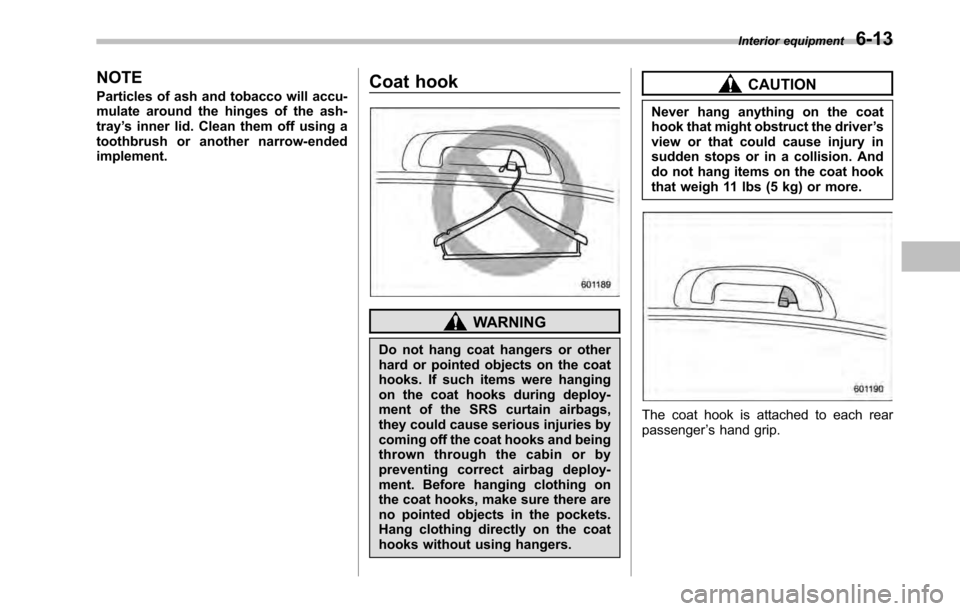
WARNING
Do not hang coat hangers or other
hard or pointed objects on the coat
hooks. If such items were hanging
on the coat hooks during deploy-
ment of the SRS curtain airbags,
they could cause serious injuries by
coming off the coat hooks and being
thrown through the cabin or by
preventing correct airbag deploy-
ment. Before hanging clothing on
the coat hooks, make sure there are
no pointed objects in the pockets.
Hang clothing directly on the coat
hooks without using hangers.
CAUTION
Never hang anything on the coat
hook that might obstruct the driver ’s
view or that could cause injury in
sudden stops or in a collision. And
do not hang items on the coat hook
that weigh 11 lbs (5 kg) or more.
The coat hook is attached to each rear passenger ’s hand grip. Interior equipment
6-13
Page 323 of 448
procedures for safety. &Towing and tie-down hooks
The towing hooks should be used only in
an emergency (e.g., to free a stuck vehicle
from mud, sand or snow).
CAUTION
. Use only the specified towing
hooks and tie-down hooks. Never
use suspension parts or other
parts of the body for towing or
tie-down purposes.
. Never use the tie-down hook
closest to the muffler under the
vehicle for towing purposes.
. To prevent deformation to the
bumper and the towing hook, do
not apply excessive lateral load
to the towing hooks.
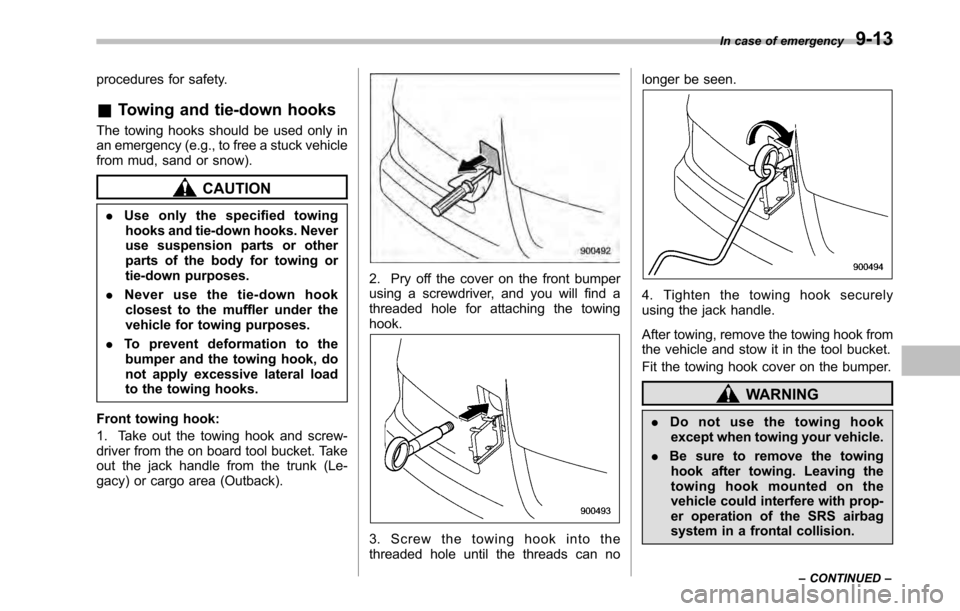
Front towing hook:
1. Take out the towing hook and screw-
driver from the on board tool bucket. Take
out the jack handle from the trunk (Le-
gacy) or cargo area (Outback).
2. Pry off the cover on the front bumper
using a screwdriver, and you will find a
threaded hole for attaching the towinghook.
3. Screw the towing hook into the
threaded hole until the threads can no longer be seen.
4. Tighten the towing hook securely
using the jack handle.
After towing, remove the towing hook from
the vehicle and stow it in the tool bucket.
Fit the towing hook cover on the bumper.
WARNING
. Do not use the towing hook
except when towing your vehicle.
. Be sure to remove the towing
hook after towing. Leaving the
towing hook mounted on the
vehicle could interfere with prop-
er operation of the SRS airbag
system in a frontal collision. In case of emergency
9-13
– CONTINUED –
Page 340 of 448
11-4Maintenance and service
guard against getting oil or fluids
in your eyes. If something does
get in your eyes, thoroughly
wash them out with clean water.
. Do not tamper with the wiring of
the SRS airbag system or seat-
belt pretensioner system, or at-
tempt to take its connectors
apart, as that may activate the
system or it can render it inop-
erative. NEVER use a circuit
tester for these wiring. If your
SRS airbag or seatbelt preten-
sioner needs service, consult
your nearest SUBARU dealer. &
Before checking or servicing
in the engine compartment
WARNING
. Always stop the engine and set
the parking brake firmly to pre-
vent the vehicle from moving.
. Always let the engine cool down.
Engine parts become very hot
when the engine is running and
remain hot for some time after
the engine is stopped.
. Do not spill engine oil, engine
coolant, brake fluid or any other
fluid on hot engine components.
This may cause a fire.
. Always remove the key from the
ignition switch. When the ignition
switch is in the “ON ”position,
thecoolingfanmayoperate
suddenly even when the engine
is stopped.
. Before performing any servicing
on a vehicle equipped with a
remote engine start system tem-
porarily place that system in the
service mode to prevent it from
unexpectedly starting the engine. &
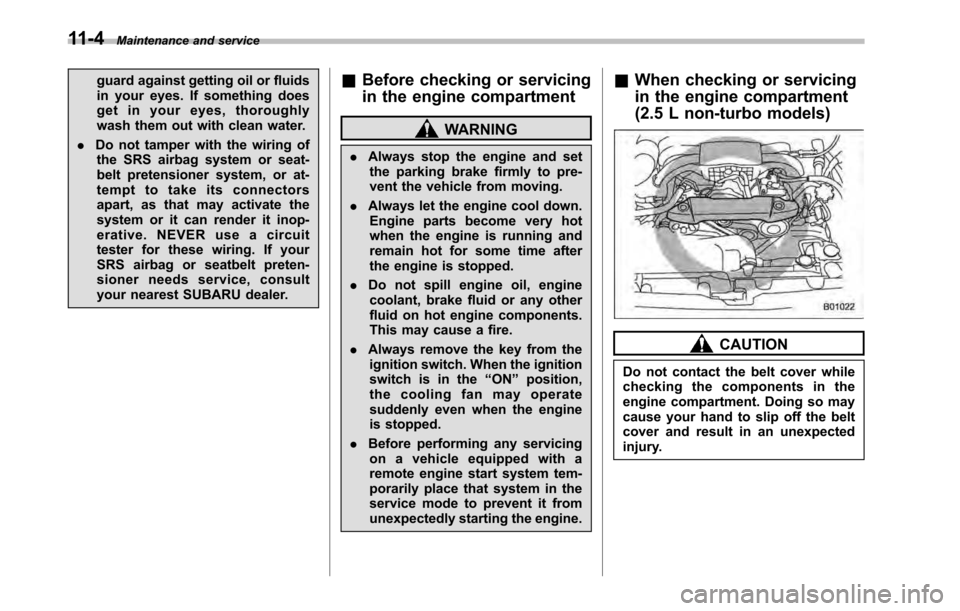
When checking or servicing
in the engine compartment
(2.5 L non-turbo models)
CAUTION
Do not contact the belt cover while
checking the components in the
engine compartment. Doing so may
cause your hand to slip off the belt
cover and result in an unexpected
injury.
Page 438 of 448

14-10Index
Sun visors ................................................................... 6-4
Supplemental Restraint System airbag (SRS) ................ 1-38
Synthetic leather upholstery ........................................ 10-5
T
Tachometer ................................................................. 3-7
Temperature warning light AT OIL TEMP ........................................................ 3-15
Coolant ................................................................. 3-13
Temporary spare tire .................................................... 9-2
Tether (child restraint system) .............................. 1-33, 1-35
Tie-down hooks ......................................................... 9-13
Tire ................................................................. 11-35, 12-5
Chains .................................................................. 8-11
Inspection ............................................................ 11-37
Pressures and wear .............................................. 11-37
Replacement ........................................................ 11-41
Rotation ............................................................... 11-40
Types .................................................................. 11-35
Tire pressure monitoring system (TPMS). ...... 7-32, 9-9, 11-35
Warning light ......................................................... 3-15
Tires and wheels. ...................................................... 11-35
Tools .......................................................................... 9-3
Top tether anchorages ........................................ 1-33, 1-35
Towing ...................................................................... 9-12
All wheels on the ground ........................................ 9-15
Flat-bed truck ........................................................ 9-15
Hooks ................................................................... 9-13
Weight.................................................................. 8-19
Trailer
Connecting ............................................................ 8-17 Hitch
............................................................. 8-16, 8-22
Towing .................................................................. 8-19
Towing tips ............................................................ 8-24
Trip meter ................................................................... 3-6
Trunk lid ............................................................ 2-24, 9-19
Release handle ...................................................... 2-25
Trunk light ............................................................... 11-60
Turn signal
Indicator lights ........................................................ 3-23
Lever .................................................................... 3-29
U
Under-floor storage compartment .................................. 6-18
V
Valet mode ................................................................ 2-18
Vanity mirror ...................................................... 6-5, 11-59
Light ................................................................... 11-59
Vehicle
Capacity weight ...................................................... 8-13
Identification ........................................................ 12-13
Symbols .................................................................... 3
Vehicle Dynamics Control OFF indicator light .......................................... 3-21, 7-31
OFF switch ............................................................ 7-31
Operation indicator light ................................... 3-21, 7-30
System .................................................................. 7-28
Warning light .................................................. 3-20, 7-29
Ventilator .................................................................... 4-2