power steering SUBARU OUTBACK 2012 5.G User Guide
[x] Cancel search | Manufacturer: SUBARU, Model Year: 2012, Model line: OUTBACK, Model: SUBARU OUTBACK 2012 5.GPages: 474, PDF Size: 17.45 MB
Page 381 of 474
11-10Maintenance and service
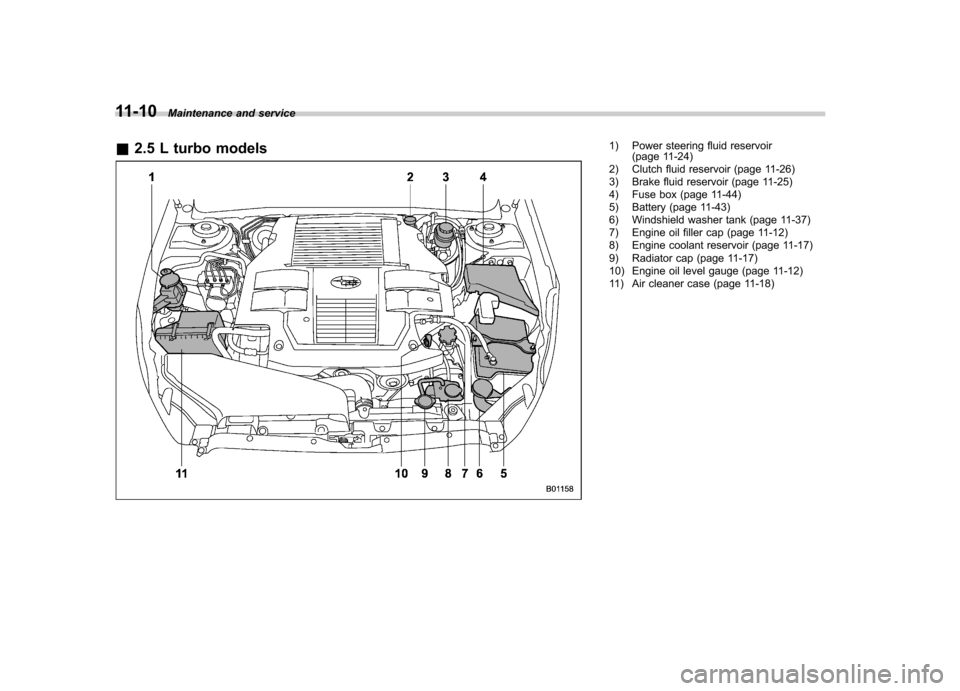
& 2.5 L turbo models
1) Power steering fluid reservoir
(page 11-24)
2) Clutch fluid reservoir (page 11-26)
3) Brake fluid reservoir (page 11-25)
4) Fuse box (page 11-44)
5) Battery (page 11-43)
6) Windshield washer tank (page 11-37)
7) Engine oil filler cap (page 11-12)
8) Engine coolant reservoir (page 11-17)
9) Radiator cap (page 11-17)
10) Engine oil level gauge (page 11-12)
11) Air cleaner case (page 11-18)
Page 382 of 474
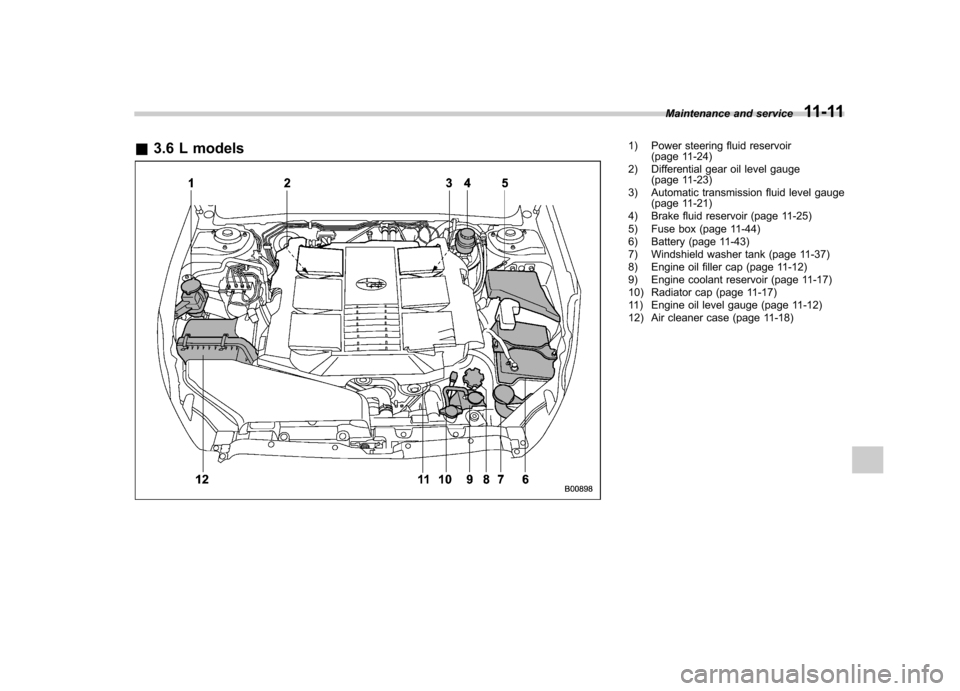
&3.6 L models1) Power steering fluid reservoir
(page 11-24)
2) Differential gear oil level gauge (page 11-23)
3) Automatic transmission fluid level gauge (page 11-21)
4) Brake fluid reservoir (page 11-25)
5) Fuse box (page 11-44)
6) Battery (page 11-43)
7) Windshield washer tank (page 11-37)
8) Engine oil filler cap (page 11-12)
9) Engine coolant reservoir (page 11-17)
10) Radiator cap (page 11-17)
11) Engine oil level gauge (page 11-12)
12) Air cleaner case (page 11-18) Maintenance and service
11-11
Page 390 of 474
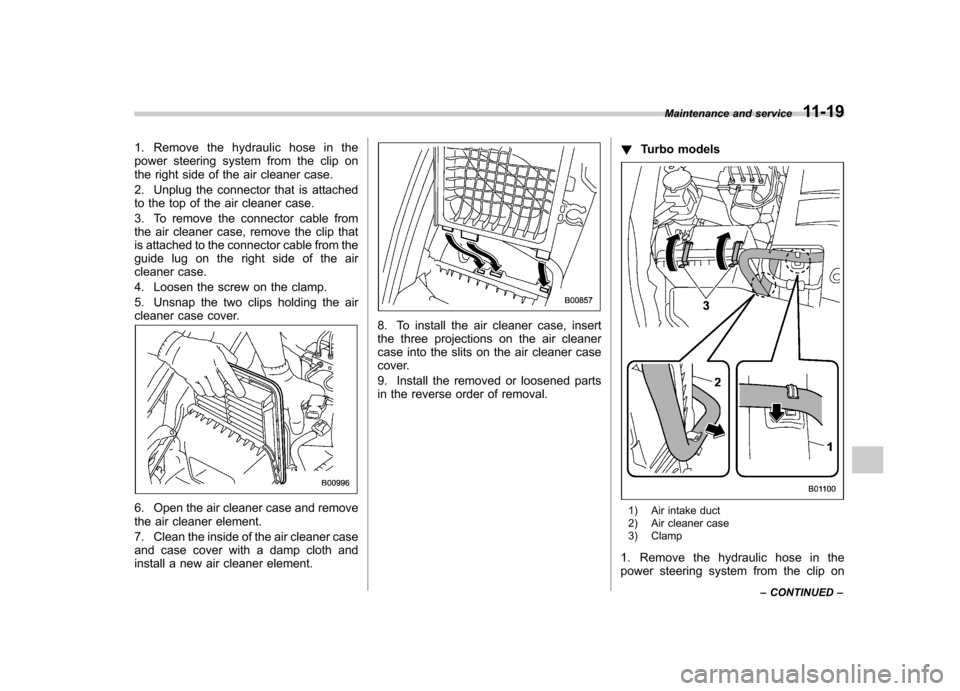
1. Remove the hydraulic hose in the
power steering system from the clip on
the right side of the air cleaner case.
2. Unplug the connector that is attached
to the top of the air cleaner case.
3. To remove the connector cable from
the air cleaner case, remove the clip that
is attached to the connector cable from the
guide lug on the right side of the air
cleaner case.
4. Loosen the screw on the clamp.
5. Unsnap the two clips holding the air
cleaner case cover.
6. Open the air cleaner case and remove
the air cleaner element.
7. Clean the inside of the air cleaner case
and case cover with a damp cloth and
install a new air cleaner element.
8. To install the air cleaner case, insert
the three projections on the air cleaner
case into the slits on the air cleaner case
cover.
9. Install the removed or loosened parts
in the reverse order of removal.!
Turbo models
1) Air intake duct
2) Air cleaner case
3) Clamp
1. Remove the hydraulic hose in the
power steering system from the clip on Maintenance and service
11-19
– CONTINUED –
Page 395 of 474
11-24Maintenance and service
!CVT models
There is no oil level gauge. To check the
front differential gear oil level, we recom-
mend that you consult your SUBARU
dealer for inspection. & Recommended grade and viscosity
Each oil manufacturer has its own base
oils and additives. Never use different
brands together. For details, refer to“ Manual transmission, front differential
and rear differential gear oil ”F 12-7. Rear differential gear oil
There is no oil level gauge. To check the
rear differential gear oil level, we recom-
mend that you consult your SUBARU
dealer for inspection. &
Recommended grade and viscosity
Each oil manufacturer has its own base
oils and additives. Never use different
brands together. For details, refer to“ Manual transmission, front differential
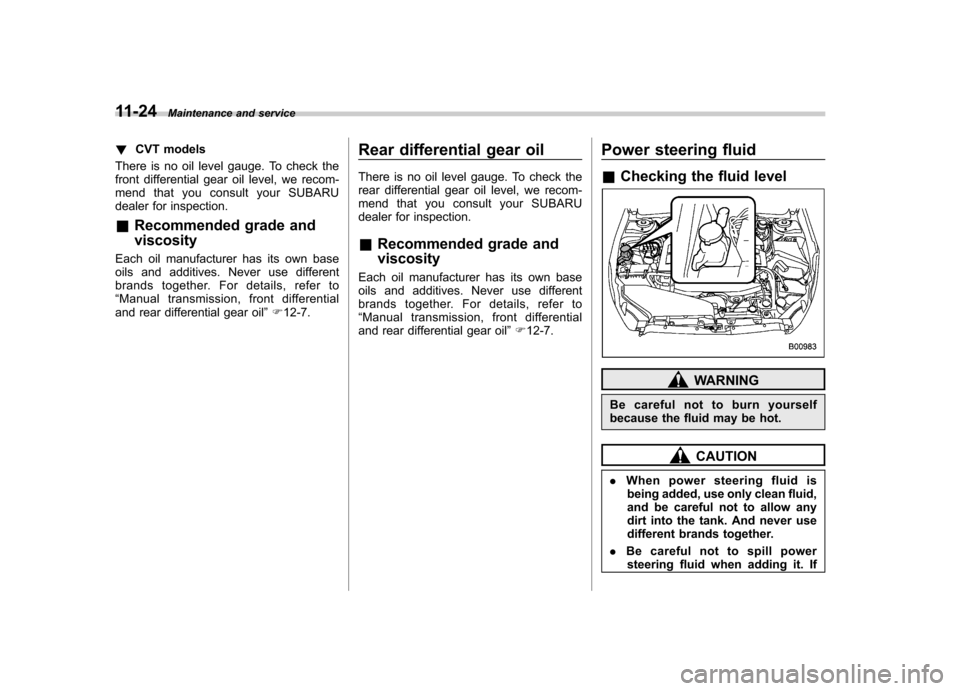
and rear differential gear oil ”F 12-7. Power steering fluid &
Checking the fluid level
WARNING
Be careful not to burn yourself
because the fluid may be hot.
CAUTION
. When power steering fluid is
being added, use only clean fluid,
and be careful not to allow any
dirt into the tank. And never use
different brands together.
. Be careful not to spill power
steering fluid when adding it. If
Page 396 of 474
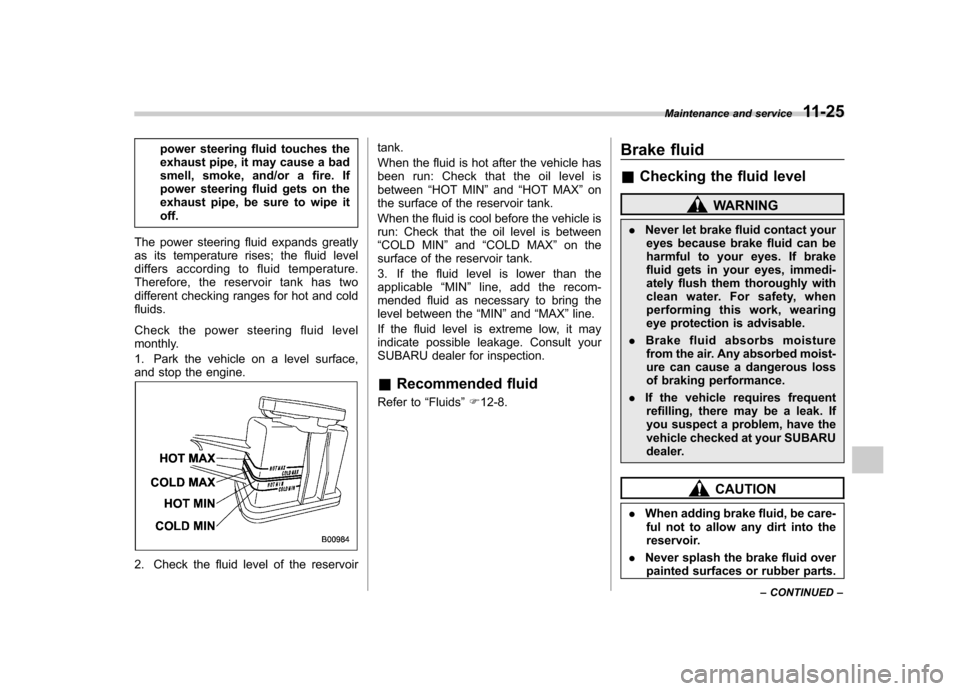
power steering fluid touches the
exhaust pipe, it may cause a bad
smell, smoke, and/or a fire. If
power steering fluid gets on the
exhaust pipe, be sure to wipe itoff.
The power steering fluid expands greatly
as its temperature rises; the fluid level
differs according to fluid temperature.
Therefore, the reservoir tank has two
different checking ranges for hot and coldfluids.
Check the power steering fluid level
monthly.
1. Park the vehicle on a level surface,
and stop the engine.
2. Check the fluid level of the reservoir tank.
When the fluid is hot after the vehicle has
been run: Check that the oil level isbetween
“HOT MIN ”and “HOT MAX ”on
the surface of the reservoir tank.
When the fluid is cool before the vehicle is
run: Check that the oil level is between“ COLD MIN ”and “COLD MAX ”on the
surface of the reservoir tank.
3. If the fluid level is lower than the
applicable “MIN ”line, add the recom-
mended fluid as necessary to bring the
level between the “MIN ”and “MAX ”line.
If the fluid level is extreme low, it may
indicate possible leakage. Consult your
SUBARU dealer for inspection.
& Recommended fluid
Refer to “Fluids ”F 12-8. Brake fluid &
Checking the fluid level
WARNING
. Never let brake fluid contact your
eyes because brake fluid can be
harmful to your eyes. If brake
fluid gets in your eyes, immedi-
ately flush them thoroughly with
clean water. For safety, when
performing this work, wearing
eye protection is advisable.
. Brake fluid absorbs moisture
from the air. Any absorbed moist-
ure can cause a dangerous loss
of braking performance.
. If the vehicle requires frequent
refilling, there may be a leak. If
you suspect a problem, have the
vehicle checked at your SUBARU
dealer.
CAUTION
. When adding brake fluid, be care-
ful not to allow any dirt into the
reservoir.
. Never splash the brake fluid over
painted surfaces or rubber parts. Maintenance and service
11-25
– CONTINUED –
Page 435 of 474

12-8Specifications
&Fluids
Fluid Fluid type*
1Fluid capacity*2Remarks*3
Automatic transmission fluid (5AT models) · SUBARU ATF
· IDEMITSU ATF HP
10.4 US qt (9.8 liters, 8.6 Imp qt)“
Automatic transmission fluid ”
F 11-21
Continuously variable transmission
fluid (CVT models) Consult your SUBARU dealer. 13.2 US qt (12.5 liters, 11.0 Imp qt) “
Continuously variable trans-
mission fluid ”F 11-23
Power steering fluid · SUBARU ATF
· IDEMITSU ATF HP ·“Dexron III ”Type Automatic
Transmission Fluid 0.7 US qt (0.7 liters, 0.6 Imp qt)
·
“Power steering ”F 7-23
· “Power steering fluid ”F 11-24
Brake fluid FMVSS No. 116, fresh DOT 3 or DOT 4
brake fluid –“
Brake fluid ”F 11-25
Clutch fluid (MT models) FMVSS No. 116, fresh DOT 3 or DOT 4
brake fluid –“
Clutch fluid (MT models) ”F 11 -
26
*1: Use one of the indicated types of fluid.
*2: The indicated fluid quantity is only a guideline. The necessary quantity for replacement may differ slightly depending on the temperature and other factors.
*3: For more details about maintenance and service, refer to the indicated section. & Engine coolant
Vehicle model Coolant capacity Coolant type
2.5 L non-turbo models MT models 6.9 US qt (6.5 liters, 5.7 Imp qt)
SUBARU Super Coolant
CVT models 6.8 US qt (6.4 liters, 5.6 Imp qt)
2.5 L turbo models 6.9 US qt (6.5 liters, 5.7 Imp qt)
3.6 L models 6.9 US qt (6.5 liters, 5.7 Imp qt)
The indicated coolant quantity is only a guideline. The necessary quantity for replacement may differ slightly depending on the temperature and other
factors. For more details about maintenance and service, refer to “Cooling system ”F 11-16.
Page 438 of 474

Fuse
panel Fuse
rating Circuit
13 20A .Socket
14 Empty
15 20A .Rear power window
(right side)
16 Empty
17 15A .Front wiper deicer
18 7.5A .Back-up light
19 7.5A .Electronic parking
brake unit
. Hill Holder system unit
20 10A .Accessory power outlet
21 7.5A .Starter relay
22 15A .Air conditioner
23 Empty
24 15A .Audio
. Navigation system
25 15A .SRS airbag system
26 7.5A .Main fan
27 30A .Power window relay Fuse
panel Fuse
rating Circuit
28 Empty
29 20A .Power window
(passenger ’s side)
30 Empty
31 7.5A .Automatic air condi-
tioner unit
32 Empty
33 7.5A .ABS/Vehicle dynamics
control unit
. Power steering Specifications
12-11
– CONTINUED –
Page 450 of 474

The vehicle placard shows original
tire size, recommended cold tire
inflation pressure on each tire at
maximum loaded vehicle weight,
seating capacity and loading infor-mation. !Adverse safety consequences
of under-inflation
Driving at high speeds with exces-
sively low tire pressures can cause
the tires to flex severely and to
rapidly become hot. A sharp in-
crease in temperature could cause
tread separation, and failure of the
tire(s). Possible resulting loss of
vehicle control could lead to anaccident. ! Measuring and adjusting air
pressure to achieve proper in-
flation
Check and, if necessary, adjust the
pressure of each tire (including the
spare) at least once a month and
before any long journey. Check the
tire pressures when the tires are
cold. Use a pressure gauge to
adjust the tire pressures to the specific values. Driving even a
short distance warms up the tires
and increases the tire pressures.
Also, the tire pressures are affected
by the outside temperature. It is
best to check tire pressure out-
doors before driving the vehicle.
When a tire becomes warm, the air
inside it expands, causing the tire
pressure to increase. Be careful not
to mistakenly release air from a
warm tire to reduce its pressure.
& Glossary of tire terminology
. Accessory weight
The combined weight (in excess of
those standard items which may be
replaced) of automatic transmis-
sion, power steering, power brakes,
power windows, power seats, radio,
and heater, to the extent that these
items are available as factory-in-
stalled equipment (whether in-
stalled or not). . Bead
The part of the tire that is made of
steel wires, wrapped or reinforced by ply cords and that is shaped to fit
the rim. .
Bead separation
A breakdown of the bond between
components in the bead.. Bias ply tire
A pneumatic tire in which the ply
cords that extend to the beads are
laid at alternate angles substantially
less than 90 degrees to the center-
line of the tread. . Carcass
The tire structure, except tread and
sidewall rubber which, when in-
flated, bears the load.. Chunking
The breaking away of pieces of the
tread or sidewall.. Cold tire pressure
The pressure in a tire that has been
driven less than 1 mile or has been
standing for three hours or more.. Cord
The strands forming the plies in thetire.. Cord separation
The parting of cords from adjacent
Consumer information and Reporting safety defects
13-5
– CONTINUED –
Page 464 of 474

Pedal.................................................................. 11-28
System ................................................................. 7-23
Brake pedal
Free play ............................................................. 11-28
Reserve distance .................................................. 11-28
Brake system ............................................................ 7-23
Warning light ......................................................... 3-17
Braking ..................................................................... 7-23
Tips...................................................................... 7-23
Breaking-in of new brake pads and linings ................... 11-30
Bulb Chart .................................................................. 12-14
Replacing ............................................................. 11-45
C
Cargo area Cover ................................................................... 6-15
Light ....................................................................... 6-3
Tie-down hooks ..................................................... 6-17
Catalytic converter ....................................................... 8-3
Center Console .................................................................. 6-6
Changing
Coolant ................................................................ 11-17
Flat tire ................................................................... 9-6
Oil and oil filter ..................................................... 11-14
Charge warning light .................................................. 3-14
CHECK ENGINE warning light/Malfunction indicator light ....................................................................... 3-12
Checking
Brake pedal free play ............................................ 11-28 Brake pedal reserve distance
................................. 11-28
Clutch function ..................................................... 11-29
Clutch pedal free play ........................................... 11-29
Coolant level ........................................................ 11-17
Fluid level (automatic transmission fluid) .................. 11-21
Fluid level (brake fluid) .......................................... 11-25
Fluid level (clutch fluid) .......................................... 11-26
Fluid level (power steering fluid) .. ........................... 11-24
Fluid level (washer fluid) ........................................ 11-37
Oil level (engine oil) .............................................. 11-12
Oil level (front differential gear oil) .......................... 11-23
Child restraint systems ................................................ 1-23
Installation of a booster seat .................................... 1-29
Installation with A/ELR seatbelt ... ............................. 1-26
Lower and tether anchorages ................................... 1-30
Top tether anchorages ............................................ 1-33
Child safety ................................................................... 5
Locks .................................................................... 2-19
Chime Key........................................................................ 3-4Light ..................................................................... 3-27
Seatbelt. ................................................................. 3-9
Cleaning Aluminum wheels ................................................... 10-3
Interior .................................................................. 10-5
Ventilation grille ....................................................... 4-8
Climate control system Automatic ............................................................... 4-5
Manual ................................................................... 4-6
Clock ........................................................................ 3-23 Index
14-3
Page 466 of 474

Warning........................................................ 3-18, 7-34
Emergency Locking Retractor (ELR) ............................. 1-13
Engine
Compartment overview ........................................... 11-9
Coolant ........................................................ 11-17, 12-8
Exhaust gas (carbon monoxide) ............................. 6, 8-2
Hood .................................................................... 11-7
Low oil level warning light ....................................... 3-14
Oil............................................................... 11-12, 12-4 Overheating .......................................................... 9-13
Starting ................................................................... 7-8
Stopping ............................................................... 7-10
Exterior care .............................................................. 10-2
F
Flat tires ..................................................................... 9-6
Floor mat .................................................................. 6-14
Fluid level Automatic transmission .......................................... 11-21
Brake .................................................................. 11-25
Clutch .................................................................. 11-26
Power steering ..................................................... 11-24
Fog light
Bulb .................................................................... 11-48
Indicator light ......................................................... 3-23
Switch .................................................................. 3-30
Folding mirror switch .................................................. 3-51
Front Differential gear oil ........................................ 11-23, 12-7
Fog light ...................................................... 3-30, 11-48
Fog light indicator light ............................................ 3-23 Position light
........................................................ 11-48
Seatbelt pretensioners ............................................ 1-21
Turn signal light .................................................... 11-48
Front fog light ........................................................... 11-48
Front seats ................................................................. 1-2
Forward and backward adjustment ............................ 1-3
Head restraint adjustment ......................................... 1-6
Power seat ............................................................. 1-4
Reclining ................................................................ 1-3
Seat height adjustment (driver ’s seat) ........................ 1-4
Fuel ........................................................................... 7-2
Economy hints ........................................................ 8-2
Filler lid and cap ...................................................... 7-3
Gauge .................................................................... 3-7
Requirements ................................................. 7-2, 12-3
Fuses ..................................................................... 11-44
Fuses and circuits .................................................... 12-10
G
GAWR (Gross Axle Weight Rating) .. ............................. 8-14
Glove box ................................................................... 6-6
GVWR (Gross Vehicle Weight Rating) ........................... 8-14
H
Hands-free system. ..................................................... 5-49
Hazard warning flasher .......................................... 3-5, 9-2
Head restraint adjustment Front seat ............................................................... 1-6
Rear seat .............................................................. 1-10
Headlight ......................................................... 3-27, 11-45
Bulb wattage ........................................................ 12-14 Index
14-5