airbag SUBARU OUTBACK 2012 5.G Repair Manual
[x] Cancel search | Manufacturer: SUBARU, Model Year: 2012, Model line: OUTBACK, Model: SUBARU OUTBACK 2012 5.GPages: 474, PDF Size: 17.45 MB
Page 77 of 474
1-54Seat, seatbelt and SRS airbags
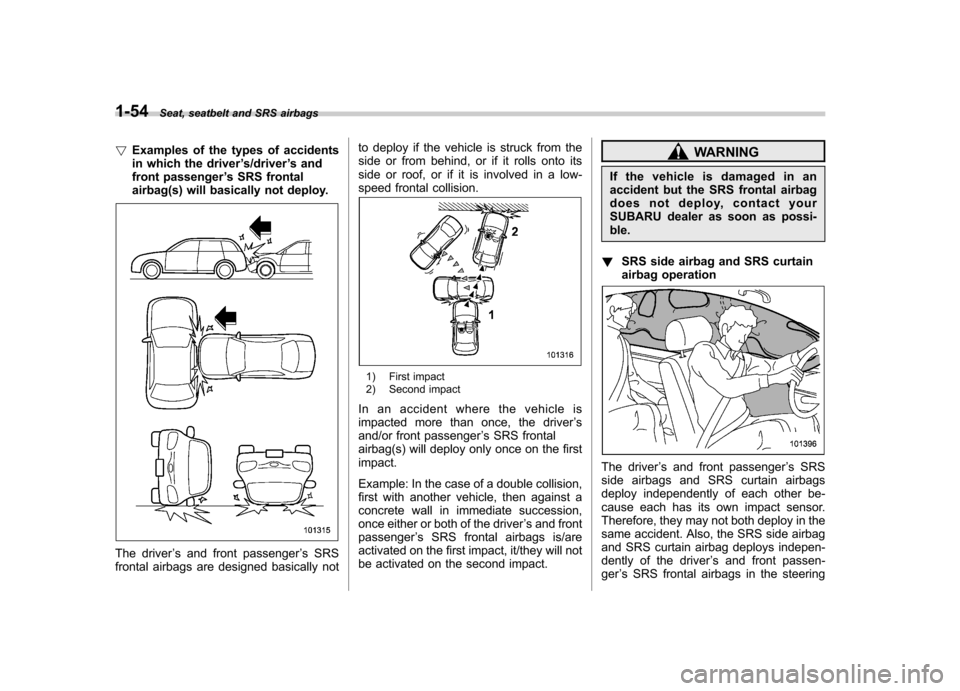
!Examples of the types of accidents
in which the driver ’s/driver ’s and
front passenger ’s SRS frontal
airbag(s) will basically not deploy.
The driver ’s and front passenger ’s SRS
frontal airbags are designed basically not to deploy if the vehicle is struck from the
side or from behind, or if it rolls onto its
side or roof, or if it is involved in a low-
speed frontal collision.
1) First impact
2) Second impact
In an accident where the vehicle is
impacted more than once, the driver ’s
and/or front passenger ’s SRS frontal
airbag(s) will deploy only once on the firstimpact.
Example: In the case of a double collision,
first with another vehicle, then against a
concrete wall in immediate succession,
once either or both of the driver ’s and front
passenger ’s SRS frontal airbags is/are
activated on the first impact, it/they will not
be activated on the second impact.
WARNING
If the vehicle is damaged in an
accident but the SRS frontal airbag
does not deploy, contact your
SUBARU dealer as soon as possi-ble.
! SRS side airbag and SRS curtain
airbag operation
The driver ’s and front passenger ’s SRS
side airbags and SRS curtain airbags
deploy independently of each other be-
cause each has its own impact sensor.
Therefore, they may not both deploy in the
same accident. Also, the SRS side airbag
and SRS curtain airbag deploys indepen-
dently of the driver ’s and front passen-
ger ’s SRS frontal airbags in the steering
Page 78 of 474

wheel and instrument panel.
An impact sensor, which senses impact
force, is located in each of the followinglocations. .In the left and right front doors
. In the left and right center pillars
. In the left and right rear wheel houses
. In the airbag control module
For Outback models, a rollover sensor is
also located inside the airbag controlmodule.
If the impact sensor that is located in the
airbag control module and one of the
center pillar impact sensors or front door
impact sensors together sense an impact
force above a predetermined level in a
side collision, the control module causes
both the SRS side airbag and curtain
airbag on the impacted side to inflate
regardless of whether the rear wheel
house impact sensor on the same side
senses an impact.
If the impact sensor that is located in the
airbag control module and one of the rear
wheel house impact sensors together
sense an impact force above a predeter-
mined level in a side collision, the control
module causes only the SRS curtain
airbag on the impacted side to inflate. For Outback models, if the rollover sensor
detects rollover of the vehicle, the control
module inflates the SRS curtain airbags.
At this time, the driver
’s and front passen-
ger ’s seatbelt pretensioners also operate
at the same time.
After the deployment, the SRS side airbag
immediately starts to deflate. The time
required from detection of an impact to
deflation of an SRS side airbag after
deployment is shorter than the blink of
an eye.
The SRS curtain airbag remains inflated
for a while following deployment then
slowly deflates.
The SRS side airbag and SRS curtain
airbag deploy even when no one occupies
the seat on the side on which an impact isapplied.
The SRS side airbag and SRS curtain
airbag are designed to deploy in the event
of an accident involving a moderate to
severe side impact collision. They are
basically not designed to deploy in a
lesser side impact.
The SRS side airbag and SRS curtain
airbag deployment depend on the level of
force experienced in the passenger com-
partment during a side impact collision.
That level differs from one type of collision to another, and it may have no bearing on
the visible damage done to the vehicleitself.
For Outback models, the SRS curtain
airbags are also designed to deploy when
the vehicle is in an extremely inclined
state such as during a rollover. They are
basically not designed to deploy in a
lesser inclined state.
The SRS side airbag and SRS curtain
airbag are basically not designed to
deploy in frontal or rear impacts because
the SRS side airbag and SRS curtain
airbag deployment would not help the
occupant in those situations.
Each SRS side airbag and SRS curtain
airbag are designed to function on a one-
time-only basis.
Seat, seatbelt and SRS airbags
1-55
– CONTINUED –
Page 79 of 474

1-56Seat, seatbelt and SRS airbags
! Example of the type of accident in
which the SRS side airbag will most
likely deploy.
A severe side impact near the front seat
activates the SRS side airbag. !
Examples of the types of accidents
in which the SRS curtain airbag will
most likely deploy.
Legacy models
A severe side impact near the front seat or
the rear seat activates the SRS curtainairbag.
Page 80 of 474

Outback models1) The vehicle is involved in a severe sideimpact near the front seat or the rear seat.
2) The vehicle rolls onto its side or the roof.
3) The angle of vehicle tip-up is marginal or the skidding vehicle ’s tires hit a curb-
stone laterally.
Seat, seatbelt and SRS airbags
1-57
– CONTINUED –
Page 81 of 474

1-58Seat, seatbelt and SRS airbags
! Examples of the types of accidents in which it is possible that the SRS side
airbag and the SRS curtain airbag will deploy (Outback).
1) Hitting a curb, edge of pavement or hard
surface
2) Falling into or jumping over a deep hole
3) Landing hard or vehicle falling
It is possible that the SRS side and curtain
airbags will deploy if a serious impact
occurs to the underside of your vehicle.
Some examples are shown in the illustra-tion.
Page 82 of 474

!Examples of the types of accidents in which the SRS side airbag is unlikely to
deploy.1) The vehicle is involved in an oblique
side-on impact.
2) The vehicle is involved in a side-on impact in an area outside the vicinity of
the passenger compartment.
3) The vehicle strikes a telephone pole or similar object.
4) The vehicle is involved in a side-on impact from a motorcycle.
5) The vehicle rolls onto its side or the roof.
There are many types of collisions which
might not necessarily require SRS side
airbag deployment. In the event of acci-
dents like those illustrated, the SRS side
airbag may not deploy depending on the
level of accident forces involved. Seat, seatbelt and SRS airbags
1-59
– CONTINUED –
Page 83 of 474

1-60Seat, seatbelt and SRS airbags
! Examples of the types of accidents in which the SRS curtain airbag is unlikely
to deploy.
Legacy models
1) The vehicle is involved in an oblique side-on impact.
2) The vehicle is involved in a side-on impact in an area outside the vicinity of
the passenger compartment.
3) The vehicle strikes a telephone pole or similar object.
4) The vehicle is involved in a side-on impact from a motorcycle.
5) The vehicle rolls onto its side or the roof.
There are many types of collisions which
might not necessarily require SRS curtain
airbag deployment. In the event of acci-
dents like those illustrated, the SRS
curtain airbag may not deploy depending
on the level of accident forces involved.
Page 84 of 474

Outback models1) The vehicle is involved in an obliqueside-on impact.
2) The vehicle is involved in a side-on impact in an area outside the vicinity of
the passenger compartment.
3) The vehicle strikes a telephone pole or similar object.
4) The vehicle is involved in a side-on impact from a motorcycle.
There are many types of collisions which
might not necessarily require SRS curtain
airbag deployment. In the event of acci-
dents like those illustrated, the SRS
curtain airbag may not deploy depending
on the level of accident forces involved. Seat, seatbelt and SRS airbags
1-61
– CONTINUED –
Page 85 of 474
1-62Seat, seatbelt and SRS airbags
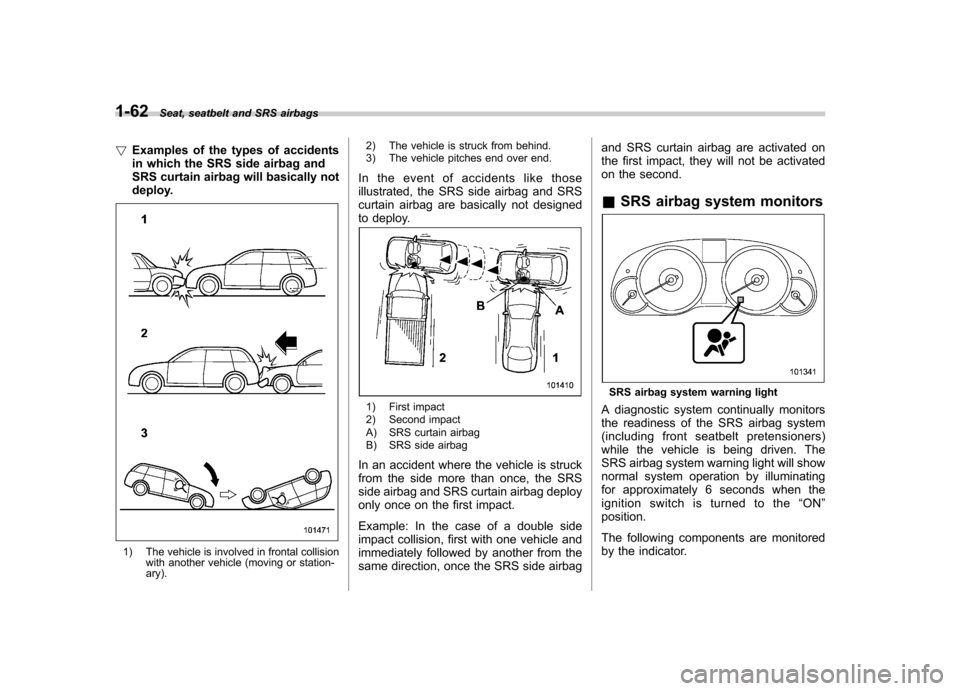
! Examples of the types of accidents
in which the SRS side airbag and
SRS curtain airbag will basically not
deploy.
1) The vehicle is involved in frontal collision
with another vehicle (moving or station- ary). 2) The vehicle is struck from behind.
3) The vehicle pitches end over end.
In the event of accidents like those
illustrated, the SRS side airbag and SRS
curtain airbag are basically not designed
to deploy.
1) First impact
2) Second impact
A) SRS curtain airbag
B) SRS side airbag
In an accident where the vehicle is struck
from the side more than once, the SRS
side airbag and SRS curtain airbag deploy
only once on the first impact.
Example: In the case of a double side
impact collision, first with one vehicle and
immediately followed by another from the
same direction, once the SRS side airbag and SRS curtain airbag are activated on
the first impact, they will not be activated
on the second. &
SRS airbag system monitors
SRS airbag system warning light
A diagnostic system continually monitors
the readiness of the SRS airbag system
(including front seatbelt pretensioners)
while the vehicle is being driven. The
SRS airbag system warning light will show
normal system operation by illuminating
for approximately 6 seconds when the
ignition switch is turned to the “ON ”
position.
The following components are monitored
by the indicator.
Page 86 of 474
![SUBARU OUTBACK 2012 5.G Repair Manual .Front sub sensor
– Right-hand side
– Left-hand side
. Airbag control module (including im-
pact sensors [all models] and rollover
sensors [Outback]) . Frontal airbag module
– Driver ’s side](/img/17/7304/w960_7304-85.png "SUBARU OUTBACK 2012 5.G Repair Manual .Front sub sensor
– Right-hand side
– Left-hand side
. Airbag control module (including im-
pact sensors [all models] and rollover
sensors [Outback]) . Frontal airbag module
– Driver ’s side")
.Front sub sensor
– Right-hand side
– Left-hand side
. Airbag control module (including im-
pact sensors [all models] and rollover
sensors [Outback]) . Frontal airbag module
– Driver ’s side
– Front passenger ’s side
. Center pillar impact sensor
– Right-hand side
– Left-hand side
. Front door impact sensor
– Right-hand side
– Left-hand side
. Side airbag module
– Driver ’s side
– Front passenger ’s side
. Rear wheel house impact sensor
– Right-hand side
– Left-hand side
. Curtain airbag module
– Right-hand side
– Left-hand side
. Seatbelt pretensioner
– Driver ’s side
– Front passenger ’s side
. Seatbelt buckle switch (front passen-
ger ’s side)
. Front passenger ’s occupant detection system weight sensor.
Front passenger ’s occupant detection
control module. Front passenger ’s frontal airbag ON
and OFF indicator. All related wiring
WARNING
If the warning light exhibits any of
the following conditions, there may
be a malfunction in the seatbelt
pretensioners and/or SRS airbag
system. Immediately take your vehi-
cle to your nearest SUBARU dealer
to have the system checked. Unless
checked and properly repaired, the
seatbelt pretensioners and/or SRS
airbags will operate improperly (e.g.
SRS airbags may inflate in a very
minor collision or not inflate in a
severe collision), which may in-
crease the risk of injury. . Flashing or flickering of the warn-
ing light
. No illumination of the warning
light when the ignition switch is
first turned to the “ON ”position
. Continuous illumination of the
warning light
. Illumination of the warning light while driving
& SRS airbag system servicing
WARNING
. When discarding an airbag mod-
ule or scrapping the entire vehi-
cle damaged by a collision, con-
sult your SUBARU dealer.
. The SRS airbag has no user-
serviceable parts. Do not use
electrical test equipment on any
circuit related to the SRS airbag
system. For required servicing of
the SRS airbag, consult your
nearest SUBARU dealer. Tamper-
ing with or disconnecting thesystem ’s wiring could result in
accidental inflation of the SRS
airbag or could make the system
inoperative, which may result in
serious injury.
Seat, seatbelt and SRS airbags
1-63
– CONTINUED –