ECO mode SUBARU OUTBACK 2012 5.G Manual PDF
[x] Cancel search | Manufacturer: SUBARU, Model Year: 2012, Model line: OUTBACK, Model: SUBARU OUTBACK 2012 5.GPages: 474, PDF Size: 17.45 MB
Page 397 of 474
11-26Maintenance and service
Alcohol contained in the brake
fluid may damage them.
. Be careful not to spill brake fluid
when adding it. If brake fluid
touches the exhaust pipe, it may
cause a bad smell, smoke, and/or
a fire. If brake fluid gets on the
exhaust pipe, be sure to wipe itoff.
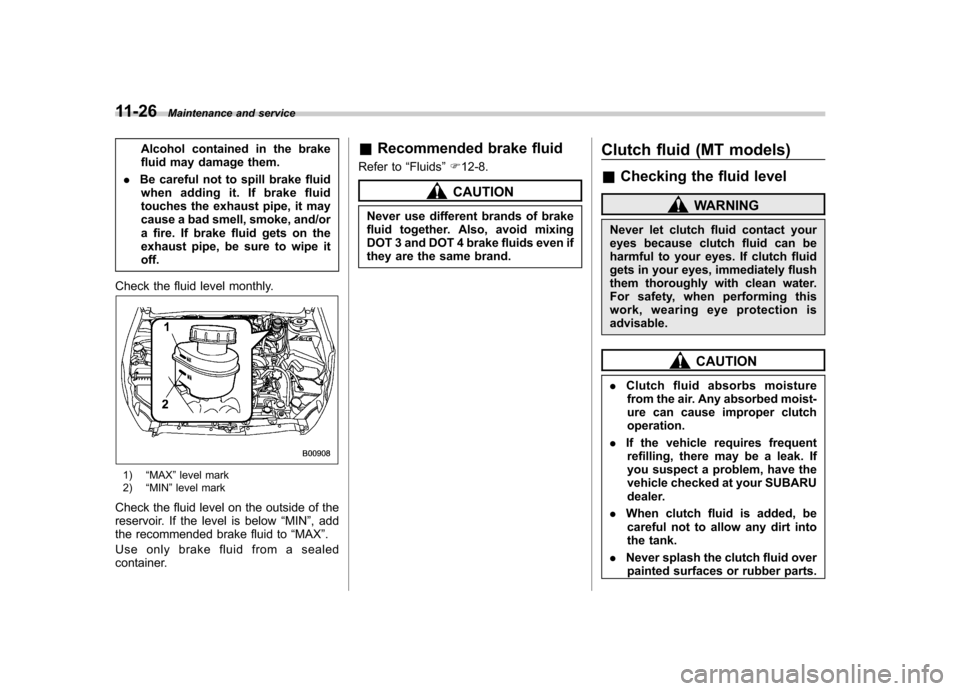
Check the fluid level monthly.
1) “MAX ”level mark
2) “MIN ”level mark
Check the fluid level on the outside of the
reservoir. If the level is below “MIN ”, add
the recommended brake fluid to “MAX ”.
Use only brake fluid from a sealed
container. &
Recommended brake fluid
Refer to “Fluids ”F 12-8.
CAUTION
Never use different brands of brake
fluid together. Also, avoid mixing
DOT 3 and DOT 4 brake fluids even if
they are the same brand. Clutch fluid (MT models) &
Checking the fluid level
WARNING
Never let clutch fluid contact your
eyes because clutch fluid can be
harmful to your eyes. If clutch fluid
gets in your eyes, immediately flush
them thoroughly with clean water.
For safety, when performing this
work, wearing eye protection isadvisable.
CAUTION
. Clutch fluid absorbs moisture
from the air. Any absorbed moist-
ure can cause improper clutchoperation.
. If the vehicle requires frequent
refilling, there may be a leak. If
you suspect a problem, have the
vehicle checked at your SUBARU
dealer.
. When clutch fluid is added, be
careful not to allow any dirt into
the tank.
. Never splash the clutch fluid over
painted surfaces or rubber parts.
Page 401 of 474

11-30Maintenance and service
you apply the brake pedal, have the brake
pads serviced by your SUBARU dealer as
soon as possible. &Breaking-in of new brake
pads and linings
When replacing the brake pad or lining,
use only genuine SUBARU parts. After
replacement, the new parts must be
broken in as follows: ! Brake pad and lining
While maintaining a speed of 30 to 40
mph (50 to 65 km/h), step on the brake
pedal lightly. Repeat this five or moretimes. ! Parking brake lining
The break-in maintenance for the parking
brake linings should be performed at a
SUBARU dealer. Tires and wheels &
Types of tires
You should be familiar with type of tires
present on your vehicle. ! All season tires
The factory-installed tires on your new
vehicle except 2.5 L turbo models are all
season tires.
All season tires are designed to provide
an adequate measure of traction, handling
and braking performance in year-round
driving including snowy and icy road
conditions. However all season tires do
not offer as much traction performance as
winter (snow) tires in heavy or loose snow
or on icy roads.
All season tires are identified by “ALL
SEASON ”and/or “M+S ”(Mud & Snow) on
the tire sidewall. ! Summer tires
The factory-installed tires on your new 2.5
L turbo models are summer tires. Summer
tires are high-speed capability tires best
suited for highway driving under dryconditions.
Summer tires are inadequate for driving
on slippery roads such as on snow-
covered or icy roads.
If you drive your vehicle on snow-covered or icy roads, we strongly recommend the
use of winter (snow) tires.
When installing winter tires, be sure to
replace all four tires. !
Winter (snow) tires
Winter tires are best suited for driving on
snow-covered and icy roads. However
winter tires do not perform as well as
summer tires and all season tires on roads
other than snow-covered and icy roads. & Tire pressure monitoring
system (TPMS) (if equipped)
The tire pressure monitoring system pro-
vides the driver with a warning message
by sending a signal from a sensor that is
installed in each wheel when tire pressure
is severely low. The tire pressure monitor-
ing system will activate only when the
vehicle is driven. Also, this system may
not react immediately to a sudden drop in
tire pressure (for example, a blow-out
caused by running over a sharp object).
If you adjust the tire pressures in a warm
garage and will then drive the vehicle in
cold outside air, the resulting drop in tire
pressures may cause the low tire pressure
warning light to illuminate. To avoid this
problem when adjusting the tire pressures
in a warm garage, inflate the tires to
pressures higher than those shown on the
Page 432 of 474
!Non-turbo models
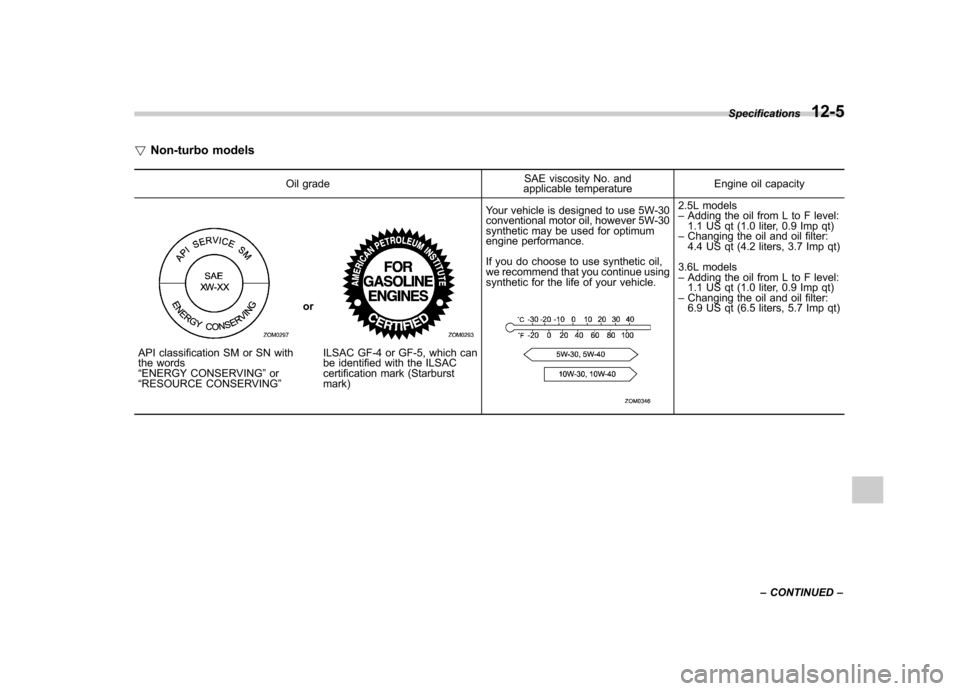
Oil grade SAE viscosity No. and
applicable temperature Engine oil capacity
API classification SM or SN with
the words “
ENERGY CONSERVING ”or
“ RESOURCE CONSERVING ”orILSAC GF-4 or GF-5, which can
be identified with the ILSAC
certification mark (Starburstmark) Your vehicle is designed to use 5W-30
conventional motor oil, however 5W-30
synthetic may be used for optimum
engine performance.
If you do choose to use synthetic oil,
we recommend that you continue using
synthetic for the life of your vehicle.
2.5L models –
Adding the oil from L to F level:
1.1 US qt (1.0 liter, 0.9 Imp qt)
– Changing the oil and oil filter:
4.4 US qt (4.2 liters, 3.7 Imp qt)
3.6L models– Adding the oil from L to F level:
1.1 US qt (1.0 liter, 0.9 Imp qt)
– Changing the oil and oil filter:
6.9 US qt (6.5 liters, 5.7 Imp qt) Specifications
12-5
– CONTINUED –
Page 451 of 474

13-6Consumer information and Reporting safety defects
rubber compounds. . Cracking
Any parting within the tread, side-
wall, or inner liner of the tire
extending to cord material. . Curb weight
The weight of a motor vehicle with
standard equipment including the
maximum capacity of fuel, oil and
coolant, and if so equipped, air
conditioning and additional weight
optional engine. . Extra load tire
A tire designed to operate at higher
loads and higher inflation pressure
than the corresponding standardtire. . Groove
The space between two adjacent
tread ribs.. Innerliner
The layer(s) forming the inside sur-
face of a tubeless tire that contains
the inflating medium within the tire.. Innerliner separation
The parting of the innerliner from
cord material in the carcass. .
Intended outboard sidewall
(1) The sidewall that contains a
whitewall, bears white lettering
or bears manufacturer, brand,
and/or model name molding that
is higher or deeper than the
same molding on the other side-
wall of the tire, or (2) The outward facing sidewall
of an asymmetrical tire that has
a particular side that must al-
ways face outward when mount-
ing on a vehicle.
. Light truck (LT) tire
A tire designated by its manufac-
turer as primarily intended for use
on lightweight trucks or multipur-
pose passenger vehicles. . Load rating
The maximum load that a tire is
rated to carry for a given inflation pressure. . Maximum inflation pressure
The maximum cold inflation pres-
sure to which a tire may be inflated.. Maximum load rating
The load rating for a tire at the maximum permissible inflation
pressure for that tire. .
Maximum loaded vehicle weight
The sum of: (a) Curb weight
(b) Accessory weight
(c) Vehicle capacity weight
(d) Production options weight
. Maximum permissible inflation
pressure
The maximum cold inflation pres-
sure to which a tire may be inflated.. Measuring rim
The rim on which a tire is fitted for
physical dimension requirements.. Normal occupant weight
150 lbs (68 kg) times the number of
occupants specified in the second
column of Table 1 that is appended
to the end of this section. . Occupant distribution
Distribution of occupants in a vehi-
cle as specified in the third column
of Table 1 that is appended to the
end of this section. . Open splice
Any parting at any junction of tread,
Page 465 of 474

14-4Index
Clutch Fluid ............................................................ 11-26, 12-8
Pedal .................................................................. 11-29
Coat hook ................................................................. 6-13
Compass .................................................. 3-36, 3-43, 3-45
Continuously variable transmission ............................... 7-17
Fluid ............................................................ 11-23, 12-8
Manual mode ........................................................ 7-21
Oil temperature warning light (AT OIL TEMP) ............ 3-14
Select lever ........................................................... 7-18
Shift lock function ................................................... 7-20
Coolant ............................................................ 11-17, 12-8
Temperature high warning light ................................ 3-13
Temperature low indicator light. ................................ 3-13
Cooling system ......................................................... 11-16
Corrosion protection ................................................... 10-4
Crossbars ................................................................. 8-14
Cruise control ............................................................ 7-35
Indicator light ......................................................... 3-23
Set indicator light ................................................... 3-23
Cup holder .................................................................. 6-8
Front passenger ’s .................................................... 6-9
Rear passenger ’s..................................................... 6-9
D
Daytime running light system ....................................... 3-28
Defogger ................................................................... 3-34
Deicer ...................................................................... 3-34
Differential gear oil Front ........................................................... 11-23, 12-7
Rear ............................................................ 11-24, 12-7 Dimensions
................................................................ 12-2
Disarming the alarm system ......................................... 2-17
Disc brake pad wear warning indicators ........................ 7-24
Dome light ......................................................... 6-2, 11-53
Door Locks ..................................................................... 2-4
Open indicator light ................................................. 3-19
Step light ............................................................. 11-55
Double trip meter ......................................................... 3-6
Drive belts ............................................................... 11-21
Driving
All-Wheel Drive warning light ................................... 3-20
AWD vehicles ......................................................... 8-5
Car phone/cell phone .................................................. 7
Drinking. .................................................................... 6
Drugs ........................................................................ 7
Foreign countries ..................................................... 8-4
Off road .................................................................. 8-6
Pets .......................................................................... 8
Snowy and icy roads .............................................. 8-10
Tips ................................................. 7-17, 7-22, 8-2, 8-5
Tired or sleepy ........................................................... 7
Winter .................................................................... 8-8
E
ECO gauge ................................................................ 3-8
Electrical system ........................................................ 12-9
Electronic Brake Force Distribution (EBD) system... 3-18, 7-25
Electronic parking brake .............................................. 7-31
Automatic release function by accelerator pedal ......... 7-32
Hill Holder ............................................................. 7-32