lock SUBARU OUTBACK 2017 6.G Owners Manual
[x] Cancel search | Manufacturer: SUBARU, Model Year: 2017, Model line: OUTBACK, Model: SUBARU OUTBACK 2017 6.GPages: 610, PDF Size: 10.28 MB
Page 453 of 610
Driving tips/Winter driving
–When the vehicle has been left
parked during a snowstorm
Check for snow or ice buildup on the suspension, disc brakes and
brake hoses underneath the ve-
hicle. If there is caked snow or
ice, remove it, being careful not
to damage the disc brakes and
brake hoses and ABS harness.
When parking for long periods in cold
weather, you should observe the following
tips.
1. For MT models, place the shift lever in
the “1”or “R”position. For CVT models,
place the select lever in the “P”position.
2. Use tire stops under the tires to
prevent the vehicle from moving.
! Refueling in cold weather
To help prevent moisture from forming in
the fuel system and the risk of its freezing,
use of an antifreeze additive in the fuel
tank is recommended during cold weather.
Use only additives that are specifically
designed for this purpose. When an
antifreeze additive is used, its effect lasts
longer if the tank is refilled whenever the
fuel level reaches half empty.
If your SUBARU is not going to be used
for an extended period, it is best to have the fuel tank filled to capacity.
&
Driving on snowy and icy
roads
WARNING
Do not use the cruise control on
slippery roads such as snowy or icy
roads. This may cause loss of
vehicle control.
CAUTION
Avoid prolonged continuous driving
in snowstorms. Snow will enter the
engine ’sintakesystemandmay
hinder the airflow, which could re-
sult in engine shutdown or even
breakdown.
To prevent skidding and slipping, avoid
sudden braking, abrupt acceleration, high-
speed driving, and sharp turning when
driving on snowy or icy roads.
Always maintain ample distance between
your vehicle and the vehicle ahead of you
to avoid the need for sudden braking.
To supplement the foot brake, use the
engine brake effectively to control the
vehicle speed. (Shift into a lower gear
when necessary.) Avoid shifting down abruptly. Such beha-
vior can cause the wheels to lock, possibly
leading to loss of vehicle control.
An anti-lock brake system (ABS) en-
hances your vehicle
’s braking perfor-
manceonsnowyandicyroads.For
information about braking on slippery
surfaces, refer to “ABS (Anti-lock Brake
System) ”F 7-33 and “Vehicle Dynamics
Control system ”F 7-35.
! Wiper operation when snowing
Before driving in cold weather, make sure
the wiper blade rubbers are not frozen to
the windshield or rear window.
If the wiper blade rubbers are frozen to the
windshield or rear window, perform the
following procedure.
. To thaw the windshield wiper blade
rubbers, use the defroster with the airflow
selection in “
”and the temperature set
for maximum warmth until the wiper blade
rubbers are completely thawed. Refer to
“Climate control ”F 4-1.
. If your vehicle is equipped with a wiper
deicer, use it. It is helpful to thaw the
windshield wiper blade rubbers. Refer to
“Defogger and deicer ”F 3-61.
. To thaw the rear wiper blade rubbers,
use the rear window defogger. Refer to
“Defogger and deicer ”F 3-61.
8-10
Page 462 of 610
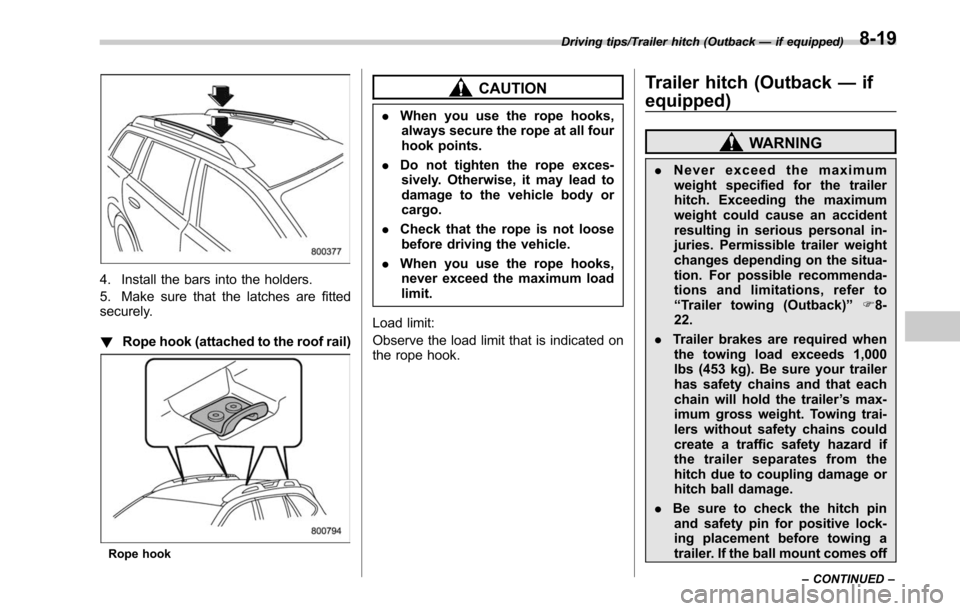
4. Install the bars into the holders.
5. Make sure that the latches are fitted
securely.
!Rope hook (attached to the roof rail)
Rope hook
CAUTION
.When you use the rope hooks,
always secure the rope at all four
hook points.
. Do not tighten the rope exces-
sively. Otherwise, it may lead to
damage to the vehicle body or
cargo.
. Check that the rope is not loose
before driving the vehicle.
. When you use the rope hooks,
never exceed the maximum load
limit.
Load limit:
Observe the load limit that is indicated on
the rope hook.
Trailer hitch (Outback —if
equipped)
WARNING
. Never exceed the maximum
weight specified for the trailer
hitch. Exceeding the maximum
weight could cause an accident
resulting in serious personal in-
juries. Permissible trailer weight
changes depending on the situa-
tion. For possible recommenda-
tions and limitations, refer to
“ Trailer towing (Outback) ”F8-
22.
. Trailer brakes are required when
the towing load exceeds 1,000
lbs (453 kg). Be sure your trailer
has safety chains and that each
chain will hold the trailer ’s max-
imum gross weight. Towing trai-
lers without safety chains could
create a traffic safety hazard if
the trailer separates from the
hitch due to coupling damage or
hitch ball damage.
. Be sure to check the hitch pin
and safety pin for positive lock-
ing placement before towing a
trailer. If the ball mount comes off
Driving tips/Trailer hitch (Outback —if equipped)
–CONTINUED –8-19
Page 470 of 610
ground.
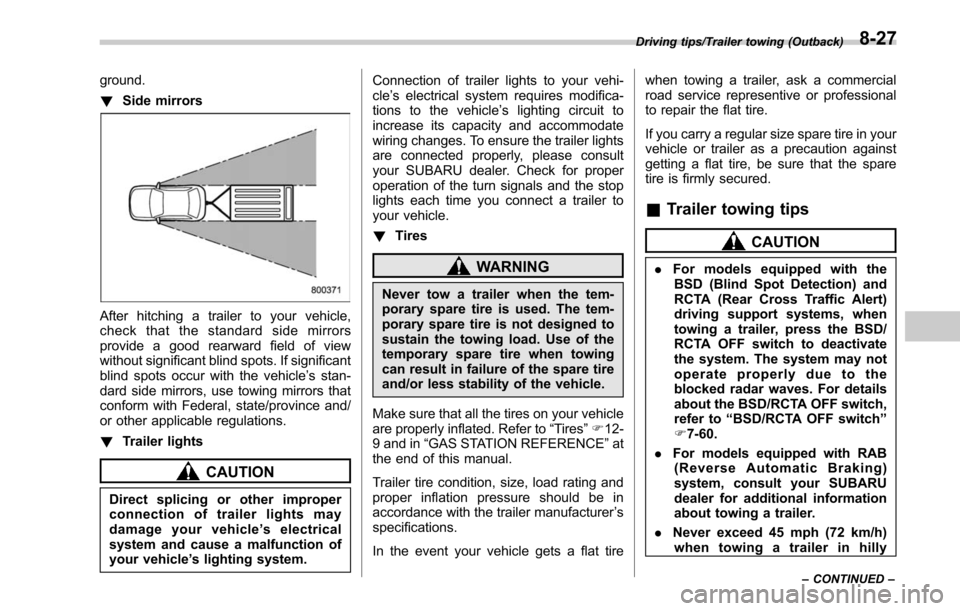
!Side mirrors
After hitching a trailer to your vehicle,
check that the standard side mirrors
provide a good rearward field of view
without significant blind spots. If significant
blind spots occur with the vehicle’ s stan-
dard side mirrors, use towing mirrors that
conform with Federal, state/province and/
or other applicable regulations.
! Trailer lights
CAUTION
Direct splicing or other improper
connection of trailer lights may
damage your vehicle ’s electrical
system and cause a malfunction of
your vehicle ’s lighting system. Connection of trailer lights to your vehi-
cle
’s electrical system requires modifica-
tions to the vehicle ’s lighting circuit to
increase its capacity and accommodate
wiring changes. To ensure the trailer lights
are connected properly, please consult
your SUBARU dealer. Check for proper
operation of the turn signals and the stop
lights each time you connect a trailer to
your vehicle.
! Tires
WARNING
Never tow a trailer when the tem-
porary spare tire is used. The tem-
porary spare tire is not designed to
sustain the towing load. Use of the
temporary spare tire when towing
can result in failure of the spare tire
and/or less stability of the vehicle.
Make sure that all the tires on your vehicle
are properly inflated. Refer to “Tires”F 12-
9 and in “GAS STATION REFERENCE ”at
the end of this manual.
Trailer tire condition, size, load rating and
proper inflation pressure should be in
accordance with the trailer manufacturer ’s
specifications.
In the event your vehicle gets a flat tire when towing a trailer, ask a commercial
road service representive or professional
to repair the flat tire.
If you carry a regular size spare tire in your
vehicle or trailer as a precaution against
getting a flat tire, be sure that the spare
tire is firmly secured.
&
Trailer towing tips
CAUTION
. For models equipped with the
BSD (Blind Spot Detection) and
RCTA (Rear Cross Traffic Alert)
driving support systems, when
towing a trailer, press the BSD/
RCTA OFF switch to deactivate
the system. The system may not
operate properly due to the
blocked radar waves. For details
about the BSD/RCTA OFF switch,
refer to “BSD/RCTA OFF switch ”
F 7-60.
. For models equipped with RAB
(Reverse Automatic Braking)
system, consult your SUBARU
dealer for additional information
about towing a trailer.
. Never exceed 45 mph (72 km/h)
when towing a trailer in hilly
Driving tips/Trailer towing (Outback)
–CONTINUED –8-27
Page 472 of 610
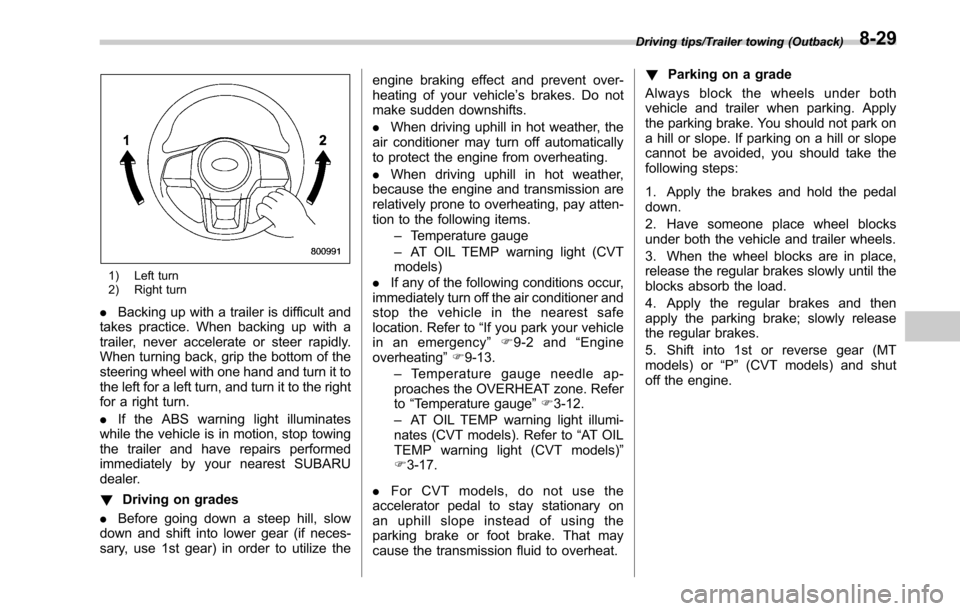
1) Left turn
2) Right turn
.Backing up with a trailer is difficult and
takes practice. When backing up with a
trailer, never accelerate or steer rapidly.
When turning back, grip the bottom of the
steering wheel with one hand and turn it to
the left for a left turn, and turn it to the right
for a right turn.
. If the ABS warning light illuminates
while the vehicle is in motion, stop towing
the trailer and have repairs performed
immediately by your nearest SUBARU
dealer.
! Driving on grades
. Before going down a steep hill, slow
down and shift into lower gear (if neces-
sary, use 1st gear) in order to utilize the engine braking effect and prevent over-
heating of your vehicle’
s brakes. Do not
make sudden downshifts.
. When driving uphill in hot weather, the
air conditioner may turn off automatically
to protect the engine from overheating.
. When driving uphill in hot weather,
because the engine and transmission are
relatively prone to overheating, pay atten-
tion to the following items.
–Temperature gauge
– AT OIL TEMP warning light (CVT
models)
. If any of the following conditions occur,
immediately turn off the air conditioner and
stop the vehicle in the nearest safe
location. Refer to “If you park your vehicle
in an emergency ”F9-2 and “Engine
overheating ”F 9-13.
– Temperature gauge needle ap-
proaches the OVERHEAT zone. Refer
to “Temperature gauge ”F 3-12.
– AT OIL TEMP warning light illumi-
nates (CVT models). Refer to “AT OIL
TEMP warning light (CVT models) ”
F 3-17.
. For CVT models, do not use the
accelerator pedal to stay stationary on
an uphill slope instead of using the
parking brake or foot brake. That may
cause the transmission fluid to overheat. !
Parking on a grade
Always block the wheels under both
vehicle and trailer when parking. Apply
the parking brake. You should not park on
a hill or slope. If parking on a hill or slope
cannot be avoided, you should take the
following steps:
1. Apply the brakes and hold the pedal
down.
2. Have someone place wheel blocks
under both the vehicle and trailer wheels.
3. When the wheel blocks are in place,
release the regular brakes slowly until the
blocks absorb the load.
4. Apply the regular brakes and then
apply the parking brake; slowly release
the regular brakes.
5. Shift into 1st or reverse gear (MT
models) or “P”(CVT models) and shut
off the engine.
Driving tips/Trailer towing (Outback)8-29
Page 474 of 610
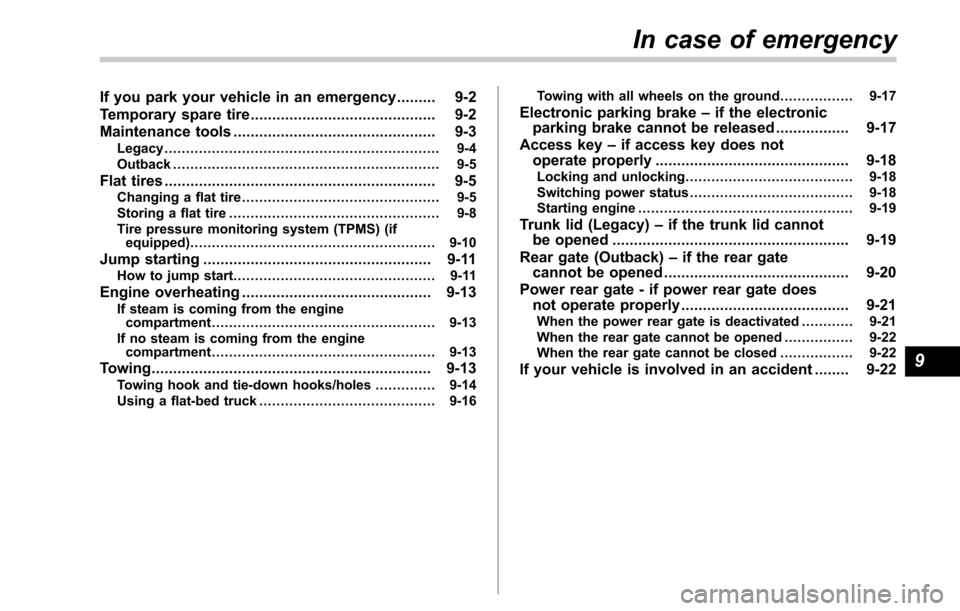
If you park your vehicle in an emergency......... 9-2
Temporary spare tire ........................................... 9-2
Maintenance tools ............................................... 9-3
Legacy................................................................ 9-4
Outback .............................................................. 9-5
Flat tires ............................................................... 9-5Changing a flat tire .............................................. 9-5
Storing a flat tire ................................................. 9-8
Tire pressure monitoring system (TPMS) (if equipped) ......................................................... 9-10
Jump starting ..................................................... 9-11How to jump start ............................................... 9-11
Engine overheating ............................................ 9-13
If steam is coming from the engine
compartment .................................................... 9-13
If no steam is coming from the engine compartment .................................................... 9-13
Towing................................................................. 9-13Towing hook and tie-down hooks/holes .. ............ 9-14
Using a flat-bed truck ......................................... 9-16 Towing with all wheels on the ground
................. 9-17
Electronic parking brake–if the electronic
parking brake cannot be released ................. 9-17
Access key –if access key does not
operate properly ............................................. 9-18
Locking and unlocking ....................................... 9-18
Switching power status ...................................... 9-18
Starting engine .................................................. 9-19
Trunk lid (Legacy) –if the trunk lid cannot
be opened ....................................................... 9-19
Rear gate (Outback) –if the rear gate
cannot be opened ........................................... 9-20
Power rear gate - if power rear gate does not operate properly ....................................... 9-21
When the power rear gate is deactivated ............ 9-21
When the rear gate cannot be opened ................ 9-22
When the rear gate cannot be closed ................. 9-22
If your vehicle is involved in an accident ........ 9-22
In case of emergency
9
Page 479 of 610
In case of emergency/Flat tires
.Always turn off the engine before
raising the flat tire off the ground
using the jack. Never swing or
push the vehicle supported with
the jack. The jack can come out
of the jacking point due to a jolt
and this can result in a serious
accident.
1. Park on a hard, level surface, when-
ever possible, then stop the engine.
2. Apply the parking brake and shift the
shift lever in reverse (MT models) or the
select lever in the “P”(Park) position (CVT
models).
3. Turn on the hazard warning flasher
and unload all occupants and luggage
from the vehicle.
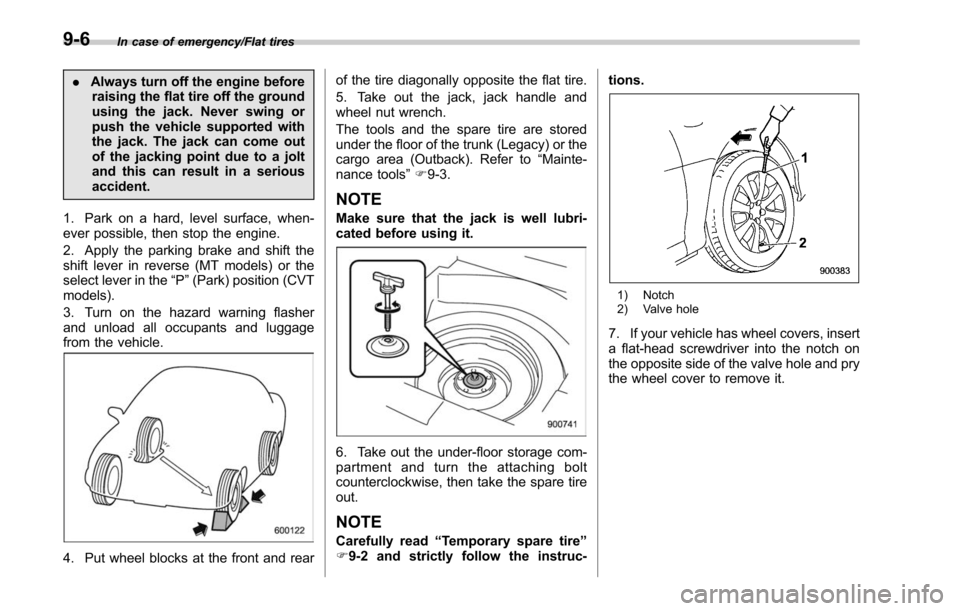
4. Put wheel blocks at the front and rear of the tire diagonally opposite the flat tire.
5. Take out the jack, jack handle and
wheel nut wrench.
The tools and the spare tire are stored
under the floor of the trunk (Legacy) or the
cargo area (Outback). Refer to
“Mainte-
nance tools ”F 9-3.
NOTE
Make sure that the jack is well lubri-
cated before using it.
6. Take out the under-floor storage com-
partment and turn the attaching bolt
counterclockwise, then take the spare tire
out.
NOTE
Carefully read “Temporary spare tire ”
F 9-2 and strictly follow the instruc- tions.
1) Notch
2) Valve hole
7. If your vehicle has wheel covers, insert
a flat-head screwdriver into the notch on
the opposite side of the valve hole and pry
the wheel cover to remove it.
9-6
Page 481 of 610
In case of emergency/Flat tires
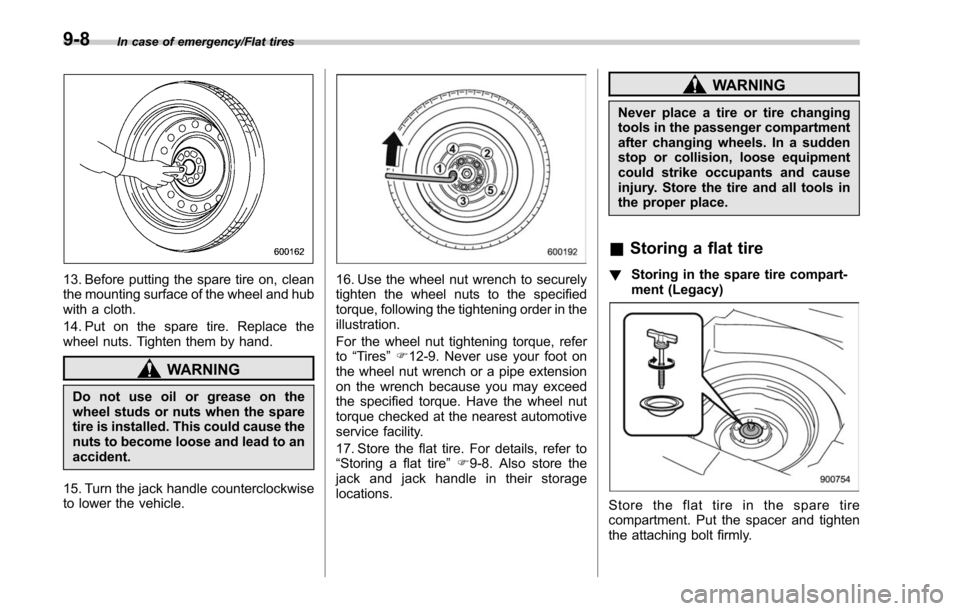
13. Before putting the spare tire on, clean
the mounting surface of the wheel and hub
with a cloth.
14. Put on the spare tire. Replace the
wheel nuts. Tighten them by hand.
WARNING
Do not use oil or grease on the
wheel studs or nuts when the spare
tire is installed. This could cause the
nuts to become loose and lead to an
accident.
15. Turn the jack handle counterclockwise
to lower the vehicle.
16. Use the wheel nut wrench to securely
tighten the wheel nuts to the specified
torque, following the tightening order in the
illustration.
For the wheel nut tightening torque, refer
to “Tires ”F 12-9. Never use your foot on
the wheel nut wrench or a pipe extension
on the wrench because you may exceed
the specified torque. Have the wheel nut
torque checked at the nearest automotive
service facility.
17. Store the flat tire. For details, refer to
“Storing a flat tire ”F 9-8. Also store the
jack and jack handle in their storage
locations.
WARNING
Never place a tire or tire changing
tools in the passenger compartment
after changing wheels. In a sudden
stop or collision, loose equipment
could strike occupants and cause
injury. Store the tire and all tools in
the proper place.
& Storing a flat tire
! Storing in the spare tire compart-
ment (Legacy)
Store the flat tire in the spare tire
compartment. Put the spacer and tighten
the attaching bolt firmly.
9-8
Page 486 of 610
Engine overheating
WARNING
Never attempt to remove the radia-
tor cap until the engine has been
shut off and has fully cooled down.
When the engine is hot, the coolant
is under pressure. Removing the
cap while the engine is still hot
could release a spray of boiling hot
coolant, which could burn you very
seriously.
If the engine overheats, pull off the road
safely and stop the vehicle in a safe place.
& If steam is coming from the
engine compartment
Turn off the engine and get everyone
away from the vehicle until it cools down.
&If no steam is coming from
the engine compartment
NOTE
For details about how to check the
coolant level or how to add coolant,
refer to “Engine coolant ”F 11-15.
1. Keep the engine running at idling
speed. 2. Open the hood to ventilate the engine
compartment. Refer to
“Engine hood ”
F 11-7.
Confirm that the cooling fan is turning. If
the fan is not turning, immediately turn off
the engine and contact your authorized
dealer for repair.
3. After the engine coolant temperature
has dropped, turn off the engine.
If the temperature gauge stays in the
overheated zone, turn off the engine.
4. After the engine has fully cooled down,
check the coolant level in the reserve
tank.
If the coolant level is below the “LOW”
mark, add coolant up to the “FULL ”mark.
5. If there is no coolant in the reserve
tank, add coolant to the reserve tank.
Then remove the radiator cap and fill the
radiator with coolant.
If you remove the radiator cap from a hot
radiator, first wrap a thick cloth around the
radiator cap, then turn the cap counter-
clockwise slowly without pressing down
until it stops. Release the pressure from
the radiator. After the pressure has been
fully released, remove the cap by pressing
down and turning it.
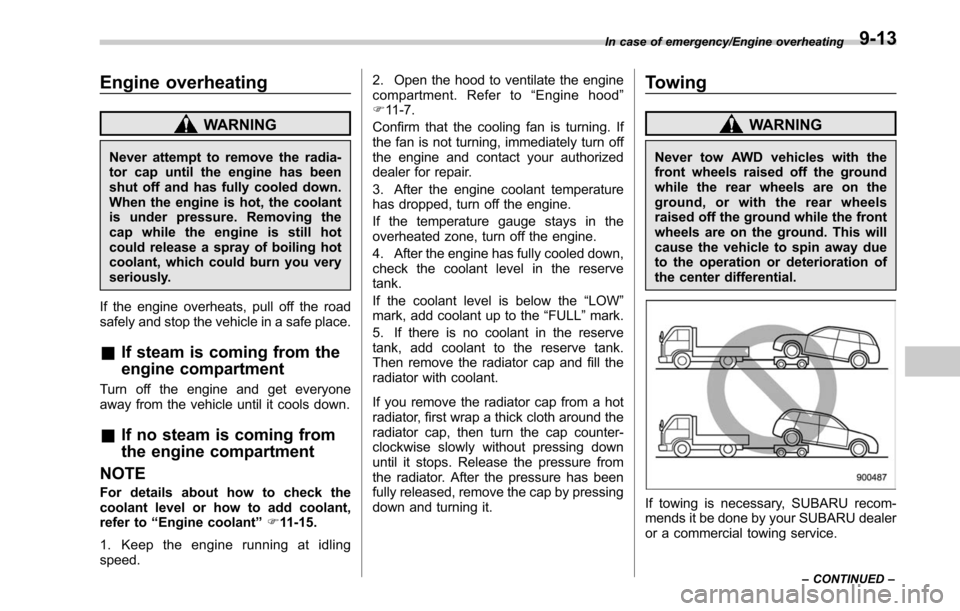
Towing
WARNING
Never tow AWD vehicles with the
front wheels raised off the ground
while the rear wheels are on the
ground, or with the rear wheels
raised off the ground while the front
wheels are on the ground. This will
cause the vehicle to spin away due
to the operation or deterioration of
the center differential.
If towing is necessary, SUBARU recom-
mends it be done by your SUBARU dealer
or a commercial towing service.
In case of emergency/Engine overheating
–CONTINUED –9-13
Page 490 of 610
the shift lever into the“1st”position.
2. Apply the parking brake firmly.
3. Secure the vehicle onto the carrier
properly with safety chains. Each safety
chain should be equally tightened and
care must be taken not to pull the chains
so tightly that the suspension bottoms out.
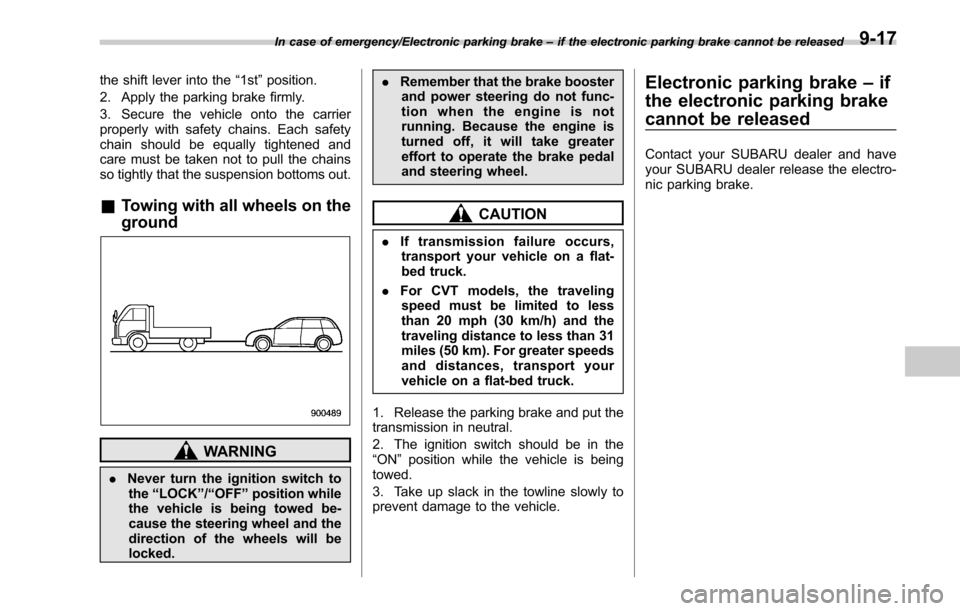
& Towing with all wheels on the
ground
WARNING
. Never turn the ignition switch to
the “LOCK ”/“ OFF ”position while
the vehicle is being towed be-
cause the steering wheel and the
direction of the wheels will be
locked. .
Remember that the brake booster
and power steering do not func-
tion when the engine is not
running. Because the engine is
turned off, it will take greater
effort to operate the brake pedal
and steering wheel.
CAUTION
. If transmission failure occurs,
transport your vehicle on a flat-
bed truck.
. For CVT models, the traveling
speed must be limited to less
than 20 mph (30 km/h) and the
traveling distance to less than 31
miles (50 km). For greater speeds
and distances, transport your
vehicle on a flat-bed truck.
1. Release the parking brake and put the
transmission in neutral.
2. The ignition switch should be in the
“ON ”position while the vehicle is being
towed.
3. Take up slack in the towline slowly to
prevent damage to the vehicle.
Electronic parking brake –if
the electronic parking brake
cannot be released
Contact your SUBARU dealer and have
your SUBARU dealer release the electro-
nic parking brake.
In case of emergency/Electronic parking brake –if the electronic parking brake cannot be released9-17
Page 491 of 610
In case of emergency/Access key–if access key does not operate properly
Access key –if access key
does not operate properly
CAUTION
Keep metallic objects, magnetic
sources and signal transmitters
away from the area between the
access key and the push-button
ignition switch. They may interfere
with the communication between
the access key and the push-button
ignition switch.
The following functions may be inoperable
because of strong radio signals in the
surrounding area or a low battery condi-
tion of the access key.
. Locking/unlocking doors including rear
gate
. Switching power status
. Starting engine
In such cases, perform the following
procedure. When the battery of the access
key is discharged, replace it with a new
one. Refer to “Replacing battery of access
key ”F 11-50.
& Locking and unlocking
1) Release button
2) Mechanical key
While pressing the release button of the
access key, take out the mechanical key.
Lock or unlock the driver ’s door with the
mechanical key in the procedure de-
scribed in “Locking and unlocking from
the outside ”F 2-6.
NOTE
After locking or unlocking, be sure to
attach the mechanical key back to the
access key.
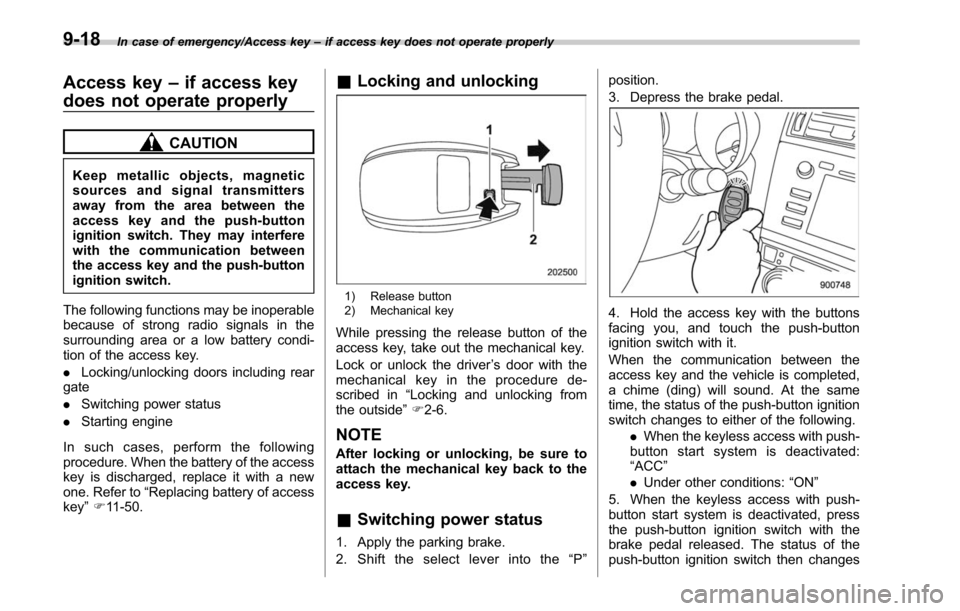
& Switching power status
1. Apply the parking brake.
2. Shift the select lever into the “P ” position.
3. Depress the brake pedal.
4. Hold the access key with the buttons
facing you, and touch the push-button
ignition switch with it.
When the communication between the
access key and the vehicle is completed,
a chime (ding) will sound. At the same
time, the status of the push-button ignition
switch changes to either of the following.
.When the keyless access with push-
button start system is deactivated:
“ACC ”
. Under other conditions: “ON ”
5. When the keyless access with push-
button start system is deactivated, press
the push-button ignition switch with the
brake pedal released. The status of the
push-button ignition switch then changes
9-18