si DRIVE SUBARU OUTBACK 2017 6.G Owners Manual
[x] Cancel search | Manufacturer: SUBARU, Model Year: 2017, Model line: OUTBACK, Model: SUBARU OUTBACK 2017 6.GPages: 610, PDF Size: 10.28 MB
Page 537 of 610
Maintenance and service/Replacement of wiper blades
.Return the passenger-side wiper
arm to its original position before
returning the driver-side wiper
arm to its original position.
Otherwise, the passenger-side
wiper assembly and driver-side
wiper assembly will touch each
other, possibly resulting in
scratches.
. When returning the raised wipers
to the original positions, return
the wipers slowly on the wind-
shield by hand. Returning the
wipers from the detached posi-
tions by the spring operation
might change the shape of the
wiper arm or scratch the wind-
shield.
If you cannot eliminate the streaking even
after following this method, replace the
wiper blades using the following proce-
dures.& Windshield wiper blade as-
sembly
NOTE
Do not lower the wiper arm while the
wiper blade assembly is removed.
1. Raise the wiper arm off the windshield.
First raise the driver ’s side wiper arm and
then raise the front passenger ’s side wiper
arm.
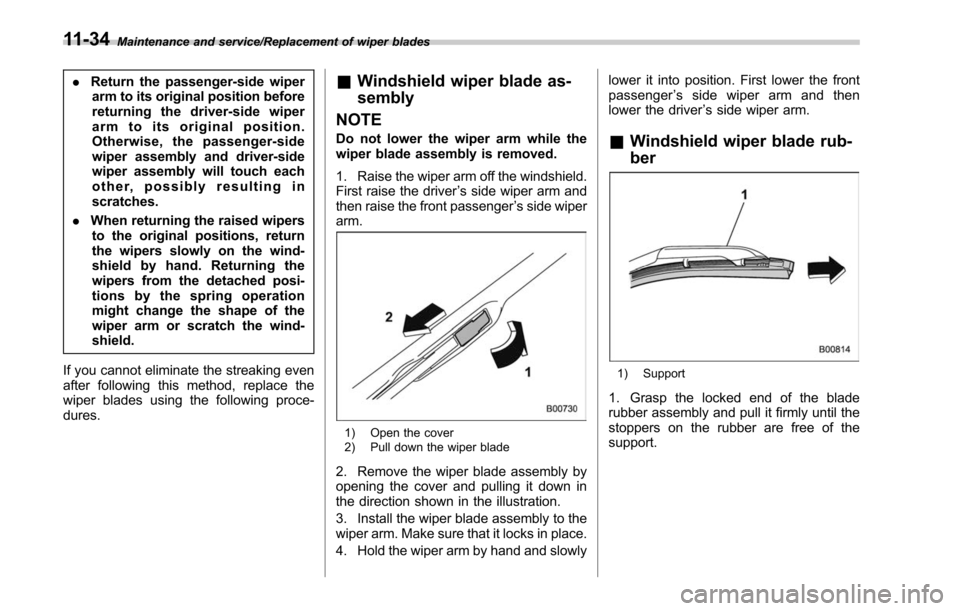
1) Open the cover
2) Pull down the wiper blade
2. Remove the wiper blade assembly by
opening the cover and pulling it down in
the direction shown in the illustration.
3. Install the wiper blade assembly to the
wiper arm. Make sure that it locks in place.
4. Hold the wiper arm by hand and slowly lower it into position. First lower the front
passenger
’s side wiper arm and then
lower the driver ’s side wiper arm.
& Windshield wiper blade rub-
ber
1) Support
1. Grasp the locked end of the blade
rubber assembly and pull it firmly until the
stoppers on the rubber are free of the
support.
11-34
Page 541 of 610
Maintenance and service/Fuses
remove rings, metal watchbands,
and other metal jewelry. Never
allow metal tools to contact the
positive battery terminal and any-
thing connected to it WHILE you
are at the same time in contact
with any other metallic portion of
the vehicle because a short cir-
cuit will result.
. Keep everyone including children
away from the battery.
. Charge the battery in a well-
ventilated area.
. Battery posts, terminals, and re-
lated accessories contain lead
and lead compounds, chemicals
known to the State of California
to cause cancer and reproductive
harm. Batteries also contain
other chemicals known to the
State of California to cause can-
cer. Wash hands after handling.CAUTION
Never use more than 10 amperes
when charging the battery because
it will shorten battery life.
It is unnecessary to periodically check the
battery fluid level or periodically refill with
distilled water.
Fuses
CAUTION
Never replace a fuse with one hav-
ing a higher rating or with material
other than a fuse because serious
damage or a fire could result.
The fuses are designed to melt during an
overload to prevent damage to the wiring
harness and electrical equipment. The
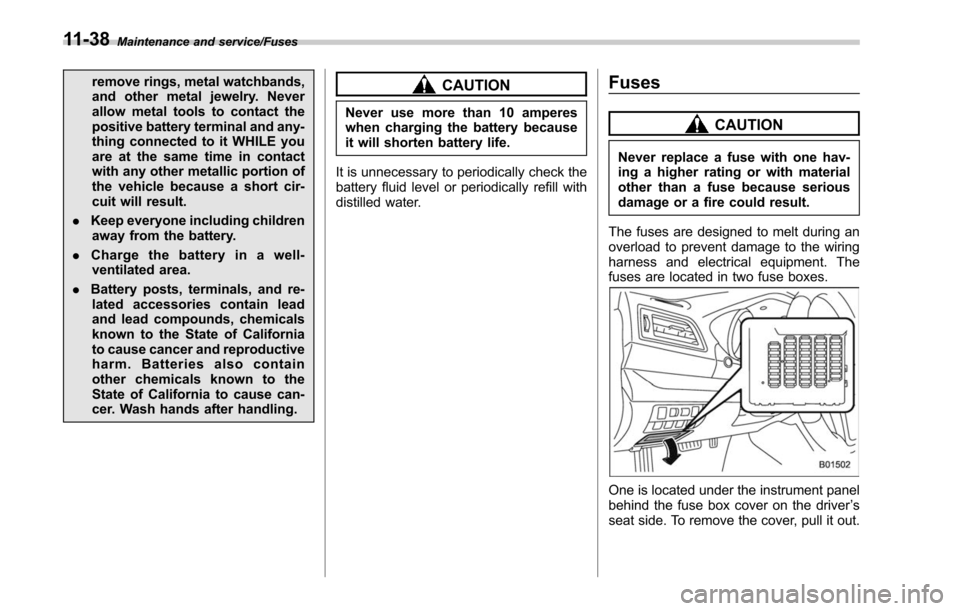
fuses are located in two fuse boxes.
One is located under the instrument panel
behind the fuse box cover on the driver ’s
seat side. To remove the cover, pull it out.
11-38
Page 549 of 610
Maintenance and service/Replacing bulbs
&Backup light
! Legacy
NOTE
It may be difficult to replace the bulbs.
We recommend that you have the bulbs
replaced by your SUBARU dealer if
necessary.
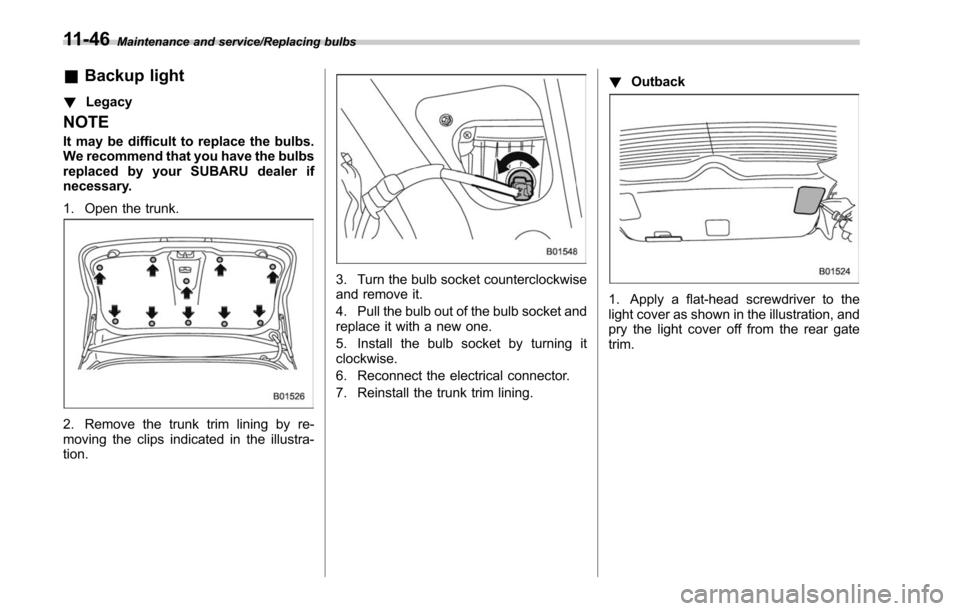
1. Open the trunk.
2. Remove the trunk trim lining by re-
moving the clips indicated in the illustra-
tion.
3. Turn the bulb socket counterclockwise
and remove it.
4. Pull the bulb out of the bulb socket and
replace it with a new one.
5. Install the bulb socket by turning it
clockwise.
6. Reconnect the electrical connector.
7. Reinstall the trunk trim lining. !
Outback
1. Apply a flat-head screwdriver to the
light cover as shown in the illustration, and
pry the light cover off from the rear gate
trim.
11-46
Page 551 of 610
Maintenance and service/Replacing bulbs
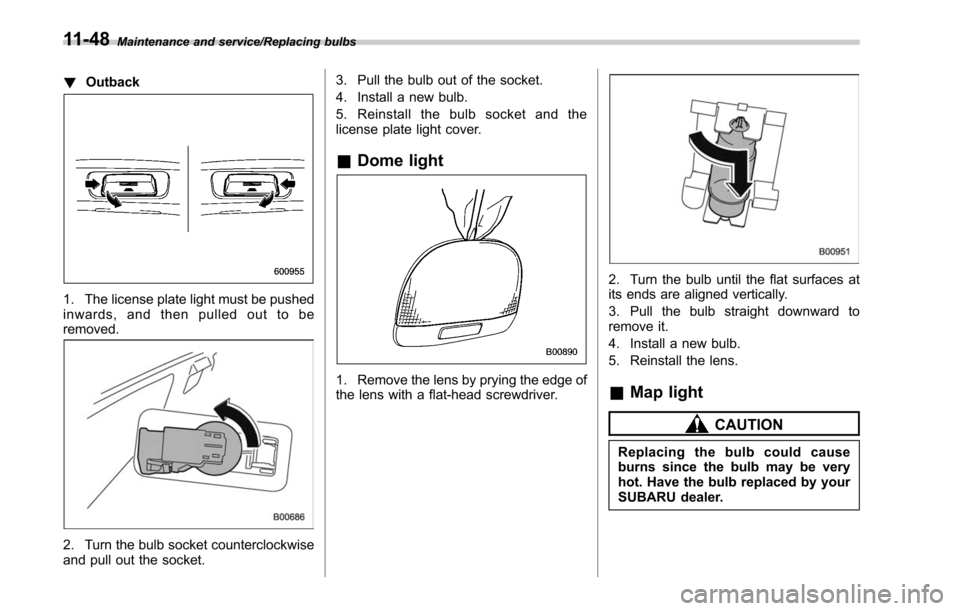
!Outback
1. The license plate light must be pushed
inwards, and then pulled out to be
removed.
2. Turn the bulb socket counterclockwise
and pull out the socket. 3. Pull the bulb out of the socket.
4. Install a new bulb.
5. Reinstall the bulb socket and the
license plate light cover.
&
Dome light
1. Remove the lens by prying the edge of
the lens with a flat-head screwdriver.
2. Turn the bulb until the flat surfaces at
its ends are aligned vertically.
3. Pull the bulb straight downward to
remove it.
4. Install a new bulb.
5. Reinstall the lens.
&Map light
CAUTION
Replacing the bulb could cause
burns since the bulb may be very
hot. Have the bulb replaced by your
SUBARU dealer.
11-48
Page 552 of 610
&Door step light
CAUTION
Replacing the bulb could cause a
short circuit. Have the bulb replaced
by your SUBARU dealer.
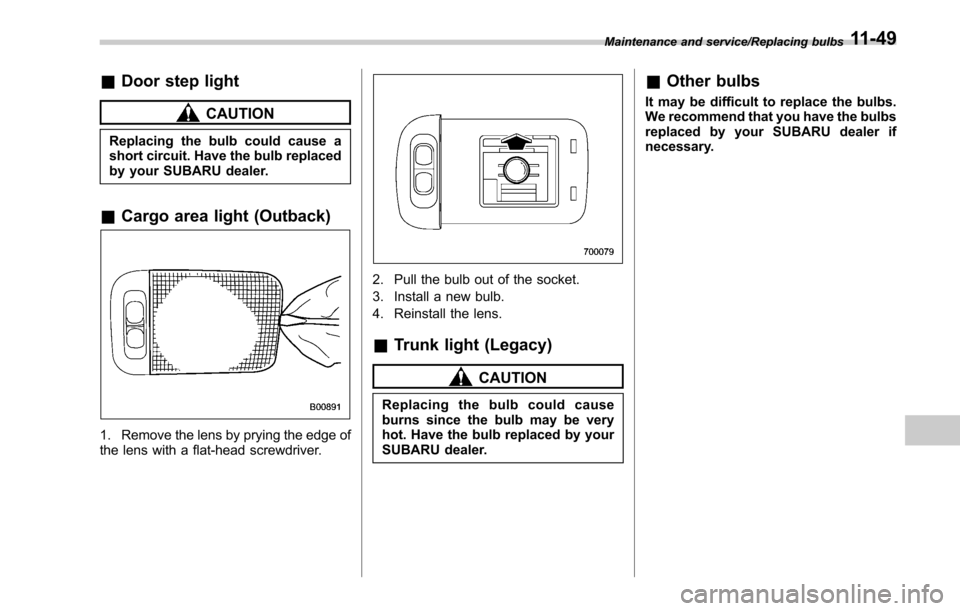
&Cargo area light (Outback)
1. Remove the lens by prying the edge of
the lens with a flat-head screwdriver.
2. Pull the bulb out of the socket.
3. Install a new bulb.
4. Reinstall the lens.
&Trunk light (Legacy)
CAUTION
Replacing the bulb could cause
burns since the bulb may be very
hot. Have the bulb replaced by your
SUBARU dealer.
&Other bulbs
It may be difficult to replace the bulbs.
We recommend that you have the bulbs
replaced by your SUBARU dealer if
necessary.
Maintenance and service/Replacing bulbs11-49
Page 554 of 610

2. Wrap a flat-head screwdriver with vinyl
tape or a cloth, and insert it in the gap to
remove the cover.
3. Take out the battery using a flat-head
screwdriver with vinyl tape or a cloth.
4. Insert a new battery with its positive (+)
side facing upward as shown in the figure.
5. Attach the cover to the access key by
fitting the projections and recesses to-
gether.
&Replacing battery of trans-
mitter
1. Open the key head using a flat-head
screwdriver.
2. Remove the transmitter case from the
Maintenance and service/Replacing battery
–CONTINUED –11-51
Page 557 of 610
Specifications/Specifications
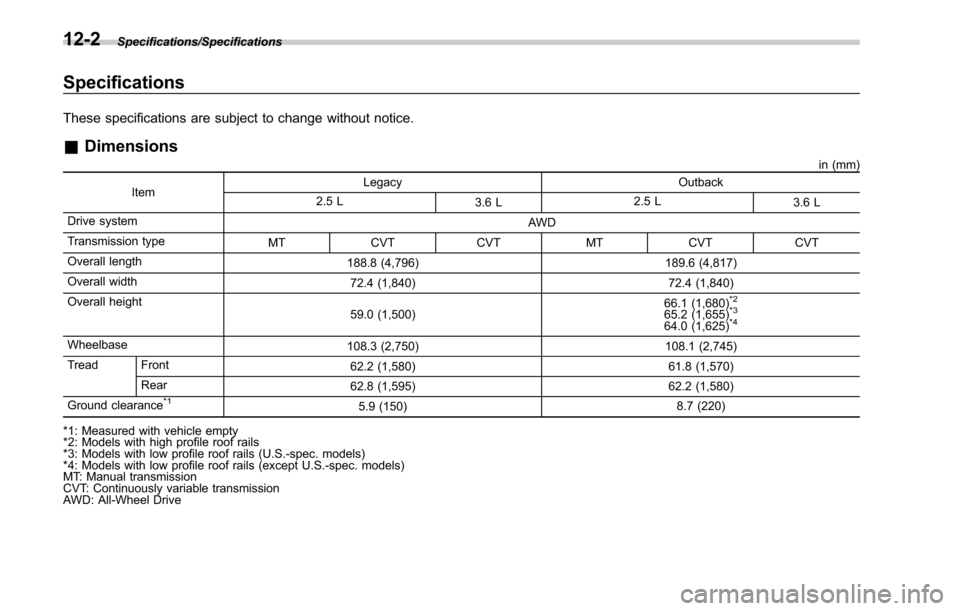
Specifications
These specifications are subject to change without notice.
&Dimensions
in (mm)
Item Legacy Outback
2.5 L 3.6 L 2.5 L
3.6 L
Drive system AWD
Transmission type MT CVT CVT MT CVT CVT
Overall length 188.8 (4,796) 189.6 (4,817)
Overall width 72.4 (1,840) 72.4 (1,840)
Overall height 59.0 (1,500) 66.1 (1,680)
*2
65.2 (1,655)*3
64.0 (1,625)*4
Wheelbase
108.3 (2,750) 108.1 (2,745)
Tread Front 62.2 (1,580) 61.8 (1,570)
Rear 62.8 (1,595) 62.2 (1,580)
Ground clearance
*15.9 (150) 8.7 (220)
*1: Measured with vehicle empty
*2: Models with high profile roof rails
*3: Models with low profile roof rails (U.S.-spec. models)
*4: Models with low profile roof rails (except U.S.-spec. models)
MT: Manual transmission
CVT: Continuously variable transmission
AWD: All-Wheel Drive
12-2
Page 562 of 610
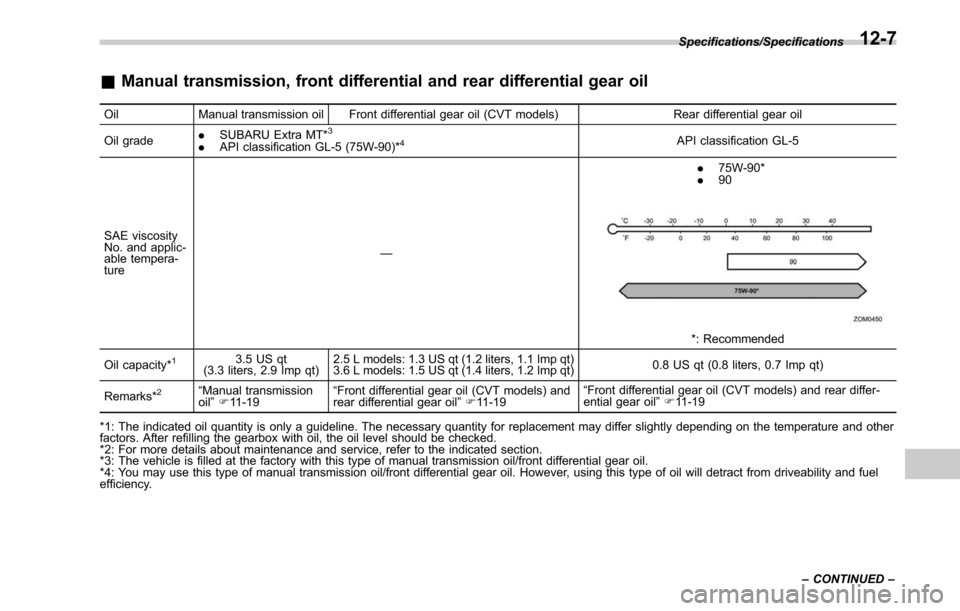
&Manual transmission, front differential and rear differential gear oil
Oil Manual transmission oil Front differential gear oil (CVT models) Rear differential gear oil
Oil grade .
SUBARU Extra MT*3
.API classification GL-5 (75W-90)*4API classification GL-5
SAE viscosity
No. and applic-
able tempera-
ture — .
75W-90*
. 90
*: Recommended
Oil capacity*
13.5 US qt
(3.3 liters, 2.9 Imp qt) 2.5 L models: 1.3 US qt (1.2 liters, 1.1 Imp qt)
3.6 L models: 1.5 US qt (1.4 liters, 1.2 Imp qt)
0.8 US qt (0.8 liters, 0.7 Imp qt)
Remarks*
2“ Manual transmission
oil ”F 11-19 “
Front differential gear oil (CVT models) and
rear differential gear oil ”F 11-19 “
Front differential gear oil (CVT models) and rear differ-
ential gear oil ”F 11-19
*1: The indicated oil quantity is only a guideline. The necessary quantity for replacement may differ slightly depending on the temperature and other
factors. After refilling the gearbox with oil, the oil level should be checked.
*2: For more details about maintenance and service, refer to the indicated section.
*3: The vehicle is filled at the factory with this type of manual transmission oil/front differential gear oil.
*4: You may use this type of manual transmission oil/front differential gear oil. However, using this type of oil will detract from driveability and fuel
efficiency. Specifications/Specifications
–CONTINUED –
12-7
Page 577 of 610
Consumer information and Reporting safety defects/Tire information
!Maximum load rating
The load rating at the maximum
permissible weight load for this tire.
For example, “MAX. LOAD 615 kg
(1,356 LBS) @ 350 kPa (51 PSI)
MAX. PRESS. ”
WARNING
Maximum load rating applies
only to the tire, not to the
vehicle. Putting a load rated
tire on any vehicle does not
mean the vehicle can be
loaded up to the tire ’s rated
load.
! Construction type
Applicable construction of this tire.
For example, “TUBELESS STEEL
BELTED RADIAL”
! Construction
The generic name of each cord
material used in the plies (both
sidewall and tread area) of this tire.
For example, “PLIES: TREAD 2 STEEL + 2 POLYESTER + 1
NYLON SIDEWALL 2 POLYE-
STER
”
!Uniform Tire Quality Grading
(UTQG)
For details, refer to “Uniform tire
quality grading standards ”F 13-14.
& Recommended tire inflation
pressure
! Recommended cold tire infla-
tion pressure
For the recommended cold tire
inflation pressure for your vehicle ’s
tires, refer to “Tires ”F 12-9.
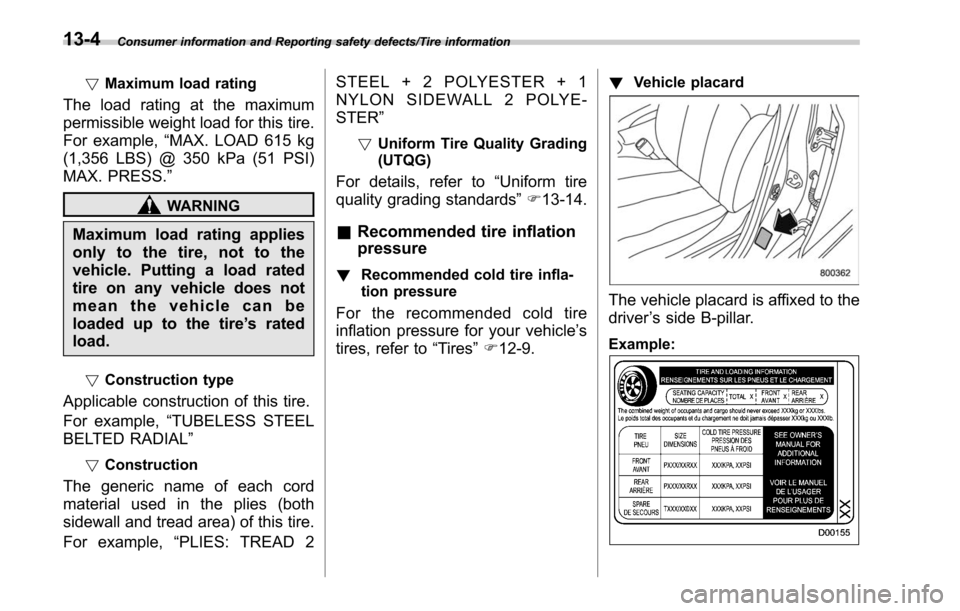
! Vehicle placard
The vehicle placard is affixed to the
driver ’s side B-pillar.
Example:
13-4
Page 578 of 610
The vehicle placard shows original
tire size, recommended cold tire
inflation pressure on each tire at
maximum loaded vehicle weight,
seating capacity and loading infor-
mation.
!Adverse safety consequences
of under-inflation
Driving at high speeds with exces-
sively low tire pressures can cause
the tires to flex severely and to
rapidly become hot. A sharp in-
crease in temperature could cause
tread separation, and failure of the
tire(s). Possible resulting loss of
vehicle control could lead to an
accident.
!Measuring and adjusting air
pressure to achieve proper in-
flation
Check and, if necessary, adjust the
pressure of each tire (including the
spare) at least once a month and
before any long journey. Check the
tire pressures when the tires are
cold. Use a pressure gauge to
adjust the tire pressures to the specific values. Driving even a
short distance warms up the tires
and increases the tire pressures.
Also, the tire pressures are affected
by the outside temperature. It is
best to check tire pressure out-
doors before driving the vehicle.
When a tire becomes warm, the air
inside it expands, causing the tire
pressure to increase. Be careful not
to mistakenly release air from a
warm tire to reduce its pressure.
&
Glossary of tire terminology
.Accessory weight
The combined weight (in excess of
those standard items which may be
replaced) of automatic transmis-
sion, power steering, power brakes,
power windows, power seats, radio,
and heater, to the extent that these
items are available as factory-in-
stalled equipment (whether in-
stalled or not).
.Bead
The part of the tire that is made of
steel wires, wrapped or reinforced by ply cords and that is shaped to fit
the rim.
.Bead separation
A breakdown of the bond between
components in the bead.
.Bias ply tire
A pneumatic tire in which the ply
cords that extend to the beads are
laid at alternate angles substantially
less than 90 degrees to the center-
line of the tread.
.Carcass
The tire structure, except tread and
sidewall rubber which, when in-
flated, bears the load.
.Chunking
The breaking away of pieces of the
tread or sidewall.
.Cold tire pressure
The pressure in a tire that has been
driven less than 1 mile or has been
standing for three hours or more.
.Cord
The strands forming the plies in the
tire.
.Cord separation
The parting of cords from adjacent
Consumer information and Reporting safety defects/Tire information
–CONTINUED –13-5