brake fluid SUBARU OUTBACK 2017 6.G User Guide
[x] Cancel search | Manufacturer: SUBARU, Model Year: 2017, Model line: OUTBACK, Model: SUBARU OUTBACK 2017 6.GPages: 610, PDF Size: 10.28 MB
Page 452 of 610
SUBARU Windshield Washer Fluid con-
tains 58.5% methyl alcohol and 41.5%
surfactant, by volume. Its freezing tem-
perature varies according to how much it
is diluted, as indicated in the following
table.
Washer Fluid Con-centration Freezing Temperature
30% 10.4 8F( −12 8C)
50% −48F( −20 8C)
100% −49
8F( −45 8C)
In order to prevent freezing of washer
fluid, check the freezing temperatures in
the table above when adjusting the fluid
concentration to the outside temperature.
If you fill the reservoir tank with a fluid with
a different concentration from the one
used previously, purge the old fluid from
the piping between the reservoir tank and
washer nozzles by operating the washer
for a certain period of time. Otherwise, if
the concentration of the fluid remaining in
thepipingistoolowfortheoutside
temperature, it may freeze and block the
nozzles.
CAUTION
. Adjust the washer fluid concen-
tration appropriately for the out- side temperature. If the concen-
tration is inappropriate, sprayed
washer fluid may freeze on the
windshield and obstruct your
view, and the fluid may freeze in
the reservoir tank.
. State or local regulations on
volatile organic compounds may
restrict the use of methanol, a
common windshield washer anti-
freeze additive. Washer fluids
containing non-methanol anti-
freeze agents should be used
only if they provide cold weather
protection without damaging
your vehicle ’s paint, wiper blades
or washer system.
! Before driving your vehicle
Before entering the vehicle, remove any
snow or ice from your shoes because that
could make the pedals slippery and
driving dangerous.
While warming up the vehicle before
driving, check that the accelerator pedal,
brake pedal, and all other controls operate
smoothly.
Clear away ice and snow that has
accumulated under the fenders to avoid
making steering difficult. During severe winter driving, stop when and where it is
safe to do so and check under the fenders
periodically.
!
Parking in cold weather
WARNING
Snow can trap dangerous exhaust
gases under your vehicle. Keep
snow clear of the exhaust pipe and
from around your vehicle if you park
the vehicle in snow with the engine
running.
CAUTION
.Do not use the parking brake
when parking for long periods in
cold weather since it could freeze
in that position.
. When the vehicle is parked in
snow or when it snows, raise the
wiper blades off the glass to
prevent damage to them.
. Under either of the following
conditions, icing may develop
on the brake system, which could
cause poor braking action.
– When the vehicle has been left
parked after use on roads
heavily covered with snow
Driving tips/Winter driving
–CONTINUED –8-9
Page 472 of 610
1) Left turn
2) Right turn
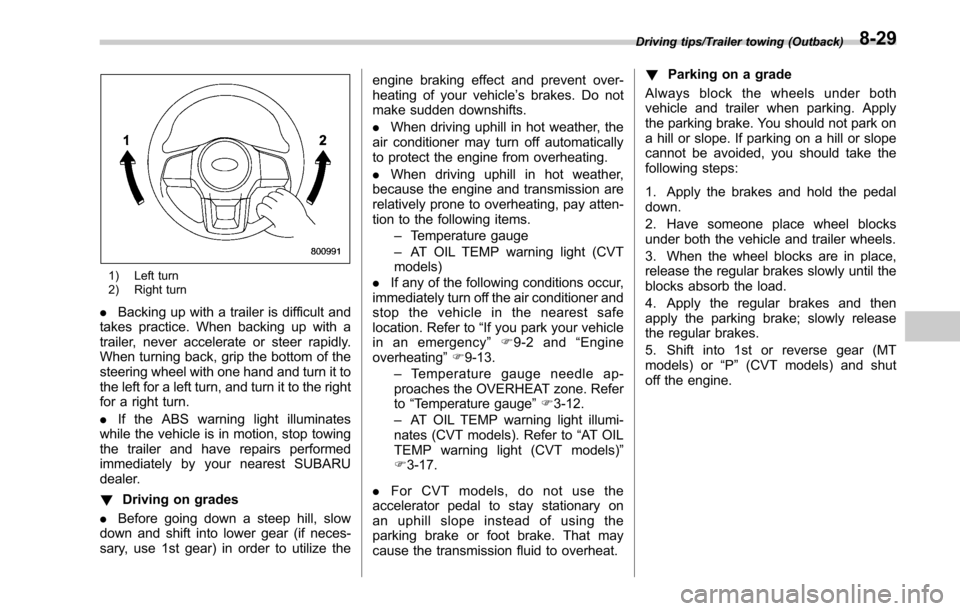
.Backing up with a trailer is difficult and
takes practice. When backing up with a
trailer, never accelerate or steer rapidly.
When turning back, grip the bottom of the
steering wheel with one hand and turn it to
the left for a left turn, and turn it to the right
for a right turn.
. If the ABS warning light illuminates
while the vehicle is in motion, stop towing
the trailer and have repairs performed
immediately by your nearest SUBARU
dealer.
! Driving on grades
. Before going down a steep hill, slow
down and shift into lower gear (if neces-
sary, use 1st gear) in order to utilize the engine braking effect and prevent over-
heating of your vehicle’
s brakes. Do not
make sudden downshifts.
. When driving uphill in hot weather, the
air conditioner may turn off automatically
to protect the engine from overheating.
. When driving uphill in hot weather,
because the engine and transmission are
relatively prone to overheating, pay atten-
tion to the following items.
–Temperature gauge
– AT OIL TEMP warning light (CVT
models)
. If any of the following conditions occur,
immediately turn off the air conditioner and
stop the vehicle in the nearest safe
location. Refer to “If you park your vehicle
in an emergency ”F9-2 and “Engine
overheating ”F 9-13.
– Temperature gauge needle ap-
proaches the OVERHEAT zone. Refer
to “Temperature gauge ”F 3-12.
– AT OIL TEMP warning light illumi-
nates (CVT models). Refer to “AT OIL
TEMP warning light (CVT models) ”
F 3-17.
. For CVT models, do not use the
accelerator pedal to stay stationary on
an uphill slope instead of using the
parking brake or foot brake. That may
cause the transmission fluid to overheat. !
Parking on a grade
Always block the wheels under both
vehicle and trailer when parking. Apply
the parking brake. You should not park on
a hill or slope. If parking on a hill or slope
cannot be avoided, you should take the
following steps:
1. Apply the brakes and hold the pedal
down.
2. Have someone place wheel blocks
under both the vehicle and trailer wheels.
3. When the wheel blocks are in place,
release the regular brakes slowly until the
blocks absorb the load.
4. Apply the regular brakes and then
apply the parking brake; slowly release
the regular brakes.
5. Shift into 1st or reverse gear (MT
models) or “P”(CVT models) and shut
off the engine.
Driving tips/Trailer towing (Outback)8-29
Page 504 of 610
Maintenance schedule....................................... 11-3
Maintenance precautions ................................... 11-3
Before checking or servicing in the engine
compartment .................................................... 11-4
When checking or servicing in the engine compartment (2.5 L models) ............................. 11-5
When checking or servicing in the engine compartment while the engine is running .......... 11-5
Maintenance tips................................................ 11-5Removing and reinstalling clips .......................... 11-5
Engine hood....................................................... 11-7
Engine compartment overview .......................... 11-9
2.5 L models...................................................... 11-9
3.6 L models .................................................... 11-10
Engine oil.......................................................... 11-11Engine oil consumption .................................... 11-11
Checking the oil level ....................................... 11-11
Changing the oil and oil filter ............................ 11-13
Recommended grade and viscosity .................. 11-13
Synthetic oil ..................................................... 11-13
Cooling system ................................................ 11-14
Cooling fan, hose and connections ................... 11-14
Engine coolant ................................................. 11-15
Air cleaner element .......................................... 11-15Replacing the air cleaner element ..................... 11-16
Spark plugs...................................................... 11-18Recommended spark plugs .............................. 11-18
Drive belts........................................................ 11-18
Manual transmission oil .................................. 11-19
Recommended grade and viscosity .................. 11-19
Continuously variable transmission fluid ...... 11-19
Front differential gear oil (CVT models) and rear differential gear oil ................................ 11-19
Recommended grade and viscosity .................. 11-19
Brake fluid........................................................ 11-20Checking the fluid level .................................... 11-20
Recommended brake fluid ............................... 11-21
Clutch fluid (MT models)................................. 11-21Checking the fluid level.................................... 11-21
Recommended clutch fluid ............................... 11-22
Brake booster.................................................. 11-22
Brake pedal ...................................................... 11-23
Checking the brake pedal free play .................. 11-23
Checking the brake pedal reserve distance ....... 11-23
Clutch pedal (MT models) ............................... 11-23Checking the clutch function ............................ 11-23
Checking the clutch pedal free play .................. 11-24
Replacement of brake pad.............................. 11-24Breaking-in of new brake pads . ........................ 11-24
Tires and wheels.............................................. 11-25Types of tires................................................... 11-25
Tire pressure monitoring system (TPMS) (if equipped) ...................................................... 11-25
Tire inspection ................................................. 11-27
Tire pressures and wear .................................. 11-27
Wheel balance ................................................. 11-29
Wear indicators ............................................... 11-29
Tire rotation direction mark .............................. 11-29
Tire rotation ..................................................... 11-30
Tire replacement .............................................. 11-30
Maintenance and service
11
Page 507 of 610
Maintenance and service/Maintenance precautions
guard against getting oil or fluids
in your eyes. If something does
get in your eyes, thoroughly
wash them out with clean water.
. Do not tamper with the wiring of
the SRS airbag system or seat-
belt pretensioner system, or at-
tempt to take its connectors
apart, as that may activate the
system or it can render it inop-
erative. NEVER use a circuit
tester for these wiring. If your
SRS airbag or seatbelt preten-
sioner needs service, consult
your nearest SUBARU dealer.
NOTE
SUBARU does not endorse the use of
non-SUBARU approved flushing sys-
tems and strongly advises against
performing these services on a
SUBARU vehicle. Non-SUBARU ap-
proved flushing systems use chemi-
cals and/or solvents which have not
been tested or approved by SUBARU.
SUBARU warranties do not cover any
part of the vehicle which is damaged by
adding or applying chemicals and/or
solvents other than those approved or
recommended by SUBARU.
& Before checking or servicing
in the engine compartment
WARNING
. Always stop the engine and apply
the parking brake to prevent the
vehicle from moving.
. Always let the engine cool down.
Engine parts become very hot
when the engine is running and
remain hot for some time after
the engine is stopped.
. Do not spill engine oil, engine
coolant, brake fluid or any other
fluid on hot engine components.
This may cause a fire.
. When the ignition switch is in the
“ ON ”position, the cooling fan
may operate suddenly even
when the engine is stopped. If
your body or clothes come into
contact with a rotating fan, that
could result in serious injury. To
avoid risk of injury, perform the
following precautions.
– Models with push-button start
system:
Always turn the push-button
ignition switch to the “OFF ”
position and confirm that the operation indicator on the
switch is turned off. Then take
the access key out from the
vehicle.
– Models without push-button
start system:
Always remove the key from
the ignition switch.
. Before performing any servicing
on a vehicle equipped with a
remote engine start system tem-
porarily place that system in the
service mode to prevent it from
unexpectedly starting the engine.
11-4
Page 512 of 610
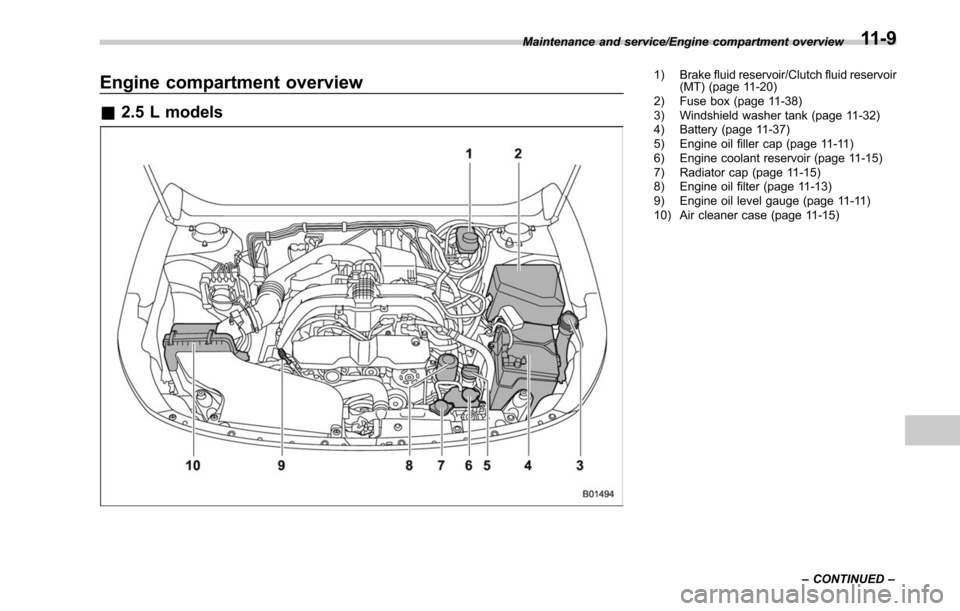
Engine compartment overview
&2.5 L models
1) Brake fluid reservoir/Clutch fluid reservoir
(MT) (page 11-20)
2) Fuse box (page 11-38)
3) Windshield washer tank (page 11-32)
4) Battery (page 11-37)
5) Engine oil filler cap (page 11-11)
6) Engine coolant reservoir (page 11-15)
7) Radiator cap (page 11-15)
8) Engine oil filter (page 11-13)
9) Engine oil level gauge (page 11-11)
10) Air cleaner case (page 11-15)
Maintenance and service/Engine compartment overview
–CONTINUED –
11-9
Page 513 of 610
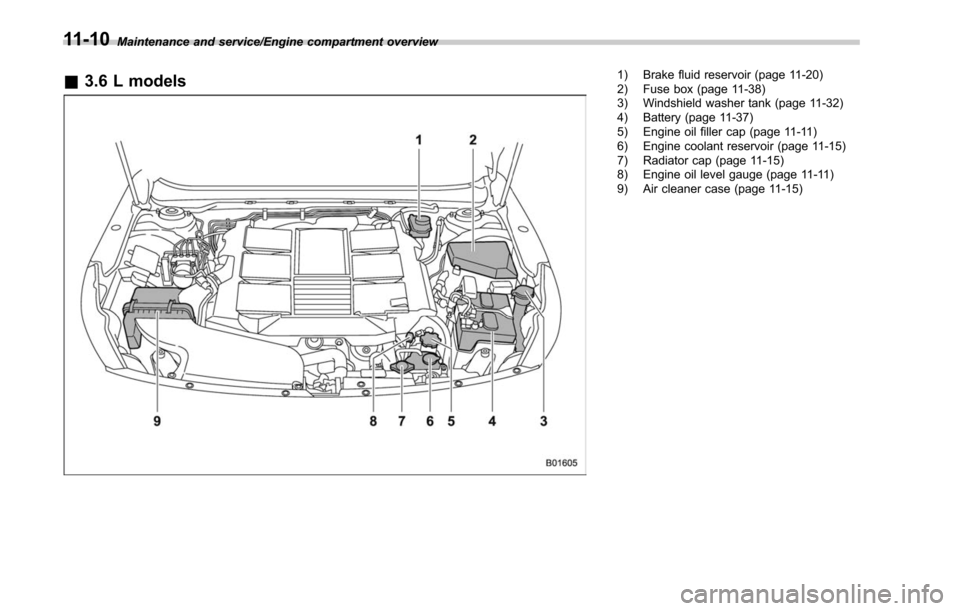
Maintenance and service/Engine compartment overview
&3.6 L models1) Brake fluid reservoir (page 11-20)
2) Fuse box (page 11-38)
3) Windshield washer tank (page 11-32)
4) Battery (page 11-37)
5) Engine oil filler cap (page 11-11)
6) Engine coolant reservoir (page 11-15)
7) Radiator cap (page 11-15)
8) Engine oil level gauge (page 11-11)
9) Air cleaner case (page 11-15)
11-10
Page 523 of 610
Maintenance and service/Brake fluid
Brake fluid
&Checking the fluid level
WARNING
. Never let brake fluid contact your
eyes because brake fluid can be
harmful to your eyes. If brake
fluid gets in your eyes, immedi-
ately flush them thoroughly with
clean water. For safety, when
performing this work, wearing
eye protection is advisable.
. Brake fluid absorbs moisture
from the air. Any absorbed moist-
ure can cause a dangerous loss
of braking performance.
. If the vehicle requires frequent
refilling, there may be a leak. If
you suspect a problem, have the
vehicle checked at your SUBARU
dealer.
CAUTION
. When adding brake fluid, be care-
ful not to allow any dirt into the
reservoir.
. Never splash the brake fluid over
painted surfaces or rubber parts. Alcohol contained in the brake
fluid may damage them.
. Be careful not to spill brake fluid
when adding it. If brake fluid
touches the exhaust pipe, it may
cause a bad smell, smoke, and/or
a fire. If brake fluid gets on the
exhaust pipe, be sure to wipe it
off.
The reservoir has two chambers, one for
clutch fluid and the other for brake fluid.
Each fluid level must therefore be checked
in the appropriate chamber. Check the
fluid level on the outside of the reservoir
monthly.
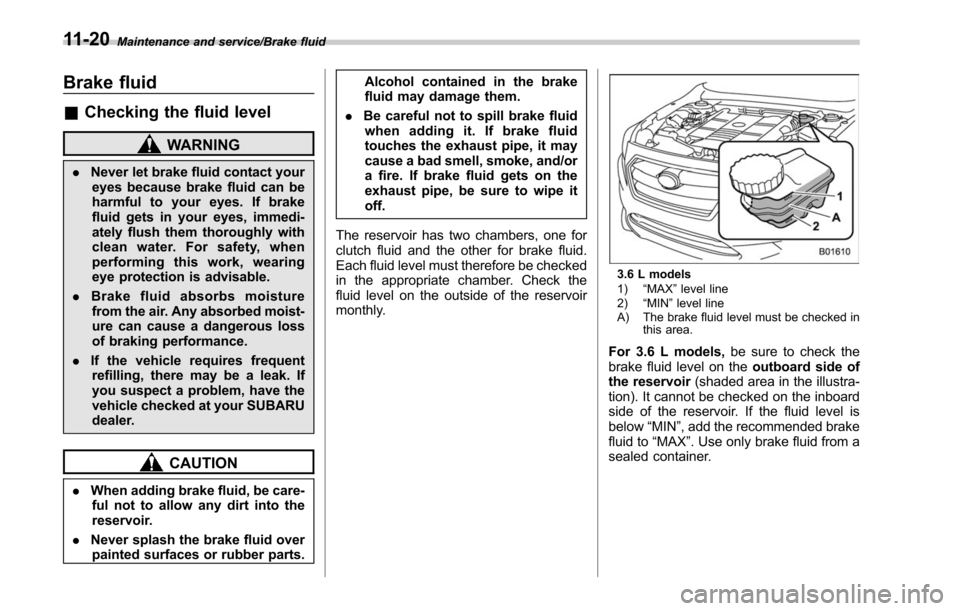
3.6 L models
1) “MAX ”level line
2) “MIN ”level line
A) The brake fluid level must be checked in this area.
For 3.6 L models, be sure to check the
brake fluid level on the outboard side of
the reservoir (shaded area in the illustra-
tion). It cannot be checked on the inboard
side of the reservoir. If the fluid level is
below “MIN”, add the recommended brake
fluid to “MAX”. Use only brake fluid from a
sealed container.
11-20
Page 524 of 610
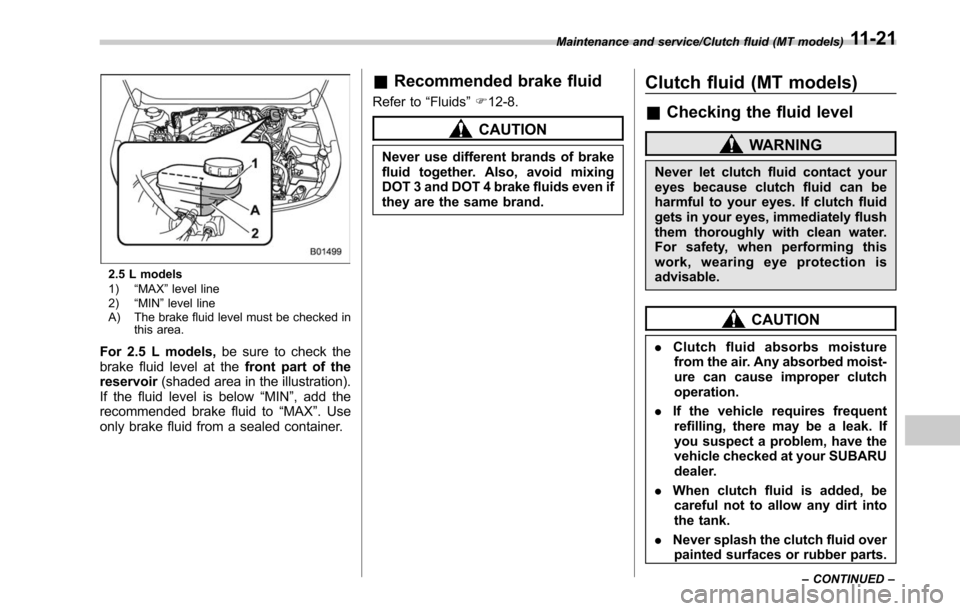
2.5 L models
1)“MAX ”level line
2) “MIN ”level line
A) The brake fluid level must be checked in this area.
For 2.5 L models, be sure to check the
brake fluid level at the front part of the
reservoir (shaded area in the illustration).
If the fluid level is below “MIN”, add the
recommended brake fluid to “MAX”. Use
only brake fluid from a sealed container.
& Recommended brake fluid
Refer to “Fluids”F 12-8.
CAUTION
Never use different brands of brake
fluid together. Also, avoid mixing
DOT 3 and DOT 4 brake fluids even if
they are the same brand.
Clutch fluid (MT models)
& Checking the fluid level
WARNING
Never let clutch fluid contact your
eyes because clutch fluid can be
harmful to your eyes. If clutch fluid
gets in your eyes, immediately flush
them thoroughly with clean water.
For safety, when performing this
work, wearing eye protection is
advisable.
CAUTION
. Clutch fluid absorbs moisture
from the air. Any absorbed moist-
ure can cause improper clutch
operation.
. If the vehicle requires frequent
refilling, there may be a leak. If
you suspect a problem, have the
vehicle checked at your SUBARU
dealer.
. When clutch fluid is added, be
careful not to allow any dirt into
the tank.
. Never splash the clutch fluid over
painted surfaces or rubber parts.
Maintenance and service/Clutch fluid (MT models)
–CONTINUED –11-21
Page 525 of 610
Maintenance and service/Brake booster
Alcohol contained in the clutch
fluid may damage them.
. Be careful not to spill clutch fluid
when adding it. If clutch fluid
touches the exhaust pipe, it may
cause a bad smell, smoke, and/or
a fire. If clutch fluid gets on the
exhaust pipe, be sure to wipe it
off.
. The fluid level for the clutch
system must be checked at the
inboard side of the reservoir. It
cannot be checked at the out-
board side of the reservoir.
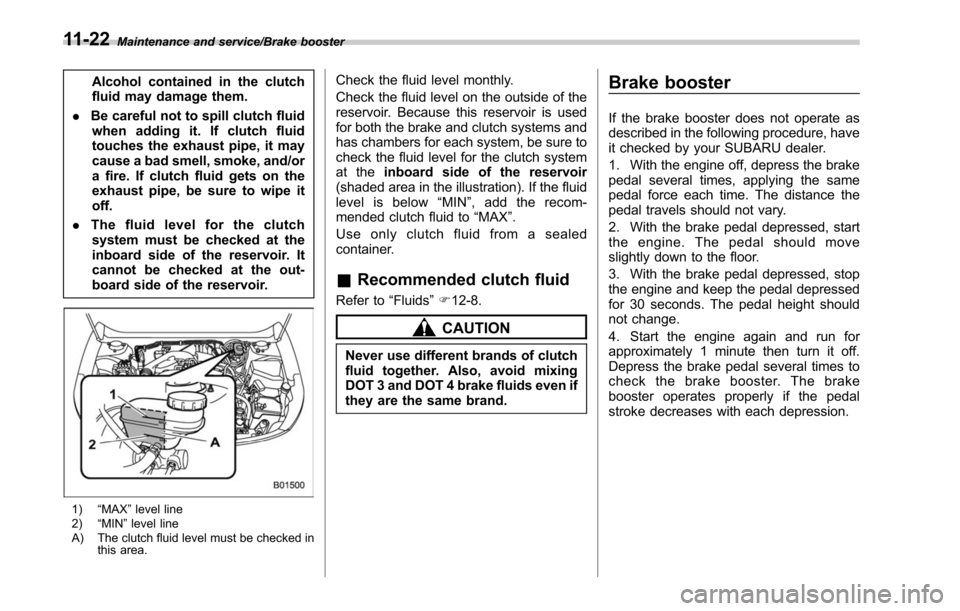
1) “MAX ”level line
2) “MIN ”level line
A) The clutch fluid level must be checked in this area.
Check the fluid level monthly.
Check the fluid level on the outside of the
reservoir. Because this reservoir is used
for both the brake and clutch systems and
has chambers for each system, be sure to
check the fluid level for the clutch system
at the inboard side of the reservoir
(shaded area in the illustration). If the fluid
level is below “MIN ”, add the recom-
mended clutch fluid to “MAX”.
Use only clutch fluid from a sealed
container.
& Recommended clutch fluid
Refer to “Fluids”F 12-8.
CAUTION
Never use different brands of clutch
fluid together. Also, avoid mixing
DOT 3 and DOT 4 brake fluids even if
they are the same brand.
Brake booster
If the brake booster does not operate as
described in the following procedure, have
it checked by your SUBARU dealer.
1. With the engine off, depress the brake
pedal several times, applying the same
pedal force each time. The distance the
pedal travels should not vary.
2. With the brake pedal depressed, start
the engine. The pedal should move
slightly down to the floor.
3. With the brake pedal depressed, stop
the engine and keep the pedal depressed
for 30 seconds. The pedal height should
not change.
4. Start the engine again and run for
approximately 1 minute then turn it off.
Depress the brake pedal several times to
check the brake booster. The brake
booster operates properly if the pedal
stroke decreases with each depression.
11-22
Page 556 of 610
Specifications..................................................... 12-2
Dimensions........................................................ 12-2
Engine ............................................................... 12-3
Fuel ................................................................... 12-3
Engine oil .......................................................... 12-4
Manual transmission, front differential and rear differential gear oil ........................................... 12-7
Fluids ................................................................ 12-8
Engine coolant ................................................... 12-8
Electrical system ................................................ 12-9
Tires .................................................................. 12-9 Brake disc
......................................................... 12-9Fuses and circuits ........................................... 12-10
Fuse panel located in the passenger
compartment ................................................. 12-10
Fuse panel located in the engine compartment ................................................. 12-12
Bulb chart......................................................... 12-14Safety precautions ........................................... 12-14
Bulb chart ....................................................... 12-15
Vehicle identification ....................................... 12-18
Specifications
12