maintenance SUBARU SOLTERRA 2023 Owner's Manual
[x] Cancel search | Manufacturer: SUBARU, Model Year: 2023, Model line: SOLTERRA, Model: SUBARU SOLTERRA 2023Pages: 628, PDF Size: 11.91 MB
Page 459 of 628
4597-2. Maintenance
Owners Manual_USA_M42C01_en
7
Maintenance and care
The OBD system determines
that a problem exists some-
where in the emission control
system. Your vehicle may not
pass the I/M test and may need
to be repaired. Contact your
Toyota dealer to service the
vehicle.
When the 12-volt battery is dis-
connected or discharged
Readiness codes that are set
during ordinary driving are
erased.
Also, depending on your driving
habits, the readiness codes may
not be completely set. The error code in the OBD sys-
tem will not be cleared unless
the vehicle is driven 40 or more
times.
Contact your Toyota dealer to
prepare the vehicle for re-test-
ing.
Emission inspection
and mainte
nance (I/M)
programs
Some states have vehicle
emission inspection pro-
grams which include OBD
(On Board Diagnostics)
checks. The OBD system
monitors the operation of
the emission control sys-
tem.
If the malfunc tion indica-
tor lamp comes on
Your vehicle may not pass
the I/M test in the follow-
ing situations:
When the malfunction
indicator lamp still
remains on after several
driving trips
If your vehicle does not
pass the I/M test
Page 460 of 628
4607-3. Do-it-yourself maintenance
Owners Manual_USA_M42C01_en
7-3.Do-it-yourself maintenance
Do-it-yourself ser vice
precautions
If you perform maintenance
by yourself, be sure to fol-
low the correct procedure
as given in these sections.
Maintenance
ItemsParts and tools
12-volt bat-
tery condi-
tion (P.468)
•Warm water
• Baking soda
•Grease
• Conventional
wrench (for termi-
nal clamp bolts)
Brake fluid
level
( P.468)
• FMVSS No.116
DOT 3 or SAE
J1703 brake fluid
FMVSS No.116
DOT 4 or SAE
J1704 brake fluid
• Rag or paper towel
• Funnel (used only for adding brake
fluid)
Power control
unit coolant
level
( P.467)
• In order to ensure
maximum perfor-
mance of the trac-
tion battery
cooling system
and limit risks of
battery short-cir-
cuit and other
damage to your
vehicle, Toyota
recommends
using “Toyota
Genuine Traction
Battery Coolant”
or similar high-
quality ethylene
glycol-based, low
electric conductiv-
ity coolant, non-
amine and non-
borate coolant
with azole addi-
tives.
• Funnel (used only for adding coolant)
ItemsParts and tools
Page 461 of 628
4617-3. Do-it-yourself maintenance
Owners Manual_USA_M42C01_en
7
Maintenance and care
Heater cool-
ant level
( P.465)
• “Toyota Super
Long Life Cool-
ant” or a similar
high quality eth-
ylene glycol-based
non-silicate, non-
amine, non-nitrite
and non-borate
coolant with long-
life hybrid organic
acid technology
“Toyota Super
Long Life Cool-
ant” is pre-mixed
with 50% coolant
and 50% deion-
ized water.
• Funnel (used only for adding coolant)
Fuses
( P.499)• Fuse with same
amperage rating
as original
Headlight aim
( P.501)Phillips-head
screwdriver
Radiator and
condenser
( P.466)
Tire inflation
pressure
( P.491)• Tire pressure
gauge
• Compressed air source
Washer fluid
( P.471)
• Water or washer
fluid containing
antifreeze (for win-
ter use)
• Funnel (used only for adding water or
washer fluid)
ItemsParts and toolsWARNING
The motor compartment contains
many mechanisms and fluids that
may move suddenly, become hot,
or become electrically energized.
To avoid death or serious injury,
observe the following precautions.
■When working on the motor
compartment
●Make sure that “POWER ON”
on the multi-information display
and the “READY” indicator are
both off.
●Keep hands, clothing and tools
away from the moving fan.
●Be careful not to touch the
motor, power control unit, radia-
tor, etc., right after driving as
they may be hot. Coolant and
other fluids may also be hot.
●Do not leave anything that may
burn easily, such as paper and
rags, in the motor compartment.
●Do not smoke, cause sparks or
expose an open flame to the 12-
volt battery. 12-volt battery
fumes are flammable.
●Be extremely cautious when
working on the 12-volt battery. It
contains poisonous and corro-
sive sulfuric acid.
●Never touch, disassemble,
remove or replace the high volt-
age parts, cables and their con-
nectors. It can cause severe
burns or electric shock that may
result in death or serious injury.
Page 462 of 628
4627-3. Do-it-yourself maintenance
Owners Manual_USA_M42C01_en
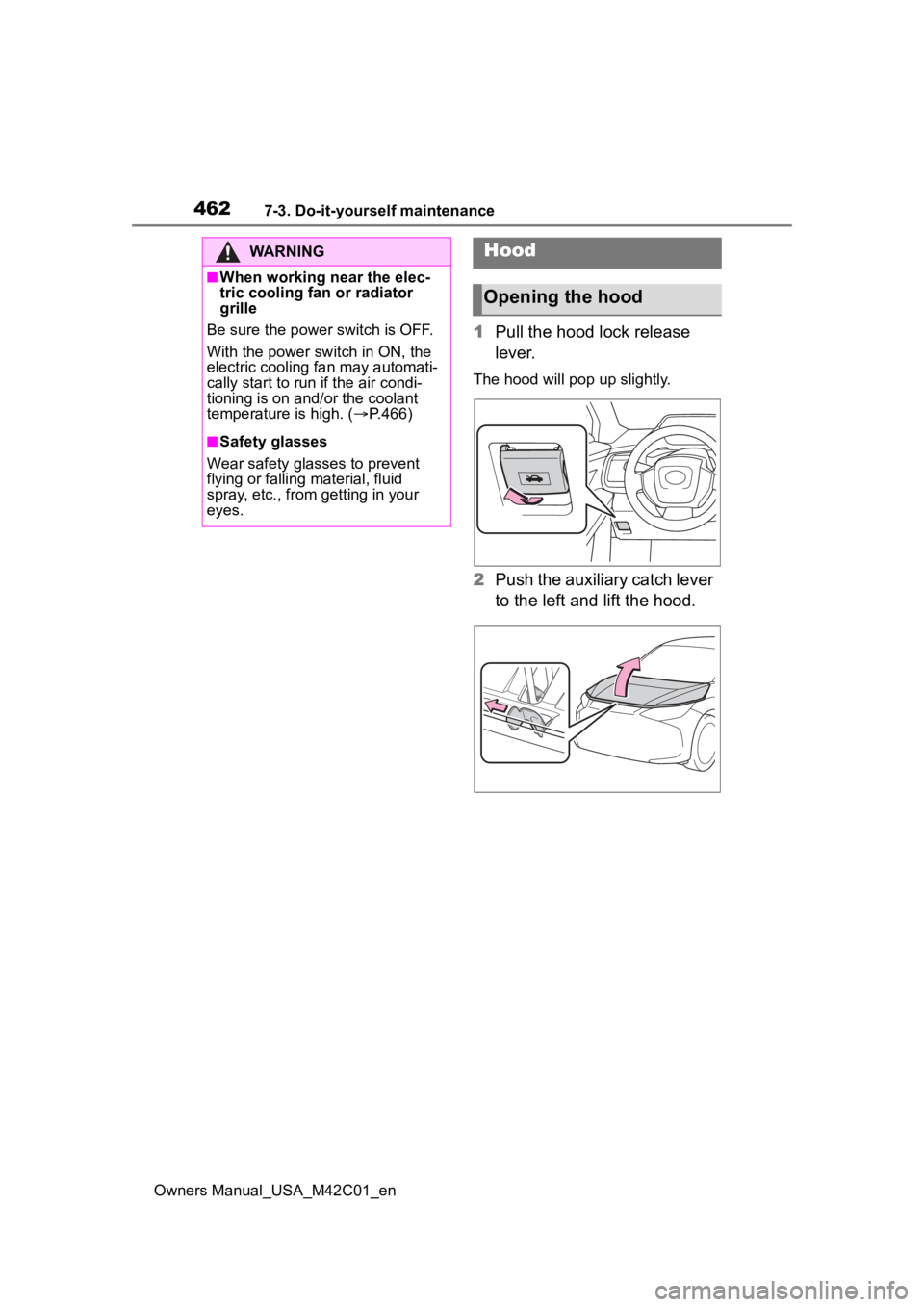
1Pull the hood lock release
lever.
The hood will pop up slightly.
2Push the auxiliary catch lever
to the left and lift the hood.
WARNING
■When working near the elec-
tric cooling fan or radiator
grille
Be sure the power switch is OFF.
With the power switch in ON, the
electric cooling fan may automati-
cally start to run if the air condi-
tioning is on and/or the coolant
temperature is high. ( P.466)
■Safety glasses
Wear safety glasses to prevent
flying or falling material, fluid
spray, etc., from getting in your
eyes.
Hood
Opening the hood
Page 463 of 628
4637-3. Do-it-yourself maintenance
Owners Manual_USA_M42C01_en
7
Maintenance and care
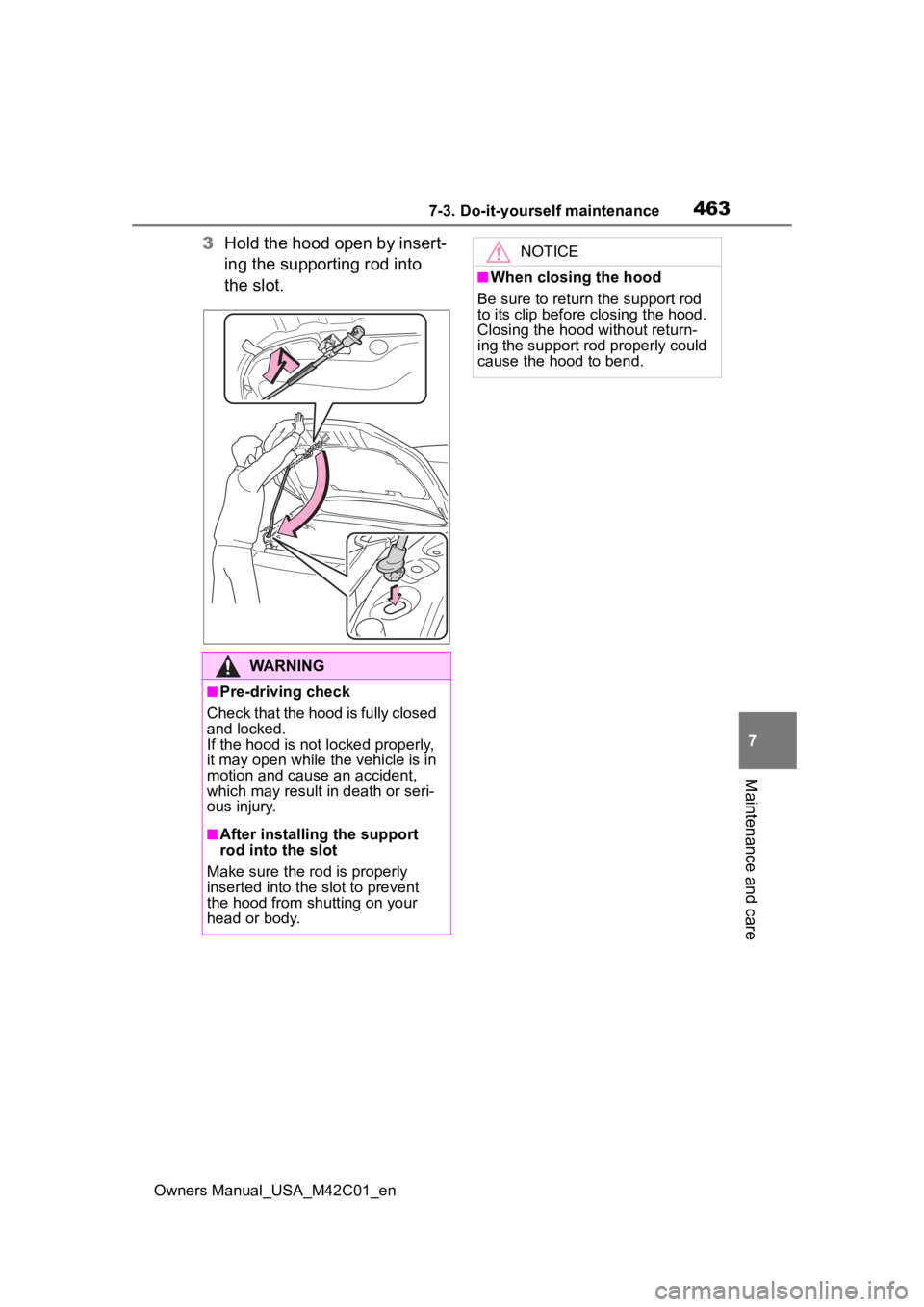
3 Hold the hood open by insert-
ing the supporting rod into
the slot.
WARNING
■Pre-driving check
Check that the hood is fully closed
and locked.
If the hood is not locked properly,
it may open while the vehicle is in
motion and cause an accident,
which may result in death or seri-
ous injury.
■After installing the support
rod into the slot
Make sure the rod is properly
inserted into the slot to prevent
the hood from shutting on your
head or body.
NOTICE
■When closing the hood
Be sure to return the support rod
to its clip before closing the hood.
Closing the hood without return-
ing the support rod properly could
cause the hood to bend.
Page 464 of 628
4647-3. Do-it-yourself maintenance
Owners Manual_USA_M42C01_en
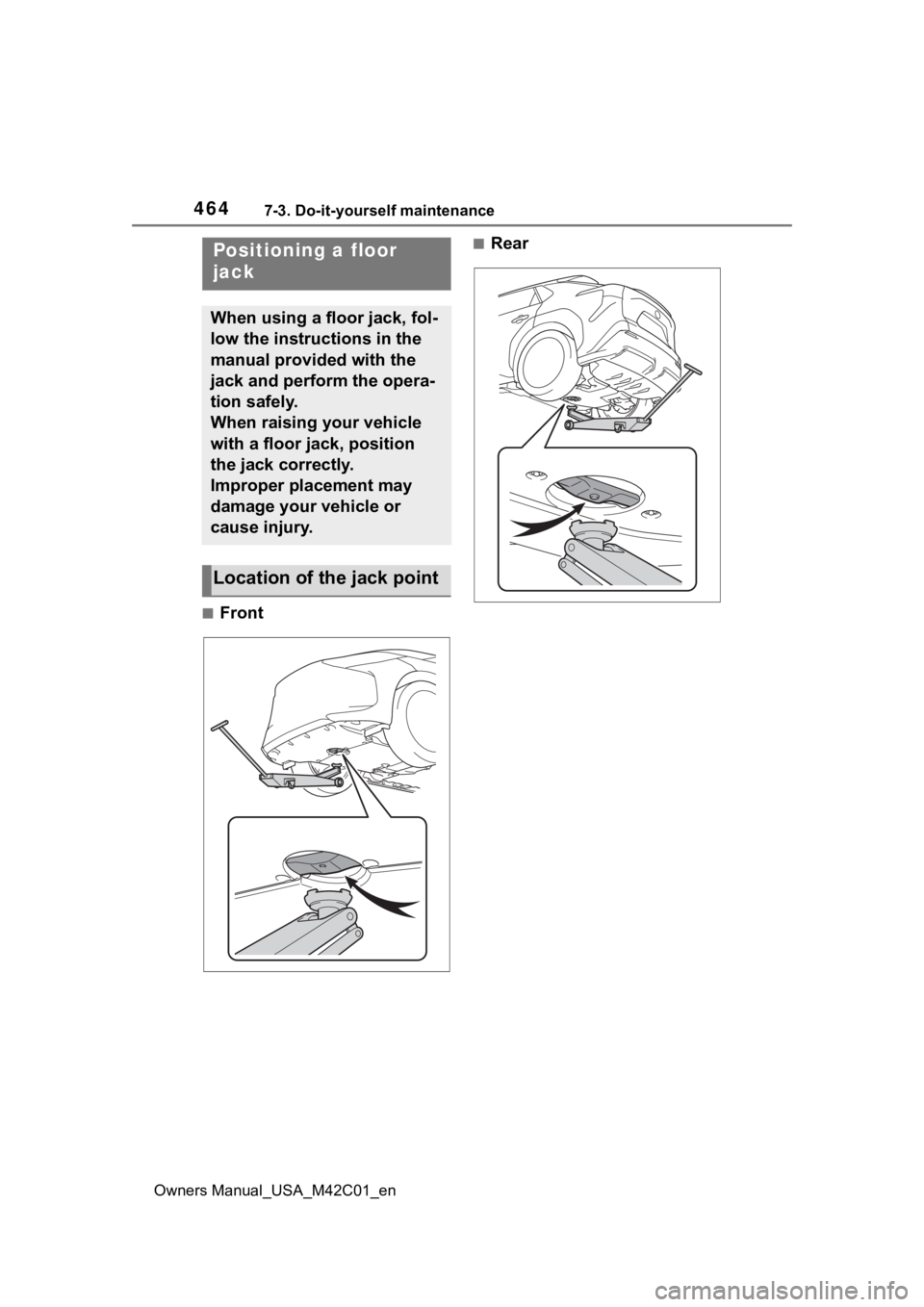
■Front
■RearPositioning a floor
jack
When using a floor jack, fol-
low the instructions in the
manual provided with the
jack and perform the opera-
tion safely.
When raising your vehicle
with a floor jack, position
the jack correctly.
Improper placement may
damage your vehicle or
cause injury.
Location of the jack point
Page 465 of 628
4657-3. Do-it-yourself maintenance
Owners Manual_USA_M42C01_en
7
Maintenance and care
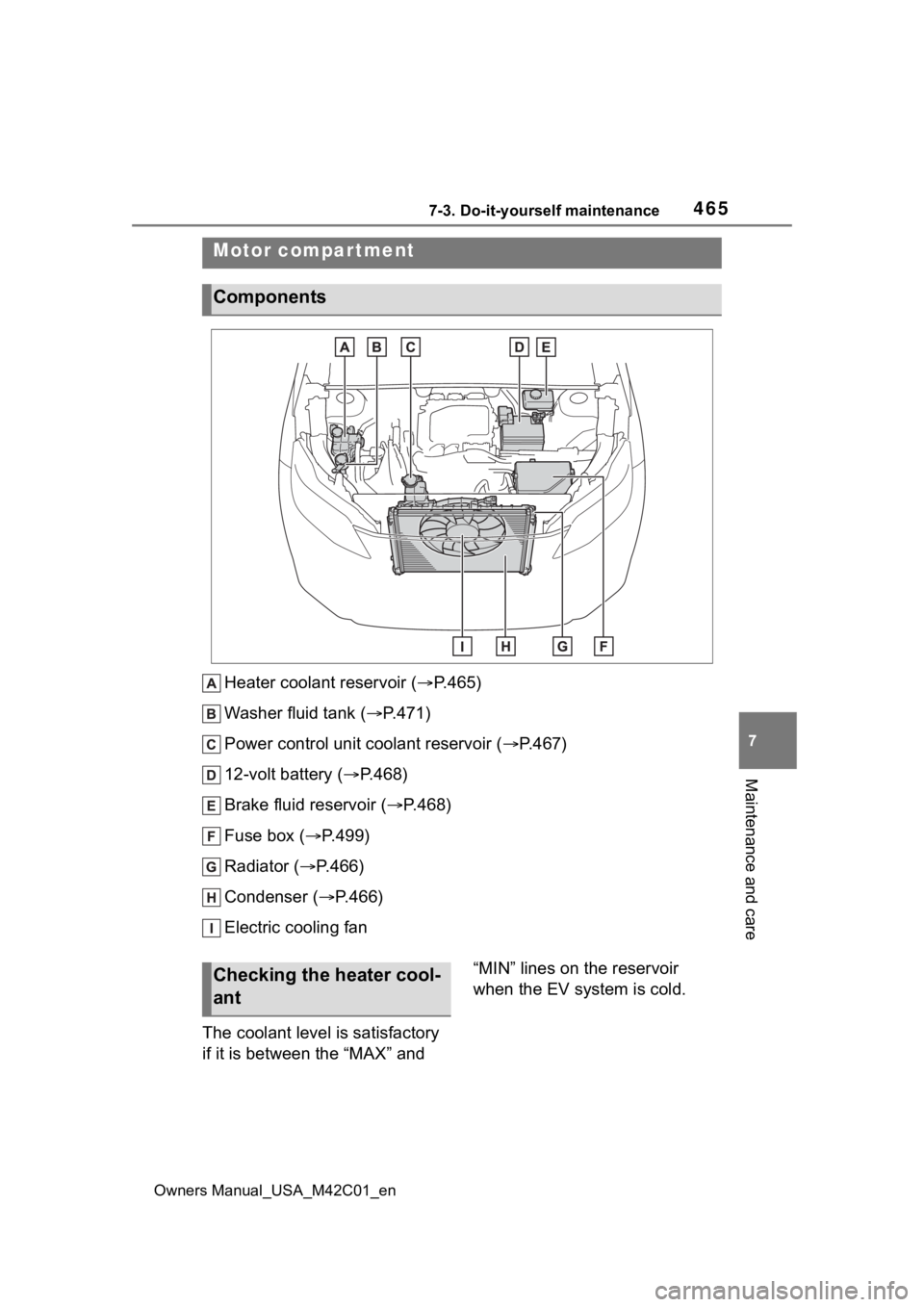
Heater coolant reservoir ( P.465)
Washer fluid tank ( P.471)
Power control unit coolant reservoir ( P.467)
12-volt battery ( P.468)
Brake fluid reservoir ( P.468)
Fuse box ( P.499)
Radiator ( P.466)
Condenser ( P.466)
Electric cooling fan
The coolant level is satisfactory
if it is between the “MAX” and “MIN” lines on the reservoir
when the EV system is cold.
Motor compar tment
Components
Checking the heater cool-
ant
Page 466 of 628
4667-3. Do-it-yourself maintenance
Owners Manual_USA_M42C01_en
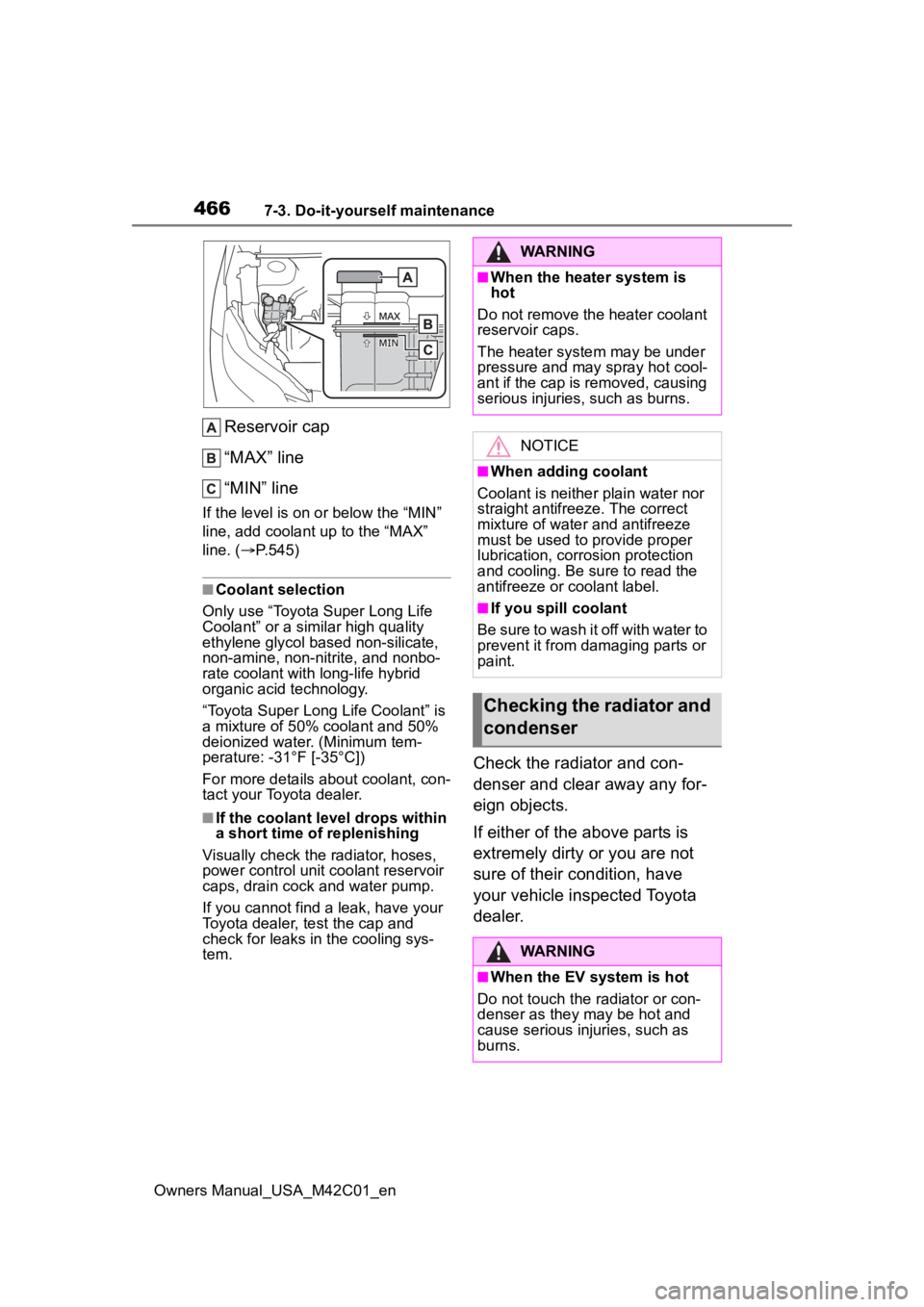
Reservoir cap
“MAX” line
“MIN” line
If the level is on or below the “MIN”
line, add coolant up to the “MAX”
line. (P.545)
■Coolant selection
Only use “Toyota Super Long Life
Coolant” or a similar high quality
ethylene glycol based non-silicate,
non-amine, non-nitrite, and nonbo-
rate coolant with long-life hybrid
organic acid technology.
“Toyota Super Long Life Coolant” is
a mixture of 50% coolant and 50%
deionized water. (Minimum tem-
perature: -31°F [-35°C])
For more details about coolant, con-
tact your Toyota dealer.
■If the coolant level drops within
a short time of replenishing
Visually check the radiator, hoses,
power control unit coolant reservoir
caps, drain cock and water pump.
If you cannot find a leak, have your
Toyota dealer, test the cap and
check for leaks in the cooling sys-
tem.
Check the radiator and con-
denser and clear away any for-
eign objects.
If either of the above parts is
extremely dirty or you are not
sure of their condition, have
your vehicle inspected Toyota
dealer.
WARNING
■When the heater system is
hot
Do not remove the heater coolant
reservoir caps.
The heater system may be under
pressure and may spray hot cool-
ant if the cap is removed, causing
serious injuries, such as burns.
NOTICE
■When adding coolant
Coolant is neither plain water nor
straight antifreeze. The correct
mixture of water and antifreeze
must be used to provide proper
lubrication, corrosion protection
and cooling. Be sure to read the
antifreeze or coolant label.
■If you spill coolant
Be sure to wash it off with water to
prevent it from damaging parts or
paint.
Checking the radiator and
condenser
WARNING
■When the EV system is hot
Do not touch the radiator or con-
denser as they may be hot and
cause serious injuries, such as
burns.
Page 467 of 628
4677-3. Do-it-yourself maintenance
Owners Manual_USA_M42C01_en
7
Maintenance and care
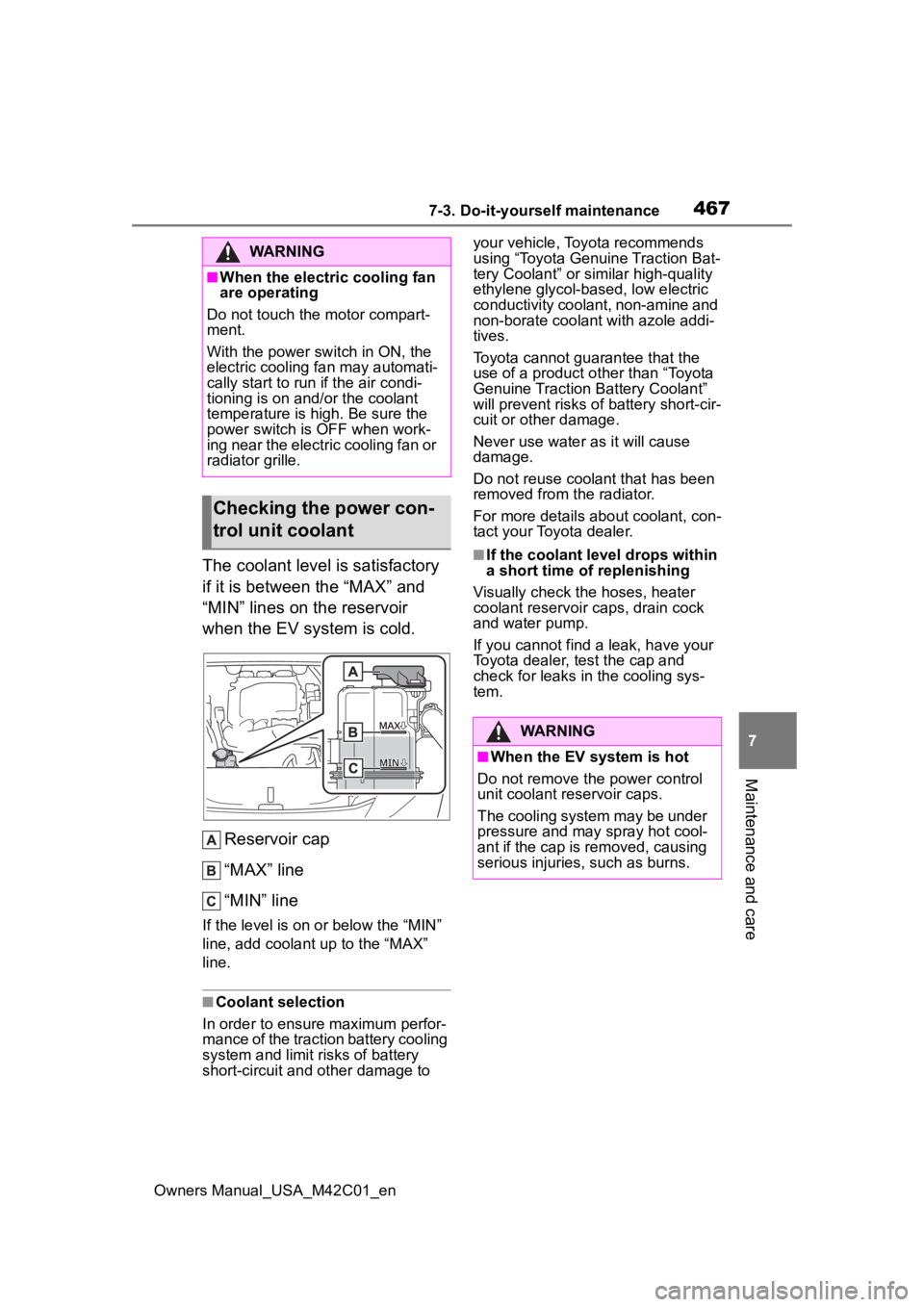
The coolant level is satisfactory
if it is between the “MAX” and
“MIN” lines on the reservoir
when the EV system is cold. Reservoir cap
“MAX” line
“MIN” line
If the level is on or below the “MIN”
line, add coolant up to the “MAX”
line.
■Coolant selection
In order to ensure maximum perfor-
mance of the traction battery cooling
system and limit risks of battery
short-circuit and other damage to your vehicle, Toyota recommends
using “Toyota Genuine Traction Bat-
tery Coolant” or similar high-quality
ethylene glycol-based, low electric
conductivity coolant, non-amine and
non-borate coolant with azole addi-
tives.
Toyota cannot guarantee that the
use of a product o
ther than “Toyota
Genuine Traction Battery Coolant”
will prevent risks of battery short-cir-
cuit or other damage.
Never use water as it will cause
damage.
Do not reuse cool ant that has been
removed from the radiator.
For more details about coolant, con-
tact your Toyota dealer.
■If the coolant level drops within
a short time of replenishing
Visually check the hoses, heater
coolant reservoir caps, drain cock
and water pump.
If you cannot find a leak, have your
Toyota dealer, t est the cap and
check for leaks in the cooling sys-
tem.
WARNING
■When the electric cooling fan
are operating
Do not touch the motor compart-
ment.
With the power switch in ON, the
electric cooling fan may automati-
cally start to run if the air condi-
tioning is on and/or the coolant
temperature is high. Be sure the
power switch is OFF when work-
ing near the electric cooling fan or
radiator grille.
Checking the power con-
trol unit coolant
WARNING
■When the EV system is hot
Do not remove the power control
unit coolant reservoir caps.
The cooling system may be under
pressure and may spray hot cool-
ant if the cap is removed, causing
serious injuries, such as burns.
Page 468 of 628
4687-3. Do-it-yourself maintenance
Owners Manual_USA_M42C01_en
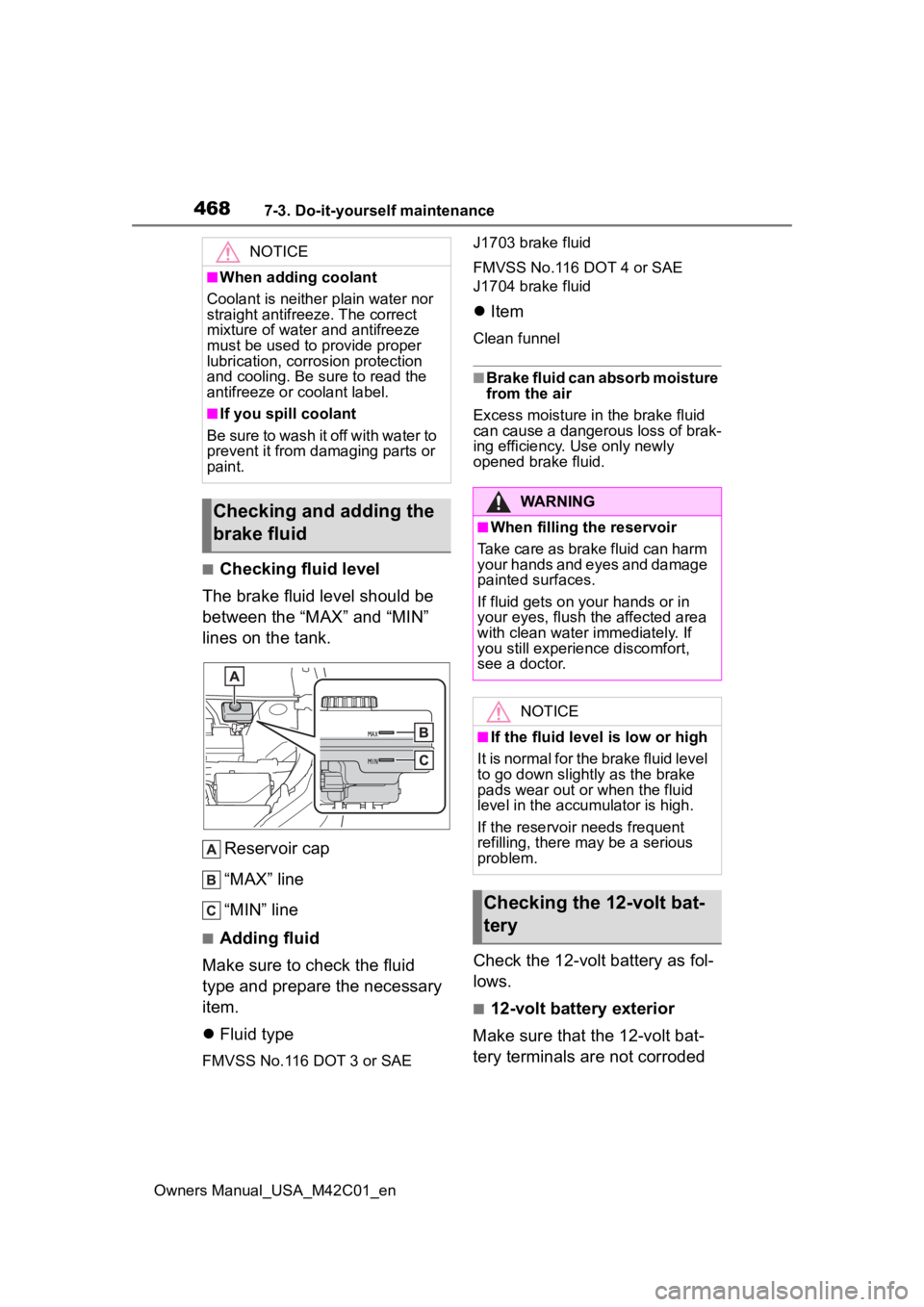
■Checking fluid level
The brake fluid level should be
between the “MAX” and “MIN”
lines on the tank.
Reservoir cap
“MAX” line
“MIN” line
■Adding fluid
Make sure to check the fluid
type and prepare the necessary
item.
Fluid type
FMVSS No.116 DOT 3 or SAE J1703 brake fluid
FMVSS No.116 DOT 4 or SAE
J1704 brake fluid
Item
Clean funnel
■Brake fluid can absorb moisture
from the air
Excess moisture in the brake fluid
can cause a dangerous loss of brak-
ing efficiency. Use only newly
opened brake fluid.
Check the 12-volt battery as fol-
lows.
■12-volt battery exterior
Make sure that the 12-volt bat-
tery terminals are not corroded
NOTICE
■When adding coolant
Coolant is neither plain water nor
straight antifreeze. The correct
mixture of water and antifreeze
must be used to provide proper
lubrication, corrosion protection
and cooling. Be sure to read the
antifreeze or coolant label.
■If you spill coolant
Be sure to wash it off with water to
prevent it from d amaging parts or
paint.
Checking and adding the
brake fluidWARNING
■When filling the reservoir
Take care as brake fluid can harm
your hands and eyes and damage
painted surfaces.
If fluid gets on your hands or in
your eyes, flush the affected area
with clean water immediately. If
you still experience discomfort,
see a doctor.
NOTICE
■If the fluid level is low or high
It is normal for the brake fluid level
to go down slight ly as the brake
pads wear out or when the fluid
level in the accumulator is high.
If the reservoir needs frequent
refilling, there m ay be a serious
problem.
Checking the 12-volt bat-
tery