load capacity SUBARU TRIBECA 2007 1.G User Guide
[x] Cancel search | Manufacturer: SUBARU, Model Year: 2007, Model line: TRIBECA, Model: SUBARU TRIBECA 2007 1.GPages: 377, PDF Size: 5.65 MB
Page 363 of 377
13-10 Consumer information and Reporting safety defects
3. The result of step 2 shows that a
further 88 lbs (40 kg) of cargo can becarried.
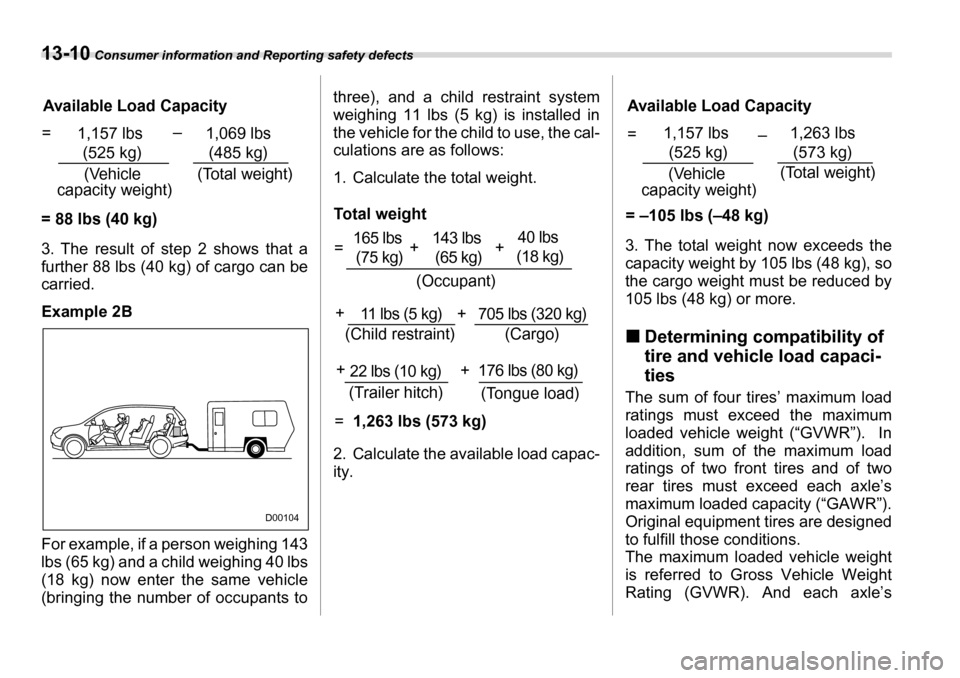
Example 2B
For example, if a person weighing 143
lbs (65 kg) and a child weighing 40 lbs
(18 kg) now enter the same vehicle
(bringing the number of occupants to three), and a child restraint system
weighing 11 lbs (5 kg) is installed in
the vehicle for the child to use, the cal-
culations are as follows:
1. Calculate the total weight.
2. Calculate the available load capac- ity.
3. The total weight now exceeds the
capacity weight by 105 lbs (48 kg), so
the cargo weight must be reduced by
105 lbs (48 kg) or more.
„ Determining compatibility of
tire and vehicle load capaci-ties
The sum of four tires’ maximum load
ratings must exceed the maximum
loaded vehicle weight (“GVWR”). In
addition, sum of the maximum load
ratings of two front tires and of two
rear tires must exceed each axle’s
maximum loaded capacity (“GAWR”).
Original equipment tires are designed to fulfill those conditions.
The maximum loaded vehicle weight
is referred to Gross Vehicle Weight
Rating (GVWR). And each axle’s
Available Load Capacity
(Vehicle
capacity weight) (Total weight)
1,157 lbs
(525 kg) 1,069 lbs
(485 kg)
= 88 lbs (40 kg) –
=
D00104
Total weight
(Occupant) (Cargo)
(Trailer hitch)
(Child restraint)
(Tongue load)
165 lbs
(75 kg) 143 lbs
(65 kg) 40 lbs
(18 kg)
++
11 lbs (5 kg) 705 lbs (320 kg)
22 lbs (10 kg) 176 lbs (80 kg)
= 1,263 lbs (573 kg)
+
+
+
+
=
Available Load Capacity
(Vehicle
capacity weight) (Total weight)
1,157 lbs
(525 kg) 1,263 lbs
(573 kg)
= –105 lbs (–48 kg) –
=
Page 364 of 377
Consumer information and Reporting safety defects 13-11
maximum loaded capacity is referred
to Gross Axle Weight Rating
(GAWR). The GVWR and each axle’s
GAWR are shown on the vehicle cer-
tification label affixed to the driver’s
door.
The GVWR and front and rear
GAWRs are determined by not only
the maximum load rating of tires but
also loaded capacities of the vehicle’s
suspension, axles and other parts of
the body.
Therefore, this means that the vehicle
cannot necessarily be loaded up to
the tire’s maximum load rating on the
tire sidewall. „Adverse safety consequenc-
es of overloading on handling
and stopping and on tires
Overloading could affect vehicle han-
dling, stopping distance, vehicle and
tire as shown in the following. This
could lead to an accident and possibly result in severe personal injury.y Vehicle stability will deteriorate.
y Heavy and/or high-mounted loads
could increase the risk of rollover.y Stopping distance will increase. y
Brakes could overheat and fail.
y Suspension, bearings, axles and
other parts of the body could break or
experience accelerated wear that will
shorten vehicle life. y Tires could fail.
y Tread separation could occur.
y Tire could separate from its rim.
„ Steps for Determining Cor-
rect Load Limit
1. Locate the statement “The com-
bined weight of occupants and cargo
should never exceed XXX pounds” on
your vehicle’s placard.
2. Determine the combined weight of
the driver and passengers that will be
riding in your vehicle.
3. Subtract the combined weight of
the driver and passengers from XXX
kilograms or XXX pounds.
4. The resulting figure equals the
available amount of cargo and lug-
gage load capacity. For example, if
the “XXX” amount equals 1,400 lbs
(635 kg). and there will be five- 150
lbs (68 kg) passengers in your vehi-
cle, the amount of available cargo and
luggage load capacity is 650 lbs. (1,400 – 750 (5
× 150) = 650 lbs.)
5. Determine the combined weight of
luggage and cargo being loaded on
the vehicle. That weight may not safe-
ly exceed the available cargo and lug-
gage load capacity calculated in Step 4.
6. If your vehicle will be towing a trail-
er, load from your trailer will be trans-
ferred to your vehicle. Consult this
manual to determine how this reduc-
es the available cargo and luggage
load capacity of your vehicle.