ECU SUBARU TRIBECA 2007 1.G Workshop Manual
[x] Cancel search | Manufacturer: SUBARU, Model Year: 2007, Model line: TRIBECA, Model: SUBARU TRIBECA 2007 1.GPages: 377, PDF Size: 5.65 MB
Page 278 of 377
In case of emergency 9-7
– CONTINUED –
Flat tires
If you have a flat tire while driving, never
brake suddenly; keep driving straight
ahead while gradually reducing speed.
Then slowly pull off the road to a safe
place. „Changing a flat tire
1. Park on a hard, level surface, whenev-
er possible, then stop the engine.
2. Set the parking brake securely and
shift in the “P” (Park) position.
3. Turn on the hazard warning flasher and
have everyone get out of the vehicle.
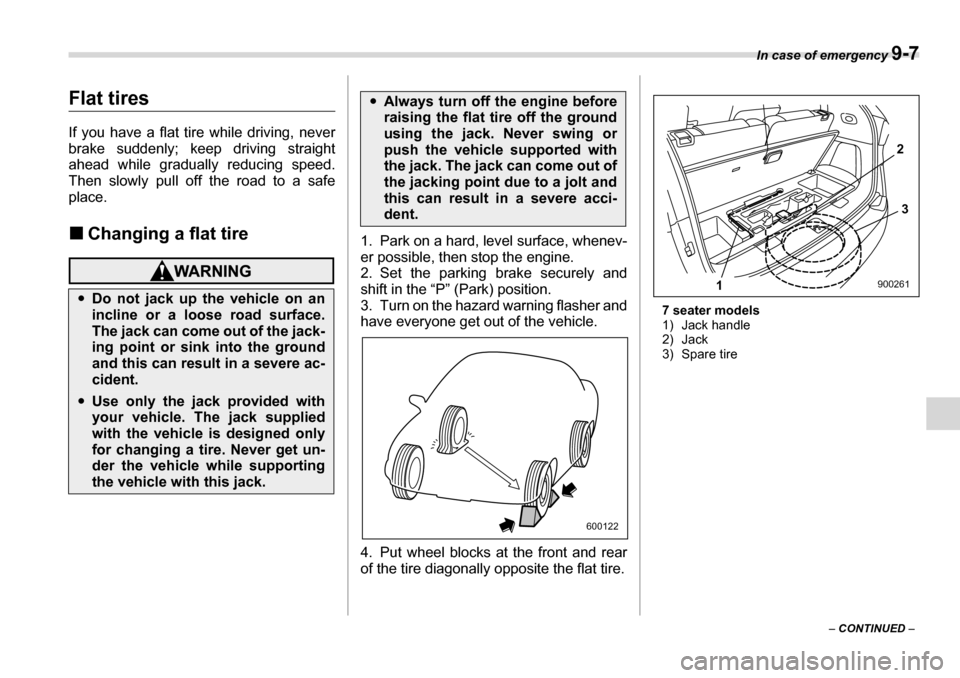
4. Put wheel blocks at the front and rear
of the tire diagonally opposite the flat tire. 7 seater models
1) Jack handle
2) Jack
3) Spare tire
y
Do not jack up the vehicle on an
incline or a loose road surface.
The jack can come out of the jack-
ing point or sink into the ground
and this can result in a severe ac-
cident.
yUse only the jack provided with
your vehicle. The jack supplied
with the vehicle is designed only for changing a tire. Never get un-
der the vehicle while supporting
the vehicle with this jack.
yAlways turn off the engine before
raising the flat tire off the ground
using the jack. Never swing or
push the vehicle supported with
the jack. The jack can come out of
the jacking point due to a jolt and
this can result in a severe acci-
dent.
600122
1 3
2900261
Page 280 of 377
In case of emergency 9-9
– CONTINUED –
head engages firmly into the jack-up point.
10.Insert the jack handle into the jack-
screw, and turn the handle until the tire
clears the ground. Do not raise the vehicle
higher than necessary.
11.Remove the wheel nuts and the flattire.
12.Before putting the spare tire on, clean
the mounting surface of the wheel and
hub with a cloth.
13.Put on the spare tire. Replace the
wheel nuts. Tighten them by hand.
14.Turn the jack handle counterclockwise
to lower the vehicle.
15.Use the wheel nut wrench to securely
tighten the wheel nuts to the specified
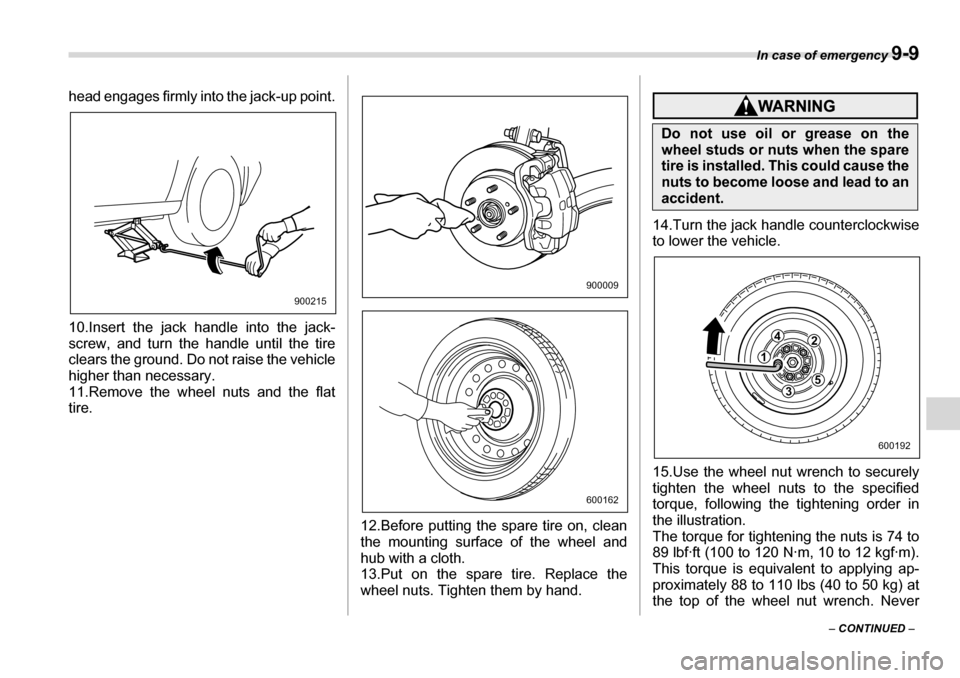
torque, following the tightening order in
the illustration.
The torque for tightening the nuts is 74 to
89 lbf·ft (100 to 120 N·m, 10 to 12 kgf·m).
This torque is equivalent to applying ap-
proximately 88 to 110 lbs (40 to 50 kg) at
the top of the wheel nut wrench. Never
900215
900009
600162
Do not use oil or grease on the
wheel studs or nuts when the spare
tire is installed. This could cause the
nuts to become loose and lead to an
accident.
1
42
53
600192
Page 287 of 377
9-16 In case of emergency
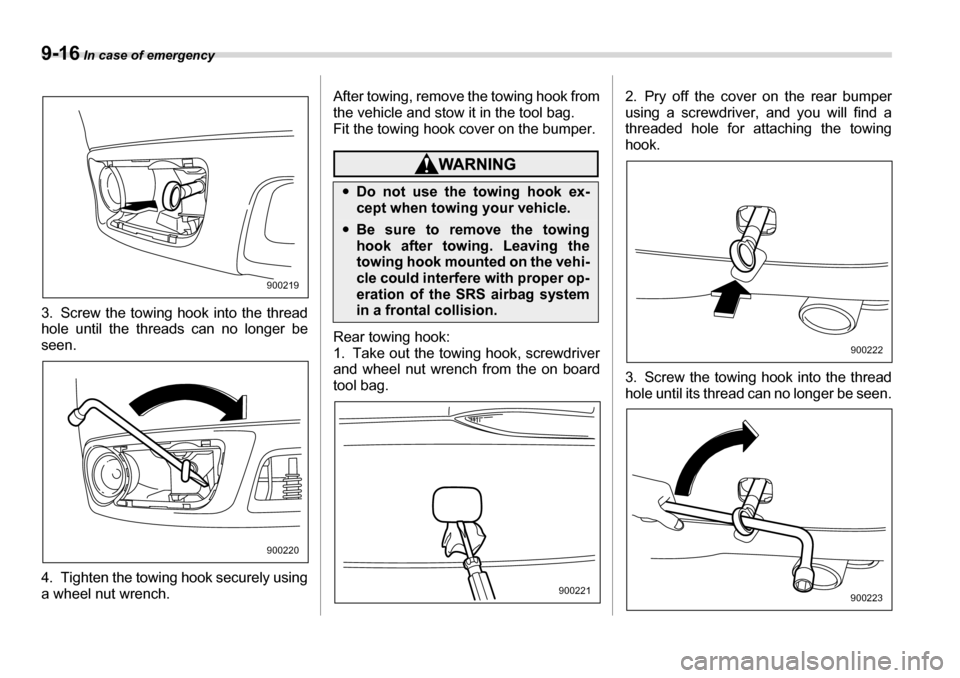
3. Screw the towing hook into the thread
hole until the threads can no longer be
seen.
4. Tighten the towing hook securely using
a wheel nut wrench. After towing, remove the towing hook from
the vehicle and stow it in the tool bag.
Fit the towing hook cover on the bumper.
Rear towing hook:
1. Take out the towing hook, screwdriver
and wheel nut wrench from the on board
tool bag.
2. Pry off the cover on the rear bumper
using a screwdriver, and you will find a
threaded hole for attaching the towing
hook.
3. Screw the towing hook into the thread
hole until its thread can no longer be seen.
900219
900220
y
Do not use the towing hook ex-
cept when towing your vehicle.
yBe sure to remove the towing hook after towing. Leaving the
towing hook mounted on the vehi-
cle could interfere with proper op-
eration of the SRS airbag system
in a frontal collision.
900221
900222
900223
Page 288 of 377
In case of emergency 9-17
– CONTINUED –
4. Tighten the towing hook securely using
a wheel nut wrench.
After towing, remove the towing hook from
the vehicle and stow it in the tool bag.
Put the thread hole cover on the rear
bumper.
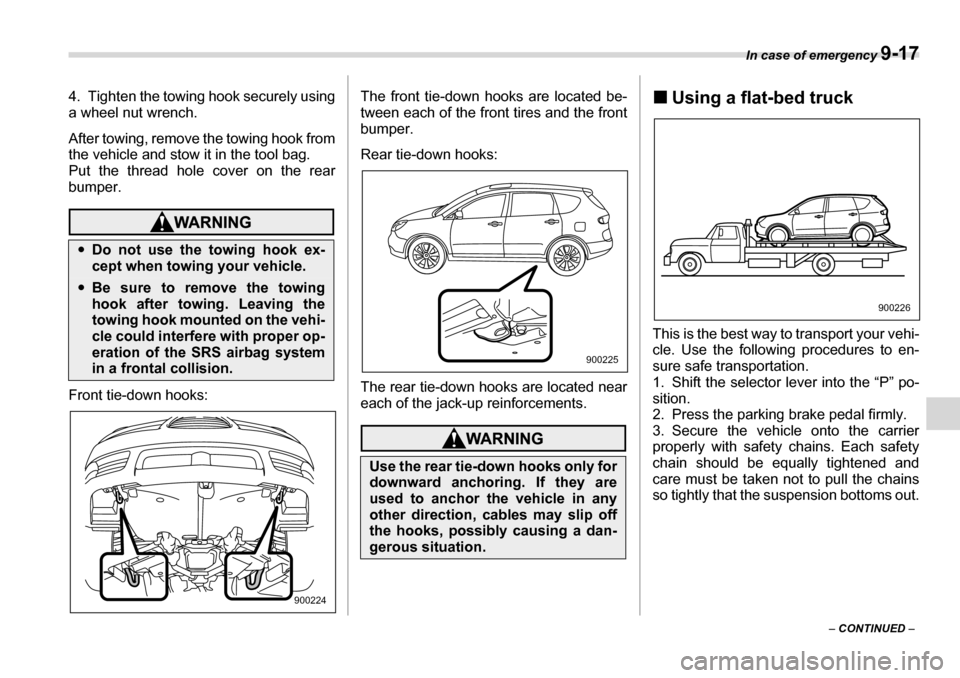
Front tie-down hooks:
The front tie-down hooks are located be-
tween each of the front tires and the front
bumper.
Rear tie-down hooks:
The rear tie-down hooks are located near
each of the jack-up reinforcements.
„
Using a flat-bed truck
This is the best way to transport your vehi-
cle. Use the following procedures to en-
sure safe transportation.
1. Shift the selector lever into the “P” po-sition.
2. Press the parking brake pedal firmly.
3. Secure the vehicle onto the carrier
properly with safety chains. Each safety
chain should be equally tightened and
care must be taken not to pull the chains
so tightly that the suspension bottoms out.
y Do not use the towing hook ex-
cept when towing your vehicle.
yBe sure to remove the towing
hook after towing. Leaving the
towing hook mounted on the vehi-
cle could interfere with proper op-
eration of the SRS airbag system
in a frontal collision.
900224
Use the rear tie-down hooks only for
downward anchoring. If they are
used to anchor the vehicle in any
other direction, cables may slip off
the hooks, possibly causing a dan-
gerous situation.
900225
900226
Page 302 of 377
Maintenance and service 11 - 5
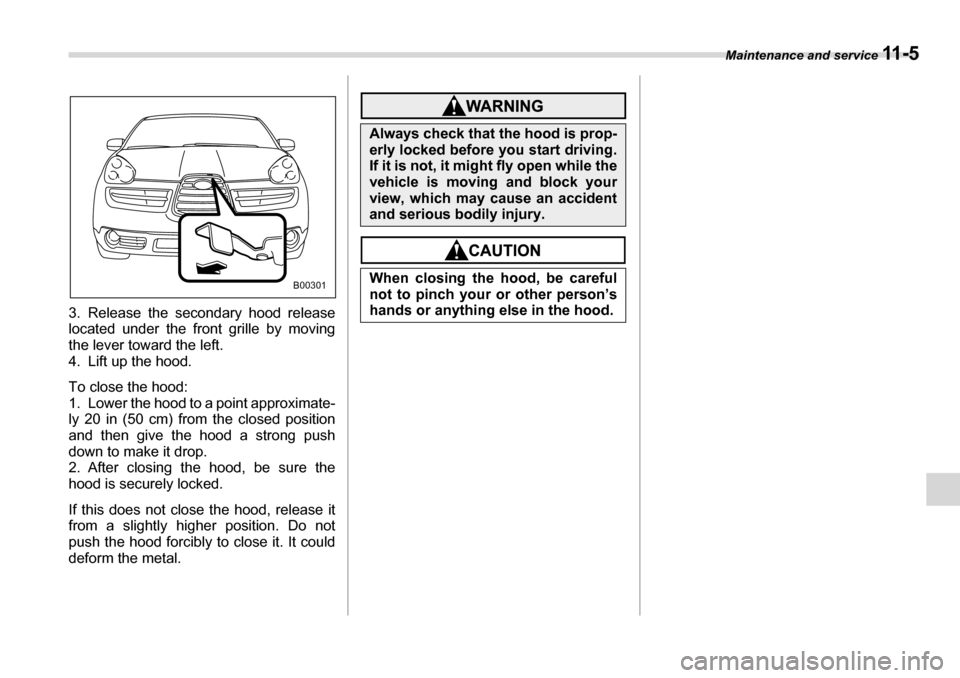
3. Release the secondary hood release
located under the front grille by moving
the lever toward the left.
4. Lift up the hood.
To close the hood:
1. Lower the hood to a point approximate-
ly 20 in (50 cm) from the closed position
and then give the hood a strong push
down to make it drop.
2. After closing the hood, be sure the
hood is securely locked.
If this does not close the hood, release it
from a slightly higher position. Do not
push the hood forcibly to close it. It could
deform the metal.
B00301
Always check that the hood is prop-
erly locked before you start driving.
If it is not, it might fly open while the
vehicle is moving and block your
view, which may cause an accident
and serious bodily injury.
When closing the hood, be careful
not to pinch your or other person’s
hands or anything else in the hood.
Page 309 of 377
11 - 1 2 Maintenance and service
TChanging the coolant
Always add genuine Subaru cooling sys-
tem conditioner whenever the coolant is
replaced.
Change the engine coolant and add gen- uine Subaru cooling system conditioner
using the following procedures according
to the maintenance schedule in the “War-
ranty and Maintenance Booklet”.
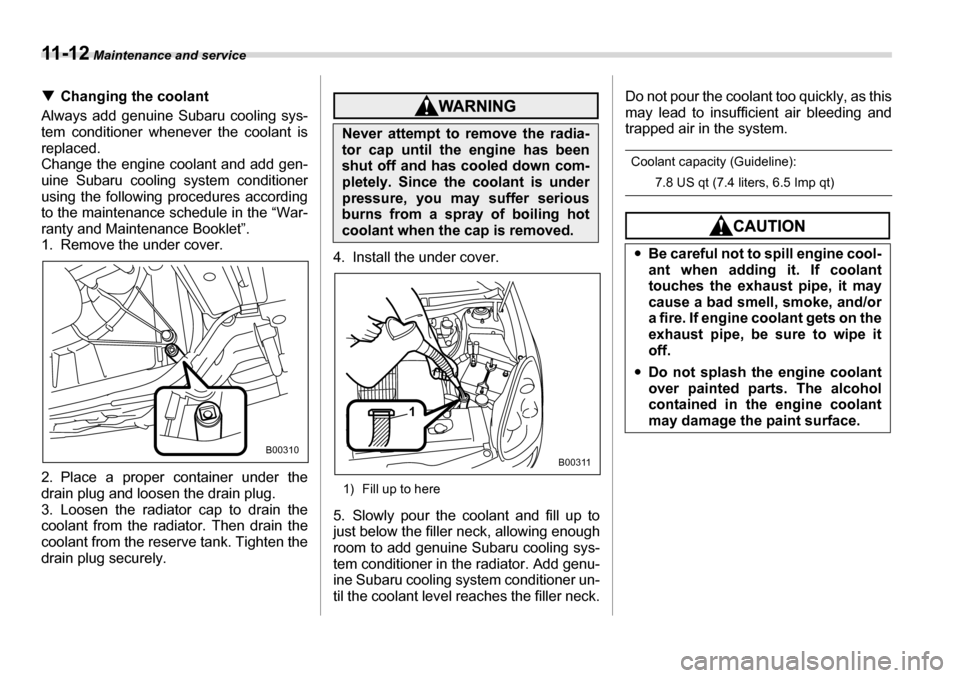
1. Remove the under cover.
2. Place a proper container under the
drain plug and loosen the drain plug.
3. Loosen the radiator cap to drain the
coolant from the radiator. Then drain the
coolant from the reserve tank. Tighten the
drain plug securely.
4. Install the under cover.
1) Fill up to here
5. Slowly pour the coolant and fill up to
just below the filler neck, allowing enough
room to add genuine Subaru cooling sys-
tem conditioner in the radiator. Add genu-
ine Subaru cooling system conditioner un-
til the coolant level reaches the filler neck. Do not pour the coolant too quickly, as this
may lead to insufficient air bleeding and
trapped air in the system.
Coolant capacity (Guideline):
7.8 US qt (7.4 liters, 6.5 Imp qt)
B00310
Never attempt to remove the radia-
tor cap until the engine has been
shut off and has cooled down com-
pletely. Since the coolant is under
pressure, you may suffer serious
burns from a spray of boiling hot
coolant when the cap is removed.
1
B00311
y
Be careful not to spill engine cool-
ant when adding it. If coolant
touches the exhaust pipe, it may
cause a bad smell, smoke, and/or
a fire. If engine coolant gets on the
exhaust pipe, be sure to wipe it off.
y Do not splash the engine coolant
over painted parts. The alcohol
contained in the engine coolant
may damage the paint surface.
Page 331 of 377
11 - 3 4 Maintenance and service
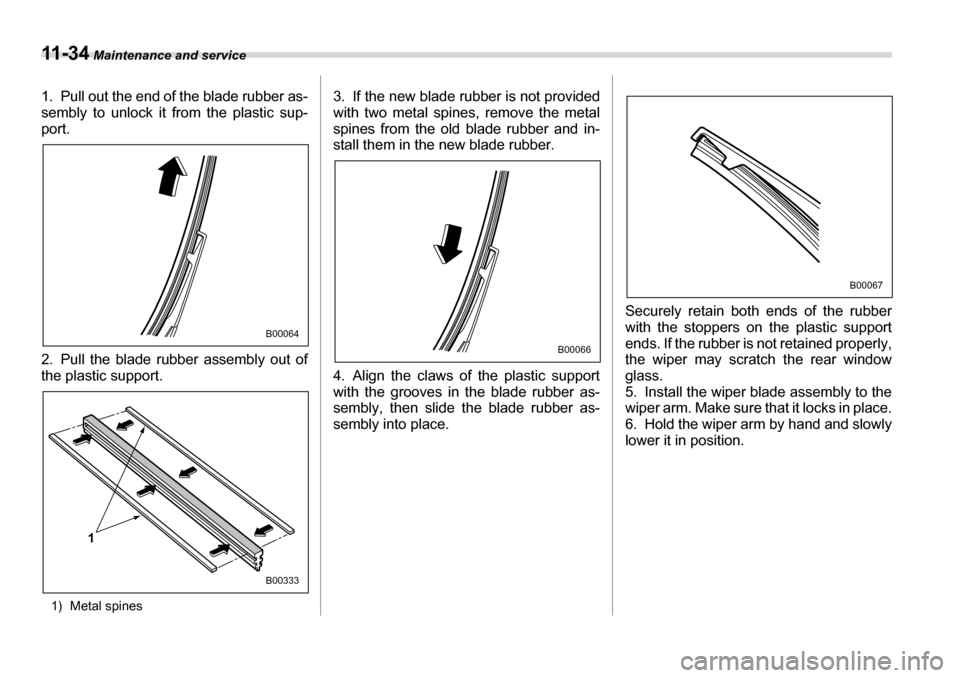
1. Pull out the end of the blade rubber as-
sembly to unlock it from the plastic sup-
port.
2. Pull the blade rubber assembly out of
the plastic support.
1) Metal spines 3. If the new blade rubber is not provided
with two metal spines, remove the metal
spines from the old blade rubber and in-
stall them in the new blade rubber.
4. Align the claws of the plastic support
with the grooves in the blade rubber as-
sembly, then slide the blade rubber as-
sembly into place.
Securely retain both ends of the rubber
with the stoppers on the plastic support
ends. If the rubber is not retained properly,
the wiper may scratch the rear window
glass.
5. Install the wiper blade assembly to the
wiper arm. Make sure that it locks in place.
6. Hold the wiper arm by hand and slowly
lower it in position.
B00064
1
B00333
B00066
B00067
Page 338 of 377
Maintenance and service 11 - 4 1
– CONTINUED –
T
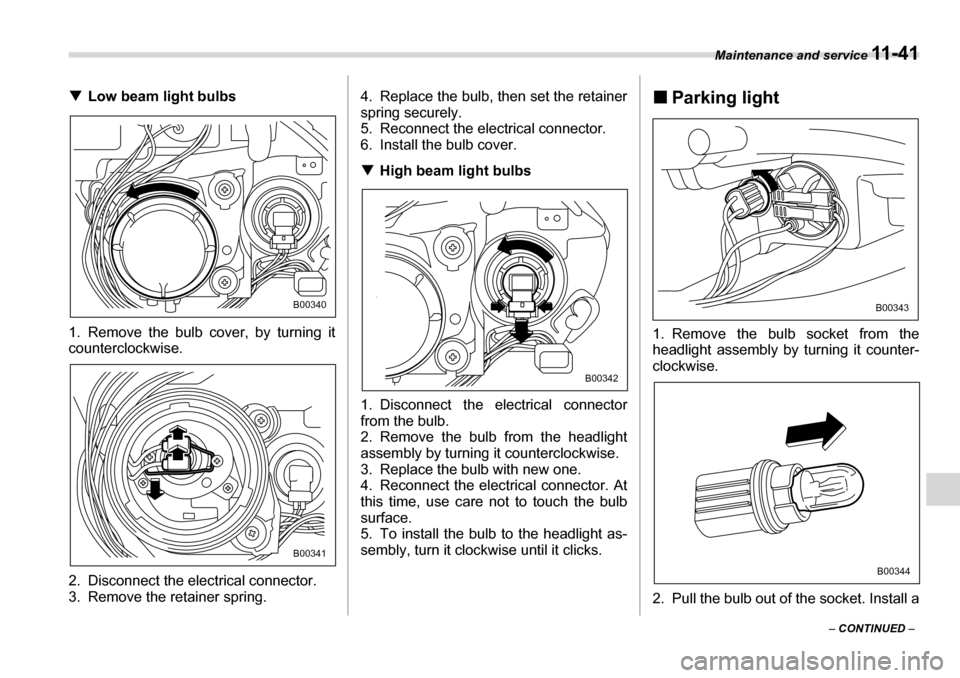
Low beam light bulbs
1. Remove the bulb cover, by turning it
counterclockwise.
2. Disconnect the electrical connector.
3. Remove the retainer spring. 4. Replace the bulb, then set the retainer spring securely.
5. Reconnect the electrical connector.
6. Install the bulb cover. T
High beam light bulbs
1. Disconnect the electrical connector
from the bulb.
2. Remove the bulb from the headlight
assembly by turning it counterclockwise.
3. Replace the bulb with new one.
4. Reconnect the electrical connector. At
this time, use care not to touch the bulb surface.
5. To install the bulb to the headlight as-
sembly, turn it clockwise until it clicks. „
Parking light
1. Remove the bulb socket from the
headlight assembly by turning it counter-
clockwise.
2. Pull the bulb out of the socket. Install a
B00340
B00341
B00342
B00343
B00344