warning SUBARU TRIBECA 2007 1.G Workshop Manual
[x] Cancel search | Manufacturer: SUBARU, Model Year: 2007, Model line: TRIBECA, Model: SUBARU TRIBECA 2007 1.GPages: 377, PDF Size: 5.65 MB
Page 239 of 377
7-24 Starting and operating
Tire pressure monitoring
system (TPMS)
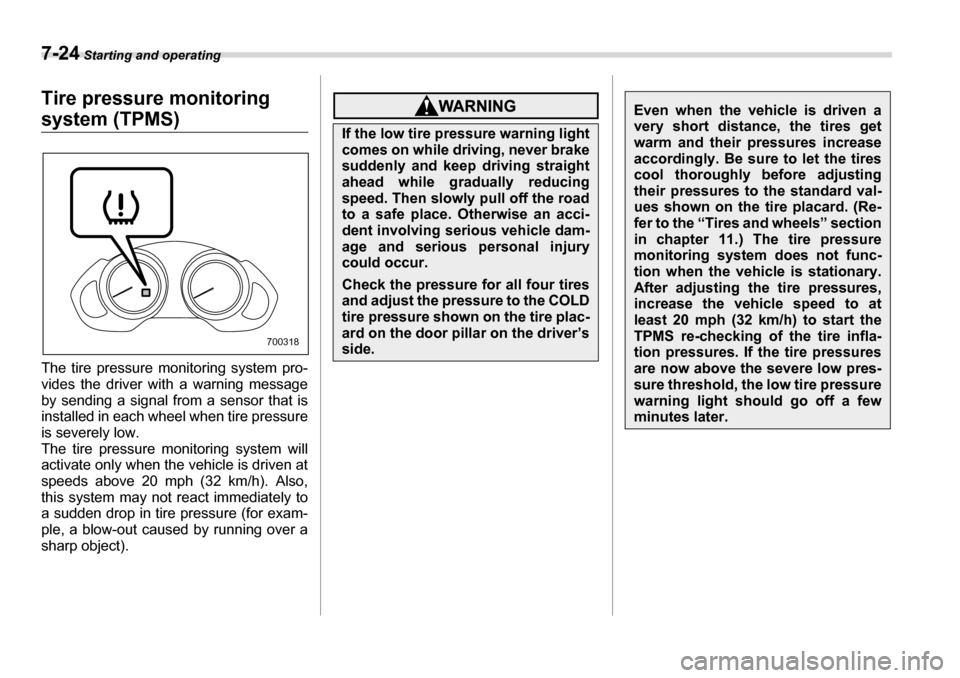
The tire pressure monitoring system pro-
vides the driver with a warning message
by sending a signal from a sensor that is
installed in each wheel when tire pressure
is severely low.
The tire pressure monitoring system will
activate only when the vehicle is driven at
speeds above 20 mph (32 km/h). Also,
this system may not react immediately to
a sudden drop in tire pressure (for exam-
ple, a blow-out caused by running over a
sharp object).
700318
If the low tire pressure warning light
comes on while driving, never brake
suddenly and keep driving straight
ahead while gradually reducing
speed. Then slowly pull off the road
to a safe place. Otherwise an acci-
dent involving serious vehicle dam-
age and serious personal injury
could occur.
Check the pressure for all four tires
and adjust the pressure to the COLD
tire pressure shown on the tire plac-
ard on the door pillar on the driver’s
side.
Even when the vehicle is driven a
very short distance, the tires get
warm and their pressures increase
accordingly. Be sure to let the tires
cool thoroughly before adjusting
their pressures to the standard val-
ues shown on the tire placard. (Re-
fer to the “Tires and wheels” section
in chapter 11.) The tire pressure
monitoring system does not func-
tion when the vehicle is stationary.
After adjusting the tire pressures,
increase the vehicle speed to at
least 20 mph (32 km/h) to start the
TPMS re-checking of the tire infla-
tion pressures. If the tire pressures
are now above the severe low pres-
sure threshold, the low tire pressure
warning light should go off a few minutes later.
Page 240 of 377
Starting and operating 7-25
– CONTINUED –
NOTE
This device complies with Part 15 of
the FCC Rules and with RSS-210 of In-
dustry Canada. Operation is subject to
the following two conditions: (1) This
device may not cause harmful interfer-
ence, and (2) this device must accept
any interference received, including in-
terference that may cause undesired
operation.
Changes or modifications not express-
ly approved by the party responsible
for compliance could void the user’s
authority to operate the equipment.
Parking your vehicleIf this light still comes on while driv-
ing after adjusting the tire pressure,
a tire may have significant damage
and a fast leak that causes the tire to
lose air rapidly. If you have a flat tire,
replace it with a spare tire as soon
as possible. When a spare tire is
mounted or a wheel rim is replaced
without the original pressure sen-
sor/transmitter being transferred,
the low tire pressure warning light
will flash. This indicates the TPMS is unable to monitor all four road
wheels. Contact your SUBARU deal-
er as soon as possible for tire and
sensor replacement and/or system resetting.
Do not inject any tire liquid or aero-
sol tire sealant into the tires, as this
may cause a malfunction of the tire
pressure sensors. If the light flash-
es, promptly contact a SUBARU
dealer to have the system inspect-
ed.
Do not place metal film or any metal
parts under the driver’s seat. This
may cause poor reception of the sig-
nals from the tire pressure sensors,
and the tire pressure monitoring
system will not function properly.
yNever leave unattended children
or pets in the vehicle. They could
accidentally injure themselves or
others through inadvertent opera-
tion of the vehicle. Also, on hot or
sunny days, the temperature in a
closed vehicle could quickly be-
come high enough to cause se-
vere or possibly fatal injuries to them.
yDo not park the vehicle over flam-
mable materials such as dry
grass, waste paper or rags, as
they may burn easily if they come
near hot engine or exhaust sys-
tem parts.
yBe sure to stop the engine if you
take a nap in the vehicle. If engine
exhaust gas enters the passenger
compartment, occupants in the
vehicle could die from carbon
monoxide (CO) contained in the
exhaust gas.
Page 241 of 377
7-26 Starting and operating
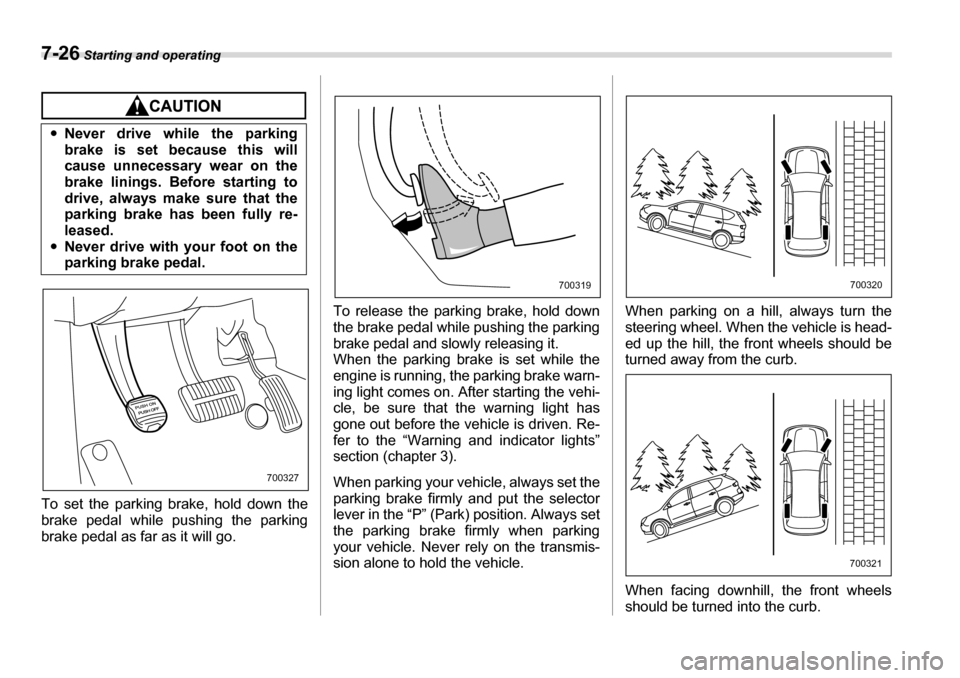
To set the parking brake, hold down the
brake pedal while pushing the parking
brake pedal as far as it will go. To release the parking brake, hold down
the brake pedal while pushing the parking
brake pedal and slowly releasing it.
When the parking brake is set while the
engine is running, the parking brake warn-
ing light comes on. After starting the vehi-
cle, be sure that the warning light has
gone out before the vehicle is driven. Re-
fer to the “Warning and indicator lights”
section (chapter 3).
When parking your vehicle, always set the
parking brake firmly and put the selector
lever in the “P” (Park) position. Always set
the parking brake firmly when parking
your vehicle. Never rely on the transmis-
sion alone to hold the vehicle. When parking on a hill, always turn the
steering wheel. When the vehicle is head-
ed up the hill, the front wheels should be
turned away from the curb.
When facing downhill, the front wheels
should be turned into the curb.
y
Never drive while the parking
brake is set because this will
cause unnecessary wear on the
brake linings. Before starting to
drive, always make sure that the
parking brake has been fully re-
leased.
y Never drive with your foot on the
parking brake pedal.
700327
700319700320
700321
Page 254 of 377
Driving tips 8-9
– CONTINUED –
If there is caked snow or ice, remove it,
being careful not to damage the disc
brakes and brake hoses and ABS har-ness. T
Refueling in cold weather
To help prevent moisture from forming in
the fuel system and the risk of its freezing,
use of an antifreeze additive in the fuel
tank is recommended during cold weath- er.
Use only additives that are specifically de-
signed for this purpose. When an anti-
freeze additive is used, its effect lasts
longer if the tank is refilled whenever the
fuel level reaches half empty.
If your SUBARU is not going to be used for
an extended period, it is best to have the
fuel tank filled to capacity. „ Driving on snowy and icy
roads
To prevent skidding and slipping, avoid
sudden braking, abrupt acceleration, high-
speed driving, and sharp turning when
driving on snowy or icy roads.
Always maintain ample distance between
your vehicle and the vehicle ahead of you
to avoid the need for sudden braking.
To supplement the foot brake, use the en-
gine brake effectively to control the vehi-
cle speed. (Shift into a lower gear when necessary.)
Avoid shifting down abruptly. Such behav-
ior can cause the wheels to lock, possibly
leading to loss of vehicle control.
An anti-lock brake system (ABS) enhanc-
es your vehicle’s braking performance on
snowy and icy roads. Refer to the “ABS
(Anti-lock Brake System)” and “Vehicle
Dynamics Control system” section in
chapter 7 for information on braking on
slippery surfaces. T
Wiper operation when snowing
Before driving in cold weather, make sure
the wiper blades are not frozen to the
windshield or rear window. If the wiper
blades are frozen to the windshield or rear
window, use the defroster with the airflow
control button in the “ ” position and
the temperature control dial set for maxi-
mum warmth until the wiper blades are
completely thawed out. If your vehicle is
equipped with a wiper deicer, it is helpful
to thaw the windshield wiper blades. To
thaw out the rear wiper blade, use the rear
window defogger.
When driving in snow, if frozen snow
starts to stick on the surface of the wind-
shield despite wiper operation, use the de-
froster with the airflow control button in
“ ” and the temperature control dial
set for maximum warmth. After the wind-
shield gets warmed enough to melt the
frozen snow on it, wash it away using the
windshield washer.
Snow stuck on the wiper arm prevents the
wiper from working effectively. If snow is
stuck on the wiper arm, pull off the road to
a safe place, then remove it. If you stop
the vehicle at road side, use the hazard
warning flasher to alert other drivers.
We recommend use of non-freezing type
Do not use the cruise control on
slippery roads such as snowy or icy
roads. This may cause loss of vehi-
cle control.
Avoid prolonged continuous driving
in snowstorms. Snow will enter the
engine’s intake system and may
hinder the air flow, which could re-
sult in engine shutdown or even
breakdown.
Page 269 of 377
8-24 Driving tips
TBefore starting out on a trip
y Check that the vehicle and vehicle-to-
hitch mounting are in good condition. If
any problems are apparent, do not tow the
trailer. y Check that the vehicle sits horizontally
with the trailer attached. If the vehicle is
tipped sharply up at the front and down at
the rear, check the total trailer weight,
GVW, GAWs and tongue load again, then
confirm that the load and its distribution
are acceptable. y Check that the tire pressures are cor-
rect. y Check that the vehicle and trailer are
connected properly. Confirm that – the trailer tongue is connected prop-
erly to the hitch ball.
– the trailer lights connector is connect-
ed properly and trailer’s brake lights illu-
minate when the vehicle’s brake pedal
is pressed, and that the trailer’s turn sig-
nal lights flash when the vehicle’s turn
signal lever is operated.
– the safety chains are connected prop- erly.
– all cargo in the trailer is secured safe- ty in position.
– the side mirrors provide a good rear-
ward field of view without a significant
blind spot.
y Sufficient time should be taken to learn the “feel” of the vehicle/trailer combination
before starting out on a trip. In an area free
of traffic, practice turning, stopping and
backing up. T
Driving with a trailer
y You should allow for considerably more
stopping distance when towing a trailer.
Avoid sudden braking because it may re-
sult in skidding or jackknifing and loss of control.y Avoid uneven steering, sharp turns and
rapid lane changes.y Slow down before turning. Make a long-
er than normal turning radius because the
trailer wheels will be closer than the vehi-
cle wheels to the inside of the turn. In a
tight turn, the trailer could hit your vehicle.y Crosswinds will adversely affect the
handling of your vehicle and trailer, caus-
ing sway. Crosswinds can be due to
weather conditions or the passing of large
trucks or buses. If swaying occurs, firmly
grip the steering wheel and slow down im-
mediately but gradually. y When passing other vehicles, consider-
able distance is required because of the
added weight and length caused by at-
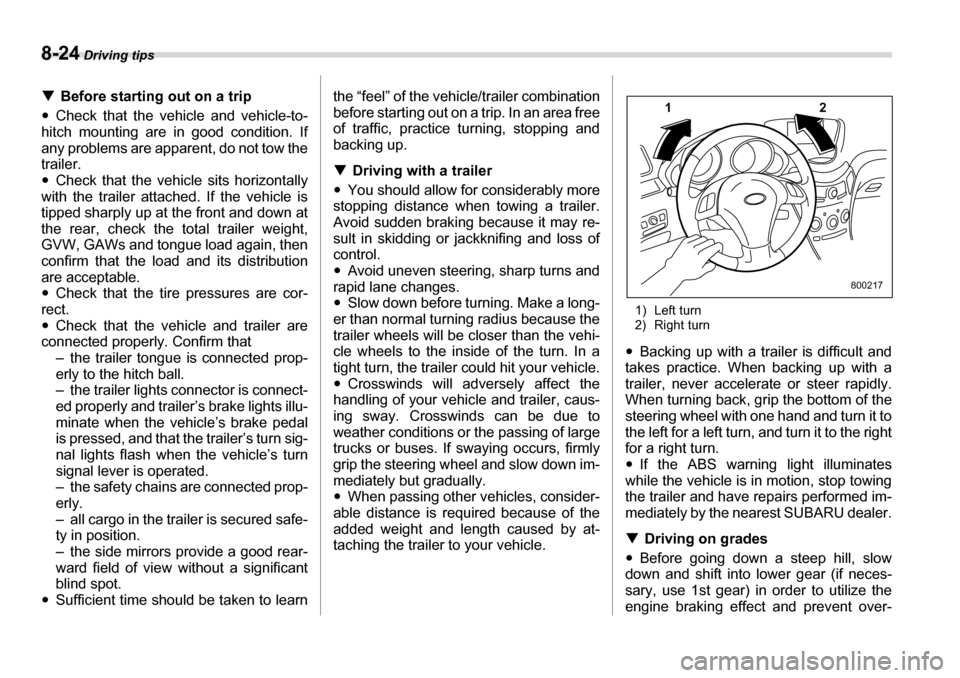
taching the trailer to your vehicle. 1) Left turn
2) Right turn
y Backing up with a trailer is difficult and
takes practice. When backing up with a
trailer, never accelerate or steer rapidly.
When turning back, grip the bottom of the
steering wheel with one hand and turn it to
the left for a left turn, and turn it to the right
for a right turn. y If the ABS warning light illuminates
while the vehicle is in motion, stop towing
the trailer and have repairs performed im-
mediately by the nearest SUBARU dealer. T Driving on grades
y Before going down a steep hill, slow
down and shift into lower gear (if neces-
sary, use 1st gear) in order to utilize the
engine braking effect and prevent over-12
800217
Page 270 of 377
Driving tips 8-25
heating of your vehicle’s brakes. Do not
make sudden downshifts. yWhen driving uphill in hot weather, the
air conditioner may turn off automatically
to protect the engine from overheating. y When driving uphill in hot weather, pay
attention to the water temperature gauge
pointer and AT OIL TEMP warning light
since the engine and transmission are rel-
atively prone to overheating under these
conditions. If the water temperature gauge
pointer approaches the OVERHEAT zone
or the AT OIL TEMP warning light illumi-
nates, immediately switch off the air con-
ditioner and stop the vehicle at the nearest
safe place. Refer to the “Engine overheat-
ing” section in chapter 9, and “Warning
and indicator lights” section in chapter 3.
NOTE
The temperature of engine coolant is
less likely to rise to the OVERHEAT
zone in the “D” position than in the
manual mode position. y Avoid using the accelerator pedal to
stay stationary on an uphill slope instead
of using the parking brake or foot brake.
That may cause the transmission fluid to
overheat. T Parking on a grade
Always block the wheels under both vehi- cle and trailer when parking. Apply the
parking brake firmly. You should not park
on a hill or slope. But if parking on a hill or
slope cannot be avoided, you should take
the following steps:
1. Apply the brakes and hold the pedal
down.
2. Have someone place wheel blocks un-
der both the vehicle and trailer wheels.
3. When the wheel blocks are in place, re-
lease the regular brakes slowly until the
blocks absorb the load.
4. Apply the regular brakes and then ap-
ply the parking brake; slowly release the
regular brakes.
5. Shift into “P” and shut off the engine.
Page 273 of 377
9-2 In case of emergency
In case of emergencyIf you park your vehicle in an
emergency
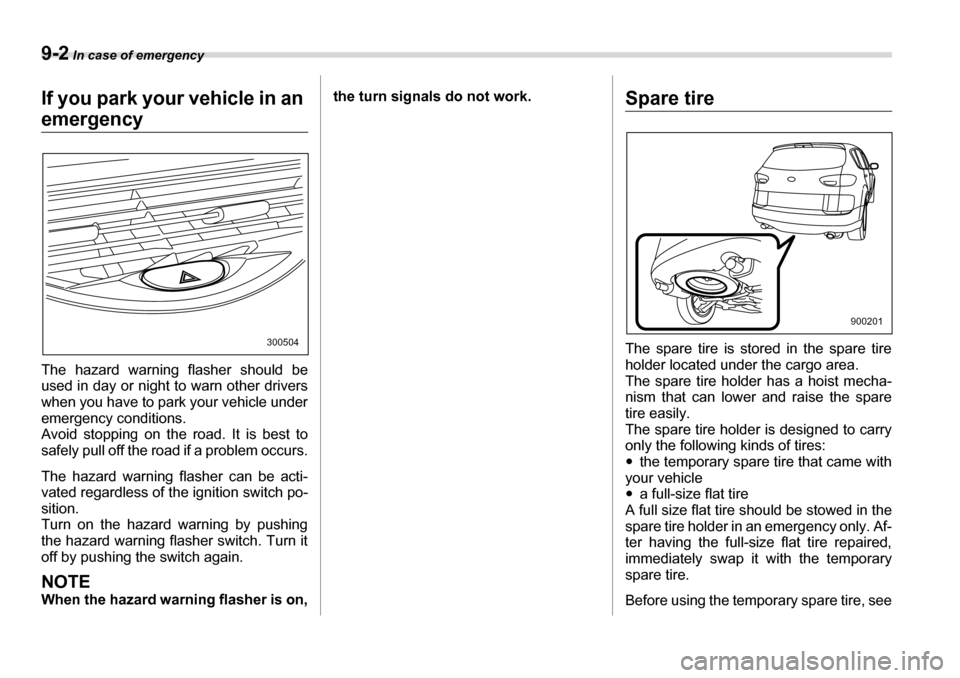
The hazard warning flasher should be
used in day or night to warn other drivers
when you have to park your vehicle under
emergency conditions.
Avoid stopping on the road. It is best to
safely pull off the road if a problem occurs.
The hazard warning flasher can be acti-
vated regardless of the ignition switch po- sition.
Turn on the hazard warning by pushing
the hazard warning flasher switch. Turn it
off by pushing the switch again.
NOTE
When the hazard warning flasher is on, the turn signals do not work.
Spare tire
The spare tire is stored in the spare tire
holder located under the cargo area.
The spare tire holder has a hoist mecha-
nism that can lower and raise the spare
tire easily.
The spare tire holder is designed to carry
only the following kinds of tires: y
the temporary spare tire that came with
your vehicle y a full-size flat tire
A full size flat tire should be stowed in the
spare tire holder in an emergency only. Af-
ter having the full-size flat tire repaired,
immediately swap it with the temporaryspare tire.
Before using the temporary spare tire, see
300504
900201
Page 277 of 377
9-6 In case of emergency
Temporary spare tire
The temporary spare tire is smaller and
lighter than a conventional tire and is de-
signed for emergency use only. Remove
the temporary spare tire and re-install the
conventional tire as soon as possible be-
cause the spare tire is designed only for
temporary use.
Check the inflation pressure of the tempo-
rary spare tire periodically to keep the tire
ready for use. The correct pressure is 60
psi (420 kPa, 4.2 kgf/cm 2
).
When using the temporary spare tire, note
the following.y Do not exceed 50 mph (80 km/h).
y Do not put a tire chain on the temporary
spare tire. Because of the smaller tire
size, a tire chain will not fit properly. y Do not use two or more temporary
spare tires at the same time. y Do not drive over obstacles. This tire
has a smaller diameter, so road clearance
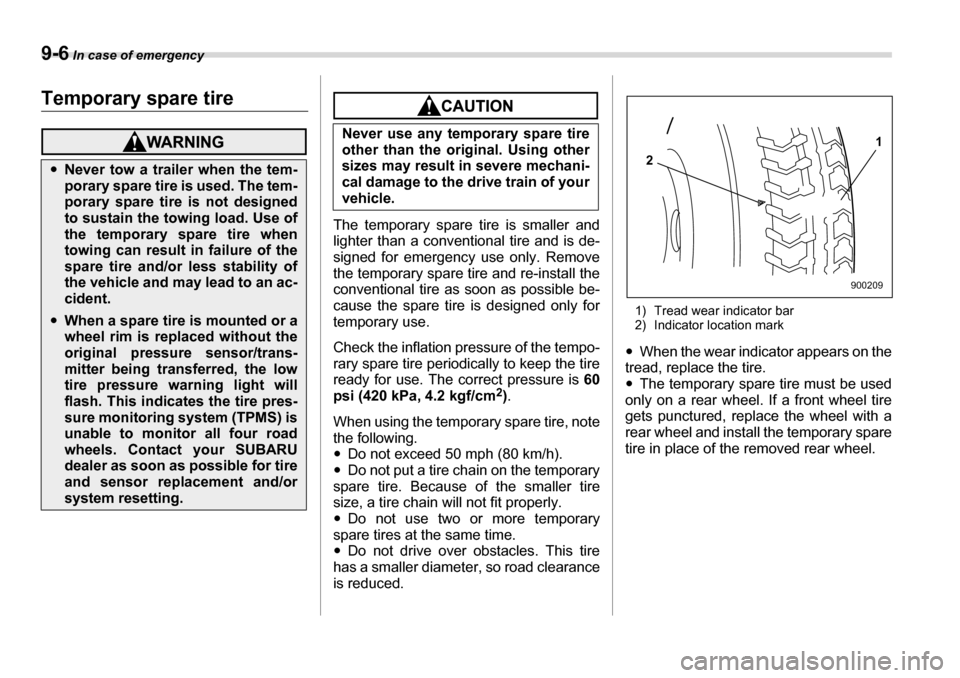
is reduced. 1) Tread wear indicator bar
2) Indicator location mark
y When the wear indicator appears on the
tread, replace the tire. y The temporary spare tire must be used
only on a rear wheel. If a front wheel tire
gets punctured, replace the wheel with a
rear wheel and install the temporary spare
tire in place of the removed rear wheel.
y Never tow a trailer when the tem-
porary spare tire is used. The tem-
porary spare tire is not designed
to sustain the towing load. Use of
the temporary spare tire when
towing can result in failure of the
spare tire and/or less stability of
the vehicle and may lead to an ac-
cident.
yWhen a spare tire is mounted or a
wheel rim is replaced without the
original pressure sensor/trans-
mitter being transferred, the low
tire pressure warning light will
flash. This indicates the tire pres-
sure monitoring system (TPMS) is
unable to monitor all four road
wheels. Contact your SUBARU
dealer as soon as possible for tire
and sensor replacement and/or
system resetting.
Never use any temporary spare tire
other than the original. Using other
sizes may result in severe mechani-
cal damage to the drive train of your
vehicle.1
2
900209
Page 278 of 377
In case of emergency 9-7
– CONTINUED –
Flat tires
If you have a flat tire while driving, never
brake suddenly; keep driving straight
ahead while gradually reducing speed.
Then slowly pull off the road to a safe
place. „Changing a flat tire
1. Park on a hard, level surface, whenev-
er possible, then stop the engine.
2. Set the parking brake securely and
shift in the “P” (Park) position.
3. Turn on the hazard warning flasher and
have everyone get out of the vehicle.
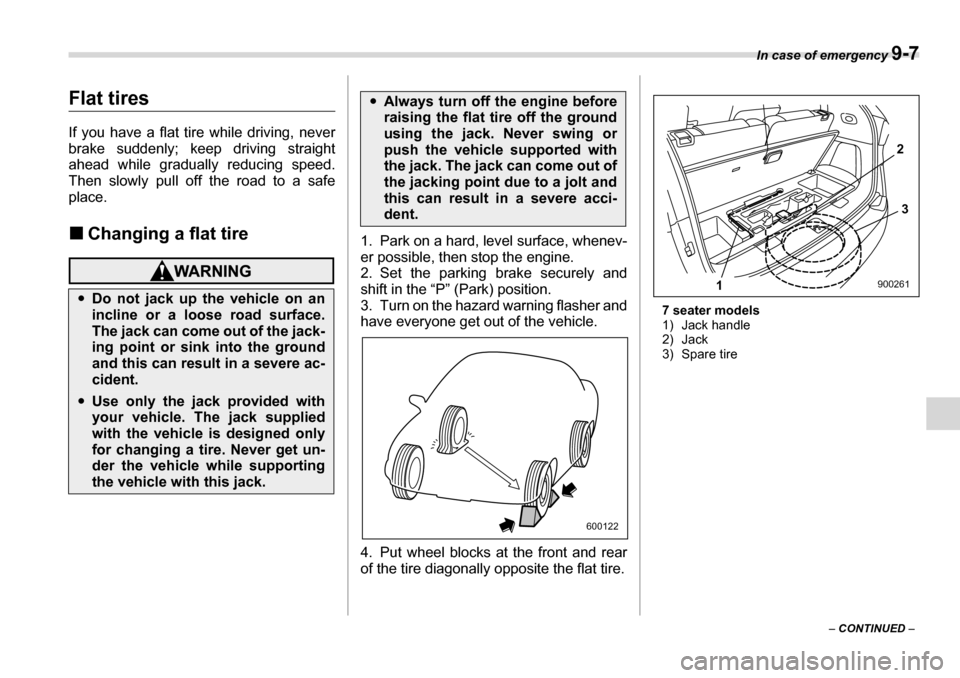
4. Put wheel blocks at the front and rear
of the tire diagonally opposite the flat tire. 7 seater models
1) Jack handle
2) Jack
3) Spare tire
y
Do not jack up the vehicle on an
incline or a loose road surface.
The jack can come out of the jack-
ing point or sink into the ground
and this can result in a severe ac-
cident.
yUse only the jack provided with
your vehicle. The jack supplied
with the vehicle is designed only for changing a tire. Never get un-
der the vehicle while supporting
the vehicle with this jack.
yAlways turn off the engine before
raising the flat tire off the ground
using the jack. Never swing or
push the vehicle supported with
the jack. The jack can come out of
the jacking point due to a jolt and
this can result in a severe acci-
dent.
600122
1 3
2900261
Page 281 of 377
9-10 In case of emergency
use your foot on the wheel nut wrench or
a pipe extension on the wrench because
you may exceed the specified torque.
Have the wheel nut torque checked at the
nearest automotive service facility.
16.Store the flat tire in the spare tire hold- er.
Refer to the sections “Spare tire” in this
chapter for its location, instructions and
precautions.
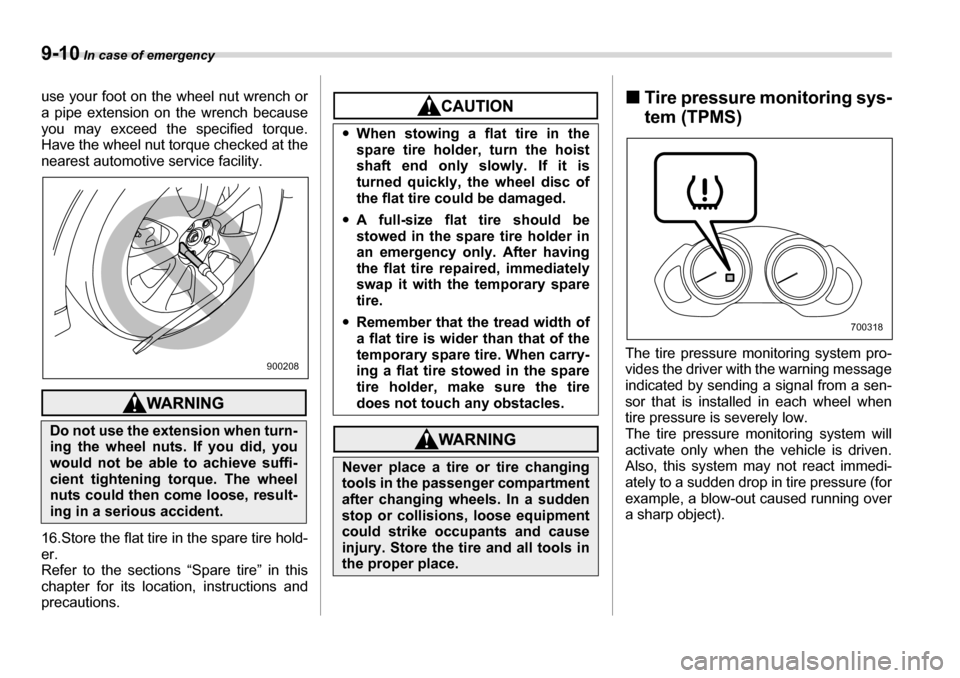
„Tire pressure monitoring sys- tem (TPMS)
The tire pressure monitoring system pro-
vides the driver with the warning message
indicated by sending a signal from a sen-
sor that is installed in each wheel when
tire pressure is severely low.
The tire pressure monitoring system will
activate only when the vehicle is driven.
Also, this system may not react immedi-
ately to a sudden drop in tire pressure (for
example, a blow-out caused running over
a sharp object).
Do not use the extension when turn-
ing the wheel nuts. If you did, you
would not be able to achieve suffi-
cient tightening torque. The wheel
nuts could then come loose, result-
ing in a serious accident.
900208
y When stowing a flat tire in the
spare tire holder, turn the hoist
shaft end only slowly. If it is
turned quickly, the wheel disc of
the flat tire could be damaged.
y A full-size flat tire should be
stowed in the spare tire holder in
an emergency only. After havingthe flat tire repaired, immediately
swap it with the temporary spare tire.
y Remember that the tread width of
a flat tire is wider than that of the
temporary spare tire. When carry-
ing a flat tire stowed in the spare
tire holder, make sure the tire
does not touch any obstacles.
Never place a tire or tire changing
tools in the passenger compartment
after changing wheels. In a sudden
stop or collisions, loose equipment
could strike occupants and cause
injury. Store the tire and all tools in
the proper place.
700318