fuel cap SUBARU TRIBECA 2008 User Guide
[x] Cancel search | Manufacturer: SUBARU, Model Year: 2008, Model line: TRIBECA, Model: SUBARU TRIBECA 2008Pages: 409, PDF Size: 5.75 MB
Page 332 of 409
11-10
Maintenance and service
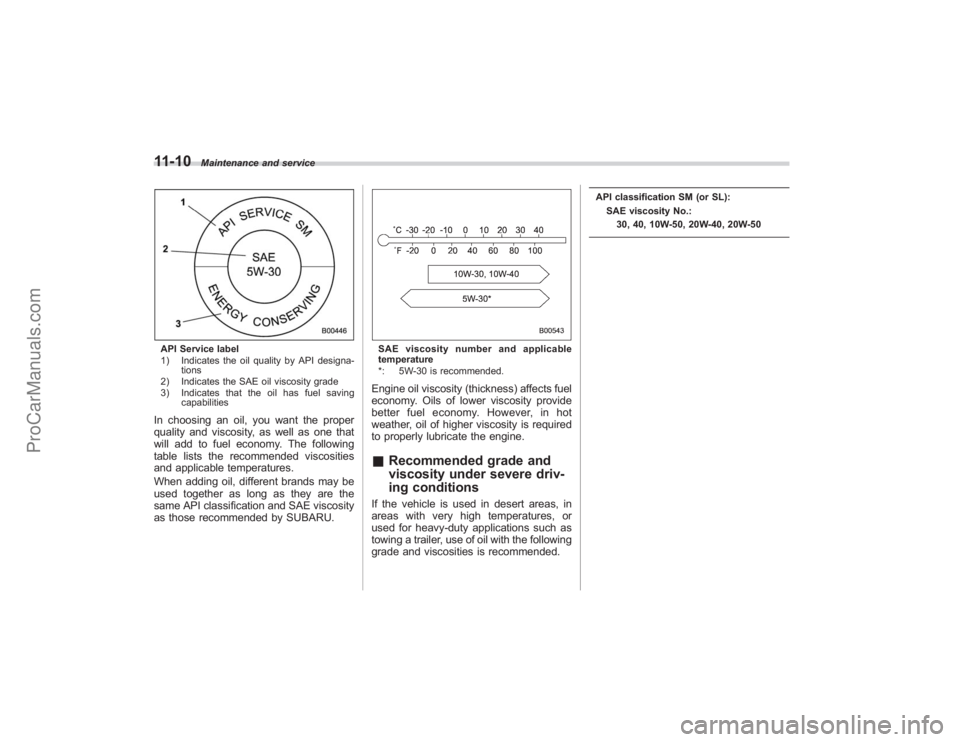
API Service label
1) Indicates the oil quality by API designa-tions
2) Indicates the SAE oil viscosity grade
3) Indicates that the oil has fuel saving capabilitiesIn choosing an oil, you want the proper
quality and viscosity, as well as one that
will add to fuel economy. The following
table lists the recommended viscosities
and applicable temperatures.
When adding oil, different brands may be
used together as long as they are the
same API classification and SAE viscosity
as those recommended by SUBARU.
SAE viscosity number and applicable
temperature
*: 5W-30 is recommended.Engine oil viscosity (thickness) affects fuel
economy. Oils of lower viscosity provide
better fuel economy. However, in hot
weather, oil of higher viscosity is required
to properly lubricate the engine.&Recommended grade and
viscosity under severe driv-
ing conditionsIf the vehicle is used in desert areas, in
areas with very high temperatures, or
used for heavy-duty applications such as
towing a trailer, use of oil with the following
grade and viscosities is recommended.
API classification SM (or SL):
SAE viscosity No.:30, 40, 10W-50, 20W-40, 20W-50
ProCarManuals.com
Page 333 of 409
Cooling system
WARNING
Never attempt to remove the radia-
tor cap until the engine has been
shut off and has cooled down
completely. Since the coolant is
under pressure, you may suffer
serious burns from a spray of boil-
ing hot coolant when the cap is
removed.
CAUTION
.The cooling system has been
filled at the factory with a high
quality, corrosion-inhibiting,
year-around coolant which pro-
vides protection against freezing
down to −33 8F( −36 8C).
Subaru engines use aluminum
components that require the
anti-corrosive and anti-freeze
properties of Subaru Genuine
Coolant, which is specifically
formulated for the Subaru cool-
ing system. Failure to use Subaru
Genuine Coolant along with
Subaru Cooling System Condi-
tioner at the recommended main- tenance intervals may result in
problems, including, but not lim-
ited to shortened life of engine
components and cooling system
clogging, coolant leaks and en-
gine damage from overheating.
Problems caused by the failure to
use Subaru Genuine Coolant and
Subaru Cooling System Condi-
tioner at recommended intervals
are not covered under the
Subaru Limited Warranty.
While there may be other generic
products that may provide the
required protection, they have
not been tested for compatibility
with Subaru engines and cooling
system components, and there-
fore not recommended.
. Do not splash the engine coolant
over painted parts. The alcohol
contained in the engine coolant
may damage the paint surface.
& Hose and connectionsYour vehicle employs an electric cooling
fan which is thermostatically controlled to
operate when the engine coolant reaches
a specific temperature.
If the radiator cooling fan does not operate even when the engine coolant tempera-
ture gauge exceeds the normal operating
range, the cooling fan circuit may be
defective. Check the fuse and replace it
if necessary. If the fuse is not blown, have
the cooling system checked by your
SUBARU dealer.
If frequent addition of coolant is neces-
sary, there may be a leak in the engine
cooling system. It is recommended that
the cooling system and connections be
checked for leaks, damage, or looseness.
&
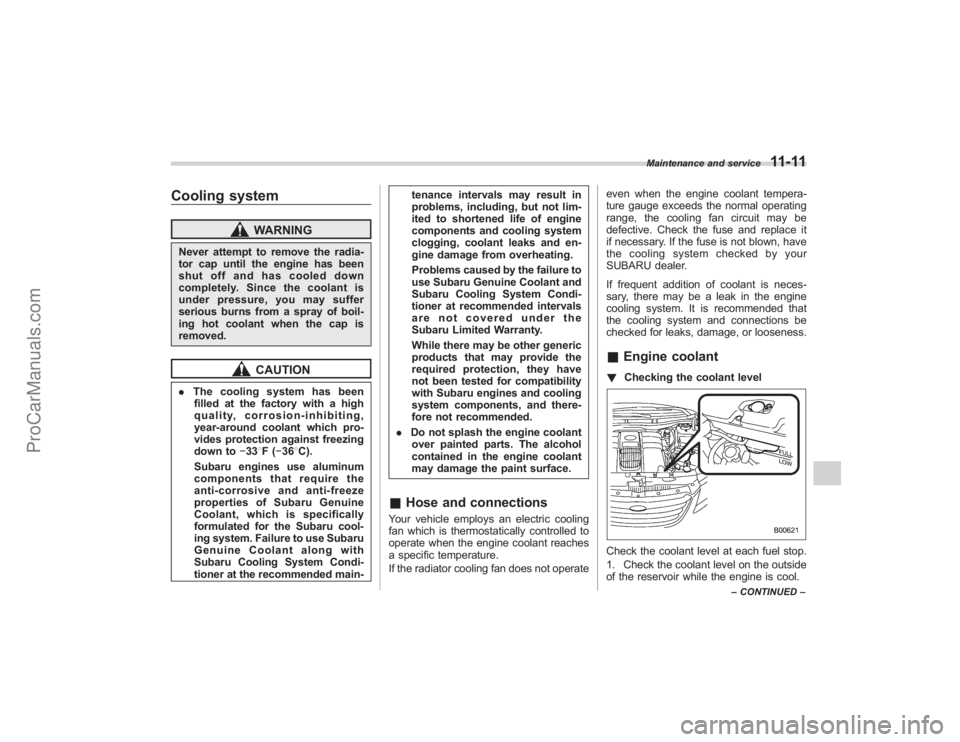
Engine coolant! Checking the coolant levelCheck the coolant level at each fuel stop.
1. Check the coolant level on the outside
of the reservoir while the engine is cool.
Maintenance and service
11-11
–CONTINUED –
ProCarManuals.com
Page 375 of 409
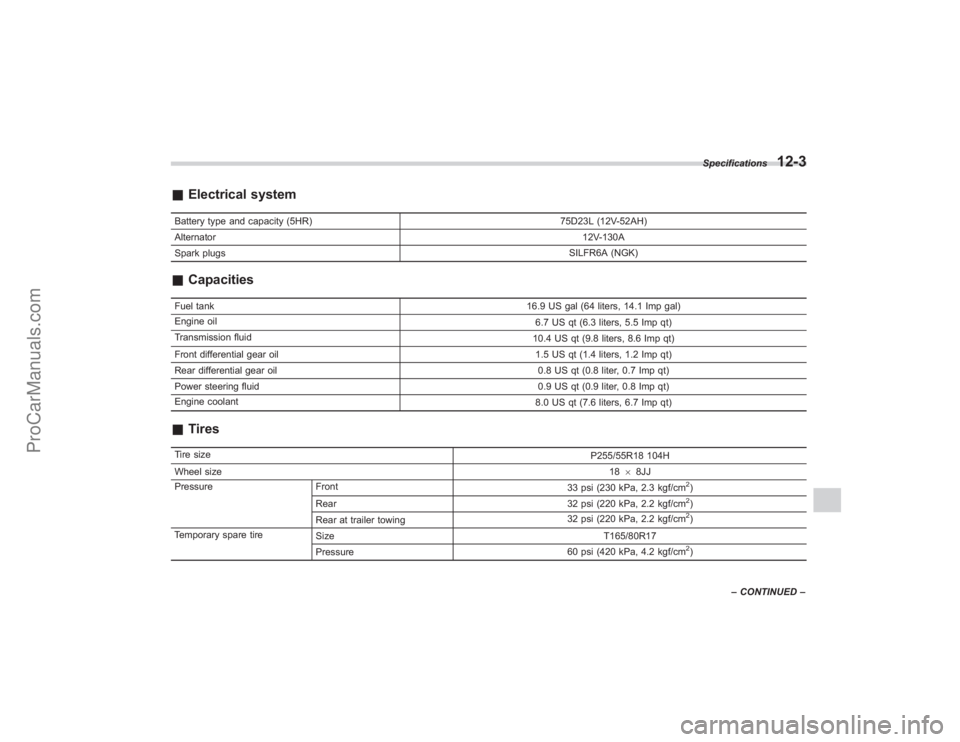
&Electrical systemBattery type and capacity (5HR) 75D23L (12V-52AH)
Alternator 12V-130A
Spark plugs SILFR6A (NGK)&
CapacitiesFuel tank 16.9 US gal (64 liters, 14.1 Imp gal)
Engine oil 6.7 US qt (6.3 liters, 5.5 Imp qt)
Transmission fluid 10.4 US qt (9.8 liters, 8.6 Imp qt)
Front differential gear oil 1.5 US qt (1.4 liters, 1.2 Imp qt)
Rear differential gear oil 0.8 US qt (0.8 liter, 0.7 Imp qt)
Power steering fluid 0.9 US qt (0.9 liter, 0.8 Imp qt)
Engine coolant 8.0 US qt (7.6 liters, 6.7 Imp qt)&TiresTire size
P255/55R18 104H
Wheel size 1868JJ
Pressure Front 33 psi (230 kPa, 2.3 kgf/cm
2)
Rear 32 psi (220 kPa, 2.2 kgf/cm2)
Rear at trailer towing 32 psi (220 kPa, 2.2 kgf/cm2)
Temporary spare tire Size T165/80R17
Pressure 60 psi (420 kPa, 4.2 kgf/cm2)Specifications
12-3
–
CONTINUED –
ProCarManuals.com
Page 389 of 409
whitewall, bears white lettering
or bears manufacturer, brand,
and/or model name molding that
is higher or deeper than the
same molding on the other side-
wall of the tire, or(2)
The outward facing sidewall
of an asymmetrical tire that has
a particular side that must al-
ways face outward when mount-
ing on a vehicle.
.
Accessory weight
The combined weight (in excess of
those standard items which may be
replaced) of floor mats, leather
seats and cross bars to the extent
that these items are available as
factory-installed equipment
(whether installed or not)..
Curb weight
The weight of a motor vehicle with
standard equipment including the
maximum capacity of fuel, oil, and
coolant and air conditioning..
Maximum loaded vehicle weight
The sum of curb weight, accessory
weight, vehicle capacity weight and production options weight.
.
Normal occupant weight
150 lbs (68 kg) times the number of
occupants (3 occupants)..
Occupant distribution
Distribution of occupants in a vehi-
cle, 2 in front, 1 in rear seat..
Production options weight
The combined weight of those
installed regular production options
weighing over 5.1 lbs (2.3 kg) in
excess of those standards items
which they replace, not previously
considered in curb weight or acces-
sory weight..
Vehicle capacity weight
The total weight of cargo, luggage
and occupants that can be added to
the vehicle..
Vehicle maximum load on a tire
Load on an individual tire that is
determined by distributing to each
axle its share of the maximum
loaded vehicle weight and dividing
by two..
Vehicle normal load on a tire
Load on an individual tire that isdetermined by distributing to each
axle its share of the curb weight,
accessory weight, and normal oc-
cupant weight and dividing by two.
&
Tire care –maintenance and
safety practices.
Check on a daily basis that the
tires are free from serious damage,
nails, and stones. At the same time,
check the tires for abnormal wear.
.
Inspect the tire tread regularly
and replace the tires before their
tread wear indicators become visi-
ble. When a tire ’s tread wear
indicator becomes visible, the tire
is worn beyond the acceptable limit
and must be replaced immediately.
With a tire in this condition, driving
at even low speeds in wet weather
can cause the vehicle to hydro-
plane. Possible resulting loss of
vehicle control can lead to an
accident.
.
To maximize the life of each tire
and ensure that the tires wear
uniformly, it is best to rotate the
Consumer information and Reporting safety defects
13-7
– CONTINUED –
ProCarManuals.com
Page 400 of 409

14-4
Index
Pets........................................................................\
. 7
Snowy and icy roads ............................................... 8-9
Tips....................................................................... 8-4
Tired or sleepy. .......................................................... 7
E
Electrical system ........................................................ 12-3
Electronic Brake Force Distribution (EBD) system ................................................. 3-17, 7-22
Emergency Locking Retractor (ELR) ............................. 1-17
Engine
Compartment overview ........................................... 11-6
Coolant ............................................................... 11-11
Exhaust gas (Carbon monoxide) ............................ 5, 8-2
Hood .................................................................... 11-4
Oil........................................................................\
11-7
Overheating .......................................................... 9-14
Starting .................................................................. 7-7
Stopping ................................................................ 7-8
Exterior care .............................................................. 10-2
F
Flat tires .................................................................... 9-6
Floor mat .................................................................. 6-12
Fluid level Automatic transmission ........................................ 11-15
Brake ................................................................. 11-20
Power steering .................................................... 11-19
Fog light switch .......................................................... 3-32
Folding mirror switch .................................................. 3-41 Front
Differential gear oil ................................................ 11-17
Fog light .............................................................. 11-45
Seatbelt pretensioners ........................................... 1-27
Seats ..................................................................... 1-2
Turn signal light .................................................... 11-45
Front seats Fore and aft adjustment ........................................... 1-3
Reclining ................................................................ 1-3
Fuel ........................................................................\
... 7-2
Economy hints ........................................................ 8-2
Filler lid and cap ...................................................... 7-3
Gauge .................................................................... 3-8
Requirements ......................................................... 7-2
Fuses ..................................................................... 11-38
Fuses and circuits ..................................................... 12-5
G
GAWR (Gross Axle Weight Rating) .............................. 8-12
Glove box ................................................................... 6-5
GVWR (Gross Vehicle Weight Rating) ... ....................... 8-12
H
Hazard warning flasher .......................................... 3-5, 9-2
Head restraint adjustment ............................................. 1-5
Rear .................................................................... 1-11
Headlight Beam leveler. ........................................................ 3-29
Flasher ................................................................. 3-27
Indicator light ........................................................ 3-21
Headlights ....................................................... 3-26, 11-42
ProCarManuals.com
Page 405 of 409
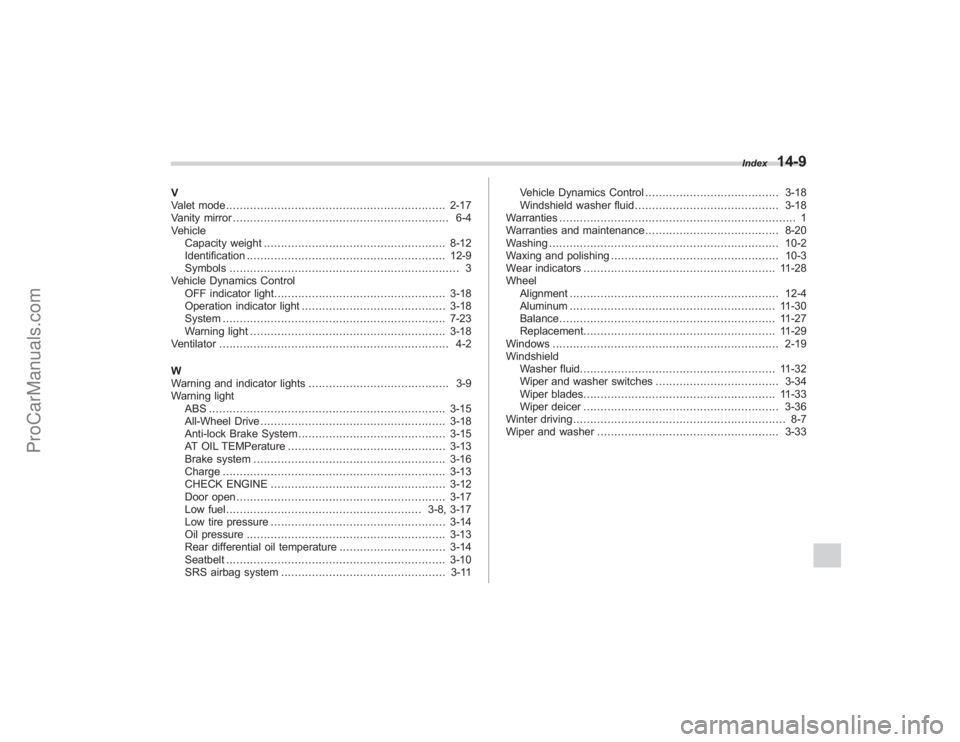
V
Valet mode................................................................ 2-17
Vanity mirror ............................................................... 6-4
Vehicle Capacity weight ..................................................... 8-12
Identification .......................................................... 12-9
Symbols ................................................................... 3
Vehicle Dynamics Control OFF indicator light .................................................. 3-18
Operation indicator light .......................................... 3-18
System ................................................................. 7-23
Warning light ......................................................... 3-18
Ventilator ................................................................... 4-2
W
Warning and indicator lights ......................................... 3-9
Warning light
ABS ..................................................................... 3-15
All-Wheel Drive ...................................................... 3-18
Anti-lock Brake System ........................................... 3-15
AT OIL TEMPerature .............................................. 3-13
Brake system ........................................................ 3-16
Charge ................................................................. 3-13
CHECK ENGINE ................................................... 3-12
Door open ............................................................. 3-17
Low fuel ......................................................... 3-8, 3-17
Low tire pressure ................................................... 3-14
Oil pressure .......................................................... 3-13
Rear differential oil temperature ............................... 3-14
Seatbelt ................................................................ 3-10
SRS airbag system ................................................ 3-11 Vehicle Dynamics Control
....................................... 3-18
Windshield washer fluid .......................................... 3-18
Warranties ..................................................................... 1
Warranties and maintenance ....................................... 8-20
Washing ................................................................... 10-2
Waxing and polishing ................................................. 10-3
Wear indicators ........................................................ 11-28
Wheel Alignment ............................................................. 12-4
Aluminum ............................................................ 11-30
Balance ............................................................... 11-27
Replacement. ....................................................... 11-29
Windows .................................................................. 2-19
Windshield Washer fluid. ........................................................ 11-32
Wiper and washer switches .................................... 3-34
Wiper blades ........................................................ 11-33
Wiper deicer ......................................................... 3-36
Winter driving .............................................................. 8-7
Wiper and washer ..................................................... 3-33
Index
14-9
ProCarManuals.com
Page 409 of 409
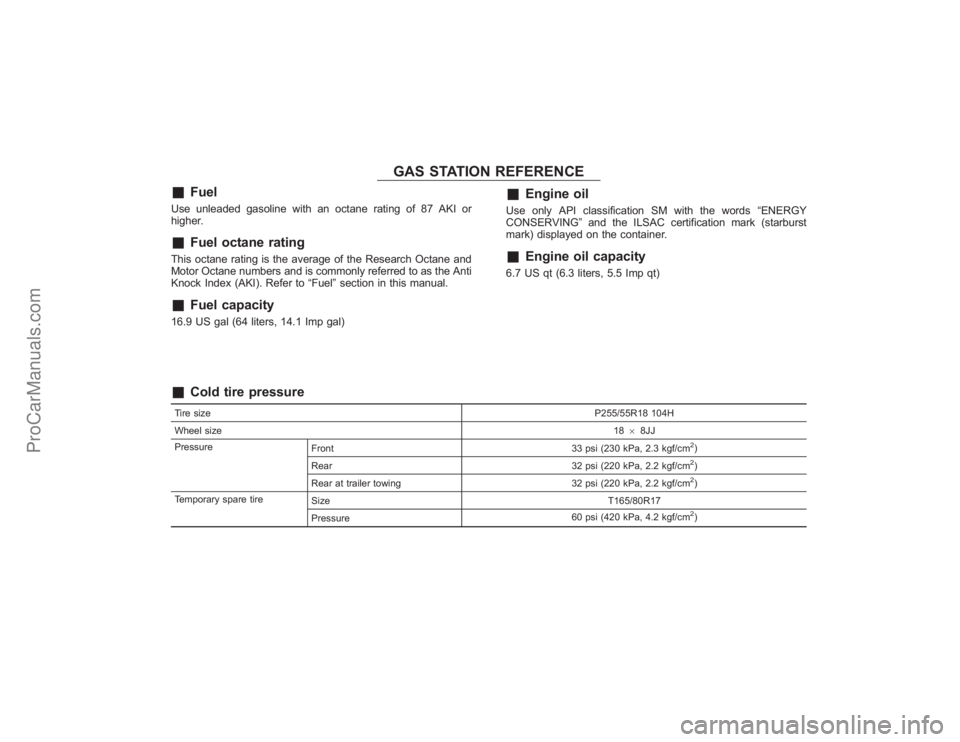
GAS STATION REFERENCE
&
Fuel
Use unleaded gasoline with an octane rating of 87 AKI or
higher.&
Fuel octane rating
This octane rating is the average of the Research Octane and
Motor Octane numbers and is commonly referred to as the Anti
Knock Index (AKI). Refer to “Fuel”section in this manual.&
Fuel capacity
16.9 US gal (64 liters, 14.1 Imp gal)
&
Engine oil
Use only API classification SM with the words “ENERGY
CONSERVING ”and the ILSAC certification mark (starburst
mark) displayed on the container.&
Engine oil capacity
6.7 US qt (6.3 liters, 5.5 Imp qt)
&
Cold tire pressure
Tire size P255/55R18 104H
Wheel size 1868JJ
Pressure Front 33 psi (230 kPa, 2.3 kgf/cm
2)
Rear 32 psi (220 kPa, 2.2 kgf/cm2)
Rear at trailer towing 32 psi (220 kPa, 2.2 kgf/cm2)
Temporary spare tire Size T165/80R17
Pressure 60 psi (420 kPa, 4.2 kgf/cm2)
ProCarManuals.com