roof SUBARU TRIBECA 2008 Owner's Manual
[x] Cancel search | Manufacturer: SUBARU, Model Year: 2008, Model line: TRIBECA, Model: SUBARU TRIBECA 2008Pages: 409, PDF Size: 5.75 MB
Page 281 of 409
adjusted by relocating luggage inside the
vehicle.
Even if the total weight of your luggage is
lower than the vehicle capacity weight,
either front or rear GAW may exceed the
GAWR, depending on the distribution of
the luggage.
When possible, the load should be evenly
distributed throughout the vehicle.
If you carry heavy loads in the vehicle, you
should confirm that GVW and front and
rear GAWs are within the GVWR and
GAWR by putting your vehicle on a
vehicle scale, found at a commercial
weighing station.
Do not use replacement tires with a lower
load range than the originals because they
may lower the GVWR and GAWR limita-
tions. Replacement tires with a higher load
range than the originals do not increase
the GVWR and GAWR limitations.
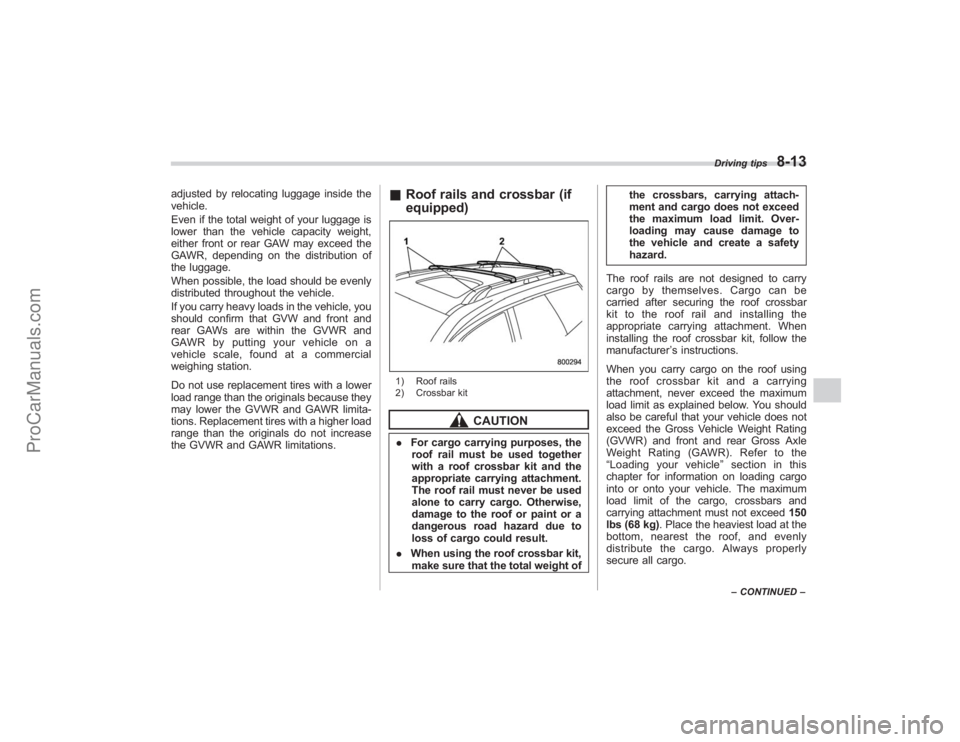
&Roof rails and crossbar (if
equipped)1) Roof rails
2) Crossbar kit
CAUTION
. For cargo carrying purposes, the
roof rail must be used together
with a roof crossbar kit and the
appropriate carrying attachment.
The roof rail must never be used
alone to carry cargo. Otherwise,
damage to the roof or paint or a
dangerous road hazard due to
loss of cargo could result.
. When using the roof crossbar kit,
make sure that the total weight of the crossbars, carrying attach-
ment and cargo does not exceed
the maximum load limit. Over-
loading may cause damage to
the vehicle and create a safety
hazard.
The roof rails are not designed to carry
cargo by themselves. Cargo can be
carried after securing the roof crossbar
kit to the roof rail and installing the
appropriate carrying attachment. When
installing the roof crossbar kit, follow the
manufacturer ’s instructions.
When you carry cargo on the roof using
the roof crossbar kit and a carrying
attachment, never exceed the maximum
load limit as explained below. You should
also be careful that your vehicle does not
exceed the Gross Vehicle Weight Rating
(GVWR) and front and rear Gross Axle
Weight Rating (GAWR). Refer to the
“ Loading your vehicle ”section in this
chapter for information on loading cargo
into or onto your vehicle. The maximum
load limit of the cargo, crossbars and
carrying attachment must not exceed 150
lbs (68 kg) . Place the heaviest load at the
bottom, nearest the roof, and evenly
distribute the cargo. Always properly
secure all cargo.
Driving tips
8-13
– CONTINUED –
ProCarManuals.com
Page 282 of 409
8-14
Driving tips
!Installing carrying attachments on
the crossbars
When installing any carrying attachment
such as a bike carrier, ski carrier, kayak
carrier, cargo basket, etc. on the cross-
bars, follow the manufacturer ’s instruc-
tions and make sure that the attachment is
securely fixed to the crossbars. Use only
attachments designed specifically for the
crossbars. A set of the crossbars is
designed to carry loads (cargo and attach-
ment) of not more than 150 lbs (68 kg).
Before operating the vehicle, make sure
that the cargo is properly secured on the
attachment.NOTERemember that the vehicle ’s center of
gravity is altered with the weight of the
load on the roof, thus affecting the
driving characteristics.
Drive carefully. Avoid rapid starts, hard
cornering and abrupt stops. Crosswind
effects will be increased.
! Removal and installation of the
crossbars
The crossbars can be removed when you
do not use the roof to carry cargo. !
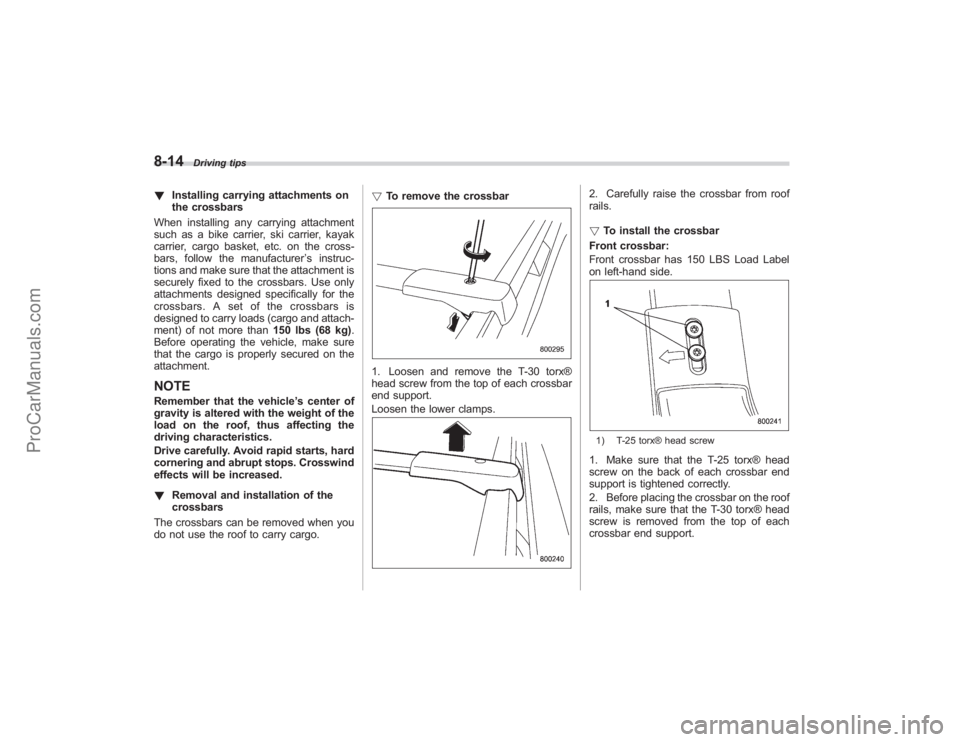
To remove the crossbar
1. Loosen and remove the T-30 torx®
head screw from the top of each crossbar
end support.
Loosen the lower clamps.
2. Carefully raise the crossbar from roof
rails.
!To install the crossbar
Front crossbar:
Front crossbar has 150 LBS Load Label
on left-hand side.1) T-25 torx® head screw1. Make sure that the T-25 torx® head
screw on the back of each crossbar end
support is tightened correctly.
2. Before placing the crossbar on the roof
rails, make sure that the T-30 torx® head
screw is removed from the top of each
crossbar end support.
ProCarManuals.com
Page 283 of 409
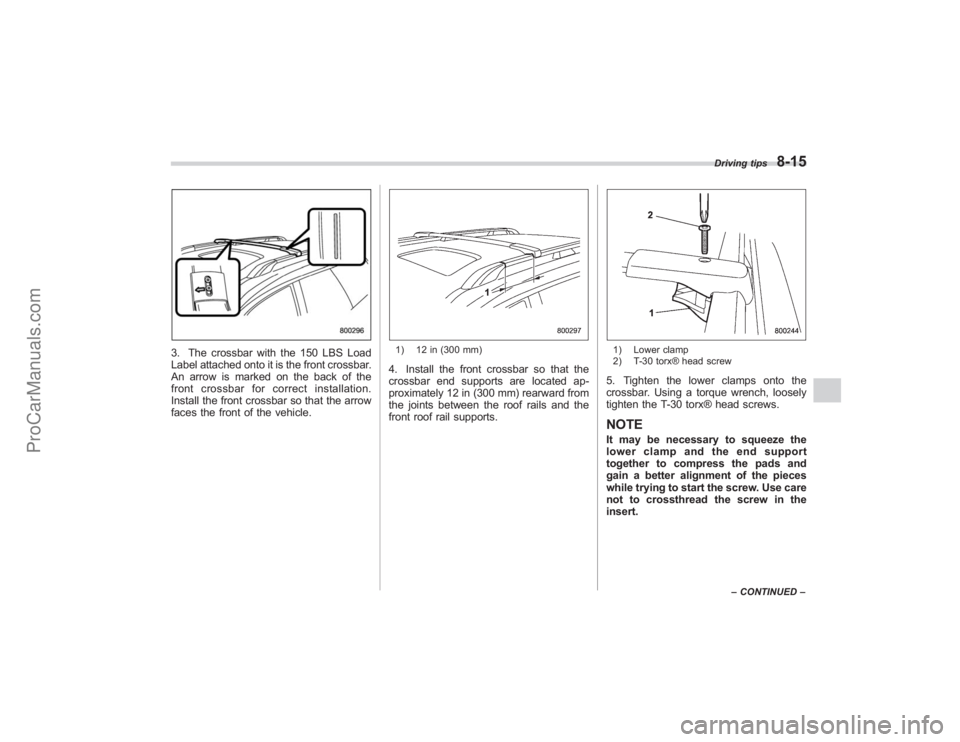
3. The crossbar with the 150 LBS Load
Label attached onto it is the front crossbar.
An arrow is marked on the back of the
front crossbar for correct installation.
Install the front crossbar so that the arrow
faces the front of the vehicle.
1) 12 in (300 mm)4. Install the front crossbar so that the
crossbar end supports are located ap-
proximately 12 in (300 mm) rearward from
the joints between the roof rails and the
front roof rail supports.
1) Lower clamp
2) T-30 torx® head screw5. Tighten the lower clamps onto the
crossbar. Using a torque wrench, loosely
tighten the T-30 torx® head screws.NOTEIt may be necessary to squeeze the
lower clamp and the end support
together to compress the pads and
gain a better alignment of the pieces
while trying to start the screw. Use care
not to crossthread the screw in the
insert.
Driving tips
8-15
–CONTINUED –
ProCarManuals.com
Page 284 of 409
8-16
Driving tips
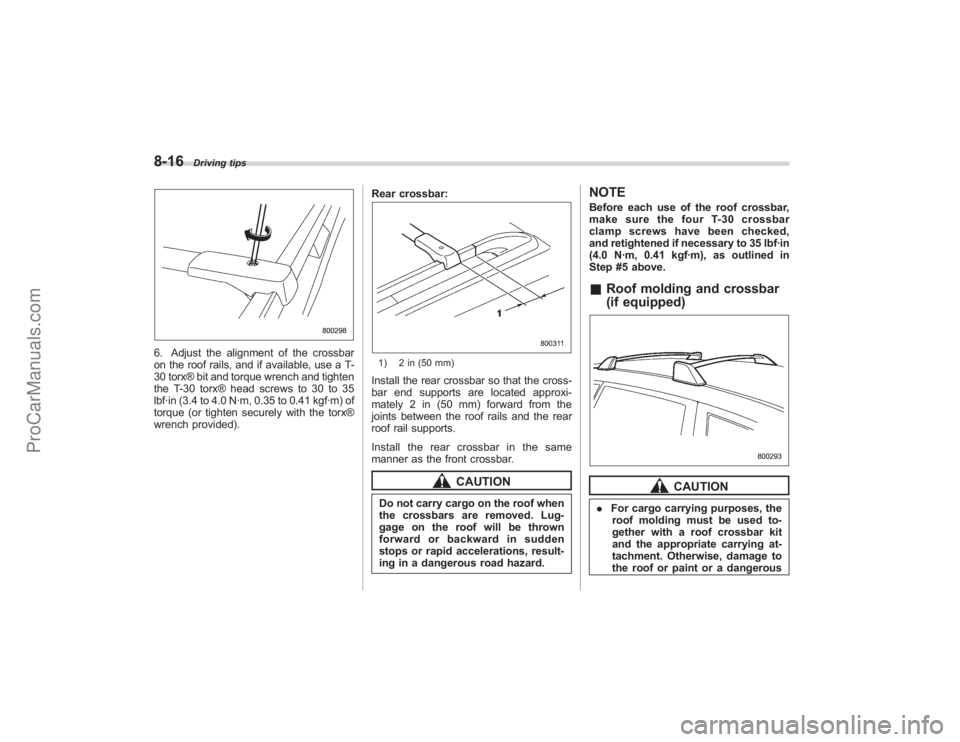
6. Adjust the alignment of the crossbar
on the roof rails, and if available, use a T-
30 torx® bit and torque wrench and tighten
the T-30 torx® head screws to 30 to 35
lbf·in (3.4 to 4.0 N·m, 0.35 to 0.41 kgf·m) of
torque (or tighten securely with the torx®
wrench provided).Rear crossbar:
1) 2 in (50 mm)Install the rear crossbar so that the cross-
bar end supports are located approxi-
mately 2 in (50 mm) forward from the
joints between the roof rails and the rear
roof rail supports.
Install the rear crossbar in the same
manner as the front crossbar.
CAUTION
Do not carry cargo on the roof when
the crossbars are removed. Lug-
gage on the roof will be thrown
forward or backward in sudden
stops or rapid accelerations, result-
ing in a dangerous road hazard.
NOTEBefore each use of the roof crossbar,
make sure the four T-30 crossbar
clamp screws have been checked,
and retightened if necessary to 35 lbf·in
(4.0 N·m, 0.41 kgf·m), as outlined in
Step #5 above.&
Roof molding and crossbar
(if equipped)
CAUTION
. For cargo carrying purposes, the
roof molding must be used to-
gether with a roof crossbar kit
and the appropriate carrying at-
tachment. Otherwise, damage to
the roof or paint or a dangerous
ProCarManuals.com
Page 285 of 409
road hazard due to loss of cargo
could result.
. When using the roof crossbar kit,
make sure that the total weight of
the crossbars, carrying attach-
ment and cargo does not exceed
the maximum load limit. Over-
loading may cause damage to
the vehicle and create a safety
hazard.
Cargo can be carried after securing the
roof crossbar kit to the roof molding and
installing the appropriate carrying attach-
ment. When installing the roof crossbar
kit, follow the manufacturer ’s instructions.
When you carry cargo on the roof using
the roof crossbar kit and a carrying
attachment, never exceed the maximum
load limit as explained below. You should
also be careful that your vehicle does not
exceed the Gross Vehicle Weight Rating
(GVWR) and front and rear Gross Axle
Weight Rating (GAWR). Refer to the
“ Loading your vehicle” section in this
chapter for information on loading cargo
into or onto your vehicle. The maximum
load limit of the cargo, crossbars and
carrying attachment must not exceed 150
lbs (68 kg) . Place the heaviest load at the
bottom, nearest the roof, and evenly
distribute the cargo. Always properly secure all cargo.
!
Installing carrying attachments on
the crossbars
When installing any carrying attachment
such as a bike carrier, ski carrier, kayak
carrier, cargo basket, etc. on the cross-
bars, follow the manufacturer ’s instruc-
tions and make sure that the attachment is
securely fixed to the crossbars. Use only
attachments designed specifically for the
crossbars. A set of the crossbars is
designed to carry loads (cargo and attach-
ment) of not more than 150 lbs (68 kg).
Before operating the vehicle, make sure
that the cargo is properly secured on the
attachment.
NOTERemember that the vehicle ’s center of
gravity is altered with the weight of the
load on the roof, thus affecting the
driving characteristics.
Drive carefully. Avoid rapid starts, hard
cornering and abrupt stops. Crosswind
effects will be increased. !
Removal and installation of the
crossbars
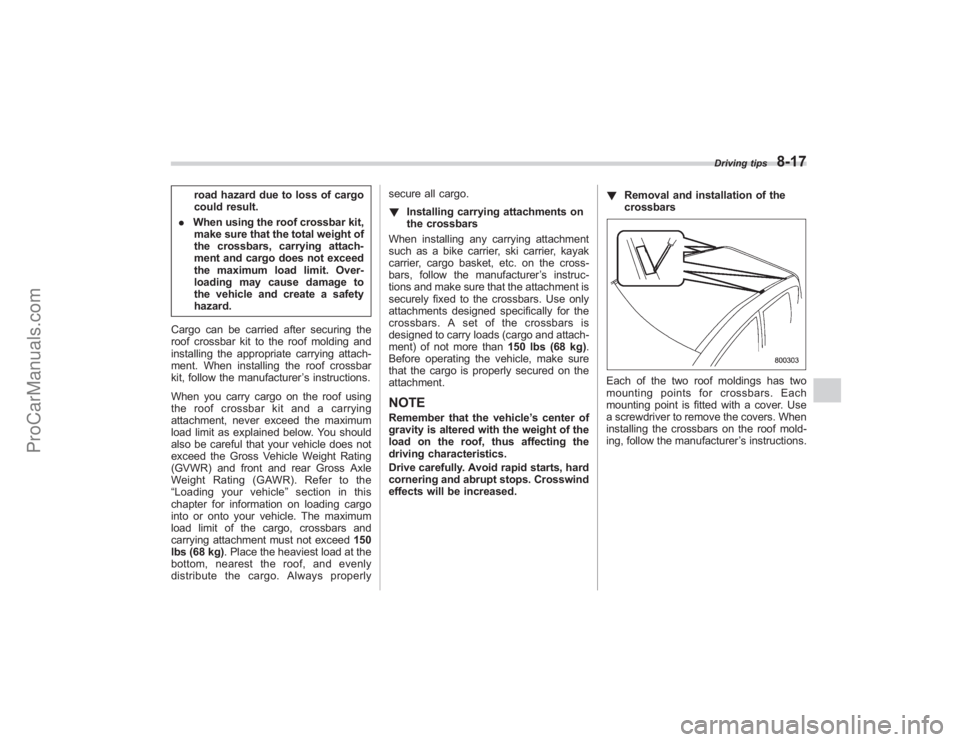
Each of the two roof moldings has two
mounting points for crossbars. Each
mounting point is fitted with a cover. Use
a screwdriver to remove the covers. When
installing the crossbars on the roof mold-
ing, follow the manufacturer ’s instructions.
Driving tips
8-17
ProCarManuals.com
Page 372 of 409
11-50
Maintenance and service
2. Pull the bulb out of the socket. Install a
new bulb.
3. Reinstall the lens.&Door step lightIt may be difficult to replace the bulbs.
Have the bulbs replaced by your SUBARU
dealer if necessary.
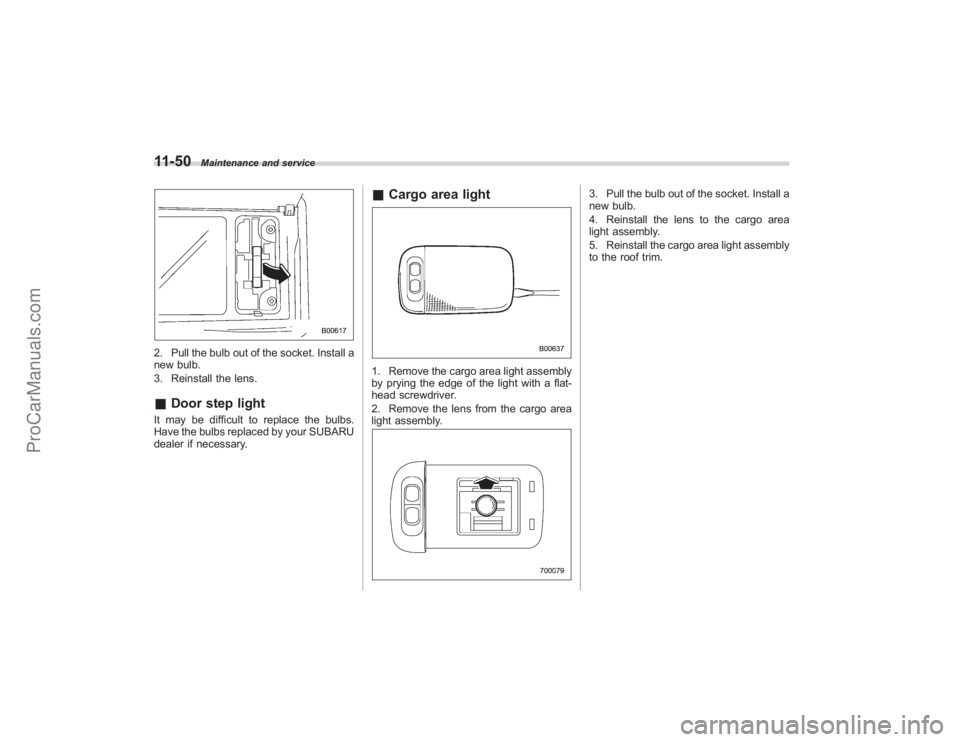
&Cargo area light1. Remove the cargo area light assembly
by prying the edge of the light with a flat-
head screwdriver.
2. Remove the lens from the cargo area
light assembly.
3. Pull the bulb out of the socket. Install a
new bulb.
4. Reinstall the lens to the cargo area
light assembly.
5. Reinstall the cargo area light assembly
to the roof trim.
ProCarManuals.com
Page 374 of 409
12-2
Specifications
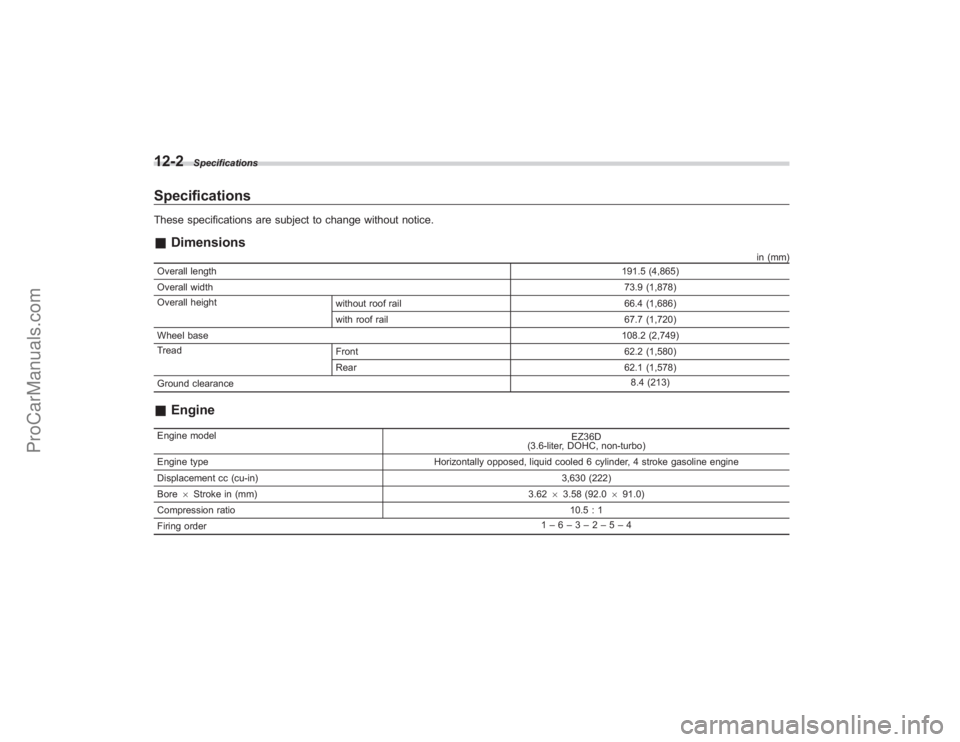
SpecificationsThese specifications are subject to change without notice.&Dimensions
in (mm)
Overall length 191.5 (4,865)
Overall width 73.9 (1,878)
Overall height without roof rail 66.4 (1,686)
with roof rail 67.7 (1,720)
Wheel base 108.2 (2,749)
Tread Front 62.2 (1,580)
Rear 62.1 (1,578)
Ground clearance 8.4 (213)
&
EngineEngine model
EZ36D
(3.6-liter, DOHC, non-turbo)
Engine type Horizontally opposed, liquid cooled 6 cylinder, 4 stroke gasoline engine
Displacement cc (cu-in) 3,630 (222)
Bore 6Stroke in (mm) 3.62 63.58 (92.0 691.0)
Compression ratio 10.5 : 1
Firing order 1
–6 –3–2 –5–4
ProCarManuals.com
Page 377 of 409
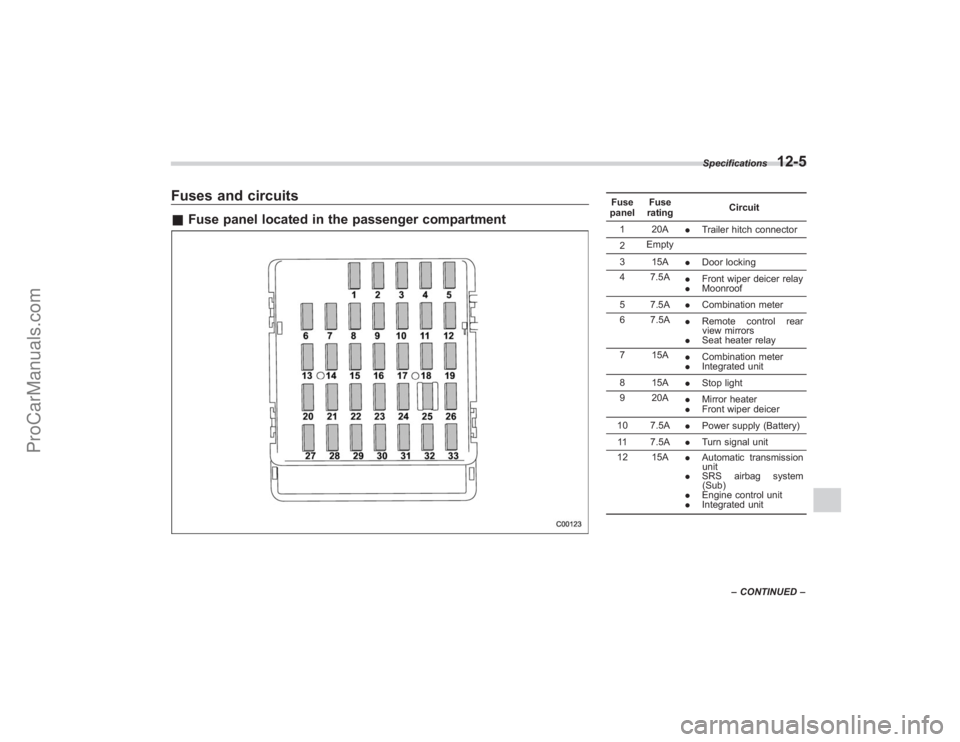
Fuses and circuits&Fuse panel located in the passenger compartment
Fuse
panel Fuse
rating Circuit
1 20A .Trailer hitch connector
2 Empty
3 15A .Door locking
4 7.5A .Front wiper deicer relay
. Moonroof
5 7.5A .Combination meter
6 7.5A .Remote control rear
view mirrors
. Seat heater relay
7 15A .Combination meter
. Integrated unit
8 15A .Stop light
9 20A .Mirror heater
. Front wiper deicer
10 7.5A .Power supply (Battery)
11 7.5A .Turn signal unit
12 15A .Automatic transmission
unit
. SRS airbag system
(Sub)
. Engine control unit
. Integrated unitSpecifications
12-5
–
CONTINUED –
ProCarManuals.com
Page 390 of 409
13-8
Consumer information and Reporting safety defects
tires every 7,500 miles (12,000 km).
Rotating the tires involves switch-
ing the front and rear tires on the
right-hand side of the vehicle and
similarly switching the front and
rear tires on the left-hand side of
the vehicle. (Each tire must be kept
on its original side of the vehicle.)
Replace any damaged or unevenly
worn tire at the time of rotation.
After tire rotation, adjust the tire
pressures and make sure the wheel
nuts are correctly tightened. A
tightening torque specification and
a tightening sequence specification
for the wheel nuts can be found
“Flat tires”in chapter 9.& Vehicle load limit –how to
determineThe load capacity of your vehicle is
determined by weight, not by avail-
able cargo space. The load limit of
your vehicle is shown on the
vehicle placard attached to the
driver ’s side B-pillar. Locate the
statement “The combined weight of occupants and cargo should
never exceed XXX kg or XXX lbs
”
on your vehicle ’s placard.
Thevehicleplacardalsoshows
seating capacity of your vehicle.
The total load capacity includes the
total weight of driver and all pas-
sengers and their belongings, any
cargo, any optional equipment such
as a trailer hitch, roof rack or bike
carrier, etc., and the tongue load of
a trailer. Therefore cargo capacity
can be calculated by the following
method.
Cargo capacity = Load limit −(total
weight of occupants + total weight
of optional equipment + tongue
load of a trailer (if applicable))
For towing capacity information and
weight limits, refer to “
Trailer towing”
section in chapter 8.
! Calculating total and load ca-
pacities varying seating con-
figurations
Calculate the available load capa-
city as shown in the following examples:
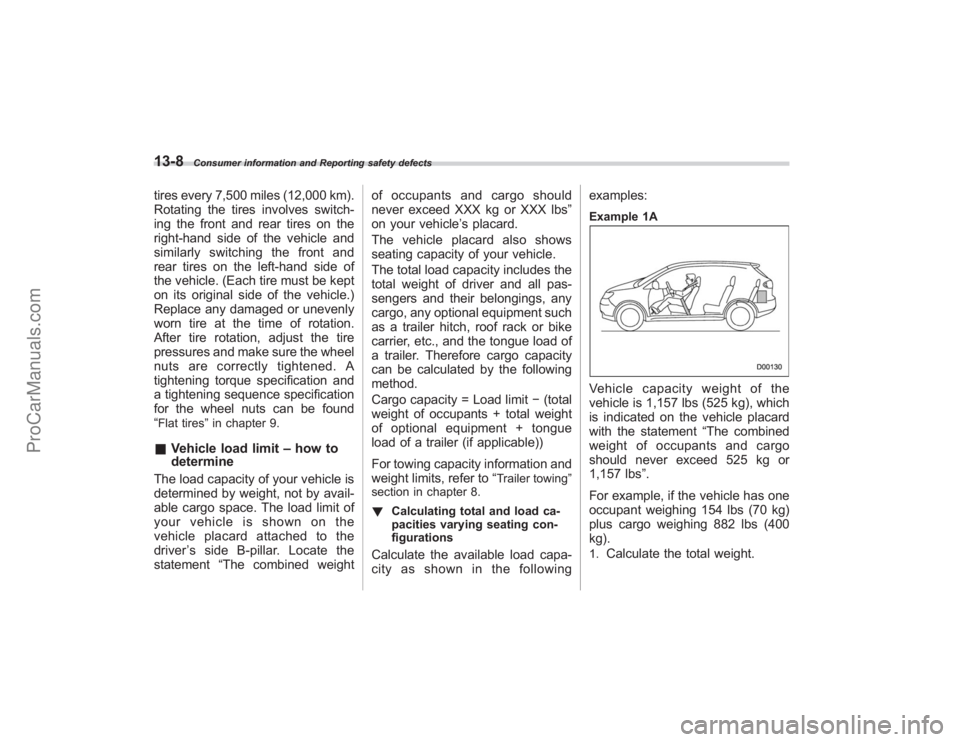
Example 1AVehicle capacity weight of the
vehicle is 1,157 lbs (525 kg), which
is indicated on the vehicle placard
with the statement
“The combined
weight of occupants and cargo
should never exceed 525 kg or
1,157 lbs ”.
For example, if the vehicle has one
occupant weighing 154 lbs (70 kg)
plus cargo weighing 882 lbs (400
kg).1.
Calculate the total weight.
ProCarManuals.com
Page 402 of 409
14-6
Index
Seatbelt................................................................ 1-27
Tools .................................................................... 9-19
Malfunction indicator lamp ........................................... 3-12
Map light ........................................................... 6-3, 11-49
Maximum load limits ................................................... 8-20
Meters and gauges ..................................................... 3-5
Mirrors ...................................................................... 3-38
Moonroof .................................................................. 2-23
Multi function display .................................................. 3-23
N
New vehicle break-in driving ......................................... 8-2
O
Odometer ................................................................... 3-6
Oil filter ..................................................................... 11-8
Oil level Engine .................................................................. 11-7
Front differential gear ........................................... 11-17
Rear differential ................................................... 11-18
Oil pressure warning light ............................................ 3-13
On-pavement and off road driving ................................. 8-5
Outside mirrors .......................................................... 3-39
Outside temperature indication. .................................... 3-22
Overhead console ....................................................... 6-7
Overheating engine .................................................... 9-14
P
Parking Brake ................................................................... 7-29
Brake stroke ........................................................ 11-23 Light switch
.......................................................... 3-32
Tips ..................................................................... 7-29
Parking your vehicle .................................................. 7-29
Periodic inspections ..................................................... 8-4
Power Door locking switch .................................................. 2-6
Outside mirrors ..................................................... 3-41
Seat ....................................................................... 1-3
Steering ............................................................... 7-18
Steering fluid ........................................................ 11-19
Windows .............................................................. 2-19
Precautions against vehicle modification ............... 1-30, 1-69
Preparing to drive ........................................................ 7-7
Printed antenna ........................................................... 5-2
R
Rear Air conditioner ......................................................... 4-8
Combination lights ................................................ 11-46
Gate ............................................................ 2-22, 9-18
Gate light ............................................................... 6-3
Seats ..................................................................... 1-7
Rear differential Gear oil ............................................................... 11-18
Oil temperature warning light .................................. 3-14
Rear seat Folding down .......................................................... 1-9
Rear view camera ..................................................... 6-21
Rear window Defogger button .................................................... 3-37
Wiper
and washer switch ........................................ 3-35
ProCarManuals.com