maintenance SUBARU TRIBECA 2008 Workshop Manual
[x] Cancel search | Manufacturer: SUBARU, Model Year: 2008, Model line: TRIBECA, Model: SUBARU TRIBECA 2008Pages: 409, PDF Size: 5.75 MB
Page 349 of 409
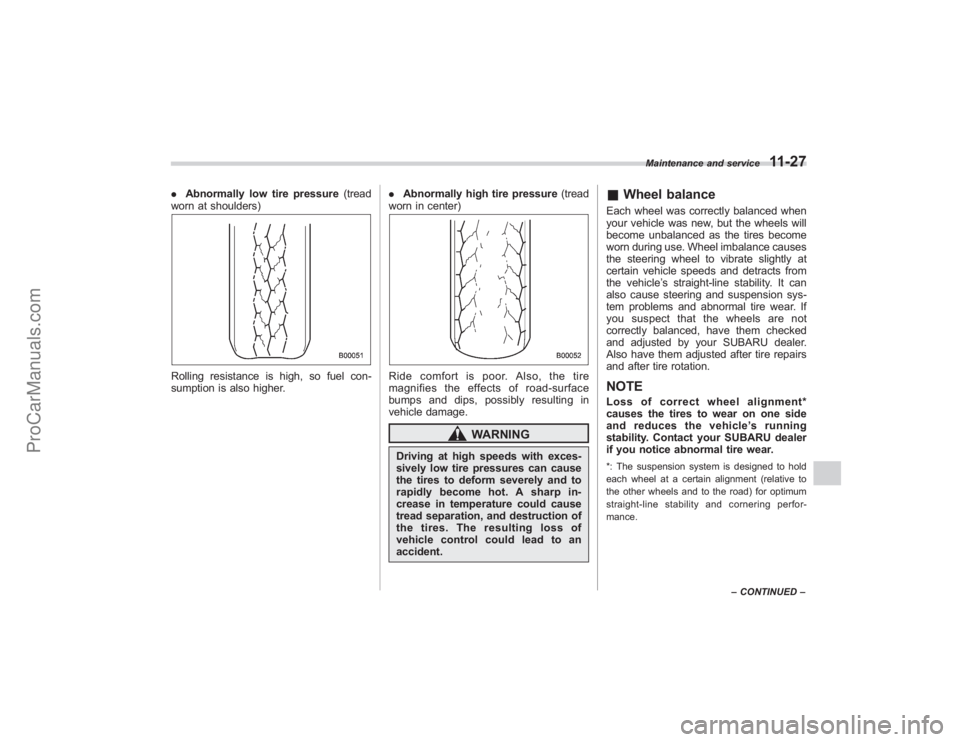
.Abnormally low tire pressure (tread
worn at shoulders)Rolling resistance is high, so fuel con-
sumption is also higher. .
Abnormally high tire pressure (tread
worn in center)
Ride comfort is poor. Also, the tire
magnifies the effects of road-surface
bumps and dips, possibly resulting in
vehicle damage.
WARNING
Driving at high speeds with exces-
sively low tire pressures can cause
the tires to deform severely and to
rapidly become hot. A sharp in-
crease in temperature could cause
tread separation, and destruction of
the tires. The resulting loss of
vehicle control could lead to an
accident.
& Wheel balanceEach wheel was correctly balanced when
your vehicle was new, but the wheels will
become unbalanced as the tires become
worn during use. Wheel imbalance causes
the steering wheel to vibrate slightly at
certain vehicle speeds and detracts from
the vehicle ’s straight-line stability. It can
also cause steering and suspension sys-
tem problems and abnormal tire wear. If
you suspect that the wheels are not
correctly balanced, have them checked
and adjusted by your SUBARU dealer.
Also have them adjusted after tire repairs
and after tire rotation.NOTELoss of correct wheel alignment*
causes the tires to wear on one side
and reduces the vehicle ’s running
stability. Contact your SUBARU dealer
if you notice abnormal tire wear.*: The suspension system is designed to hold
each wheel at a certain alignment (relative to
the other wheels and to the road) for optimum
straight-line stability and cornering perfor-
mance. Maintenance and service
11-27
–
CONTINUED –
ProCarManuals.com
Page 350 of 409
11-28
Maintenance and service
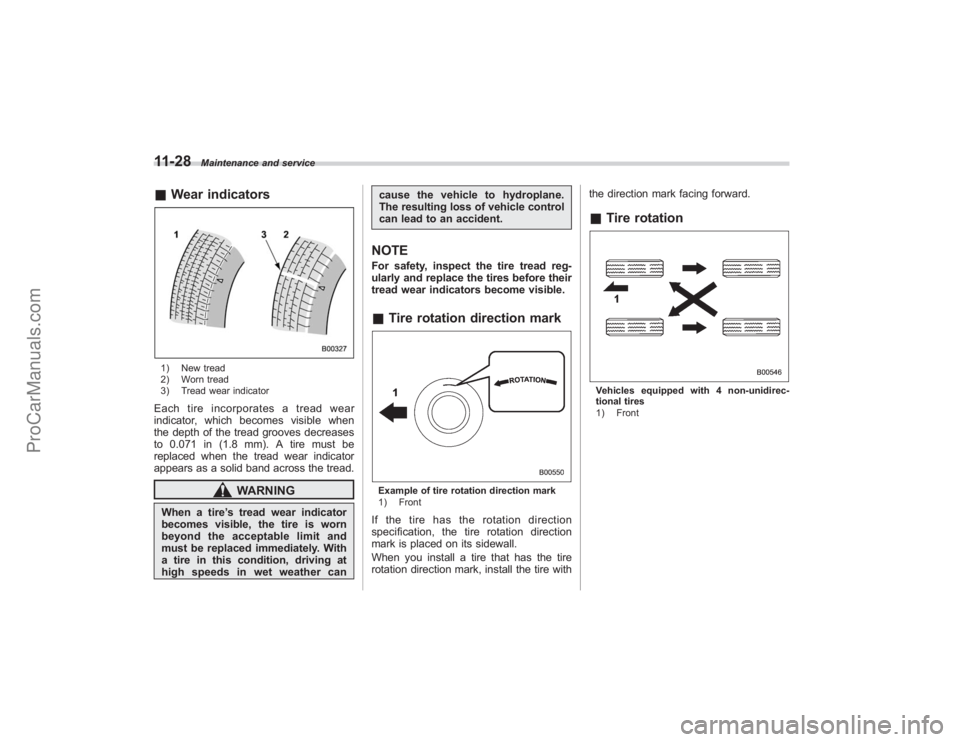
&Wear indicators1) New tread
2) Worn tread
3) Tread wear indicatorEach tire incorporates a tread wear
indicator, which becomes visible when
the depth of the tread grooves decreases
to 0.071 in (1.8 mm). A tire must be
replaced when the tread wear indicator
appears as a solid band across the tread.
WARNING
When a tire ’s tread wear indicator
becomes visible, the tire is worn
beyond the acceptable limit and
must be replaced immediately. With
a tire in this condition, driving at
high speeds in wet weather can cause the vehicle to hydroplane.
The resulting loss of vehicle control
can lead to an accident.
NOTEFor safety, inspect the tire tread reg-
ularly and replace the tires before their
tread wear indicators become visible.&
Tire rotation direction markExample of tire rotation direction mark
1) FrontIf the tire has the rotation direction
specification, the tire rotation direction
mark is placed on its sidewall.
When you install a tire that has the tire
rotation direction mark, install the tire with the direction mark facing forward.
&
Tire rotationVehicles equipped with 4 non-unidirec-
tional tires
1) Front
ProCarManuals.com
Page 351 of 409
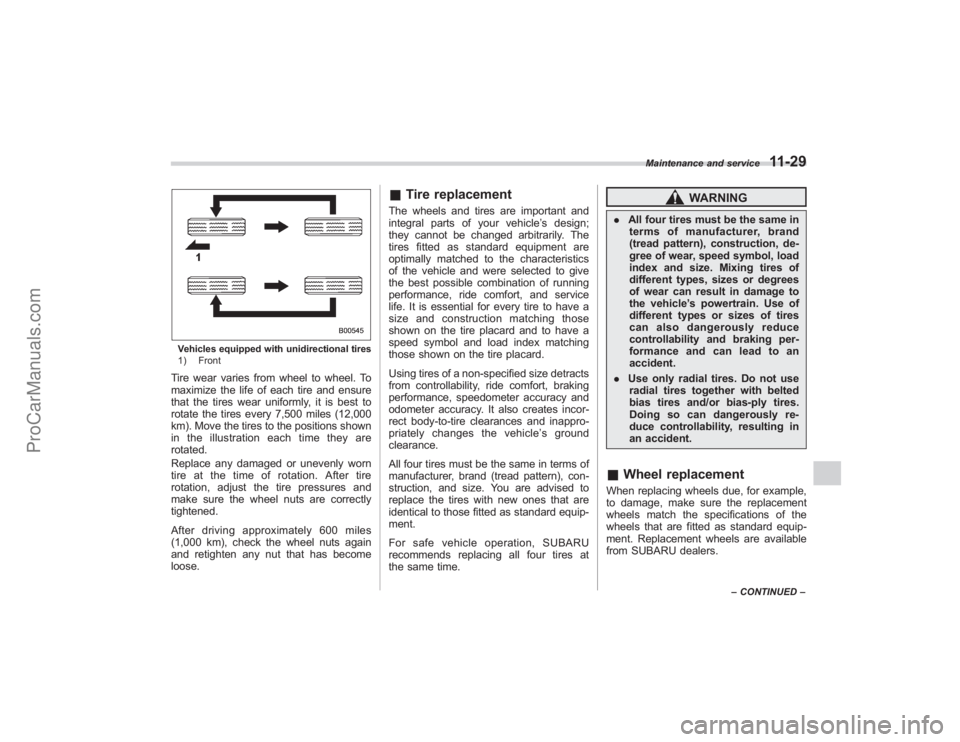
Vehicles equipped with unidirectional tires
1) FrontTire wear varies from wheel to wheel. To
maximize the life of each tire and ensure
that the tires wear uniformly, it is best to
rotate the tires every 7,500 miles (12,000
km). Move the tires to the positions shown
in the illustration each time they are
rotated.
Replace any damaged or unevenly worn
tire at the time of rotation. After tire
rotation, adjust the tire pressures and
make sure the wheel nuts are correctly
tightened.
After driving approximately 600 miles
(1,000 km), check the wheel nuts again
and retighten any nut that has become
loose.
&Tire replacementThe wheels and tires are important and
integral parts of your vehicle ’s design;
they cannot be changed arbitrarily. The
tires fitted as standard equipment are
optimally matched to the characteristics
of the vehicle and were selected to give
the best possible combination of running
performance, ride comfort, and service
life. It is essential for every tire to have a
size and construction matching those
shown on the tire placard and to have a
speed symbol and load index matching
those shown on the tire placard.
Using tires of a non-specified size detracts
from controllability, ride comfort, braking
performance, speedometer accuracy and
odometer accuracy. It also creates incor-
rect body-to-tire clearances and inappro-
priately changes the vehicle ’s ground
clearance.
All four tires must be the same in terms of
manufacturer, brand (tread pattern), con-
struction, and size. You are advised to
replace the tires with new ones that are
identical to those fitted as standard equip-
ment.
For safe vehicle operation, SUBARU
recommends replacing all four tires at
the same time.
WARNING
. All four tires must be the same in
terms of manufacturer, brand
(tread pattern), construction, de-
gree of wear, speed symbol, load
index and size. Mixing tires of
different types, sizes or degrees
of wear can result in damage to
the vehicle ’s powertrain. Use of
different types or sizes of tires
can also dangerously reduce
controllability and braking per-
formance and can lead to an
accident.
. Use only radial tires. Do not use
radial tires together with belted
bias tires and/or bias-ply tires.
Doing so can dangerously re-
duce controllability, resulting in
an accident.& Wheel replacementWhen replacing wheels due, for example,
to damage, make sure the replacement
wheels match the specifications of the
wheels that are fitted as standard equip-
ment. Replacement wheels are available
from SUBARU dealers.
Maintenance and service
11-29
–CONTINUED –
ProCarManuals.com
Page 352 of 409
11-30
Maintenance and service
WARNING
Use only those wheels that are
specified for your vehicle. Wheels
not meeting specifications could
interfere with brake caliper opera-
tion and may cause the tires to rub
against the wheel well housing dur-
ing turns. The resulting loss of
vehicle control could lead to an
accident.
Aluminum wheels.Aluminum wheels can be scratched
and damaged easily. Handle them care-
fully to maintain their appearance, perfor-
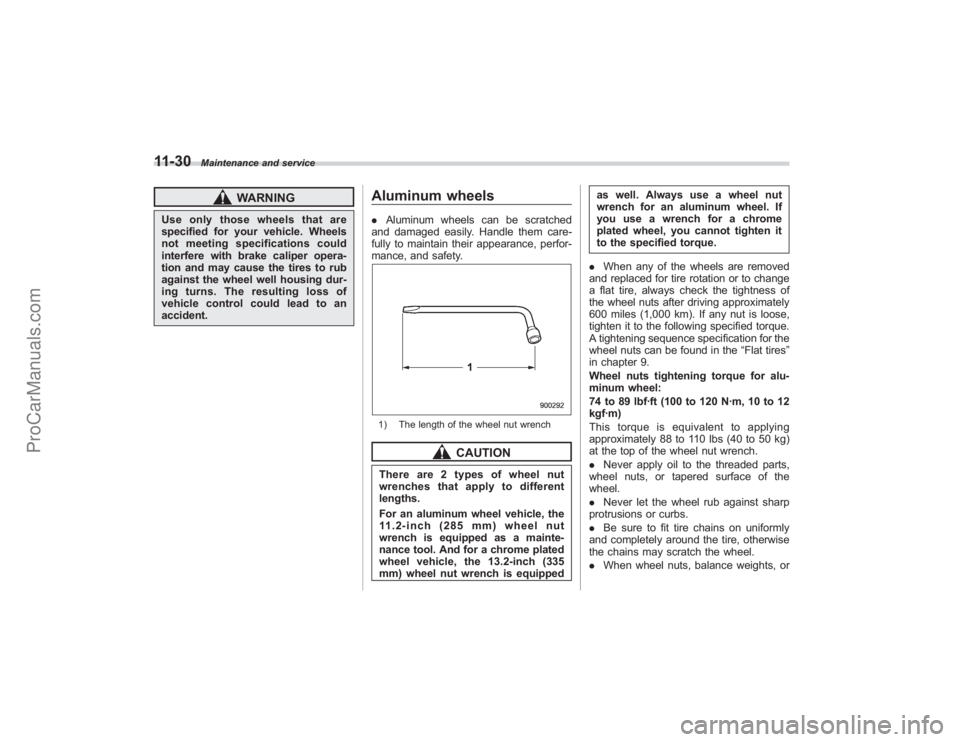
mance, and safety.1) The length of the wheel nut wrench
CAUTION
There are 2 types of wheel nut
wrenches that apply to different
lengths.
For an aluminum wheel vehicle, the
11.2-inch (285 mm) wheel nut
wrench is equipped as a mainte-
nance tool. And for a chrome plated
wheel vehicle, the 13.2-inch (335
mm) wheel nut wrench is equipped as well. Always use a wheel nut
wrench for an aluminum wheel. If
youuseawrenchforachrome
plated wheel, you cannot tighten it
to the specified torque.
. When any of the wheels are removed
and replaced for tire rotation or to change
a flat tire, always check the tightness of
the wheel nuts after driving approximately
600 miles (1,000 km). If any nut is loose,
tighten it to the following specified torque.
A tightening sequence specification for the
wheel nuts can be found in the “Flat tires”
in chapter 9.
Wheel nuts tightening torque for alu-
minum wheel:
74 to 89 lbf·ft (100 to 120 N·m, 10 to 12
kgf·m)
This torque is equivalent to applying
approximately 88 to 110 lbs (40 to 50 kg)
at the top of the wheel nut wrench.
. Never apply oil to the threaded parts,
wheel nuts, or tapered surface of the
wheel.
. Never let the wheel rub against sharp
protrusions or curbs.
. Be sure to fit tire chains on uniformly
and completely around the tire, otherwise
the chains may scratch the wheel.
. When wheel nuts, balance weights, or
ProCarManuals.com
Page 353 of 409
the center cap is replaced, be sure to
replace them with genuine SUBARU parts
designed for aluminum wheels.
Chrome plated wheels (if
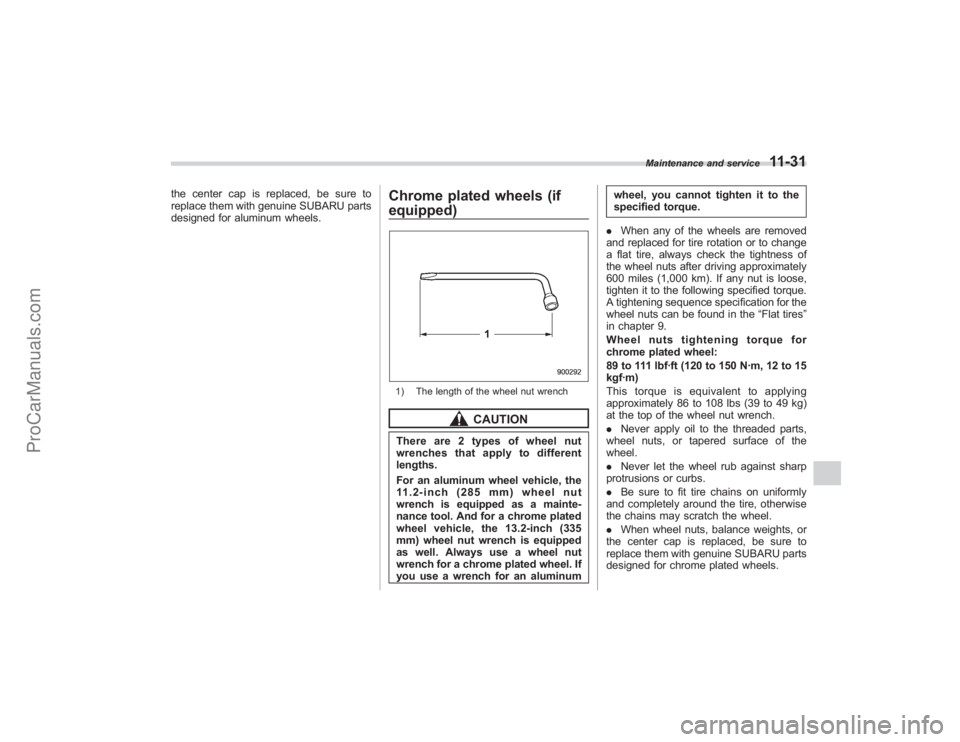
equipped)1) The length of the wheel nut wrench
CAUTION
There are 2 types of wheel nut
wrenches that apply to different
lengths.
For an aluminum wheel vehicle, the
11.2-inch (285 mm) wheel nut
wrench is equipped as a mainte-
nance tool. And for a chrome plated
wheel vehicle, the 13.2-inch (335
mm) wheel nut wrench is equipped
as well. Always use a wheel nut
wrench for a chrome plated wheel. If
you use a wrench for an aluminumwheel, you cannot tighten it to the
specified torque.
. When any of the wheels are removed
and replaced for tire rotation or to change
a flat tire, always check the tightness of
the wheel nuts after driving approximately
600 miles (1,000 km). If any nut is loose,
tighten it to the following specified torque.
A tightening sequence specification for the
wheel nuts can be found in the “Flat tires”
in chapter 9.
Wheel nuts tightening torque for
chrome plated wheel:
89 to 111 lbf·ft (120 to 150 N·m, 12 to 15
kgf·m)
This torque is equivalent to applying
approximately 86 to 108 lbs (39 to 49 kg)
at the top of the wheel nut wrench.
. Never apply oil to the threaded parts,
wheel nuts, or tapered surface of the
wheel.
. Never let the wheel rub against sharp
protrusions or curbs.
. Be sure to fit tire chains on uniformly
and completely around the tire, otherwise
the chains may scratch the wheel.
. When wheel nuts, balance weights, or
the center cap is replaced, be sure to
replace them with genuine SUBARU parts
designed for chrome plated wheels.
Maintenance and service
11-31
ProCarManuals.com
Page 354 of 409
11-32
Maintenance and service
Windshield washer fluid
CAUTION
Never use engine coolant as washer
fluid because it could cause paint
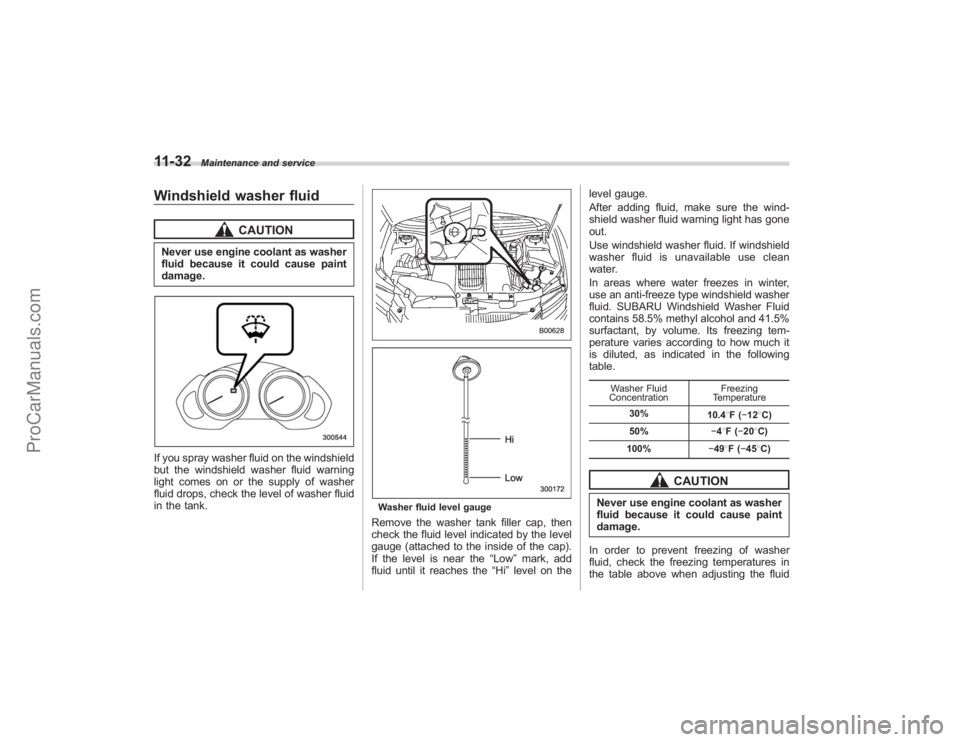
damage.If you spray washer fluid on the windshield
but the windshield washer fluid warning
light comes on or the supply of washer
fluid drops, check the level of washer fluid
in the tank.
Washer fluid level gaugeRemove the washer tank filler cap, then
check the fluid level indicated by the level
gauge (attached to the inside of the cap).
If the level is near the“Low”mark, add
fluid until it reaches the “Hi”level on the level gauge.
After adding fluid, make sure the wind-
shield washer fluid warning light has gone
out.
Use windshield washer fluid. If windshield
washer fluid is unavailable use clean
water.
In areas where water freezes in winter,
use an anti-freeze type windshield washer
fluid. SUBARU Windshield Washer Fluid
contains 58.5% methyl alcohol and 41.5%
surfactant, by volume. Its freezing tem-
perature varies according to how much it
is diluted, as indicated in the following
table.
Washer Fluid
Concentration Freezing
Temperature
30% 10.48F( −12 8C)
50% −48F( −20 8C)
100% −498F( −45 8C)
CAUTION
Never use engine coolant as washer
fluid because it could cause paint
damage.
In order to prevent freezing of washer
fluid, check the freezing temperatures in
the table above when adjusting the fluid
ProCarManuals.com
Page 355 of 409
concentration to the outside temperature.
If you fill the reservoir tank with a fluid with
a different concentration from the one
used previously, purge the old fluid from
the piping between the reservoir tank and
washer nozzles by operating the washer
for a certain period of time. Otherwise, if
the concentration of the fluid remaining in
thepipingistoolowfortheoutside
temperature, it may freeze and block the
nozzles.
CAUTION
Adjust the washer fluid concentra-
tion appropriately for the outside
temperature. If the concentration is
inappropriate, sprayed washer fluid
may freeze on the windshield and
obstruct your view, and the fluid
may freeze in the reservoir tank.
Replacement of wiper bladesGrease, wax, insects, or other materials
on the windshield or the wiper blade
results in jerky wiper operation and streak-
ing on the glass. If you cannot remove the
streaks after operating the windshield
washer or if the wiper operation is jerky,
clean the outer surface of the windshield
(or rear window) and the wiper blades
using a sponge or soft cloth with a neutral
detergent or mild-abrasive cleaner. After
cleaning, rinse the windshield and wiper
blades with clean water. The windshield is
clean if beads do not form when you rinse
the windshield with water.
CAUTION
.Do not clean the wiper blades
with gasoline or a solvent, such
as paint thinner or benzine. This
will cause deterioration of the
wiper blades.
. Whenyouwishtoraisethe
passenger-side wiper arm, first
raise the driver-side wiper arm.
Otherwise, the passenger-side
wiper assembly and driver-side
wiper assembly will touch each
other, possibly resulting in
scratches. .
Return the passenger-side wiper
arm to its original position before
returning the driver-side wiper
arm to its original position.
Otherwise, the passenger-side
wiper assembly and driver-side
wiper assembly will touch each
other, possibly resulting in
scratches.
If you cannot eliminate the streaking even
after following this method, replace the
wiper blades using the following proce-
dures. Be sure to use genuine SUBARU
wiper blade rubbers as replacements.
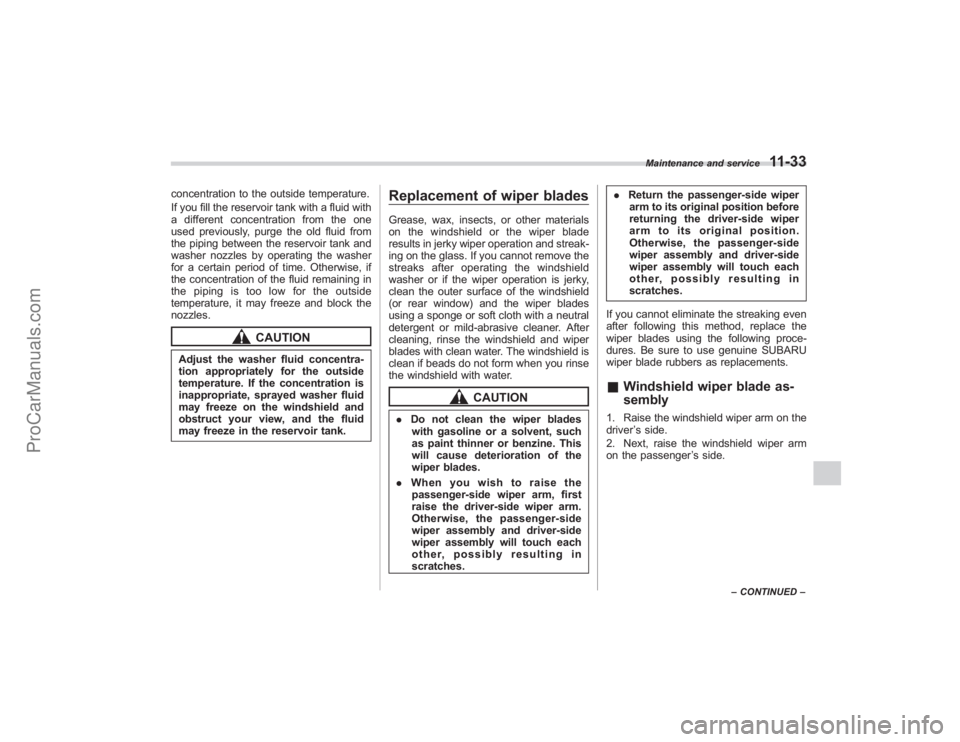
& Windshield wiper blade as-
sembly1. Raise the windshield wiper arm on the
driver ’s side.
2. Next, raise the windshield wiper arm
on the passenger ’s side.
Maintenance and service
11-33
– CONTINUED –
ProCarManuals.com
Page 356 of 409
11-34
Maintenance and service
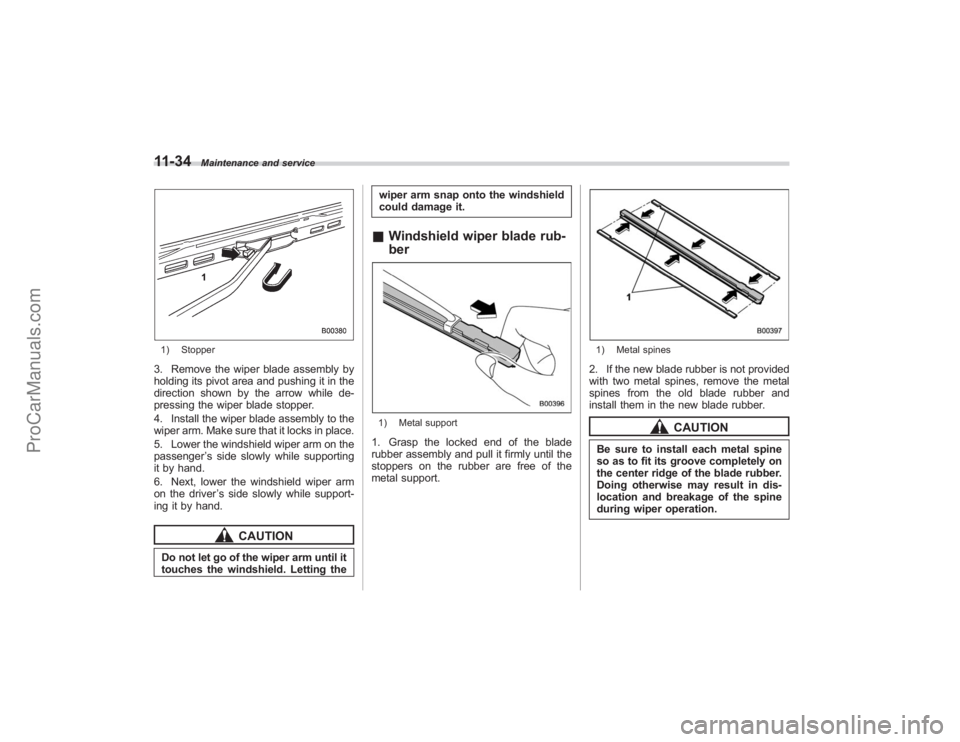
1) Stopper3. Remove the wiper blade assembly by
holding its pivot area and pushing it in the
direction shown by the arrow while de-
pressing the wiper blade stopper.
4. Install the wiper blade assembly to the
wiper arm. Make sure that it locks in place.
5. Lower the windshield wiper arm on the
passenger’s side slowly while supporting
it by hand.
6. Next, lower the windshield wiper arm
on the driver ’s side slowly while support-
ing it by hand.
CAUTION
Do not let go of the wiper arm until it
touches the windshield. Letting the wiper arm snap onto the windshield
could damage it.
&
Windshield wiper blade rub-
ber1) Metal support1. Grasp the locked end of the blade
rubber assembly and pull it firmly until the
stoppers on the rubber are free of the
metal support.
1) Metal spines2. If the new blade rubber is not provided
with two metal spines, remove the metal
spines from the old blade rubber and
install them in the new blade rubber.
CAUTION
Be sure to install each metal spine
so as to fit its groove completely on
the center ridge of the blade rubber.
Doing otherwise may result in dis-
location and breakage of the spine
during wiper operation.
ProCarManuals.com
Page 357 of 409
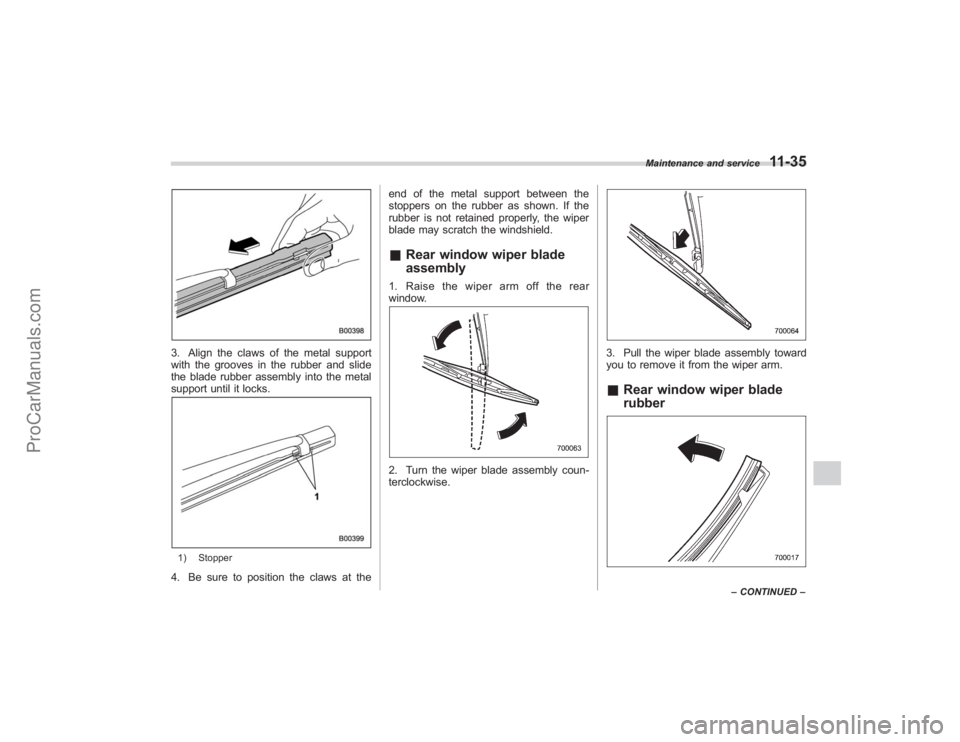
3. Align the claws of the metal support
with the grooves in the rubber and slide
the blade rubber assembly into the metal
support until it locks.1) Stopper4. Be sure to position the claws at theend of the metal support between the
stoppers on the rubber as shown. If the
rubber is not retained properly, the wiper
blade may scratch the windshield.
&
Rear window wiper blade
assembly1. Raise the wiper arm off the rear
window.2. Turn the wiper blade assembly coun-
terclockwise.
3. Pull the wiper blade assembly toward
you to remove it from the wiper arm.&Rear window wiper blade
rubber
Maintenance and service
11-35
–CONTINUED –
ProCarManuals.com
Page 358 of 409
11-36
Maintenance and service
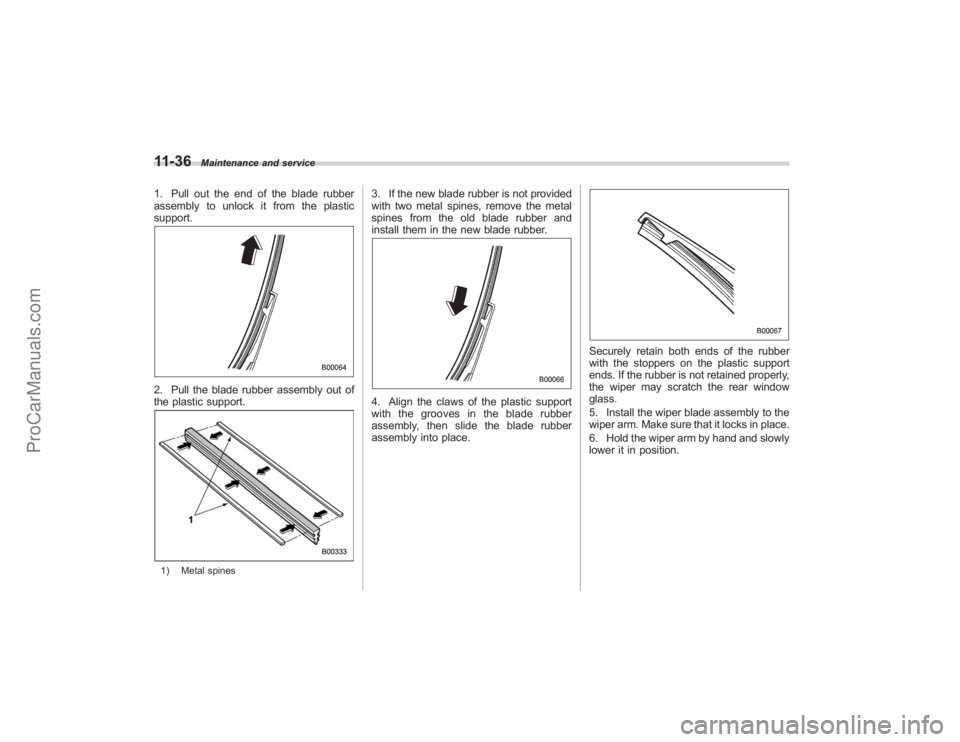
1. Pull out the end of the blade rubber
assembly to unlock it from the plastic
support.2. Pull the blade rubber assembly out of
the plastic support.1) Metal spines
3. If the new blade rubber is not provided
with two metal spines, remove the metal
spines from the old blade rubber and
install them in the new blade rubber.4. Align the claws of the plastic support
with the grooves in the blade rubber
assembly, then slide the blade rubber
assembly into place.
Securely retain both ends of the rubber
with the stoppers on the plastic support
ends. If the rubber is not retained properly,
the wiper may scratch the rear window
glass.
5. Install the wiper blade assembly to the
wiper arm. Make sure that it locks in place.
6. Hold the wiper arm by hand and slowly
lower it in position.
ProCarManuals.com