wheel SUBARU TRIBECA 2008 Manual Online
[x] Cancel search | Manufacturer: SUBARU, Model Year: 2008, Model line: TRIBECA, Model: SUBARU TRIBECA 2008Pages: 409, PDF Size: 5.75 MB
Page 352 of 409
11-30
Maintenance and service
WARNING
Use only those wheels that are
specified for your vehicle. Wheels
not meeting specifications could
interfere with brake caliper opera-
tion and may cause the tires to rub
against the wheel well housing dur-
ing turns. The resulting loss of
vehicle control could lead to an
accident.
Aluminum wheels.Aluminum wheels can be scratched
and damaged easily. Handle them care-
fully to maintain their appearance, perfor-
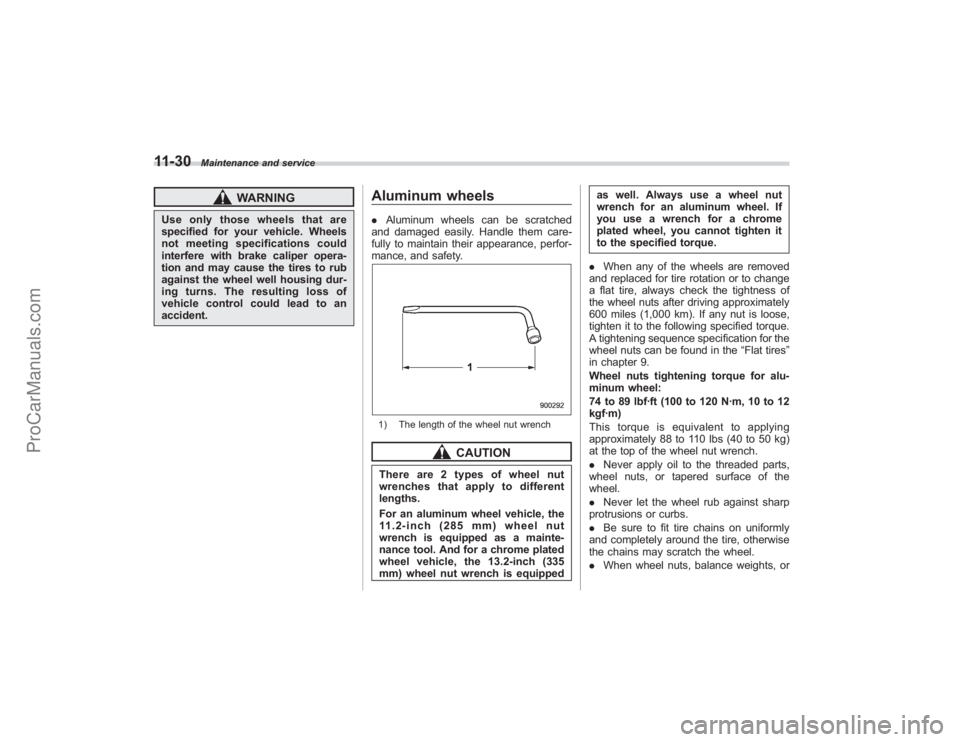
mance, and safety.1) The length of the wheel nut wrench
CAUTION
There are 2 types of wheel nut
wrenches that apply to different
lengths.
For an aluminum wheel vehicle, the
11.2-inch (285 mm) wheel nut
wrench is equipped as a mainte-
nance tool. And for a chrome plated
wheel vehicle, the 13.2-inch (335
mm) wheel nut wrench is equipped as well. Always use a wheel nut
wrench for an aluminum wheel. If
youuseawrenchforachrome
plated wheel, you cannot tighten it
to the specified torque.
. When any of the wheels are removed
and replaced for tire rotation or to change
a flat tire, always check the tightness of
the wheel nuts after driving approximately
600 miles (1,000 km). If any nut is loose,
tighten it to the following specified torque.
A tightening sequence specification for the
wheel nuts can be found in the “Flat tires”
in chapter 9.
Wheel nuts tightening torque for alu-
minum wheel:
74 to 89 lbf·ft (100 to 120 N·m, 10 to 12
kgf·m)
This torque is equivalent to applying
approximately 88 to 110 lbs (40 to 50 kg)
at the top of the wheel nut wrench.
. Never apply oil to the threaded parts,
wheel nuts, or tapered surface of the
wheel.
. Never let the wheel rub against sharp
protrusions or curbs.
. Be sure to fit tire chains on uniformly
and completely around the tire, otherwise
the chains may scratch the wheel.
. When wheel nuts, balance weights, or
ProCarManuals.com
Page 353 of 409
the center cap is replaced, be sure to
replace them with genuine SUBARU parts
designed for aluminum wheels.
Chrome plated wheels (if
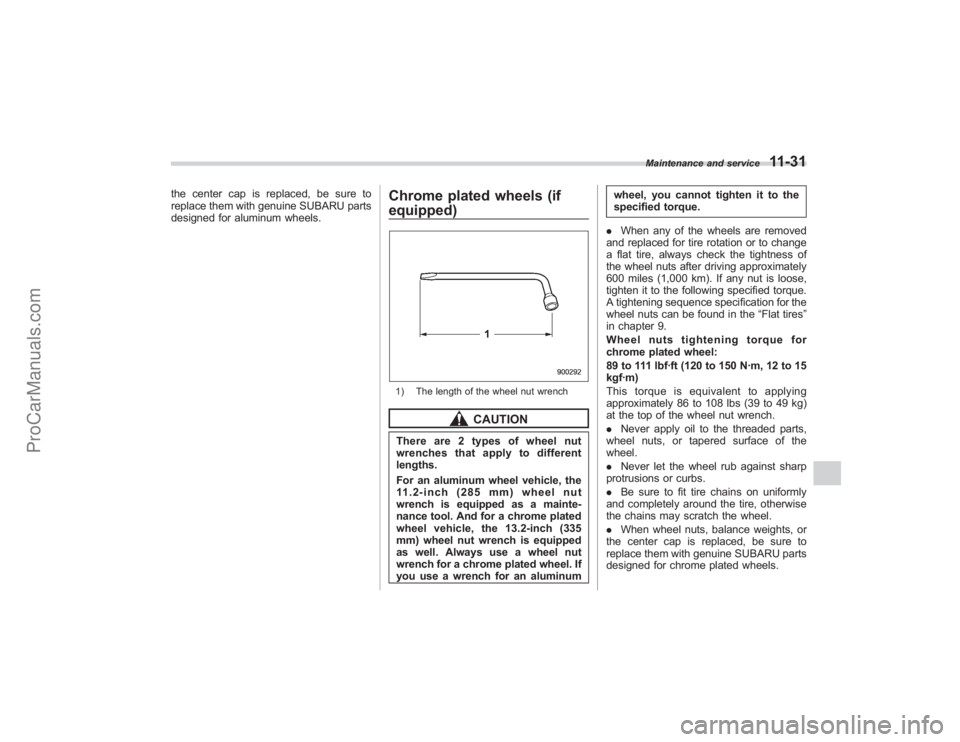
equipped)1) The length of the wheel nut wrench
CAUTION
There are 2 types of wheel nut
wrenches that apply to different
lengths.
For an aluminum wheel vehicle, the
11.2-inch (285 mm) wheel nut
wrench is equipped as a mainte-
nance tool. And for a chrome plated
wheel vehicle, the 13.2-inch (335
mm) wheel nut wrench is equipped
as well. Always use a wheel nut
wrench for a chrome plated wheel. If
you use a wrench for an aluminumwheel, you cannot tighten it to the
specified torque.
. When any of the wheels are removed
and replaced for tire rotation or to change
a flat tire, always check the tightness of
the wheel nuts after driving approximately
600 miles (1,000 km). If any nut is loose,
tighten it to the following specified torque.
A tightening sequence specification for the
wheel nuts can be found in the “Flat tires”
in chapter 9.
Wheel nuts tightening torque for
chrome plated wheel:
89 to 111 lbf·ft (120 to 150 N·m, 12 to 15
kgf·m)
This torque is equivalent to applying
approximately 86 to 108 lbs (39 to 49 kg)
at the top of the wheel nut wrench.
. Never apply oil to the threaded parts,
wheel nuts, or tapered surface of the
wheel.
. Never let the wheel rub against sharp
protrusions or curbs.
. Be sure to fit tire chains on uniformly
and completely around the tire, otherwise
the chains may scratch the wheel.
. When wheel nuts, balance weights, or
the center cap is replaced, be sure to
replace them with genuine SUBARU parts
designed for chrome plated wheels.
Maintenance and service
11-31
ProCarManuals.com
Page 373 of 409
Specifications................................................. 12-2
Dimensions.................................................... 12-2
Engine ........................................................... 12-2
Electrical system ............................................ 12-3
Capacities ...................................................... 12-3
Tires .............................................................. 12-3
Wheel alignment ............................................ 12-4
Fuses and circuits ......................................... 12-5
Fuse panel located in the passenger
compartment ................................................ 12-5
Fuse panel located in the engine compartment ................................................ 12-7
Bulb chart....................................................... 12-8
Vehicle identification ..................................... 12-9
Specifications
12
ProCarManuals.com
Page 374 of 409
12-2
Specifications
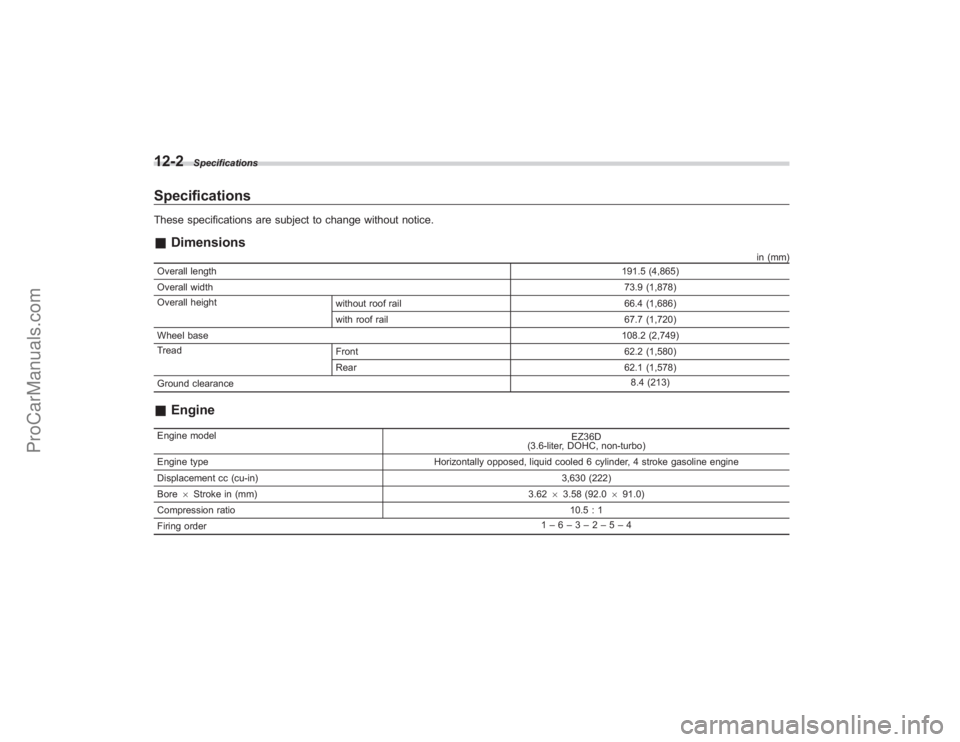
SpecificationsThese specifications are subject to change without notice.&Dimensions
in (mm)
Overall length 191.5 (4,865)
Overall width 73.9 (1,878)
Overall height without roof rail 66.4 (1,686)
with roof rail 67.7 (1,720)
Wheel base 108.2 (2,749)
Tread Front 62.2 (1,580)
Rear 62.1 (1,578)
Ground clearance 8.4 (213)
&
EngineEngine model
EZ36D
(3.6-liter, DOHC, non-turbo)
Engine type Horizontally opposed, liquid cooled 6 cylinder, 4 stroke gasoline engine
Displacement cc (cu-in) 3,630 (222)
Bore 6Stroke in (mm) 3.62 63.58 (92.0 691.0)
Compression ratio 10.5 : 1
Firing order 1
–6 –3–2 –5–4
ProCarManuals.com
Page 375 of 409
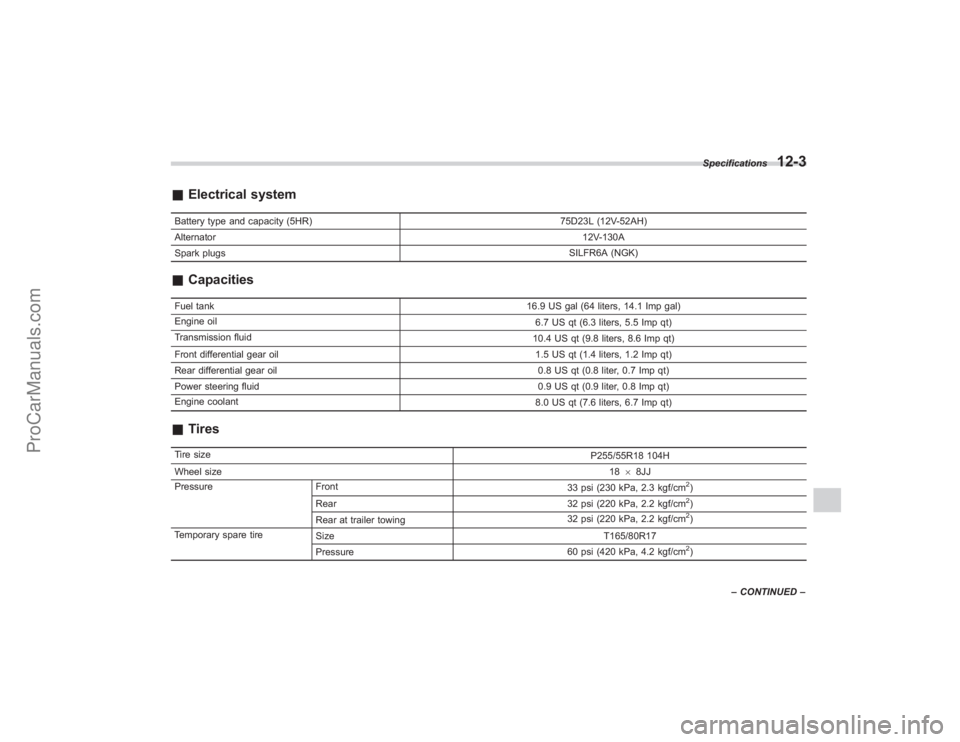
&Electrical systemBattery type and capacity (5HR) 75D23L (12V-52AH)
Alternator 12V-130A
Spark plugs SILFR6A (NGK)&
CapacitiesFuel tank 16.9 US gal (64 liters, 14.1 Imp gal)
Engine oil 6.7 US qt (6.3 liters, 5.5 Imp qt)
Transmission fluid 10.4 US qt (9.8 liters, 8.6 Imp qt)
Front differential gear oil 1.5 US qt (1.4 liters, 1.2 Imp qt)
Rear differential gear oil 0.8 US qt (0.8 liter, 0.7 Imp qt)
Power steering fluid 0.9 US qt (0.9 liter, 0.8 Imp qt)
Engine coolant 8.0 US qt (7.6 liters, 6.7 Imp qt)&TiresTire size
P255/55R18 104H
Wheel size 1868JJ
Pressure Front 33 psi (230 kPa, 2.3 kgf/cm
2)
Rear 32 psi (220 kPa, 2.2 kgf/cm2)
Rear at trailer towing 32 psi (220 kPa, 2.2 kgf/cm2)
Temporary spare tire Size T165/80R17
Pressure 60 psi (420 kPa, 4.2 kgf/cm2)Specifications
12-3
–
CONTINUED –
ProCarManuals.com
Page 376 of 409
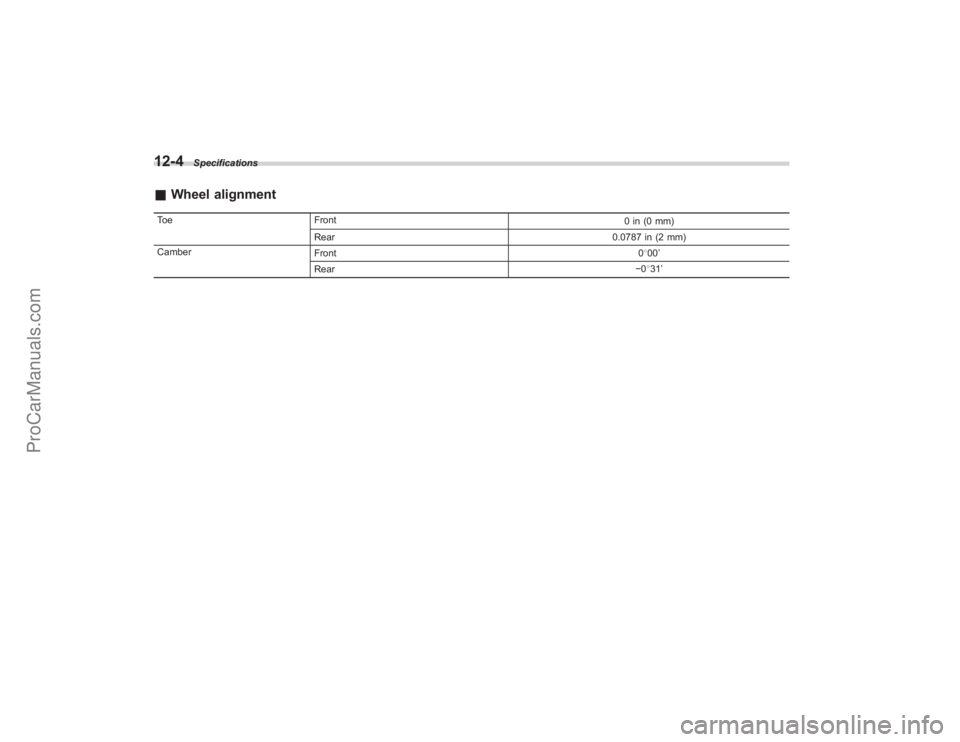
12-4
Specifications
&Wheel alignmentToe Front
0 in (0 mm)
Rear 0.0787 in (2 mm)
Camber Front 0800 ’
Rear −0
831 ’
ProCarManuals.com
Page 387 of 409
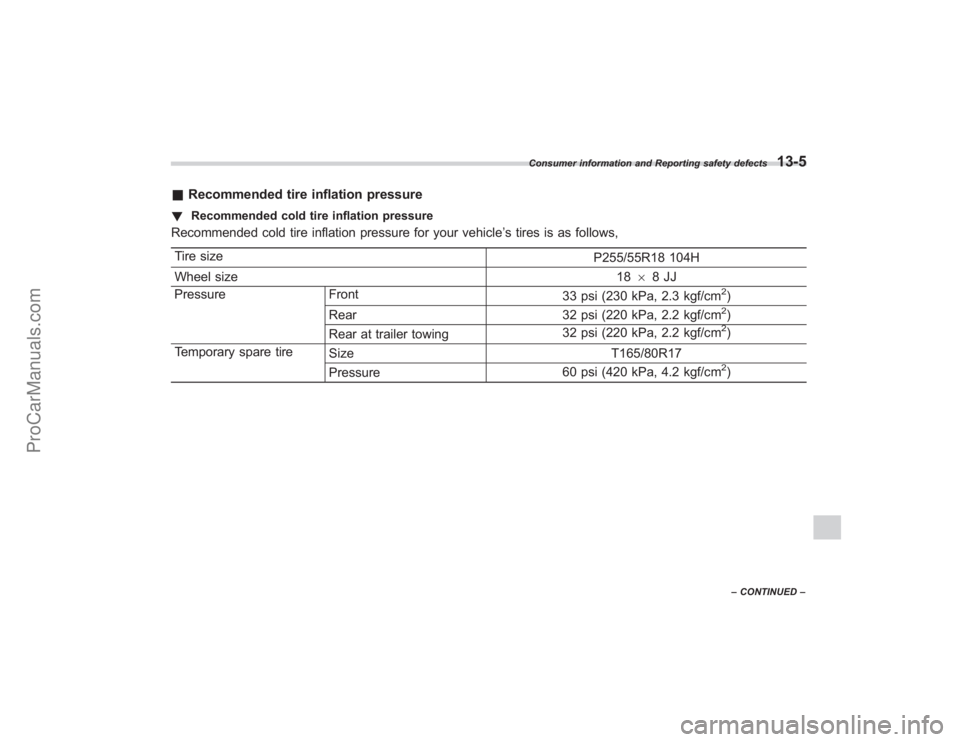
&Recommended tire inflation pressure! Recommended cold tire inflation pressureRecommended cold tire inflation pressure for your vehicle ’s tires is as follows,
Tire size P255/55R18 104H
Wheel size 18 68JJ
Pressure Front 33 psi (230 kPa, 2.3 kgf/cm
2)
Rear 32 psi (220 kPa, 2.2 kgf/cm2)
Rear at trailer towing 32 psi (220 kPa, 2.2 kgf/cm2)
Temporary spare tire Size T165/80R17
Pressure 60 psi (420 kPa, 4.2 kgf/cm2)
Consumer information and Reporting safety defects
13-5
–
CONTINUED –
ProCarManuals.com
Page 390 of 409
13-8
Consumer information and Reporting safety defects
tires every 7,500 miles (12,000 km).
Rotating the tires involves switch-
ing the front and rear tires on the
right-hand side of the vehicle and
similarly switching the front and
rear tires on the left-hand side of
the vehicle. (Each tire must be kept
on its original side of the vehicle.)
Replace any damaged or unevenly
worn tire at the time of rotation.
After tire rotation, adjust the tire
pressures and make sure the wheel
nuts are correctly tightened. A
tightening torque specification and
a tightening sequence specification
for the wheel nuts can be found
“Flat tires”in chapter 9.& Vehicle load limit –how to
determineThe load capacity of your vehicle is
determined by weight, not by avail-
able cargo space. The load limit of
your vehicle is shown on the
vehicle placard attached to the
driver ’s side B-pillar. Locate the
statement “The combined weight of occupants and cargo should
never exceed XXX kg or XXX lbs
”
on your vehicle ’s placard.
Thevehicleplacardalsoshows
seating capacity of your vehicle.
The total load capacity includes the
total weight of driver and all pas-
sengers and their belongings, any
cargo, any optional equipment such
as a trailer hitch, roof rack or bike
carrier, etc., and the tongue load of
a trailer. Therefore cargo capacity
can be calculated by the following
method.
Cargo capacity = Load limit −(total
weight of occupants + total weight
of optional equipment + tongue
load of a trailer (if applicable))
For towing capacity information and
weight limits, refer to “
Trailer towing”
section in chapter 8.
! Calculating total and load ca-
pacities varying seating con-
figurations
Calculate the available load capa-
city as shown in the following examples:
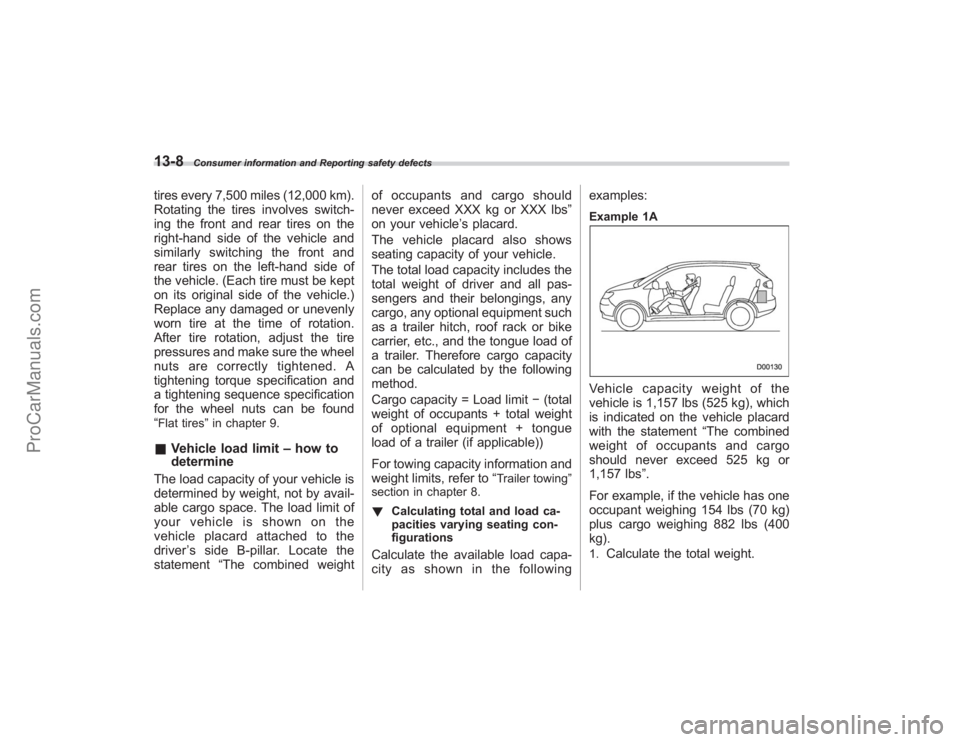
Example 1AVehicle capacity weight of the
vehicle is 1,157 lbs (525 kg), which
is indicated on the vehicle placard
with the statement
“The combined
weight of occupants and cargo
should never exceed 525 kg or
1,157 lbs ”.
For example, if the vehicle has one
occupant weighing 154 lbs (70 kg)
plus cargo weighing 882 lbs (400
kg).1.
Calculate the total weight.
ProCarManuals.com
Page 395 of 409
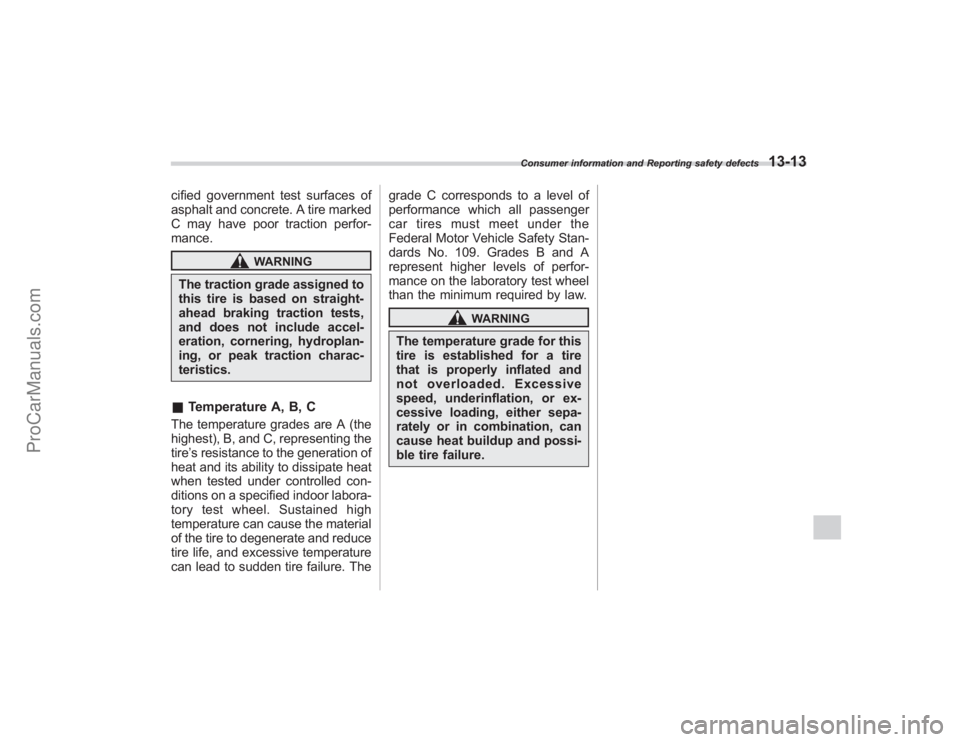
cified government test surfaces of
asphalt and concrete. A tire marked
C may have poor traction perfor-
mance.
WARNING
The traction grade assigned to
this tire is based on straight-
ahead braking traction tests,
and does not include accel-
eration, cornering, hydroplan-
ing, or peak traction charac-
teristics.&Temperature A, B, CThe temperature grades are A (the
highest), B, and C, representing the
tire ’s resistance to the generation of
heat and its ability to dissipate heat
when tested under controlled con-
ditions on a specified indoor labora-
tory test wheel. Sustained high
temperature can cause the material
of the tire to degenerate and reduce
tire life, and excessive temperature
can lead to sudden tire failure. The grade C corresponds to a level of
performance which all passenger
car tires must meet under the
Federal Motor Vehicle Safety Stan-
dards No. 109. Grades B and A
represent higher levels of perfor-
mance on the laboratory test wheel
than the minimum required by law.
WARNING
The temperature grade for this
tire is established for a tire
that is properly inflated and
not overloaded. Excessive
speed, underinflation, or ex-
cessive loading, either sepa-
rately or in combination, can
cause heat buildup and possi-
ble tire failure.
Consumer information and Reporting safety defects
13-13
ProCarManuals.com
Page 398 of 409
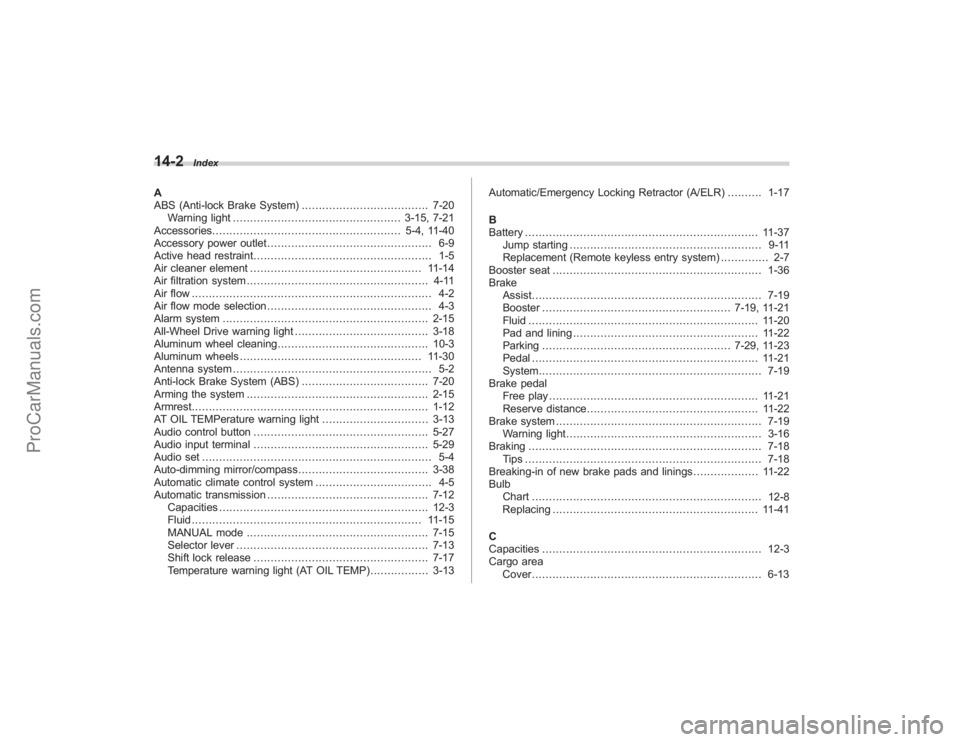
14-2
Index
A
ABS (Anti-lock Brake System)..................................... 7-20
Warning light ................................................. 3-15, 7-21
Accessories ....................................................... 5-4, 11-40
Accessory power outlet ................................................ 6-9
Active head restraint .................................................... 1-5
Air cleaner element .................................................. 11-14
Air filtration system ..................................................... 4-11
Air flow ...................................................................... 4-2
Air flow mode selection ................................................ 4-3
Alarm system ............................................................ 2-15
All-Wheel Drive warning light ....................................... 3-18
Aluminum wheel cleaning ............................................ 10-3
Aluminum wheels ..................................................... 11-30
Antenna system .......................................................... 5-2
Anti-lock Brake System (ABS) ..................................... 7-20
Arming the system ..................................................... 2-15
Armrest ..................................................................... 1-12
AT OIL TEMPerature warning light ............................... 3-13
Audio control button ................................................... 5-27
Audio input terminal ................................................... 5-29
Audio set ................................................................... 5-4
Auto-dimming mirror/compass ...................................... 3-38
Automatic climate control system .................................. 4-5
Automatic transmission ............................................... 7-12
Capacities ............................................................. 12-3
Fluid ................................................................... 11-15
MANUAL mode ..................................................... 7-15
Selector lever ........................................................ 7-13
Shift lock release ................................................... 7-17
Temperature warning light (AT OIL TEMP) ................. 3-13Automatic/Emergency Locking Retractor (A/ELR)
.......... 1-17
B
Battery .................................................................... 11-37
Jump starting ........................................................ 9-11
Replacement (Remote keyless entry system) .............. 2-7
Booster seat ............................................................. 1-36
Brake Assist ................................................................... 7-19
Booster ....................................................... 7-19, 11-21
Fluid ................................................................... 11-20
Pad and lining ...................................................... 11-22
Parking ....................................................... 7-29, 11-23
Pedal .................................................................. 11-21
System ................................................................. 7-19
Brake pedal Free play ............................................................. 11-21
Reserve distance .................................................. 11-22
Brake system ............................................................ 7-19
Warning light ......................................................... 3-16
Braking .................................................................... 7-18
Tips ..................................................................... 7-18
Breaking-in of new brake pads and linings ................... 11-22
Bulb
Chart ...................................................................
12-8
Replacing ............................................................ 11-41
C
Capacities ................................................................ 12-3
Cargo area Cover ................................................................... 6-13
ProCarManuals.com