child lock SUBARU TRIBECA 2008 Owners Manual
[x] Cancel search | Manufacturer: SUBARU, Model Year: 2008, Model line: TRIBECA, Model: SUBARU TRIBECA 2008Pages: 409, PDF Size: 5.75 MB
Page 5 of 409
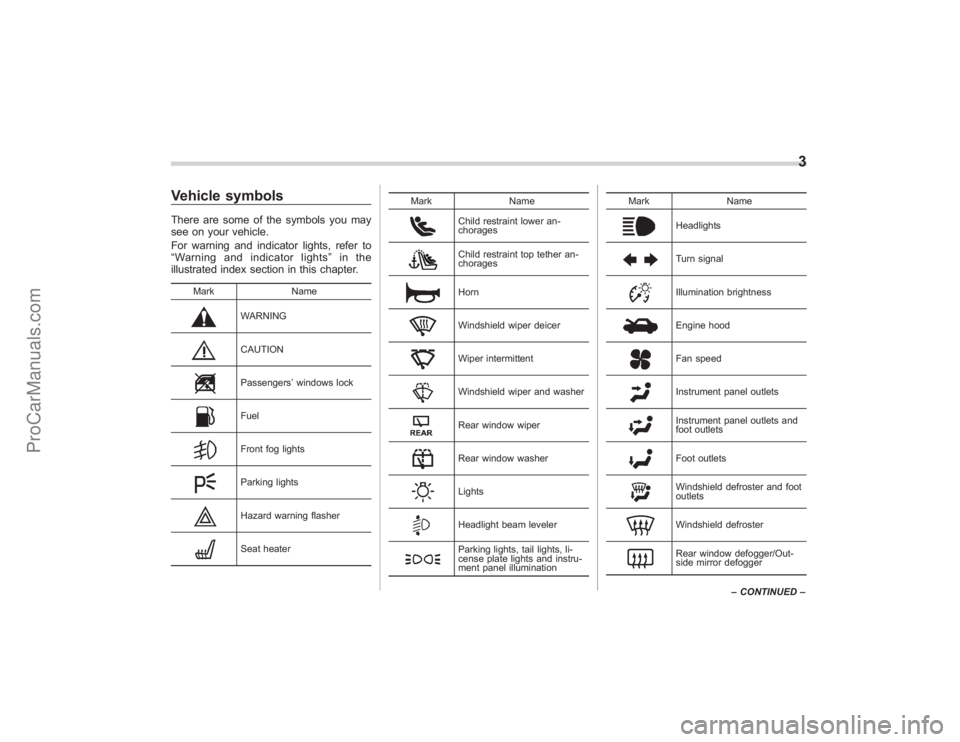
Vehicle symbolsThere are some of the symbols you may
see on your vehicle.
For warning and indicator lights, refer to
“Warning and indicator lights ”in the
illustrated index section in this chapter.
Mark Name
WARNINGCAUTIONPassengers’windows lockFuelFront fog lightsParking lightsHazard warning flasherSeat heater Mark Name
Child restraint lower an-
choragesChild restraint top tether an-
choragesHornWindshield wiper deicerWiper intermittentWindshield wiper and washerRear window wiperRear window washerLightsHeadlight beam levelerParking lights, tail lights, li-
cense plate lights and instru-
ment panel illuminationMark
Name
HeadlightsTurn signalIllumination brightnessEngine hoodFan speedInstrument panel outletsInstrument panel outlets and
foot outletsFoot outletsWindshield defroster and foot
outletsWindshield defrosterRear window defogger/Out-
side mirror defogger
3
–CONTINUED –
ProCarManuals.com
Page 7 of 409
&Child safety
WARNING
. Never hold a child on your lap or
in your arms while the vehicle is
moving. The passenger cannot
protect the child from injury in a
collision, because the child will
be caught between the passen-
ger and objects inside the vehi-
cle.
. While riding in the vehicle, in-
fants and small children should
always be placed in one of the
rear seating positions recom-
mended in this Owner ’s Manual
in an infant or child restraint
system which is appropriate for
the child ’s age, height and
weight. If a child is too big for a
child restraint system, the child
should sit in a REAR seat and be
restrained using the seatbelts.
According to accident statistics,
children are safer when properly
restrained in the rear seating
positions than in the front seat-
ing positions. Never allow a child
to stand up or kneel on the seat.
. Put children aged 12 and under in
a REAR seat properly restrained at all times in a child restraint
device or in a seatbelt. The SRS
airbag deploys with considerable
speed and force and can injure or
even kill children, especially if
they are 12 years of age and
under and are not restrained or
improperly restrained. Because
children are lighter and weaker
than adults, their risk of being
injured from deployment is great-
er.
. NEVER INSTALL A REARWARD
FACING CHILD SAFETY SEAT IN
THE FRONT SEAT. DOING SO
RISKS SERIOUS INJURY OR
DEATH TO THE CHILD BY PLA-
CING THE CHILD ’S HEAD TOO
CLOSE TO THE SRS AIRBAG.
. Always use the child safety locks
whenever a child rides in the
rear. Serious injury could result
if a child accidentally opened the
door and fell out. Refer to the
“ Child safety locks ”section in
chapter 2.
. Always lock the passenger ’s win-
dows using the lock switch when
children are riding in the vehicle.
Failure to follow this procedure
could result in injury to a child
operating the power window. Re- fer to the
“Power windows ”sec-
tion in chapter 2.
. Never leave unattended children
in the vehicle. They could acci-
dentally injure themselves or
others through inadvertent op-
eration of the vehicle. Also, on
hot or sunny days, temperature
in a closed vehicle could quickly
become high enough to cause
severe or possibly fatal injuries
to them.
Carefully read the sections “Child restraint
systems ”, “*SRS airbag (Supplemental
Restraint System airbag) ”, and“Seatbelts ”
in chapter 1 of this Owner ’s Manual for
instructions and precautions concerning
the child restraint system, seatbelt system
and SRS airbag system.
& Engine exhaust gas (carbon
monoxide)
WARNING
. Never inhale engine exhaust gas.
Engine exhaust gas contains
carbon monoxide, a colorless
and odorless gas which is dan-
gerous, or even lethal, if inhaled.
. Always properly maintain the en-
5
–CONTINUED –
ProCarManuals.com
Page 13 of 409
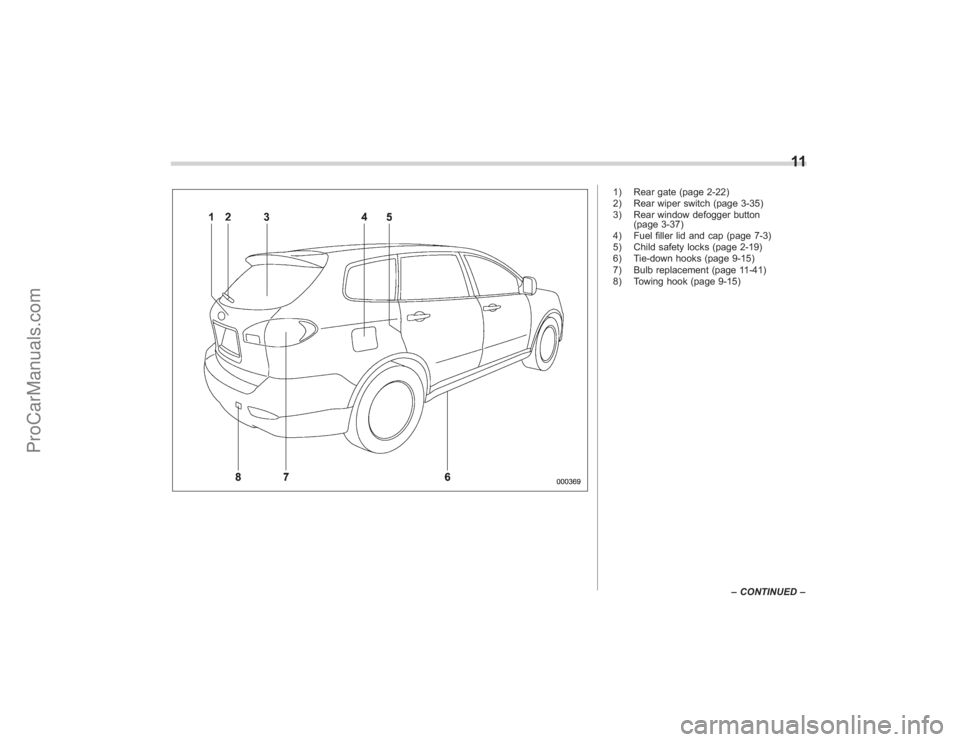
1) Rear gate (page 2-22)
2) Rear wiper switch (page 3-35)
3) Rear window defogger button(page 3-37)
4) Fuel filler lid and cap (page 7-3)
5) Child safety locks (page 2-19)
6) Tie-down hooks (page 9-15)
7) Bulb replacement (page 11-41)
8) Towing hook (page 9-15)
11
– CONTINUED –
ProCarManuals.com
Page 25 of 409
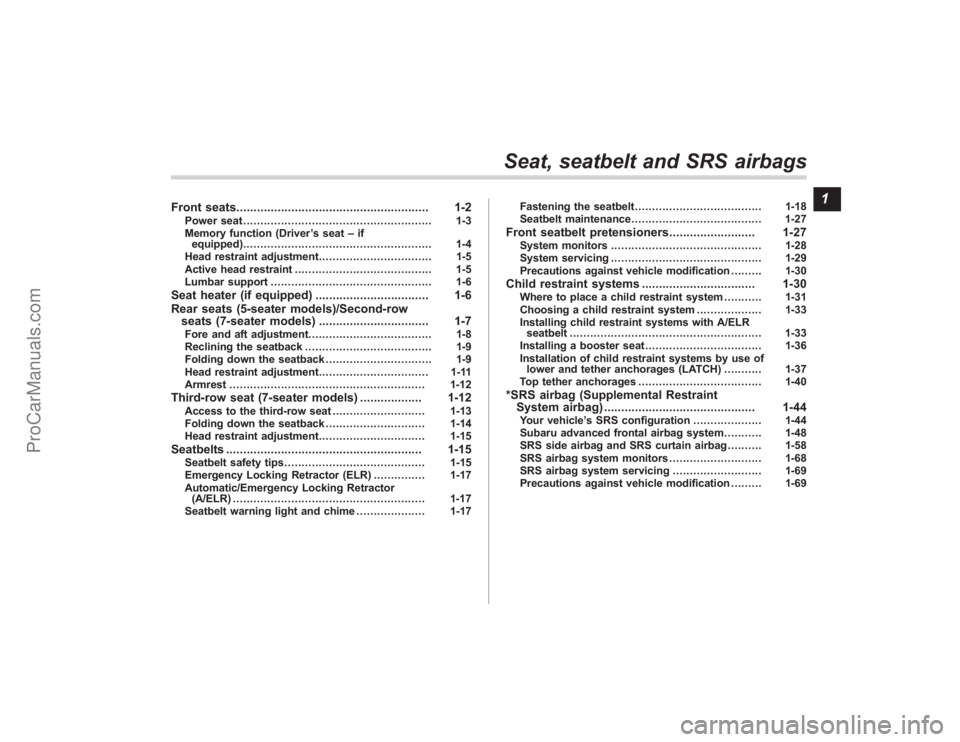
Front seats........................................................ 1-2
Power seat....................................................... 1-3
Memory function (Driver ’s seat –if
equipped) ....................................................... 1-4
Head restraint adjustment ................................. 1-5
Active head restraint ........................................ 1-5
Lumbar support ............................................... 1-6
Seat heater (if equipped) ................................. 1-6
Rear seats (5-seater models)/Second-row seats (7-seater models) ................................ 1-7
Fore and aft adjustment.................................... 1-8
Reclining the seatback ..................................... 1-9
Folding down the seatback ............................... 1-9
Head restraint adjustment ................................ 1-11
Armrest ......................................................... 1-12
Third-row seat (7-seater models) .................. 1-12
Access to the third-row seat........................... 1-13
Folding down the seatback ............................. 1-14
Head restraint adjustment ............................... 1-15
Seatbelts......................................................... 1-15
Seatbelt safety tips ......................................... 1-15
Emergency Locking Retractor (ELR) ............... 1-17
Automatic/Emergency Locking Retractor (A/ELR) ........................................................ 1-17
Seatbelt warning light and chime .................... 1-17Fastening the seatbelt
..................................... 1-18
Seatbelt maintenance...................................... 1-27
Front seatbelt pretensioners ......................... 1-27
System monitors............................................ 1-28
System servicing ............................................ 1-29
Precautions against vehicle modification ......... 1-30
Child restraint systems................................. 1-30
Where to place a child restraint system ........... 1-31
Choosing a child restraint system ................... 1-33
Installing child restraint systems with A/ELR seatbelt ........................................................ 1-33
Installing a booster seat .................................. 1-36
Installation of child restraint systems by use of lower and tether anchorages (LATCH) ........... 1-37
Top tether anchorages .................................... 1-40
*SRS airbag (Supplemental Restraint
System airbag) ............................................ 1-44
Your vehicle’s SRS configuration .................... 1-44
Subaru advanced frontal airbag system ........... 1-48
SRS side airbag and SRS curtain airbag .......... 1-58
SRS airbag system monitors ........................... 1-68
SRS airbag system servicing .......................... 1-69
Precautions against vehicle modification ......... 1-69
Seat, seatbelt and SRS airbags
1
ProCarManuals.com
Page 41 of 409
&Emergency Locking Retrac-
tor (ELR)The driver ’s seatbelt has an Emergency
Locking Retractor (ELR).
The emergency locking retractor allows
normal body movement but the retractor
locks automatically during a sudden stop,
impact or if you pull the belt very quickly
out of the retractor.& Automatic/Emergency Lock-
ing Retractor (A/ELR)Each passenger ’s seatbelt has an Auto-
matic/Emergency Locking Retractor (A/
ELR). The Automatic/Emergency Locking
Retractor normally functions as an Emer-
gency Locking Retractor (ELR). The A/
ELR has an additional locking mode
“ Automatic Locking Retractor (ALR)
mode ”intended to secure a child restraint
system. When the seatbelt is once drawn
out completely and is then retracted even
slightly, the retractor locks the seatbelt in
that position and the seatbelt cannot be
extended. As the belt is rewinding, clicks
will be heard which indicate the retractor
functions as ALR. When the seatbelt is
retracted fully, ALR mode is released.
When securing a child restraint system on
the passengers’ seats, the seatbelt must
be changed over to the Automatic Locking Retractor (ALR) mode.
When the child restraint system is re-
moved, make sure that the retractor is
restored to the Emergency Locking Re-
tractor (ELR) function by allowing the
seatbelt to retract fully.
For instructions on how to convert the
retractor to the ALR mode and restore it to
the ELR mode, refer to the
“Installing child
restraint systems with A/ELR seatbelt ”
section in this chapter.
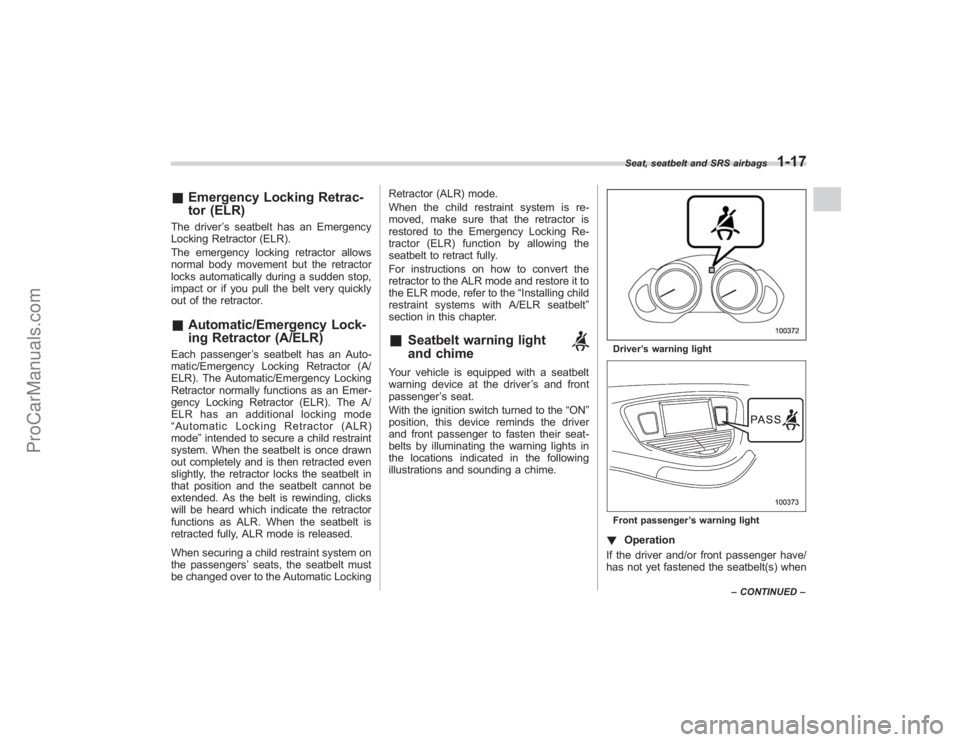
&
Seatbelt warning light
and chime
Your vehicle is equipped with a seatbelt
warning device at the driver ’s and front
passenger ’s seat.
With the ignition switch turned to the “ON”
position, this device reminds the driver
and front passenger to fasten their seat-
belts by illuminating the warning lights in
the locations indicated in the following
illustrations and sounding a chime.
Driver ’s warning lightFront passenger ’s warning light! Operation
If the driver and/or front passenger have/
has not yet fastened the seatbelt(s) when
Seat, seatbelt and SRS airbags
1-17
– CONTINUED –
ProCarManuals.com
Page 55 of 409
WARNING
Never let a passenger hold a child
on his or her lap while the vehicle is
moving. The passenger cannot pro-
tect the child from injury in a colli-
sion, because the child will be
caught between the passenger and
objects inside the vehicle. Addition-
ally, holding a child in your lap or
arms in the front seat exposes that
child to another serious danger.
Since the SRS airbag deploys with
considerable speed and force, the
child could be injured or even killed.
WARNING
Children should be properly re-
strained at all times. Never allow a
child to stand up, or to kneel on any
seat. Unrestrained children will be
thrown forward during sudden stop
or in an accident and can be injured
seriously.
Additionally, children standing up or
kneeling on or in front of the front
seat are exposed another serious
danger. Since the SRS airbag de-
ploys with considerable speed and
force, the child could be injured or
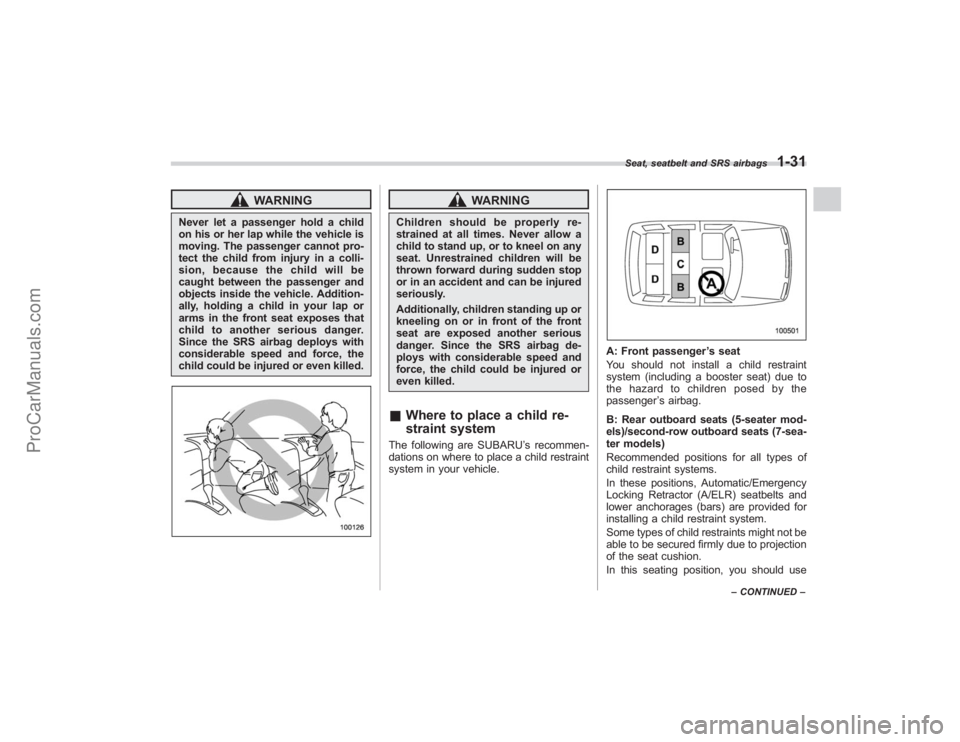
even killed.&Where to place a child re-
straint systemThe following are SUBARU ’s recommen-
dations on where to place a child restraint
system in your vehicle.
A: Front passenger ’s seat
You should not install a child restraint
system (including a booster seat) due to
the hazard to children posed by the
passenger ’s airbag.
B: Rear outboard seats (5-seater mod-
els)/second-row outboard seats (7-sea-
ter models)
Recommended positions for all types of
child restraint systems.
In these positions, Automatic/Emergency
Locking Retractor (A/ELR) seatbelts and
lower anchorages (bars) are provided for
installing a child restraint system.
Some types of child restraints might not be
able to be secured firmly due to projection
of the seat cushion.
In this seating position, you should use
Seat, seatbelt and SRS airbags
1-31
– CONTINUED –
ProCarManuals.com
Page 58 of 409
1-34
Seat, seatbelt and SRS airbags
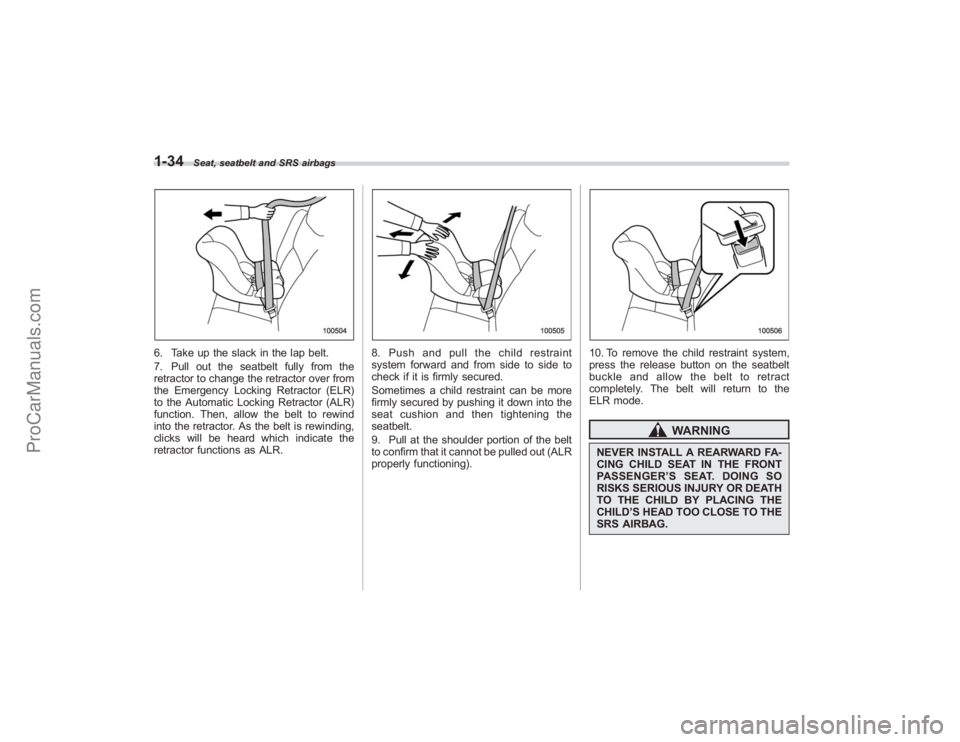
6. Take up the slack in the lap belt.
7. Pull out the seatbelt fully from the
retractor to change the retractor over from
the Emergency Locking Retractor (ELR)
to the Automatic Locking Retractor (ALR)
function. Then, allow the belt to rewind
into the retractor. As the belt is rewinding,
clicks will be heard which indicate the
retractor functions as ALR.
8. Push and pull the child restraint
system forward and from side to side to
check if it is firmly secured.
Sometimes a child restraint can be more
firmly secured by pushing it down into the
seat cushion and then tightening the
seatbelt.
9. Pull at the shoulder portion of the belt
to confirm that it cannot be pulled out (ALR
properly functioning).
10. To remove the child restraint system,
press the release button on the seatbelt
buckle and allow the belt to retract
completely. The belt will return to the
ELR mode.
WARNING
NEVER INSTALL A REARWARD FA-
CING CHILD SEAT IN THE FRONT
PASSENGER’SSEAT.DOINGSO
RISKS SERIOUS INJURY OR DEATH
TO THE CHILD BY PLACING THE
CHILD ’S HEAD TOO CLOSE TO THE
SRS AIRBAG.
ProCarManuals.com
Page 59 of 409
NOTEWhen the child restraint system is no
longer in use, remove it and restore the
ELR function of the retractor. That
function is restored by retracting the
seatbelt fully.
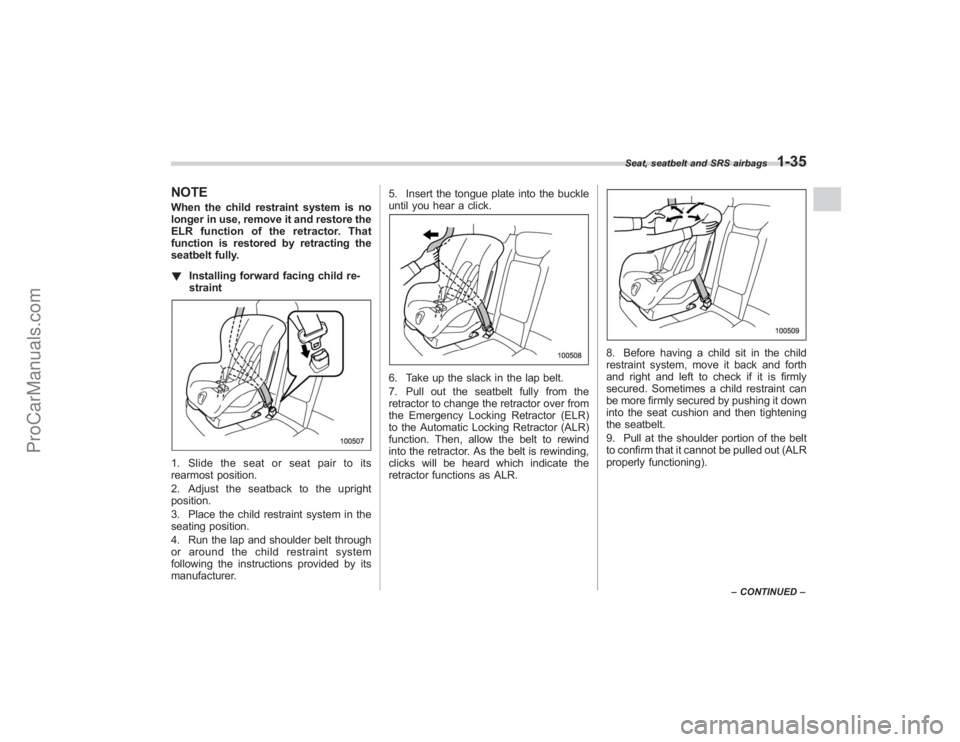
!Installing forward facing child re-
straint1. Slide the seat or seat pair to its
rearmost position.
2. Adjust the seatback to the upright
position.
3. Place the child restraint system in the
seating position.
4. Run the lap and shoulder belt through
or around the child restraint system
following the instructions provided by its
manufacturer. 5. Insert the tongue plate into the buckle
until you hear a click.
6. Take up the slack in the lap belt.
7. Pull out the seatbelt fully from the
retractor to change the retractor over from
the Emergency Locking Retractor (ELR)
to the Automatic Locking Retractor (ALR)
function. Then, allow the belt to rewind
into the retractor. As the belt is rewinding,
clicks will be heard which indicate the
retractor functions as ALR.
8. Before having a child sit in the child
restraint system, move it back and forth
and right and left to check if it is firmly
secured. Sometimes a child restraint can
be more firmly secured by pushing it down
into the seat cushion and then tightening
the seatbelt.
9. Pull at the shoulder portion of the belt
to confirm that it cannot be pulled out (ALR
properly functioning).
Seat, seatbelt and SRS airbags
1-35
–
CONTINUED –
ProCarManuals.com
Page 76 of 409
1-52
Seat, seatbelt and SRS airbags
!Conditions in which front passen-
ger’s SRS frontal airbag is not
activated
The front passenger ’s SRS frontal airbag
will not be activated when any of the
following conditions are met regarding the
front passenger ’s seat:
. The seat is empty.
. The seat is equipped with a rearward
facing child restraint system and an infant
is restrained with it. (See WARNING that
follows.)
. The seat is equipped with a forward
facing child restraint system and a small
child is restrained with it. (See WARNING
that follows.)
. The seat is equipped with a booster
seat and a small child is in the booster
seat. (See WARNING that follows.)
. The seat is relieved of the occupant
load for a time exceeding the predeter-
mined monitoring time period.
. The seat is occupied by a child who
has outgrown a child restraint system
(See WARNING that follows.) or by a
small adult.
. The front passenger ’s occupant detec-
tion system is faulty.
WARNING
NEVER INSTALL A REARWARD FA-
CING CHILD SEAT IN THE FRONT
PASSENGER ’S SEAT EVEN IF THE
FRONT PASSENGER ’S SRS FRON-
TAL AIRBAG IS DEACTIVATED. Be
sure to install it in one of the rear
seating positions recommended in
this Owner ’s Manual in a correct
manner. Also, it is strongly recom-
mended that any forward facing
child seat or booster seat be in-
stalled in one of the rear seating
positions recommended in this
Owner ’s Manual, and that even
children who have outgrown a child
restraint system be also seated in a
REAR seat. This is because children
sitting in the front passenger ’s seat
may be killed or severely injured
should the front passenger ’s SRS
frontal airbag deploy. REAR seats
are the safest place for children.
When the front passenger ’s seat is occu-
pied by a child, observe the following
precautions. Failure to do so may increase
the load on the front passenger ’s seat,
activating the front passenger ’sSRS
frontal airbag even though that seat is
occupied by a child. .
Do not place any article on the seat
other than the child occupant and a child
restraint system.
. Do not place more than one child on
the seat.
. Do not install any accessory such as a
table or TV onto the seatback.
. Do not store a heavy load in the
seatback pocket.
. Do not allow the rear/second-row seat
occupant to place his/her hands or legs on
the front passenger ’s seatback, or allow
him/her to pull the seatback.
! If the front passenger ’s frontal air-
bag ON indicator illuminates and the
OFF indicator extinguishes even
when an infant or a small child is in
a child restraint system (including
booster seat)
Turn the ignition switch to the “LOCK”
position if the front passenger ’s frontal
airbag ON indicator illuminates and the
OFF indicator extinguishes even when an
infant or a small child is in a child restraint
system (including booster seat). Remove
the child restraint system from the seat. By
referring to the child restraint manufac-
turer ’s recommendations as well as the
child restraint system installation proce-
dures in the “Child restraint systems ”
section in this chapter, correctly install
ProCarManuals.com
Page 77 of 409
the child restraint system. Turn the ignition
switch to the“ON ”position and make sure
that the front passenger ’s frontal airbag
ON indicator goes out and the OFF
indicator comes on.
If still the ON indicator remains illuminated
while the OFF indicator extinguishes, take
the following actions.
. Ensure that no article is placed on the
seat other than the child restraint system
and the child occupant.
. Ensure that there is no article left in the
seatback pocket.
If the ON indicator still illuminates while
the OFF indicator extinguishes after taking
relevant corrective actions described
above, relocate the child restraint system
to one of the rear seating positions
recommended in this Owner ’sManual
and immediately contact your SUBARU
dealer for an inspection.NOTEWhen a child who has outgrown a child
restraint system or a small adult is
seated in the front passenger ’s seat,
the Subaru advanced frontal airbag
system may or may not activate the
front passenger ’s SRS frontal airbag
depending on the occupant’ s seating
posture. If the front passenger ’s SRS frontal airbag is activated (the ON
indicator illuminates while the OFF
indicator extinguishes), take the follow-
ing actions.
.
Ensure that no article is placed on
the seat other than the occupant.
. Ensure that there is no article left in
the seatback pocket.
If the ON indicator still illuminates while
the OFF indicator extinguishes despite
the fact that the actions noted above
have been taken, seat the child/small
adult in the rear seat and immediately
contact your SUBARU dealer for an
inspection. Even if the system has
passed the dealer inspection, it is
recommended that on subsequent trips
the child/small adult always take the
rear seat.
Children who have outgrown a child
restraint system should always wear the
seatbelt irrespective of whether the airbag
is deactivated or activated.
! Conditions in which front passen-
ger’s SRS frontal airbag is activated
The front passenger ’s SRS frontal airbag
will be activated for deployment upon
impact when any of the following condi-
tions is met regarding the front passen-
ger ’s seat.
. When the seat is occupied by an adult. .
When a heavy article is placed on the
seat.
When the front passenger ’s seat is occu-
pied by an adult, observe the following
precautions. Failure to do so may lessen
the load on the front passenger ’s seat,
deactivating the front passenger ’s SRS
frontal airbag despite the fact that the seat
is occupied by an adult.
. Do not allow the rear seat occupant to
lift the front passenger ’s seat cushion
using his/her feet.
. Do not place any article under the front
passenger ’s seat, or squeeze any article
from behind and under the seat. This may
lift the seat cushion.
. Do not squeeze any article between
the front passenger ’s seat and side trim/
pillar, door or center console box. This
may lift the seat cushion.
! If the passenger ’s frontal airbag OFF
indicator illuminates and the ON
indicator extinguishes even when
the front passenger ’s seat is occu-
pied by an adult
This can be caused by the adult incor-
rectly sitting in the front passenger ’s seat.
Turn the ignition switch to the “LOCK”
position. Ask the front passenger to set
the seatback to the upright position, sit up
Seat, seatbelt and SRS airbags
1-53
– CONTINUED –
ProCarManuals.com