weight SUBARU TRIBECA 2008 Owners Manual
[x] Cancel search | Manufacturer: SUBARU, Model Year: 2008, Model line: TRIBECA, Model: SUBARU TRIBECA 2008Pages: 409, PDF Size: 5.75 MB
Page 7 of 409
&Child safety
WARNING
. Never hold a child on your lap or
in your arms while the vehicle is
moving. The passenger cannot
protect the child from injury in a
collision, because the child will
be caught between the passen-
ger and objects inside the vehi-
cle.
. While riding in the vehicle, in-
fants and small children should
always be placed in one of the
rear seating positions recom-
mended in this Owner ’s Manual
in an infant or child restraint
system which is appropriate for
the child ’s age, height and
weight. If a child is too big for a
child restraint system, the child
should sit in a REAR seat and be
restrained using the seatbelts.
According to accident statistics,
children are safer when properly
restrained in the rear seating
positions than in the front seat-
ing positions. Never allow a child
to stand up or kneel on the seat.
. Put children aged 12 and under in
a REAR seat properly restrained at all times in a child restraint
device or in a seatbelt. The SRS
airbag deploys with considerable
speed and force and can injure or
even kill children, especially if
they are 12 years of age and
under and are not restrained or
improperly restrained. Because
children are lighter and weaker
than adults, their risk of being
injured from deployment is great-
er.
. NEVER INSTALL A REARWARD
FACING CHILD SAFETY SEAT IN
THE FRONT SEAT. DOING SO
RISKS SERIOUS INJURY OR
DEATH TO THE CHILD BY PLA-
CING THE CHILD ’S HEAD TOO
CLOSE TO THE SRS AIRBAG.
. Always use the child safety locks
whenever a child rides in the
rear. Serious injury could result
if a child accidentally opened the
door and fell out. Refer to the
“ Child safety locks ”section in
chapter 2.
. Always lock the passenger ’s win-
dows using the lock switch when
children are riding in the vehicle.
Failure to follow this procedure
could result in injury to a child
operating the power window. Re- fer to the
“Power windows ”sec-
tion in chapter 2.
. Never leave unattended children
in the vehicle. They could acci-
dentally injure themselves or
others through inadvertent op-
eration of the vehicle. Also, on
hot or sunny days, temperature
in a closed vehicle could quickly
become high enough to cause
severe or possibly fatal injuries
to them.
Carefully read the sections “Child restraint
systems ”, “*SRS airbag (Supplemental
Restraint System airbag) ”, and“Seatbelts ”
in chapter 1 of this Owner ’s Manual for
instructions and precautions concerning
the child restraint system, seatbelt system
and SRS airbag system.
& Engine exhaust gas (carbon
monoxide)
WARNING
. Never inhale engine exhaust gas.
Engine exhaust gas contains
carbon monoxide, a colorless
and odorless gas which is dan-
gerous, or even lethal, if inhaled.
. Always properly maintain the en-
5
–CONTINUED –
ProCarManuals.com
Page 26 of 409
1-2
Seat, seatbelt and SRS airbags
Front seats
WARNING
.Never adjust the seat while driv-
ing to avoid the possibility of
loss of vehicle control and of
personal injury.
. Before adjusting the seat, make
sure the hands and feet of rear
seat passengers or luggage are
clear of the adjusting mechan-
ism.
. Seatbelts provide maximum re-
straint when the occupant sits
well back and upright in the seat.
To reduce the risk of sliding
under the seatbelt in a collision,
the front seatbacks should be
always used in the upright posi-
tion while the vehicle is running.
If the front seatbacks are not
used in the upright position in a
collision, the risk of sliding under
the lap belt and of the lap belt
sliding up over the abdomen will
increase, and both can result in
serious internal injury or death.
. The SRS airbags deploy with
considerable speed and force.
Occupants who are out of proper position when the SRS airbag
deploys could suffer very serious
injuries. Because the SRS airbag
needs enough space for deploy-
ment, the driver should always
sit upright and well back in the
seat as far from the steering
wheel as practical while still
maintaining full vehicle control
and the front passenger should
move the seat as far back as
possible and sit upright and well
back in the seat.
WARNING
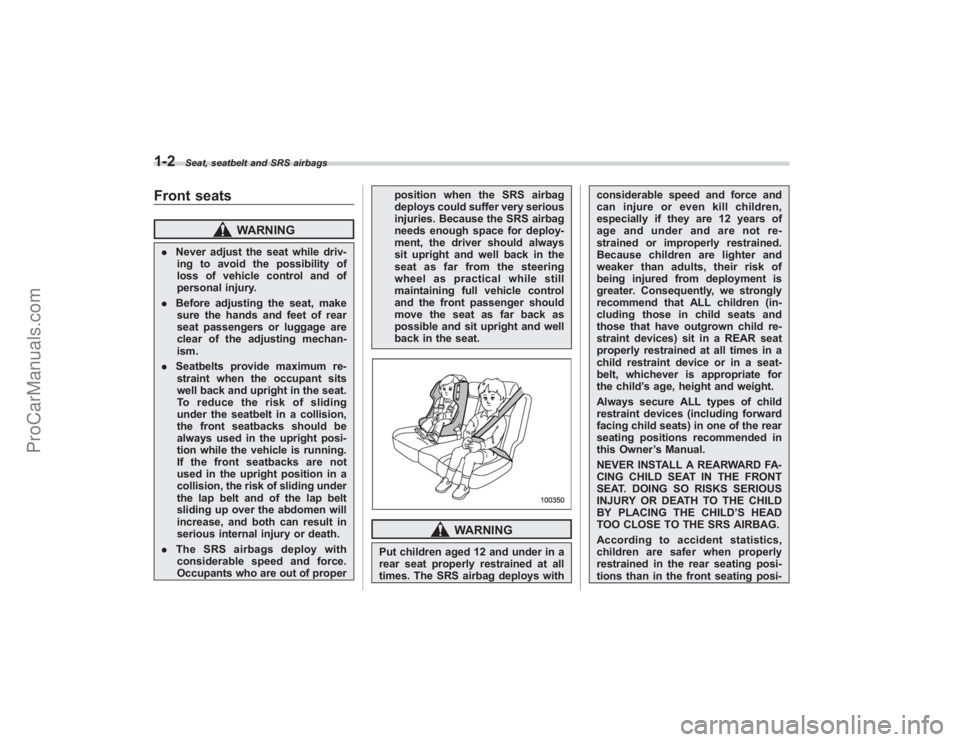
Put children aged 12 and under in a
rear seat properly restrained at all
times. The SRS airbag deploys withconsiderable speed and force and
can injure or even kill children,
especially if they are 12 years of
age and under and are not re-
strained or improperly restrained.
Because children are lighter and
weaker than adults, their risk of
being injured from deployment is
greater. Consequently, we strongly
recommend that ALL children (in-
cluding those in child seats and
those that have outgrown child re-
straint devices) sit in a REAR seat
properly restrained at all times in a
child restraint device or in a seat-
belt, whichever is appropriate for
the child
’s age, height and weight.
Always secure ALL types of child
restraint devices (including forward
facing child seats) in one of the rear
seating positions recommended in
this Owner ’s Manual.
NEVER INSTALL A REARWARD FA-
CING CHILD SEAT IN THE FRONT
SEAT. DOING SO RISKS SERIOUS
INJURY OR DEATH TO THE CHILD
BY PLACING THE CHILD ’S HEAD
TOO CLOSE TO THE SRS AIRBAG.
According to accident statistics,
children are safer when properly
restrained in the rear seating posi-
tions than in the front seating posi-
ProCarManuals.com
Page 40 of 409
1-16
Seat, seatbelt and SRS airbags
a rear seat properly restrained at
all times. The SRS airbag de-
ploys with considerable speed
and force and can injure or even
kill children, especially if they are
12 years of age and under and
are not restrained or improperly
restrained. Because children are
lighter and weaker than adults,
their risk of being injured from
deployment is greater. Conse-
quently, we strongly recommend
that ALL children (including
those in child seats and those
that have outgrown child re-
straint devices) sit in a REAR
seat properly restrained at all
times in a child restraint device
or in a seatbelt, whichever is
appropriate for the child’s height
and weight.
Always secure ALL types of child
restraint devices (including for-
ward facing child seats) in one of
the rear seating positions recom-
mended in this Owner ’s Manual.
NEVER INSTALL A REARWARD
FACING CHILD SEAT IN THE
FRONT SEAT. DOING SO RISKS
SERIOUS INJURY OR DEATH TO
THE CHILD BY PLACING THE
CHILD ’S HEAD TOO CLOSE TO THE SRS AIRBAG.
According to accident statistics,
children are safer when properly
restrained in the rear seating
positions than in the front seat-
ing positions. For instructions
and precautions concerning the
child restraint system, refer to
the
“Child restraint systems ”
section in this chapter.
Your vehicle is equipped with a crash
sensing and diagnostic module, which will
record the use of the seatbelt(s) by the
driver and front passenger when any of
the SRS frontal, side and curtain airbags
deploy.
! Infants or small children
Use a child restraint system that is
suitable for your vehicle. Refer to the
information on “Child restraint systems ”in
this chapter.
! Children
If a child is too big for a child restraint
system, the child should sit in the rear seat
and be restrained using the seatbelts.
According to accident statistics, children
are safer when properly restrained in the
rear seating positions than in the front
seating positions. Never allow a child to
stand up or kneel on the seat. If the shoulder portion of the belt crosses
the face or neck, adjust the shoulder belt
anchor height (window-side seating posi-
tions only) and then if necessary move the
child closer to the belt buckle to help
provide a good shoulder belt fit. Care must
be taken to securely place the lap belt as
low as possible on the hips and not on the
child
’s waist. If the shoulder portion of the
belt cannot be properly positioned, a child
restraint system should be used. Never
place the shoulder belt under the child ’s
arm or behind the child ’s back.
! Expectant mothers
Expectant mothers also need to use the
seatbelts. They should consult their doctor
for specific recommendations. The lap belt
should be worn securely and as low as
possible over the hips, not over the waist.
ProCarManuals.com
Page 53 of 409
.Seatbelt pretensioner (Driver ’s side)
. Seatbelt pretensioner (Front passen-
ger ’s side)
. Seatbelt buckle switch (Driver ’s side)
. Seatbelt buckle switch (Front passen-
ger ’s side)
. Driver ’s seat position sensor
. Front passenger ’s seatbelt tension
sensor
. Front passenger ’s occupant detection
system weight sensor
. Front passenger ’s occupant detection
control module
. Front passenger ’s frontal airbag ON
and OFF indicator
. All related wiring
WARNING
If the warning light exhibits any of
the following conditions, there may
be a malfunction in the seatbelt
pretensioners and/or SRS airbag
system. Immediately take your vehi-
cle to your nearest SUBARU dealer
to have the system checked. Unless
checked and properly repaired, the
seatbelt pretensioners and/or SRS
airbags will operate improperly (e.g.
SRS airbags may inflate in a very
minor collision or not inflate in a
severe collision), which may in- crease the risk of injury.
.
Flashing or flickering of the warn-
ing light
. No illumination of the warning
light when the ignition switch is
first turned to the “ON ”position
. Continuous illumination of the
warning light
. Illumination of the warning light
while driving
& System servicing
WARNING
. When discarding a seatbelt re-
tractor assembly or scrapping
the entire vehicle damaged by a
collision, consult your SUBARU
dealer.
. Tampering with or disconnecting
the system ’s wiring could result
in accidental activation of the
seatbelt pretensioner and/or air-
bag or could make the system
inoperative, which may result in
serious injury. The wiring har-
nesses of the seatbelt preten-
sioner and SRS airbag systems
are covered with yellow insula- tion and the connectors of the
system are yellow for easy iden-
tification. Do not use electrical
test equipment on any circuit
related to the seatbelt preten-
sioner and airbag systems. For
required servicing of the seatbelt
pretensioner, see your nearest
SUBARU dealer.
CAUTION
The front sub sensors are located
on both sides of the radiator panel,
and the airbag control module in-
cluding the impact sensors is lo-
cated under the center console. If
you need service or repair in those
areas or near the front seatbelt
retractors, we recommend that you
have an authorized SUBARU dealer
perform the work.NOTEIf the front part of the vehicle is
damaged in an accident to the extent
that the seatbelt pretensioner does not
operate, contact your SUBARU dealer
as soon as possible.
Seat, seatbelt and SRS airbags
1-29
–
CONTINUED –
ProCarManuals.com
Page 56 of 409
1-32
Seat, seatbelt and SRS airbags
only a child restraint system that has a
bottom base that fits snugly against the
contours of the seat cushion and can be
securely retained using the seatbelt.
C: Rear center seat (5-seater models)/
second-row center seat (7-seater mod-
els)
Installing a child restraint system is not
recommended, although the A/ELR seat-
belt and an upper anchorage (tether
anchorage) are provided in this position.
Some types of child restraints might not be
able to be secured firmly due to projection
of the seat cushion.
In this seating position, you should use
only a child restraint system that has a
bottom base that fits snugly against the
contours of the seat cushion and can be
securely retained using the seatbelt.
D: Third-row seat (7-seater models)
Installing a child restraint system is not
recommended, although the A/ELR seat-
belt and two upper anchorages (tether
anchorages) are provided in these posi-
tions.
These seating positions are not equipped
with lower anchorages (bars) for installing
LATCH system-type child restraints. How-
ever, child restraint devices can be used in
these position using the A/ELR seatbelts
and upper anchorages (tether an-chorages) provided.
Some types of child restraints might not be
able to be secured firmly due to projection
of the seat cushion.
In this seating position, you should use
only a child restraint system that has a
bottom base that fits snugly against the
contours of the seat cushion and can be
securely retained using the seatbelt.
WARNING
Put children aged 12 and under in
the rear seat properly restrained at
all times. The SRS airbag deploys
with considerable speed and force
and can injure or even kill children,
especially if they are 12 years of age
and under and are not restrained or
improperly restrained. Because chil-
dren are lighter and weaker than
adults, their risk of being injured
from deployment is greater.
Consequently, be sure to secure
ALL types of child restraint devices
(including forward facing child
seats) in the REAR seats at all times.
You should choose a restraint de-
vice which is appropriate for the
child
’s age, height and weight. Ac-
cording to accident statistics, chil-
dren are safer when properly re- strained in the rear seating posi-
tions than in the front seating posi-
tions.
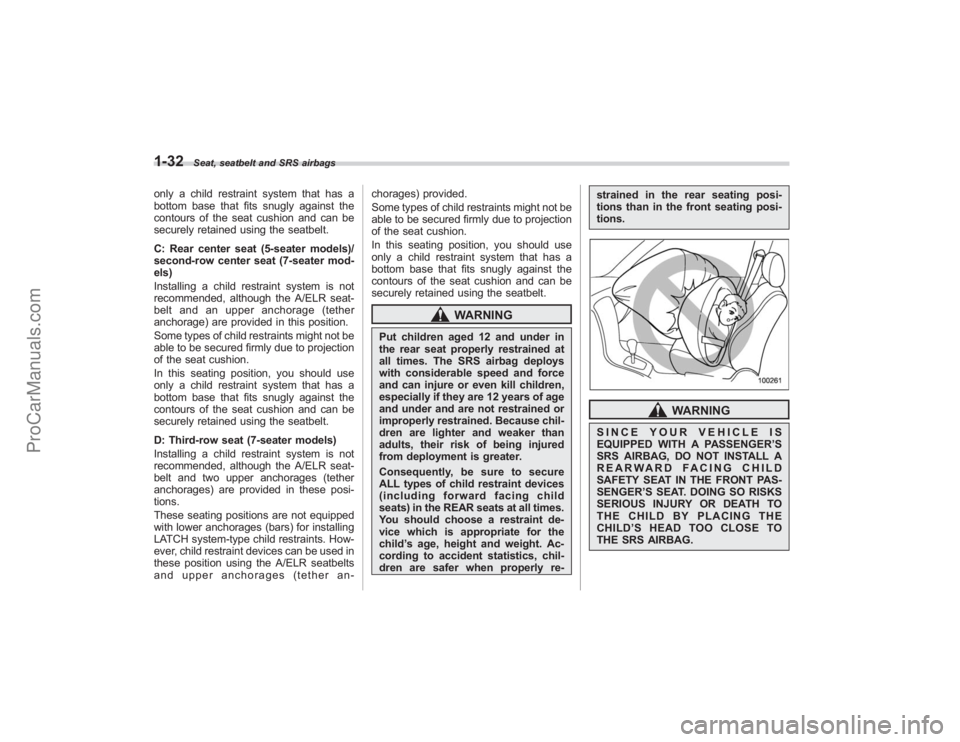
WARNING
SINCE YOUR VEHICLE IS
EQUIPPED WITH A PASSENGER
’S
SRS AIRBAG, DO NOT INSTALL A
REARWARD FACING CHILD
SAFETY SEAT IN THE FRONT PAS-
SENGER ’S SEAT. DOING SO RISKS
SERIOUS INJURY OR DEATH TO
THE CHILD BY PLACING THE
CHILD’ S HEAD TOO CLOSE TO
THE SRS AIRBAG.
ProCarManuals.com
Page 57 of 409
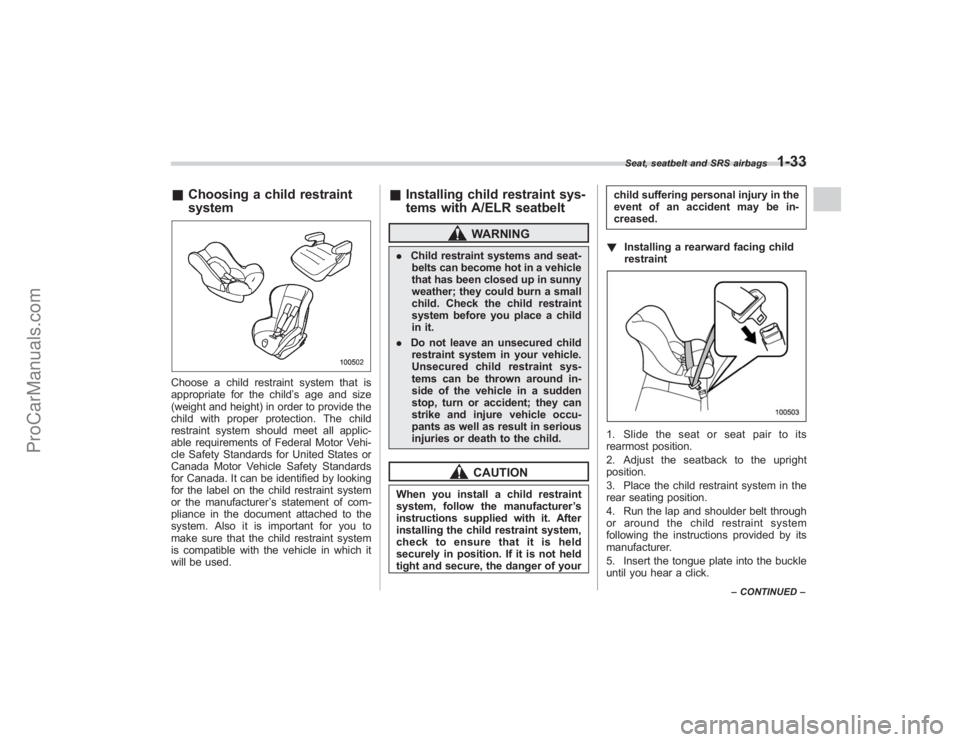
&Choosing a child restraint
systemChoose a child restraint system that is
appropriate for the child ’s age and size
(weight and height) in order to provide the
child with proper protection. The child
restraint system should meet all applic-
able requirements of Federal Motor Vehi-
cle Safety Standards for United States or
Canada Motor Vehicle Safety Standards
for Canada. It can be identified by looking
for the label on the child restraint system
or the manufacturer ’s statement of com-
pliance in the document attached to the
system. Also it is important for you to
make sure that the child restraint system
is compatible with the vehicle in which it
will be used.
& Installing child restraint sys-
tems with A/ELR seatbelt
WARNING
. Child restraint systems and seat-
belts can become hot in a vehicle
that has been closed up in sunny
weather; they could burn a small
child. Check the child restraint
system before you place a child
in it.
. Do not leave an unsecured child
restraint system in your vehicle.
Unsecured child restraint sys-
tems can be thrown around in-
side of the vehicle in a sudden
stop, turn or accident; they can
strike and injure vehicle occu-
pants as well as result in serious
injuries or death to the child.
CAUTION
When you install a child restraint
system, follow the manufacturer ’s
instructions supplied with it. After
installing the child restraint system,
check to ensure that it is held
securely in position. If it is not held
tight and secure, the danger of your child suffering personal injury in the
event of an accident may be in-
creased.
! Installing a rearward facing child
restraint
1. Slide the seat or seat pair to its
rearmost position.
2. Adjust the seatback to the upright
position.
3. Place the child restraint system in the
rear seating position.
4. Run the lap and shoulder belt through
or around the child restraint system
following the instructions provided by its
manufacturer.
5. Insert the tongue plate into the buckle
until you hear a click.
Seat, seatbelt and SRS airbags
1-33
–CONTINUED –
ProCarManuals.com
Page 69 of 409
seat as far from the steering
wheel as practical while still
maintaining full vehicle control
and the front passenger should
move the seat as far back as
possible and sit upright and well
back in the seat.
. Do not place any objects over or
near the SRS airbag cover or
between you and the SRS airbag.
If the SRS airbag deploys, those
objects could interfere with its
proper operation and could be
propelled inside the vehicle and
cause injury.
WARNING
. Put children aged 12 and under in
a rear seat properly restrained at
all times. The SRS airbag de-
ploys with considerable speed
and force and can injure or even
kill children, especially if they are
12 years of age and under and
are not restrained or improperly
restrained. Because children are
lighter and weaker than adults,
their risk of being injured from
deployment is greater.
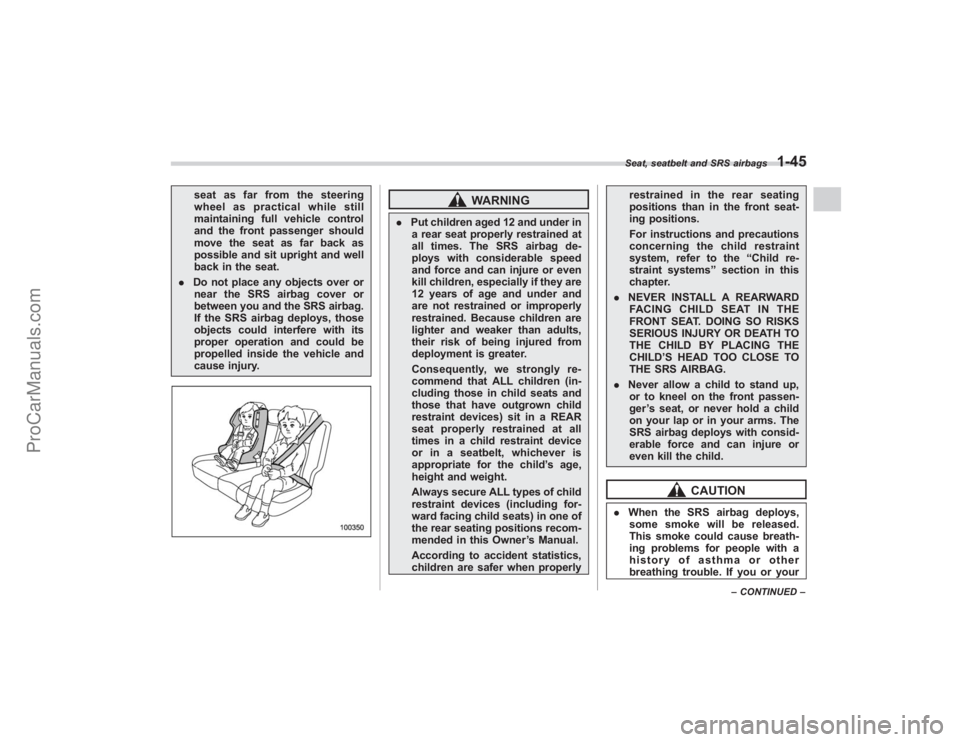
Consequently, we strongly re-
commend that ALL children (in-
cluding those in child seats and
those that have outgrown child
restraint devices) sit in a REAR
seat properly restrained at all
times in a child restraint device
or in a seatbelt, whichever is
appropriate for the child ’s age,
height and weight.
Always secure ALL types of child
restraint devices (including for-
ward facing child seats) in one of
the rear seating positions recom-
mended in this Owner ’s Manual.
According to accident statistics,
children are safer when properly restrained in the rear seating
positions than in the front seat-
ing positions.
For instructions and precautions
concerning the child restraint
system, refer to the
“Child re-
straint systems ”section in this
chapter.
. NEVER INSTALL A REARWARD
FACING CHILD SEAT IN THE
FRONT SEAT. DOING SO RISKS
SERIOUS INJURY OR DEATH TO
THE CHILD BY PLACING THE
CHILD ’S HEAD TOO CLOSE TO
THE SRS AIRBAG.
. Never allow a child to stand up,
or to kneel on the front passen-
ger ’s seat, or never hold a child
on your lap or in your arms. The
SRS airbag deploys with consid-
erable force and can injure or
even kill the child.
CAUTION
. When the SRS airbag deploys,
some smoke will be released.
This smoke could cause breath-
ing problems for people with a
history of asthma or other
breathing trouble. If you or yourSeat, seatbelt and SRS airbags
1-45
– CONTINUED –
ProCarManuals.com
Page 71 of 409
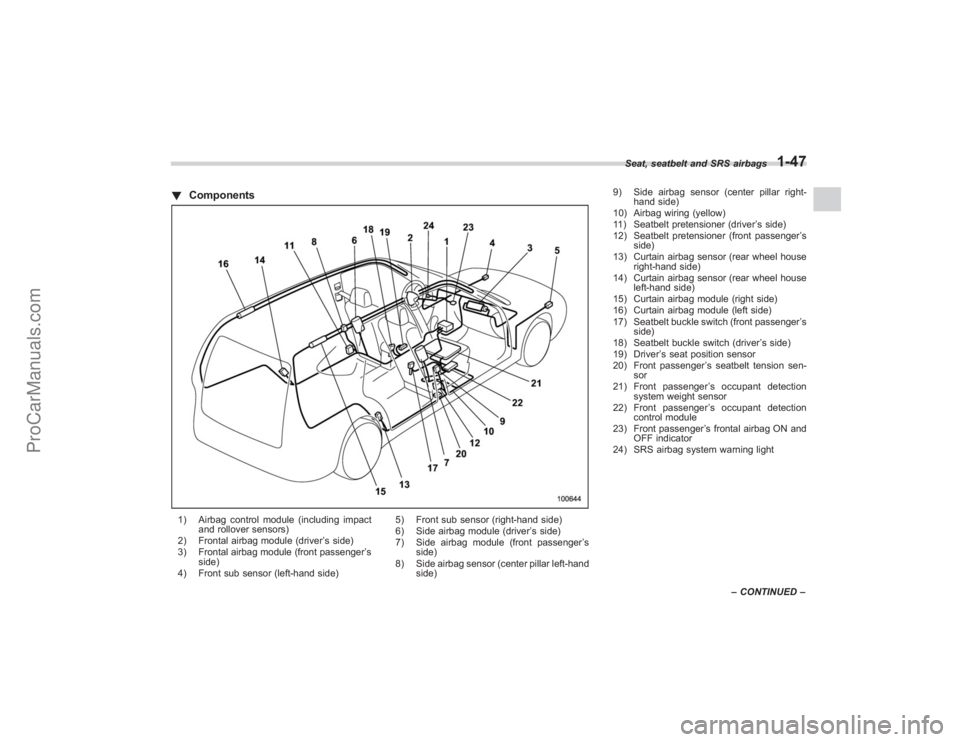
!Components1) Airbag control module (including impact
and rollover sensors)
2) Frontal airbag module (driver ’s side)
3) Frontal airbag module (front passenger ’s
side)
4) Front sub sensor (left-hand side) 5) Front sub sensor (right-hand side)
6) Side airbag module (driver
’s side)
7) Side airbag module (front passenger ’s
side)
8) Side airbag sensor (center pillar left-hand side) 9) Side airbag sensor (center pillar right-
hand side)
10) Airbag wiring (yellow)
11) Seatbelt pretensioner (driver ’s side)
12) Seatbelt pretensioner (front passenger ’s
side)
13) Curtain airbag sensor (rear wheel house right-hand side)
14) Curtain airbag sensor (rear wheel house left-hand side)
15) Curtain airbag module (right side)
16) Curtain airbag module (left side)
17) Seatbelt buckle switch (front passenger ’s
side)
18) Seatbelt buckle switch (driver ’s side)
19) Driver ’s seat position sensor
20) Front passenger ’s seatbelt tension sen-
sor
21) Front passenger ’s occupant detection
system weight sensor
22) Front passenger ’s occupant detection
control module
23) Front passenger ’s frontal airbag ON and
OFF indicator
24) SRS airbag system warning light Seat, seatbelt and SRS airbags
1-47
–
CONTINUED –
ProCarManuals.com
Page 74 of 409
1-50
Seat, seatbelt and SRS airbags
WARNING
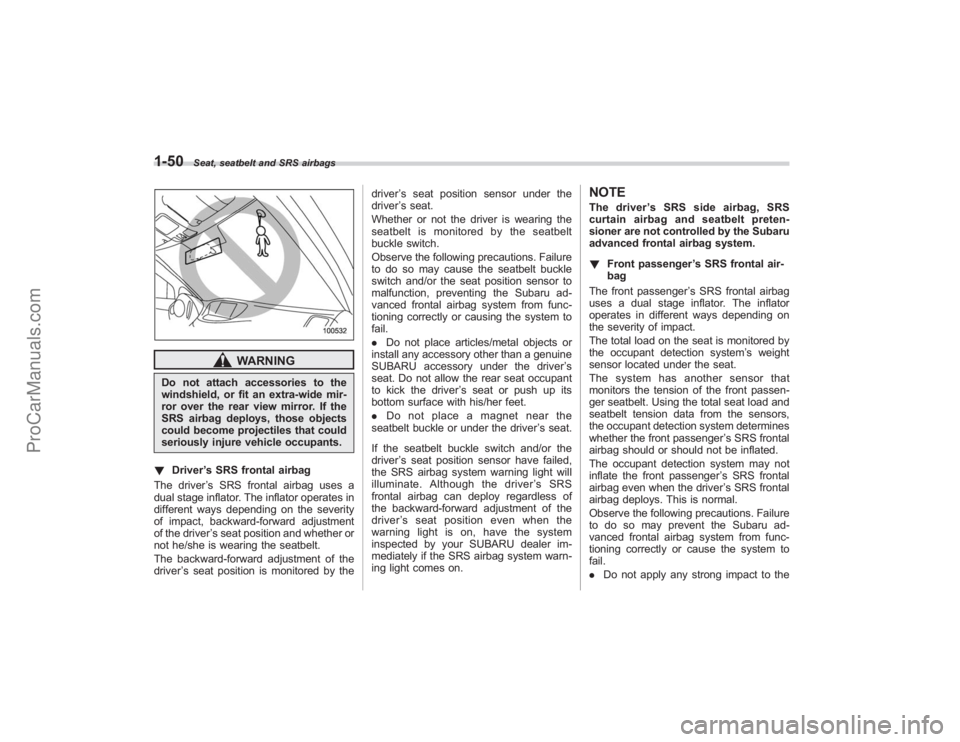
Do not attach accessories to the
windshield, or fit an extra-wide mir-
ror over the rear view mirror. If the
SRS airbag deploys, those objects
could become projectiles that could
seriously injure vehicle occupants.
! Driver ’s SRS frontal airbag
The driver ’s SRS frontal airbag uses a
dual stage inflator. The inflator operates in
different ways depending on the severity
of impact, backward-forward adjustment
of the driver ’s seat position and whether or
not he/she is wearing the seatbelt.
The backward-forward adjustment of the
driver ’s seat position is monitored by the driver
’s seat position sensor under the
driver ’s seat.
Whether or not the driver is wearing the
seatbelt is monitored by the seatbelt
buckle switch.
Observe the following precautions. Failure
to do so may cause the seatbelt buckle
switch and/or the seat position sensor to
malfunction, preventing the Subaru ad-
vanced frontal airbag system from func-
tioning correctly or causing the system to
fail.
. Do not place articles/metal objects or
install any accessory other than a genuine
SUBARU accessory under the driver ’s
seat. Do not allow the rear seat occupant
to kick the driver ’s seat or push up its
bottom surface with his/her feet.
. Do not place a magnet near the
seatbelt buckle or under the driver ’s seat.
If the seatbelt buckle switch and/or the
driver ’s seat position sensor have failed,
the SRS airbag system warning light will
illuminate. Although the driver ’sSRS
frontal airbag can deploy regardless of
the backward-forward adjustment of the
driver ’s seat position even when the
warning light is on, have the system
inspected by your SUBARU dealer im-
mediately if the SRS airbag system warn-
ing light comes on.
NOTEThe driver ’s SRS side airbag, SRS
curtain airbag and seatbelt preten-
sioner are not controlled by the Subaru
advanced frontal airbag system.
! Front passenger ’s SRS frontal air-
bag
The front passenger ’s SRS frontal airbag
uses a dual stage inflator. The inflator
operates in different ways depending on
the severity of impact.
The total load on the seat is monitored by
the occupant detection system ’s weight
sensor located under the seat.
The system has another sensor that
monitors the tension of the front passen-
ger seatbelt. Using the total seat load and
seatbelt tension data from the sensors,
the occupant detection system determines
whether the front passenger ’s SRS frontal
airbag should or should not be inflated.
The occupant detection system may not
inflate the front passenger ’s SRS frontal
airbag even when the driver ’s SRS frontal
airbag deploys. This is normal.
Observe the following precautions. Failure
to do so may prevent the Subaru ad-
vanced frontal airbag system from func-
tioning correctly or cause the system to
fail.
. Do not apply any strong impact to the
ProCarManuals.com
Page 79 of 409
The Subaru advanced frontal airbag sys-
tem is designed to determine the activa-
tion or deactivation condition of the front
passenger’s SRS frontal airbag depend-
ing on the total load on the front passen-
ger ’s seat monitored by the front passen-
ger ’s occupant detection system weight
sensor. For this reason, only the driver ’s
SRS frontal airbag may deploy in the
event of a collision, but this does not mean
failure of the system.
If the front sub sensors located on both
sides of the radiator panel and the impact
sensors in the airbag control module
detect a predetermined amount of force
during a frontal collision, the control
module sends signals to the airbag
module(s) (only driver ’s module or both
driver ’s and front passenger ’s modules)
instructing the module(s) to inflate the
SRS frontal airbag(s). The driver ’s and
front passenger ’s SRS frontal airbags use
dual stage inflators. The two inflators of
each airbag are triggered either sequen-
tially or simultaneously, depending on the
severity of impact, backward-forward ad-
justment of the driver ’s seat position and
fastening/unfastening of the seatbelt in the
case of the driver ’s SRS frontal airbag and
depending on the severity of impact and
the total load on the seat in the case of the
front passenger ’s SRS frontal airbag. After deployment, the SRS airbag immediately
starts to deflate so that the driver
’s vision
is not obstructed. The time required from
detecting impact to the deflation of the
SRS airbag after deployment is shorter
than the blink of an eye.
Both when only the driver ’s SRS frontal
airbag deploys and the driver ’s and front
passenger ’s SRS frontal airbags deploy,
the driver ’s and front passenger ’s seatbelt
pretensioners operate at the same time.
Although it is highly unlikely that the SRS
airbag would activate in a non-accident
situation, should it occur, the SRS airbag
will deflate quickly, not obscuring vision
and will not interfere with the driver ’s
ability to maintain control of the vehicle.
When the SRS airbag deploys, a sudden,
fairly loud inflation noise will be heard and
some smoke will be released. These
occurrences are a normal result of the
deployment. This smoke does not indicate
a fire in the vehicle.
CAUTION
Do not touch the SRS airbag system
components around the steering
wheel and dashboard with bare
hands right after deployment. Doing
so can cause burns because the components can be very hot as a
result of deployment.
The driver ’s SRS frontal airbag and front
passenger ’s SRS frontal airbag are de-
signed to deploy in the event of an
accident involving a moderate to severe
frontal collision. It is basically not designed
to deploy in lesser frontal impacts be-
cause the necessary protection can be
achieved by the seatbelt alone. Also, they
are basically not designed to deploy in
side or rear impacts or in rollover acci-
dents because deployment of only the
driver ’s SRS frontal airbag or both driver ’s
and front passenger ’s SRS frontal airbags
would not help the occupant in those
situations. The driver ’s and front passen-
ger ’s SRS frontal airbags are designed to
function on a one-time-only basis.
SRS airbag deployment depends on the
level of force experienced in the passen-
ger compartment during a collision. That
level differs from one type of collision to
another, and it may have no bearing on
the visible damage done to the vehicle
itself.
Seat, seatbelt and SRS airbags
1-55
– CONTINUED –
ProCarManuals.com