check engine light SUBARU TRIBECA 2010 1.G Owner's Manual
[x] Cancel search | Manufacturer: SUBARU, Model Year: 2010, Model line: TRIBECA, Model: SUBARU TRIBECA 2010 1.GPages: 422, PDF Size: 12.87 MB
Page 266 of 422
warning light illuminate simultaneously,
take the following steps.
1. Stop the vehicle in the nearest safe,
flat location.
2. Shut down the engine, apply the
parking brake, and then restart it.
3. Release the parking brake. If both
warning lights turn off, the EBD system
may be malfunctioning.
Drive carefully to the nearest SUBARU
dealer and have the system inspected.
4. If both warning lights illuminate again
and remain illuminated after the engine
has been restarted, shut down the engine
again, apply the parking brake, and check
the brake fluid level. Refer to“Brake fluid ”
F 11-20.
5. If the brake fluid level is not below the“ MIN ”mark, the EBD system may be
malfunctioning. Drive carefully to the
nearest SUBARU dealer and have the
system inspected.
6. If the brake fluid level is below the “ MIN ”mark, DO NOT drive the vehicle.
Instead, have the vehicle towed to the
nearest SUBARU dealer for repair.
WARNING
. Driving with the brake system
warning light illuminated is dan- gerous. This indicates your brake
system may not be working
properly. If the light remains
illuminated, have the brakes in-
spected by a SUBARU dealer
immediately.
. If at all in doubt about whether
the brakes are operating prop-
erly, do not drive the vehicle.
Have your vehicle towed to the
nearest SUBARU dealer for re-
pair. Vehicle Dynamics Control system
WARNING
Always use the utmost care in driving –overconfidence because
you are driving with a Vehicle Dy-
namics Control system equipped
vehicle could easily lead to a ser-
ious accident.
CAUTION
. Even if your vehicle is equipped
with Vehicle Dynamics Control
system, winter tires should be
used when driving on snow-cov-
ered or icy roads; in addition,
vehicle speed should be reduced
considerably. Simply having a
Vehicle Dynamics Control sys-
tem does not guarantee that the
vehicle will be able to avoid
accidents in any situation.
. Activation of the Vehicle Dy-
namics Control system is an
indication that the road being
travelled on has a slippery sur-
face; since having Vehicle Dy-
namics Control is no guarantee Starting and operating
7-23
– CONTINUED –
Page 267 of 422
7-24Starting and operating
that full vehicle control will be
maintained at all times and under
all conditions, its activation
should be seen as a sign that
the speed of the vehicle should
be reduced considerably.
. Whenever suspension compo-
nents, steering components, or
an axle are removed from a
vehicle equipped with Vehicle
Dynamics Control system, have
an inspection of that system
performedbyanauthorized
SUBARU dealer.
. The following precautions should
be observed in order to ensure
that the Vehicle Dynamics Con-
trol system is operating properly. – All four wheels should be
fitted with tires of the same
size, type, and brand. Further-
more, the amount of wear
should be the same for all
four tires.
– Keep the tire pressure at the
proper level as shown on the
vehicle placard attached to
the driver ’s side door pillar.
In the event of wheelspin and/or skidding
on a slippery road surface and/or during cornering and/or an evasive maneuver,
the Vehicle Dynamics Control system
adjusts the engine
’s output and the
wheels ’respective braking forces to help
maintain traction and directional control. . Traction Control Function
The traction control function is designed to
prevent spinning of the driving wheels on
slippery road surfaces, thereby helping to
maintain traction and directional control.
Activation of this function is shown by
steady illumination of the Vehicle Dy-
namics Control operation indicator light. . Skid Suppression Function
The skid suppression function is designed
to help maintain directional stability by
suppressing the wheels ’tendency to slide
sideways during steering operations. Acti-
vation of this function is shown by flashing
of the Vehicle Dynamics Control operation
indicator light.
NOTE . Slight twitching of the brake pedal
may be felt when the Vehicle Dynamics
Control system operates; a small de-
gree of vehicle or steering wheel shak-
ing may also be noticed in this situa-
tion. These are normal characteristics
of Vehicle Dynamics Control operation
and are no cause for alarm.. When driving off immediately after starting the engine, a short operation
noise may be noticed coming from the
engine compartment. This noise is
generated as a result of a check being
performed on the Vehicle Dynamics
Control system and is normal..
Depending on the timing of activa-
tion of the brakes, the brake pedal may
seem to jolt when you drive off after
starting the engine. This is a conse-
quence of the Vehicle Dynamics Con-
trol operational check and is normal.. In the circumstances shown in the
following list, the vehicle may be more
unstable than it feels to the driver. The
Vehicle Dynamics Control System may
therefore operate. Such operation does
not indicate a system malfunction.
–on gravel-covered or rutted
roads – on unfinished roads
– when the vehicle is towing a
trailer– when the vehicle is fitted with
snow tires or winter tires
. Activation of the Vehicle Dynamics
Control system will cause operation of
the steering wheel to feel slightly
different compared to that for normalconditions. . Even if the vehicle is equipped with
a Vehicle Dynamics Control system, it
Page 284 of 422

underbody. Clear off any such matter from
the underbody. If the vehicle is used with
these materials trapped or adhering to the
underbody, a mechanical breakdown or
fire could occur. .Secure all cargo carried inside the
vehicle and make certain that it is not
piled higher than the seatbacks. During
sudden stops or jolts, unsecured cargo
could be thrown around in the vehicle and
cause injury. Do not pile heavy loads on
the roof. Those loads raise the vehicle ’s
center of gravity and make it more prone
to tip over. . If you must rock the vehicle to free it
from sand or mud, depress the accelerator
pedal slightly and move the select lever
back and forth between “D ” and “R ”
repeatedly. Do not race the engine. For
the best possible traction, avoid spinning
the wheels when trying to free the vehicle. . When the road surface is extremely
slippery, you can obtain better traction by
starting the vehicle with the transmission
in 2nd than 1st. . Never equip your vehicle with tires
larger than those specified in this manual.. Wash the vehicle ’s underbody after off-
road driving. Suspension components are
particularly prone to dirt buildup, so they
need to be washed thoroughly. . Frequent driving of an AWD model under hard-driving conditions such as
rough roads or off roads will necessitate
more frequent replacement of engine oil,
brake fluid and transmission oil than that
specified in the maintenance schedule
described in the
“Warranty and Mainte-
nance Booklet ”.
Remember that damage done to your
SUBARU while operating it off-road and
not using common sense precautions
such as those listed above is not eligible
for warranty coverage. Winter driving
&
Operation during cold weather
Carry some emergency equipment, such
as a window scraper, a bag of sand,
flares, a small shovel and jumper cables.
Check the battery and cables. Cold
temperatures reduce battery capacity.
The battery must be in good condition to
provide enough power for cold winterstarts.
Use an engine oil of proper grade and
viscosity for cold weather. Heavy summer
oil will cause harder starting.
Keep the door locks from freezing by
squirting them with deicer or glycerin. Driving tips
8-7
– CONTINUED –
Page 340 of 422
8. Clean the rubber seal seating area of
the bottom of engine and install the oil
filter by hand turning. Be careful not to
twist or damage the seal.
9. Tighten the oil filter by the amount
indicated in the following table after the
seal makes contact with the bottom ofengine.Oil filter color Part number Amount of ro-
tation
Black 15208AA031 3/4 rotation
CAUTION
. Never over tighten the oil filter
because that can result in an oil leak.
. Thoroughly wipe off any engine
oil that has spilled over the
exhaust pipe and/or under-cover.
If left unremoved, the oil could
catch fire.
10. Reinstall the cover under the oil filter.
11. Pour engine oil through the filler neck. Oil capacity (guideline):
6.7 US qt (6.3 liters, 5.5 Imp qt)
The oil quantity indicated above is only a
guideline. The necessary quantity of oil
depends on the quantity of oil that has
been drained. The quantity of drained oil
differs slightly depending on the tempera-
ture of the oil and the time the oil is left
flowing out. After refilling the engine with
oil, therefore, you must use the level
gauge to confirm that the level is correct.
12. Start the engine and make sure that no
oil leaks appear around the filter ’s rubber
seal and drain plug.
13. Run the engine until it reaches the
normal operating temperature. Then stop
the engine and wait a few minutes to allow
the oil drain back. Check the oil level
again and if necessary, add more engineoil.
& Recommended grade and viscosity
CAUTION
Use only engine oil with the recom-
mended grade and viscosity. Oil grade:
ILSAC GF-4, which can be identified with
the ILSAC certification mark (Starburst mark)
or API classification SM with the words“ENERGY CONSERVING ”
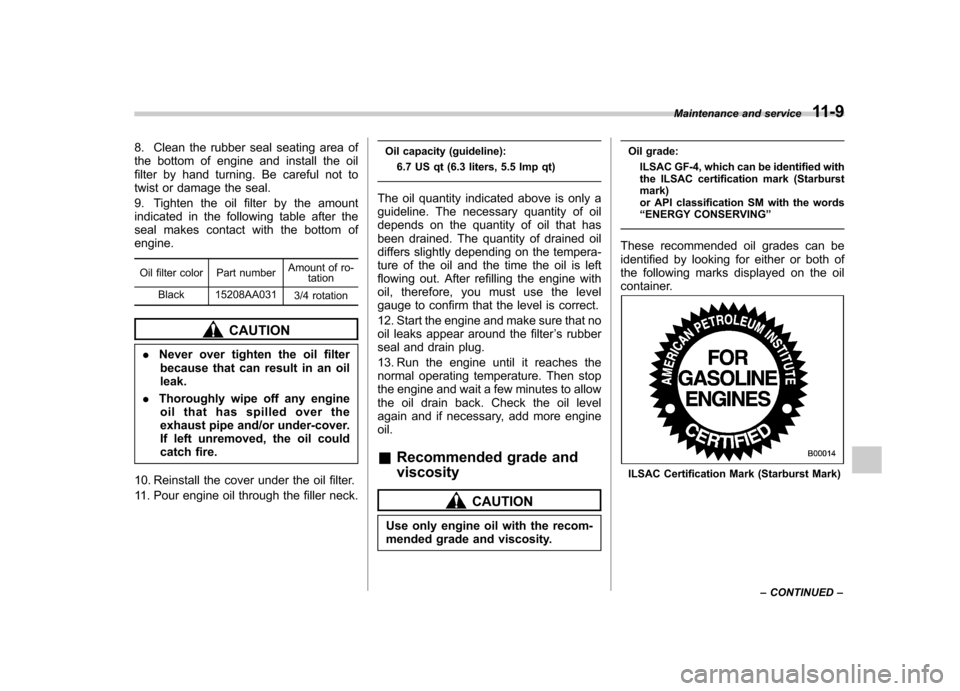
These recommended oil grades can be
identified by looking for either or both of
the following marks displayed on the oil
container.
ILSAC Certification Mark (Starburst Mark) Maintenance and service
11-9
– CONTINUED –
Page 352 of 422
Alcohol contained in the brake
fluid may damage them.
. Be careful not to spill brake fluid
when adding it. If brake fluid
touches the exhaust pipe, it may
cause a bad smell, smoke, and/or
a fire. If brake fluid gets on the
exhaust pipe, be sure to wipe itoff.
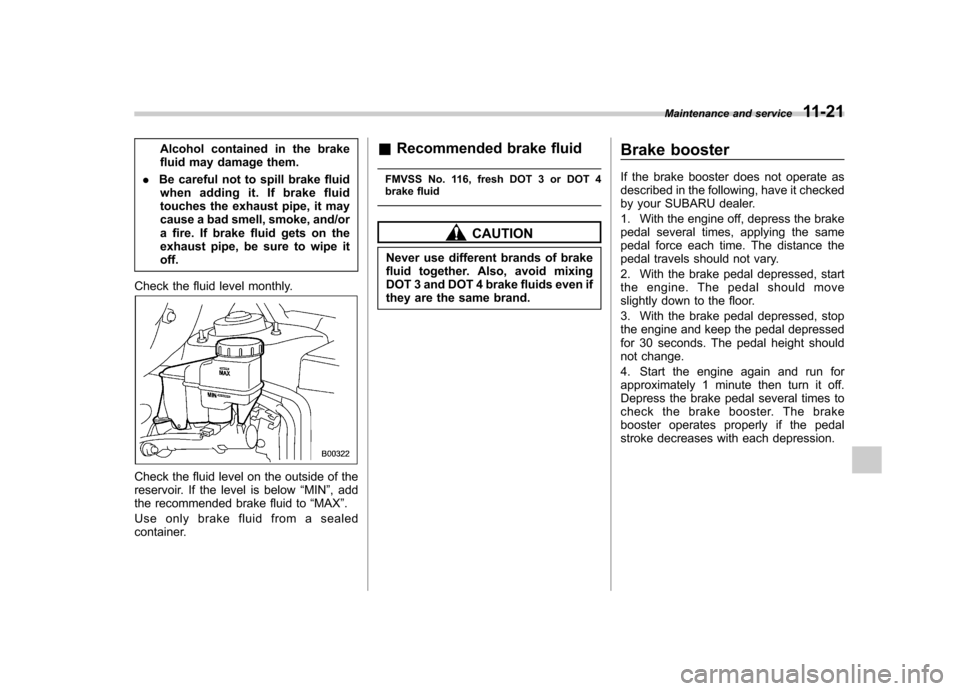
Check the fluid level monthly.
Check the fluid level on the outside of the
reservoir. If the level is below “MIN ”, add
the recommended brake fluid to “MAX ”.
Use only brake fluid from a sealed
container. &
Recommended brake fluid
FMVSS No. 116, fresh DOT 3 or DOT 4
brake fluid
CAUTION
Never use different brands of brake
fluid together. Also, avoid mixing
DOT 3 and DOT 4 brake fluids even if
they are the same brand. Brake booster
If the brake booster does not operate as
described in the following, have it checked
by your SUBARU dealer.
1. With the engine off, depress the brake
pedal several times, applying the same
pedal force each time. The distance the
pedal travels should not vary.
2. With the brake pedal depressed, start
the engine. The pedal should move
slightly down to the floor.
3. With the brake pedal depressed, stop
the engine and keep the pedal depressed
for 30 seconds. The pedal height should
not change.
4. Start the engine again and run for
approximately 1 minute then turn it off.
Depress the brake pedal several times to
check the brake booster. The brake
booster operates properly if the pedal
stroke decreases with each depression.Maintenance and service
11-21
Page 353 of 422
11-22Maintenance and service
Brake pedal
Check the brake pedal free play and
reserve distance according to the main-
tenance schedule in the “Warranty and
Maintenance Booklet ”.
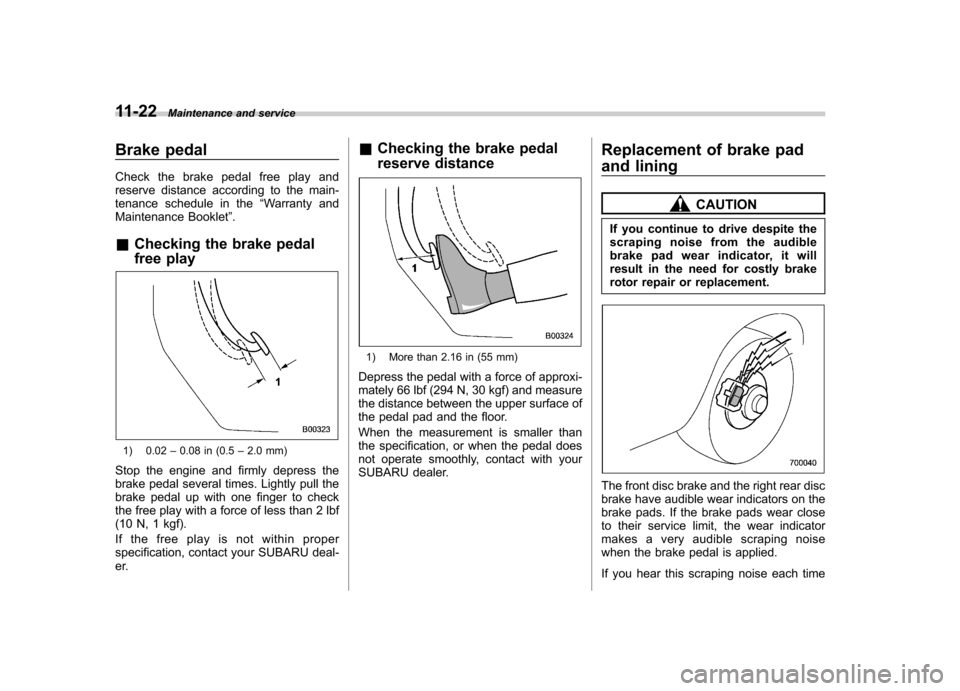
& Checking the brake pedal
free play
1) 0.02 –0.08 in (0.5 –2.0 mm)
Stop the engine and firmly depress the
brake pedal several times. Lightly pull the
brake pedal up with one finger to check
the free play with a force of less than 2 lbf
(10 N, 1 kgf).
If the free play is not within proper
specification, contact your SUBARU deal-
er. &
Checking the brake pedal
reserve distance
1) More than 2.16 in (55 mm)
Depress the pedal with a force of approxi-
mately 66 lbf (294 N, 30 kgf) and measure
the distance between the upper surface of
the pedal pad and the floor.
When the measurement is smaller than
the specification, or when the pedal does
not operate smoothly, contact with your
SUBARU dealer. Replacement of brake pad
and lining
CAUTION
If you continue to drive despite the
scraping noise from the audible
brake pad wear indicator, it will
result in the need for costly brake
rotor repair or replacement.
The front disc brake and the right rear disc
brake have audible wear indicators on the
brake pads. If the brake pads wear close
to their service limit, the wear indicator
makes a very audible scraping noise
when the brake pedal is applied.
If you hear this scraping noise each time
Page 363 of 422
11-32Maintenance and service
Windshield washer fluid
CAUTION
Never use engine coolant as washer
fluid because it could cause paintdamage.
If you spray washer fluid on the windshield
but the windshield washer fluid warning
light illuminates or the supply of washer
fluid appears to diminish, add washer fluid
in the tank.
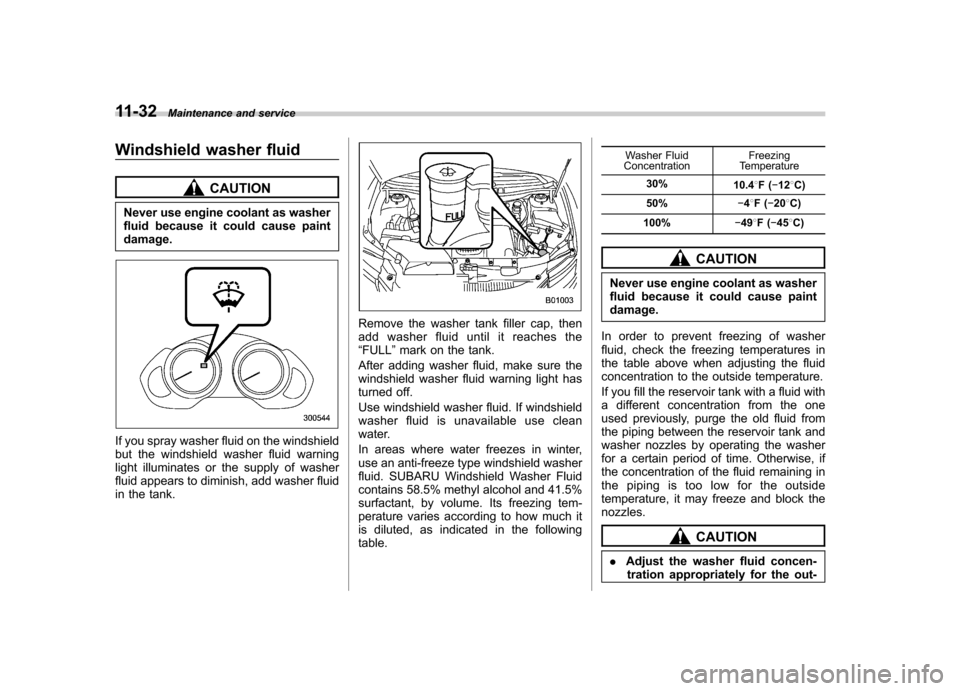
Remove the washer tank filler cap, then
add washer fluid until it reaches the“ FULL ”mark on the tank.
After adding washer fluid, make sure the
windshield washer fluid warning light has
turned off.
Use windshield washer fluid. If windshield
washer fluid is unavailable use clean
water.
In areas where water freezes in winter,
use an anti-freeze type windshield washer
fluid. SUBARU Windshield Washer Fluid
contains 58.5% methyl alcohol and 41.5%
surfactant, by volume. Its freezing tem-
perature varies according to how much it
is diluted, as indicated in the followingtable. Washer Fluid
Concentration Freezing
Temperature
30% 10.48F( 12 8C)
50% 48F( 20 8C)
100% 49 8F( 45 8C)
CAUTION
Never use engine coolant as washer
fluid because it could cause paint damage.
In order to prevent freezing of washer
fluid, check the freezing temperatures in
the table above when adjusting the fluid
concentration to the outside temperature.
If you fill the reservoir tank with a fluid with
a different concentration from the one
used previously, purge the old fluid from
the piping between the reservoir tank and
washer nozzles by operating the washer
for a certain period of time. Otherwise, if
the concentration of the fluid remaining in
the piping is too low for the outside
temperature, it may freeze and block thenozzles.
CAUTION
. Adjust the washer fluid concen-
tration appropriately for the out-
Page 412 of 422

Braking..................................................................... 7-19
Tips...................................................................... 7-19
Breaking-in of new brake pads and linings ................... 11-23
Bulb Chart .................................................................... 12-8
Replacing ............................................................. 11-40
C Capacities ................................................................. 12-3
Cargo area
Cover ................................................................... 6-14
Light ....................................................................... 6-3
Tie-down hooks ..................................................... 6-16
Catalytic converter ....................................................... 8-3
Center Console .................................................................. 6-6
Ventilators ............................................................... 4-4
Changing Coolant ................................................................ 11-12
Flat tire ................................................................... 9-6
Oil and oil filter ...................................................... 11-8
Charge warning light .................................................. 3-13
CHECK ENGINE warning light/Malfunction indicator lamp ...................................................................... 3-12
Checking Brake pedal free play ............................................ 11-22
Brake pedal reserve distance ................................. 11-22
Coolant level ........................................................ 11-11
Fluid level (automatic transmission fluid) .................. 11-16
Fluid level (brake fluid) .......................................... 11-20
Fluid level (power steering fluid) .............................. 11-19 Fluid level (washer fluid)
........................................ 11-32
Oil level (engine oil) ................................................ 11-7
Oil level (front differential gear oil) .......................... 11-17
Oil level (rear differential gear oil) ........................... 11-18
Child restraint systems ................................................ 1-31
Installation of a booster seat .................................... 1-37
Installation with A/ELR seatbelt ... ............................. 1-34
Lower and tether anchorages ................................... 1-38
Top tether anchorages ............................................ 1-41
Child safety ................................................................... 5
Locks .................................................................... 2-21
Chime Key........................................................................ 3-4Light ..................................................................... 3-26
Seatbelt. ........................................................ 1-18, 3-10
Chrome plated wheels .............................................. 11-31
Cleaning Aluminum wheels ................................................... 10-3
Interior .................................................................. 10-5
Ventilation grille ...................................................... 4-10
Climate control system
Automatic ............................................................... 4-5
Clock ........................................................................ 3-21
Coat hook. ................................................................. 6-12
Coolant ................................................................... 11-11
Cooling system ........................................................ 11-11
Corrosion protection .................................................... 10-4
Cruise control ............................................................ 7-30
Indicator light ................................................. 3-20, 7-33
Set indicator light ............................................ 3-21, 7-33 Index
14-3
Page 415 of 422

14-6Index
SPORT mode ........................................................ 3-20
Traction control system OFF .................................... 7-25
Turn signal ............................................................ 3-20
Vehicle Dynamics Control OFF ................................ 3-18
Vehicle Dynamics Control operation ................. 3-18, 7-25
Interior lights ............................................................... 6-2
J
Jack and jack handle .................................................. 9-19
Jack-up point ............................................................... 9-6
Jump starting. ............................................................ 9-12
K
Key ............................................................................ 2-2 Number .................................................................. 2-2
Reminder chime. ...................................................... 3-4
Replacement ........................................................... 2-4
Keyless entry system ................................................... 2-8
L
Leather seat materials ................................................ 10-5
License plate light ..................................................... 11-45
Light Back-up (Station wagon) ........................................ 11-44
Cargo area .................................................... 6-3, 11-48
Control switch ........................................................ 3-26
Dome ........................................................... 6-2, 11-46
Door step ............................................................. 11-47
Front fog ...................................................... 3-32, 11-43
Ignition switch .......................................................... 3-4
License plate ........................................................ 11-45 Map .............................................................. 6-3, 11-47
Rear combination
................................................. 11-43
Rear gate ............................................................... 6-3
Turn signal .................................................. 3-28, 11-43
Vanity mirror .................................................. 6-5, 11-47
Loading your vehicle ................................................... 8-11
Low fuel warning light .......................................... 3-8, 3-17
Low tire pressure warning light ..................................... 3-14
Lower and tether anchorage ........................................ 1-38
Lumbar support ........................................................... 1-6
M
Main fuse ................................................................ 11-39
Maintenance Precautions ........................................................... 11-3
Schedule ............................................................... 11-3
Seatbelt. ................................................................ 1-28
Tools ..................................................................... 9-19
Malfunction indicator lamp (check engine warning light)... 3-12
Map light ........................................................... 6-3, 11-47
Maximum load limits ................................................... 8-20
Meters and gauges ...................................................... 3-5
Mirrors ...................................................................... 3-38
Moonroof ................................................................... 2-25
Multi function display ................................................... 3-23
N
New vehicle break-in driving ......................................... 8-2
OOdometer ................................................................... 3-6
Page 419 of 422

14-10Index
U
Under-floor storage compartment ................................. 6-16
V
Valet mode ................................................................ 2-18
Vanity mirror ...................................................... 6-5, 11-47
Vehicle Capacity weight ..................................................... 8-12
Identification ......................................................... 12-11
Symbols .................................................................... 3
Vehicle Dynamics Control
Operation indicator light .................................. 3-18, 7-25
System ................................................................. 7-23
Warning light ................................................. 3-18, 7-25
Ventilator .................................................................... 4-2
W
Warning and indicator lights .......................................... 3-9
Warning chimes
Seatbelt ........................................................ 1-18, 3-10
Warning light ABS ............................................................. 3-15, 7-21
All-Wheel Drive ...................................................... 3-18
AT OIL TEMP ........................................................ 3-13
Brake system ........................................................ 3-16
Charge ................................................................. 3-13
CHECK ENGINE ................................................... 3-12
Door open ............................................................. 3-17
Low fuel .......................................................... 3-8, 3-17 Low tire pressure
.................................................... 3-14
Oil pressure ........................................................... 3-13
Rear differential oil temperature ................................ 3-14
Seatbelt. ........................................................ 1-18, 3-10
SRS airbag system ................................................. 3-11
Vehicle Dynamics Control ................................ 3-18, 7-25
Windshield washer fluid ........................................... 3-18
Warranties ..................................................................... 1
Warranties and maintenance ........................................ 8-20
Washing .................................................................... 10-2
Waxing and polishing .................................................. 10-3
Wear indicators ........................................................ 11-28
Wheel Alignment .............................................................. 12-4
Aluminum ............................................................ 11-30
Balance ............................................................... 11-28
Chrome plated wheels .......................................... 11-31
Replacement. ....................................................... 11-30
Windows ................................................................... 2-21
Windshield Washer fluid. ........................................................ 11-32
Wiper and washer switches ..................................... 3-34
Wiper blades ........................................................ 11-34
Wiper deicer .......................................................... 3-36
Winter Driving ................................................................... 8-7
Tires ........................................................... 8-10, 11-24
Wiper and washer ...................................................... 3-33
Wiper deicer .............................................................. 3-36