traction control SUBARU TRIBECA 2011 1.G User Guide
[x] Cancel search | Manufacturer: SUBARU, Model Year: 2011, Model line: TRIBECA, Model: SUBARU TRIBECA 2011 1.GPages: 422, PDF Size: 12.7 MB
Page 270 of 422

to heat up sufficiently. &Traction Control system OFF switch
Pressingtheswitchtodeactivatethe
Traction Control system can facilitate the
following operations. .a standing start on a steeply sloping
road with a snowy, gravel-covered, or
otherwise slippery surface . extrication of the vehicle when its
wheels are stuck in mud or deep snow
When the switch is pressed during engine
operation, the Traction Control system
OFF indicator light “
”on the combination
meter illuminates. The Traction Control
system will be deactivated and the vehicle
will behave like a model not equipped with the Traction Control system. When the
switch is pressed again to reactivate the
Traction Control system OFF indicatorlight
“
”turns off.
With the Traction Control system deacti-
vated, traction enhancement offered by
Traction Control system is unavailable.
Therefore you should not deactivate the
Traction Control system except under
above-mentioned situations. NOTE . When the switch has been pressed
to deactivate the Traction Control sys-
tem, the Traction Control system auto-
matically reactivates itself the next time
the ignition key is turned to the “LOCK ”
position and the engine is restarted.. If the switch is held down for 10
seconds or longer, the indicator light
turns off, the Traction Control system
is activated, and the system ignores
any further pressing of the switch. To
make the switch usable again, turn the
ignition key to the “LOCK ”position and
restart the engine.. When the switch is pressed to
deactivate the Traction Control system,
the vehicle ’s running performance is
comparable with that of a vehicle that
does not have a Traction Control
system. Do not deactivate the Traction Control system except when absolutely
necessary.
Starting and operating
7-27
Page 282 of 422
power to all four wheels. AWD models
provide better traction when driving on
slippery, wet or snow-covered roads and
when moving out of mud, dirt or sand. By
shifting power between the front and rear
wheels, SUBARU AWD can also provide
added traction during acceleration, and
added engine braking force during decel-eration.
Therefore, your SUBARU AWD vehicle
may handle differently than an ordinary
two wheel drive vehicle and it contains
some features unique to AWD. For safety
purposes as well as to avoid damaging
the AWD system, you should keep the
following tips in mind. .An AWD model is better able to climb
steeper roads under snowy or slippery
conditions than a two wheel drive vehicle.
There is little difference in handling,
however, during extremely sharp turns or
sudden braking. Therefore, when driving
down a slope or turning corners, be sure
to reduce your speed and maintain an
ample distance from other vehicles. . When replacing a tire, make sure you
use only the same size, circumference,
construction, brand, and load range as the
original tires listed on the tire placard.
Using other sizes, circumferences or
construction may result in severe mechan-
ical damage to the drive train of your vehicle and may affect ride, handling,
braking, speedometer/odometer calibra-
tion, and clearance between the body
and tires. It also may be dangerous and
lead to loss of vehicle control. .
If you use a temporary spare tire to
replace a flat tire, be sure to use the
original temporary spare tire stored in the
vehicle. Using other sizes may result in
severe mechanical damage to the drive
train of your vehicle. . Always check the cold tire pressure
before starting to drive. The recom-
mended tire pressure is provided on the
tire placard, which is located under the
door latch on the driver ’s side.
. There are some precautions that you
must observe when towing your vehicle.
For detailed information, refer to “Towing ”
F 9-14. On-road and off-road driving
WARNING
. In a rollover crash, an unbelted
person is significantly more
likely to die than a person wear-
ing a seatbelt. You the driver and
all your passengers should fas-
ten the seatbelts before starting
to drive in order to minimize the
chance of serious injury or death.
. Do not make sharp turns and
quick maneuvers unless abso-
lutely unavoidable. Such actions
are dangerous as you may lose
control, possibly resulting in a
rollover which could cause death
or serious injury.
. Always maintain a safe driving
speed according to the road and
weather conditions in order to
avoid having an accident on a
sharp turn, during sudden brak-
ing or under other similar condi- tions.
. Whenever strong crosswinds are
present, slow down sufficiently
to maintain control of your vehi-
cle. Remember that your vehicle,
with its higher profile and center Driving tips
8-5
– CONTINUED –
Page 287 of 422
8-10Driving tips
Snow stuck on the wiper arm prevents the
wiper from working effectively. If snow is
stuck on the wiper arm, pull off the road to
a safe place, then remove it. If you stop
the vehicle at road side, use the hazard
warning flasher to alert other drivers.
We recommend use of non-freezing type
wiper blades (winter blades) during the
seasons in which you could have snow
and freezing temperatures. Blades of this
type give superior wiping performance in
snowy conditions. Be sure to use blades
that are suitable for your vehicle.
CAUTION
During high-speed driving, non-
freezing type wiper blades may not
perform as well as standard wiper
blades. If this happens, reduce the
vehicle speed.
NOTE
When the season requiring non-freez-
ing type wiper blades is over, replace
them with standard wiper blades. & Corrosion protection
Refer to “Corrosion protection ”F 10-4. &
Snow tires
WARNING
. When replacing original tires with
winter (snow) tires, make sure
you use only the same size and
construction as recommended.
Using other sizes or construction
may affect speedometer/od-
ometer calibration and clearance
between the body and tires. It
also may be dangerous and lead
to loss of vehicle control.
. You must install four winter tires
that are of the same size, circum-
ferences, construction, brand,
andloadrange.Mixingother
sizes, circumferences or con-
structions may result in severe
mechanical damage to the drive
train of your vehicle and may
affect ride, handling, braking and
speedometer/odometer calibra-
tion. It also may be dangerous
and lead to loss of vehicle con-trol.
. Do not use a combination of
radial, belted bias or bias tires
since it may cause dangerous
handling characteristics and lead
to an accident. Your vehicle is equipped with
“all season
tires ”which are designed to provide an
adequate measure of traction, handling
and braking performance in year-round
driving. In winter, it may be possible to
enhance performance through use of tires
designed specifically for winter drivingconditions.
If you choose to install winter tires on your
vehicle, be sure to use the correct tire size
and type. You must install four winter tires
that are of the same size, construction,
brand and load range and you should
never mix radial, belted bias or bias tires
since this may result in dangerous hand-
ling characteristics. When you choose a
tire, make sure that there is enough
clearance between the tire and vehicle
body.
Remember to drive with care at all times
regardless of the type of tires on yourvehicle.
Your vehicle comes with P255/55R18 “ all season tires ”as original equip-
ment. You should be aware that some
winter tires with that same size desig-
nation may actually be too large for the
vehicle and may cause rubbing on
sharp turns. Listed in the following is
the winter tire size that we recommend.
Page 288 of 422
Recommended winter (snow) tire sizeP255/55R18 stud less
& Tire chains
CAUTION
Tire chains cannot be used on your
vehicle because of the lack of
clearance between the tires and
vehicle body.
& Rocking the vehicle
If you must rock the vehicle to free it from
snow, sand, or mud, depress the accel-
erator pedal slightly and move the select
lever back and forth between “D ”and “R ”
repeatedly. Do not race the engine. For
the best possible traction, avoid spinning
the wheels when trying to free the vehicle.
When the road surface is extremely
slippery, you can obtain better traction by
starting the vehicle with the transmission
in 2nd than 1st.
For information about holding the trans-
mission in the 2nd position, refer to“ Selection of manual mode ”F 7-16 and
“ Driving tips ”F 7-17. Loading your vehicle
WARNING
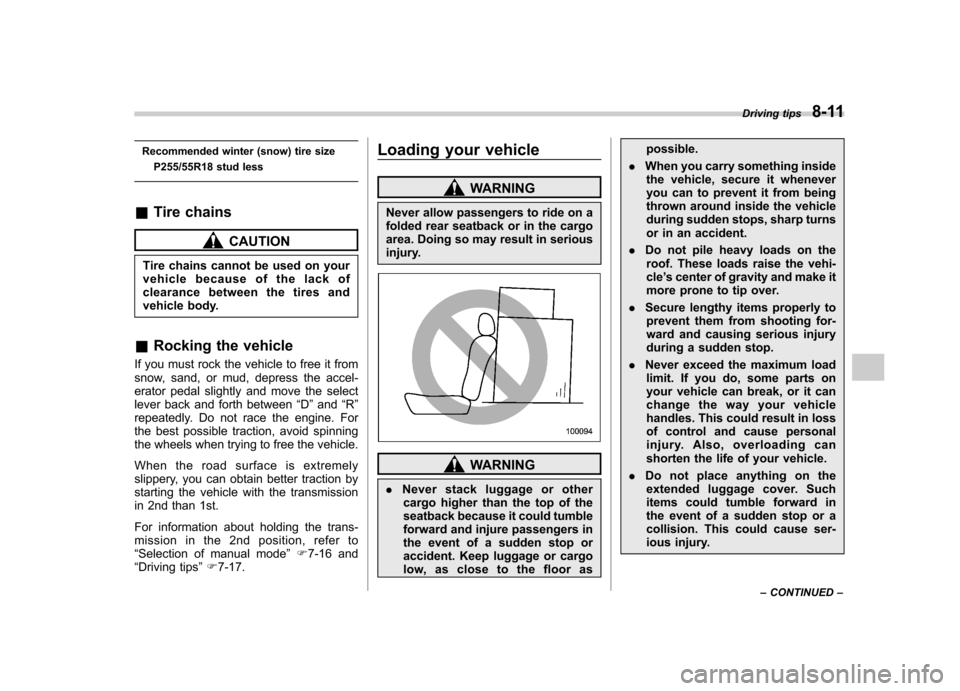
Never allow passengers to ride on a
folded rear seatback or in the cargo
area. Doing so may result in serious
injury.
WARNING
. Never stack luggage or other
cargo higher than the top of the
seatback because it could tumble
forward and injure passengers in
the event of a sudden stop or
accident. Keep luggage or cargo
low, as close to the floor as possible.
. When you carry something inside
the vehicle, secure it whenever
you can to prevent it from being
thrown around inside the vehicle
during sudden stops, sharp turns
or in an accident.
. Do not pile heavy loads on the
roof. These loads raise the vehi-cle ’s center of gravity and make it
more prone to tip over.
. Secure lengthy items properly to
prevent them from shooting for-
ward and causing serious injury
during a sudden stop.
. Never exceed the maximum load
limit. If you do, some parts on
your vehicle can break, or it can
change the way your vehicle
handles. This could result in loss
of control and cause personal
injury. Also, overloading can
shorten the life of your vehicle.
. Do not place anything on the
extended luggage cover. Such
items could tumble forward in
the event of a sudden stop or a
collision. This could cause ser-
ious injury. Driving tips
8-11
– CONTINUED –
Page 407 of 422

13-14Consumer information and Reporting safety defects
4.The resulting figure equals the
available amount of cargo and
luggage load capacity. For exam-
ple, if the “XXX ”amount equals
1,400 lbs (635 kg) and there will be
five- 150 lbs (68 kg) passengers in
your vehicle, the amount of avail-
able cargo and luggage load capa-
city is 650 lbs. (1,400 750 (5 6
150) = 650 lbs).
5. Determine the combined weight
of luggage and cargo being loaded
on the vehicle. That weight may not
safely exceed the available cargo
and luggage load capacity calcu-
lated in Step 4. 6. If your vehicle will be towing a
trailer, load from your trailer will be
transferred to your vehicle. Consult
this manual to determine how this
reduces the available cargo and
luggage load capacity of your ve- hicle. Uniform tire quality grading standards
This information indicates the rela-
tive performance of passenger car
tires in the area of treadwear,
traction, and temperature resis-
tance. This is to aid the consumer
in making an informed choice in the
purchase of tires.
Quality grades can be found where
applicable on the tire sidewall be-
tween tread shoulder and maxi-
mum section width. For example:
Treadwear 200 Traction AA Tem-
perature A
The quality grades apply to new
pneumatic tires for use on passen-
ger cars. However, they do not
apply to deep tread, winter type
snow tires, space-saver or tempor-
ary use spare tires, tires with
nominal rim diameters of 12 inches
or less, or to some limited produc-
tion tires.
All passenger car tires must con-form to Federal Safety Require-
ments in addition to these grades. &
Treadwear
The treadwear grade is a compara-
tive rating based on the wear rate of
the tire when tested under con-
trolled conditions on a specified
government test course.
For example, a tire graded 150
would wear one and one-half (1-
1/2) times as well on the govern-
ment course as a tire graded 100.
The relative performance of tires
depends upon the actual conditions
of their use, however, and may
depart significantly from the norm
due to variations in driving habits,
service practices and differences in
road characteristics and climate. & Traction AA, A, B, C
The traction grades, from highest to
lowest, are AA, A, B and C. Those
grades represent the tire ’s ability to
stop on wet pavement as measured
under controlled conditions on spe-
Page 408 of 422
cified government test surfaces of
asphalt and concrete. A tire marked
C may have poor traction perfor- mance.
WARNING
The traction grade assigned to
this tire is based on straight-
ahead braking traction tests,
and does not include accel-
eration, cornering, hydroplan-
ing, or peak traction charac-teristics.
& Temperature A, B, C
The temperature grades are A (the
highest), B, and C, representing thetire ’s resistance to the generation of
heat and its ability to dissipate heat
when tested under controlled con-
ditions on a specified indoor labora-
tory test wheel. Sustained high
temperature can cause the material
of the tire to degenerate and reduce
tire life, and excessive temperature
can lead to sudden tire failure. The grade C corresponds to a level of
performance which all passenger
car tires must meet under the
Federal Motor Vehicle Safety Stan-
dards No. 109. Grades B and A
represent higher levels of perfor-
mance on the laboratory test wheel
than the minimum required by law.
WARNING
The temperature grade for this
tire is established for a tire
that is properly inflated and
not overloaded. Excessive
speed, underinflation, or ex-
cessive loading, either sepa-
rately or in combination, can
cause heat buildup and possi-
ble tire failure. Reporting safety defects (U.S.A.)
If you believe that your vehicle has
a defect which could cause a
crash or could cause injury or
death, you should immediately in-
form the National Highway Traffic
Safety Administration (NHTSA) in
addition to notifying Subaru of
America, Inc.
If NHTSA receives similar com-
plaints, it may open an investiga-
tion, and if it finds that a safety
defect exists in a group of vehi-
cles, it may order a recall and
remedy campaign. However,
NHTSA cannot become involved
in individual problems between
you, your dealer, or Subaru of
America, Inc. To contact NHTSA,
you may call the Vehicle Safety
Hotline toll-free at 1-888-327-4236
(TTY: 1-800-424-9153); go to
http://www.safercar.gov; or write
to: Administrator, NHTSA, 1200
New Jersey Avenue, SE, West
Consumer information and Reporting safety defects
13-15
– CONTINUED –
Page 415 of 422

14-6Index
SPORT mode ........................................................ 3-20
Traction control system OFF .................................... 7-25
Turn signal ............................................................ 3-20
Vehicle Dynamics Control OFF ................................ 3-18
Vehicle Dynamics Control operation ................. 3-18, 7-25
Inside mirror .............................................................. 3-37
Interior lights ............................................................... 6-2
J
Jack and jack handle .................................................. 9-19
Jack-up point ............................................................... 9-6
Jump starting. ............................................................ 9-11
K
Key ............................................................................ 2-2 Number .................................................................. 2-2
Reminder chime. ...................................................... 3-4
Replacement ........................................................... 2-4
Keyless entry system ................................................... 2-8
L
Leather seat materials ................................................ 10-5
License plate light ..................................................... 11-42
Light Back-up (Station wagon) ........................................ 11-41
Cargo area .................................................... 6-3, 11-45
Control switch ........................................................ 3-26
Dome ........................................................... 6-2, 11-43
Door step ............................................................. 11-44
Front fog ...................................................... 3-31, 11-40
Ignition switch .......................................................... 3-4 License plate
....................................................... 11-42
Map .............................................................. 6-3, 11-44
Rear combination ................................................. 11-40
Rear gate ............................................................... 6-3
Turn signal .................................................. 3-28, 11-40
Vanity mirror .................................................. 6-5, 11-44
Loading your vehicle ................................................... 8-11
Low fuel warning light .......................................... 3-8, 3-17
Low tire pressure warning light ..................................... 3-14
Lower and tether anchorage ........................................ 1-38
Lubricants .................................................................. 12-4
Lumbar support ........................................................... 1-7
M
Main fuse ................................................................ 11-36
Maintenance Precautions ........................................................... 11-3
Schedule ............................................................... 11-3
Seatbelt. ................................................................ 1-28
Tools ..................................................................... 9-19
Malfunction indicator lamp (check engine warning light)... 3-12
Map light ........................................................... 6-3, 11-44
Maximum load limits ................................................... 8-20
Meters and gauges ...................................................... 3-5
Mirrors ...................................................................... 3-37
Moonroof ................................................................... 2-25
Multi function display ................................................... 3-23
N
New vehicle break-in driving ......................................... 8-2
Page 419 of 422

14-10Index
Weight.................................................................. 8-20
Traction Control system OFF indicator light .......................................... 3-18, 7-25
OFF switch ........................................................... 7-27
Trailer Connecting ............................................................ 8-18
Hitch ............................................................ 8-18, 8-23
Towing .................................................................. 8-20
Towing tips ............................................................ 8-26
Trip meter ................................................................... 3-7
Turn signal Indicator lights ....................................................... 3-20
Lever .................................................................... 3-28
U
Under-floor storage compartment ................................. 6-16
V
Valet mode ................................................................ 2-18
Vanity mirror ...................................................... 6-5, 11-44
Vehicle Capacity weight ..................................................... 8-12
Identification ........................................................ 12-16
Symbols .................................................................... 3
Vehicle Dynamics Control Operation indicator light .................................. 3-18, 7-25
System ................................................................. 7-23
Warning light ................................................. 3-18, 7-25
Ventilator .................................................................... 4-2 W
Warning and indicator lights
.......................................... 3-9
Warning chimes
Seatbelt. ........................................................ 1-18, 3-10
Warning light ABS.............................................................. 3-15, 7-21
All-Wheel Drive ...................................................... 3-18
AT OIL TEMP ......................................................... 3-13
Brake system ......................................................... 3-16
Charge .................................................................. 3-13
CHECK ENGINE .................................................... 3-12
Door open ............................................................. 3-17
Low fuel ......................................................... 3-8, 3-17
Low tire pressure .................................................... 3-14
Oil pressure ........................................................... 3-13
Rear differential oil temperature ................................ 3-14
Seatbelt. ........................................................ 1-18, 3-10
SRS airbag system ................................................. 3-11
Vehicle Dynamics Control ................................ 3-18, 7-25
Windshield washer fluid ........................................... 3-18
Warranties ..................................................................... 1
Warranties and maintenance ........................................ 8-20
Washing .................................................................... 10-2
Waxing and polishing .................................................. 10-3
Wear indicators ........................................................ 11-26
Wheel Alignment .............................................................. 12-9
Aluminum ............................................................ 11-28
Balance ............................................................... 11-26
Nut tightening torque ............................................... 12-8
Replacement. ....................................................... 11-28