lock SUBARU TRIBECA 2012 1.G User Guide
[x] Cancel search | Manufacturer: SUBARU, Model Year: 2012, Model line: TRIBECA, Model: SUBARU TRIBECA 2012 1.GPages: 420, PDF Size: 12.72 MB
Page 35 of 420
1-6Seat, seatbelt and SRS airbags
To raise:
Pull the head restraint up.
To lower:
Push the head restraint down while
pressing the release button on the top of
the seatback.
To remove:
While pressing the release button, pull out
the head restraint.
To install:
Install the head restraint into the holes that
are located on the top of the seatback until
the head restraint locks.
WARNING
. Never drive the vehicle with the
head restraints removed because
they are designed to reduce the
risk of serious neck injury in the
event that the vehicle is struck
from the rear. Therefore, when
you remove the head restraints,
you must reinstall all head re-
straints to protect vehicle occu-pants.
. All occupants, including the dri-
ver, should not operate a vehicle
or sit in a vehicle ’s seat until the
head restraints are placed in their
proper positions in order to mini-
mize the risk of neck injury in the event of a crash.
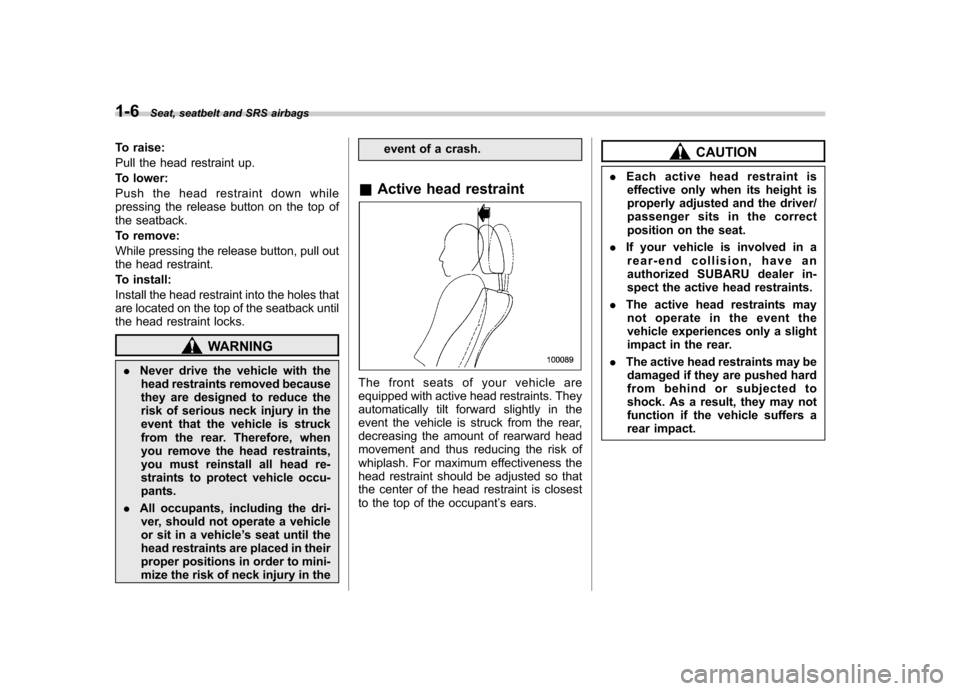
& Active head restraint
The front seats of your vehicle are
equipped with active head restraints. They
automatically tilt forward slightly in the
event the vehicle is struck from the rear,
decreasing the amount of rearward head
movement and thus reducing the risk of
whiplash. For maximum effectiveness the
head restraint should be adjusted so that
the center of the head restraint is closest
to the top of the occupant ’s ears.
CAUTION
. Each active head restraint is
effective only when its height is
properly adjusted and the driver/
passenger sits in the correct
position on the seat.
. If your vehicle is involved in a
rear-end collision, have an
authorized SUBARU dealer in-
spect the active head restraints.
. The active head restraints may
not operate in the event the
vehicle experiences only a slight
impact in the rear.
. The active head restraints may be
damaged if they are pushed hard
from behind or subjected to
shock. As a result, they may not
function if the vehicle suffers a
rear impact.
Page 37 of 420
1-8Seat, seatbelt and SRS airbags
Second-row seats
WARNING
. Seatbelts provide maximum re-
straint when the occupant sits
well back and upright in the seat.
Do not put cushions or any other
materials between occupants
and seatbacks or seat cushions.
If you do so, the risk of sliding
under the lap belt and of the lap
belt sliding up over the abdomen
will increase, and both can result
in serious internal injury ordeath.
. Never adjust the seat while driv-
ing. Doing so is dangerous as the seat could move rapidly and you
could be injured.
. Before adjusting the seat, make
sure the hands and feet of the
third-row seat passengers are
clear of the adjusting mechan-ism.
. After adjusting the seat, push it
slightly to make sure it is se-
curely locked. If the seat is not
securely locked, it may move or
the seatbelt may not operate
properly.
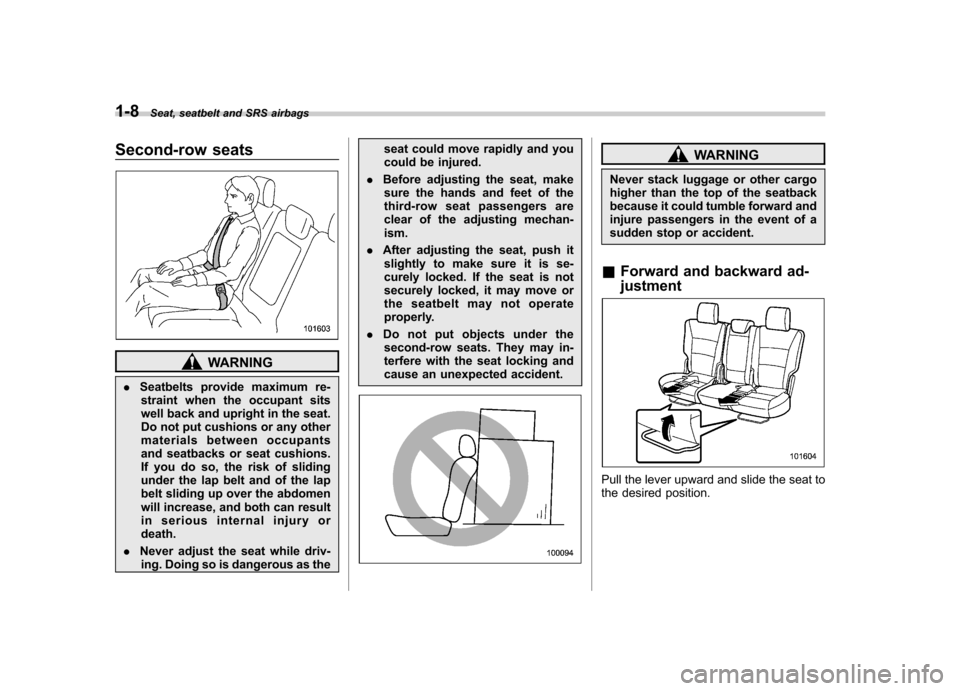
. Do not put objects under the
second-row seats. They may in-
terfere with the seat locking and
cause an unexpected accident.
WARNING
Never stack luggage or other cargo
higher than the top of the seatback
because it could tumble forward and
injure passengers in the event of a
sudden stop or accident.
& Forward and backward ad- justment
Pull the lever upward and slide the seat to
the desired position.
Page 38 of 420
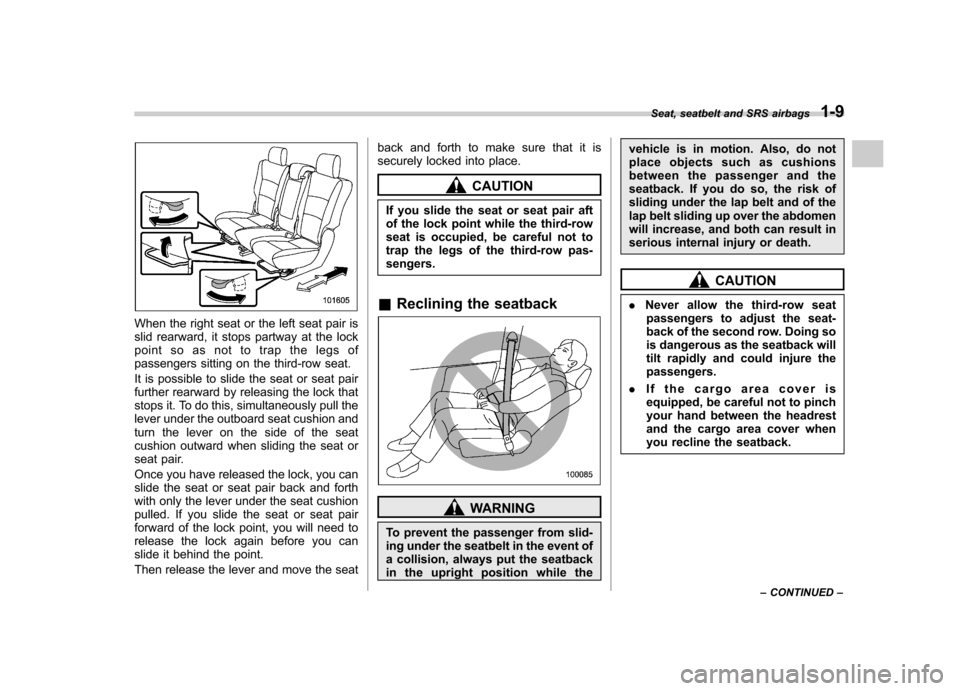
When the right seat or the left seat pair is
slid rearward, it stops partway at the lock
point so as not to trap the legs of
passengers sitting on the third-row seat.
It is possible to slide the seat or seat pair
further rearward by releasing the lock that
stops it. To do this, simultaneously pull the
lever under the outboard seat cushion and
turn the lever on the side of the seat
cushion outward when sliding the seat or
seat pair.
Once you have released the lock, you can
slide the seat or seat pair back and forth
with only the lever under the seat cushion
pulled. If you slide the seat or seat pair
forward of the lock point, you will need to
release the lock again before you can
slide it behind the point.
Then release the lever and move the seatback and forth to make sure that it is
securely locked into place.
CAUTION
If you slide the seat or seat pair aft
of the lock point while the third-row
seat is occupied, be careful not to
trap the legs of the third-row pas-sengers.
& Reclining the seatback
WARNING
To prevent the passenger from slid-
ing under the seatbelt in the event of
a collision, always put the seatback
in the upright position while the vehicle is in motion. Also, do not
place objects such as cushions
between the passenger and the
seatback. If you do so, the risk of
sliding under the lap belt and of the
lap belt sliding up over the abdomen
will increase, and both can result in
serious internal injury or death.
CAUTION
. Never allow the third-row seat
passengers to adjust the seat-
back of the second row. Doing so
is dangerous as the seatback will
tilt rapidly and could injure thepassengers.
. If the cargo area cover is
equipped, be careful not to pinch
your hand between the headrest
and the cargo area cover when
you recline the seatback. Seat, seatbelt and SRS airbags
1-9
– CONTINUED –
Page 39 of 420
1-10Seat, seatbelt and SRS airbags
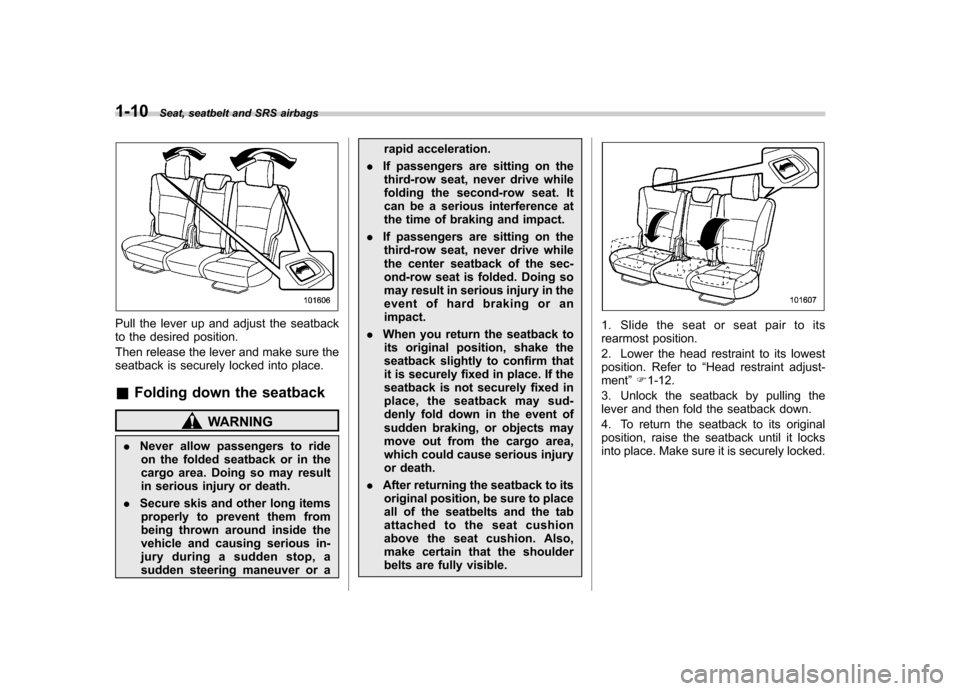
Pull the lever up and adjust the seatback
to the desired position.
Then release the lever and make sure the
seatback is securely locked into place. &Folding down the seatback
WARNING
. Never allow passengers to ride
on the folded seatback or in the
cargo area. Doing so may result
in serious injury or death.
. Secure skis and other long items
properly to prevent them from
being thrown around inside the
vehicle and causing serious in-
jury during a sudden stop, a
sudden steering maneuver or a rapid acceleration.
. If passengers are sitting on the
third-row seat, never drive while
folding the second-row seat. It
can be a serious interference at
the time of braking and impact.
. If passengers are sitting on the
third-row seat, never drive while
the center seatback of the sec-
ond-row seat is folded. Doing so
may result in serious injury in the
event of hard braking or animpact.
. When you return the seatback to
its original position, shake the
seatback slightly to confirm that
it is securely fixed in place. If the
seatback is not securely fixed in
place, the seatback may sud-
denly fold down in the event of
sudden braking, or objects may
move out from the cargo area,
which could cause serious injury
or death.
. After returning the seatback to its
original position, be sure to place
all of the seatbelts and the tab
attached to the seat cushion
above the seat cushion. Also,
make certain that the shoulder
belts are fully visible.
1. Slide the seat or seat pair to its
rearmost position.
2. Lower the head restraint to its lowest
position. Refer to “Head restraint adjust-
ment ”F 1-12.
3. Unlock the seatback by pulling the
lever and then fold the seatback down.
4. To return the seatback to its original
position, raise the seatback until it locks
into place. Make sure it is securely locked.
Page 40 of 420
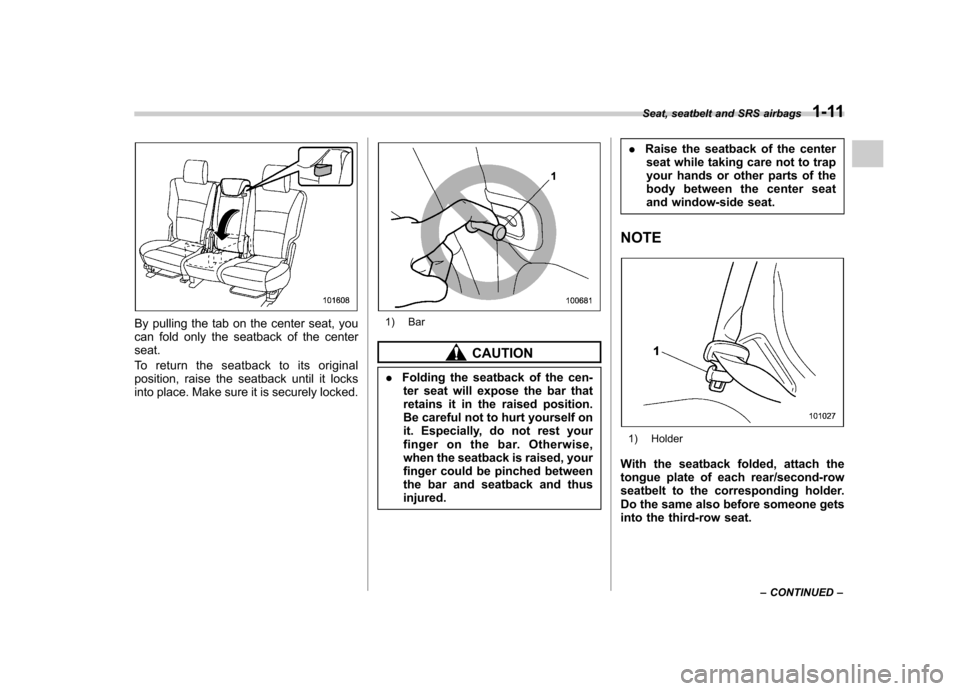
By pulling the tab on the center seat, you
can fold only the seatback of the centerseat.
To return the seatback to its original
position, raise the seatback until it locks
into place. Make sure it is securely locked.1) Bar
CAUTION
. Folding the seatback of the cen-
ter seat will expose the bar that
retains it in the raised position.
Be careful not to hurt yourself on
it. Especially, do not rest your
finger on the bar. Otherwise,
when the seatback is raised, your
finger could be pinched between
the bar and seatback and thusinjured. .
Raise the seatback of the center
seat while taking care not to trap
your hands or other parts of the
body between the center seat
and window-side seat.
NOTE
1) Holder
With the seatback folded, attach the
tongue plate of each rear/second-row
seatbelt to the corresponding holder.
Do the same also before someone gets
into the third-row seat. Seat, seatbelt and SRS airbags
1-11
– CONTINUED –
Page 41 of 420
1-12Seat, seatbelt and SRS airbags
&Head restraint adjustment
Both the second-row window side seats
and the second-row center seat are
equipped with head restraints.
WARNING
. Never drive the vehicle with the
head restraints removed because
they are designed to reduce the
risk of serious neck injury in the
event that the vehicle is struck
from the rear. Therefore, when
you remove the head restraints,
you must reinstall all head re-
straints to protect vehicle occu-pants.
. All occupants, including the dri-
ver, should not operate a vehicle
or sit in a vehicle ’s seat until the
head restraints are placed in their
proper positions in order to mini-
mize the risk of neck injury in the
event of a crash. !
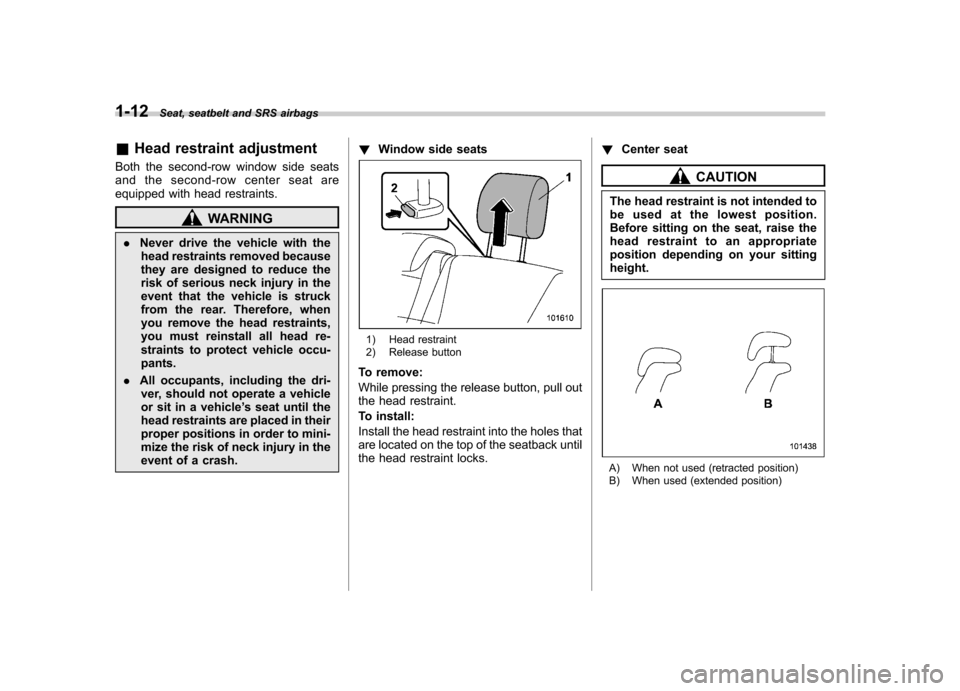
Window side seats
1) Head restraint
2) Release button
To remove:
While pressing the release button, pull out
the head restraint.
To install:
Install the head restraint into the holes that
are located on the top of the seatback until
the head restraint locks. !
Center seat
CAUTION
The head restraint is not intended to
be used at the lowest position.
Before sitting on the seat, raise the
head restraint to an appropriate
position depending on your sittingheight.
A) When not used (retracted position)
B) When used (extended position)
Page 43 of 420
1-14Seat, seatbelt and SRS airbags
WARNING
Never stack luggage or other cargo
higher than the top of the seatback
because it could tumble forward and
injure passengers in the event of a
sudden stop or accident.
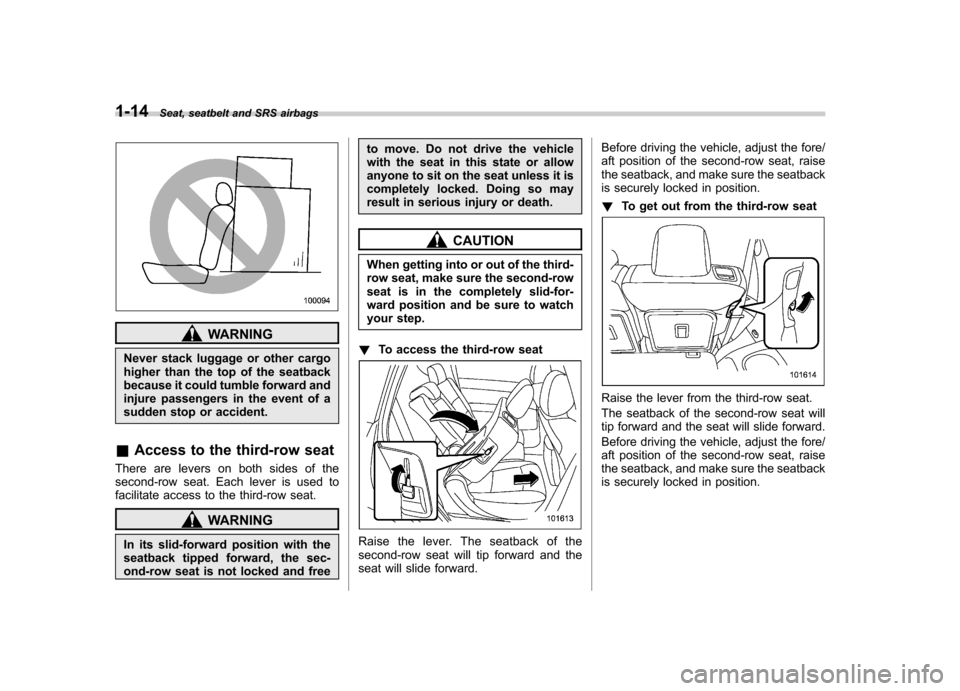
& Access to the third-row seat
There are levers on both sides of the
second-row seat. Each lever is used to
facilitate access to the third-row seat.
WARNING
In its slid-forward position with the
seatback tipped forward, the sec-
ond-row seat is not locked and free to move. Do not drive the vehicle
with the seat in this state or allow
anyone to sit on the seat unless it is
completely locked. Doing so may
result in serious injury or death.
CAUTION
When getting into or out of the third-
row seat, make sure the second-row
seat is in the completely slid-for-
ward position and be sure to watch
your step.
! To access the third-row seat
Raise the lever. The seatback of the
second-row seat will tip forward and the
seat will slide forward. Before driving the vehicle, adjust the fore/
aft position of the second-row seat, raise
the seatback, and make sure the seatback
is securely locked in position. !
To get out from the third-row seat
Raise the lever from the third-row seat.
The seatback of the second-row seat will
tip forward and the seat will slide forward.
Before driving the vehicle, adjust the fore/
aft position of the second-row seat, raise
the seatback, and make sure the seatback
is securely locked in position.
Page 44 of 420
&Folding down the seatback
WARNING
. Never allow passengers to ride
on the folded seatback or in the
cargo area. Doing so may result
in serious injury or death.
. Secure skis and other long items
properly to prevent them from
being thrown around inside the
vehicle and causing serious in-
jury during a sudden stop, a
sudden steering maneuver or a
rapid acceleration.
. When you return the seatback to
its original position, shake the
seatback slightly to confirm that
it is securely fixed in place. If the
seatback is not securely fixed in
place, the seatback may sud-
denly fold down in the event of
sudden braking, or objects may
move out from the cargo area,
which could cause serious injury
or death.
. After returning the seatback to its
original position, be sure to place
all of the seatbelts and the tab
attached to the seat cushion
above the seat cushion. Also,
make certain that the shoulder belts are fully visible.
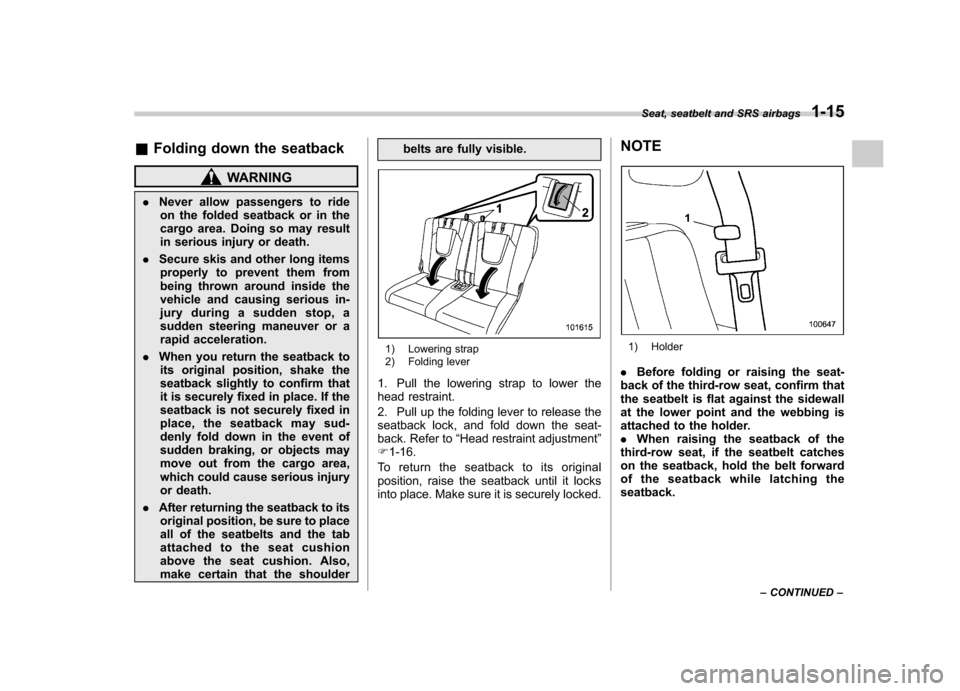
1) Lowering strap
2) Folding lever
1. Pull the lowering strap to lower the
head restraint.
2. Pull up the folding lever to release the
seatback lock, and fold down the seat-
back. Refer to “Head restraint adjustment ”
F 1-16.
To return the seatback to its original
position, raise the seatback until it locks
into place. Make sure it is securely locked. NOTE1) Holder
. Before folding or raising the seat-
back of the third-row seat, confirm that
the seatbelt is flat against the sidewall
at the lower point and the webbing is
attached to the holder.. When raising the seatback of the
third-row seat, if the seatbelt catches
on the seatback, hold the belt forward
of the seatback while latching theseatback. Seat, seatbelt and SRS airbags
1-15
– CONTINUED –
Page 47 of 420
1-18Seat, seatbelt and SRS airbags
the face or neck, adjust the shoulder belt
anchor height (window-side seating posi-
tions only) and then if necessary move the
child closer to the belt buckle to help
provide a good shoulder belt fit. Care must
be taken to securely place the lap belt as
low as possible on the hips and not on thechild’s waist. If the shoulder portion of the
belt cannot be properly positioned, a child
restraint system should be used. Never
place the shoulder belt under the child ’s
arm or behind the child ’s back.
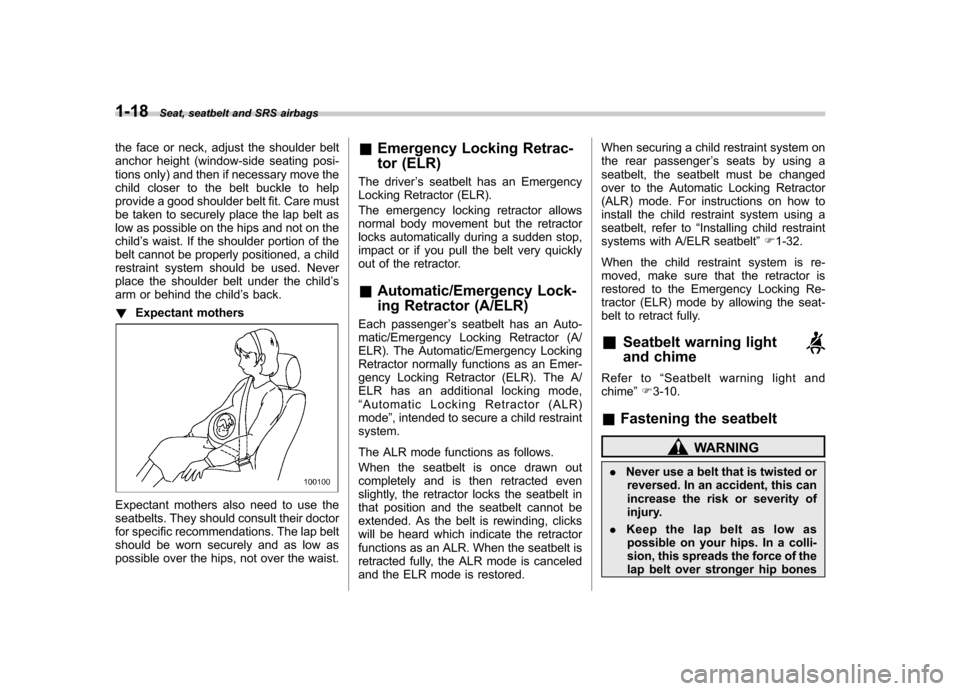
! Expectant mothers
Expectant mothers also need to use the
seatbelts. They should consult their doctor
for specific recommendations. The lap belt
should be worn securely and as low as
possible over the hips, not over the waist. &
Emergency Locking Retrac-
tor (ELR)
The driver ’s seatbelt has an Emergency
Locking Retractor (ELR).
The emergency locking retractor allows
normal body movement but the retractor
locks automatically during a sudden stop,
impact or if you pull the belt very quickly
out of the retractor. & Automatic/Emergency Lock-
ing Retractor (A/ELR)
Each passenger ’s seatbelt has an Auto-
matic/Emergency Locking Retractor (A/
ELR). The Automatic/Emergency Locking
Retractor normally functions as an Emer-
gency Locking Retractor (ELR). The A/
ELR has an additional locking mode,“ Automatic Locking Retractor (ALR)
mode ”, intended to secure a child restraint
system.
The ALR mode functions as follows.
When the seatbelt is once drawn out
completely and is then retracted even
slightly, the retractor locks the seatbelt in
that position and the seatbelt cannot be
extended. As the belt is rewinding, clicks
will be heard which indicate the retractor
functions as an ALR. When the seatbelt is
retracted fully, the ALR mode is canceled
and the ELR mode is restored. When securing a child restraint system on
the rear passenger
’s seats by using a
seatbelt, the seatbelt must be changed
over to the Automatic Locking Retractor
(ALR) mode. For instructions on how to
install the child restraint system using a
seatbelt, refer to “Installing child restraint
systems with A/ELR seatbelt ”F 1-32.
When the child restraint system is re-
moved, make sure that the retractor is
restored to the Emergency Locking Re-
tractor (ELR) mode by allowing the seat-
belt to retract fully.
& Seatbelt warning light
and chime
Refer to “Seatbelt warning light and
chime ”F 3-10.
& Fastening the seatbelt
WARNING
. Never use a belt that is twisted or
reversed. In an accident, this can
increase the risk or severity of
injury.
. Keep the lap belt as low as
possible on your hips. In a colli-
sion, this spreads the force of the
lap belt over stronger hip bones
Page 48 of 420
instead of across the weaker abdomen.
. Seatbelts provide maximum re-
straint when the occupant sits
well back and upright in the seat.
To reduce the risk of sliding
under the seatbelt in a collision,
the front seatbacks should be
always used in the upright posi-
tion while the vehicle is running.
If the front seatbacks are not
used in the upright position in a
collision, the risk of sliding under
the lap belt and of the lap belt
sliding up over the abdomen will
increase, and both can result in
serious internal injury or death.
. Do not put cushions or any other
materials between occupants
and seatbacks or seat cushions.
If you do so, the risk of sliding
under the lap belt and of the lap
belt sliding up over the abdomen
will increase, and both can result
in serious internal injury ordeath.
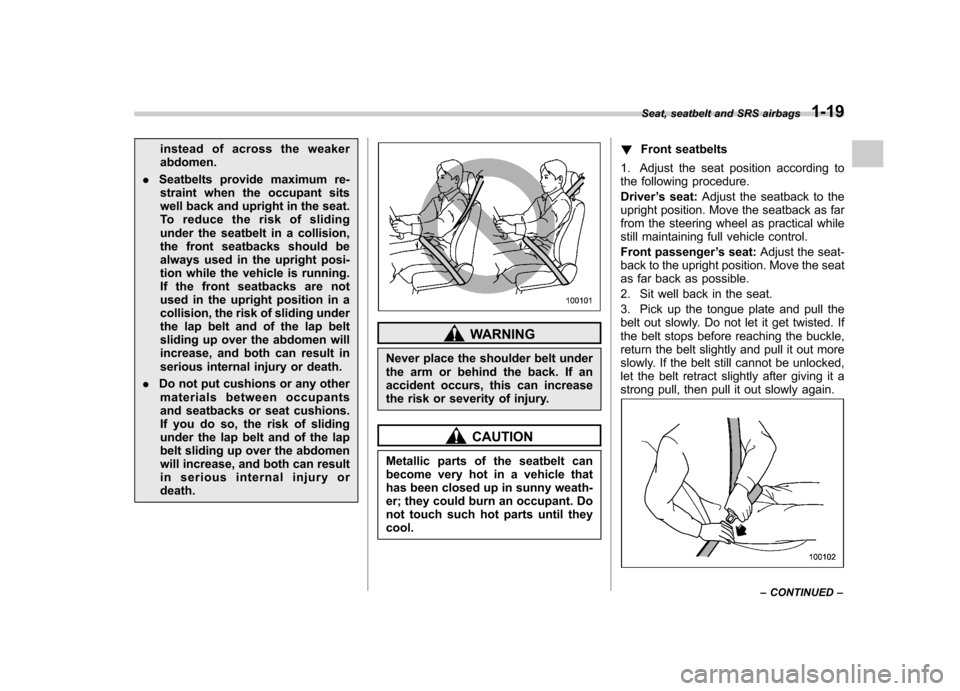
WARNING
Never place the shoulder belt under
the arm or behind the back. If an
accident occurs, this can increase
the risk or severity of injury.
CAUTION
Metallic parts of the seatbelt can
become very hot in a vehicle that
has been closed up in sunny weath-
er; they could burn an occupant. Do
not touch such hot parts until theycool. !
Front seatbelts
1. Adjust the seat position according to
the following procedure. Driver ’s seat: Adjust the seatback to the
upright position. Move the seatback as far
from the steering wheel as practical while
still maintaining full vehicle control.
Front passenger ’s seat: Adjust the seat-
back to the upright position. Move the seat
as far back as possible.
2. Sit well back in the seat.
3. Pick up the tongue plate and pull the
belt out slowly. Do not let it get twisted. If
the belt stops before reaching the buckle,
return the belt slightly and pull it out more
slowly. If the belt still cannot be unlocked,
let the belt retract slightly after giving it a
strong pull, then pull it out slowly again.
Seat, seatbelt and SRS airbags 1-19
– CONTINUED –