light SUBARU TRIBECA 2013 1.G User Guide
[x] Cancel search | Manufacturer: SUBARU, Model Year: 2013, Model line: TRIBECA, Model: SUBARU TRIBECA 2013 1.GPages: 420, PDF Size: 12.74 MB
Page 30 of 420
Front seats........................................................... 1-2
Power seat .......................................................... 1-3
Memory function (driver ’s seat –if equipped) ....... 1-4
Head restraint adjustment .................................... 1-5
Active head restraint ........................................... 1-6
Lumbar support .................................................. 1-7
Seat heater (if equipped) .................................... 1-7
Second-row seats ............................................... 1-8
Forward and backward adjustment ...................... 1-8
Reclining the seatback ........................................ 1-9
Folding down the seatback ................................. 1-10
Head restraint adjustment ................................... 1-12
Armrest ............................................................. 1-13
Third-row seat .................................................... 1-13
Access to the third-row seat ............................... 1-14
Folding down the seatback ................................. 1-15
Head restraint adjustment ................................... 1-16
Seatbelts ............................................................. 1-17
Seatbelt safety tips ............................................. 1-17
Emergency Locking Retractor (ELR) ................... 1-18
Automatic/Emergency Locking Retractor (A/ELR) ............................................................ 1-18
Seatbelt warning light and chime ........................ 1-18Fastening the seatbelt
........................................ 1-18
Seatbelt maintenance ......................................... 1-26
Front seatbelt pretensioners ............................. 1-27
System monitors ............................................... 1-28
System servicing ............................................... 1-28
Precautions against vehicle modification ............ 1-28
Child restraint systems ..................................... 1-29
Where to place a child restraint system .............. 1-30
Choosing a child restraint system ...................... 1-32
Installing child restraint systems with A/ELR seatbelt ........................................................... 1-32
Installing a booster seat ..................................... 1-36
Installation of child restraint systems by use of lower and tether anchorages (LATCH) .............. 1-37
Top tether anchorages ....................................... 1-40
*SRS airbag (Supplemental Restraint System airbag) ................................................ 1-45
Your vehicle ’s SRS configuration ....................... 1-45
SUBARU advanced frontal airbag system ........... 1-49
SRS side airbag and SRS curtain airbag ............. 1-60
SRS airbag system monitors .............................. 1-71
SRS airbag system servicing ... .......................... 1-72
Precautions against vehicle modification ............ 1-72
Seat, seatbelt and SRS airbags1
Page 31 of 420
1-2Seat, seatbelt and SRS airbags/Front seats
Front seats
WARNING
. Never adjust the seat while driv-
ing to avoid loss of vehicle con-
trol and personal injury.
. Before adjusting the seat, make
sure luggage and the hands and
feet of second-row seat passen-
gers are clear of the adjustingmechanism.
. Do not put objects under the front
seats. They may interfere with
front seat locking and cause anaccident.
. Seatbelts provide maximum re-
straint when the occupant sits
well back and upright in the seat.
To reduce the risk of sliding
under the seatbelt in a collision,
the front seatbacks should be
always used in the upright posi-
tion while the vehicle is running.
If the front seatbacks are not
used in the upright position in a
collision, the risk of sliding under
the lap belt and of the lap belt
sliding up over the abdomen will
increase, and both can result in
serious internal injury or death. .
The SRS airbags deploy with
considerable speed and force.
Occupants who are out of proper
position when the SRS airbag
deploys could suffer very serious
injuries. Because the SRS airbag
needs enough space for deploy-
ment, the driver should always
sit upright and well back in the
seat as far from the steering
wheel as practical while still
maintaining full vehicle control
and the front passenger should
move the seat as far back as
possible and sit upright and well
back in the seat.
WARNING
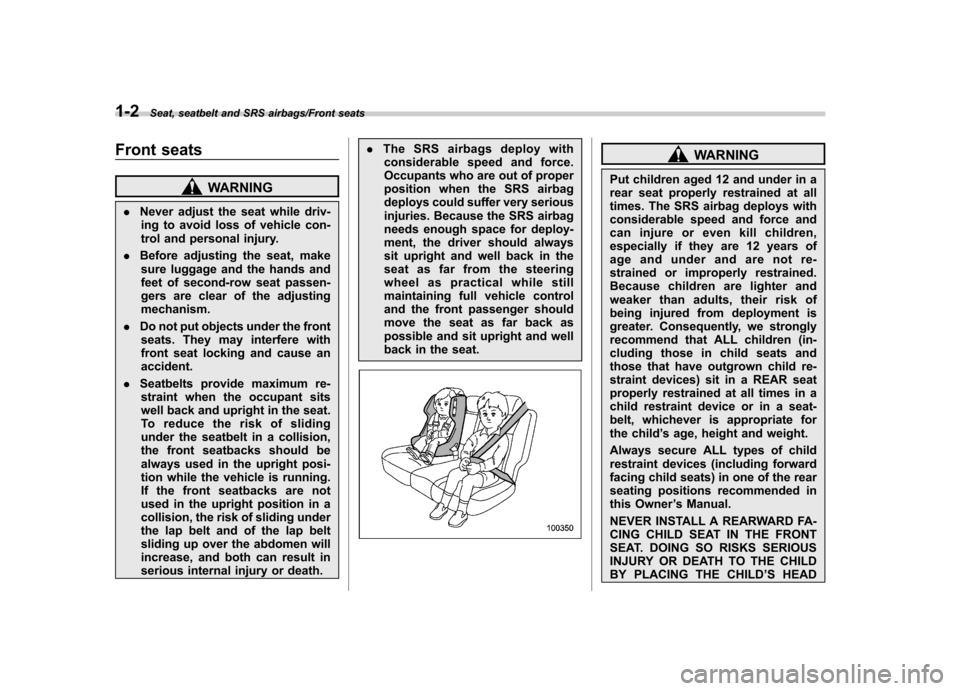
Put children aged 12 and under in a
rear seat properly restrained at all
times. The SRS airbag deploys with
considerable speed and force and
can injure or even kill children,
especially if they are 12 years of
age and under and are not re-
strained or improperly restrained.
Because children are lighter and
weaker than adults, their risk of
being injured from deployment is
greater. Consequently, we strongly
recommend that ALL children (in-
cluding those in child seats and
those that have outgrown child re-
straint devices) sit in a REAR seat
properly restrained at all times in a
child restraint device or in a seat-
belt, whichever is appropriate for
the child ’s age, height and weight.
Always secure ALL types of child
restraint devices (including forward
facing child seats) in one of the rear
seating positions recommended in
this Owner ’s Manual.
NEVER INSTALL A REARWARD FA-
CING CHILD SEAT IN THE FRONT
SEAT. DOING SO RISKS SERIOUS
INJURY OR DEATH TO THE CHILD
BY PLACING THE CHILD ’S HEAD
Page 35 of 420
1-6Seat, seatbelt and SRS airbags/Front seats
To raise:
Pull the head restraint up.
To lower:
Push the head restraint down while
pressing the release button on the top of
the seatback.
To remove:
While pressing the release button, pull out
the head restraint.
To install:
Install the head restraint into the holes that
are located on the top of the seatback until
the head restraint locks.
WARNING
. Never drive the vehicle with the
head restraints removed because
they are designed to reduce the
risk of serious neck injury in the
event that the vehicle is struck
from the rear. Therefore, when
you remove the head restraints,
you must reinstall all head re-
straints to protect vehicle occu-pants.
. All occupants, including the dri-
ver, should not operate a vehicle
or sit in a vehicle ’s seat until the
head restraints are placed in their
proper positions in order to mini-
mize the risk of neck injury in the event of a crash.
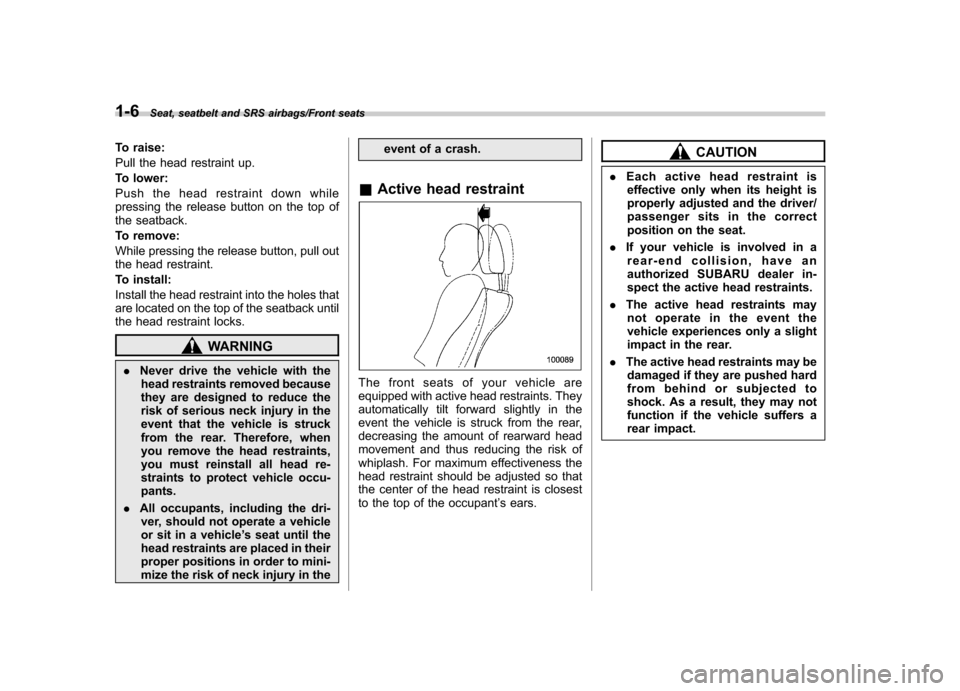
& Active head restraint
The front seats of your vehicle are
equipped with active head restraints. They
automatically tilt forward slightly in the
event the vehicle is struck from the rear,
decreasing the amount of rearward head
movement and thus reducing the risk of
whiplash. For maximum effectiveness the
head restraint should be adjusted so that
the center of the head restraint is closest
to the top of the occupant ’s ears.
CAUTION
. Each active head restraint is
effective only when its height is
properly adjusted and the driver/
passenger sits in the correct
position on the seat.
. If your vehicle is involved in a
rear-end collision, have an
authorized SUBARU dealer in-
spect the active head restraints.
. The active head restraints may
not operate in the event the
vehicle experiences only a slight
impact in the rear.
. The active head restraints may be
damaged if they are pushed hard
from behind or subjected to
shock. As a result, they may not
function if the vehicle suffers a
rear impact.
Page 36 of 420
&Lumbar support
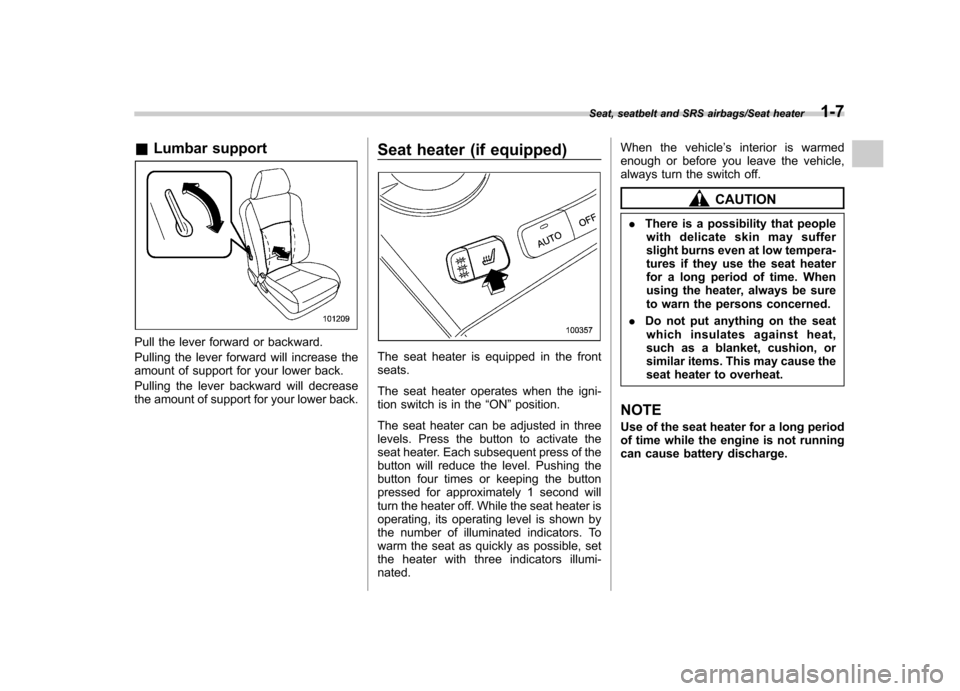
Pull the lever forward or backward.
Pulling the lever forward will increase the
amount of support for your lower back.
Pulling the lever backward will decrease
the amount of support for your lower back. Seat heater (if equipped)
The seat heater is equipped in the front seats.
The seat heater operates when the igni-
tion switch is in the
“ON ”position.
The seat heater can be adjusted in three
levels. Press the button to activate the
seat heater. Each subsequent press of the
button will reduce the level. Pushing the
button four times or keeping the button
pressed for approximately 1 second will
turn the heater off. While the seat heater is
operating, its operating level is shown by
the number of illuminated indicators. To
warm the seat as quickly as possible, set
the heater with three indicators illumi- nated. When the vehicle
’s interior is warmed
enough or before you leave the vehicle,
always turn the switch off.
CAUTION
. There is a possibility that people
with delicate skin may suffer
slight burns even at low tempera-
tures if they use the seat heater
for a long period of time. When
using the heater, always be sure
to warn the persons concerned.
. Do not put anything on the seat
which insulates against heat,
such as a blanket, cushion, or
similar items. This may cause the
seat heater to overheat.
NOTE
Use of the seat heater for a long period
of time while the engine is not running
can cause battery discharge.
Seat, seatbelt and SRS airbags/Seat heater1-7
Page 37 of 420
1-8Seat, seatbelt and SRS airbags/Second–row seats
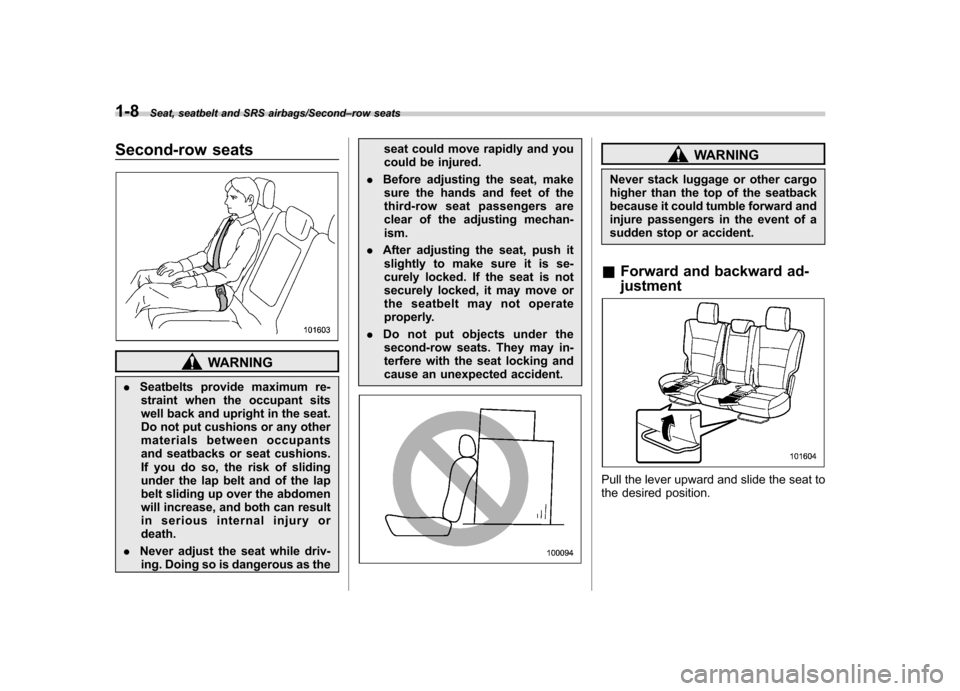
Second-row seats
WARNING
. Seatbelts provide maximum re-
straint when the occupant sits
well back and upright in the seat.
Do not put cushions or any other
materials between occupants
and seatbacks or seat cushions.
If you do so, the risk of sliding
under the lap belt and of the lap
belt sliding up over the abdomen
will increase, and both can result
in serious internal injury or death.
. Never adjust the seat while driv-
ing. Doing so is dangerous as the seat could move rapidly and you
could be injured.
. Before adjusting the seat, make
sure the hands and feet of the
third-row seat passengers are
clear of the adjusting mechan-ism.
. After adjusting the seat, push it
slightly to make sure it is se-
curely locked. If the seat is not
securely locked, it may move or
the seatbelt may not operate
properly.
. Do not put objects under the
second-row seats. They may in-
terfere with the seat locking and
cause an unexpected accident.
WARNING
Never stack luggage or other cargo
higher than the top of the seatback
because it could tumble forward and
injure passengers in the event of a
sudden stop or accident.
& Forward and backward ad- justment
Pull the lever upward and slide the seat to
the desired position.
Page 39 of 420
1-10Seat, seatbelt and SRS airbags/Second–row seats
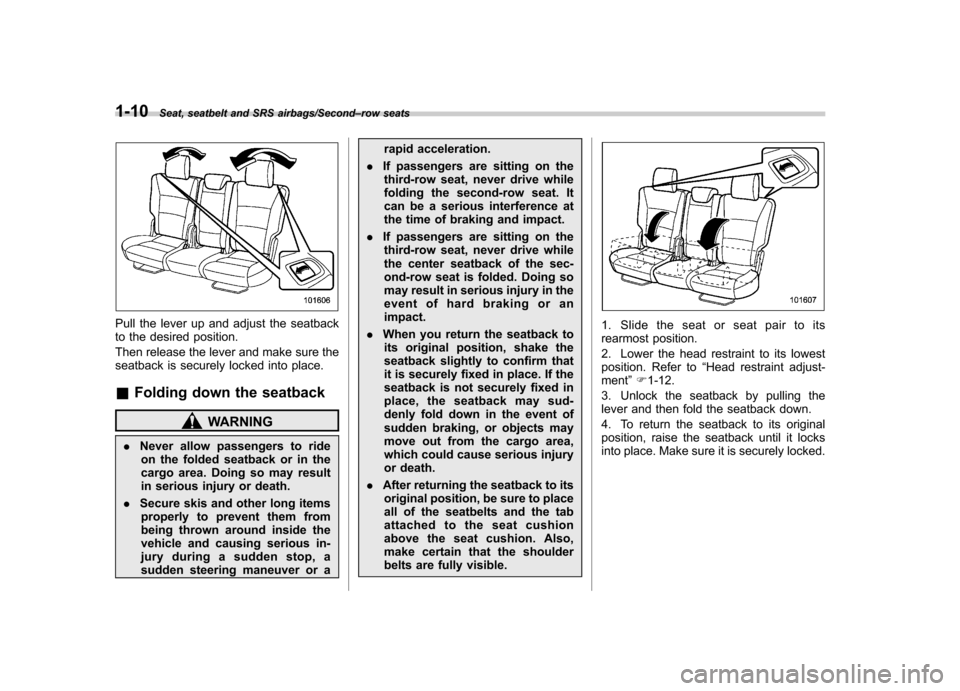
Pull the lever up and adjust the seatback
to the desired position.
Then release the lever and make sure the
seatback is securely locked into place. & Folding down the seatback
WARNING
. Never allow passengers to ride
on the folded seatback or in the
cargo area. Doing so may result
in serious injury or death.
. Secure skis and other long items
properly to prevent them from
being thrown around inside the
vehicle and causing serious in-
jury during a sudden stop, a
sudden steering maneuver or a rapid acceleration.
. If passengers are sitting on the
third-row seat, never drive while
folding the second-row seat. It
can be a serious interference at
the time of braking and impact.
. If passengers are sitting on the
third-row seat, never drive while
the center seatback of the sec-
ond-row seat is folded. Doing so
may result in serious injury in the
event of hard braking or animpact.
. When you return the seatback to
its original position, shake the
seatback slightly to confirm that
it is securely fixed in place. If the
seatback is not securely fixed in
place, the seatback may sud-
denly fold down in the event of
sudden braking, or objects may
move out from the cargo area,
which could cause serious injury
or death.
. After returning the seatback to its
original position, be sure to place
all of the seatbelts and the tab
attached to the seat cushion
above the seat cushion. Also,
make certain that the shoulder
belts are fully visible.
1. Slide the seat or seat pair to its
rearmost position.
2. Lower the head restraint to its lowest
position. Refer to “Head restraint adjust-
ment ”F 1-12.
3. Unlock the seatback by pulling the
lever and then fold the seatback down.
4. To return the seatback to its original
position, raise the seatback until it locks
into place. Make sure it is securely locked.
Page 44 of 420
&Folding down the seatback
WARNING
. Never allow passengers to ride
on the folded seatback or in the
cargo area. Doing so may result
in serious injury or death.
. Secure skis and other long items
properly to prevent them from
being thrown around inside the
vehicle and causing serious in-
jury during a sudden stop, a
sudden steering maneuver or a
rapid acceleration.
. When you return the seatback to
its original position, shake the
seatback slightly to confirm that
it is securely fixed in place. If the
seatback is not securely fixed in
place, the seatback may sud-
denly fold down in the event of
sudden braking, or objects may
move out from the cargo area,
which could cause serious injury
or death.
. After returning the seatback to its
original position, be sure to place
all of the seatbelts and the tab
attached to the seat cushion
above the seat cushion. Also,
make certain that the shoulder belts are fully visible.
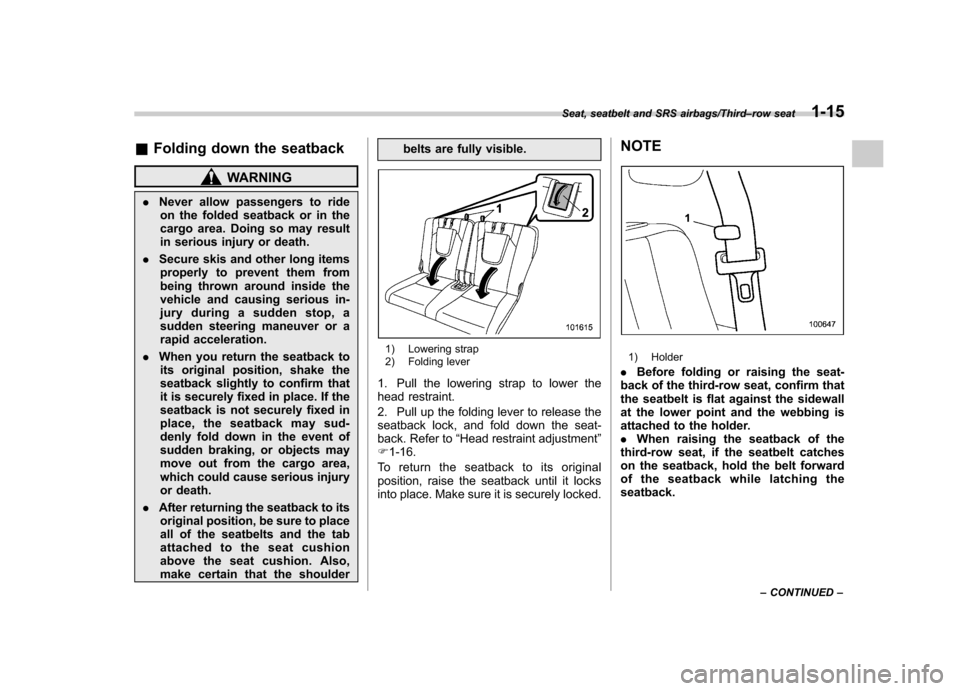
1) Lowering strap
2) Folding lever
1. Pull the lowering strap to lower the
head restraint.
2. Pull up the folding lever to release the
seatback lock, and fold down the seat-
back. Refer to “Head restraint adjustment ”
F 1-16.
To return the seatback to its original
position, raise the seatback until it locks
into place. Make sure it is securely locked. NOTE1) Holder
. Before folding or raising the seat-
back of the third-row seat, confirm that
the seatbelt is flat against the sidewall
at the lower point and the webbing is
attached to the holder.. When raising the seatback of the
third-row seat, if the seatbelt catches
on the seatback, hold the belt forward
of the seatback while latching theseatback.
Seat, seatbelt and SRS airbags/Third –row seat1-15
– CONTINUED –
Page 45 of 420
1-16Seat, seatbelt and SRS airbags/Third–row seat
& Head restraint adjustment
Both the third-row seats are equipped with
head restraints.
WARNING
. Never drive the vehicle with the
head restraints lowered when the
seats are occupied because they
are designed to reduce the risk of
serious neck injury in the event
that the vehicle is struck from the
rear.
. All occupants, including the dri-
ver, should not operate a vehicle
or sit in a vehicle ’s seat until the
head restraints are placed in their
proper positions in order to mini-
mize the risk of neck injury in the
event of a crash.
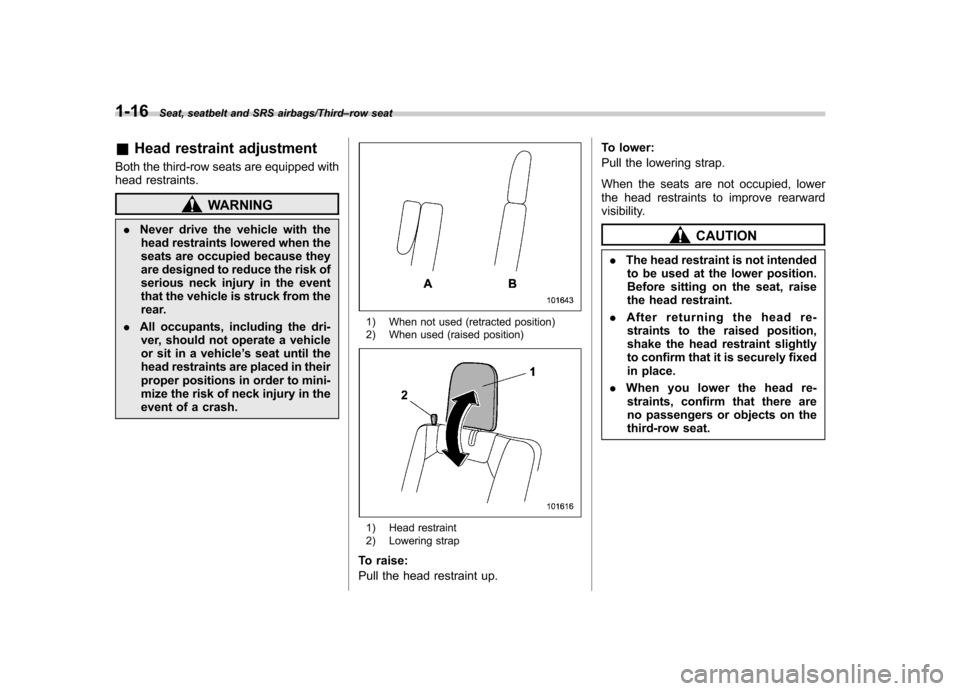
1) When not used (retracted position)
2) When used (raised position)
1) Head restraint
2) Lowering strap
To raise:
Pull the head restraint up. To lower:
Pull the lowering strap.
When the seats are not occupied, lower
the head restraints to improve rearward
visibility.
CAUTION
. The head restraint is not intended
to be used at the lower position.
Before sitting on the seat, raise
the head restraint.
. After returning the head re-
straints to the raised position,
shake the head restraint slightly
to confirm that it is securely fixed
in place.
. When you lower the head re-
straints, confirm that there are
no passengers or objects on the
third-row seat.
Page 46 of 420
Seatbelts &Seatbelt safety tips
WARNING
. All persons in the vehicle should
fasten their seatbelts BEFORE
the vehicle starts to move. Other-
wise, the possibility of serious
injury becomes greater in the
event of a sudden stop or acci-dent.
. All belts should fit snugly in order
to provide full restraint. Loose
fitting belts are not as effective in
preventing or reducing injury.
. Each seatbelt is designed to
support only one person. Never
use a single belt for two or morepersons –even children. Other-
wise, in an accident, serious
injury or death could result.
. Replace all seatbelt assemblies
including retractors and attach-
ing hardware worn by occupants
of a vehicle that has been in a
serious accident. The entire as-
sembly should be replaced even
if damage is not obvious.
. Put children aged 12 and under in a rear seat properly restrained at
all times. The SRS airbag de-
ploys with considerable speed
and force and can injure or even
kill children, especially if they are
12 years of age and under and
are not restrained or improperly
restrained. Because children are
lighter and weaker than adults,
their risk of being injured from
deployment is greater. Conse-
quently, we strongly recommend
that ALL children (including
those in child seats and those
that have outgrown child re-
straint devices) sit in a REAR
seat properly restrained at all
times in a child restraint device
or in a seatbelt, whichever is
appropriate for the child
’s height
and weight.
Always secure ALL types of child
restraint devices (including for-
ward facing child seats) in one of
the rear seating positions recom-
mended in this Owner ’s Manual.
NEVER INSTALL A REARWARD
FACING CHILD SEAT IN THE
FRONT SEAT. DOING SO RISKS
SERIOUS INJURY OR DEATH TO
THE CHILD BY PLACING THECHILD ’S HEAD TOO CLOSE TO THE SRS AIRBAG.
According to accident statistics,
children are safer when properly
restrained in the rear seating
positions than in the front seat-
ing positions. For instructions
and precautions concerning the
child restraint system, refer to“
Child restraint systems ”F 1-29.
Your vehicle is equipped with a crash
sensing and diagnostic module, which will
record the use of the seatbelt(s) by the
driver and front passenger when any of
the SRS frontal, side and curtain airbags
deploy. ! Infants or small children
Use a child restraint system that is
suitable for your vehicle. Refer to “Child
restraint systems ”F 1-29.
! Children
If a child is too big for a child restraint
system, the child should sit in the rear seat
and be restrained using the seatbelts.
According to accident statistics, children
are safer when properly restrained in the
rear seating positions than in the front
seating positions. Never allow a child to
stand up or kneel on the seat.
If the shoulder portion of the belt crosses
Seat, seatbelt and SRS airbags/Seatbelts1-17
– CONTINUED –
Page 47 of 420
1-18Seat, seatbelt and SRS airbags/Seatbelts
the face or neck, adjust the shoulder belt
anchor height (window-side seating posi-
tions only) and then if necessary move the
child closer to the belt buckle to help
provide a good shoulder belt fit. Care must
be taken to securely place the lap belt as
low as possible on the hips and not on thechild’s waist. If the shoulder portion of the
belt cannot be properly positioned, a child
restraint system should be used. Never
place the shoulder belt under the child ’s
arm or behind the child ’s back.
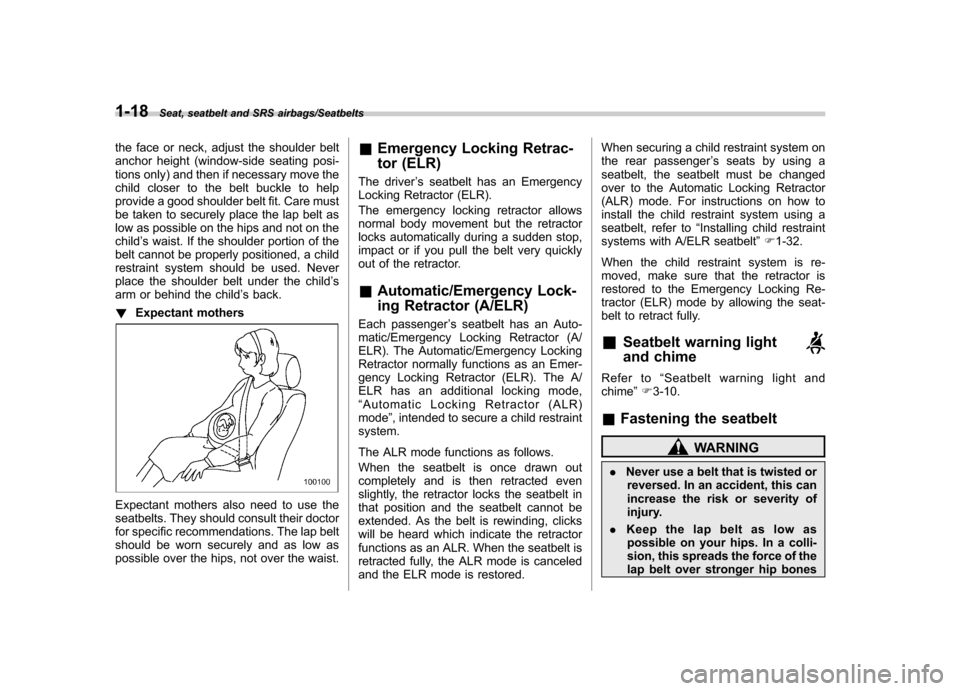
! Expectant mothers
Expectant mothers also need to use the
seatbelts. They should consult their doctor
for specific recommendations. The lap belt
should be worn securely and as low as
possible over the hips, not over the waist. &
Emergency Locking Retrac-
tor (ELR)
The driver ’s seatbelt has an Emergency
Locking Retractor (ELR).
The emergency locking retractor allows
normal body movement but the retractor
locks automatically during a sudden stop,
impact or if you pull the belt very quickly
out of the retractor. & Automatic/Emergency Lock-
ing Retractor (A/ELR)
Each passenger ’s seatbelt has an Auto-
matic/Emergency Locking Retractor (A/
ELR). The Automatic/Emergency Locking
Retractor normally functions as an Emer-
gency Locking Retractor (ELR). The A/
ELR has an additional locking mode,“ Automatic Locking Retractor (ALR)
mode ”, intended to secure a child restraint
system.
The ALR mode functions as follows.
When the seatbelt is once drawn out
completely and is then retracted even
slightly, the retractor locks the seatbelt in
that position and the seatbelt cannot be
extended. As the belt is rewinding, clicks
will be heard which indicate the retractor
functions as an ALR. When the seatbelt is
retracted fully, the ALR mode is canceled
and the ELR mode is restored. When securing a child restraint system on
the rear passenger
’s seats by using a
seatbelt, the seatbelt must be changed
over to the Automatic Locking Retractor
(ALR) mode. For instructions on how to
install the child restraint system using a
seatbelt, refer to “Installing child restraint
systems with A/ELR seatbelt ”F 1-32.
When the child restraint system is re-
moved, make sure that the retractor is
restored to the Emergency Locking Re-
tractor (ELR) mode by allowing the seat-
belt to retract fully.
& Seatbelt warning light
and chime
Refer to “Seatbelt warning light and
chime ”F 3-10.
& Fastening the seatbelt
WARNING
. Never use a belt that is twisted or
reversed. In an accident, this can
increase the risk or severity of
injury.
. Keep the lap belt as low as
possible on your hips. In a colli-
sion, this spreads the force of the
lap belt over stronger hip bones