lock SUBARU TRIBECA 2014 1.G Owners Manual
[x] Cancel search | Manufacturer: SUBARU, Model Year: 2014, Model line: TRIBECA, Model: SUBARU TRIBECA 2014 1.GPages: 426, PDF Size: 6.37 MB
Page 277 of 426
7-30Starting and operating
to the“Acc”or“LOCK”position, andthen turn it again to the“ON”position.
&To set cruise control
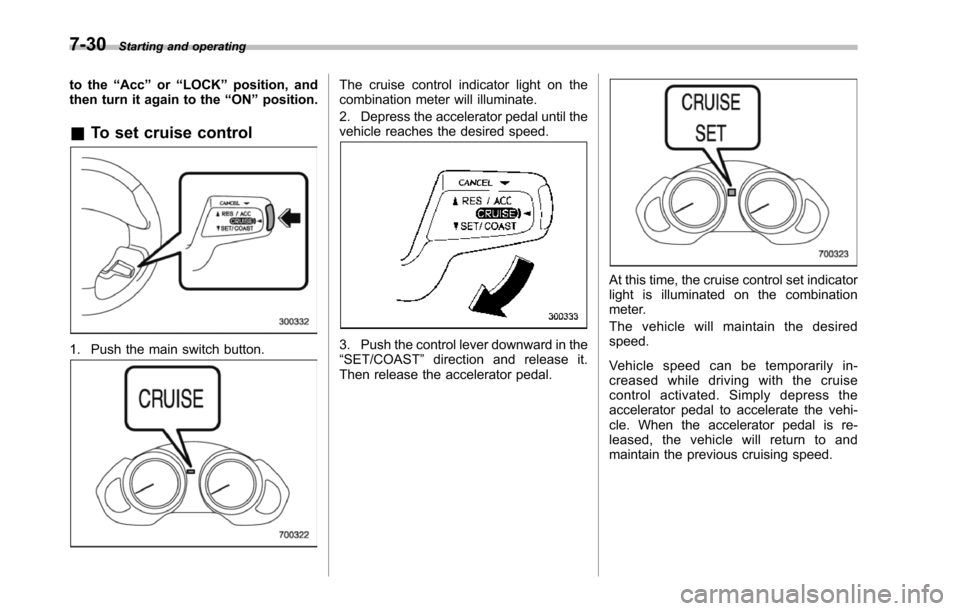
1. Push the main switch button.
The cruise control indicator light on thecombination meter will illuminate.
2. Depress the accelerator pedal until thevehicle reaches the desired speed.
3. Push the control lever downward in the“SET/COAST”direction and release it.Then release the accelerator pedal.
At this time, the cruise control set indicatorlight is illuminated on the combinationmeter.
The vehicle will maintain the desiredspeed.
Vehicle speed can be temporarily in-creased while driving with the cruisecontrol activated. Simply depress theaccelerator pedal to accelerate the vehi-cle. When the accelerator pedal is re-leased, the vehicle will return to andmaintain the previous cruising speed.
Page 278 of 426
&To temporarily cancel the
cruise control
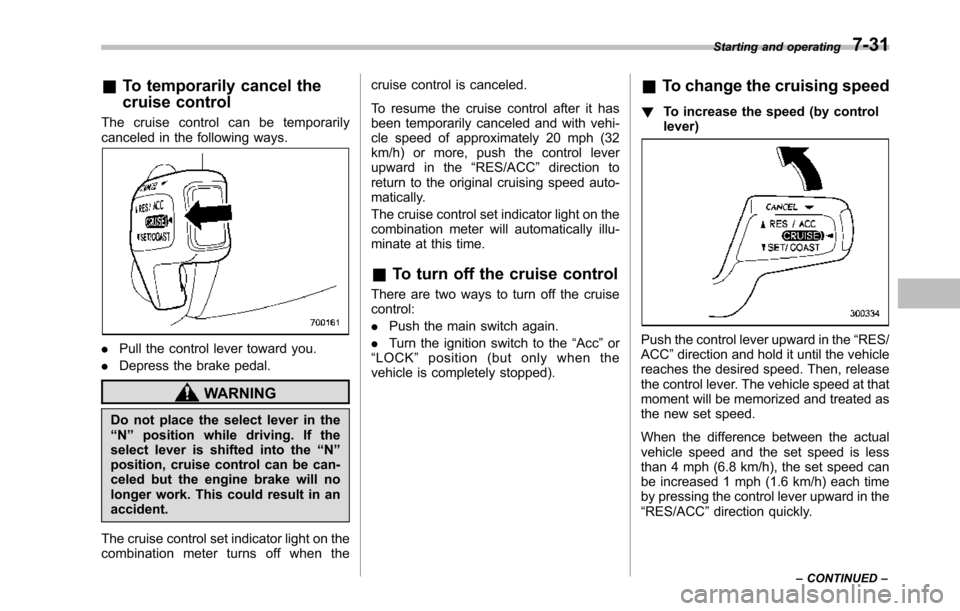
The cruise control can be temporarilycanceled in the following ways.
.Pull the control lever toward you.
.Depressthe brake pedal.
WARNING
Do not place the select lever in the“N”position while driving. If theselect lever is shifted into the“N”position, cruise control can be can-celed but the engine brake will nolonger work. This could result in anaccident.
The cruise control set indicator light on thecombination meter turns off when the
cruise control is canceled.
To resume the cruise control after it hasbeen temporarily canceled and with vehi-cle speed of approximately 20 mph (32km/h) or more, push the control leverupward in the“RES/ACC”direction toreturn to the original cruising speed auto-matically.
The cruise control set indicator light on thecombination meter will automatically illu-minate at this time.
&To turn off the cruise control
There are two ways to turn off the cruisecontrol:
.Push the main switch again.
.Turn the ignition switch to the“Acc”or“LOCK”position (but only when thevehicle is completely stopped).
&To change the cruising speed
!To increase the speed (by controllever)
Push the control lever upward in the“RES/ACC”direction and hold it until the vehiclereaches the desired speed. Then, releasethe control lever. The vehicle speed at thatmoment will be memorized and treated asthe new set speed.
When the difference between the actualvehicle speed and the set speed is lessthan 4 mph (6.8 km/h), the set speed canbe increased 1 mph (1.6 km/h) each timeby pressing the control lever upward in the“RES/ACC”direction quickly.
Starting and operating7-31
–CONTINUED–
Page 285 of 426
8-6Driving tips
On-road and off-road driving
WARNING
.In a rollover crash, an unbeltedperson is significantly morelikely to die than a person wear-ing a seatbelt. You the driver andall your passengers should fas-ten the seatbelts before startingto drive in order to minimize thechance of serious injury or death.
.Do not make sharp turns andquick maneuvers unless abso-lutely unavoidable. Such actionsare dangerous as you may losecontrol, possibly resulting in arolloverwhich could cause deathor serious injury.
.Always maintain a safe drivingspeed according to the road andweather conditions in order toavoid havingan accident on asharp turn, during sudden brak-ing or under other similar condi-tions.
.Whenever strong crosswinds arepresent, slow down sufficientlyto maintain control of your vehi-cle. Remember that your vehicle,with its higher profile and center
of gravity, is more likely to beaffected by crosswinds than or-dinary passenger cars.
.Always use the utmost care indriving–overconfidence be-cause you are driving an All-Wheel Drive model could easilylead to a serious accident.
Yo u r v e h i c l e i s c l a s s i f i e d a s a u t i l i t yvehicle. Utilityvehicles feature a higherground clearance which enables them tobe used for wide applications including off-road driving. But please keep in mind thatyour vehicle is neither a conventional off-road vehicle nor an all-terrain vehicle. Ahighercenter of gravity in relation to thetread width as compared with ordinarypassenger cars makes vehicles of thistype more likely to roll over. In reality, utilityvehicles have a significantly higher roll-over rate thanother types of vehicles. Thehigh ground clearance of this vehicle is areal advantage, giving you a better view ofthe road and allowing you to anticipateproblems earlier. However, remember thatyour utility vehicleis not designed for high-speed cornering comparable to ordinarypassenger cars and that your vehiclecould roll over if you make a sharp turnat high speed. If you do take yourSUBARU off-road, certain common sense
precautions such as those in the followinglist should be taken.
.Make certain that you and all of yourpassengers are wearing seatbelts.
.Carry some emergency equipment,such as a towing rope or chain, a shovel,wheel blocks, first aid kit and cell phone orcitizens band radio.
.Drive carefully. Do not take unneces-sary risks by driving in dangerous areas orover rough terrain.
.Slow down and employ extra caution atall times. When driving off-road, you willnot have the benefit of marked trafficlanes, banked curves, traffic signs andthe like.
.Do not drive across steep slopes.Instead, drive either straight up or straightdown the slopes. A vehicle can muchmore easily tip over sideways than it canend over end. Avoid driving straight up ordown slopes that are too steep.
.Avoid sharp turning maneuvers, espe-cially at higher speeds.
.Do not grip the inside or spokes of thesteering wheel. A bad bump could jerk thewheel andinjure your hands. Instead drivewith your fingers and thumbs on theoutside of the rim.
.If driving through water, such as whencrossing shallow streams, first check the
Page 287 of 426
8-8Driving tips
Winter driving
&Operation during cold
weather
Carry some emergency equipment, suchas a window scraper, a bag of sand,flares, a small shovel and jumper cables.
Check the battery and cables. Coldtemperatures reduce battery capacity.The battery must be in good condition toprovide enough power for cold winterstarts.
Use an engine oil of proper grade andviscosity for cold weather. Heavy summeroil will cause harder starting.
Keep the door locks from freezing bysquirting them with deicer or glycerin.
Forcing a frozen door open may damageor separate the rubber weather stripsaround the door. If the door is frozen,use hot water to melt the ice, and after-wards thoroughly wipe the water away.
Use a windshield washer fluid that con-tains an antifreeze solution. Do not useengine antifreeze or other substitutesbecause they may damage the paint ofthe vehicle.
SUBARU Windshield Washer Fluid con-tains 58.5% methyl alcohol and 41.5%surfactant, by volume. Its freezing tem-perature varies according to how much itis diluted, as indicated in the followingtable.
Washer Fluid Con-centrationFreezing Temperature
30% 10.48F(!128C)
50%!48F(!208C)
100%!498F(!458C)
In order to prevent freezing of washerfluid, check the freezing temperatures inthe table above when adjusting the fluidconcentration to the outside temperature.
If you fill the reservoir tank with a fluid witha different concentration from the oneused previously, purge the old fluid fromthe piping between the reservoir tank and
washer nozzles by operating the washerfor a certain period of time. Otherwise, ifthe concentration of the fluid remaining inthe piping is too low for the outsidetemperature, it may freeze and block thenozzles.
CAUTION
.Adjust the washer fluid concen-tration appropriately for the out-side temperature. If the concen-tration is inappropriate, sprayedwasher fluid may freeze on thewindshield and obstruct yourview, and the fluid may freeze inthe reservoir tank.
.State or local regulations onvolatile organic compounds mayrestrict the use of methanol, acommon windshield washer anti-freeze additive. Washer fluidscontaining non-methanol anti-freeze agents should be usedonly if they provide cold weatherprotection without damagingyour vehicle’s paint, wiper bladesor washer system.
!Before driving your vehicle
Before entering the vehicle, remove anysnow or ice from your shoes because that
Page 289 of 426
8-10Driving tips
vior can cause the wheels to lock, possiblyleading to loss of vehicle control.
An anti-lock brake system (ABS) en-hances your vehicle’sbrakingperfor-mance on snowy and icy roads. Forinformation about braking on slipperysurfaces, refer to“ABS (Anti-lock BrakeSystem)”F7-20 and“Vehicle DynamicsControl system”F7-23.
!Wiper operation when snowing
Before driving in cold weather, make surethe wiper blades are not frozen to thewindshield or rear window. If the wiperblades are frozen to the windshield or rearwindow, use the defroster with the airflowcontrol button in the“”position and thetemperature control dial set for maximumwarmth until the wiper blades are com-pletely thawed out. The wiper deicer ishelpful to thaw the windshield wiperblades. To thaw out the rear wiper blade,use the rear window defogger.
When driving in snow, if frozen snow startsto stick on the surface of the windshielddespite wiper operation, use the defrosterwith the airflow control button in“”andthe temperature control dial set for max-imum warmth. After the windshield getswarmed enoughto melt the frozen snowon it, wash it away using the windshieldwasher.
Snow stuck on the wiper arm prevents thewiper from working effectively. If snow isstuck on the wiper arm, pull off the road toa safe place, then remove it. If you stopthe vehicle at road side, use the hazardwarning flasher to alert other drivers.
We recommend use of non-freezing typewiper blades (winter blades) during theseasons in which you could have snowand freezing temperatures. Blades of thistype givesuperior wiping performance insnowy conditions. Be sure to use bladesthat are suitable for your vehicle.
CAUTION
During high-speed driving, non-freezing type wiper blades may notperformas well as standard wiperblades. If this happens, reduce thevehicle speed.
NOTE
When the season requiring non-freez-ing type wiper blades is over, replacethem with standard wiper blades.
&Corrosion protection
Refer to“Corrosion protection”F10-4.
&Snow tires
WARNING
.When replacing original tires withwinter (snow) tires, make sureyou use only tires of the samesize, circumference, speed sym-bol and load index as the originaltires listed on the tire placard.Using tires of other sizes orconstructions may affect speed-ometer/odometer calibration andclearance between the body andtires. It also may be dangerousand lead to loss of vehicle con-trol.
.You must install four winter tiresthat are of the same size, circum-ferences,construction, manufac-turer, brand (tread pattern), de-gree of wear, speed symbol andload index. Mixing tires of othersizes, circumferences or con-structions may result in severemechanical damage to the drivetrain of your vehicle and mayaffect ride, handling, braking andspeedometer/odometer calibra-tion. It also may be dangerousand lead to loss of vehicle con-trol.
Page 298 of 426
has safety chains and that eachchain will hold the trailer’s max-imum gross weight. Towing trai-lers without safety chains couldcreate a traffic safety hazard ifthe trailer separates from thehitch due to coupling damage orhitch ball damage.
.Be sure to check the hitch pinand safety pin for positive lock-ing placement before towing atrailer. If the ball mount comes offthe hitch receiver, the trailercould get loose and create atraffic safety hazard.
.Use only the ball mount suppliedwith this hitch. Use the hitch onlyas a weight carrying hitch. Do notuse with any type of weightdistributing hitch.
The maximum gross trailer weight andmaximum gross tongue weight are indi-cated in the following table.
Maximumgross trailerweight
Maximumgross tongueweight
Vehicle with-out cooling kit2,000 lbs(906 kg)200 lbs(90 kg)
Vehicle withcooling kit3,500 lbs(1,587 kg)350 lbs(158 kg)
When you tow a trailer, follow the instruc-tions in“Trailer towing”F8-21.
&Connecting a trailer
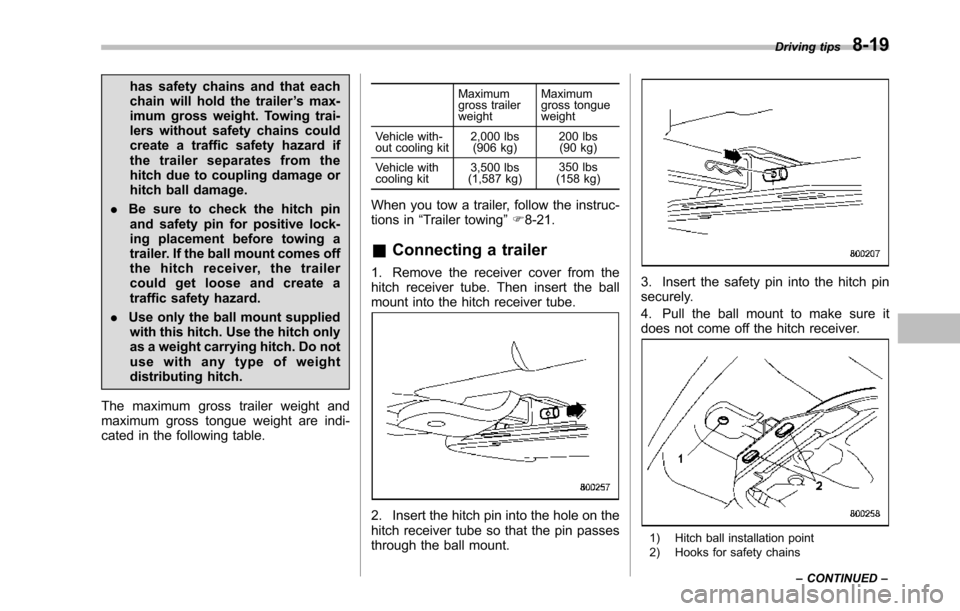
1. Remove the receiver cover from thehitch receiver tube. Then insert the ballmount into the hitch receiver tube.
2. Insert the hitch pin into the hole on thehitch receiver tube so that the pin passesthrough the ball mount.
3. Insert the safety pin into the hitch pinsecurely.
4. Pull the ball mount to make sure itdoes not come off the hitch receiver.
1) Hitch ball installation point2) Hooks for safety chains
Driving tips8-19
–CONTINUED–
Page 307 of 426
8-28Driving tips
zone in the“D”position than in themanual mode position.
.Avoid using the accelerator pedal tostay stationary on an uphill slope insteadof using the parking brake or foot brake.That may cause the transmission fluid tooverheat.
!Parking on a grade
Always block the wheels under bothvehicle and trailer when parking. Applythe parking brake firmly. You should notpark on a hill or slope. But if parking on ahill or slope cannot be avoided, youshould take the following steps.
1. Apply the brakes and hold the pedaldown.
2. Have someone place wheel blocksunder both the vehicle and trailer wheels.
3. When the wheel blocks are in place,release the regular brakes slowly until theblocks absorb theload.
4. Apply the regular brakes and thenapply the parking brake; slowly releasethe regular brakes.
5. Shift into“P”and shut off the engine.
Page 308 of 426
If you park your vehicle in an emergency......... 9-2
Spare tire............................................................. 9-2Removing the spare tire...................................... 9-3Re-storage of spare tire....................................... 9-4
Temporary spare tire........................................... 9-5
Flat tires............................................................... 9-6Changing a flat tire.............................................. 9-6Tire pressure monitoring system (TPMS) ............ 9-10
Jump starting..................................................... 9-11How to jump start............................................... 9-12
Engine overheating........................................... 9-14If steam is coming from the enginecompartment................................................... 9-14If no steam is coming from the enginecompartment................................................... 9-14
Towing................................................................ 9-14Towing and tie-down hooks................................ 9-15Using a flat-bed truck......................................... 9-17Towing with all wheels on the ground................. 9-17
Reargate–if the rear gate cannot beunlocked.......................................................... 9-18
Maintenance tools............................................. 9-19Jack and jack handle......................................... 9-19
In case of emergency
9
Page 310 of 426
carefully read“Temporary spare tire”F9-5for instructions and precautions.
&Removing the spare tire
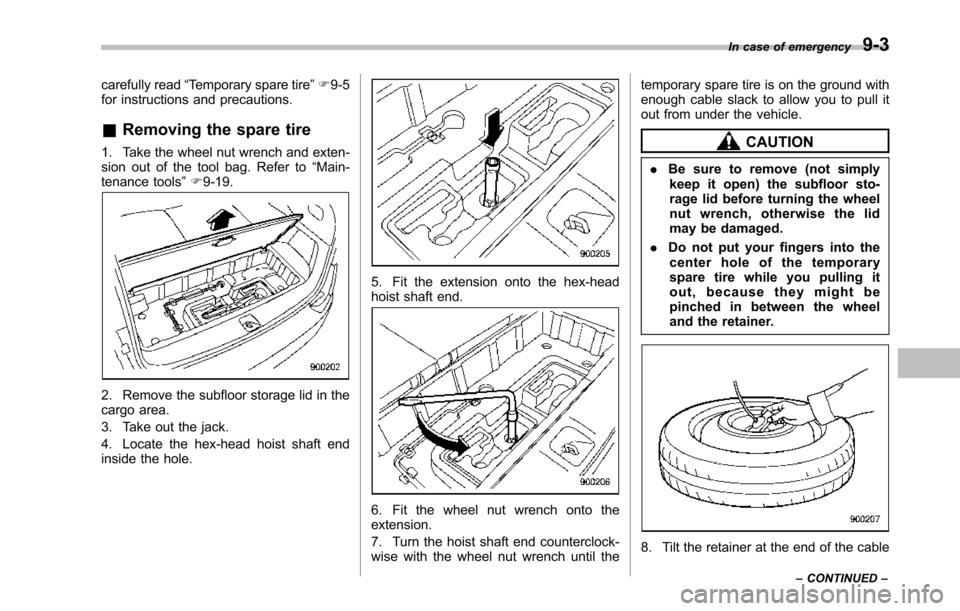
1. Take the wheel nut wrench and exten-sion out of the tool bag. Refer to“Main-tenance tools”F9-19.
2. Remove the subfloor storage lid in thecargo area.
3. Take out the jack.
4. Locate the hex-head hoist shaft endinside the hole.
5. Fit the extension onto the hex-headhoist shaft end.
6. Fit the wheel nut wrench onto theextension.
7. Turn the hoist shaft end counterclock-wise with the wheel nut wrench until the
temporary spare tire is on the ground withenough cable slack to allow you to pull itout from under the vehicle.
CAUTION
.Be sure to remove (not simplykeep it open) the subfloor sto-ragelid before turning the wheelnut wrench, otherwise the lidmay be damaged.
.Do not put your fingers into thecenter hole of the temporaryspare tire while you pulling itout, because they might bepinched in between the wheelandthe retainer.
8. Tilt the retainer at the end of the cable
In case of emergency9-3
–CONTINUED–
Page 311 of 426
9-4In case of emergency
and pull it through the center of thetemporary spare tire.
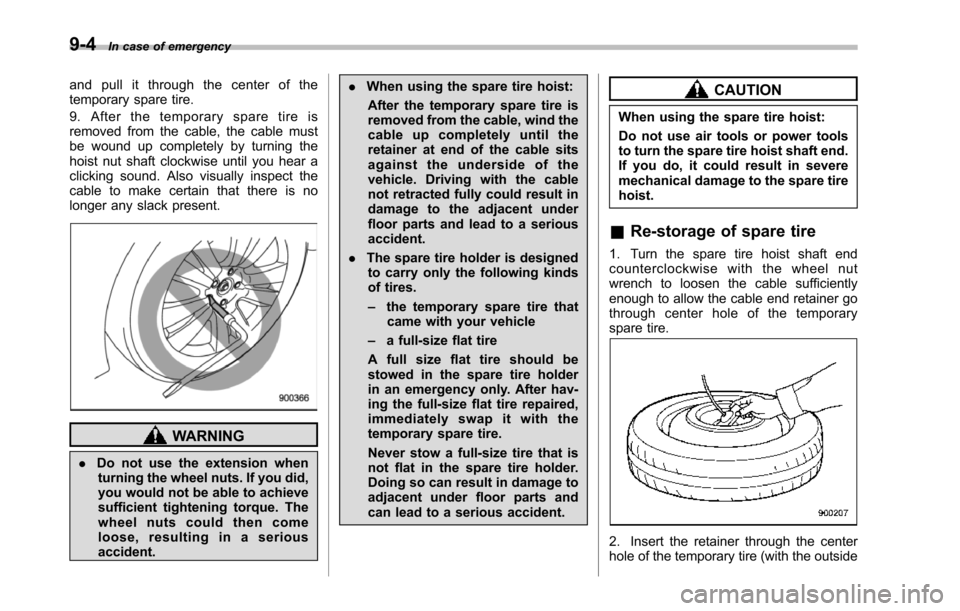
9. After the temporary spare tire isremoved from the cable, the cable mustbe wound up completely by turning thehoist nut shaft clockwise until you hear aclicking sound. Also visually inspect thecable to make certain that there is nolonger any slack present.
WARNING
.Do not use the extension whenturning the wheel nuts. If you did,you would not be able to achievesufficient tightening torque. Thewheel nuts could then comeloose, resulting in a seriousaccident.
.When using the spare tire hoist:
After the temporary spare tire isremoved from the cable, wind thecable up completely until theretainer at end of the cable sitsagainst the underside of thevehicle. Driving with the cablenot retracted fully could result indamage to the adjacent underfloor partsand lead to a seriousaccident.
.The spare tire holder is designedto carry only the following kindsof tires.
–the temporaryspare tire thatcame with your vehicle
–a full-size flat tire
A full size flat tire should bestowed in the spare tire holderin an emergency only. After hav-ing the full-sizeflat tire repaired,immediately swap it with thetemporary spare tire.
Never stow a full-size tire that isnot flat in the spare tire holder.Doing so can result in damage toadjacent under floor parts andcan lead to a serious accident.
CAUTION
When using the spare tire hoist:
Do not use air tools or power toolsto turn the spare tire hoist shaft end.If you do, it could result in severemechanical damage to the spare tirehoist.
&Re-storage of spare tire
1. Turn the spare tire hoist shaft endcounterclockwise with the wheel nutwrench to loosen the cable sufficientlyenough to allow the cable end retainer gothrough center hole of the temporaryspare tire.
2. Insert the retainer through the centerhole of the temporary tire (with the outside