climate control SUBARU TRIBECA 2014 1.G User Guide
[x] Cancel search | Manufacturer: SUBARU, Model Year: 2014, Model line: TRIBECA, Model: SUBARU TRIBECA 2014 1.GPages: 426, PDF Size: 6.37 MB
Page 184 of 426
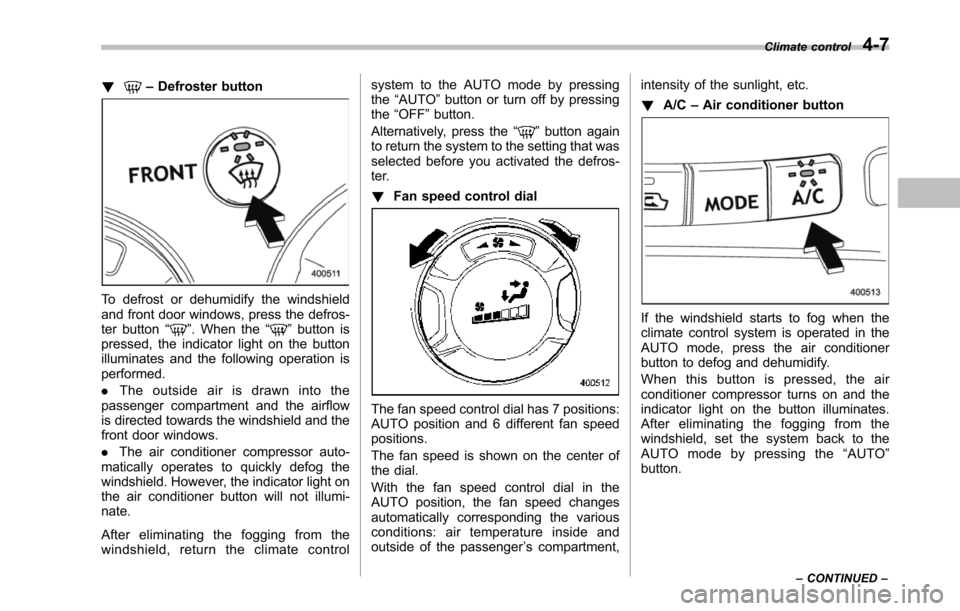
!–Defroster button
To defrost or dehumidify the windshieldand front door windows, press the defros-ter button“”. When the“”button ispressed, the indicator light on the buttonilluminates and the following operation isperformed.
.The outside air is drawn into thepassenger compartment and the airflowis directed towards the windshield and thefront door windows.
.The air conditioner compressor auto-matically operates to quickly defog thewindshield. However, the indicator light onthe air conditioner button will not illumi-nate.
After eliminating the fogging from thewindshield, return the climate control
system to the AUTO mode by pressingthe“AUTO”button or turn off by pressingthe“OFF”button.
Alternatively, press the“”button againto return the system to the setting that wasselected before you activated the defros-ter.
!Fan speed control dial
The fan speed control dial has 7 positions:AUTO positionand 6 different fan speedpositions.
The fan speed is shown on the center ofthe dial.
With the fan speed control dial in theAUTO position, the fan speed changesautomatically corresponding the variousconditions: air temperature inside andoutside of the passenger’s compartment,
intensity of the sunlight, etc.
!A/C–Air conditioner button
If the windshield starts to fog when theclimate control system is operated in theAUTO mode, press the air conditionerbutton to defog and dehumidify.
When this button is pressed, the airconditioner compressor turns on and theindicator light on the button illuminates.After eliminating the fogging from thewindshield, set the system back to theAUTO mode by pressing the“AUTO”button.
Climate control4-7
–CONTINUED–
Page 185 of 426
4-8Climate control
NOTE
For efficient defogging or dehumidify-ing in cold weather, turn on the airconditioner. However, if the ambienttemperature decreases to approxi-mately 328F(08C), the air conditionercompressor may stop operating.
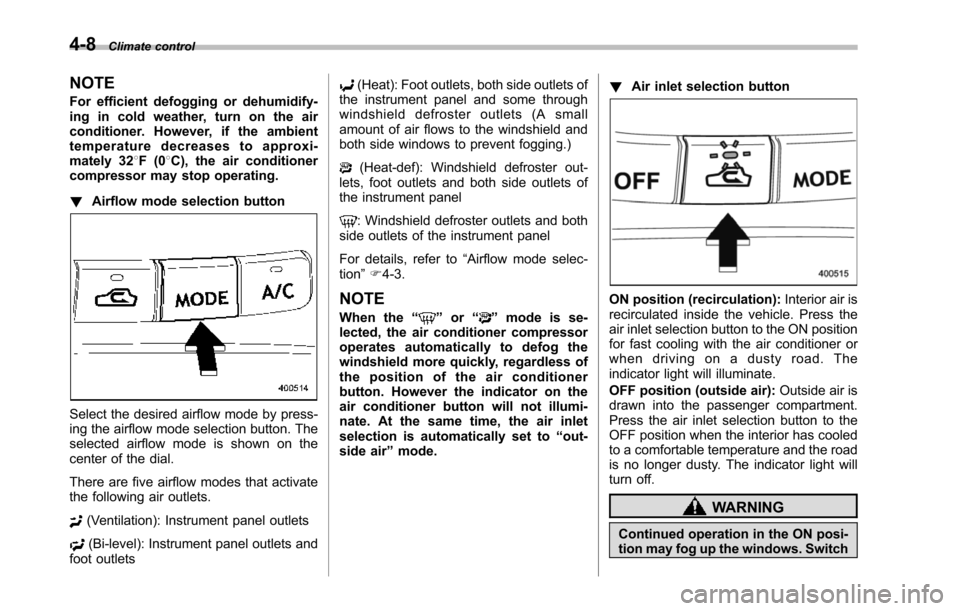
!Airflow mode selection button
Select the desired airflow mode by press-ing the airflow mode selection button. Theselected airflow mode is shown on thecenter of the dial.
There are five airflow modes that activatethe following air outlets.
(Ventilation): Instrument panel outlets
(Bi-level): Instrument panel outlets andfoot outlets
(Heat): Foot outlets, both side outlets ofthe instrument panel and some throughwindshield defroster outlets (A smallamount of air flows to the windshield andboth side windows to prevent fogging.)
(Heat-def): Windshield defroster out-lets, foot outlets and both side outlets ofthe instrument panel
: Windshield defroster outlets and bothside outletsof the instrument panel
For details, refer to“Airflow mode selec-tion”F4-3.
NOTE
When the“”or“”mode is se-lected, the air conditioner compressoroperates automatically to defog thewindshield more quickly, regardless ofthe position of the air conditionerbutton. However the indicator on theair conditioner button will not illumi-nate. At the same time, the air inletselection is automatically set to“out-side air”mode.
!Air inlet selection button
ON position (recirculation):Interior air isrecirculated inside the vehicle. Press theair inlet selection button to the ON positionfor fast cooling with the air conditioner orwhen driving on a dusty road. Theindicator light will illuminate.
OFF position (outside air):Outside air isdrawninto the passenger compartment.Press the air inlet selection button to theOFF position when the interior has cooledto a comfortable temperature and the roadis no longer dusty. The indicator light willturn off.
WARNING
Continued operation in the ON posi-tion may fog up the windows. Switch
Page 186 of 426
to the OFF position as soon as theoutside dusty condition clears.
NOTE
When driving on a dusty road or behinda vehicle that emits unpleasant exhaustgases, set the air inlet selection buttonto the ON position.
From time to time, return the air inletselection button to the OFF position todraw outside air into the passengercompartment.
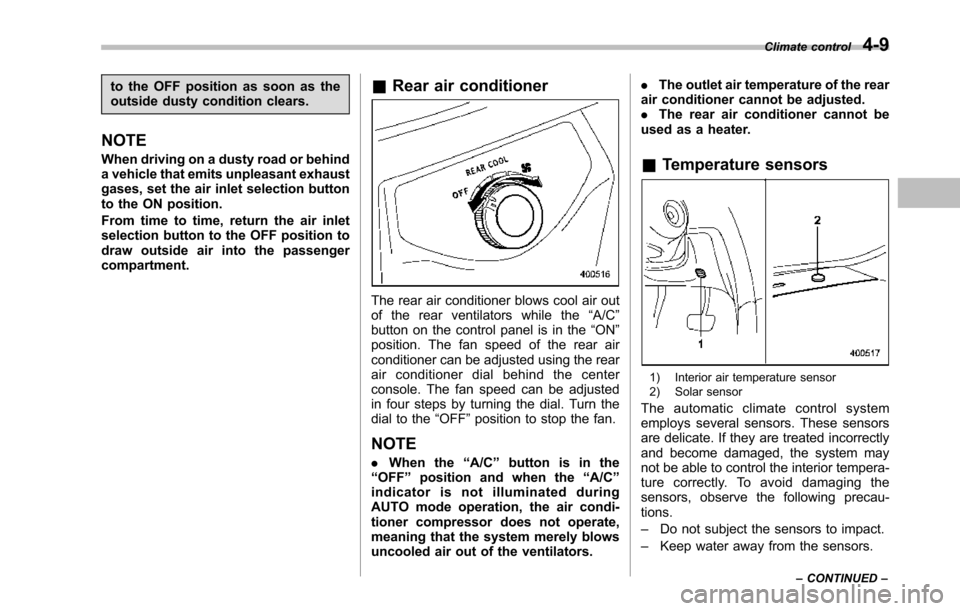
&Rear air conditioner
The rear air conditioner blows cool air outof the rear ventilators while the“A/C”button on the control panel is in the“ON”position. The fan speed of the rear airconditionercan be adjusted using the rearair conditioner dial behind the centerconsole. The fan speed can be adjustedin four steps by turning the dial. Turn thedial to the“OFF”position to stop the fan.
NOTE
.When the“A/C”button is in the“OFF”position and when the“A/C”indicator is not illuminated duringAUTO mode operation, the air condi-tioner compressor does not operate,meaning that the system merely blowsuncooled air out of the ventilators.
.The outlet air temperature of the rearair conditioner cannot be adjusted..The rear air conditioner cannot beused as a heater.
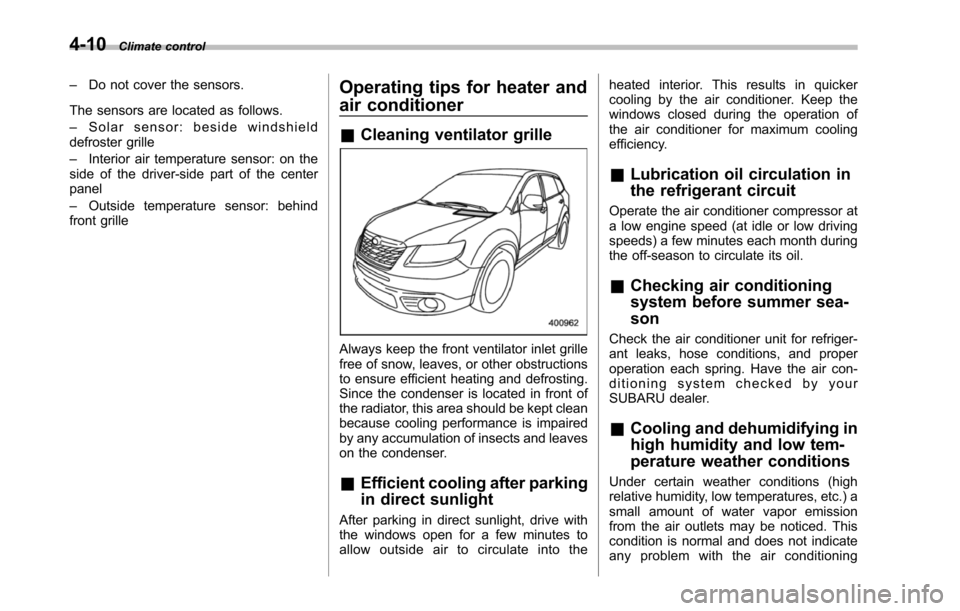
&Temperature sensors
1) Interior air temperature sensor2) Solar sensor
The automatic climate control systememploys several sensors. These sensorsare delicate. If they are treated incorrectlyand become damaged, the system maynot be able to control the interior tempera-ture correctly. To avoid damaging thesensors, observe the following precau-tions.
–Do not subject the sensors to impact.
–Keep water away from the sensors.
Climate control4-9
–CONTINUED–
Page 187 of 426
4-10Climate control
–Do not cover the sensors.
The sensors are located as follows.
–Solar sensor: beside windshielddefroster grille
–Interior air temperature sensor: on theside of the driver-side part of the centerpanel
–Outside temperature sensor: behindfront grille
Operating tips for heater and
air conditioner
&Cleaning ventilator grille
Always keep the front ventilator inlet grillefree of snow, leaves, or other obstructionsto ensure efficient heating and defrosting.Since the condenser is located in front ofthe radiator, this area should be kept cleanbecause cooling performance is impairedby any accumulation of insects and leaveson the condenser.
&Efficient cooling after parking
in direct sunlight
After parking in direct sunlight, drive withthe windows open for a few minutes toallow outside air to circulate into the
heated interior. This results in quickercooling by the air conditioner. Keep thewindows closed during the operation ofthe air conditioner for maximum coolingefficiency.
&Lubrication oil circulation in
the refrigerant circuit
Operate the air conditioner compressor ata low engine speed (at idle or low drivingspeeds) a few minutes each month duringthe off-season to circulate its oil.
&Checking air conditioning
system before summer sea-
son
Check the air conditioner unit for refriger-ant leaks,hose conditions, and properoperation each spring. Have the air con-ditioning system checked by yourSUBARU dealer.
&Cooling and dehumidifying in
high humidity and low tem-
perature weather conditions
Under certain weather conditions (highrelative humidity, low temperatures, etc.) asmall amount of water vapor emissionfrom the air outlets may be noticed. Thiscondition is normal and does not indicateany problem with the air conditioning
Page 188 of 426
system.
&Air conditioner compressor
shut-off when engine is
heavily loaded
To improve acceleration and gas mileage,the air conditioner compressor is designedto temporarily shut off during air condi-tioner operation whenever the acceleratoris fully depressed such as during rapidacceleration or when driving on a steepupgrade.
&Refrigerant for your climate
control system
Your air conditioner uses ozone friendlyrefrigerant HFC134a. Therefore, the meth-od of adding, changing or checking therefrigerant is different from the method forCFC12 (freon). Consult your SUBARUdealer for service. Repairs needed as aresult of using the wrong refrigerant arenot covered under warranty.
Air filtration system
Replace the filter element according to thereplacement schedule shown in the fol-lowing. This schedule should be followedto maintain the filter’sdustcollectionability. Under extremely dusty conditions,the filter should be replaced more fre-quently. It is recommended that you haveyour filter checked or replaced by yourSUBARU dealer. For replacement, werecommend the use of a genuineSUBARU airfilter kit.
Replacement schedule:
Every 15 months or 15,000 miles (24,000km) whichever comes first
&Replacing the air filter
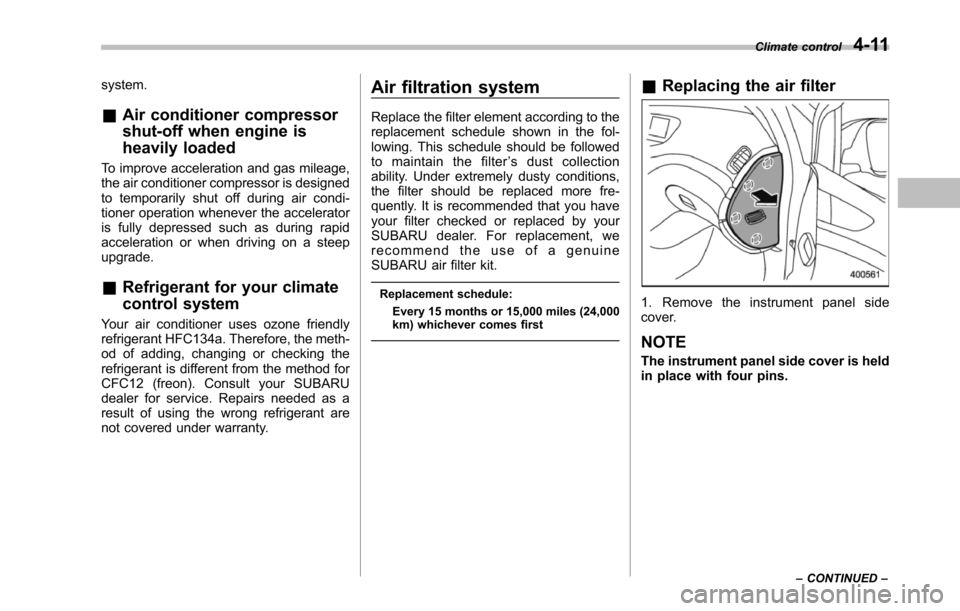
1. Remove the instrument panel sidecover.
NOTE
The instrument panel side cover is heldin place with four pins.
Climate control4-11
–CONTINUED–
Page 189 of 426
4-12Climate control
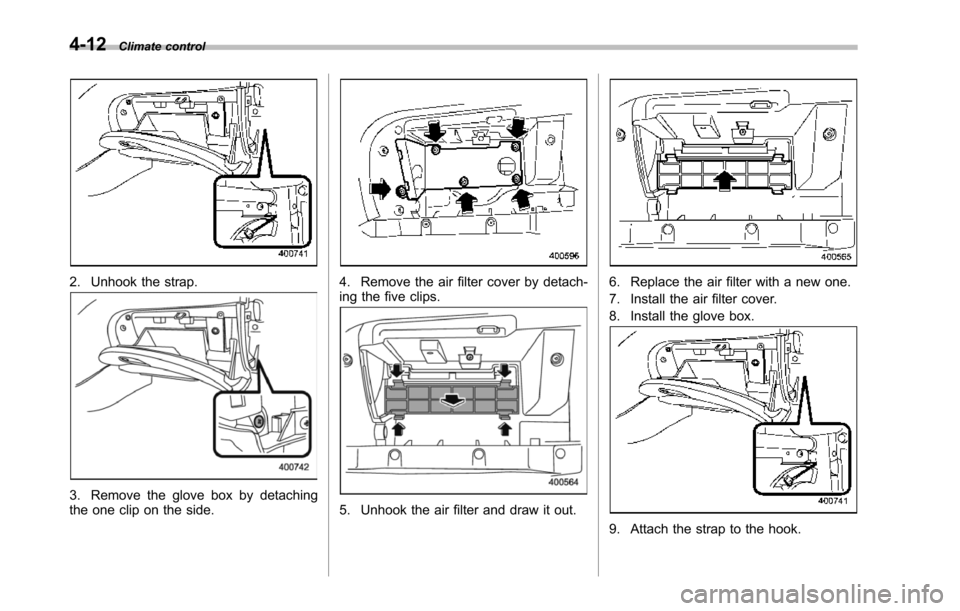
2. Unhook the strap.
3. Remove the glove box by detachingthe one clip on the side.
4. Remove the air filter cover by detach-ing the five clips.
5. Unhook the air filter and draw it out.
6. Replace the air filter with a new one.
7. Install the air filter cover.
8. Install the glove box.
9. Attach the strap to the hook.
Page 190 of 426
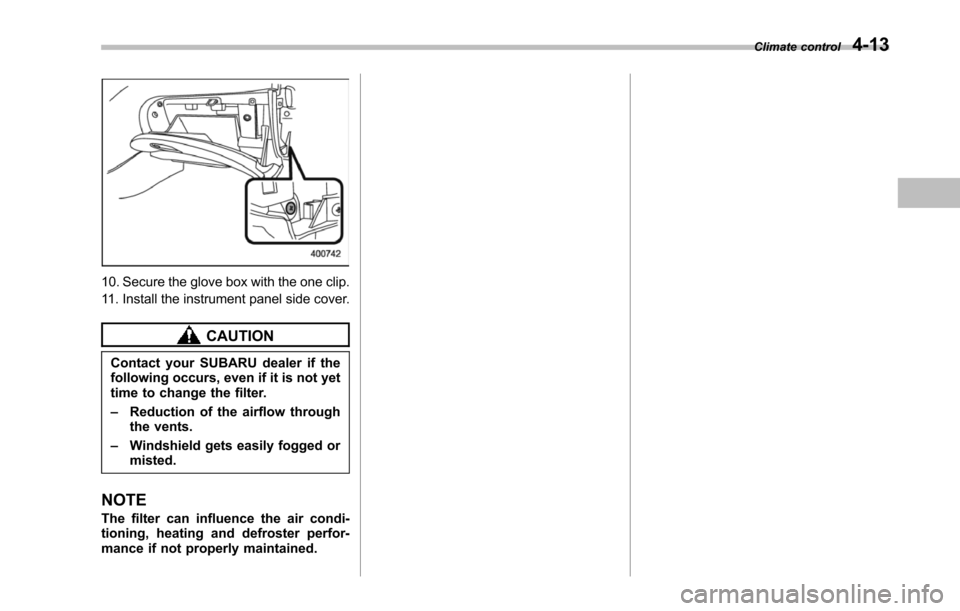
10. Secure the glove box with the one clip.
11. Install the instrument panel side cover.
CAUTION
Contact your SUBARU dealer if thefollowingoccurs, even if it is not yettime to change the filter.
–Reduction of the airflow throughthe vents.
–Windshield gets easily fogged ormisted.
NOTE
The filter can influence the air condi-tioning, heating and defroster perfor-mance if not properly maintained.
Climate control4-13
Page 328 of 426
Exterior care....................................................... 10-2Washing............................................................. 10-2Waxing and polishing......................................... 10-3Cleaning aluminum wheels................................. 10-3
Corrosion protection.......................................... 10-4Most common causes of corrosion..................... 10-4To help prevent corrosion................................... 10-4
Cleaning the interior.......................................... 10-5Seat fabric......................................................... 10-5Leather seat materials........................................ 10-5Synthetic leather upholstery............................... 10-5Climate control panel, audio panel, instrumentpanel, console panel, switches, combinationmeter, and other plastic surface....................... 10-5Navigation monitor (if equipped)........................ 10-6
Appearance care
10
Page 332 of 426
Cleaning the interior
Use a soft, damp cloth to clean the climatecontrol panel, audio equipment, instru-ment panel, center console, combinationmeter panel, and switches. (Do not useorganic solvents.)
&Seat fabric
Remove loose dirt, dust or debris with avacuum cleaner. If the dirt is caked on thefabric or hard to remove with a vacuumcleaner, use a soft blush then vacuum it.
Wipe the fabric surface with a tightlywrung cloth and dry the seat fabricthoroughly. If the fabric is still dirty, wipeusing a solution of mild soap and luke-warmwater then dry thoroughly.
If the stain does not come out, try acommercially available fabric cleaner. Usethe cleaner on a hidden place and makesure it does not affect the fabric adversely.Use the cleaner according to its instruc-tions.
NOTE
When cleaning the seat, do not usebenzine, paint thinner, or any similarmaterials.
&Leather seat materials
The leather used by SUBARU is a highquality natural product which will retain itsdistinctive appearance and feel for manyyears with proper care.
Allowing dust or road dirt to build up on thesurface can cause the material to becomebrittle and to wear prematurely. Regularcleaning witha soft, moist, natural fibercloth should be performed monthly, takingcare not to soak the leather or allow waterto penetrate the stitched seams.
A mild detergent suitable for cleaningwoolen fabrics may be used to removedifficult dirt spots, rubbing with a soft, drycloth afterwards to restore the luster. Ifyour SUBARU is to be parked for a longtime in bright sunlight, it is recommendedthat the seats and headrests be covered,or the windows shaded, to prevent fadingor shrinkage.
Minor surface blemishes or bald patchesmay be treated with a commercial leatherspray lacquer. You will discover that eachleather seat section will develop soft foldsor wrinkles, which is characteristic ofgenuine leather.
&Synthetic leather upholstery
The synthetic leather material used on theSUBARU may be cleaned using mild soap
or detergent and water, after first vacuum-ing or brushing away loose dirt. Allow thesoap to soak in for a few minutes and wipeoff with a clean, damp cloth. Commercialfoam-type cleaners suitable for syntheticleather materials may be used whennecessary.
NOTE
Strong cleaning agents such as sol-vents, paint thinners, window cleaneror gasoline must never be used onleather or synthetic interior materials.
&Climate control panel, audio
panel, instrument panel,
console panel, switches,
combination meter, and other
plastic surface
Use a soft, damp cloth to clean the climatecontrol panel, audio equipment, instru-ment panel, center console, combinationmeter panel, and switches.
CAUTION
.Do not use organic solvents suchas paint thinners or fuel, orstrongcleaning agents that con-tain those solvents.
.Do not use chemical solvents
Appearance care10-5
–CONTINUED–
Page 407 of 426
13-14Consumer information and Reporting safety defects
XXX kg or XXX lbs.
4.The resulting figure equals the
available amount of cargo and
luggage load capacity. For exam-
ple, if the“XXX”amount equals
1,400 lbs (635 kg) and there will be
five- 150 lbs (68 kg) passengers in
your vehicle, the amount of avail-
able cargo and luggage load capa-
city is 650 lbs. (1,400!750 (56
150) = 650 lbs).
5.Determine the combined weight
of luggage and cargo being loaded
on the vehicle. That weight may not
safely exceed the available cargo
and luggage load capacity calcu-
lated in Step 4.
6.If your vehicle will be towing a
trailer, load from your trailer will be
transferred to your vehicle. Consult
this manual to determine how this
reduces the available cargo and
luggage load capacity of your ve-
hicle.
Uniform tire quality grading
standards
This information indicates the rela-
tive performance of passenger car
tires in the area of treadwear,
traction, and temperature resis-
tance. This is to aid the consumer
in making an informed choice in the
purchase of tires.
Quality grades can be found where
applicable on the tire sidewall be-
tween tread shoulder and maxi-
mum section width. For example:
Treadwear 200 Traction AA Tem-
perature A
The quality grades apply to new
pneumatic tires for use on passen-
ger cars. However, they do not
apply to deep tread, winter type
snow tires, space-saver or tempor-
ary use spare tires, tires with
nominal rim diameters of 12 inches
or less, or to some limited produc-
tion tires.
All passenger car tires must con-
form to Federal Safety Require-
ments in addition to these grades.
&Treadwear
The treadwear grade is a compara-
tive rating based on the wear rate of
the tire when tested under con-
trolled conditions on a specified
government test course.
For example, a tire graded 150
would wear one and one-half (1-
1/2) times as well on the govern-
ment course as a tire graded 100.
The relative performance of tires
depends upon the actual conditions
of their use, however, and may
depart significantly from the norm
due to variations in driving habits,
service practices and differences in
road characteristics and climate.
&Traction AA, A, B, C
The traction grades, from highest to
lowest, are AA, A, B and C. Those
grades represent the tire’s ability to
stop on wet pavement as measured
under controlled conditions on spe-