height SUBARU TRIBECA 2014 1.G User Guide
[x] Cancel search | Manufacturer: SUBARU, Model Year: 2014, Model line: TRIBECA, Model: SUBARU TRIBECA 2014 1.GPages: 426, PDF Size: 6.37 MB
Page 62 of 426
contours of the seat cushion and can besecurely retained using the seatbelt.
C: Second-row center seat
Installing a child restraint system is notrecommended, although the A/ELR seat-belt and an upper anchorage (tetheranchorage) are provided in this position.
Some types of child restraints might not beable to be secured firmly due to projectionof the seat cushion.
In this seating position, you should useonly a child restraint system that has abottom base that fits snugly against thecontours of the seat cushion and can besecurelyretained using the seatbelt.
D: Third-row seat
Installing a child restraint system is notrecommended, although the A/ELR seat-belt and two upper anchorages (tetheranchorages)are provided in these posi-tions.
These seating positions are not equippedwith lower anchorages (bars) for installingLATCH system-type child restraints. How-ever, child restraint devices can be used inthese position using the A/ELR seatbeltsand upper anchorages (tether an-chorages) provided.
Some typesof child restraints might not beable to be secured firmly due to projectionof the seat cushion.
In this seating position, you should useonly a child restraint system that has abottom base that fits snugly against thecontours of the seat cushion and can besecurely retained using the seatbelt.
WARNING
Put children aged 12 and under inthe rear seat properly restrained atalltimes. The SRS airbag deployswith considerable speed and forceand can injure or even kill children,especially if they are 12 years of ageand under and are not restrained orimproperly restrained. Because chil-dren are lighter and weaker thanadults, their risk of being injuredfrom deployment is greater.
Consequently, be sure to secureALL types of child restraint devices(including forward facing childseats) in the REAR seats at all times.You should choose a restraint de-vice which is appropriate for thechild’s age, height and weight. Ac-cording to accident statistics, chil-dren are safer when properly re-strained in the rear seating posi-tions than in the front seating posi-tions.
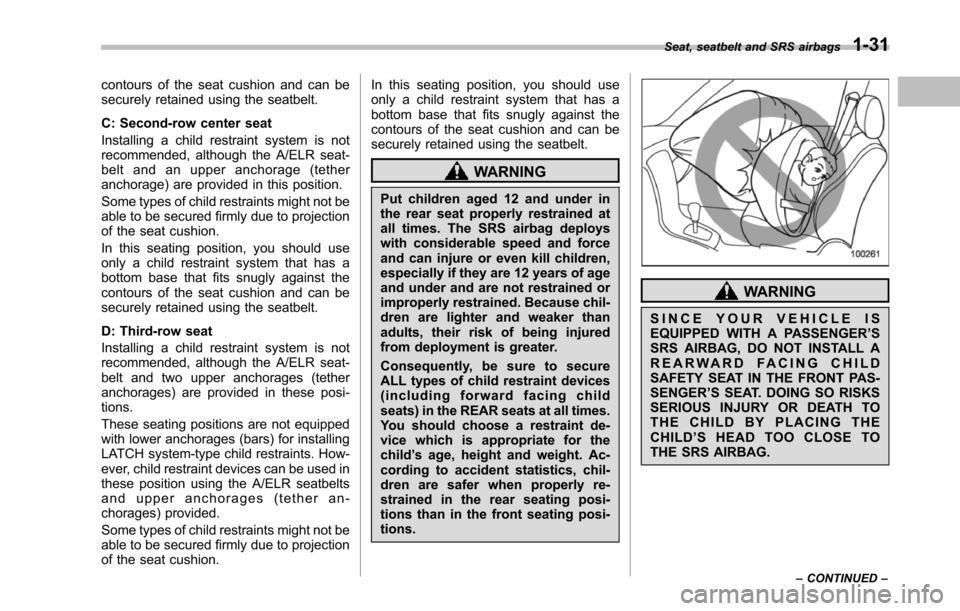
WARNING
SINCE YOUR VEHICLE ISEQUIPPED WITH A PASSENGER’SSRS AIRBAG, DO NOT INSTALL AREARWARD FACING CHILDSAFETY SEAT IN THE FRONT PAS-SENGER’S SEAT. DOING SO RISKSSERIOUS INJURY OR DEATH TOTHE CHILD BY PLACING THECHILD’SHEADTOOCLOSETOTHE SRS AIRBAG.
Seat, seatbelt and SRS airbags1-31
–CONTINUED–
Page 63 of 426
1-32Seat, seatbelt and SRS airbags
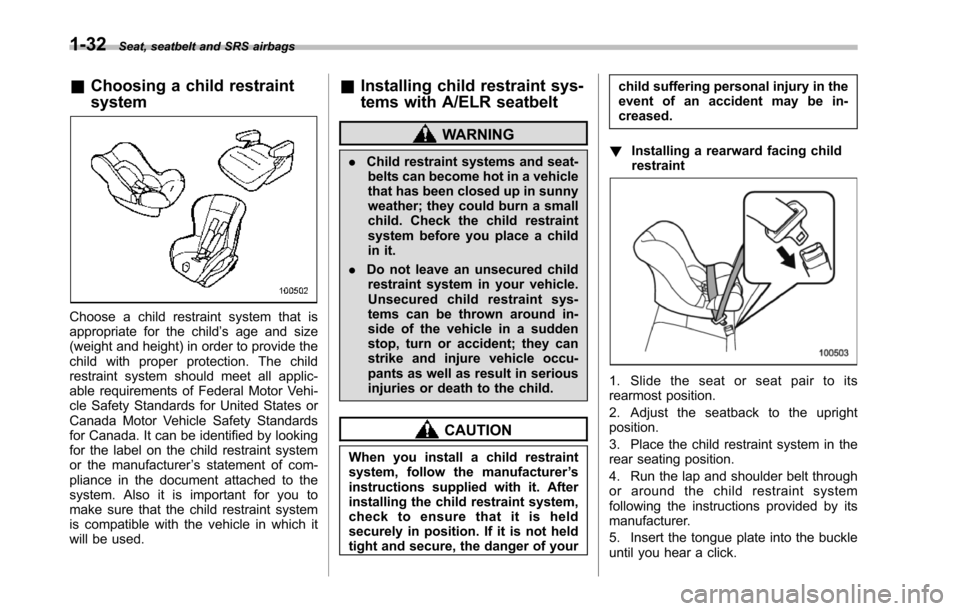
&Choosing a child restraint
system
Choose a child restraint system that isappropriate for the child’s age and size(weight and height) in order to provide thechild with proper protection. The childrestraint system should meet all applic-able requirements of Federal Motor Vehi-cle Safety Standards for United States orCanada Motor Vehicle Safety Standardsfor Canada. It can be identified by lookingfor the label on the child restraint systemor the manufacturer’s statement of com-pliance in the document attached to thesystem. Also it is important for you tomake sure thatthe child restraint systemis compatible with the vehicle in which itwill be used.
&Installing child restraint sys-
tems with A/ELR seatbelt
WARNING
.Child restraint systems and seat-belts can become hot in a vehiclethat has been closed up in sunnyweather; they could burn a smallchild. Check the child restraintsystem before you place a childin it.
.Do not leave an unsecured childrestraint system in your vehicle.Unsecured child restraint sys-tems can be thrown around in-side of the vehicle in a suddenstop, turn or accident; they canstrikeand injure vehicle occu-pants as well as result in seriousinjuries or death to the child.
CAUTION
When you install a child restraintsystem, follow the manufacturer’sinstructions supplied with it. Afterinstalling the child restraint system,check to ensure that it is heldsecurely in position. If it is not heldtight and secure, the danger of your
child suffering personal injury in theevent of an accident may be in-creased.
!Installing a rearward facing childrestraint
1. Slide the seat or seat pair to itsrearmost position.
2. Adjust the seatback to the uprightposition.
3. Place the child restraint system in therear seating position.
4. Run the lap and shoulder belt throughor around the child restraint systemfollowing the instructions provided by itsmanufacturer.
5. Insert the tongue plate into the buckleuntil you hear a click.
Page 77 of 426
1-46Seat, seatbelt and SRS airbags
refer to“Seatbelts”F1-17.
.Do not sit or lean unnecessarilyclose to the SRS airbag. Becausethe SRS airbag deploys withconsiderable speed–faster thanthe blink of an eye–and force toprotect in high speed collisions,the force of an airbag can injurean occupant whose body is tooclose to SRS airbag.
It is also important to wear yourseatbelt to help avoid injuriesthat can result when the SRSairbag contacts an occupant notin proper position such as onethrown forward during pre-acci-dent braking.
Even when properly positioned,there remainsa possibility thatan occupant may suffer minorinjury such as abrasions andbruises to the face or armsbecause of the SRS airbag de-ployment force.
.The SRS airbags deploy withconsiderable speed and force.Occupants who are out of properposition when the SRS airbagdeploys could suffer very seriousinjuries. Because the SRS airbagneeds enough space for deploy-
ment, the driver should alwayssit upright and well back in theseat as far from the steeringwheel as practical while stillmaintaining full vehicle controland the front passenger shouldmove the seat as far back aspossible and sit upright and wellback in the seat.
.Do not place any objects over ornear the SRS airbag cover orbetween you and the SRS airbag.If the SRS airbag deploys, thoseobjects could interfere with itsproper operation and could bepropelled inside the vehicle andcause injury.
WARNING
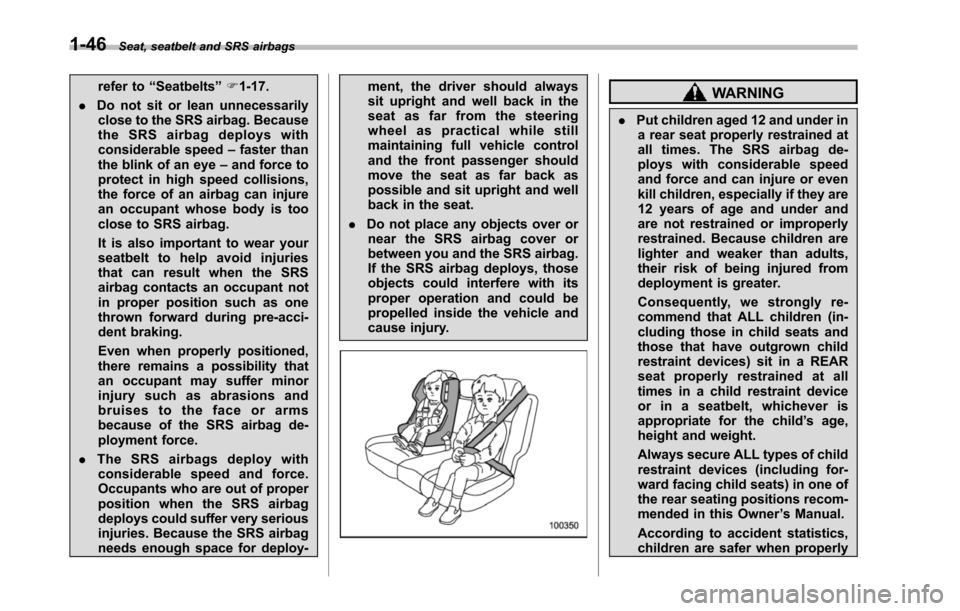
.Put children aged 12 and under ina rear seat properly restrained atall times. The SRS airbag de-ploys with considerable speedand force and can injure or evenkill children, especially if they are12 years of age and under andare not restrained or improperlyrestrained. Because children arelighter and weaker than adults,their risk of being injured fromdeployment is greater.
Consequently, we strongly re-commend that ALL children (in-cluding those in child seats andthose that have outgrown childrestraintdevices) sit in a REARseat properly restrained at alltimes in a child restraint deviceor in a seatbelt, whichever isappropriate for the child’s age,height and weight.
Always secure ALL types of childrestraint devices (including for-ward facing child seats) in one ofthe rear seating positions recom-mended in this Owner’s Manual.
According to accident statistics,children are safer when properly
Page 303 of 426
8-24Driving tips
Vehicle without cooling kit: 200 lbs (90 kg)
Vehicle with cooling kit: 350 lbs (158 kg)
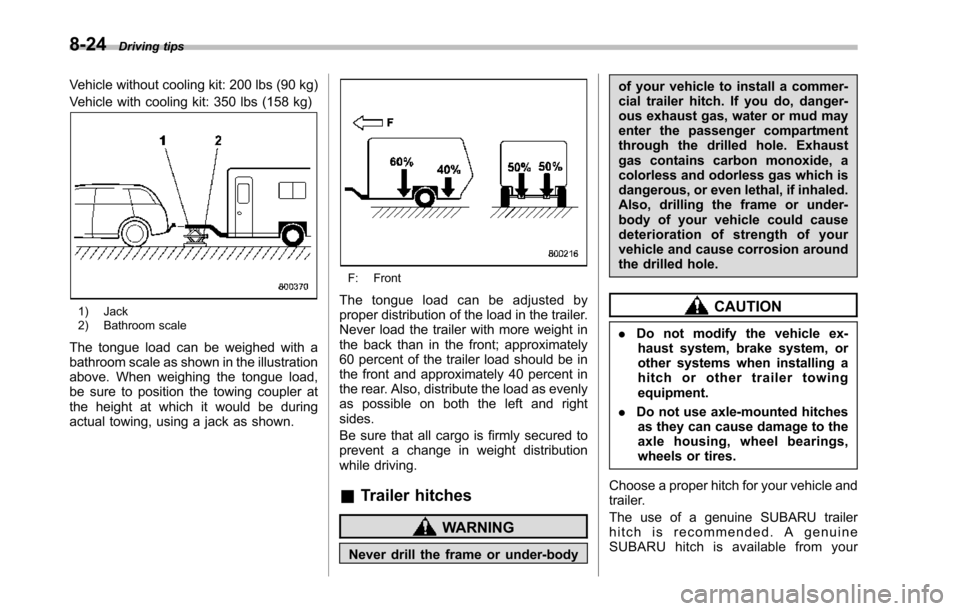
1) Jack2) Bathroom scale
The tongue load can be weighed with abathroomscale as shown in the illustrationabove. When weighing the tongue load,be sure to position the towing coupler atthe height at which it would be duringactual towing, using a jack as shown.
F: Front
The tongue load can be adjusted byproper distribution of the load in the trailer.Never load the trailer with more weight inthe back thanin the front; approximately60 percent of the trailer load should be inthe front and approximately 40 percent inthe rear. Also, distribute the load as evenlyas possible on both the left and rightsides.
Be sure that all cargo is firmly secured toprevent a change in weight distributionwhile driving.
&Trailer hitches
WARNING
Never drill the frame or under-body
of your vehicle to install a commer-cial trailer hitch. If you do, danger-ous exhaust gas, water or mud mayenter the passenger compartmentthrough the drilled hole. Exhaustgas contains carbon monoxide, acolorless and odorless gas which isdangerous, or even lethal, if inhaled.Also, drilling the frame or under-body of your vehicle could causedeterioration of strength of yourvehicle and cause corrosion aroundthe drilled hole.
CAUTION
.Do not modify the vehicle ex-haust system, brake system, orother systems when installing ahitch or other trailer towingequipment.
.Do not use axle-mounted hitchesas they can cause damage to theaxle housing, wheel bearings,wheels or tires.
Choose a proper hitch for your vehicle andtrailer.
The use of a genuine SUBARU trailerhitch is recommended. A genuineSUBARU hitch is available from your
Page 351 of 426
11-18Maintenance and service
Alcohol contained in the brakefluid may damage them.
.Be careful not to spill brake fluidwhen adding it. If brake fluidtouches the exhaust pipe, it maycause a bad smell, smoke, and/ora fire. If brake fluid gets on theexhaust pipe, be sure to wipe itoff.
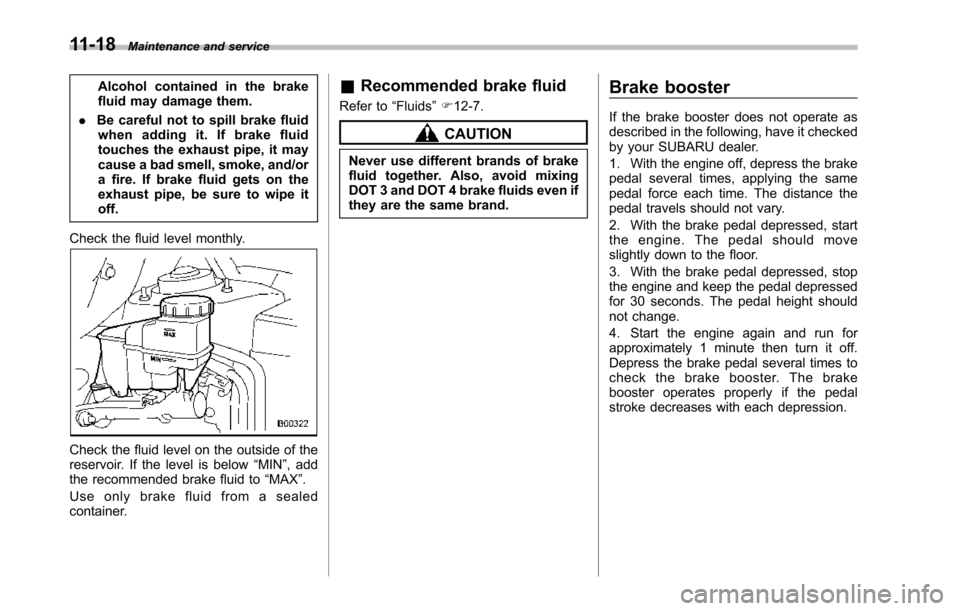
Check the fluid level monthly.
Check thefluid level on the outside of thereservoir. If the level is below“MIN”, addthe recommended brake fluid to“MAX”.
Use only brake fluid from a sealedcontainer.
&Recommended brake fluid
Refer to“Fluids”F12-7.
CAUTION
Never use different brands of brakefluid together. Also, avoid mixingDOT 3 and DOT 4 brake fluids even ifthey are the same brand.
Brake booster
If the brake booster does not operate asdescribed in the following, have it checkedby your SUBARU dealer.
1. With the engine off, depress the brakepedal several times, applying the samepedal force each time. The distance thepedal travels should not vary.
2. With the brake pedal depressed, startthe engine. The pedal should moveslightly down to the floor.
3. With the brake pedal depressed, stopthe engine and keep the pedal depressedfor 30 seconds. The pedal height shouldnot change.
4. Start the engine again and run forapproximately 1 minute then turn it off.Depress the brake pedal several times tocheck the brake booster. The brakebooster operates properly if the pedalstroke decreases with each depression.
Page 379 of 426
12-2Specifications
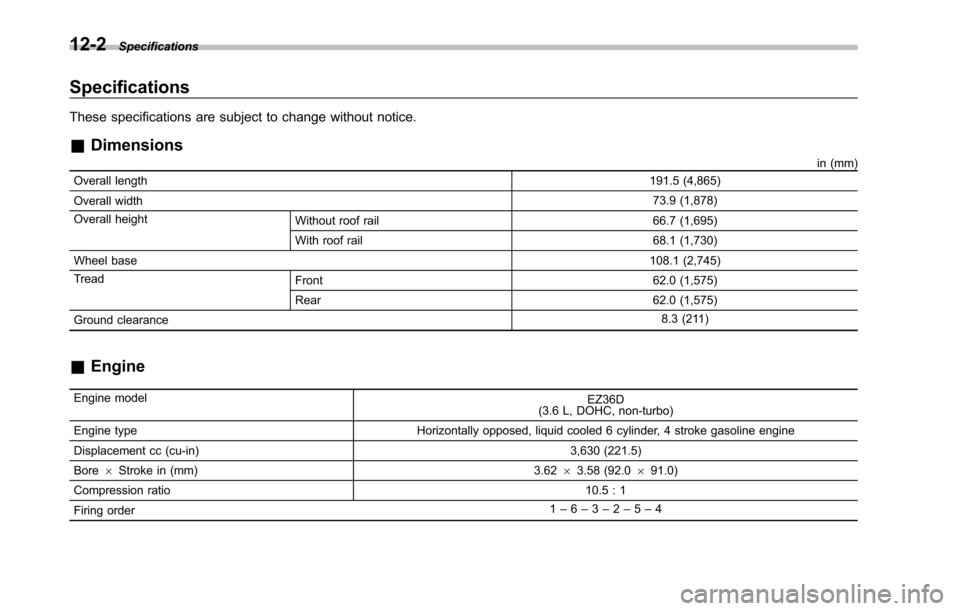
Specifications
These specifications are subject to change without notice.
&Dimensions
in (mm)
Overall length191.5 (4,865)
Overall width73.9 (1,878)
Overall heightWithout roof rail 66.7 (1,695)
With roof rail 68.1 (1,730)
Wheel base108.1 (2,745)
TreadFront 62.0 (1,575)
Rear 62.0 (1,575)
Ground clearance8.3 (211)
&Engine
Engine modelEZ36D(3.6 L, DOHC, non-turbo)
Engine type Horizontally opposed, liquid cooled 6 cylinder, 4 strokegasoline engine
Displacement cc (cu-in) 3,630 (221.5)
Bore6Stroke in (mm) 3.6263.58 (92.0691.0)
Compression ratio10.5 : 1
Firing order1–6–3–2–5–4
Page 395 of 426
13-2Consumer information and Reporting safety defects
For U.S.A.
The following information has been
compiled according to Code of
Federal Regulations“Title 49, Part
575”.
Tire information
&Tire labeling
Many markings (e.g. Tire size, Tire
Identification Number or TIN) are
placed on the sidewall of a tire by
tire manufacturers. These markings
can provide you with useful infor-
mation on the tire.
!Tire size
Your vehicle comes equipped with
P-Metric tire size. It is important to
understand the sizing system in
selecting the proper tire for your
vehicle. Here is a brief review of the
tire sizing system with a breakdown
of its individual elements.
!P Metric
With the P-Metric system, Section
Width is measured in millimeters.
To convert millimeters into inches,
divide by 25.4. The Aspect Ratio
(Section Height divided by Section
Width) helps provide more dimen-
sional information about the tire
size.
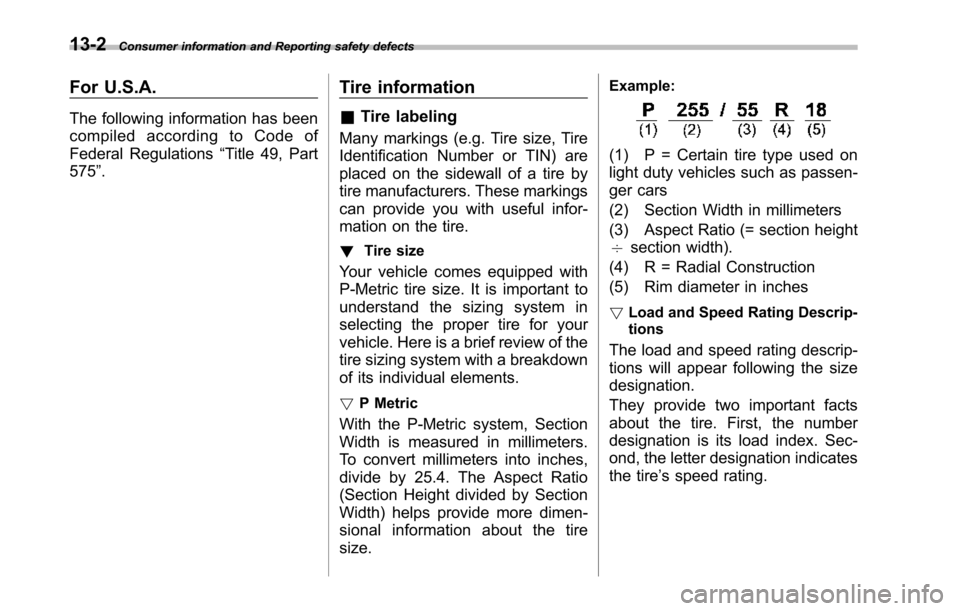
Example:
(1) P = Certain tire type used on
light duty vehicles such as passen-
ger cars
(2) Section Width in millimeters
(3) Aspect Ratio (= section height
7section width).
(4) R = Radial Construction
(5) Rim diameter in inches
!Load and Speed Rating Descrip-
tions
The load and speed rating descrip-
tions will appear following the size
designation.
They provide two important facts
about the tire. First, the number
designation is its load index. Sec-
ond, the letter designation indicates
the tire’s speed rating.
Page 414 of 426
Seatbelt pretensioners............................................ 1-27Turn signal light.................................................... 11-39Front seats.................................................................. 1-2Active head restraint................................................. 1-6Forward and backward adjustment............................. 1-3Head restraint adjustment......................................... 1-5Lumbar support....................................................... 1-7Memory function...................................................... 1-4Power seat.............................................................. 1-3Reclining................................................................. 1-3Seat height adjustment............................................. 1-4Fuel........................................................................... 7-2Economy hints......................................................... 8-2Filler lid and cap...................................................... 7-3Gauge.................................................................... 3-8Requirements.................................................. 7-2, 12-3Fuses...................................................................... 11-34Main fuse............................................................. 11-35Fuses and circuits...................................................... 12-9
GGAWR (Gross Axle Weight Rating).............................. 8-13Glove box................................................................... 6-6GVWR (Gross Vehicle Weight Rating).......................... 8-13
HHazard warning flasher........................................... 3-5, 9-2Head restraint adjustmentFront seat............................................................... 1-5Second-row seat.................................................... 1-12Third-row seat....................................................... 1-16
HeadlightBeam leveler.......................................................... 3-30Bulb replacement................................................. 11-36Bulb wattage........................................................ 12-12Control switch........................................................ 3-27Flasher.................................................................. 3-28Indicator light......................................................... 3-22HID headlights......................................................... 11-36High beam indicator light............................................. 3-22High/low beam change (dimmer).................................. 3-28HomeLink®Wireless Control System............................. 6-17HookCoat..................................................................... 6-12Convenienttie-down............................................... 6-16Shopping bag........................................................ 6-13Towing and tie-down............................................... 9-15Horn......................................................................... 3-44Hose and connections............................................... 11-10
IIgnition switch............................................................. 3-3Light...................................................................... 3-4Illuminated entry......................................................... 2-10Illumination brightness control...................................... 3-29Immobilizer................................................................. 2-3Indicator light (security indicator light)................. 2-4, 3-21Indicator lightCruise control........................................................ 3-22Cruise control set................................................... 3-22Front fog light......................................................... 3-22Headlight............................................................... 3-22
Index14-5