light SUBARU TRIBECA 2014 1.G Owner's Manual
[x] Cancel search | Manufacturer: SUBARU, Model Year: 2014, Model line: TRIBECA, Model: SUBARU TRIBECA 2014 1.GPages: 426, PDF Size: 6.37 MB
Page 50 of 426
instead of across the weakerabdomen.
.Seatbelts provide maximum re-straint when the occupant sitswell back and upright in the seat.To r e d u c e t h e r i s k o f s l i d i n gunder the seatbelt in a collision,thefront seatbacks should bealways used in the upright posi-tion while the vehicle is running.If the front seatbacks are notused in the upright position in acollision, the risk of sliding underthe lap belt and of the lap beltsliding up over the abdomen willincrease, and both can result inserious internal injury or death.
.Do not put cushions or any othermaterials between occupantsand seatbacks or seat cushions.If you do so, the risk of slidingunder the lap belt and of the lapbelt sliding up over the abdomenwill increase, and both can resultin serious internal injury ordeath.
WARNING
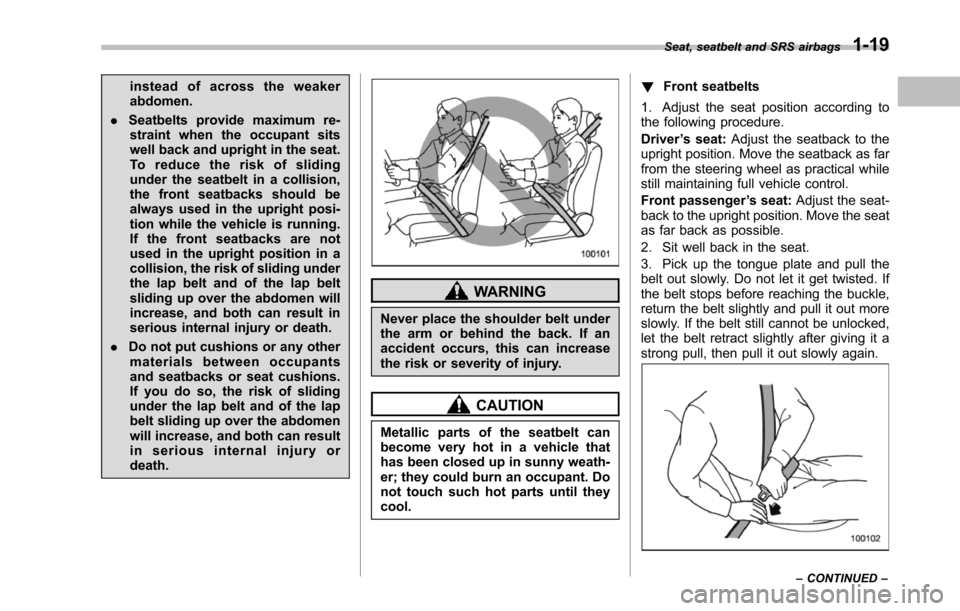
Never place the shoulder belt underthe arm or behind the back. If anaccident occurs, this can increasethe risk or severity of injury.
CAUTION
Metallic parts of the seatbelt canbecome very hot in a vehicle thathas been closed up in sunny weath-er; they could burn an occupant. Donot touch such hot parts until theycool.
!Front seatbelts
1. Adjust the seat position according tothe following procedure.
Driver’s seat:Adjust the seatback to theupright position. Move the seatback as farfrom the steering wheel as practical whilestill maintaining full vehicle control.
Front passenger’s seat:Adjust the seat-back to the upright position. Move the seatas far back as possible.
2. Sit well back in the seat.
3. Pick up the tongue plate and pull thebelt out slowly. Do not let it get twisted. Ifthe belt stops before reaching the buckle,return the beltslightly and pull it out moreslowly. If the belt still cannot be unlocked,let the belt retract slightly after giving it astrong pull, then pull it out slowly again.
Seat, seatbelt and SRS airbags1-19
–CONTINUED–
Page 52 of 426
!Second-row seatbelts–excludingcenter seatbelt
1. Sit well back in the seat.
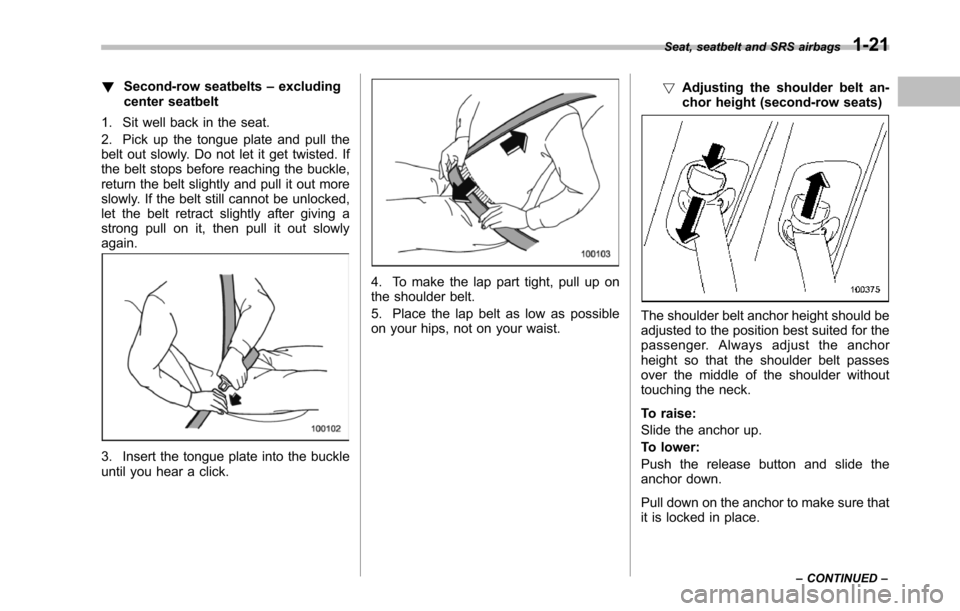
2. Pick up the tongue plate and pull thebelt out slowly. Do not let it get twisted. Ifthe belt stops before reaching the buckle,return the belt slightly and pull it out moreslowly. If the belt still cannot be unlocked,let the belt retract slightly after giving astrong pull on it, then pull it out slowlyagain.
3. Insert the tongue plate into the buckleuntil you hear a click.
4. To make the lap part tight, pull up onthe shoulder belt.
5. Place the lap belt as low as possibleon your hips, not on your waist.
!Adjusting the shoulder belt an-chor height (second-row seats)
The shoulder belt anchor height should beadjusted to the position best suited for thepassenger. Always adjust the anchorheight so that the shoulder belt passesover the middle of the shoulder withouttouching the neck.
To raise:
Slide the anchor up.
To lower:
Push the release button and slide theanchor down.
Pull down on the anchor to make sure thatit is locked in place.
Seat, seatbelt and SRS airbags1-21
–CONTINUED–
Page 55 of 426
1-24Seat, seatbelt and SRS airbags
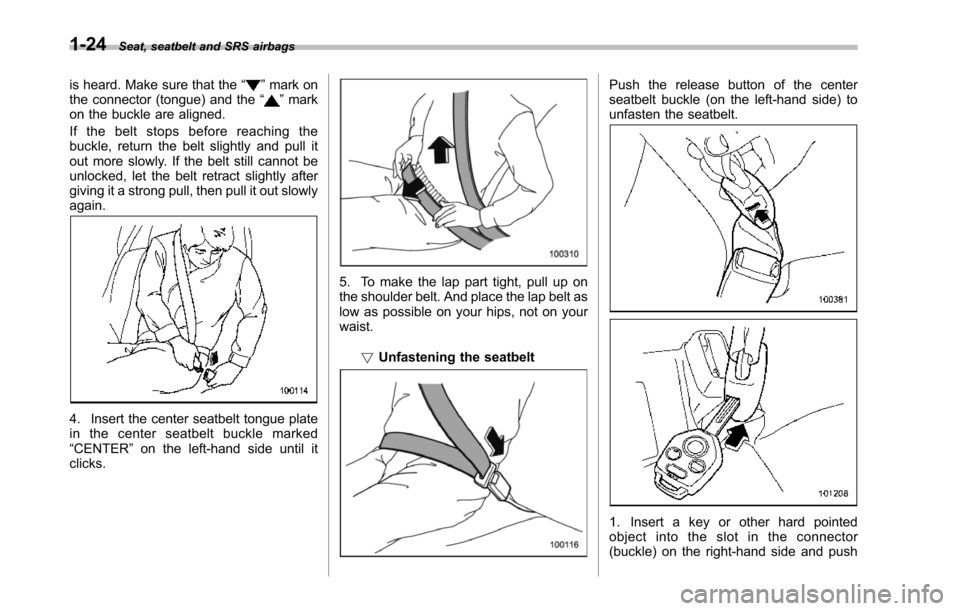
is heard. Make sure that the“”mark onthe connector (tongue) and the“”markon the buckle are aligned.
If the belt stops before reaching thebuckle, return the belt slightly and pull itout more slowly. If the belt still cannot beunlocked, let the belt retract slightly aftergiving it a strong pull, then pull it out slowlyagain.
4. Insert the center seatbelt tongue platein the center seatbelt buckle marked“CENTER”on the left-hand side until itclicks.
5. To make the lap part tight, pull up onthe shoulder belt. And place the lap belt aslow as possible on your hips, not on yourwaist.
!Unfastening the seatbelt
Push the release button of the centerseatbelt buckle (on the left-hand side) tounfasten the seatbelt.
1. Insert a key or other hard pointedobject into the slot in the connector(buckle) on the right-hand side and push
Page 56 of 426
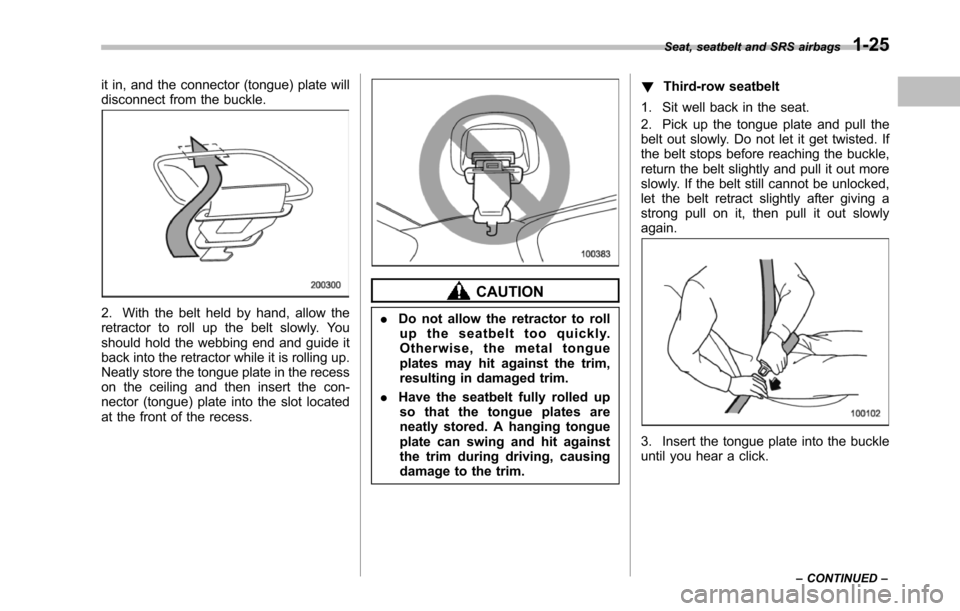
it in, and the connector (tongue) plate willdisconnect from the buckle.
2. With the belt held by hand, allow theretractor to roll up the belt slowly. Youshould hold thewebbing end and guide itback into the retractor while it is rolling up.Neatly store the tongue plate in the recesson the ceiling and then insert the con-nector (tongue) plate into the slot locatedat the front of the recess.
CAUTION
.Do not allow the retractor to rollup the seatbelt too quickly.Otherwise, the metal tongueplates may hit against the trim,resulting in damaged trim.
.Have the seatbelt fully rolled upso that the tongue plates areneatly stored. A hanging tongueplate can swing and hit againstthe trim during driving, causingdamage to the trim.
!Third-row seatbelt
1. Sit well back in the seat.
2. Pick up the tongue plate and pull thebelt out slowly. Do not let it get twisted. Ifthe belt stops before reaching the buckle,return the belt slightly and pull it out moreslowly. If the belt still cannot be unlocked,let the belt retract slightly after giving astrong pull on it, then pull it out slowlyagain.
3. Insert the tongue plate into the buckleuntil you hear a click.
Seat, seatbelt and SRS airbags1-25
–CONTINUED–
Page 59 of 426
1-28Seat, seatbelt and SRS airbags
viceable parts. For required ser-vicing of front seatbelt retractorsequipped with seatbelt preten-sioners, see your nearestSUBARU dealer.
.When discarding front seatbeltretractor assemblies or scrap-ping the entire vehicle due tocollision damage or for otherreasons, consult your SUBARUdealer.
&System monitors
A diagnostic system continually monitorsthe readiness of the seatbelt pretensionerwhile the vehicle is being driven. Theseatbeltpretensioners share the controlmodule with the airbag system. Therefore,if any malfunction occurs in a seatbeltpretensioner, the SRS airbag systemwarning light will illuminate. For details,refer to“SRS airbag system monitors”F1-71.
&System servicing
WARNING
.When discarding a seatbelt re-tractor assembly or scrappingthe entire vehicle damaged by a
collision, consult your SUBARUdealer.
.Tampering with or disconnectingthe system’s wiring could resultin accidental activation of theseatbelt pretensioner and/or air-bag or could make the systeminoperative, which may result inserious injury. Do not use elec-trical test equipment on anycircuit related to the seatbeltpretensioner and airbag sys-tems. For required servicing ofthe seatbelt pretensioner, seeyour nearest SUBARU dealer.
CAUTION
The front sub sensors are locatedon both sides of the radiator panel,and the airbag control module in-cludingthe impact sensors is lo-cated under the center console. Ifyou need service or repair in thoseareas or near the front seatbeltretractors, we recommend that youhave an authorized SUBARU dealerperform the work.
NOTE
If the front part of the vehicle isdamaged in an accident to the extentthat the seatbelt pretensioner does notoperate, contact your SUBARU dealeras soon as possible.
&Precautions against vehicle
modification
Always consult your SUBARU dealer ifyou want to install any accessory parts toyour vehicle.
CAUTION
Do not perform any of the followingmodifications. Such modificationscan interfere with proper operationof the seatbelt pretensioners.
.Attachment of any equipment(bush bar, winches, snow plow,skid plate, etc.)other than genu-ine SUBARU accessory parts tothe front end.
.Modification of the suspensionsystem or front end structure.
.Installation of a tire of differentsize and construction from thetires specified on the vehicleplacard attached to the doorpillar or specified for individual
Page 62 of 426
contours of the seat cushion and can besecurely retained using the seatbelt.
C: Second-row center seat
Installing a child restraint system is notrecommended, although the A/ELR seat-belt and an upper anchorage (tetheranchorage) are provided in this position.
Some types of child restraints might not beable to be secured firmly due to projectionof the seat cushion.
In this seating position, you should useonly a child restraint system that has abottom base that fits snugly against thecontours of the seat cushion and can besecurelyretained using the seatbelt.
D: Third-row seat
Installing a child restraint system is notrecommended, although the A/ELR seat-belt and two upper anchorages (tetheranchorages)are provided in these posi-tions.
These seating positions are not equippedwith lower anchorages (bars) for installingLATCH system-type child restraints. How-ever, child restraint devices can be used inthese position using the A/ELR seatbeltsand upper anchorages (tether an-chorages) provided.
Some typesof child restraints might not beable to be secured firmly due to projectionof the seat cushion.
In this seating position, you should useonly a child restraint system that has abottom base that fits snugly against thecontours of the seat cushion and can besecurely retained using the seatbelt.
WARNING
Put children aged 12 and under inthe rear seat properly restrained atalltimes. The SRS airbag deployswith considerable speed and forceand can injure or even kill children,especially if they are 12 years of ageand under and are not restrained orimproperly restrained. Because chil-dren are lighter and weaker thanadults, their risk of being injuredfrom deployment is greater.
Consequently, be sure to secureALL types of child restraint devices(including forward facing childseats) in the REAR seats at all times.You should choose a restraint de-vice which is appropriate for thechild’s age, height and weight. Ac-cording to accident statistics, chil-dren are safer when properly re-strained in the rear seating posi-tions than in the front seating posi-tions.
WARNING
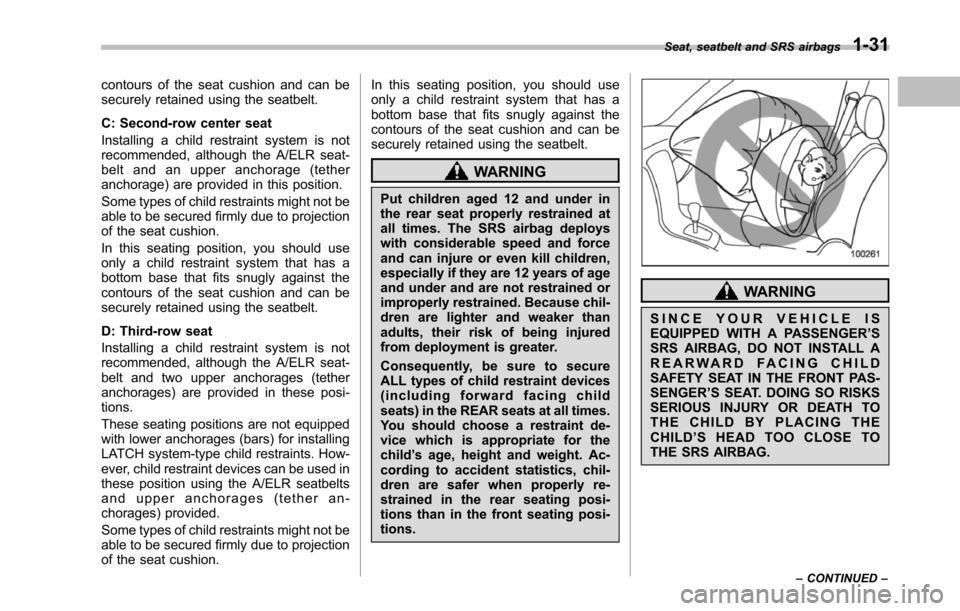
SINCE YOUR VEHICLE ISEQUIPPED WITH A PASSENGER’SSRS AIRBAG, DO NOT INSTALL AREARWARD FACING CHILDSAFETY SEAT IN THE FRONT PAS-SENGER’S SEAT. DOING SO RISKSSERIOUS INJURY OR DEATH TOTHE CHILD BY PLACING THECHILD’SHEADTOOCLOSETOTHE SRS AIRBAG.
Seat, seatbelt and SRS airbags1-31
–CONTINUED–
Page 77 of 426
1-46Seat, seatbelt and SRS airbags
refer to“Seatbelts”F1-17.
.Do not sit or lean unnecessarilyclose to the SRS airbag. Becausethe SRS airbag deploys withconsiderable speed–faster thanthe blink of an eye–and force toprotect in high speed collisions,the force of an airbag can injurean occupant whose body is tooclose to SRS airbag.
It is also important to wear yourseatbelt to help avoid injuriesthat can result when the SRSairbag contacts an occupant notin proper position such as onethrown forward during pre-acci-dent braking.
Even when properly positioned,there remainsa possibility thatan occupant may suffer minorinjury such as abrasions andbruises to the face or armsbecause of the SRS airbag de-ployment force.
.The SRS airbags deploy withconsiderable speed and force.Occupants who are out of properposition when the SRS airbagdeploys could suffer very seriousinjuries. Because the SRS airbagneeds enough space for deploy-
ment, the driver should alwayssit upright and well back in theseat as far from the steeringwheel as practical while stillmaintaining full vehicle controland the front passenger shouldmove the seat as far back aspossible and sit upright and wellback in the seat.
.Do not place any objects over ornear the SRS airbag cover orbetween you and the SRS airbag.If the SRS airbag deploys, thoseobjects could interfere with itsproper operation and could bepropelled inside the vehicle andcause injury.
WARNING
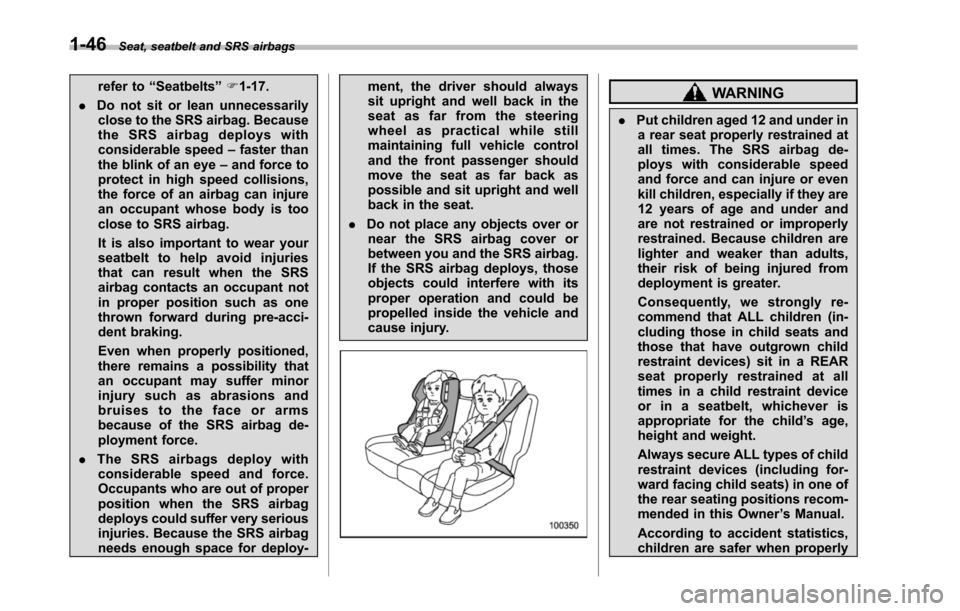
.Put children aged 12 and under ina rear seat properly restrained atall times. The SRS airbag de-ploys with considerable speedand force and can injure or evenkill children, especially if they are12 years of age and under andare not restrained or improperlyrestrained. Because children arelighter and weaker than adults,their risk of being injured fromdeployment is greater.
Consequently, we strongly re-commend that ALL children (in-cluding those in child seats andthose that have outgrown childrestraintdevices) sit in a REARseat properly restrained at alltimes in a child restraint deviceor in a seatbelt, whichever isappropriate for the child’s age,height and weight.
Always secure ALL types of childrestraint devices (including for-ward facing child seats) in one ofthe rear seating positions recom-mended in this Owner’s Manual.
According to accident statistics,children are safer when properly
Page 79 of 426
1-48Seat, seatbelt and SRS airbags
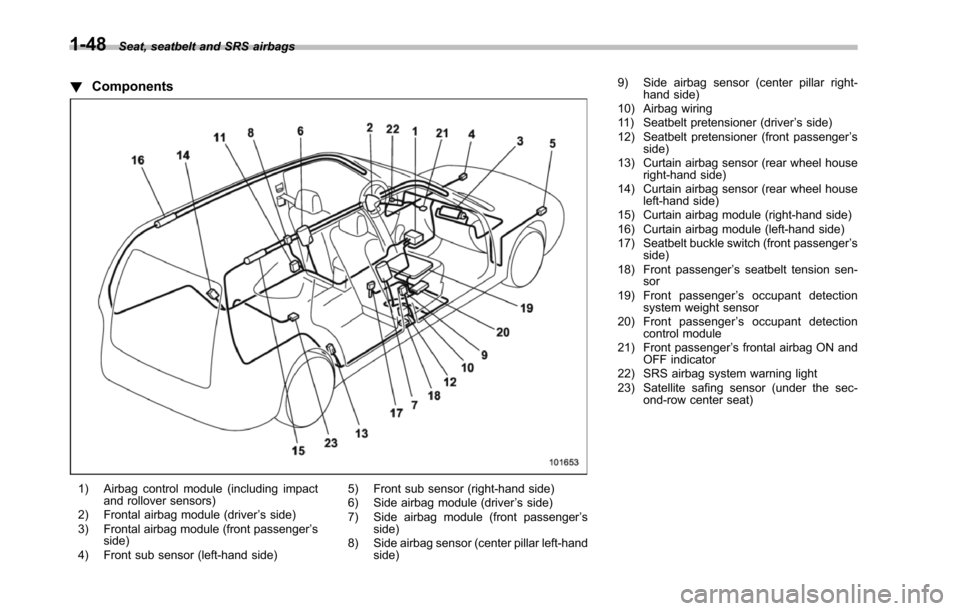
!Components
1) Airbag control module (including impactand rollover sensors)2) Frontal airbag module (driver’s side)3) Frontal airbag module (front passenger’sside)4) Front sub sensor (left-hand side)
5) Front sub sensor (right-hand side)6) Side airbag module (driver’s side)7) Side airbag module (front passenger’sside)8) Side airbag sensor (center pillar left-handside)
9) Side airbag sensor (center pillar right-hand side)10) Airbag wiring11) Seatbelt pretensioner (driver’s side)12) Seatbelt pretensioner (front passenger’sside)13) Curtain airbag sensor (rear wheel houseright-hand side)14) Curtain airbag sensor (rear wheel houseleft-hand side)15) Curtain airbag module (right-hand side)16) Curtain airbag module (left-hand side)17) Seatbelt buckle switch (front passenger’sside)18) Front passenger’s seatbelt tension sen-sor19) Front passenger’s occupant detectionsystem weight sensor20) Front passenger’s occupant detectioncontrol module21) Front passenger’s frontal airbag ON andOFF indicator22) SRS airbag system warning light23) Satellite safing sensor (under the sec-ond-row center seat)
Page 82 of 426
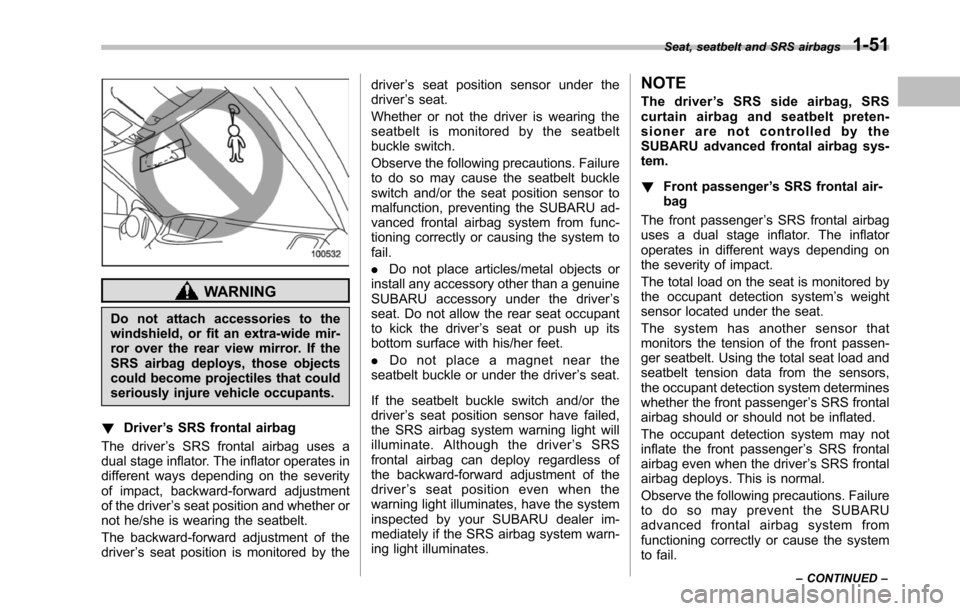
WARNING
Do not attach accessories to thewindshield, or fit an extra-wide mir-ror over the rear view mirror. If theSRS airbag deploys, those objectscould become projectiles that couldseriouslyinjure vehicle occupants.
!Driver’s SRS frontal airbag
The driver’s SRS frontal airbag uses adual stage inflator. The inflator operates indifferent ways depending on the severityof impact, backward-forward adjustmentof the driver’s seat position and whether ornot he/she is wearing the seatbelt.
The backward-forward adjustment of thedriver’s seat position is monitored by the
driver’s seat position sensor under thedriver’s seat.
Whether or not the driver is wearing theseatbelt is monitored by the seatbeltbuckle switch.
Observe the following precautions. Failureto do so may cause the seatbelt buckleswitch and/or the seat position sensor tomalfunction,preventing the SUBARU ad-vanced frontal airbag system from func-tioning correctly or causing the system tofail.
.Do not place articles/metal objects orinstall any accessory other than a genuineSUBARU accessory under the driver’sseat. Do not allow the rear seat occupantto kick the driver’s seat or push up itsbottom surface with his/her feet.
.Do not place a magnet near theseatbelt buckle or under the driver’s seat.
If the seatbelt buckle switch and/or thedriver’s seat position sensor have failed,the SRS airbag system warning light willilluminate. Although the driver’sSRSfrontal airbag can deploy regardless ofthe backward-forward adjustment of thedriver’sseatpositionevenwhenthewarning light illuminates, have the systeminspected by your SUBARU dealer im-mediatelyif the SRS airbag system warn-ing light illuminates.
NOTE
The driver’sSRSsideairbag,SRScurtain airbag and seatbelt preten-sioner are not controlled by theSUBARU advanced frontal airbag sys-tem.
!Front passenger’s SRS frontal air-bag
The front passenger’s SRS frontal airbaguses a dual stage inflator. The inflatoroperates in different ways depending onthe severity of impact.
The total load on the seat is monitored bythe occupant detection system’s weightsensor located under the seat.
The system has another sensor thatmonitors the tension of the front passen-ger seatbelt. Using the total seat load andseatbelt tension data from the sensors,the occupant detection system determineswhether the front passenger’s SRS frontalairbag should or should not be inflated.
The occupant detection system may notinflate the front passenger’s SRS frontalairbag even when the driver’s SRS frontalairbagdeploys. This is normal.
Observe the following precautions. Failureto do so may prevent the SUBARUadvanced frontal airbag system fromfunctioning correctly or cause the systemto fail.
Seat, seatbelt and SRS airbags1-51
–CONTINUED–
Page 83 of 426
1-52Seat, seatbelt and SRS airbags
.Do not apply any strong impact to thefront passenger’s seat such as by kicking.
.Do not spill liquid on the front passen-ger’s seat. If liquid is spilled, wipe it offimmediately.
.Do not remove or disassemble the frontpassenger’s seat.
.Do not install any accessory (such asan audio amplifier) other than a genuineSUBARU accessory under the front pas-senger’s seat.
.Do not place anything (shoes, umbrel-la, etc.) under the front passenger’s seat.
.The front passenger’s seat must not beused with the head restraint removed.
.Do not leave any article including achild restraint system on the front passen-ger’s seat or the seatbelt tongue andbuckle engaged when you leave yourvehicle.
.Do not place a magnet near theseatbelt buckle and the seatbelt retractor.
If the seatbelt buckle switch and/or frontpassenger’s occupant detection systemhave failed, the SRS airbag systemwarning light will illuminate. Have thesystem inspected by your SUBARU deal-er immediately if the SRS airbag systemwarning light illuminates.
If your vehicle has sustained impact, thismay affect the proper function of the
SUBARU advanced frontal airbag system.Have your vehicle inspected at yourSUBARU dealer.
NOTE
The front passenger’s SRS side airbag,SRS curtain airbag and seatbelt pre-tensioner are not controlled by theSUBARU advanced frontal airbag sys-tem.
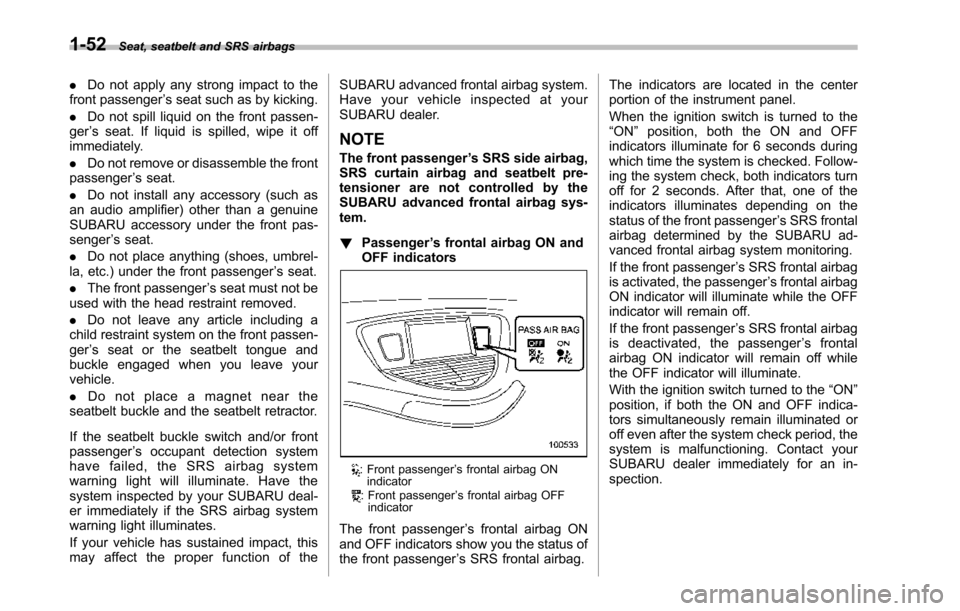
!Passenger’s frontal airbag ON andOFF indicators
: Front passenger’s frontal airbag ONindicator: Front passenger’s frontal airbag OFFindicator
The front passenger’s frontal airbag ONand OFF indicators show you the status ofthe front passenger’s SRS frontal airbag.
The indicators are located in the centerportion of the instrument panel.
When the ignition switch is turned to the“ON”position, both the ON and OFFindicators illuminate for 6 seconds duringwhich time the system is checked. Follow-ing the system check, both indicators turnoff for 2 seconds. After that, one of theindicators illuminates depending on thestatus of the front passenger’s SRS frontalairbag determined by the SUBARU ad-vanced frontal airbag system monitoring.
If the front passenger’s SRS frontal airbagis activated, the passenger’s frontal airbagON indicator will illuminate while the OFFindicator will remain off.
If the front passenger’s SRS frontal airbagis deactivated, the passenger’s frontalairbag ON indicator will remain off whilethe OFFindicator will illuminate.
With the ignition switch turned to the“ON”position, if both the ON and OFF indica-tors simultaneously remain illuminated oroff even after the system check period, thesystem is malfunctioning. Contact yourSUBARU dealer immediately for an in-spection.