dashboard SUBARU TRIBECA 2014 1.G Owners Manual
[x] Cancel search | Manufacturer: SUBARU, Model Year: 2014, Model line: TRIBECA, Model: SUBARU TRIBECA 2014 1.GPages: 426, PDF Size: 6.37 MB
Page 80 of 426
&SUBARU advanced frontal
airbag system
Your vehicle is equipped with a SUBARUadvanced frontal airbag system that com-plies with the new advanced frontal airbagrequirements in the amended FederalMotor Vehicle Safety Standard (FMVSS)No. 208.
The SUBARU advanced frontal airbagsystem automatically determines the de-ployment force of the driver’s SRS frontalairbag at the time of deployment as well aswhether or not to activate the frontpassenger’s SRS frontal airbag and, ifactivated, the deployment force of theSRS frontal airbag at the time of deploy-ment.
Your vehicle has warning labels on thedriver’s and front passenger’s sun visorsbeginning withthe phrase“EVENWITHADVANCED AIR BAGS”and a tagattached to the glove box lid beginningwiththe phrase“Evenwith Advanced AirBags”. Make sure that you carefully readthe instructions on the warning labels andtag.
Always wearyour seatbelt. The SUBARUadvanced frontal airbag system is asupplemental restraint system and mustbe used in combination with a seatbelt. Alloccupants should wear a seatbelt or beseated in an appropriate child restraint
system.
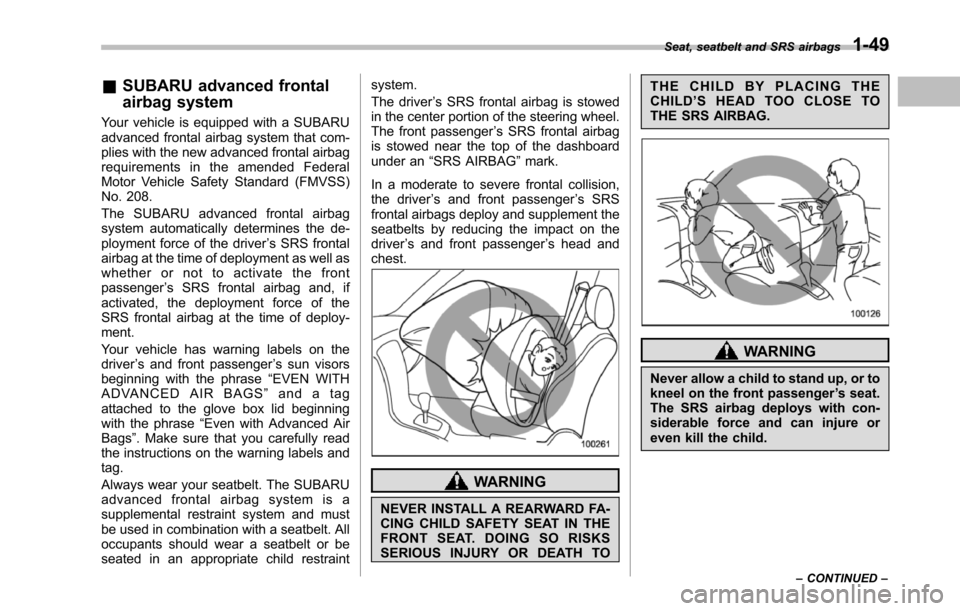
The driver’s SRS frontal airbag is stowedin the center portion of the steering wheel.The front passenger’s SRS frontal airbagis stowed near the top of the dashboardunder an“SRS AIRBAG”mark.
In a moderate to severe frontal collision,the driver’s and front passenger’s SRSfrontal airbagsdeploy and supplement theseatbelts by reducing the impact on thedriver’s and front passenger’s head andchest.
WARNING
NEVER INSTALL A REARWARD FA-CING CHILD SAFETY SEAT IN THEFRONT SEAT. DOING SO RISKSSERIOUS INJURY OR DEATH TO
THE CHILD BY PLACING THECHILD’SHEADTOOCLOSETOTHE SRS AIRBAG.
WARNING
Never allow a child to stand up, or tokneel on the front passenger’s seat.The SRS airbag deploys with con-siderable force and can injure oreven kill the child.
Seat, seatbelt and SRS airbags1-49
–CONTINUED–
Page 81 of 426
1-50Seat, seatbelt and SRS airbags
WARNING
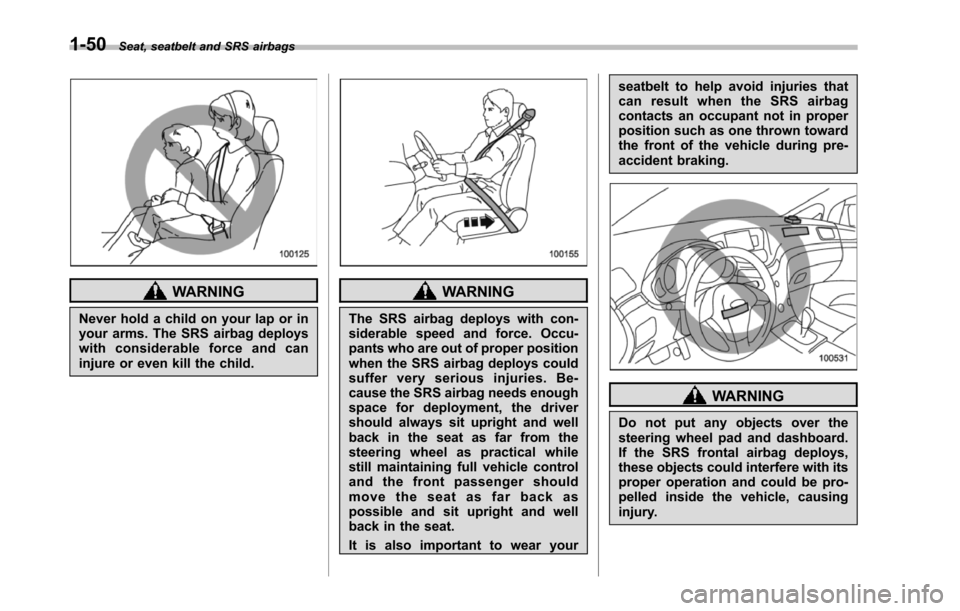
Never hold a child on your lap or inyour arms. The SRS airbag deployswith considerable force and caninjure or even kill the child.
WARNING
The SRS airbag deploys with con-siderable speed and force. Occu-pants who are out of proper positionwhen the SRS airbag deploys couldsuffer very serious injuries. Be-cause the SRS airbag needs enoughspace for deployment, the drivershould always sit upright and wellback in the seat as far from thesteering wheel as practical whilestill maintaining full vehicle controland the front passenger shouldmove the seat as far back aspossible and sit upright and wellbackin the seat.
It is also important to wear your
seatbelt to help avoid injuries thatcan result when the SRS airbagcontacts an occupant not in properposition such as one thrown towardthe front of the vehicle during pre-accident braking.
WARNING
Do not put any objects over thesteeringwheel pad and dashboard.If the SRS frontal airbag deploys,these objects could interfere with itsproper operation and could be pro-pelled inside the vehicle, causinginjury.
Page 87 of 426
1-56Seat, seatbelt and SRS airbags
!Operation
1) Driver’s side2) Passenger’s side
The SRS airbag can function only whenthe ignition switch is in the“ON”position.
The SUBARU advanced frontal airbag
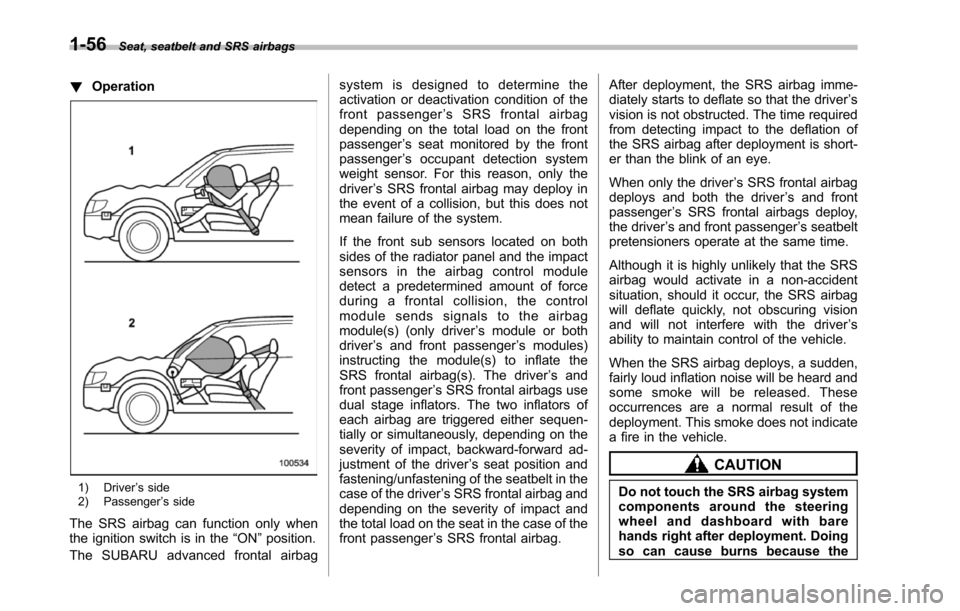
system is designed to determine theactivation or deactivation condition of thefront passenger’sSRSfrontalairbagdepending on the total load on the frontpassenger’s seat monitored by the frontpassenger’s occupant detection systemweight sensor. For this reason, only thedriver’s SRS frontal airbag may deploy inthe event of a collision, but this does notmeanfailure of the system.
If the front sub sensors located on bothsides of the radiator panel and the impactsensors in the airbag control moduledetect a predetermined amount of forceduring a frontal collision, the controlmodule sends signals to the airbagmodule(s) (only driver’s module or bothdriver’s and front passenger’s modules)instructing the module(s) to inflate theSRS frontal airbag(s). The driver’s andfront passenger’s SRS frontal airbags usedual stage inflators. The two inflators ofeach airbag are triggered either sequen-tially or simultaneously, depending on theseverity of impact, backward-forward ad-justmentof the driver’s seat position andfastening/unfastening of the seatbelt in thecase of the driver’s SRS frontal airbag anddepending on the severity of impact andthe total load on the seat in the case of thefront passenger’s SRS frontal airbag.
After deployment, the SRS airbag imme-diately starts to deflate so that the driver’svision is not obstructed. The time requiredfrom detecting impact to the deflation ofthe SRS airbag after deployment is short-er than the blink of an eye.
When only the driver’s SRS frontal airbagdeploys and both the driver’s and frontpassenger’s SRS frontal airbags deploy,the driver’s and front passenger’s seatbeltpretensioners operate at the same time.
Although it is highly unlikely that the SRSairbag would activate in a non-accidentsituation, should it occur, the SRS airbagwill deflate quickly, not obscuring visionand will not interfere with the driver’sability to maintain control of the vehicle.
When the SRS airbag deploys, a sudden,fairly loud inflation noise will be heard andsome smoke will be released. Theseoccurrencesare a normal result of thedeployment. This smoke does not indicatea fire in the vehicle.
CAUTION
Do not touch the SRS airbag systemcomponents around the steeringwheel and dashboard with barehands right after deployment. Doingso can cause burns because the
Page 103 of 426
1-72Seat, seatbelt and SRS airbags
&SRS airbag system servicing
WARNING
.When discarding an airbag mod-ule or scrapping the entire vehi-cle damaged by a collision, con-sult your SUBARU dealer.
.The SRS airbag has no user-serviceable parts. Do not useelectrical test equipment on anycircuit related to the SRS airbagsystem. For required servicing ofthe SRS airbag, consult yournearest SUBARU dealer. Tamper-ing with or disconnecting thesystem’s wiring could result inaccidental inflation of the SRSairbag or could make the systeminoperative, which may result inserious injury.
CAUTION
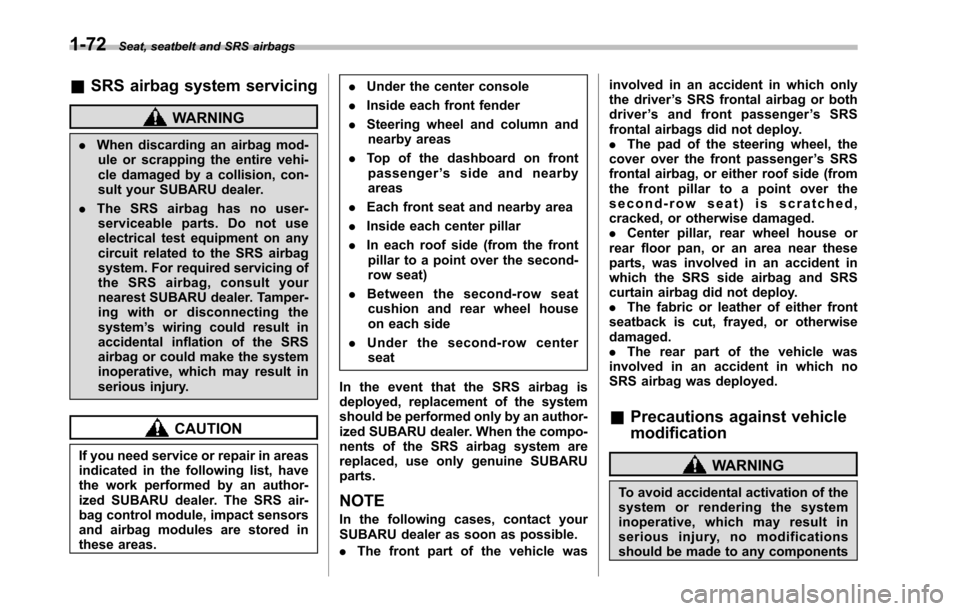
If you need service or repair in areasindicated in the following list, havethe work performed by an author-ized SUBARU dealer. The SRS air-bag control module, impact sensorsand airbag modules are stored inthese areas.
.Under the center console
.Inside each front fender
.Steering wheel and column andnearby areas
.Top of the dashboard on frontpassenger’ssideandnearbyareas
.Each front seat and nearby area
.Inside each center pillar
.In each roof side (from the frontpillar to a point over the second-row seat)
.Between the second-row seatcushion and rear wheel houseon each side
.Under the second-row centerseat
In the event that the SRS airbag isdeployed, replacement of the systemshould be performed only by an author-ized SUBARU dealer. When the compo-nents of the SRS airbag system arereplaced, use only genuine SUBARUparts.
NOTE
In the following cases, contact yourSUBARU dealer as soon as possible.
.The front part of the vehicle was
involved in an accident in which onlythe driver’s SRS frontal airbag or bothdriver’sandfrontpassenger’sSRSfrontal airbags did not deploy..The pad of the steering wheel, thecover over the front passenger’s SRSfrontal airbag, or either roof side (fromthe front pillar to a point over thesecond-row seat) is scratched,cracked, or otherwise damaged..Center pillar, rear wheel house orrearfloor pan, or an area near theseparts, was involved in an accident inwhich the SRS side airbag and SRScurtain airbag did not deploy..The fabric or leather of either frontseatback is cut, frayed, or otherwisedamaged..The rear part of the vehicle wasinvolved in an accident in which noSRS airbag was deployed.
&Precautions against vehicle
modification
WARNING
To avoid accidental activation of thesystem or rendering the systeminoperative, which may result inserious injury, no modificationsshould be made to any components
Page 104 of 426
or wiring of the SRS airbag system.
This includes following modifica-tions.
.Installation of custom steeringwheels
.Attachment of additional trimmaterials to the dashboard
.Installation of custom seats
.Replacement of seat fabric orleather
.Installation of additional fabric orleather on the front seat
.Attachment of a hands-free mi-crophone or any other accessoryto a front pillar, a center pillar, arear pillar, the windshield, a sidewindow, an assist grip, or anyother cabin surface that would benear a deploying SRS curtainairbag.
.Installation of additional electri-cal/electronic equipment such asa mobile two-way radio on ornear the SRS airbag systemcomponents and/or wiring is notadvisable. This could interferewith proper operation of theSRS airbag system.
CAUTION
Do not perform any of the followingmodifications. Such modificationscan interfere with proper operationof the SRS airbag system.
.Attachment of any equipment(bush bar, winches, snow plow,skid plate, etc.) other than genu-ine SUBARU accessory parts.
.Modificationof the suspensionsystem or front end structure.
.Installation of a tire of differentsize and construction from thetires specified on the vehicleplacardattached to the driver’sdoor pillar or specified for indivi-dual vehicle models in this Own-er’s Manual.
.Attachment of any equipment(side steps or side sill protectors,etc.) other than genuine SUBARUaccessory parts to the side body.
Always consult your SUBARU dealer ifyou want to install any accessory parts onyour vehicle.
Seat, seatbelt and SRS airbags1-73
Page 145 of 426
3-12Instruments and controls
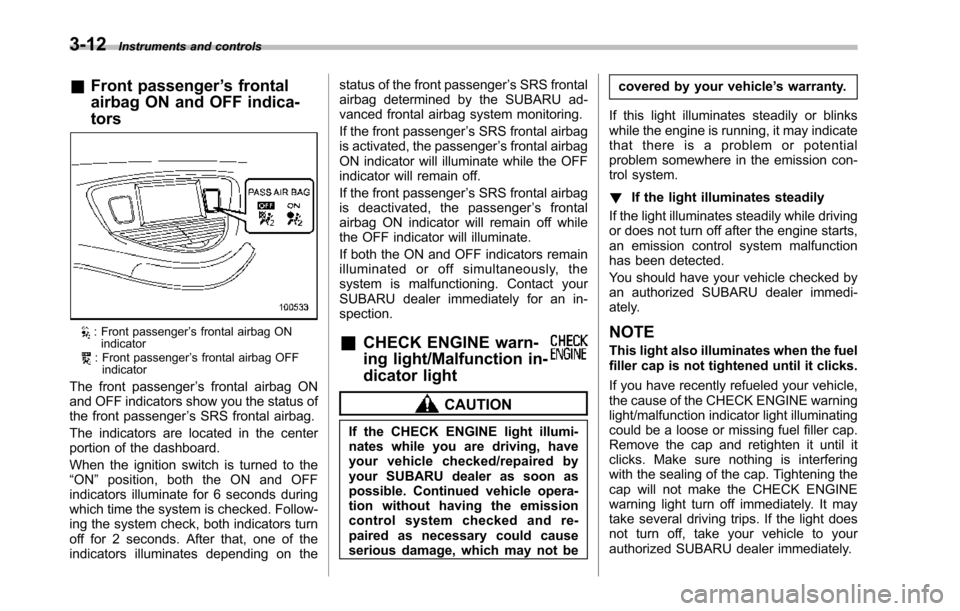
&Front passenger’s frontal
airbag ON and OFF indica-
tors
: Front passenger’s frontal airbag ONindicator: Front passenger’s frontal airbag OFFindicator
The front passenger’s frontal airbag ONand OFF indicators show you the status ofthe front passenger’s SRS frontal airbag.
The indicators are located in the centerportion of the dashboard.
Whenthe ignition switch is turned to the“ON”position, both the ON and OFFindicators illuminate for 6 seconds duringwhich time the system is checked. Follow-ing the system check, both indicators turnoff for 2 seconds. After that, one of theindicators illuminates depending on the
status of the front passenger’s SRS frontalairbag determined by the SUBARU ad-vanced frontal airbag system monitoring.
If the front passenger’s SRS frontal airbagis activated, the passenger’s frontal airbagON indicator will illuminate while the OFFindicator will remain off.
If the front passenger’s SRS frontal airbagis deactivated, the passenger’sfrontalairbag ON indicator will remain off whilethe OFF indicator will illuminate.
If both the ON and OFF indicators remainilluminated or off simultaneously, thesystem is malfunctioning. Contact yourSUBARU dealer immediately for an in-spection.
&CHECK ENGINE warn-
ing light/Malfunction in-
dicator light
CAUTION
If the CHECK ENGINE light illumi-nates while you are driving, haveyour vehicle checked/repaired byyour SUBARU dealer as soon aspossible. Continued vehicle opera-tion without having the emissioncontrol system checked and re-paired as necessary could causeserious damage, which may not be
covered by your vehicle’s warranty.
If this light illuminates steadily or blinkswhile the engine is running, it may indicatethat there is a problem or potentialproblem somewhere in the emission con-trol system.
!If the light illuminates steadily
If the light illuminates steadily while drivingor does not turn off after the engine starts,an emission control system malfunctionhas been detected.
You should have your vehicle checked byan authorized SUBARU dealer immedi-ately.
NOTE
This light also illuminates when the fuelfiller cap is not tightened until it clicks.
If you have recently refueled your vehicle,the cause of the CHECK ENGINE warninglight/malfunction indicator light illuminatingcould be a loose or missing fuel filler cap.Remove the cap and retighten it until itclicks. Make sure nothing is interferingwith the sealing of the cap. Tightening thecap will not make the CHECK ENGINEwarning light turn off immediately. It maytake several driving trips. If the light doesnot turn off, take your vehicle to yourauthorized SUBARU dealer immediately.
Page 150 of 426
warning light illuminate simultaneously,take the following steps.
1. Stop the vehicle in the nearest safe,flat place.
2. Shut down the engine, apply theparking brake, and then restart it.
3. Release the parking brake. If bothwarning lights turn off, the EBD systemmay be malfunctioning.
Drive carefully to the nearest SUBARUdealer and have the system inspected.
4. If both warning lights illuminate againand remain illuminated after the enginehas been restarted, shut down the engineagain, apply the parking brake, and checkthe brake fluid level.
5. If the brake fluid level is not below the“MIN”mark, the EBD system may bemalfunctioning. Drive carefully to thenearest SUBARU dealer and have thesystem inspected.
6. If the brake fluid level is below the“MIN”mark, DO NOT drive the vehicle.Instead, have the vehicle towed to thenearest SUBARU dealer for repair.
&Low fuel warning light
CAUTION
Immediately put fuel in the tankwhenever the low fuel warning lightilluminates. Engine misfires as aresult of an empty tank could causedamage to the engine.
The low fuel warning light illuminateswhen the tank is nearly empty approxi-mately 2.6 US gal (10 liters, 2.2 Imp gal). Itonly operates when the ignition switch isin the“ON”position. When this lightilluminates, fillthe fuel tank immediately.
NOTE
This light does not turn off unless thetank is replenished up to an internalfuel quantity of approximately 4.0 USgal (15 liters, 3.3 Imp gal).
&Door open warning light
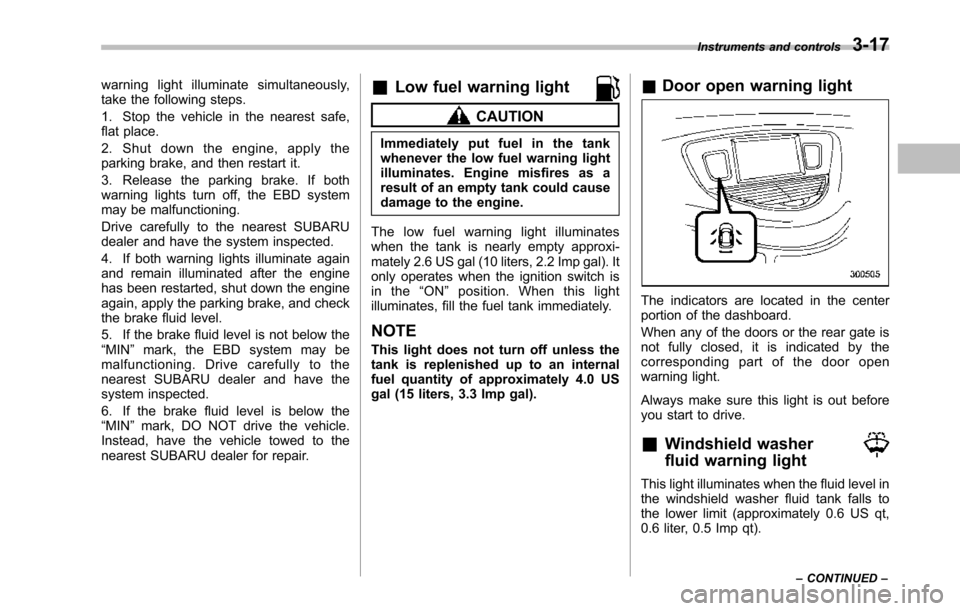
The indicators are located in the centerportion of the dashboard.
When any of the doors or the rear gate isnot fully closed, it is indicated by thecorresponding part of the door openwarning light.
Always make sure this light is out beforeyou start to drive.
&Windshield washer
fluid warning light
This light illuminates when the fluid level inthe windshield washer fluid tank falls tothe lower limit (approximately 0.6 US qt,0.6 liter, 0.5 Imp qt).
Instruments and controls3-17
–CONTINUED–
Page 154 of 426
&Security indicator light
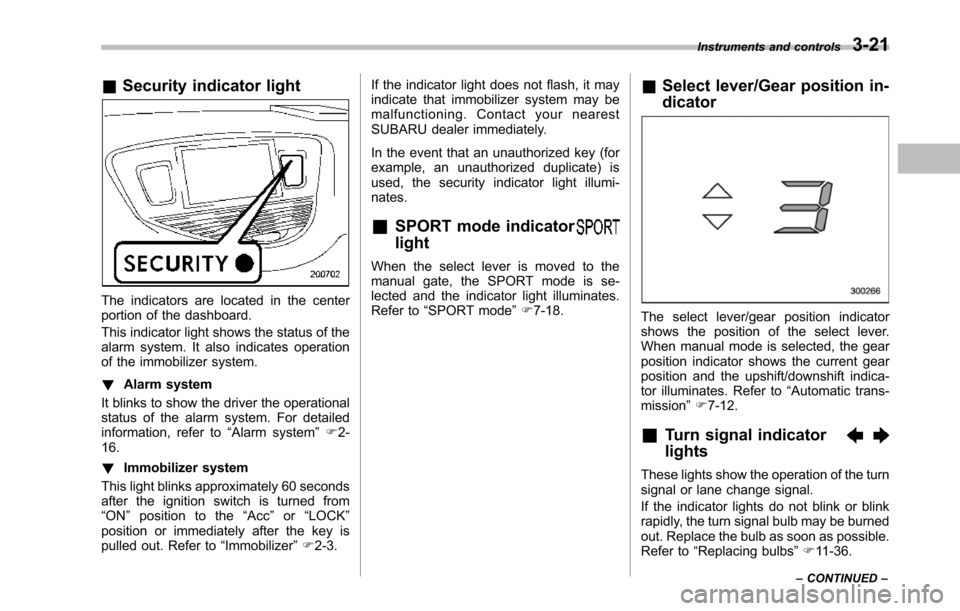
The indicators are located in the centerportion of the dashboard.
This indicator light shows the status of thealarm system. It also indicates operationof the immobilizer system.
!Alarm system
It blinks to show the driver the operationalstatus of the alarm system. For detailedinformation, refer to“Alarm system”F2-16.
!Immobilizer system
This light blinks approximately 60 secondsafter the ignition switch is turned from“ON”position to the“Acc”or“LOCK”position or immediately after the key ispulled out. Refer to“Immobilizer”F2-3.
If the indicator light does not flash, it mayindicate that immobilizer system may bemalfunctioning. Contact your nearestSUBARU dealer immediately.
In the event that an unauthorized key (forexample, an unauthorized duplicate) isused, the security indicator light illumi-nates.
&SPORT mode indicator
light
When the select lever is moved to themanual gate, the SPORT mode is se-lected and theindicator light illuminates.Refer to“SPORTmode”F7-18.
&Select lever/Gear position in-
dicator
The select lever/gear position indicatorshows the position of the select lever.When manual mode is selected, the gearposition indicator shows the current gearposition andthe upshift/downshift indica-tor illuminates. Refer to“Automatic trans-mission”F7-12.
&Turn signal indicator
lights
These lights show the operation of the turnsignal or lane change signal.
If the indicator lights do not blink or blinkrapidly, the turn signal bulb may be burnedout. Replace the bulb as soon as possible.Refer to“Replacing bulbs”F11-36.
Instruments and controls3-21
–CONTINUED–
Page 256 of 426
&Starting your vehicle
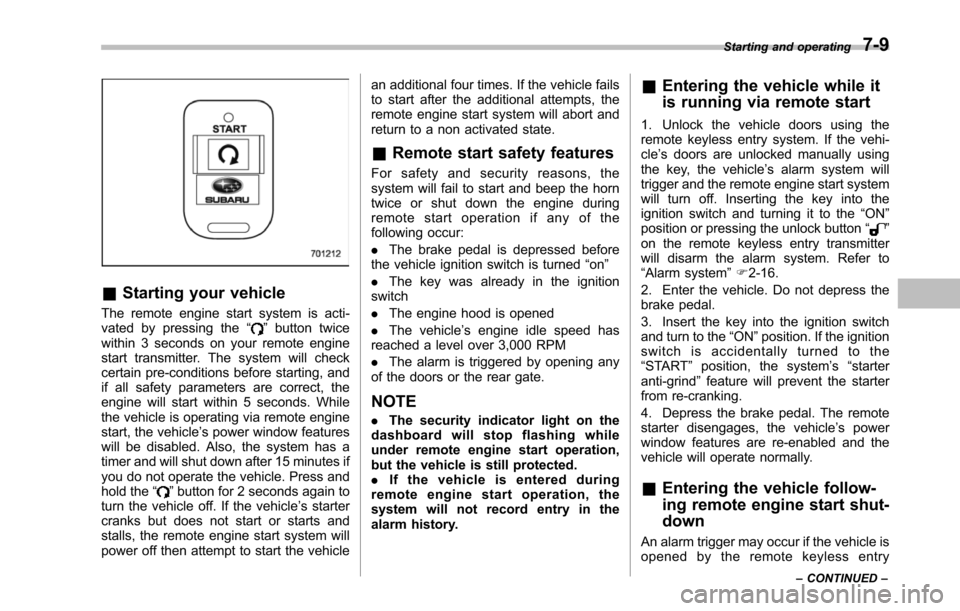
The remote engine start system is acti-vated by pressing the“”button twicewithin 3 seconds on your remote enginestart transmitter. The system will checkcertain pre-conditions before starting, andif all safety parameters are correct, theengine will start within 5 seconds. Whilethe vehicle is operating via remote enginestart, the vehicle’s power window featureswill be disabled. Also, the system has atimer and will shut down after 15 minutes ifyou do not operate the vehicle. Press andhold the“”button for 2 seconds again toturn the vehicle off. If the vehicle’s startercranks but does not start or starts andstalls, the remote engine start system willpower off then attempt to start the vehicle
an additional four times. If the vehicle failsto start after the additional attempts, theremote engine start system will abort andreturn to a non activated state.
&Remote start safety features
For safety and security reasons, thesystem will fail to start and beep the horntwice or shut down the engine duringremote start operation if any of thefollowing occur:
.The brake pedal is depressed beforethe vehicle ignition switch is turned“on”
.The key was already in the ignitionswitch
.The engine hood is opened
.The vehicle’s engine idle speed hasreached a level over 3,000 RPM
.The alarm is triggered by opening anyof the doors or the rear gate.
NOTE
.The security indicator light on thedashboard will stop flashing whileunder remote engine start operation,but the vehicle is still protected..If the vehicle is entered duringremote engine start operation, thesystem will not record entry in thealarm history.
&Entering the vehicle while it
is running via remote start
1. Unlock the vehicle doors using theremote keyless entry system. If the vehi-cle’s doors are unlocked manually usingthe key, the vehicle’s alarm system willtrigger and the remote engine start systemwill turn off. Inserting the key into theignition switch and turning it to the“ON”position or pressing the unlock button“”on the remote keyless entry transmitterwill disarm the alarm system. Refer to“Alarmsystem”F2-16.
2. Enter the vehicle. Do not depress thebrake pedal.
3. Insert the key into the ignition switchand turn to the“ON”position. If the ignitionswitch is accidentally turned to the“START”position, the system’s“starteranti-grind”feature will prevent the starterfrom re-cranking.
4. Depress the brake pedal. The remotestarter disengages, the vehicle’s powerwindow features are re-enabled and thevehicle will operate normally.
&Entering the vehicle follow-
ing remote engine start shut-
down
An alarm trigger may occur if the vehicle isopened by the remote keyless entry
Starting and operating7-9
–CONTINUED–
Page 257 of 426
7-10Starting and operating
transmitter within a few seconds immedi-ately following remote engine start shut-down.
&Pre-heating or pre-cooling
the interior of the vehicle
Before exiting the vehicle, set the tem-perature controls to the desired settingand operation. After the system starts thevehicle, the heater or air-conditioning willactivate and heat or cool the interior toyour setting.
&Service mode
In service mode, the remote start functionis temporarily disabled to prevent thesystem from unexpectedly starting theengine while being serviced.
!To engage the service mode
Turn the ignition switch to the“ON”position, depress and hold the brake pedalthen, press and release the“”button onthe remote engine start transmitter threetimes. The system will pause for 1 secondand then flash the parking lights and honkthe hornthree times indicating that thesystem is in service mode. When attempt-ing to activate the remote start systemwhile in service mode, the parking lightswill flash and the horn will honk two timesand will not start.
!To disengage the service mode
Turn the ignition switch to the“ON”position, depress and hold the brakepedal, then press and release the“”button on the remote engine start trans-mitter three times. The system will pausefor 1 second and flash the parking lightsone time indicating that the system hasexited service mode.
NOTE
When taking your vehicle in for service,it is recommended that you inform theservice personnel that your vehicle isequippedwith a remote engine startsystem.
&Remote engine start trans-
mitter programming and pro-
grammable feature option
New transmitters can be programmed tothe remote engine start system in theevent that remote engine start transmittersare lost, stolen or damaged. The remoteengine start system also has one pro-grammable feature that can be adjustedfor user preference.
The remote engine start system can beprogrammed to either make an audiblehorn chirp upon remote start activation ornot. Remote engine start transmitter pro-gramming and feature programming can
be adjusted using the following procedure.
1. Open the driver’s door (the driver’sdoor must remain opened throughout theentire process).
2. Insert the key into the vehicle’s ignitionswitch and turn to the“ON”position.
3. Locate the small black programmingbutton behind the fuse box cover, on thedriver’s side left under the dashboardpanel.
4. Press and hold the black programmingbutton for 10 to 15 seconds. The horn willhonk and the parking lights will flash threetimes to indicate that the system hasentered programming mode. At this pointyou can perform either action (step 5 orstep 6).
5. To program a remote transmitter:press and release the“”button on eachtransmitter. The horn will honk and theparking lights will flash one time to indicatea successful transmitter learn each timethe“”button is pressed. You canprogram up to eight transmitters.
6. To toggle the Horn Confirmation chirpsON/OFF: press and release the brake totoggle the feature. The horn will chirp andthe parking lights will flash one time toindicate Confirmation Horn Chirps are“OFF”. The horn will honk and the parkinglights will flash 2 times to indicate Con-firmation Horn Chirps are“ON”. Depres-