lock SUBARU TRIBECA 2014 1.G Owners Manual
[x] Cancel search | Manufacturer: SUBARU, Model Year: 2014, Model line: TRIBECA, Model: SUBARU TRIBECA 2014 1.GPages: 426, PDF Size: 6.37 MB
Page 6 of 426
Warranties
&Warranties for U.S.A.
All SUBARU vehicles distributed bySubaru of America, Inc. and sold at retailby an authorized SUBARU dealer in theUnited States come with the followingwarranties.
.SUBARU Limited Warranty
.Emission Control Systems Warranty
.Emissions Performance Warranty
All warranty information, including detailsof coverage and exclusions, is in the“Warranty and Maintenance Booklet”.Please read these warranties carefully.
&Warranties for Canada
All SUBARU vehicles distributed bySubaru Canada, Inc. and sold at retail byan authorized SUBARU dealer in Canadacome with the following warranties.
.SUBARU Limited Warranty
.Anti-CorrosionWarranty
.Emission Control Warranty
All warranty information, including detailsof coverage and exclusions, is in the“Warranty and Service Booklet”. Pleaseread these warranties carefully.
CAUTION
.If your vehicle is equipped with anavigation system and/or RearSeat Entertainment System, thedisplays contain mercury. There-fore, the displays of the naviga-tion system and/or Rear SeatEntertainment System must beremoved beforevehicle disposal.Once the displays have beenremoved, please reuse, recycleor dispose of them as hazardouswaste.
.If your vehicle is equipped withHigh Intensity Discharge (HID)headlights, the HID headlightscontain mercury. Therefore, it isnecessary to remove HID head-lights before vehicle disposal.Once removed, please reuse, re-cycle or dispose of the HID head-lights as hazardous waste.
How to use this Owner’s
Manual
&Using your Owner’s Manual
Before you operate your vehicle, carefullyread this manual. To protect yourself andextend the service life of your vehicle,follow the instructions in this manual.Failure to observe these instructions mayresult in serious injury and damage to yourvehicle.
This manual is composed of fourteenchapters. Each chapter begins with a brieftable of contents, so you can usually tell ataglanceifthatchaptercontainstheinformation you want.
Chapter 1: Seat, seatbelt and SRSairbags
This chapter informs you how to use theseat and seatbelt and contains precau-tions for the SRS airbags.
Chapter 2: Keys and doors
This chapter informs you how to operatethe keys, locks and windows.
Chapter 3: Instruments and controls
This chapter informs you about the opera-tion of instrument panel indicators andhow to use the instruments and otherswitches.
1
–CONTINUED–
Page 8 of 426
&Abbreviation list
You will find several abbreviations in thismanual. The meanings of the abbrevia-tions are shown in the following list.
Abbreviation Meaning
A/C Air conditioner
A/ELRAutomatic/Emergency lockingretractor
ABSAnti-lock brake system
AKI Anti knock index
ALR Automatic locking retractor
AT Automatic transmission
ATF Automatic transmission fluid
AWD All-wheel drive
DRL Daytime running light
EBDElectronicbrake force distri-bution
ELR Emergency locking retractor
GAW Gross axle weight
GAWR Gross axle weight rating
GVW Gross vehicle weight
GVWRGross vehicle weight rating
HID Highintensity discharge
INT Intermittent
LATCHLower anchors and tethers forchildren
Abbreviation Meaning
LED Light emitting diode
MIL Malfunction indicator light
MMTMethylcyclopentadienyl man-ganese tricarbonyl
OBD On-board diagnostics
RON Research octane number
SRSSupplemental restraint sys-tem
TIN Tire identification number
TPMSTire pressure monitoring sys-tem
VDCVehicle dynamics control
Vehicle symbols
There are some of the symbols you maysee on your vehicle.
For warning and indicator lights, refer to“Warning and indicator lights”F22.
Mark Name
WARNING
CAUTION
Passengers’windows lock
Fuel
Front fog lights
Parking lights
Hazard warning flasher
Seat heater
3
–CONTINUED–
Page 9 of 426
4
Mark Name
Child restraint lower an-chorages
Child restraint top tether an-chorages
Horn
Windshield wiper deicer
Wiper intermittent
Windshield wiper and washer
Windshield wiper mist (forsingle wipe)
Rear window wiper
Rear window washer
Lights
Headlight beam leveler
Mark Name
Parking lights, tail lights, li-cense plate lights and instru-ment panel illumination
Headlights
Turn signal
Illumination brightness
Engine hood
Fan speed
Instrument panel outlets
Instrument panel outlets andfoot outlets
Foot outlets
Windshield defroster and footoutlets
Windshield defroster
Mark Name
Rear window defogger/Out-side mirror defogger
Air recirculation
Outside air
Engine oil
Washer
Door lock (transmitter)
Door unlock (transmitter)
Rear gate (transmitter)
Power folding mirror
Page 11 of 426
6
at all times in a child restraintdevice or in a seatbelt. The SRSairbag deploys with considerablespeed and force and can injure oreven kill children, especially ifthey are 12 years of age andunder and are not restrained orimproperly restrained. Becausechildren are lighter and weakerthan adults, their risk of beinginjured from deployment is great-er.
.NEVER INSTALL A REARWARDFACING CHILD SAFETY SEAT INTHE FRONT SEAT. DOING SORISKS SERIOUS INJURY ORDEATH TO THE CHILD BY PLA-CING THE CHILD’S HEAD TOOCLOSE TO THE SRS AIRBAG.
.Always use the child safety lockswhenever a child rides in therear. Serious injury could resultif a child accidentally opened thedoor and fell out. Refer to“Childsafety locks”F2-21.
.Always lock the passenger’s win-dows using the lock switch whenchildren are riding in the vehicle.Failure to follow this procedurecould result in injury to a childoperating the power window. Re-fer to“Power windows”F2-21.
.Never leave unattended childrenin the vehicle. They could acci-dentally injure themselves orothers through inadvertent op-eration of the vehicle. Also, onhot or sunny days, temperaturein a closed vehicle could quicklybecome high enough to causesevere or possibly fatal injuriesto them.
For instructions and precautions, carefullyread the following sections.
.For the seatbelt system, refer to“Seat-belts”F1-17.
.For the childrestraint system, refer to“Child restraint systems”F1-29.
.For the SRS airbag system, refer to“*SRS airbag (Supplemental RestraintSystem airbag)”F1-45.
&Engine exhaust gas (carbon
monoxide)
WARNING
.Never inhale engine exhaust gas.Engine exhaust gas containscarbon monoxide, a colorlessand odorless gas which is dan-gerous, or even lethal, if inhaled.
.Always properly maintain the en-
gine exhaust system to preventengine exhaust gas from enter-ing the vehicle.
.Never run the engine in a closedspace, such as a garage, exceptfor the brief time needed to drivethe vehicle in or out of it.
.Avoid remaining in a parkedvehicle for a lengthy time whilethe engine is running. If that isunavoidable, then use the venti-lation fan to force fresh air intothe vehicle.
.Always keep the front ventilatorinlet grille free from snow, leavesor other obstructions to ensurethat the ventilation system al-ways works properly.
.If at any time you suspect thatexhaust fumes are entering thevehicle, have the problemchecked and corrected as soonas possible. If you must driveunder these conditions, driveonly with all windows fully open.
.Keep the rear gate closed whiledriving to prevent exhaust gasfrom entering the vehicle.
Page 17 of 426
12
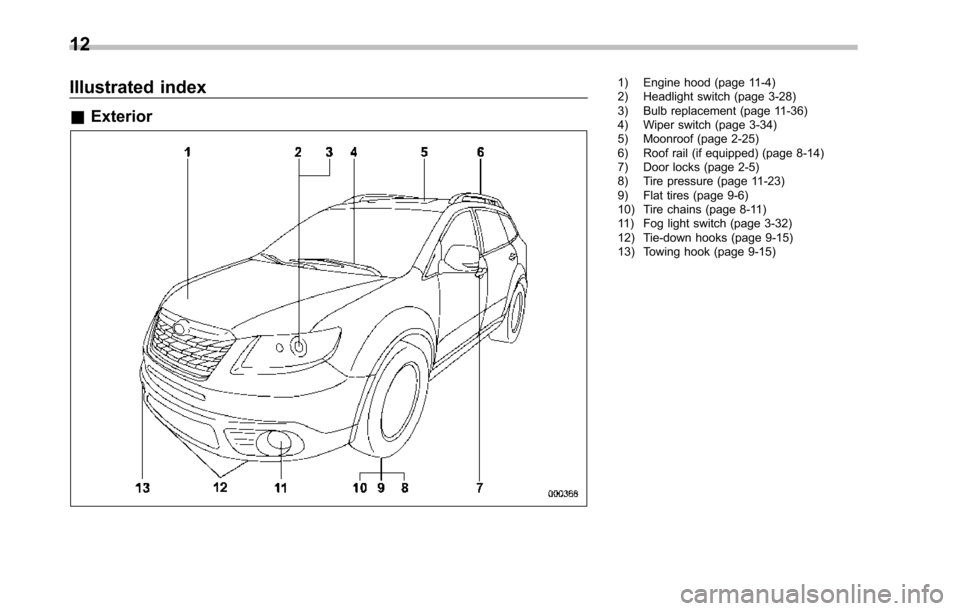
Illustrated index
&Exterior
1) Engine hood (page 11-4)2) Headlight switch (page 3-28)3) Bulb replacement (page 11-36)4) Wiper switch (page 3-34)5) Moonroof (page 2-25)6) Roof rail (if equipped) (page 8-14)7) Door locks (page 2-5)8) Tire pressure (page 11-23)9) Flat tires (page 9-6)10) Tire chains (page 8-11)11) Fog light switch (page 3-32)12) Tie-down hooks (page 9-15)13) Towing hook (page 9-15)
Page 18 of 426
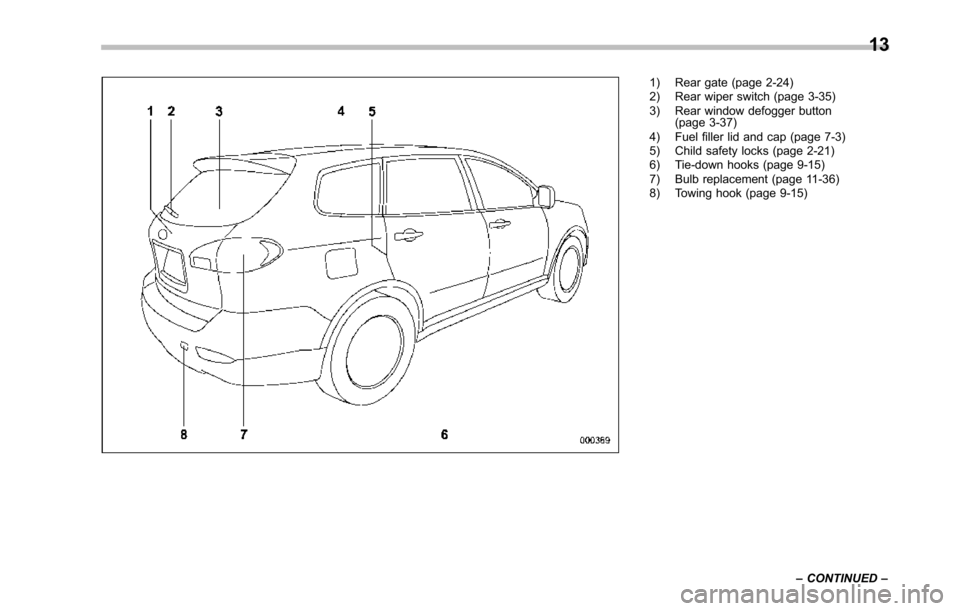
1) Rear gate (page 2-24)2) Rear wiper switch (page 3-35)3) Rear window defogger button(page 3-37)4) Fuel filler lid and cap (page 7-3)5) Child safety locks (page 2-21)6) Tie-down hooks (page 9-15)7) Bulb replacement (page 11-36)8) Towing hook (page 9-15)
13
–CONTINUED–
Page 22 of 426
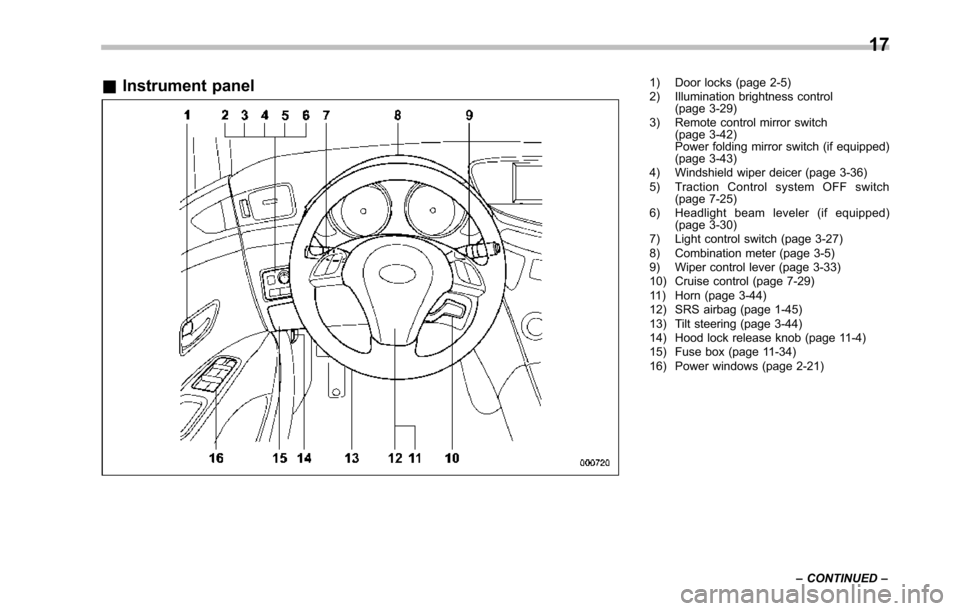
&Instrument panel1) Door locks (page 2-5)2) Illumination brightness control(page 3-29)3) Remote control mirror switch(page 3-42)Power folding mirror switch (if equipped)(page 3-43)4) Windshield wiper deicer (page 3-36)5) Traction Control system OFF switch(page 7-25)6) Headlight beam leveler (if equipped)(page 3-30)7) Light control switch (page 3-27)8) Combination meter (page 3-5)9) Wiper control lever (page 3-33)10) Cruise control (page 7-29)11) Horn (page 3-44)12) SRS airbag (page 1-45)13) Tilt steering (page 3-44)14) Hood lock release knob (page 11-4)15) Fusebox (page 11-34)16) Power windows (page 2-21)
17
–CONTINUED–
Page 29 of 426
24
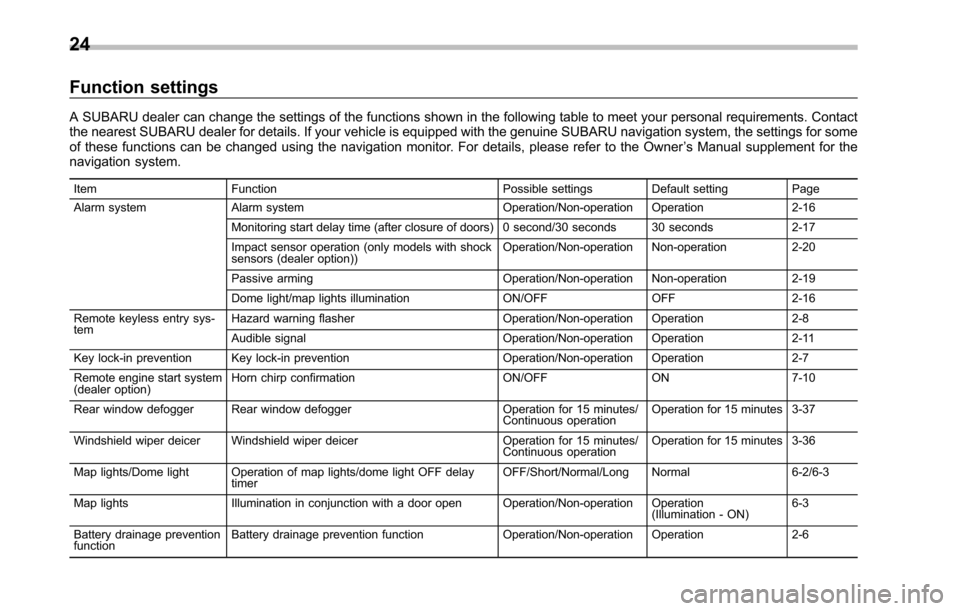
Function settings
A SUBARU dealer can change the settings of the functions shown in the following table to meet your personal requirements. Contactthe nearest SUBARU dealer for details. If your vehicle is equipped with the genuine SUBARU navigation system, the settings for someof these functions can be changed using the navigation monitor. For details, please refer to the Owner’s Manual supplement for thenavigation system.
Item Function Possible settings Default setting Page
Alarm system Alarm system Operation/Non-operation Operation 2-16
Monitoring start delay time (after closure of doors) 0 second/30 seconds 30 seconds 2-17
Impact sensor operation (only models with shocksensors (dealer option))Operation/Non-operation Non-operation 2-20
Passive arming Operation/Non-operation Non-operation 2-19
Dome light/map lights illuminationON/OFFOFF 2-16
Remote keyless entry sys-temHazard warning flasher Operation/Non-operation Operation 2-8
Audible signal Operation/Non-operation Operation 2-11
Key lock-in prevention Key lock-in preventionOperation/Non-operationOperation2-7
Remote engine start system(dealer option)Horn chirp confirmation ON/OFF ON 7-10
Rear window defogger Rear window defoggerOperation for 15 minutes/Continuous operationOperation for 15 minutes 3-37
Windshield wiper deicer Windshield wiper deicer Operation for 15 minutes/Continuous operationOperation for 15 minutes 3-36
Map lights/Dome light Operation of map lights/dome light OFF delaytimerOFF/Short/Normal/Long Normal 6-2/6-3
Map lights Illumination in conjunction with a door open Operation/Non-operation Operation(Illumination - ON)6-3
Battery drainage preventionfunctionBattery drainage prevention function Operation/Non-operation Operation 2-6
Page 32 of 426
Front seats........................................................... 1-2Power seat.......................................................... 1-3Memory function (driver’s seat–if equipped)....... 1-4Head restraint adjustment.................................... 1-5Active head restraint........................................... 1-6Lumbar support.................................................. 1-7
Seat heater (if equipped).................................... 1-7
Second-row seats............................................... 1-8Forward andbackward adjustment...................... 1-8Reclining the seatback........................................ 1-9Folding down the seatback................................. 1-10Head restraint adjustment................................... 1-12Armrest............................................................. 1-13
Third-row seat.................................................... 1-13Access to the third-row seat............................... 1-14Folding down the seatback................................. 1-15Head restraint adjustment................................... 1-16
Seatbelts............................................................. 1-17Seatbelt safety tips............................................. 1-17Emergency Locking Retractor (ELR)................... 1-18Automatic/Emergency Locking Retractor(A/ELR)............................................................ 1-18Seatbelt warning light and chime........................ 1-18
Fastening the seatbelt........................................ 1-18Seatbelt maintenance......................................... 1-26
Front seatbelt pretensioners............................. 1-27System monitors............................................... 1-28System servicing............................................... 1-28Precautions against vehicle modification............ 1-28
Child restraint systems..................................... 1-29Where to place a child restraint system.............. 1-30Choosing a child restraint system...................... 1-32Installing child restraint systems with A/ELRseatbelt........................................................... 1-32Installing a booster seat..................................... 1-36Installation of child restraint systems by use oflower and tether anchorages (LATCH).............. 1-37Top tether anchorages....................................... 1-40
*SRS airbag (Supplemental RestraintSystem airbag)................................................ 1-45Your vehicle’s SRS configuration....................... 1-45SUBARU advanced frontal airbag system........... 1-49SRS side airbagand SRS curtain airbag............. 1-60SRS airbag system monitors.............................. 1-71SRS airbag system servicing ............................. 1-72Precautions against vehicle modification............ 1-72
Seat, seatbelt and SRS airbags
1
Page 33 of 426
1-2Seat, seatbelt and SRS airbags
Front seats
WARNING
.Never adjust the seat while driv-ing to avoid loss of vehicle con-trol and personal injury.
.Before adjustingthe seat, makesure luggage and the hands andfeet of second-row seat passen-gers are clear of the adjustingmechanism.
.Do not put objects under the frontseats. They may interfere withfront seat locking and cause anaccident.
.Seatbelts provide maximum re-straint when the occupant sitswell back and upright in the seat.To r e d u c e t h e r i s k o f s l i d i n gunder the seatbelt in a collision,the front seatbacks should bealways used in the upright posi-tion while the vehicle is running.If the front seatbacks are notused in the upright position in acollision, the risk of sliding underthe lap belt and of the lap beltsliding up over the abdomen willincrease, and both can result inserious internalinjury or death.
.The SRS airbags deploy withconsiderable speed and force.Occupants who are out of properposition when the SRS airbagdeploys could suffer very seriousinjuries. Because the SRS airbagneeds enough space for deploy-ment, the driver should alwayssit upright and well back in theseat as far from the steeringwheel as practical while stillmaintaining full vehicle controland the frontpassenger shouldmove the seat as far back aspossible and sit upright and wellback in the seat.
WARNING
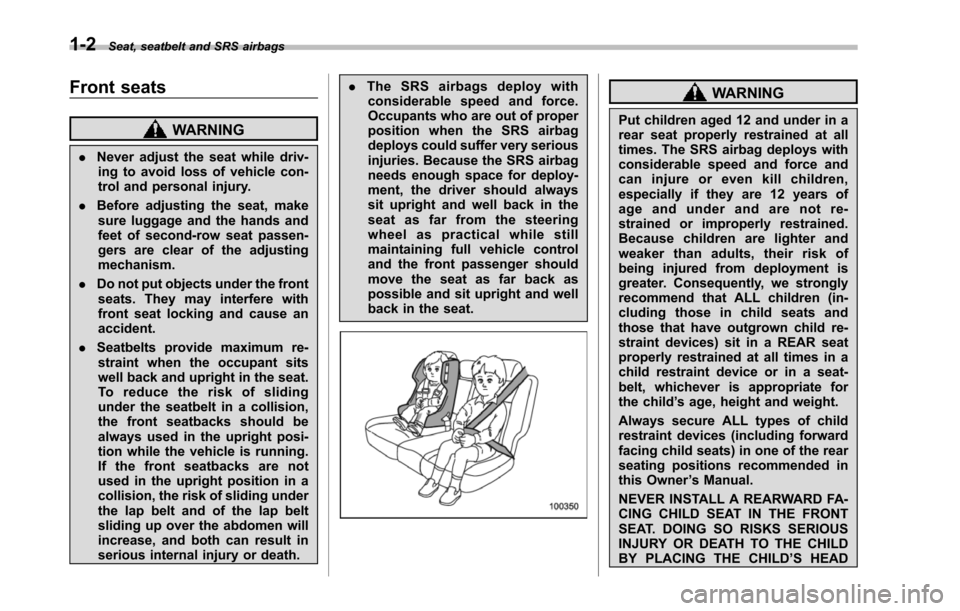
Put children aged 12 and under in arear seat properly restrained at alltimes. The SRS airbag deploys withconsiderable speed and force andcan injure or even kill children,especially if they are 12 years ofage and under and are not re-strained or improperly restrained.Because children are lighter andweaker than adults, their risk ofbeing injured from deployment isgreater. Consequently, we stronglyrecommend that ALL children (in-cluding those in child seats andthose that have outgrown child re-straint devices) sit in a REAR seatproperly restrained at all times in achild restraint device or in a seat-belt, whichever is appropriate forthe child’s age, height and weight.
Always secure ALL types of childrestraint devices (including forwardfacingchild seats) in one of the rearseating positions recommended inthis Owner’s Manual.
NEVER INSTALL A REARWARD FA-CING CHILD SEAT IN THE FRONTSEAT. DOING SO RISKS SERIOUSINJURY OR DEATH TO THE CHILDBY PLACING THE CHILD’S HEAD