maintenance schedule SUBARU TRIBECA 2014 1.G Owners Manual
[x] Cancel search | Manufacturer: SUBARU, Model Year: 2014, Model line: TRIBECA, Model: SUBARU TRIBECA 2014 1.GPages: 426, PDF Size: 6.37 MB
Page 7 of 426
2
Chapter 4: Climate control
This chapter informs you how to operatethe climate control.
Chapter 5: Audio
This chapter informs you how to operateyour audio system.
Chapter 6: Interior equipment
This chapter informs you how to operateinterior equipment.
Chapter 7: Starting and operating
This chapter informs you how to start andoperate your SUBARU.
Chapter 8: Driving tips
This chapterinforms you how to drive yourSUBARU in various conditions and ex-plains some safety tips on driving.
Chapter 9: In case of emergency
This chapter informs you what to do if youhave a problem while driving, such as aflat tire or engine overheating.
Chapter 10: Appearance care
This chapter informs you how to keep yourSUBARU looking good.
Chapter 11: Maintenance and service
This chapter informs you when you needto take your SUBARU to the dealer forscheduled maintenance and informs youhow to keep your SUBARU runningproperly.
Chapter 12: Specifications
This chapter informs you about the dimen-sions and capacities of your SUBARU.
Chapter 13: Consumer information andReporting safety defects
This chapter informs you about Tireinformation, Uniform tire quality gradingstandards and Reporting safety defects.
Chapter 14: Index
This is an alphabetical listing of all that’sinthis manual. You can use it to quickly findsomething you want to read.
&Safety warnings
You will find a number of WARNINGs,CAUTIONs and NOTEs in this manual.
These safety warnings alert you to poten-tial hazards that could result in injury toyou or others.
Please read these safety warnings as wellas all other portions of this manual care-fully in order to gain a better understand-ing of how to use your SUBARU vehiclesafely.
WARNING
A WARNING indicates a situation inwhich serious injury or death couldresult if the warning is ignored.
CAUTION
A CAUTION indicates a situation inwhich injury or damage to yourvehicle, or both, could result if thecaution is ignored.
NOTE
A NOTE gives information or sugges-tions how to make better use of yourvehicle.
&Safety symbol
You will find a circle with a slash through itin this manual. This symbol means“Donot”,“Do not do this”,or“Do not let thishappen”, depending upon the context.
Page 283 of 426
8-4Driving tips
Periodic inspections
To keep your vehicle in the best conditionat all times, always have the recom-mended maintenance services listed inthe maintenance schedule in the“War-ranty and Maintenance Booklet”per-formed at the specified time or mileageintervals.
Driving in foreign countries
When planning to use your vehicle inanother country:
.Confirm the availability of the correctfuel. Refer to“Fuel requirements”F7-2.
.Comply with all regulations and re-quirements of each country.
Driving tips for AWD models
WARNING
.Always maintain a safe drivingspeed according to the road andweather conditions in order toavoidhaving an accident on asharp turn, during sudden brak-ing or under other similar condi-tions.
.Always use the utmost care indriving–overconfidence be-cause you are driving an All-Wheel Drive model could easilylead to a serious accident.
.When replacing a tire, you mustuse a tire that is of the same size,circumference, speed symboland load index as the originaltires listed on the tire placard.Using tires of other sizes, cir-cumferences or constructionsmay result in severe mechanicaldamage to the drive train of yourvehicle and may affect ride,handling,braking, speedometer/odometer calibration, and clear-ance between the body and tires.It also may be dangerous andlead to loss of vehicle control.
Page 286 of 426
depth of the water and the bottom of thestream bed for firmness and ensure thatthe bed of the stream is flat. Drive slowlyand completely through the stream. Thewater should be shallow enough that itdoes not reach the vehicle’s undercar-riage. Water entering the engine air intakeor the exhaust pipe or water splashingonto electrical parts may damage yourvehicle and may cause it to stall. Neverattempt to drive through rushing water;regardless of its depth, it can wash awaythe ground from under your tires, resultingin possible loss of traction and evenvehicle rollover.
.Always check your brakes for effec-tiveness immediately after driving in sand,mud or water. Do this by driving slowlyand stepping on the brake pedal. Repeatthat process several times to dry out thebrake discsand brake pads.
.Do not drive or park over or nearflammable materials such as dry grass orfallen leaves,as they may burn easily. Theexhaust system is very hot while theengine is running and right after enginestops. This could create a fire hazard.
.After driving through tall grass, mud,rocks, sand, rivers, etc., check that thereis no grass, bush, paper, rags, stones,sand, etc. adhering to or trapped on theunderbody. Clear off any such matter from
the underbody. If the vehicle is used withthese materials trapped or adhering to theunderbody, a mechanical breakdown orfire could occur.
.Secure all cargo carried inside thevehicle and make certain that it is notpiled higher than the seatbacks. Duringsudden stops or jolts, unsecured cargocould be thrown around in the vehicle andcause injury. Do not pile heavy loads onthe roof. Those loads raise the vehicle’scenter of gravity and make it more proneto tip over.
.If you must rock the vehicle to free itfrom sand or mud, depress the acceleratorpedal slightly andmove the select leverback and forth between“D”and“R”repeatedly. Do not race the engine. Forthe best possible traction, avoid spinningthe wheels when trying to free the vehicle.
.When the road surface is extremelyslippery, you can obtain better traction bystarting the vehicle with the transmissionin 2nd than 1st.
.Never equip your vehicle with tireslarger than thosespecified in this manual.
.Wash the vehicle’s underbody after off-road driving. Suspension components areparticularly prone to dirt buildup, so theyneed to be washed thoroughly.
.Frequent driving of an AWD modelunder hard-driving conditions such as
rough roads or off roads will necessitatemore frequent replacement of engine oil,brake fluid and transmission oil than thatspecified in the maintenance scheduledescribed in the“Warranty and Mainte-nance Booklet”.
Remember that damage done to yourSUBARU while operating it off-road andnot using common sense precautionssuch as those listed above is not eligiblefor warranty coverage.
Driving tips8-7
Page 300 of 426
Trailer towing
Your vehicle is designed and intended tobe used primarily as a passenger-carryingvehicle. Towing a trailer puts additionalloads on your vehicle’s engine, drivetrain,brakes, tires and suspension and has anadverse effect on fuel economy.
If you do decide to tow a trailer, your safetyand satisfaction depend upon proper useof correct equipment and cautious opera-tion of your vehicle. Seek the advice ofyour SUBARU dealer to assist you inpurchasing a hitch and other necessarytowing equipment appropriate for yourvehicle. In addition, be sure to follow theinstructionson correct installation and useprovided by the trailer and other towingequipment manufacturers.
SUBARUassumes no responsibility forinjuries or vehicle damage that result fromtrailer towing equipment, or from anyerrors or omissions in the instructionsaccompanying such equipment or for yourfailure to follow the proper instructions.
&Warranties and maintenance
SUBARU warranties do not apply tovehicle damage or malfunction causedby trailer towing. If you use your vehicle totow a trailer, more frequent maintenancewill be required due to the additional load.
(Refer to“Maintenance schedule undersevere driving conditions”in the“Warrantyand Maintenance Booklet”.)
Under no circumstances should a trailerbe towed with a new vehicle or a vehiclewith any new powertrain component (en-gine, transmission, differential, wheelbearings, etc.) for the first 1,000 miles(1,600 km) of driving.
&Maximum load limits
WARNING
Never exceed the maximum loadlimits explained in the following.Exceeding the maximum load limitscould cause personal injury and/orvehicle damage.
CAUTION
.Adequate size trailer brakes arerequired when the trailer and itscargo exceed1,000 lbs (453 kg)total weight.
.Before towing a trailer, check thetrailer total weight, GVW, GAWsand tongue load. Make sure theload and its distribution in yourvehicle and trailer are accepta-
ble.
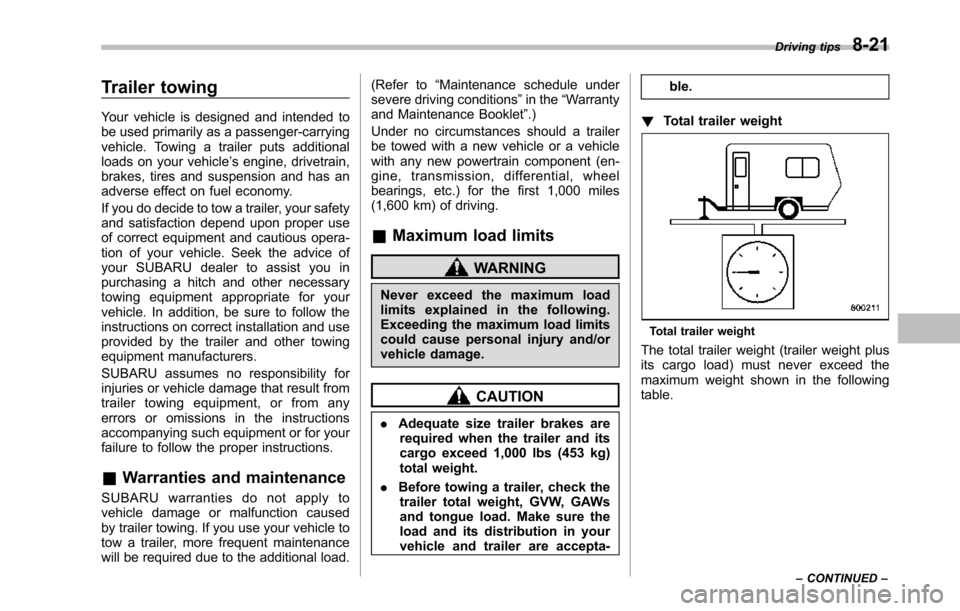
!Total trailer weight
Total trailer weight
The total trailer weight (trailer weight plusits cargo load) must never exceed themaximum weight shown in the followingtable.
Driving tips8-21
–CONTINUED–
Page 334 of 426

Maintenance schedule....................................... 11-3
Maintenance precautions................................... 11-3Before checking or servicing in the enginecompartment.................................................... 11-4When you do checking or servicing in the enginecompartment while the engine is running.......... 11-4
Engine hood....................................................... 11-4
Engine compartment overview.......................... 11-6
Engine oil............................................................ 11-7Checking the oil level......................................... 11-7Changing the oil and oil filter.............................. 11-8Recommendedgrade and viscosity.................... 11-9Synthetic oil....................................................... 11-9
Cooling system................................................ 11-10Hose and connections...................................... 11-10Engine coolant................................................. 11-11
Air cleaner element.......................................... 11-12Replacing the air cleaner element..................... 11-12
Spark plugs...................................................... 11-13Recommended spark plugs.............................. 11-13
Drive belts........................................................ 11-13
Automatic transmission fluid.......................... 11-14Checking the fluid level.................................... 11-14Recommended fluid......................................... 11-15
Front differential gear oil................................. 11-15Checking the oil level....................................... 11-15Recommended grade and viscosity.................. 11-16
Rear differential gear oil.................................. 11-16Recommended grade and viscosity.................. 11-16
Power steering fluid........................................ 11-16Checking the fluid level.................................... 11-16Recommended fluid......................................... 11-17
Brake fluid........................................................ 11-17Checking the fluid level.................................... 11-17Recommended brake fluid............................... 11-18
Brakebooster.................................................. 11-18
Brake pedal...................................................... 11-19Checking the brake pedal free play.................. 11-19Checking the brake pedal reserve distance....... 11-19
Replacement of brake pad and lining............ 11-19Breaking-in of new brake pads and linings....... 11-20
Parking brake stroke....................................... 11-20
Tires and wheels.............................................. 11-21Types of tires................................................... 11-21Tire pressure monitoring system (TPMS).......... 11-21Tire inspection................................................. 11-22Tire pressuresand wear.................................. 11-23Wheel balance................................................. 11-25Wear indicators............................................... 11-25Tire rotation direction mark.............................. 11-25Tire rotation..................................................... 11-26Tire replacement.............................................. 11-26Wheel replacement.......................................... 11-27
Aluminum wheels............................................ 11-27
Windshield washer fluid.................................. 11-28
Replacement of wiper blades......................... 11-29Windshield wiper blade assembly..................... 11-30Windshield wiper blade rubber ......................... 11-30Rear window wiper blade assembly.................. 11-31
Maintenance and service
11
Page 336 of 426
Maintenance schedule
The scheduled maintenance items re-quired to be serviced at regular intervalsare shown in the“Warranty and Main-tenance Booklet”.
For details of your maintenance schedule,read the separate“Warranty and Main-tenance Booklet”.
Maintenance precautions
When maintenance and service are re-quired, it is recommended that all work bedone by an authorized SUBARU dealer.
If you perform maintenance and serviceby yourself, you should familiarize yourselfwith the information provided in thissection on general maintenance andservice for yourSUBARU.
Incorrect or incomplete service couldcause improper or unsafe vehicle opera-tion. Any problems caused by impropermaintenance and service performed byyou are not eligible for warranty coverage.
WARNING
.Te s t i n g o f a n A l l - W h e e l D r i v emodel must NEVER be per-formed on a single two-wheeldynamometer or similar appara-tus. Attempting to do so willresult in transmission damageand in uncontrolled vehiclemovement and may cause anaccident or injuries to personsnearby.
.Always select a safe area whenperforming maintenance on yourvehicle.
.Always be very careful to avoidinjury when working on the vehi-cle. Remember that some of thematerials in the vehicle may behazardous if improperly used orhandled, for example, batteryacid.
.Your vehicle should only be ser-viced by persons fully competentto do so. Serious personal injurymay result to persons not experi-enced in servicing vehicles.
.Always use the proper tools andmake certain that they are wellmaintained.
.Never get under the vehicle sup-ported only by a jack. Always usea safety stands to support thevehicle.
.Never keep the engine running ina poorly ventilated area, such asa garage or other closed areas.
.Do not smoke or allow openflames around the fuel or battery.This will cause a fire.
.Because the fuel system is underpressure, replacement of the fuelfilter should be performed onlyby your SUBARU dealer.
.Wear adequate eye protection to
Maintenance and service11-3
–CONTINUED–
Page 341 of 426
11-8Maintenance and service
.Be careful not to spill engine oilwhen adding it. If oil touches theexhaust pipe, it may cause a badsmell, smoke, and/or a fire. Ifengine oil gets on the exhaustpipe, be sure to wipe it off.
If you check the oil level just after stoppingthe engine, wait a few minutes for the oil todrain back into the oil pan before checkingthe level.
To prevent overfilling the engine oil, do notadd any additional oil above the full levelwhen the engine is cold.
&Changing the oil and oil filter
CAUTION
.If you change your own oil, besure to drain all the oil from thefilter before disposal.
.Do not dispose of used engine oilby placing it in the trash, or bypouring it onto the ground, intosewers, or into any body of water.Check with your local govern-ment office for the proper dis-posal options available to you.
Change the oil and oil filter according tothe maintenance schedule in the“War-
ranty and Maintenance Booklet”.
The engine oil and oil filter must bechanged more frequently than listed inthe maintenance schedule when drivingon dusty roads, when short trips arefrequently made, or when driving inextremely cold weather.
1. Warm up the engine by letting theengine idle for approximately 10 minutesto ease draining the engine oil.
2. Park the vehicle on a level surface andstop the engine.
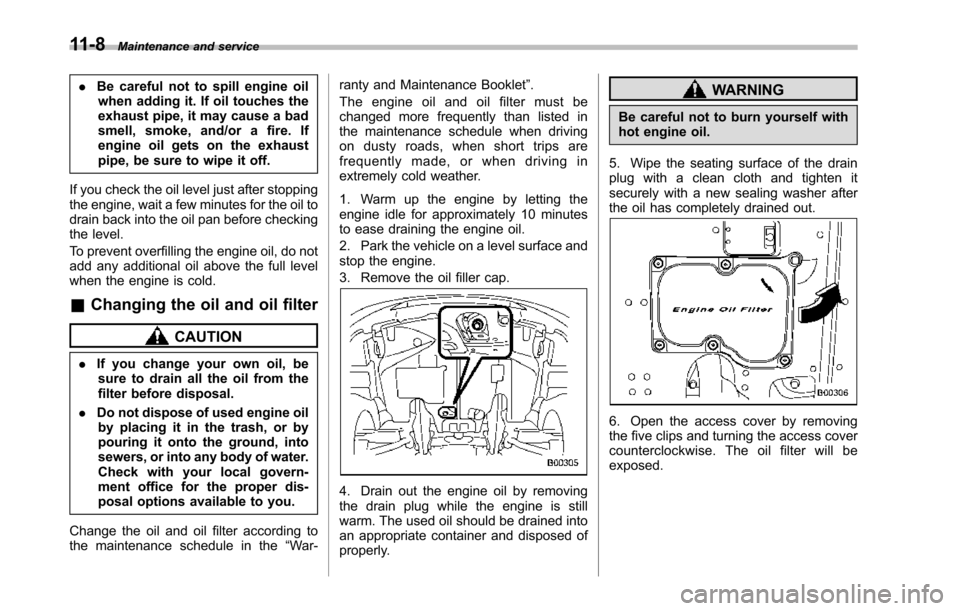
3. Remove the oil filler cap.
4. Drain out the engine oil by removingthe drain plug while the engine is stillwarm. The used oil should be drained intoan appropriate container and disposed ofproperly.
WARNING
Be careful not to burn yourself withhot engine oil.
5. Wipe the seating surface of the drainplug with a clean cloth and tighten itsecurely with a new sealing washer afterthe oil has completely drained out.
6. Open the access cover by removingthe five clips and turning the access covercounterclockwise. The oil filter will beexposed.
Page 344 of 426

&Engine coolant
!Checking the coolant level
Check the coolant level at each fuel stop.
1. Check the coolant level on the outsideof the reservoir while the engine is cool.
2. If the level is close to or lower than the“LOW”level mark, add coolant up to the“FULL”level mark. If the reserve tank isempty, remove the radiator cap and refillas required.
3. After refilling the reserve tank and theradiator, reinstall the caps and check thatthe rubber gaskets inside the radiator capare in the proper position.
CAUTION
.Be careful not to spill enginecoolant when adding it. If coolanttouches the exhaust pipe, it maycause a bad smell, smoke, and/ora fire. If engine coolant gets onthe exhaust pipe, be sure to wipeit off.
.Do not splash the engine coolantover painted parts. The alcoholcontained in the engine coolantmay damage the paint surface.
!Changing the coolant
It may be difficult to change the coolant.Have the coolant changed by yourSUBARU dealer if necessary.
The coolant should be changed accordingto the maintenance schedule in the“Warranty and Maintenance Booklet”.
Maintenance and service11-11
Page 345 of 426
11-12Maintenance and service
Air cleaner element
WARNING
Do not operate the engine with theair cleaner element removed. The aircleaner element not only filtersintake airbut also stops flames ifthe engine backfires. If the aircleaner element is not installedwhen the engine backfires, youcould be burned.
CAUTION
When replacing the air cleaner ele-ment, use a genuine SUBARU aircleaner element. If it is not used,there is the possibility of causing anegative effect to the engine.
The air cleaner element functions as afilter screen. When the element is perfo-rated or removed, engine wear will beexcessiveand engine life shortened.
It is unnecessary to clean or wash theelement.
&Replacing the air cleaner
element
Replace the air cleaner element accordingto the maintenance schedule in the“Warranty and Maintenance Booklet”. Un-der extremely dusty conditions, replace itmore frequently. It is recommended thatyou always use genuine SUBARU parts.
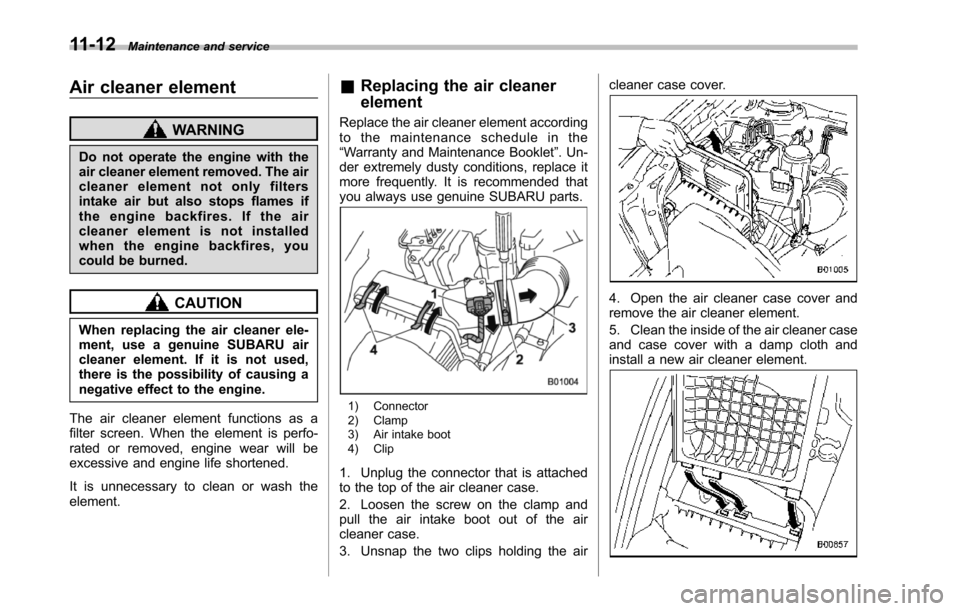
1) Connector2) Clamp3) Air intake boot4) Clip
1. Unplug the connector that is attachedto the top of the air cleaner case.
2. Loosen the screw on the clamp andpull theair intake boot out of the aircleaner case.
3. Unsnap the two clips holding the air
cleaner case cover.
4. Open the air cleaner case cover andremove the air cleaner element.
5. Clean the inside of the air cleaner caseand case cover with a damp cloth andinstall a new air cleaner element.
Page 346 of 426

6. To install the air cleaner case cover,insert the three projections on the aircleaner case cover into the slits on theair cleaner case.
7. Install in the reverse order of removal.
Spark plugs
It may be difficult to replace the sparkplugs. It is recommended that you havethe spark plugs replaced by yourSUBARU dealer.
The spark plugs should be replacedaccording to the maintenance schedulein the“Warranty and Maintenance Book-let”.
&Recommended spark plugs
Refer to“Electrical system”F12-7.
Drive belts
The alternator, power steering pump, andair conditioner compressor depend ondrive belts. Satisfactory performance re-quires that belt tension be correct.
It is unnecessary to check belt tensionperiodically because your engine isequipped with an automatic belt tensionadjuster. However, replacement of the beltshould be done according to the main-tenance schedule in the“Warranty andMaintenance Booklet”.ConsultyourSUBARU dealer for replacement.
If a belt is loose, cracked, or worn, contactyour SUBARU dealer.
Maintenance and service11-13