weight SUBARU TRIBECA 2014 1.G Owners Manual
[x] Cancel search | Manufacturer: SUBARU, Model Year: 2014, Model line: TRIBECA, Model: SUBARU TRIBECA 2014 1.GPages: 426, PDF Size: 6.37 MB
Page 8 of 426
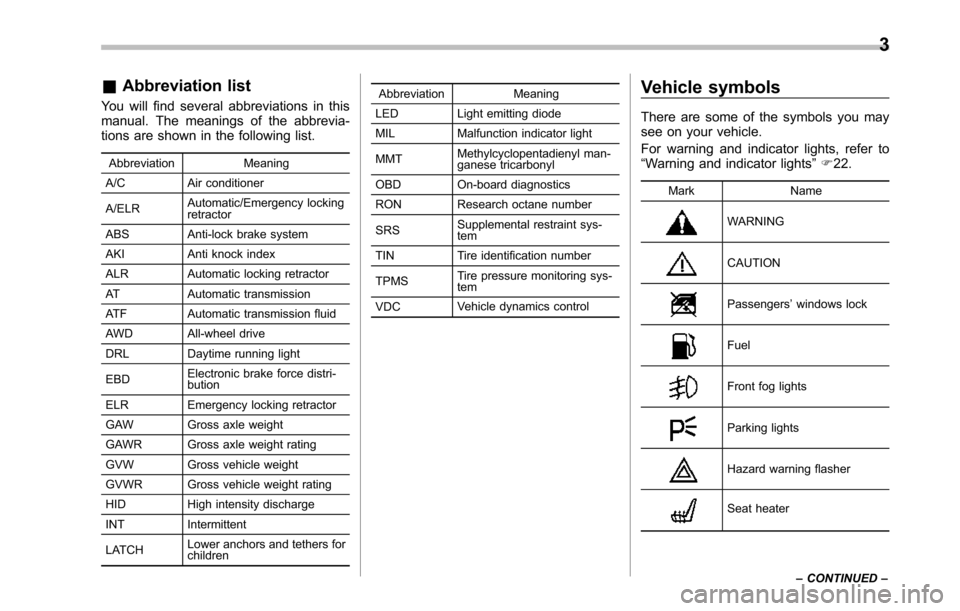
&Abbreviation list
You will find several abbreviations in thismanual. The meanings of the abbrevia-tions are shown in the following list.
Abbreviation Meaning
A/C Air conditioner
A/ELRAutomatic/Emergency lockingretractor
ABSAnti-lock brake system
AKI Anti knock index
ALR Automatic locking retractor
AT Automatic transmission
ATF Automatic transmission fluid
AWD All-wheel drive
DRL Daytime running light
EBDElectronicbrake force distri-bution
ELR Emergency locking retractor
GAW Gross axle weight
GAWR Gross axle weight rating
GVW Gross vehicle weight
GVWRGross vehicle weight rating
HID Highintensity discharge
INT Intermittent
LATCHLower anchors and tethers forchildren
Abbreviation Meaning
LED Light emitting diode
MIL Malfunction indicator light
MMTMethylcyclopentadienyl man-ganese tricarbonyl
OBD On-board diagnostics
RON Research octane number
SRSSupplemental restraint sys-tem
TIN Tire identification number
TPMSTire pressure monitoring sys-tem
VDCVehicle dynamics control
Vehicle symbols
There are some of the symbols you maysee on your vehicle.
For warning and indicator lights, refer to“Warning and indicator lights”F22.
Mark Name
WARNING
CAUTION
Passengers’windows lock
Fuel
Front fog lights
Parking lights
Hazard warning flasher
Seat heater
3
–CONTINUED–
Page 10 of 426
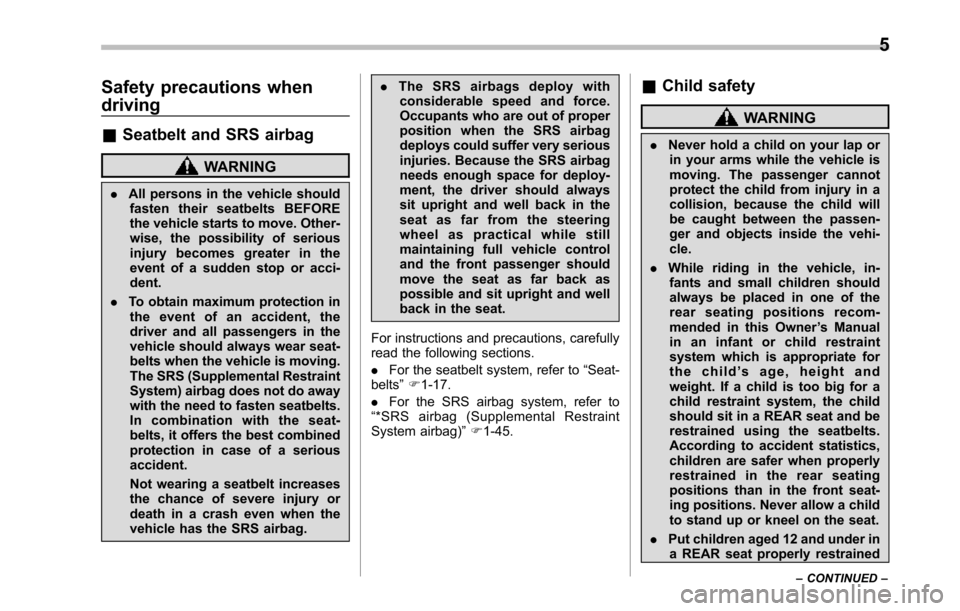
Safety precautions when
driving
&Seatbelt and SRS airbag
WARNING
.All persons in the vehicle shouldfasten their seatbelts BEFOREthe vehicle starts to move. Other-wise, the possibility of seriousinjury becomes greater in theevent of a sudden stop or acci-dent.
.To obtain maximum protection inthe event of an accident, thedriver and all passengers in thevehicle shouldalways wear seat-belts when the vehicle is moving.The SRS (Supplemental RestraintSystem) airbag does not do awaywith the need to fasten seatbelts.In combination with the seat-belts, it offers the best combinedprotection in case of a seriousaccident.
Not wearing a seatbelt increasesthe chance of severe injury ordeath in a crash even when thevehicle has the SRS airbag.
.The SRS airbags deploy withconsiderable speed and force.Occupants who are out of properposition when the SRS airbagdeploys could suffer very seriousinjuries. Because the SRS airbagneeds enough space for deploy-ment, the driver should alwayssit upright and well back in theseat as far from the steeringwheel as practical while stillmaintaining full vehicle controland the front passenger shouldmove the seat as far back aspossible and sit upright and wellback in the seat.
For instructions and precautions, carefullyread the following sections.
.For the seatbelt system, refer to“Seat-belts”F1-17.
.For the SRS airbag system, refer to“*SRS airbag (Supplemental RestraintSystem airbag)”F1-45.
&Child safety
WARNING
.Never hold a child on your lap orin your arms while the vehicle ismoving. The passenger cannotprotect the child from injury in acollision, because the child willbe caught between the passen-ger and objects inside the vehi-cle.
.While riding in the vehicle, in-fants and small children shouldalways be placed in one of therear seating positions recom-mended in this Owner’s Manualin an infant or child restraintsystem which is appropriate forthe child’sage,heightandweight. If a child is too big for achild restraint system, the childshould sit in a REAR seat and berestrained using the seatbelts.According to accident statistics,children are safer when properlyrestrained in the rear seatingpositions than in the front seat-ing positions. Never allow a childto stand up or kneel on the seat.
.Put childrenaged 12 and under ina REAR seat properly restrained
5
–CONTINUED–
Page 33 of 426
1-2Seat, seatbelt and SRS airbags
Front seats
WARNING
.Never adjust the seat while driv-ing to avoid loss of vehicle con-trol and personal injury.
.Before adjustingthe seat, makesure luggage and the hands andfeet of second-row seat passen-gers are clear of the adjustingmechanism.
.Do not put objects under the frontseats. They may interfere withfront seat locking and cause anaccident.
.Seatbelts provide maximum re-straint when the occupant sitswell back and upright in the seat.To r e d u c e t h e r i s k o f s l i d i n gunder the seatbelt in a collision,the front seatbacks should bealways used in the upright posi-tion while the vehicle is running.If the front seatbacks are notused in the upright position in acollision, the risk of sliding underthe lap belt and of the lap beltsliding up over the abdomen willincrease, and both can result inserious internalinjury or death.
.The SRS airbags deploy withconsiderable speed and force.Occupants who are out of properposition when the SRS airbagdeploys could suffer very seriousinjuries. Because the SRS airbagneeds enough space for deploy-ment, the driver should alwayssit upright and well back in theseat as far from the steeringwheel as practical while stillmaintaining full vehicle controland the frontpassenger shouldmove the seat as far back aspossible and sit upright and wellback in the seat.
WARNING
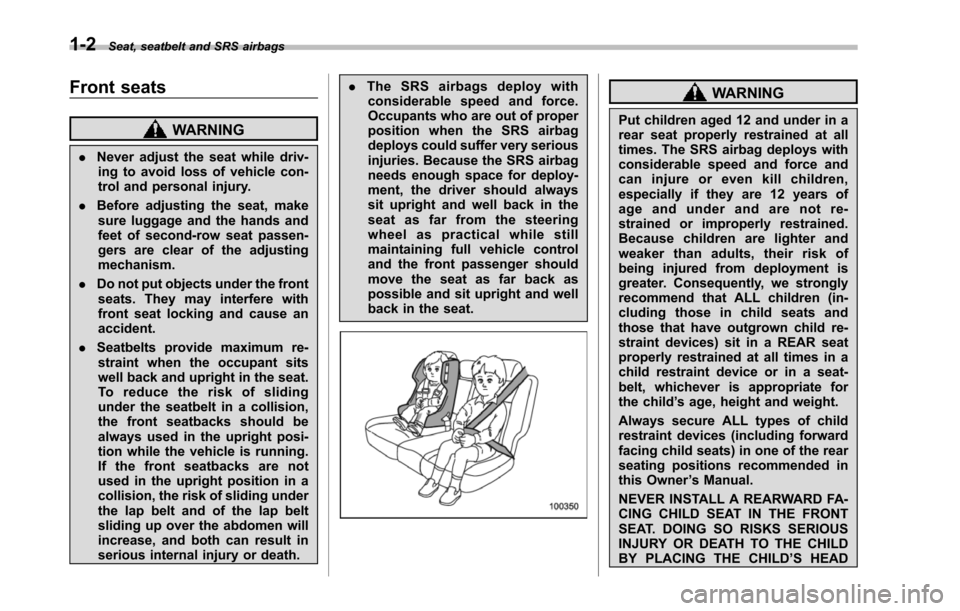
Put children aged 12 and under in arear seat properly restrained at alltimes. The SRS airbag deploys withconsiderable speed and force andcan injure or even kill children,especially if they are 12 years ofage and under and are not re-strained or improperly restrained.Because children are lighter andweaker than adults, their risk ofbeing injured from deployment isgreater. Consequently, we stronglyrecommend that ALL children (in-cluding those in child seats andthose that have outgrown child re-straint devices) sit in a REAR seatproperly restrained at all times in achild restraint device or in a seat-belt, whichever is appropriate forthe child’s age, height and weight.
Always secure ALL types of childrestraint devices (including forwardfacingchild seats) in one of the rearseating positions recommended inthis Owner’s Manual.
NEVER INSTALL A REARWARD FA-CING CHILD SEAT IN THE FRONTSEAT. DOING SO RISKS SERIOUSINJURY OR DEATH TO THE CHILDBY PLACING THE CHILD’S HEAD
Page 48 of 426
Seatbelts
&Seatbelt safety tips
WARNING
.All persons in the vehicle shouldfasten their seatbelts BEFOREthe vehicle starts to move. Other-wise, the possibility of seriousinjury becomes greater in theevent of a sudden stop or acci-dent.
.All belts should fit snugly in orderto provide full restraint. Loosefitting belts are not as effective inpreventing or reducing injury.
.Each seatbelt is designed tosupport only one person. Neveruse a single belt for two or morepersons–even children.Other-wise, in an accident, seriousinjury or death could result.
.Replace all seatbelt assembliesincluding retractors and attach-ing hardware worn by occupantsof a vehicle that has been in aserious accident. The entire as-sembly should be replaced evenif damage is not obvious.
.Put children aged 12 and under in
a rear seat properly restrained atall times. The SRS airbag de-ploys with considerable speedand force and can injure or evenkill children, especially if they are12 years of age and under andare not restrained or improperlyrestrained. Because children arelighter and weaker than adults,their risk of being injured fromdeployment is greater. Conse-quently, we strongly recommendthat ALL children (includingthose in child seats and thosethat have outgrown child re-straint devices) sit in a REARseat properly restrained at alltimes in a child restraint deviceor in a seatbelt, whichever isappropriate for the child’s heightand weight.
Always secure ALL types of childrestraint devices (including for-ward facing child seats) in one ofthe rear seating positions recom-mended in this Owner’s Manual.
NEVERINSTALL A REARWARDFA C I N G C H I L D S E AT I N T H EFRONT SEAT. DOING SO RISKSSERIOUS INJURY OR DEATH TOTHE CHILD BY PLACING THECHILD’S HEAD TOO CLOSE TO
THE SRS AIRBAG.
According to accident statistics,children are safer when properlyrestrained in the rear seatingpositions than in the front seat-ing positions. For instructionsand precautions concerning thechild restraint system, refer to“Child restraint systems”F1-29.
Your vehicle is equipped with a crashsensing and diagnostic module, which willrecord the use of the seatbelt(s) by thedriver and front passenger when any ofthe SRS frontal, side and curtain airbagsdeploy.
!Infants or small children
Use a child restraint system that issuitable for your vehicle. Refer to“Childrestraint systems”F1-29.
!Children
If a child is too big for a child restraintsystem, the child should sit in the rear seatand be restrained using the seatbelts.According to accident statistics, childrenare safer when properly restrained in therear seating positions than in the frontseating positions.Never allow a child tostand up or kneel on the seat.
If the shoulder portion of the belt crosses
Seat, seatbelt and SRS airbags1-17
–CONTINUED–
Page 62 of 426
contours of the seat cushion and can besecurely retained using the seatbelt.
C: Second-row center seat
Installing a child restraint system is notrecommended, although the A/ELR seat-belt and an upper anchorage (tetheranchorage) are provided in this position.
Some types of child restraints might not beable to be secured firmly due to projectionof the seat cushion.
In this seating position, you should useonly a child restraint system that has abottom base that fits snugly against thecontours of the seat cushion and can besecurelyretained using the seatbelt.
D: Third-row seat
Installing a child restraint system is notrecommended, although the A/ELR seat-belt and two upper anchorages (tetheranchorages)are provided in these posi-tions.
These seating positions are not equippedwith lower anchorages (bars) for installingLATCH system-type child restraints. How-ever, child restraint devices can be used inthese position using the A/ELR seatbeltsand upper anchorages (tether an-chorages) provided.
Some typesof child restraints might not beable to be secured firmly due to projectionof the seat cushion.
In this seating position, you should useonly a child restraint system that has abottom base that fits snugly against thecontours of the seat cushion and can besecurely retained using the seatbelt.
WARNING
Put children aged 12 and under inthe rear seat properly restrained atalltimes. The SRS airbag deployswith considerable speed and forceand can injure or even kill children,especially if they are 12 years of ageand under and are not restrained orimproperly restrained. Because chil-dren are lighter and weaker thanadults, their risk of being injuredfrom deployment is greater.
Consequently, be sure to secureALL types of child restraint devices(including forward facing childseats) in the REAR seats at all times.You should choose a restraint de-vice which is appropriate for thechild’s age, height and weight. Ac-cording to accident statistics, chil-dren are safer when properly re-strained in the rear seating posi-tions than in the front seating posi-tions.
WARNING
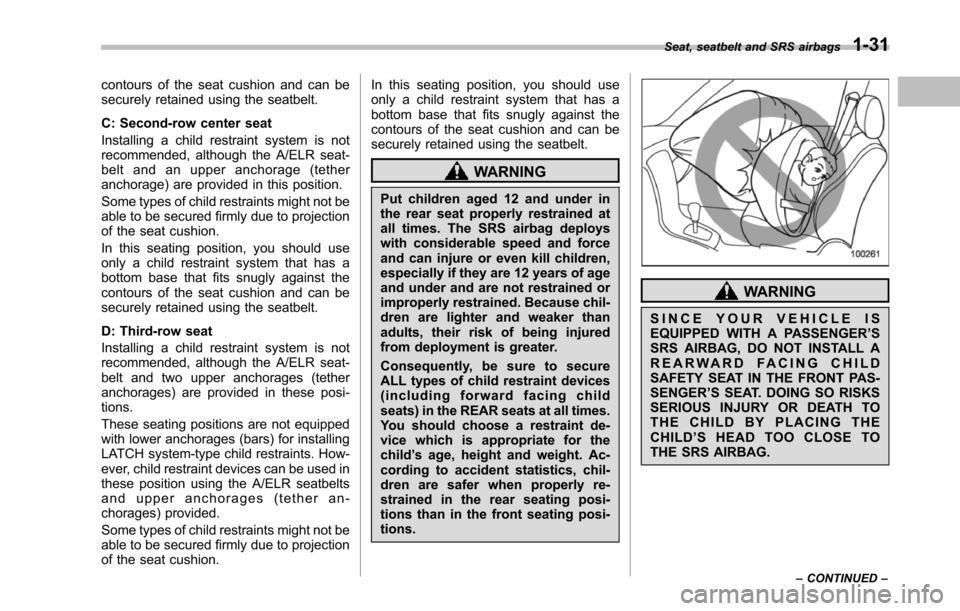
SINCE YOUR VEHICLE ISEQUIPPED WITH A PASSENGER’SSRS AIRBAG, DO NOT INSTALL AREARWARD FACING CHILDSAFETY SEAT IN THE FRONT PAS-SENGER’S SEAT. DOING SO RISKSSERIOUS INJURY OR DEATH TOTHE CHILD BY PLACING THECHILD’SHEADTOOCLOSETOTHE SRS AIRBAG.
Seat, seatbelt and SRS airbags1-31
–CONTINUED–
Page 63 of 426
1-32Seat, seatbelt and SRS airbags
&Choosing a child restraint
system
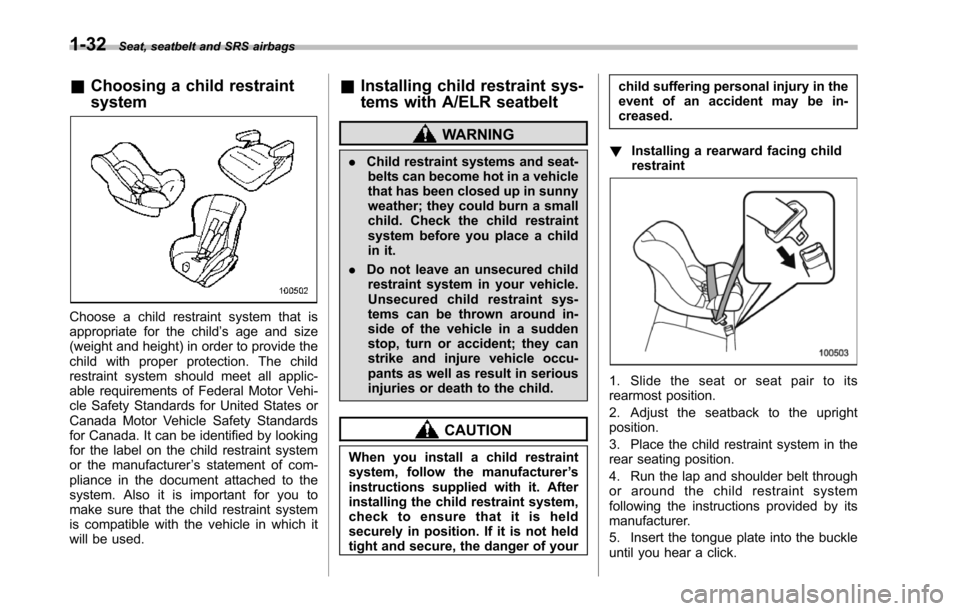
Choose a child restraint system that isappropriate for the child’s age and size(weight and height) in order to provide thechild with proper protection. The childrestraint system should meet all applic-able requirements of Federal Motor Vehi-cle Safety Standards for United States orCanada Motor Vehicle Safety Standardsfor Canada. It can be identified by lookingfor the label on the child restraint systemor the manufacturer’s statement of com-pliance in the document attached to thesystem. Also it is important for you tomake sure thatthe child restraint systemis compatible with the vehicle in which itwill be used.
&Installing child restraint sys-
tems with A/ELR seatbelt
WARNING
.Child restraint systems and seat-belts can become hot in a vehiclethat has been closed up in sunnyweather; they could burn a smallchild. Check the child restraintsystem before you place a childin it.
.Do not leave an unsecured childrestraint system in your vehicle.Unsecured child restraint sys-tems can be thrown around in-side of the vehicle in a suddenstop, turn or accident; they canstrikeand injure vehicle occu-pants as well as result in seriousinjuries or death to the child.
CAUTION
When you install a child restraintsystem, follow the manufacturer’sinstructions supplied with it. Afterinstalling the child restraint system,check to ensure that it is heldsecurely in position. If it is not heldtight and secure, the danger of your
child suffering personal injury in theevent of an accident may be in-creased.
!Installing a rearward facing childrestraint
1. Slide the seat or seat pair to itsrearmost position.
2. Adjust the seatback to the uprightposition.
3. Place the child restraint system in therear seating position.
4. Run the lap and shoulder belt throughor around the child restraint systemfollowing the instructions provided by itsmanufacturer.
5. Insert the tongue plate into the buckleuntil you hear a click.
Page 77 of 426
1-46Seat, seatbelt and SRS airbags
refer to“Seatbelts”F1-17.
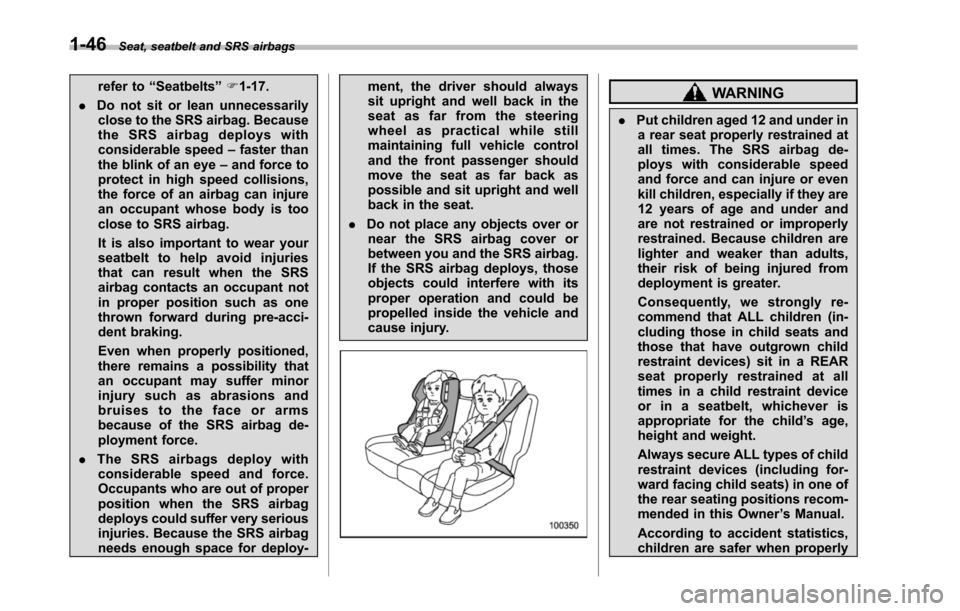
.Do not sit or lean unnecessarilyclose to the SRS airbag. Becausethe SRS airbag deploys withconsiderable speed–faster thanthe blink of an eye–and force toprotect in high speed collisions,the force of an airbag can injurean occupant whose body is tooclose to SRS airbag.
It is also important to wear yourseatbelt to help avoid injuriesthat can result when the SRSairbag contacts an occupant notin proper position such as onethrown forward during pre-acci-dent braking.
Even when properly positioned,there remainsa possibility thatan occupant may suffer minorinjury such as abrasions andbruises to the face or armsbecause of the SRS airbag de-ployment force.
.The SRS airbags deploy withconsiderable speed and force.Occupants who are out of properposition when the SRS airbagdeploys could suffer very seriousinjuries. Because the SRS airbagneeds enough space for deploy-
ment, the driver should alwayssit upright and well back in theseat as far from the steeringwheel as practical while stillmaintaining full vehicle controland the front passenger shouldmove the seat as far back aspossible and sit upright and wellback in the seat.
.Do not place any objects over ornear the SRS airbag cover orbetween you and the SRS airbag.If the SRS airbag deploys, thoseobjects could interfere with itsproper operation and could bepropelled inside the vehicle andcause injury.
WARNING
.Put children aged 12 and under ina rear seat properly restrained atall times. The SRS airbag de-ploys with considerable speedand force and can injure or evenkill children, especially if they are12 years of age and under andare not restrained or improperlyrestrained. Because children arelighter and weaker than adults,their risk of being injured fromdeployment is greater.
Consequently, we strongly re-commend that ALL children (in-cluding those in child seats andthose that have outgrown childrestraintdevices) sit in a REARseat properly restrained at alltimes in a child restraint deviceor in a seatbelt, whichever isappropriate for the child’s age,height and weight.
Always secure ALL types of childrestraint devices (including for-ward facing child seats) in one ofthe rear seating positions recom-mended in this Owner’s Manual.
According to accident statistics,children are safer when properly
Page 79 of 426
1-48Seat, seatbelt and SRS airbags
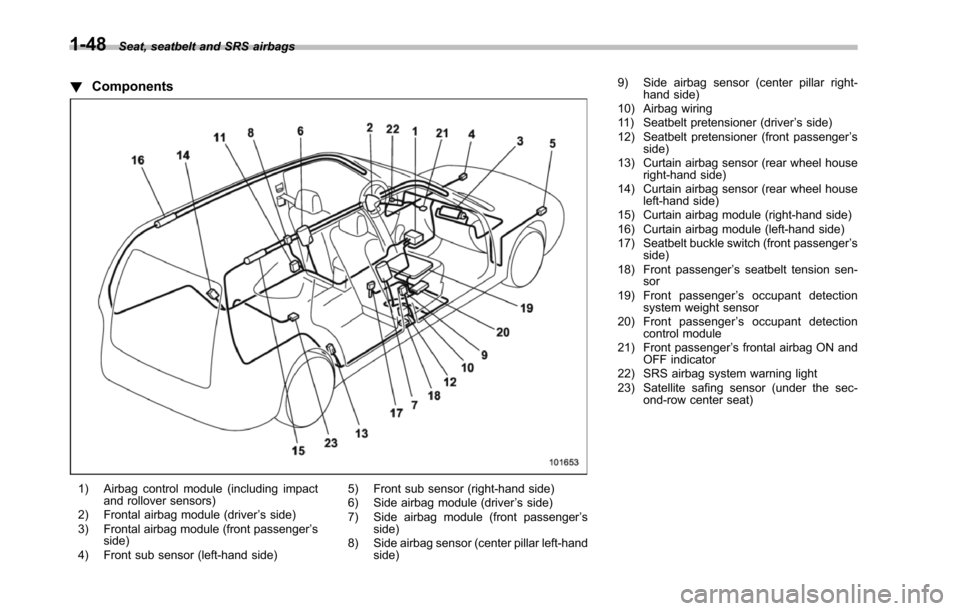
!Components
1) Airbag control module (including impactand rollover sensors)2) Frontal airbag module (driver’s side)3) Frontal airbag module (front passenger’sside)4) Front sub sensor (left-hand side)
5) Front sub sensor (right-hand side)6) Side airbag module (driver’s side)7) Side airbag module (front passenger’sside)8) Side airbag sensor (center pillar left-handside)
9) Side airbag sensor (center pillar right-hand side)10) Airbag wiring11) Seatbelt pretensioner (driver’s side)12) Seatbelt pretensioner (front passenger’sside)13) Curtain airbag sensor (rear wheel houseright-hand side)14) Curtain airbag sensor (rear wheel houseleft-hand side)15) Curtain airbag module (right-hand side)16) Curtain airbag module (left-hand side)17) Seatbelt buckle switch (front passenger’sside)18) Front passenger’s seatbelt tension sen-sor19) Front passenger’s occupant detectionsystem weight sensor20) Front passenger’s occupant detectioncontrol module21) Front passenger’s frontal airbag ON andOFF indicator22) SRS airbag system warning light23) Satellite safing sensor (under the sec-ond-row center seat)
Page 82 of 426
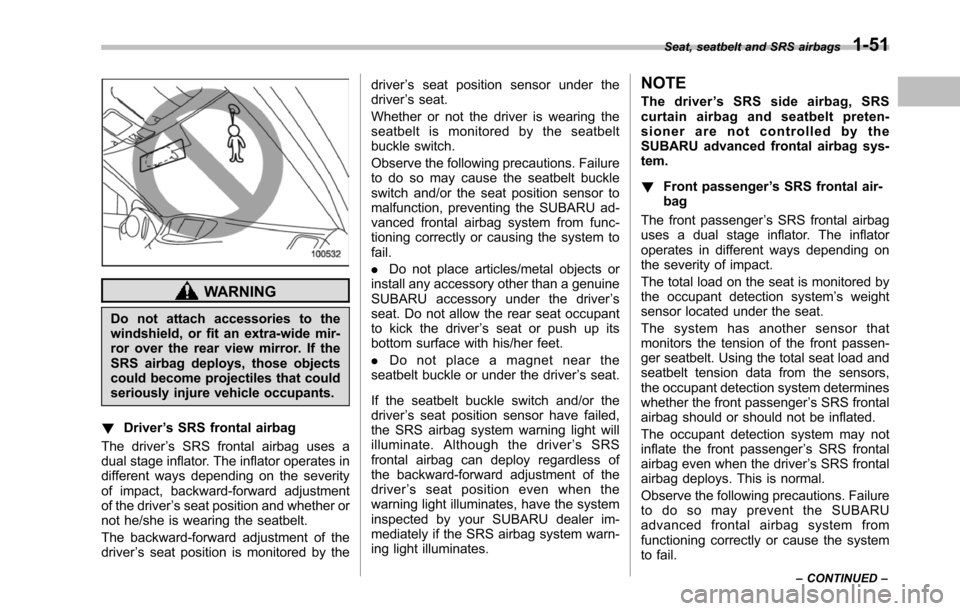
WARNING
Do not attach accessories to thewindshield, or fit an extra-wide mir-ror over the rear view mirror. If theSRS airbag deploys, those objectscould become projectiles that couldseriouslyinjure vehicle occupants.
!Driver’s SRS frontal airbag
The driver’s SRS frontal airbag uses adual stage inflator. The inflator operates indifferent ways depending on the severityof impact, backward-forward adjustmentof the driver’s seat position and whether ornot he/she is wearing the seatbelt.
The backward-forward adjustment of thedriver’s seat position is monitored by the
driver’s seat position sensor under thedriver’s seat.
Whether or not the driver is wearing theseatbelt is monitored by the seatbeltbuckle switch.
Observe the following precautions. Failureto do so may cause the seatbelt buckleswitch and/or the seat position sensor tomalfunction,preventing the SUBARU ad-vanced frontal airbag system from func-tioning correctly or causing the system tofail.
.Do not place articles/metal objects orinstall any accessory other than a genuineSUBARU accessory under the driver’sseat. Do not allow the rear seat occupantto kick the driver’s seat or push up itsbottom surface with his/her feet.
.Do not place a magnet near theseatbelt buckle or under the driver’s seat.
If the seatbelt buckle switch and/or thedriver’s seat position sensor have failed,the SRS airbag system warning light willilluminate. Although the driver’sSRSfrontal airbag can deploy regardless ofthe backward-forward adjustment of thedriver’sseatpositionevenwhenthewarning light illuminates, have the systeminspected by your SUBARU dealer im-mediatelyif the SRS airbag system warn-ing light illuminates.
NOTE
The driver’sSRSsideairbag,SRScurtain airbag and seatbelt preten-sioner are not controlled by theSUBARU advanced frontal airbag sys-tem.
!Front passenger’s SRS frontal air-bag
The front passenger’s SRS frontal airbaguses a dual stage inflator. The inflatoroperates in different ways depending onthe severity of impact.
The total load on the seat is monitored bythe occupant detection system’s weightsensor located under the seat.
The system has another sensor thatmonitors the tension of the front passen-ger seatbelt. Using the total seat load andseatbelt tension data from the sensors,the occupant detection system determineswhether the front passenger’s SRS frontalairbag should or should not be inflated.
The occupant detection system may notinflate the front passenger’s SRS frontalairbag even when the driver’s SRS frontalairbagdeploys. This is normal.
Observe the following precautions. Failureto do so may prevent the SUBARUadvanced frontal airbag system fromfunctioning correctly or cause the systemto fail.
Seat, seatbelt and SRS airbags1-51
–CONTINUED–
Page 87 of 426
1-56Seat, seatbelt and SRS airbags
!Operation
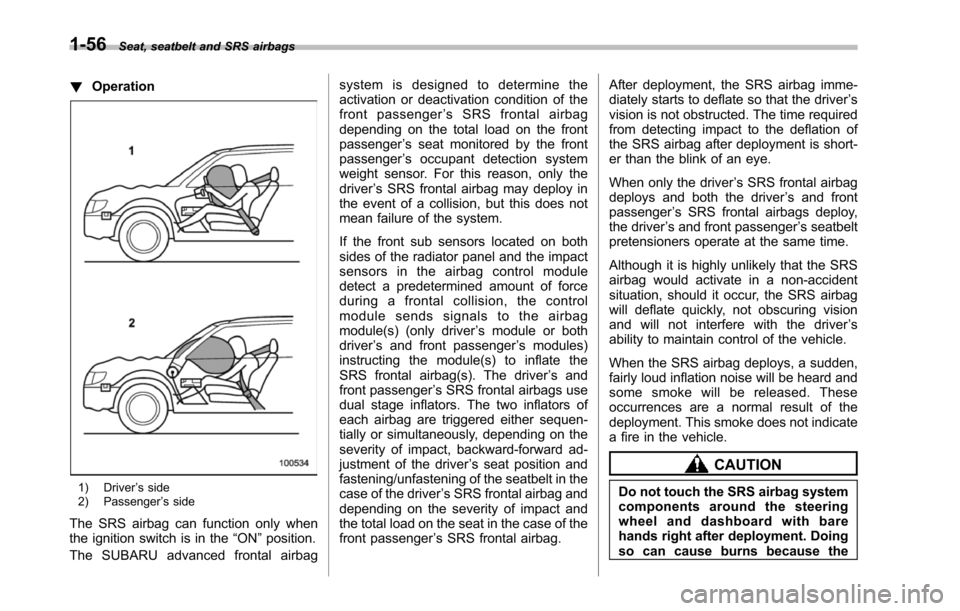
1) Driver’s side2) Passenger’s side
The SRS airbag can function only whenthe ignition switch is in the“ON”position.
The SUBARU advanced frontal airbag
system is designed to determine theactivation or deactivation condition of thefront passenger’sSRSfrontalairbagdepending on the total load on the frontpassenger’s seat monitored by the frontpassenger’s occupant detection systemweight sensor. For this reason, only thedriver’s SRS frontal airbag may deploy inthe event of a collision, but this does notmeanfailure of the system.
If the front sub sensors located on bothsides of the radiator panel and the impactsensors in the airbag control moduledetect a predetermined amount of forceduring a frontal collision, the controlmodule sends signals to the airbagmodule(s) (only driver’s module or bothdriver’s and front passenger’s modules)instructing the module(s) to inflate theSRS frontal airbag(s). The driver’s andfront passenger’s SRS frontal airbags usedual stage inflators. The two inflators ofeach airbag are triggered either sequen-tially or simultaneously, depending on theseverity of impact, backward-forward ad-justmentof the driver’s seat position andfastening/unfastening of the seatbelt in thecase of the driver’s SRS frontal airbag anddepending on the severity of impact andthe total load on the seat in the case of thefront passenger’s SRS frontal airbag.
After deployment, the SRS airbag imme-diately starts to deflate so that the driver’svision is not obstructed. The time requiredfrom detecting impact to the deflation ofthe SRS airbag after deployment is short-er than the blink of an eye.
When only the driver’s SRS frontal airbagdeploys and both the driver’s and frontpassenger’s SRS frontal airbags deploy,the driver’s and front passenger’s seatbeltpretensioners operate at the same time.
Although it is highly unlikely that the SRSairbag would activate in a non-accidentsituation, should it occur, the SRS airbagwill deflate quickly, not obscuring visionand will not interfere with the driver’sability to maintain control of the vehicle.
When the SRS airbag deploys, a sudden,fairly loud inflation noise will be heard andsome smoke will be released. Theseoccurrencesare a normal result of thedeployment. This smoke does not indicatea fire in the vehicle.
CAUTION
Do not touch the SRS airbag systemcomponents around the steeringwheel and dashboard with barehands right after deployment. Doingso can cause burns because the