tire type SUBARU WRX 2016 User Guide
[x] Cancel search | Manufacturer: SUBARU, Model Year: 2016, Model line: WRX, Model: SUBARU WRX 2016Pages: 594, PDF Size: 19.43 MB
Page 549 of 594

Specifications/Specifications
& Electrical system Battery type and capacity (5HR) 55D23L
Alternator STI 12V-110A
Except STI 12V-130A
Spark plugs STI SILFR6A (NGK)
Except STI ILKAR8H6 (NGK)
& Tires Tire size 235/45R17 94W 245/40R18 97W
Wheel size
17 6 8J 18 6 8 1/2J
Pressure Front
33 psi (230 kPa, 2.3 kgf/cm 2
) 33 psi (230 kPa, 2.3 kgf/cm 2
)
Rear
32 psi (220 kPa, 2.2 kgf/cm 2
) 32 psi (220 kPa, 2.2 kgf/cm 2
)
Wheel nut tightening torque
89 lbf·ft (120 N·m, 12 kgf·m)* 1
*1: This torque is equivalent to applying approximately 88 to 110 lbf (40 to 50 kgf) at the end of the wheel nut wrench. If you have tightened the wheel
nuts by yourself, have the tightening torque checked at the nearest automotive service facility as soon as possible. For the wheel nut tightening
procedure, refer to “ Changing a flat tire ” F 9-4.
& Temporary spare tires Temporary spare tire size T145/70D17 205/50R17
Temporary spare tire inflation pressure
(recommended cold tire inflation pressure) 60 psi (420 kPa, 4.2 kgf/cm 2
) 33 psi (230 kPa, 2.3 kgf/cm 2
)
Wheel nut tightening torque
89 lbf·ft (120 N·m, 12 kgf·m)* 1
* 2
*1: This torque is equivalent to applying approximately 88 to 110 lbf (40 to 50 kgf) at the end of the wheel nut wrench. If you have tightened the wheel
nuts by yourself, have the tightening torque checked at the nearest automotive service facility as soon as possible.
*2: For the wheel nut tightening procedure, refer to “ Changing a flat tire ” F 9-4.12-8
Page 561 of 594

Consumer information and Reporting safety defects/For U.S.A.
For U.S.A. The following information has been
compiled according to Code of
Federal Regulations “ Title 49, Part
575 ” . Tire information & Tire labeling
Many markings (e.g. Tire size, Tire
Identification Number or TIN) are
placed on the sidewall of a tire by
tire manufacturers. These markings
can provide you with useful infor-
mation on the tire. ! Tire size
Your vehicle comes equipped with
P-Metric tire size. It is important to
understand the sizing system in
selecting the proper tire for your
vehicles. Here is a brief review of
the tire sizing system with a break-
down of its individual elements.
! P Metric
With the P-Metric system, Section
Width is measured in millimeters.
To convert millimeters into inches,
divide by 25.4. The Aspect Ratio
(Section Height divided by Section
Width) helps provide more dimen-
sional information about the tire
size. Example:
(1) P = Certain tire type used on
light duty vehicles such as passen-
ger cars
(2) Section Width in millimeters
(3) Aspect Ratio (= section height
7 section width).
(4) R = Radial Construction
(5) Rim diameter in inches
! Load and Speed Rating De-
scriptions
The load and speed rating descrip-
tions will appear following the size
designation.
They provide two important facts
about the tire. First, the number
designation is its load index. Sec-
ond, the letter designation indicates
the tire ’ s speed rating.13-2
Page 562 of 594
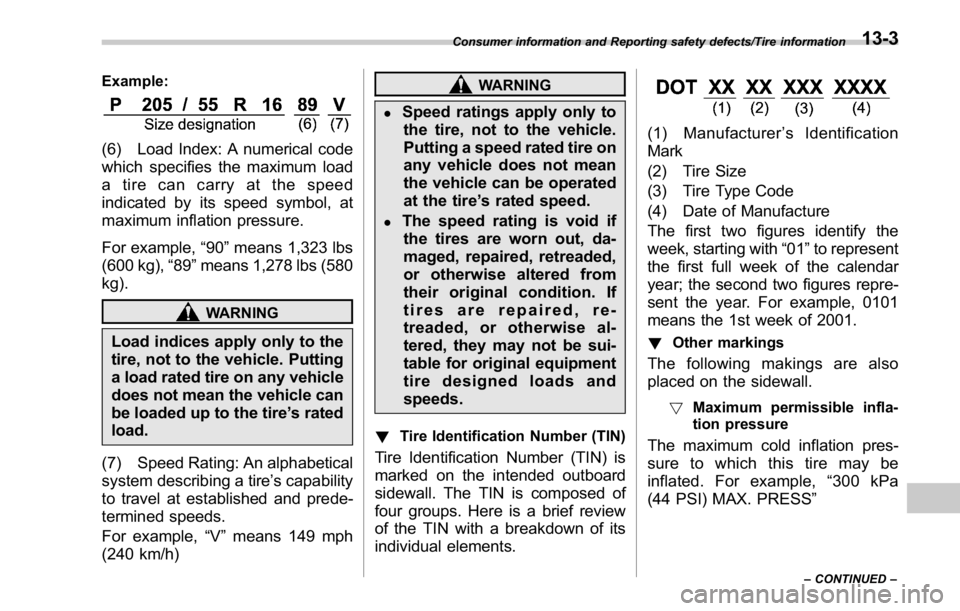
Example:
(6) Load Index: A numerical code
which specifies the maximum load
a tire can carry at the speed
indicated by its speed symbol, at
maximum inflation pressure.
For example, “ 90 ” means 1,323 lbs
(600 kg), “ 89 ” means 1,278 lbs (580
kg).
WARNING
Load indices apply only to the
tire, not to the vehicle. Putting
a load rated tire on any vehicle
does not mean the vehicle can
be loaded up to the tire ’ s rated
load.
(7) Speed Rating: An alphabetical
system describing a tire ’ s capability
to travel at established and prede-
termined speeds.
For example, “ V ” means 149 mph
(240 km/h) WARNING.
Speed ratings apply only to
the tire, not to the vehicle.
Putting a speed rated tire on
any vehicle does not mean
the vehicle can be operated
at the tire ’ s rated speed..
The speed rating is void if
the tires are worn out, da-
maged, repaired, retreaded,
or otherwise altered from
their original condition. If
tires are repaired, re-
treaded, or otherwise al-
tered, they may not be sui-
table for original equipment
tire designed loads and
speeds.
! Tire Identification Number (TIN)
Tire Identification Number (TIN) is
marked on the intended outboard
sidewall. The TIN is composed of
four groups. Here is a brief review
of the TIN with a breakdown of its
individual elements. (1) Manufacturer ’ s Identification
Mark
(2) Tire Size
(3) Tire Type Code
(4) Date of Manufacture
The first two figures identify the
week, starting with “ 01 ” to represent
the first full week of the calendar
year; the second two figures repre-
sent the year. For example, 0101
means the 1st week of 2001.
! Other markings
The following makings are also
placed on the sidewall.
! Maximum permissible infla-
tion pressure
The maximum cold inflation pres-
sure to which this tire may be
inflated. For example, “ 300 kPa
(44 PSI) MAX. PRESS ”Consumer information and Reporting safety defects/Tire information
– CONTINUED –13-3
Page 563 of 594
Consumer information and Reporting safety defects/Tire information
! Maximum load rating
The load rating at the maximum
permissible weight load for this tire.
For example, “ MAX. LOAD 580 kg
(1279 LBS) @ 300 kPa (44 PSI)
MAX. PRESS. ”
WARNING
Maximum load rating applies
only to the tire, not to the
vehicle. Putting a load rated
tire on any vehicle does not
mean the vehicle can be
loaded up to the tire ’ s rated
load.
! Construction type
Applicable construction of this tire.
For example, “ TUBELESS STEEL
BELTED RADIAL ”
! Construction
The generic name of each cord
material used in the plies (both
sidewall and tread area) of this tire.
For example, “ PLIES: TREAD 2 STEEL + 2 POLYESTER SIDE-
WALL 2 POLYESTER ”! Uniform Tire Quality Grading
(UTQG)
For details, refer to “ Uniform tire
quality grading standards ” F 13-14 .
& Recommended tire inflation
pressure ! Recommended cold tire infla-
tion pressure
For recommended cold tire inflation
pressure for your vehicle ’ s tires,
refer to “ Tires ” F 12-8 .
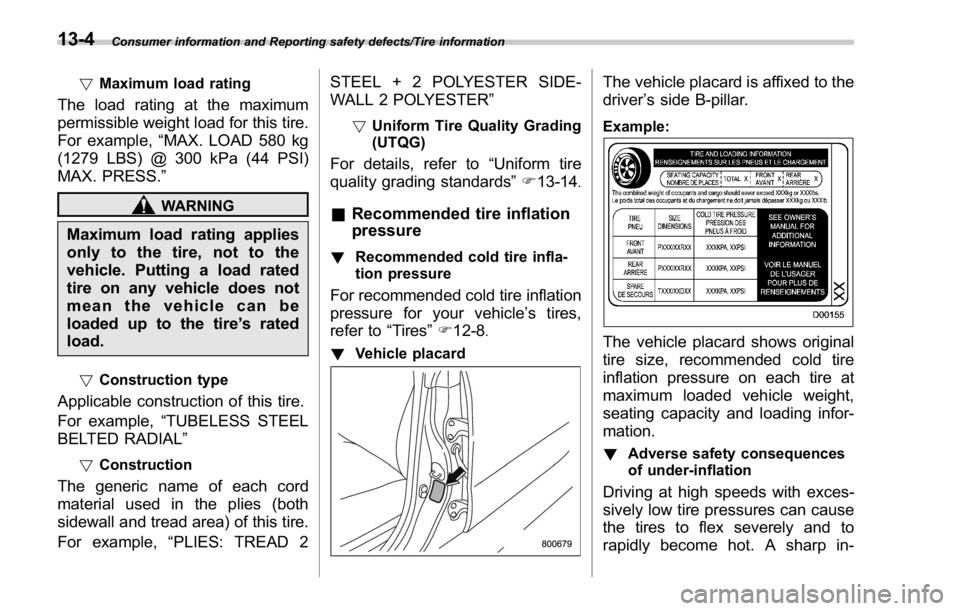
! Vehicle placard The vehicle placard is affixed to the
driver ’ s side B-pillar.Example:
The vehicle placard shows original
tire size, recommended cold tire
inflation pressure on each tire at
maximum loaded vehicle weight,
seating capacity and loading infor-
mation.
! Adverse safety consequences
of under-inflation
Driving at high speeds with exces-
sively low tire pressures can cause
the tires to flex severely and to
rapidly become hot. A sharp in-13-4
Page 566 of 594

.
Passenger car tire
A tire intended for use on passen-
ger cars, multipurpose passenger
vehicles, and trucks, that have a
gross vehicle weight rating (GVWR)
of 10,000 lbs (4,535 kg) or less. .
Ply
A layer of rubber-coated parallel
cords. .
Ply separation
A parting of rubber compound
between adjacent plies. .
Pneumatic tire
A mechanical device made of rub-
ber, chemicals, fabric and steel or
other materials, that, when
mounted on an automotive wheel,
provides the traction and contains
the gas or fluid that sustains the
load. .
Production options weight
The combined weight of those
installed regular production options
weighing over 5.1 lbs (2.3 kg) in
excess of those standard items
which they replace, not previously
considered in curb weight or acces- sory weight, including heavy duty
brakes, ride levelers, roof rack,
heavy duty battery, and special
trim. .
Radial ply tire
A pneumatic tire in which the ply
cords that extend to the beads are
laid at substantially 90 degrees to
the centerline of the tread. .
Recommended inflation pres-
sure
The cold inflation pressure recom-
mended by a vehicle manufacturer. .
Reinforced tire
A tire designed to operate at higher
loads and at higher inflation pres-
sures than the corresponding stan-
dard tire. .
Rim
A metal support for a tire or a tire
and tube assembly upon which the
tire beads are seated. .
Rim diameter
Nominal diameter of the bead seat.
.
Rim size designation
Rim diameter and width. .
Rim type designation
The industry of manufacturer ’ s des-
ignation for a rim by style or code. .
Rim width
Nominal distance between rim
flanges. .
Section width
The linear distance between the
exteriors of the sidewalls of an
inflated tire, excluding elevations
due to labeling, decoration, or
protective bands. .
Sidewall
That portion of a tire between the
tread and bead. .
Sidewall separation
The parting of the rubber com-
pound from the cord material in
the sidewall. .
Test rim
The rim on which a tire is fitted for
testing, and it may be any rim listed
as appropriate for use with that tire. .
Tread
That portion of a tire that comes
into contact with the road.Consumer information and Reporting safety defects/Tire information
– CONTINUED –13-7
Page 573 of 594

Consumer information and Reporting safety defects/Uniform tire quality grading standards
.
Vehicle stability will deteriorate..
Heavy and/or high-mounted
loads could increase the risk of
rollover. .
Stopping distance will increase..
Brakes could overheat and fail..
Suspension, bearings, axles and
other body parts could break or
experience accelerated wear that
will shorten vehicle life. .
Tires could fail..
Tread separation could occur..
Tire could separate from its rim.
& Steps for Determining Cor-
rect Load Limit1.
Locate the statement “ The com-
bined weight of occupants and
cargo should never exceed XXX
kg or XXX lbs. ” on your vehicle ’ s
placard.
2.
Determine the combined weight
of the driver and passengers that
will be riding in your vehicle.
3.
Subtract the combined weight of
the driver and passengers from
XXX kg or XXX lbs. 4.
The resulting figure equals the
available amount of cargo and
luggage load capacity. For exam-
ple, if the “ XXX ” amount equals
1400 lbs. and there will be five 150
lb passengers in your vehicle, the
amount of available cargo and
luggage load capacity is 650 lbs.
(1400 − 750 (5 6 150) = 650 lbs.)5.
Determine the combined weight
of luggage and cargo being loaded
on the vehicle. That weight may not
safely exceed the available cargo
and luggage load capacity calcu-
lated in Step 4.
6.
If your vehicle will be towing a
trailer, load from your trailer will be
transferred to your vehicle. Consult
this manual to determine how this
reduces the available cargo and
luggage load capacity of your ve-
hicle. Uniform tire quality grading
standards This information indicates the rela-
tive performance of passenger car
tires in the area of treadwear,
traction, and temperature resis-
tance. This is to aid the consumer
in making an informed choice in the
purchase of tires.
Quality grades can be found where
applicable on the tire sidewall be-
tween tread shoulder and maxi-
mum section width. For example:
Treadwear 200 Traction AA Tem-
perature A
The quality grades apply to new
pneumatic tires for use on passen-
ger cars. However, they do not
apply to deep tread, winter type
snow tires, space-saver or tempor-
ary use spare tires, tires with
nominal rim diameters of 12 inches
or less, or to some limited produc-
tion tires.
All passenger car tires must con-13-14
Page 585 of 594

14-10 Index
Select lever
Position indicator ................................................... 3-34
Shift lock function ................................................... 7-27
Setup (phone settings) .............................................. 5-101
Phone settings ..................................................... 5-101
Shift-up indicator light ................................................. 3-34
Shock sensors ........................................................... 2-31
Shoulder pretensioners ............................................... 1-17
SI-DRIVE
Indicator light ......................................................... 3-34
SI-DRIVE mode ......................................................... 7-29
Snow tires ......................................................... 8-9, 11-31
Snowy and icy roads .................................................... 8-8
Sounding a panic alarm .............................................. 2-23
Spark plugs ...................................................... 11-21, 12-8
Specifications ............................................................ 12-2
Speedometer ............................................................... 3-9
SRS
Curtain airbag ........................................................ 1-50
Frontal airbag ........................................................ 1-38
Side airbag ........................................................... 1-50
SRS airbag (Supplemental Restraint System airbag) ... 3, 1-33
SRS airbag system
Monitors. ............................................................... 1-57
Servicing ............................................................... 1-58
Warning light ......................................................... 3-15
Starting & stopping engine .................................... 7-9, 7-12
State emission testing (U.S. only) .................................. 7-7
Steering responsive fog lights system ........................... 3-99
OFF indicator ........................................................ 3-37 Steering wheel
Power ................................................................... 7-33
Tilt/telescopic ....................................................... 3-113
Stop light ................................................................. 11-48
Storage compartment ................................................... 6-5
Sun shade ................................................................. 2-40
Sun visors .................................................................. 6-3
Supplemental Restraint System airbag (SRS) ................ 1-33
Synthetic leather upholstery ......................................... 10-5
T
Tachometer ................................................................ 3-10
Temperature gauge ..................................................... 3-11
Temperature warning light
AT OIL TEMP ......................................................... 3-18
Rear differential oil .................................................. 3-18
Temporary spare tire ............................................ 9-2, 12-8
Tether (child restraint system) .............................. 1-29, 1-32
Tie-down hooks .......................................................... 9-12
Tips for operating the audio/visual system ..................... 5-21
Operating information .............................................. 5-21
Tire................................................................. 11-31, 12-8
Chains .................................................................. 8-10
Inspection ............................................................ 11-32
Pressures and wear .............................................. 11-33
Replacement. ....................................................... 11-36
Rotation ..............................................................
11-36
Size and pressure .................................................. 12-8
Types .................................................................. 11-31
Tire pressure monitoring system (TPMS) ....... 7-42, 9-8, 11-31
Warning light .......................................................... 3-19