engine oil SUBARU WRX 2016 Owner's Guide
[x] Cancel search | Manufacturer: SUBARU, Model Year: 2016, Model line: WRX, Model: SUBARU WRX 2016Pages: 594, PDF Size: 19.43 MB
Page 506 of 594
used if synthetic oil is unavailable.
Cooling system WARNING. Never attempt to remove the
radiator cap until the engine has
been shut off and has cooled
down completely. Since the cool-
ant is under pressure, you may
suffer serious burns from a spray
of boiling hot coolant when the
cap is removed.
. Be careful of the rotating cooling
fan when the engine hood is
open. When the engine tempera-
ture is high, the cooling fan in the
engine compartment may oper-
ate when the ignition switch is
turned to the “ ON ” position, even
if the engine is stopped. Touch-
ing the cooling fan while it is
rotating may result in injury.
CAUTION
. Vehicles are filled at the factory
with SUBARU Super Coolant that
does not require the first change
for 11 years/137,500 miles (11
years/220,000 km). This coolant
should not be mixed with any other brand or type of coolant
during this period. Mixing with a
different coolant will reduce the
life of the coolant. Should it be
necessary to top up the coolant
for any reason, use only
SUBARU Super Coolant.
If the SUBARU Super Coolant is
diluted with another brand or
type, the maintenance interval is
shortened to that of the mixing
coolant.
. Do not splash the engine coolant
over painted parts. The alcohol
contained in the engine coolant
may damage the paint surface.
& Cooling fan, hose and con-
nections Your vehicle employs an electric cooling
fan which is thermostatically controlled to
operate when the engine coolant reaches
a specific temperature.
If the radiator cooling fan does not operate
even when the engine coolant tempera-
ture gauge exceeds the normal operating
range, the cooling fan circuit may be
defective. Refer to “ Temperature gauge ”
F 3-11. Maintenance and service/Cooling system
– CONTINUED –11-17
Page 511 of 594

Maintenance and service/Drive belts
Drive belts NOTE For models except STI, it is unneces-
sary to check the deflection of the drive
belt periodically because this engine is
equipped with an automatic belt ten-
sion adjuster. However, replacement of
the belt should be done according to
the maintenance schedule in the “ War-
ranty and Maintenance Booklet ” . Con-
sult your SUBARU dealer for replace-
ment.
If the drive belt is loose, cracked or
worn, contact your SUBARU dealer. STI
1) Power steering oil pump pulley
2) Front side belt
3) Alternator pulley
4) Air conditioner compressor pulley
5) Rear side belt
6) Crank pulley
A) 22 lbf (98 N, 10 kgf)
CAUTION
The front side belt, which runs in
conjunction with the following com-
ponents, must be used within the
specified deflection.
. Power steering oil pump pulley
. Alternator pulley
. Crank pulley
Check the deflection of the front side belt and if there is any loosen-
ess, cracks, wear or unusual noise
on the front side belt, contact your
SUBARU dealer.
Continuing to use the vehicle with
the belt outside of the specification
may cause the engine to malfunc-
tion and the above components to
malfunction.
To check the deflection of the front side
belt, place a straightedge (ruler) across
two adjacent pulleys (alternator pulley and
crank pulley) and apply a force of 22 lbf
(98 N, 10 kgf) midway between the pulleys
by using a spring scale. The belt deflec-
tion should be the amount specified. If the
front side belt is loose, cracked or worn,
contact your SUBARU dealer. in (mm)
Deflection
New belt
Used belt
A 0.28 – 0.35
(7.0 – 9.0) 0.35 – 0.43
(9.0 – 11.0)
The rear side belt is a stretch-type belt,
therefore the deflection does not need to
be checked. If there are cracks or wear
confirmed on the belts and a squeaking
noise is heard from them, contact your
SUBARU dealer.11-22
Page 513 of 594
Maintenance and service/Power steering fluid (STI)
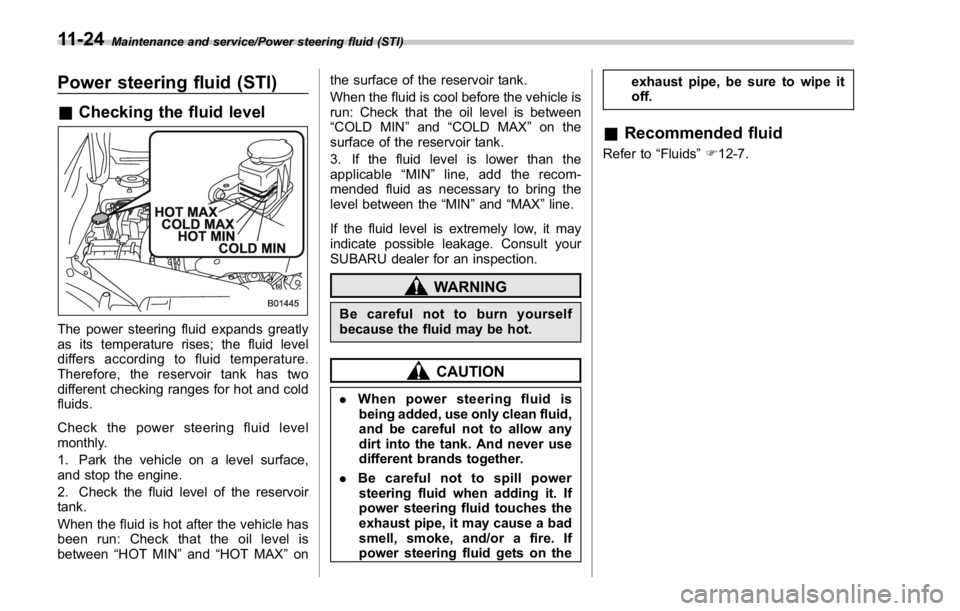
Power steering fluid (STI) & Checking the fluid level
The power steering fluid expands greatly
as its temperature rises; the fluid level
differs according to fluid temperature.
Therefore, the reservoir tank has two
different checking ranges for hot and cold
fluids.
Check the power steering fluid level
monthly.
1. Park the vehicle on a level surface,
and stop the engine.
2. Check the fluid level of the reservoir
tank.
When the fluid is hot after the vehicle has
been run: Check that the oil level is
between “ HOT MIN ” and “ HOT MAX ” on the surface of the reservoir tank.
When the fluid is cool before the vehicle is
run: Check that the oil level is between
“ COLD MIN ” and “ COLD MAX ” on the
surface of the reservoir tank.
3. If the fluid level is lower than the
applicable “ MIN ” line, add the recom-
mended fluid as necessary to bring the
level between the “ MIN ” and “ MAX ” line.
If the fluid level is extremely low, it may
indicate possible leakage. Consult your
SUBARU dealer for an inspection.
WARNINGBe careful not to burn yourself
because the fluid may be hot.
CAUTION
. When power steering fluid is
being added, use only clean fluid,
and be careful not to allow any
dirt into the tank. And never use
different brands together.
. Be careful not to spill power
steering fluid when adding it. If
power steering fluid touches the
exhaust pipe, it may cause a bad
smell, smoke, and/or a fire. If
power steering fluid gets on the exhaust pipe, be sure to wipe it
off.
& Recommended fluid Refer to “ Fluids ” F 12-7.
11-24
Page 527 of 594
Maintenance and service/Aluminum wheels
Aluminum wheels Aluminum wheels can be scratched and
damaged easily. Handle them carefully to
maintain their appearance, performance,
and safety.
. When any of the wheels are removed
and replaced for tire rotation or to change
a flat tire, always check the tightness of
the wheel nuts after driving approximately
600 miles (1,000 km). If any nut is loose,
tighten it to the specified torque.
. Never apply oil to the threaded parts,
wheel nuts, or tapered surface of the
wheel.
. Never let the wheel rub against sharp
protrusions or curbs.
. When wheel nuts, balance weights, or
the center cap is replaced, be sure to
replace them with genuine SUBARU parts
designed for aluminum wheels. Windshield washer fluid CAUTIONNever use engine coolant as washer
fluid because it could cause paint
damage.
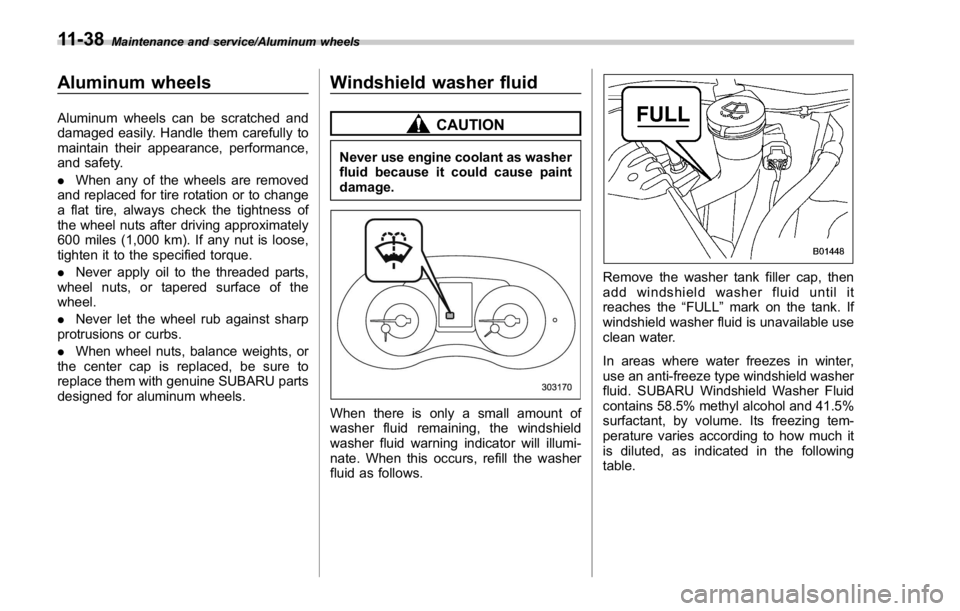
When there is only a small amount of
washer fluid remaining, the windshield
washer fluid warning indicator will illumi-
nate. When this occurs, refill the washer
fluid as follows. Remove the washer tank filler cap, then
add windshield washer fluid until it
reaches the “ FULL ” mark on the tank. If
windshield washer fluid is unavailable use
clean water.
In areas where water freezes in winter,
use an anti-freeze type windshield washer
fluid. SUBARU Windshield Washer Fluid
contains 58.5% methyl alcohol and 41.5%
surfactant, by volume. Its freezing tem-
perature varies according to how much it
is diluted, as indicated in the following
table.11-38
Page 542 of 594

Specifications ..................................................... 12-2Dimensions ........................................................ 12-2
Engine ............................................................... 12-3
Fuel ................................................................... 12-3
Engine oil .......................................................... 12-4
Manual transmission, front differential and rear
differential gear oil ........................................... 12-6
Fluids ................................................................ 12-7
Engine coolant ................................................... 12-7
Electrical system ................................................ 12-8
Tires .................................................................. 12-8 Temporary spare tires ........................................ 12-8
Brake disc ......................................................... 12-9
Fuses and circuits ........................................... 12-10Fuse panel located in the passenger
compartment ................................................. 12-10
Fuse panel located in the engine
compartment ................................................. 12-12
Bulb chart ......................................................... 12-16
Vehicle identification ....................................... 12-18
Specifications
12
Page 545 of 594

Specifications/Specifications
& Engine oilFor the checking, adding and replacing procedure or other details, refer to “ Engine oil ” F 11-13.
NOTE The procedure for changing the engine oil and oil filter should be performed by a properly-trained expert. It is recommended
that you have this service performed by your SUBARU dealer.
! Oil filterModel STI Except STI
Oil filter color Black Black
Part number 15208AA100 15208AA170
Amount of rotation 1 rotation 3/4 rotation
! Approved engine oil
Always use the SUBARU approved engine oil. For further details, please contact your SUBARU dealer.
If the approved engine oil is unavailable, use the alternative engine oil described on the next page.12-4
Page 546 of 594
! Alternative engine oil
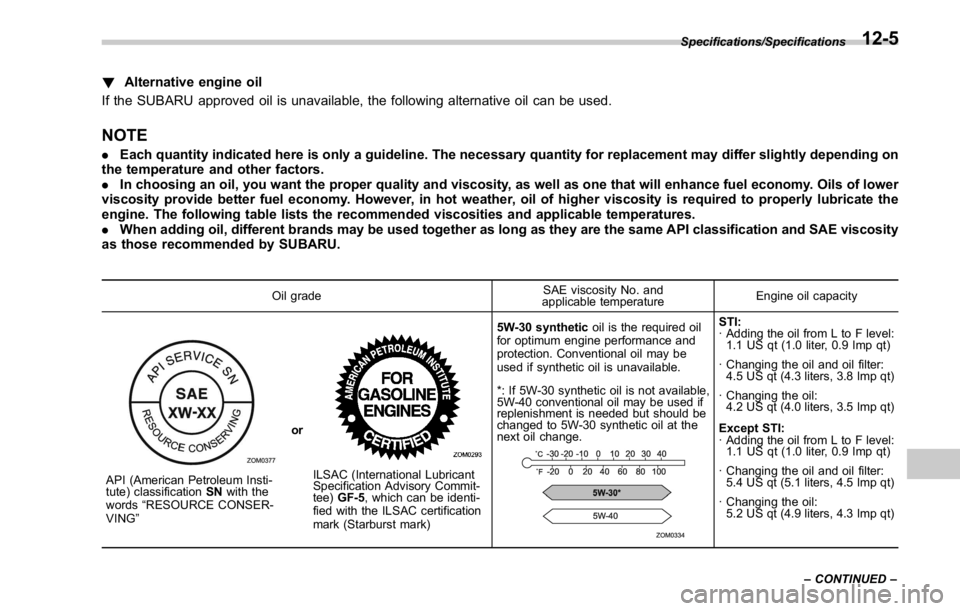
If the SUBARU approved oil is unavailable, the following alternative oil can be used.
NOTE . Each quantity indicated here is only a guideline. The necessary quantity for replacement may differ slightly depending on
the temperature and other factors.
. In choosing an oil, you want the proper quality and viscosity, as well as one that will enhance fuel economy. Oils of lower
viscosity provide better fuel economy. However, in hot weather, oil of higher viscosity is required to properly lubricate the
engine. The following table lists the recommended viscosities and applicable temperatures.
. When adding oil, different brands may be used together as long as they are the same API classification and SAE viscosity
as those recommended by SUBARU.
Oil grade SAE viscosity No. and
applicable temperature Engine oil capacity
API (American Petroleum Insti-
tute) classification SN with the
words “ RESOURCE CONSER-
VING ” or
ILSAC (International Lubricant
Specification Advisory Commit-
tee) GF-5 , which can be identi-
fied with the ILSAC certification
mark (Starburst mark) 5W-30 synthetic oil is the required oil
for optimum engine performance and
protection. Conventional oil may be
used if synthetic oil is unavailable.
*: If 5W-30 synthetic oil is not available,
5W-40 conventional oil may be used if
replenishment is needed but should be
changed to 5W-30 synthetic oil at the
next oil change. STI:
· Adding the oil from L to F level:
1.1 US qt (1.0 liter, 0.9 Imp qt)
· Changing the oil and oil filter:
4.5 US qt (4.3 liters, 3.8 Imp qt)
· Changing the oil:
4.2 US qt (4.0 liters, 3.5 Imp qt)
Except STI:
· Adding the oil from L to F level:
1.1 US qt (1.0 liter, 0.9 Imp qt)
· Changing the oil and oil filter:
5.4 US qt (5.1 liters, 4.5 Imp qt)
· Changing the oil:
5.2 US qt (4.9 liters, 4.3 Imp qt)Specifications/Specifications
– CONTINUED –12-5
Page 548 of 594

*4: You may use this type of manual transmission oil. However, using this type of oil will detract from driveability and fuel efficiency.
& Fluids Fluid
Fluid type* 1
Fluid capacity* 2
Remarks* 3
Continuously variable transmission
fluid (CVT models) Consult your SUBARU dealer. 13.1 US qt (12.4 liters, 10.9 Imp qt) “ Continuously variable trans-
mission fluid ” F 11-23
Brake fluid FMVSS No. 116, fresh DOT 3 or DOT 4
brake fluid –“ Brake fluid ” F 11-25
Clutch fluid (MT models) FMVSS No. 116, fresh DOT 3 or DOT 4
brake fluid – “ Clutch fluid (MT models) ” F 11 -
26
Power steering fluid (STI) · SUBARU ATF
· “ Dexron III ” Type Automatic Transmis-
sion Fluid
· IDEMITSU ATF HP 0.7 US qt (0.7 liter, 0.6 Imp qt) “ Power steering fluid (STI) ”
F 11-24
*1: Use one of the indicated types of fluid.
*2: The indicated fluid quantity is only a guideline. The necessary quantity for replacement may differ slightly depending on the temperature and other
factors.
*3: For more details about maintenance and service, refer to the indicated section.
& Engine coolant Vehicle model Coolant capacity Coolant type
STI 8.2 US qt (7.7 liters, 6.8 Imp qt)
SUBARU Super Coolant
Except STI MT models 8.7 US qt (8.2 liters, 7.2 Imp qt)
CVT models 8.9 US qt (8.4 liters, 7.4 Imp qt)
The indicated coolant quantity is only a guideline. The necessary quantity for replacement may differ slightly depending on the temperature and other
factors. For more details about maintenance and service, refer to “ Cooling system ” F 11-17. Specifications/Specifications
– CONTINUED –12-7
Page 564 of 594

crease in temperature could cause
tread separation, and failure of the
tire(s). Possible resulting loss of
vehicle control could lead to an
accident. ! Measuring and adjusting air
pressure to achieve proper in-
flation
Check and, if necessary, adjust the
pressure of each tire (including the
spare) at least once a month and
before any long journey. Check the
tire pressures when the tires are
cold. Use a pressure gauge to
adjust the tire pressures to the
specific values. Driving even a
short distance warms up the tires
and increases the tire pressures.
Also, the tire pressures are affected
by the outside temperature. It is
best to check tire pressure out-
doors before driving the vehicle.
When a tire becomes warm, the air
inside it expands, causing the tire
pressure to increase. Be careful not
to mistakenly release air from a
warm tire to reduce its pressure. & Glossary of tire terminology .
Accessory weight
The combined weight (in excess of
those standard items which may be
replaced) of automatic transmis-
sion, power steering, power brakes,
power windows, power seats, radio,
and heater, to the extent that these
items are available as factory-in-
stalled equipment (whether in-
stalled or not). .
Bead
The part of the tire that is made of
steel wires, wrapped or reinforced
by ply cords and that is shaped to fit
the rim. .
Bead separation
A breakdown of the bond between
components in the bead. .
Bias ply tire
A pneumatic tire in which the ply
cords that extend to the beads are
laid at alternate angles substantially
less than 90 degrees to the center-
line of the tread.
.
Carcass
The tire structure, except tread and sidewall rubber which, when in-
flated, bears the load. .
Chunking
The breaking away of pieces of the
tread or sidewall. .
Cold tire pressure
The pressure in a tire that has been
driven less than 1 mile or has been
standing for three hours or more. .
Cord
The strands forming the plies in the
tire. .
Cord separation
The parting of cords from adjacent
rubber compounds. .
Cracking
Any parting within the tread, side-
wall, or inner liner of the tire
extending to cord material. .
Curb weight
The weight of a motor vehicle with
standard equipment including the
maximum capacity of fuel, oil and
coolant, and if so equipped, air
conditioning and additional weight
optional engine.Consumer information and Reporting safety defects/Tire information
– CONTINUED –13-5
Page 578 of 594

Booster ........................................................ 7-35, 11-27
Disc ..................................................................... 12-9
Fluid ............................................................ 11-25, 12-7
Pad and lining ...................................................... 11-30
Parking ........................................................ 7-44, 11-30
Pedal .................................................................. 11-27
System ................................................................. 7-35
Brake pedal
Free play ............................................................. 11-27
Reserve distance .................................................. 11-28
Brake system ............................................................ 7-35
Warning light ......................................................... 3-21
Braking ..................................................................... 7-35
Tips...................................................................... 7-35
Breaking-in of new brake pads and linings ................... 11-30
BSD/RCTA ................................................................ 7-56
BSD/RCTA approach indicator light/warning buzzer .... 7-59
BSD/RCTA OFF switch ........................................... 7-61
BSD/RCTA warning indicator ................................... 7-60
Bulb
Chart .................................................................. 12-16
Replacing ............................................................. 11-44
C
Catalytic converter ....................................................... 8-3
Center
Console .................................................................. 6-5
Changing
Coolant ................................................................ 11-19
Flat tire ................................................................... 9-4
Oil and oil filter ..................................................... 11-15 Charge warning light ................................................... 3-17
CHECK ENGINE warning light/Malfunction indicator
light ....................................................................... 3-16
Checking
Brake pedal free play ............................................ 11-27
Brake pedal reserve distance ................................. 11-28
Clutch function ..................................................... 11-28
Clutch pedal free play ........................................... 11-28
Coolant level ........................................................ 11-18
Fluid level (brake fluid) .......................................... 11-25
Fluid level (clutch fluid) .......................................... 11-26
Fluid level (power steering fluid) ............................. 11-24
Fluid level (washer fluid) ........................................ 11-38
Oil level (engine oil) .............................................. 11-13
Child restraint systems ................................................ 1-21
Installation of a booster seat .................................... 1-28
Installation with ALR/ELR seatbelt ............................ 1-24
Lower and tether anchorages ................................... 1-29
Top tether anchorages ............................................ 1-32
Child safety ................................................................... 4
Locks .................................................................... 2-32
Chime
Key........................................................................ 3-5
Light ..................................................................... 3-94
Seatbelt. ................................................................ 3-14
Cigarette lighter ........................................................... 6-9
Cleaning
Aluminum
wheels ................................................... 10-3
Interior .................................................................. 10-5
Ventilation grille ....................................................... 4-9
Climate control system ................................................. 4-3 Index
14-3