fuel pressure SUBARU WRX 2016 Owners Manual
[x] Cancel search | Manufacturer: SUBARU, Model Year: 2016, Model line: WRX, Model: SUBARU WRX 2016Pages: 594, PDF Size: 19.43 MB
Page 27 of 594

Mark Name Page
Cruise control indica-
tor 3-35
Cruise control set in-
dicator 3-35
Traction mode indica-
tor 3-27
Low fuel warning light 3-24
Low tire pressure
warning light
(U.S.-spec. models) 3-19
Windshield washer
fluid warning indicator 3-18
Sport (S) mode indi-
cator (if equipped) 3-34
Intelligent (I) mode in-
dicator (if equipped) 3-34
Sport Sharp (S#)
mode indicator (if
equipped) 3-34
Shift-up indicator (STI) 3-34
Driver ’ s control center
differential auto indi-
cator (STI) 3-35 Mark Name Page
Auto [+] mode indica-
tor (STI) 3-36
Auto [ − ] mode indica-
tor (STI) 3-36
Driver ’ s control center
differential indicator
and warning (STI) 3-36
REV indicator light
(STI) 3-37
Steering responsive
fog lights warning in-
dicator/Steering re-
sponsive fog lights
OFF indicator (if
equipped) 3-37
BSD/RCTA warning
indicator (if equipped) 3-37
BSD/RCTA OFF indi-
cator (if equipped) 3-3722
Page 130 of 594

Ignition switch (models without push-
button start system) ......................................... 3-4LOCK .................................................................. 3-4
ACC.................................................................... 3-5
ON...................................................................... 3-5
START ................................................................ 3-5
Key reminder chime ............................................ 3-5
Ignition switch light ............................................. 3-6
Push-button ignition switch (models with
push-button start system) ............................... 3-6Safety precautions .............................................. 3-6
Operating range for push-button start system ...... 3-6
Switching power ................................................. 3-7
When access key does not operate properly ........ 3-8
Hazard warning flasher ....................................... 3-8
Meters and gauges. ............................................. 3-8Combination meter illumination ........................... 3-8
Canceling the function for meter/gauge needle
movement upon turning on the ignition
switch ............................................................... 3-9
Speedometer ....................................................... 3-9
Odometer ............................................................ 3-9
Double trip meter ................................................ 3-9
Tachometer ........................................................ 3-10
Fuel gauge ......................................................... 3-10
Temperature gauge ............................................ 3-11
ECO gauge ........................................................ 3-12
REV indicator light and buzzer (STI). ................ 3-12
Warning and indicator lights ............................. 3-13
Seatbelt warning light and chime ........................ 3-14
SRS airbag system warning light ........................ 3-15 Front passenger ’ s frontal airbag ON and OFF
indicators ........................................................ 3-16
CHECK ENGINE warning light/Malfunction
indicator light .................................................. 3-16
Charge warning light .......................................... 3-17
Oil pressure warning light .................................. 3-17
Engine low oil level warning indicator (except
STI) ................................................................. 3-17
Windshield washer fluid warning indicator .......... 3-18
AT OIL TEMP warning light (CVT models) ........... 3-18
Rear differential oil temperature warning light
(STI) ................................................................ 3-18
Low tire pressure warning light (U.S.-spec.
models) ........................................................... 3-19
ABS warning light .............................................. 3-20
Brake system warning light ................................ 3-21
Electronic parking brake indicator light (models
with electronic parking brake system) .............. 3-23
Low fuel warning light ....................................... 3-24
Hill start assist warning light/Hill start assist OFF
indicator light (models without electronic
parking brake system) ..................................... 3-24
Hill Holder indicator light (models with electronic
parking brake system) ..................................... 3-24
Door open warning light .................................... 3-25
All-Wheel Drive warning light (if equipped) ......... 3-25
Power steering warning light (except STI) ........... 3-25
LED headlight warning light (if equipped) ........... 3-25
Vehicle Dynamics Control warning light/Vehicle
Dynamics Control operation indicator light .. ..... 3-26
Vehicle Dynamics Control OFF indicator light/
Traction mode indicator light.. .......................... 3-27Instruments and controls 3
Page 142 of 594
ever the engine speed enters the red
zone of the tachometer.
To change the REV indicator settings,
perform the procedures described in “ REV
settings (STI) ” F 3-47.
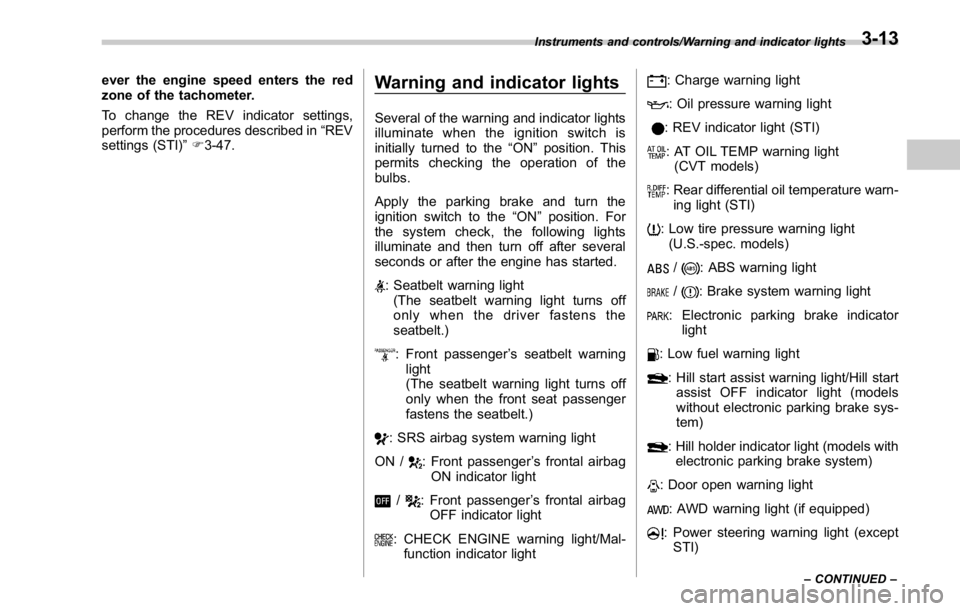
Warning and indicator lights Several of the warning and indicator lights
illuminate when the ignition switch is
initially turned to the “ ON ” position. This
permits checking the operation of the
bulbs.
Apply the parking brake and turn the
ignition switch to the “ ON ” position. For
the system check, the following lights
illuminate and then turn off after several
seconds or after the engine has started.
: Seatbelt warning light
(The seatbelt warning light turns off
only when the driver fastens the
seatbelt.)
: Front passenger ’ s seatbelt warning
light
(The seatbelt warning light turns off
only when the front seat passenger
fastens the seatbelt.)
: SRS airbag system warning light
ON /
: Front passenger ’ s frontal airbag
ON indicator light
/ : Front passenger ’ s frontal airbag
OFF indicator light
: CHECK ENGINE warning light/Mal-
function indicator light : Charge warning light
: Oil pressure warning light
: REV indicator light (STI)
: AT OIL TEMP warning light
(CVT models)
: Rear differential oil temperature warn-
ing light (STI)
: Low tire pressure warning light
(U.S.-spec. models)
/ : ABS warning light
/ : Brake system warning light
: Electronic parking brake indicator
light
: Low fuel warning light
: Hill start assist warning light/Hill start
assist OFF indicator light (models
without electronic parking brake sys-
tem)
: Hill holder indicator light (models with
electronic parking brake system)
: Door open warning light
: AWD warning light (if equipped)
: Power steering warning light (except
STI)Instruments and controls/Warning and indicator lights
– CONTINUED –3-13
Page 146 of 594

NOTE This light also illuminates when the fuel
filler cap is not tightened until it clicks.
If you have recently refueled your vehicle,
the cause of the CHECK ENGINE warning
light/malfunction indicator light illuminating
could be a loose or missing fuel filler cap.
Remove the cap and retighten it until it
clicks. Make sure nothing is interfering
with the sealing of the cap. Tightening the
cap will not make the CHECK ENGINE
warning light/malfunction indicator light
turn off immediately. It may take several
driving trips. If the light does not turn off,
take your vehicle to your authorized
SUBARU dealer immediately.
! If the light is blinking
If the light is blinking while driving, an
engine misfire condition has been de-
tected which may damage the emission
control system.
To prevent serious damage to the emis-
sion control system, you should do the
following.
. Reduce vehicle speed.
. Avoid hard acceleration.
. Avoid steep uphill grades.
. Reduce the amount of cargo, if possi-
ble.
The CHECK ENGINE warning light may stop blinking and illuminate steadily after
several driving trips. You should have your
vehicle checked by an authorized
SUBARU dealer immediately.
& Charge warning light If this light illuminates when the engine is
running, it may indicate that the charging
system is not working properly.
If the light illuminates while driving or does
not turn off after the engine starts, stop the
engine at the first safe opportunity and
check the alternator belt. If the belt is
loose, broken or if the belt is in good
condition but the light remains illuminated,
contact your nearest SUBARU dealer
immediately.
& Oil pressure warning
light If this light illuminates when the engine is
running, it may indicate that the engine oil
pressure is low and the lubricating system
is not working properly.
If the light illuminates while driving or does
not turn off after the engine starts, stop the
engine at the first safe opportunity and
check the engine oil level. If the oil level is
low, add oil immediately. If the engine oil is
at the proper level but the light remains
illuminated, contact your nearest SUBARU dealer immediately.
For details about checking the engine oil
level or adding the engine oil, refer to
“ Engine oil ” F 11-13.
CAUTIONDo not operate the engine with the
oil pressure warning light on. This
may cause serious engine damage.
& Engine low oil level
warning indicator (ex-
cept STI) This indicator appears when the engine oil
level decreases to the lower limit.
If the engine low oil level warning indicator
appears while driving, park the vehicle in a
safe and level location, and then check
the engine oil level. When the engine oil
level is not within the normal range, refill
with engine oil. Refer to “ Engine oil ” F 11 -
13.
If the warning indicator does not disappear
after refilling the engine oil, or the warning
indicator appears even though the engine
oil level is within the normal range, have
the vehicle checked by a SUBARU dealer.Instruments and controls/Warning and indicator lights
– CONTINUED –3-17
Page 148 of 594
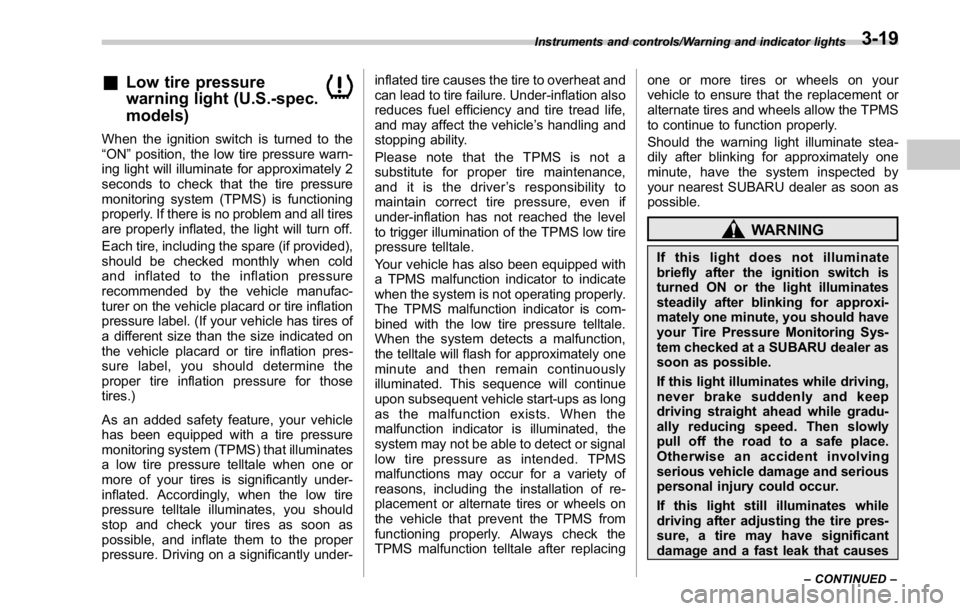
& Low tire pressure
warning light (U.S.-spec.
models)When the ignition switch is turned to the
“ ON ” position, the low tire pressure warn-
ing light will illuminate for approximately 2
seconds to check that the tire pressure
monitoring system (TPMS) is functioning
properly. If there is no problem and all tires
are properly inflated, the light will turn off.
Each tire, including the spare (if provided),
should be checked monthly when cold
and inflated to the inflation pressure
recommended by the vehicle manufac-
turer on the vehicle placard or tire inflation
pressure label. (If your vehicle has tires of
a different size than the size indicated on
the vehicle placard or tire inflation pres-
sure label, you should determine the
proper tire inflation pressure for those
tires.)
As an added safety feature, your vehicle
has been equipped with a tire pressure
monitoring system (TPMS) that illuminates
a low tire pressure telltale when one or
more of your tires is significantly under-
inflated. Accordingly, when the low tire
pressure telltale illuminates, you should
stop and check your tires as soon as
possible, and inflate them to the proper
pressure. Driving on a significantly under- inflated tire causes the tire to overheat and
can lead to tire failure. Under-inflation also
reduces fuel efficiency and tire tread life,
and may affect the vehicle ’ s handling and
stopping ability.
Please note that the TPMS is not a
substitute for proper tire maintenance,
and it is the driver ’ s responsibility to
maintain correct tire pressure, even if
under-inflation has not reached the level
to trigger illumination of the TPMS low tire
pressure telltale.
Your vehicle has also been equipped with
a TPMS malfunction indicator to indicate
when the system is not operating properly.
The TPMS malfunction indicator is com-
bined with the low tire pressure telltale.
When the system detects a malfunction,
the telltale will flash for approximately one
minute and then remain continuously
illuminated. This sequence will continue
upon subsequent vehicle start-ups as long
as the malfunction exists. When the
malfunction indicator is illuminated, the
system may not be able to detect or signal
low tire pressure as intended. TPMS
malfunctions may occur for a variety of
reasons, including the installation of re-
placement or alternate tires or wheels on
the vehicle that prevent the TPMS from
functioning properly. Always check the
TPMS malfunction telltale after replacing one or more tires or wheels on your
vehicle to ensure that the replacement or
alternate tires and wheels allow the TPMS
to continue to function properly.
Should the warning light illuminate stea-
dily after blinking for approximately one
minute, have the system inspected by
your nearest SUBARU dealer as soon as
possible.
WARNINGIf this light does not illuminate
briefly after the ignition switch is
turned ON or the light illuminates
steadily after blinking for approxi-
mately one minute, you should have
your Tire Pressure Monitoring Sys-
tem checked at a SUBARU dealer as
soon as possible.
If this light illuminates while driving,
never brake suddenly and keep
driving straight ahead while gradu-
ally reducing speed. Then slowly
pull off the road to a safe place.
Otherwise an accident involving
serious vehicle damage and serious
personal injury could occur.
If this light still illuminates while
driving after adjusting the tire pres-
sure, a tire may have significant
damage and a fast leak that causesInstruments and controls/Warning and indicator lights
– CONTINUED –3-19
Page 181 of 594
Instruments and controls/Multi function display
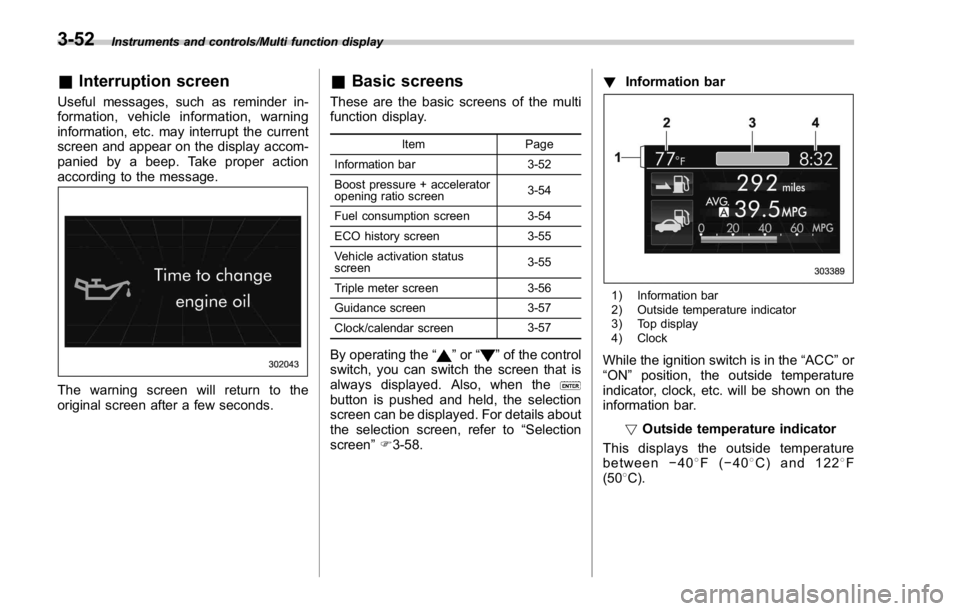
& Interruption screenUseful messages, such as reminder in-
formation, vehicle information, warning
information, etc. may interrupt the current
screen and appear on the display accom-
panied by a beep. Take proper action
according to the message.
The warning screen will return to the
original screen after a few seconds. & Basic screens These are the basic screens of the multi
function display. Item Page
Information bar 3-52
Boost pressure + accelerator
opening ratio screen 3-54
Fuel consumption screen 3-54
ECO history screen 3-55
Vehicle activation status
screen 3-55
Triple meter screen 3-56
Guidance screen 3-57
Clock/calendar screen 3-57
By operating the “ ” or “ ” of the control
switch, you can switch the screen that is
always displayed. Also, when the
button is pushed and held, the selection
screen can be displayed. For details about
the selection screen, refer to “ Selection
screen ” F 3-58. ! Information bar
1) Information bar
2) Outside temperature indicator
3) Top display
4) Clock
While the ignition switch is in the “ ACC ” or
“ ON ” position, the outside temperature
indicator, clock, etc. will be shown on the
information bar.
! Outside temperature indicator
This displays the outside temperature
between − 40 8 F( − 40 8 C) and 122 8 F
(50 8 C).3-52
Page 183 of 594
Instruments and controls/Multi function display
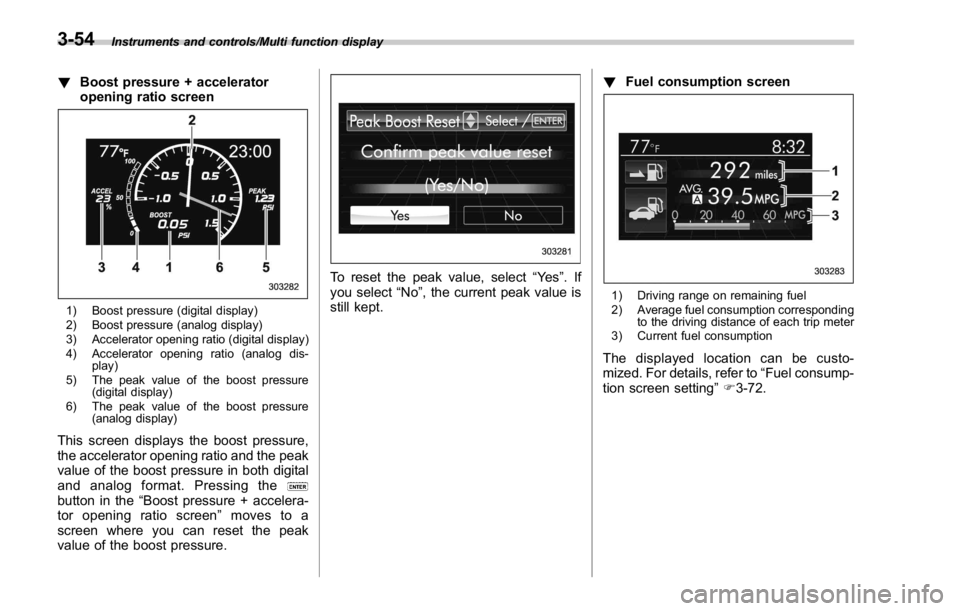
! Boost pressure + accelerator
opening ratio screen
1) Boost pressure (digital display)
2) Boost pressure (analog display)
3) Accelerator opening ratio (digital display)
4) Accelerator opening ratio (analog dis-
play)
5) The peak value of the boost pressure
(digital display)
6) The peak value of the boost pressure
(analog display)
This screen displays the boost pressure,
the accelerator opening ratio and the peak
value of the boost pressure in both digital
and analog format. Pressing the
button in the “ Boost pressure + accelera-
tor opening ratio screen ” moves to a
screen where you can reset the peak
value of the boost pressure. To reset the peak value, select “ Ye s ” .If
you select “ No ” , the current peak value is
still kept. ! Fuel consumption screen
1) Driving range on remaining fuel
2) Average fuel consumption corresponding
to the driving distance of each trip meter
3) Current fuel consumption
The displayed location can be custo-
mized. For details, refer to “ Fuel consump-
tion screen setting ” F 3-72.3-54
Page 185 of 594
Instruments and controls/Multi function display
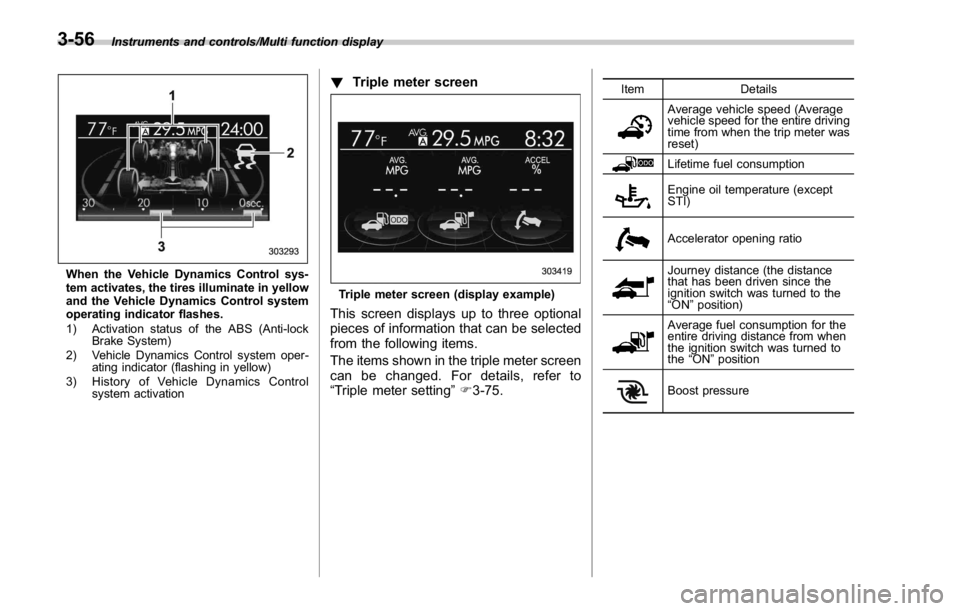
When the Vehicle Dynamics Control sys-
tem activates, the tires illuminate in yellow
and the Vehicle Dynamics Control system
operating indicator flashes.
1) Activation status of the ABS (Anti-lock
Brake System)
2) Vehicle Dynamics Control system oper-
ating indicator (flashing in yellow)
3) History of Vehicle Dynamics Control
system activation ! Triple meter screen
Triple meter screen (display example)
This screen displays up to three optional
pieces of information that can be selected
from the following items.
The items shown in the triple meter screen
can be changed. For details, refer to
“ Triple meter setting ” F 3-75. Item Details
Average vehicle speed (Average
vehicle speed for the entire driving
time from when the trip meter was
reset)
Lifetime fuel consumption
Engine oil temperature (except
STI)
Accelerator opening ratio
Journey distance (the distance
that has been driven since the
ignition switch was turned to the
“ ON ” position)
Average fuel consumption for the
entire driving distance from when
the ignition switch was turned to
the “ ON ” position
Boost pressure3-56
Page 455 of 594
Driving tips/New vehicle break – in driving – the first 1,000 miles (1,600 km)
New vehicle break-in driving
– the first 1,000 miles (1,600
km) The performance and long life of your
vehicle are dependent on how you handle
and care for your vehicle while it is new.
Follow these instructions during the first
1,000 miles (1,600 km):
. Do not race the engine. And do not
allow engine speed to exceed 4,000 rpm
except in an emergency.
. Do not drive at one constant engine or
vehicle speed for a long time, either fast or
slow.
. Avoid starting suddenly and rapid
acceleration, except in an emergency.
. Avoid hard braking, except in an
emergency.
The same break-in procedures should be
applied to an overhauled engine, newly
mounted engine or when brake pads or
brake linings are replaced with new ones. Fuel economy hints The following suggestions will help to save
fuel.
. Select the proper gear position for the
speed and road conditions.
. Avoid sudden acceleration or decelera-
tion. Always accelerate gently until you
reach the desired speed. Then try to
maintain that speed for as long as
possible.
. Do not pump the accelerator and avoid
racing the engine.
. Avoid unnecessary engine idling.
. Keep the engine properly tuned.
. Keep the tires inflated to the correct
pressure shown on the tire placard, which
is located under the door latch on the
driver ’ s side. Low pressure will increase
tire wear and fuel consumption.
. Use the air conditioner only when
necessary.
. Keep the front and rear wheels in
proper alignment.
. Avoid carrying unnecessary luggage or
cargo.
. The indication of the ECO gauge
shows a reference for saving fuel. For
details, refer to “ ECO gauge ” F 3-12.Engine exhaust gas (carbon
monoxide) WARNING. Never inhale engine exhaust gas.
Engine exhaust gas contains
carbon monoxide, a colorless
and odorless gas which is dan-
gerous, or even lethal, if inhaled.
. Always properly maintain the en-
gine exhaust system to prevent
engine exhaust gas from enter-
ing the vehicle.
. Never run the engine in a closed
space, such as a garage, except
for the brief time needed to drive
the vehicle in or out of it.
. Avoid remaining in a parked
vehicle for a lengthy time while
the engine is running. If that is
unavoidable, then use the venti-
lation fan to force fresh air into
the vehicle.
. Always keep the front ventilator
inlet grille free from snow, leaves
or other obstructions to ensure
that the ventilation system al-
ways works properly.
. If at any time you suspect that8-2
Page 492 of 594
Maintenance schedule The scheduled maintenance items re-
quired to be serviced at regular intervals
are shown in the “ Warranty and Main-
tenance Booklet ” .
For details of your maintenance schedule,
read the separate “ Warranty and Main-
tenance Booklet ” .
NOTE For models with a multi function dis-
play, you can set a reminder to be
displayed when a scheduled mainte-
nance item is almost due. For details,
refer to “ Maintenance settings ” F 3-79.Maintenance precautions When maintenance and service are re-
quired, it is recommended that all work be
done by an authorized SUBARU dealer.
If you perform maintenance and service
by yourself, you should familiarize yourself
with the information provided in this
section on general maintenance and
service for your SUBARU.
Incorrect or incomplete service could
cause improper or unsafe vehicle opera-
tion. Any problems caused by improper
maintenance and service performed by
you are not eligible for warranty coverage.
WARNING
. Testing of an All-Wheel Drive
model must NEVER be per-
formed on a single two-wheel
dynamometer or similar appara-
tus. Attempting to do so will
result in transmission damage
and in uncontrolled vehicle
movement and may cause an
accident or injuries to persons
nearby.
. Always select a safe area when
performing maintenance on your
vehicle. . Always be very careful to avoid
injury when working on the vehi-
cle. Remember that some of the
materials in the vehicle may be
hazardous if improperly used or
handled, for example, battery
acid.
. Your vehicle should only be ser-
viced by persons fully competent
to do so. Serious personal injury
may result to persons not experi-
enced in servicing vehicles.
. Always use the proper tools and
make certain that they are well
maintained.
. Never get under the vehicle sup-
ported only by a jack. Always use
safety stands to support the
vehicle.
. Never keep the engine running in
a poorly ventilated area, such as
a garage or other closed areas.
. Do not smoke or allow open
flames around the fuel or battery.
This will cause a fire.
. Because the fuel system is under
pressure, replacement of the fuel
filter should be performed only
by your SUBARU dealer.
. Wear adequate eye protection toMaintenance and service/Maintenance schedule
– CONTINUED –11-3