ECO mode SUBARU WRX 2018 Owners Manual
[x] Cancel search | Manufacturer: SUBARU, Model Year: 2018, Model line: WRX, Model: SUBARU WRX 2018Pages: 578, PDF Size: 33.21 MB
Page 429 of 578
(444,1)
北米Model "A1700BE-B" EDITED: 2017/ 10/ 11
tures.
.Keep everyone and flammable
materials away from the exhaust
pipe while the engine is running.
The exhaust gas is very hot.
Periodic inspectionsTo keep your vehicle in the best condition
at all times, always have the recom-
mended maintenance services listed in
the maintenance schedule in the“War-
ranty and Maintenance Booklet”per-
formed at the specified time or mileage
intervals.
Driving in foreign countriesWhen planning to use your vehicle in
another country:
.Confirm the availability of the correct
fuel. Refer to“Fuel requirements”F7-3.
.Comply with all regulations and require-
ments of each country.
Driving tips/Periodic inspections
8-4
Page 431 of 578

(446,1)
北米Model "A1700BE-B" EDITED: 2017/ 10/ 11
conditions than a two wheel drive vehicle.
There is little difference in handling, how-
ever, during extremely sharp turns or
sudden braking. Therefore, when driving
down a slope or turning corners, be sure to
reduce your speed and maintain an ample
distance from other vehicles.
.Always check the cold tire pressure
before starting to drive. The recommended
tire pressure is provided on the tire
placard, which is located under the door
latch on the driver’s side.
.Frequent driving of an AWD vehicle
under hard-driving conditions such as
steep hills or dusty roads will necessitate
more frequent replacement of the follow-
ing items than that specified in the“War-
ranty and Maintenance Booklet”.
–Engine oil
–Brake fluid
–Rear differential gear oil
–Manual transmission oil (MT mod-
els)
–Continuously variable transmission
fluid (CVT models)
–Front differential gear oil (CVT
models)
.There are some precautions that you
must observe when towing your vehicle.
For detailed information, refer to“Towing”
F9-21.
Driving precautionWater entering the engine air intake or the
exhaust pipe or water splashing onto
electrical parts may damage your vehicle
and may cause it to stall. Never attempt to
drive through rushing water; regardless of
its depth, it can wash away the ground
from under your tires, resulting in possible
loss of traction and even vehicle rollover.
Winter driving&Operation during cold weath-
erCarry some emergency equipment, such
as a window scraper, a bag of sand, flares,
a small shovel and jumper cables.
Check the battery and cables. Cold tem-
peratures reduce battery capacity. The
battery must be in good condition to
provide enough power for cold winter
starts.
It normally takes longer to start the engine
in very cold weather conditions. Use an
engine oil of a proper grade and viscosity
for cold weather. Using heavy summer oil
will make it harder to start the engine.
Keep the door locks from freezing by
squirting them with deicer or glycerin.
Forcing a frozen door open may damage
or separate the rubber weather strips
around the door. If the door is frozen, use
hot water to melt the ice, and afterwards
thoroughly wipe the water away.
Use a windshield washer fluid that con-
tains an antifreeze solution. Do not use
engine antifreeze or other substitutes
because they may damage the paint of
the vehicle.
Driving tips/Driving precaution
8-6
Page 433 of 578
(448,1)
北米Model "A1700BE-B" EDITED: 2017/ 10/ 11
–When the vehicle has been left
parked during a snowstorm
Check for snow or ice buildup on
the suspension, disc brakes and
brake hoses underneath the ve-
hicle. If there is caked snow or
ice, remove it, being careful not
to damage the disc brakes and
brake hoses and ABS harness.
When parking for long periods in cold
weather, you should observe the following
tips.
1. For MT models, place the shift lever in
the“1”or“R”position. For CVT models,
place the select lever in the“P”position.
2. Use tire stops under the tires to prevent
the vehicle from moving.
!Refueling in cold weather
To help prevent moisture from forming in
the fuel system and the risk of its freezing,
use of an antifreeze additive in the fuel
tank is recommended during cold weather.
Use only additives that are specifically
designed for this purpose. When an anti-
freeze additive is used, its effect lasts
longer if the tank is refilled whenever the
fuel level reaches half empty.
If your SUBARU is not going to be used for
an extended period, it is best to have thefuel tank filled to capacity.
&Driving on snowy and icy
roadsTo prevent skidding and slipping, avoid
sudden braking, abrupt acceleration, high-
speed driving, and sharp turning when
driving on snowy or icy roads.
Always maintain ample distance between
your vehicle and the vehicle ahead of you
to avoid the need for sudden braking.
To supplement the foot brake, use the
engine brake effectively to control the
vehicle speed. (Shift into a lower gear
when necessary.)
Avoid shifting down abruptly. Such beha-
vior can cause the wheels to lock, possibly
leading to loss of vehicle control.
An anti-lock brake system (ABS) en-
hances your vehicle’s braking perfor-
mance on snowy and icy roads. For
information on braking on slippery sur-
faces, refer to“ABS (Anti-lock Brake
System)”F7-35 and“Vehicle Dynamics
Control system”F7-37.
WARNING
Do not use the cruise control on
slippery roads such as snowy or icy
roads. This may cause loss of vehi-
cle control.
CAUTION
Avoid prolonged continuous driving
in snowstorms. Snow will enter the
engine’sintakesystemandmay
hinder the airflow, which could re-
sult in engine shutdown or even
breakdown.
!Wiper operation when snowing
Before driving in cold weather, make sure
the wiper blade rubbers are not frozen to
the windshield.
If the wiper blade rubbers are frozen to the
windshield, use the defroster and the
temperature set for maximum warmth until
the wiper blade rubbers are completely
thawed. Refer to“Climate control”F4-1.
If your vehicle is equipped with a wiper
deicer, use it. It is helpful to thaw the
windshield wiper blade rubbers. Refer to
“Defogger and deicer”F3-84.
When driving in snow, if frozen snow starts
Driving tips/Winter driving
8-8
Page 434 of 578
(449,1)
北米Model "A1700BE-B" EDITED: 2017/ 10/ 11
to stick on the surface of the windshield
despite wiper operation, use the defroster
and the temperature set for maximum
warmth. After the windshield gets warmed
enough to melt the frozen snow on it, wash
it away using the windshield washer. Refer
to“Windshield washer”F3-74.
Snow stuck on the wiper arm prevents the
wiper from working effectively. If snow is
stuck on the wiper arm, pull off the road to
a safe place, then remove it. If you stop the
vehicle at road side, use the hazard
warning flasher to alert other drivers. Refer
to“Hazard warning flasher”F3-8.
We recommend use of non-freezing type
wiper blades (winter blades) during the
seasons you could have snow and freez-
ing temperatures. Blades of this type give
superior wiping performance in snowy
conditions. Be sure to use blades that are
suitable for your vehicle.
CAUTION
During high-speed driving, non-
freezing type wiper blades may not
perform as well as standard wiper
blades. If this happens, reduce the
vehicle speed.
NOTEWhen the season requiring non-freez-
ing type wiper blades is over, replace
them with standard wiper blades.&Corrosion protectionRefer to“Corrosion protection”F10-5.&Snow tires
WARNING
.When you replacing or installing
winter tire(s), all four tires must
be the same for following items.
(a) Size
(b) Circumference
(c) Speed symbol
(d) Load index
(e) Construction
(f) Manufacturer
(g) Brand (tread pattern)
(h) Degrees of wear
For the items (a) to (d), you must
obey the specification that is
printed on the tire placard. The
tire placard is located on the
bottom of driver’s door pillar.If all of four winter tires are not
the same for items (a) to (h), there
is a possibility that serious me-
chanical damage could occur to
the drive train of your car, and
affect the following.
—Ride
—Handling
—Braking
—Speedometer/Odometer
calibration
—Clearance between the body
and tires
It also may be dangerous and
lead to loss of vehicle control,
and it can lead to an accident.
.Do not use a combination of
radial, belted bias or bias tires
since it may cause dangerous
handling characteristics and lead
to an accident.
Your vehicle is equipped with“summer
tires”as original equipment, which are
inadequate for driving on slippery roads
such as on snow-covered or icy roads.
When you choose to install winter tires on
your vehicle, be sure to use the correct tire
size and type. You must install four winter
tires that are of the same size, construc-
–CONTINUED–
Driving tips/Winter driving
8-9
8
Page 435 of 578

(450,1)
北米Model "A1700BE-B" EDITED: 2017/ 10/ 11
tion, brand and load range and you should
never mix radial, belted bias or bias tires
since this may result in dangerous hand-
ling characteristics. When you choose a
tire, make sure that there is enough
clearance between the tire and vehicle
body.
Remember to drive with care at all times
regardless of the type of tires on your
vehicle.&Tire chains
CAUTION
You cannot use tire chains on your
vehicle because of the lack of clear-
ance between the tires and vehicle
body.NOTEEven though you cannot use tire
chains, use of another type of traction
device (such as spring chains) may be
acceptable if use on your vehicle is
recommended by the device manufac-
turer, taking into account tire size and
road conditions. Follow the device
manufacturer’s instructions, especially
regarding maximum vehicle speed.
To help avoid damage to your vehicle,drive slowly, readjust or remove the
device if it is contacting your vehicle,
and do not spin your wheels. Damage
caused to your vehicle by use of a
traction device is not covered under
warranty.
Make certain that any traction device
you use is an SAE class S device, and
use it on the front wheels only. Always
use the utmost care when driving with a
traction device. Overconfidence be-
cause you are using a traction device
could easily lead to a serious accident.
&Rocking the vehicleIf you must rock the vehicle to free it from
snow, sand, or mud, depress the accel-
erator pedal slightly and move the shift
lever/select lever back and forth between
“1”/“D”and“R”repeatedly. Do not race the
engine. For the best possible traction,
avoid spinning the wheels when trying to
free the vehicle.
When the road surface is extremely
slippery, you can obtain better traction by
starting the vehicle with the transmission in
2nd than in 1st (MT models and CVT
models).
If your vehicle is a CVT model, for
information about holding the transmissionin the 2nd position, refer to“Selection of
manual mode”F7-25.
Driving tips/Winter driving
8-10
Page 436 of 578
(451,1)
北米Model "A1700BE-B" EDITED: 2017/ 10/ 11
Loading your vehicle
WARNING
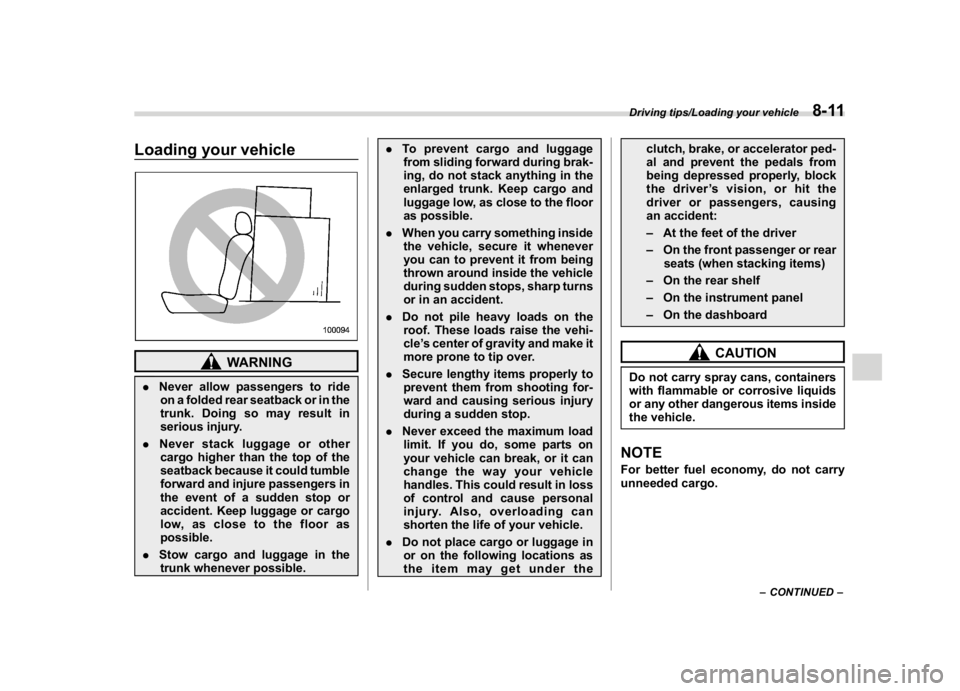
.Never allow passengers to ride
on a folded rear seatback or in the
trunk. Doing so may result in
serious injury.
.Never stack luggage or other
cargo higher than the top of the
seatback because it could tumble
forward and injure passengers in
the event of a sudden stop or
accident. Keep luggage or cargo
low, as close to the floor as
possible.
.Stow cargo and luggage in the
trunk whenever possible..To prevent cargo and luggage
from sliding forward during brak-
ing, do not stack anything in the
enlarged trunk. Keep cargo and
luggage low, as close to the floor
as possible.
.When you carry something inside
the vehicle, secure it whenever
you can to prevent it from being
thrown around inside the vehicle
during sudden stops, sharp turns
or in an accident.
.Do not pile heavy loads on the
roof. These loads raise the vehi-
cle’s center of gravity and make it
more prone to tip over.
.Secure lengthy items properly to
prevent them from shooting for-
ward and causing serious injury
during a sudden stop.
.Never exceed the maximum load
limit. If you do, some parts on
your vehicle can break, or it can
change the way your vehicle
handles. This could result in loss
of control and cause personal
injury. Also, overloading can
shorten the life of your vehicle.
.Do not place cargo or luggage in
or on the following locations as
the item may get under theclutch, brake, or accelerator ped-
al and prevent the pedals from
being depressed properly, block
the driver’s vision, or hit the
driver or passengers, causing
an accident:
–At the feet of the driver
–On the front passenger or rear
seats (when stacking items)
–On the rear shelf
–On the instrument panel
–On the dashboard
CAUTION
Do not carry spray cans, containers
with flammable or corrosive liquids
or any other dangerous items inside
the vehicle.NOTEFor better fuel economy, do not carry
unneeded cargo.
–CONTINUED–
Driving tips/Loading your vehicle
8-11
8
Page 441 of 578
(456,1)
北米Model "A1700BE-B" EDITED: 2017/ 10/ 11
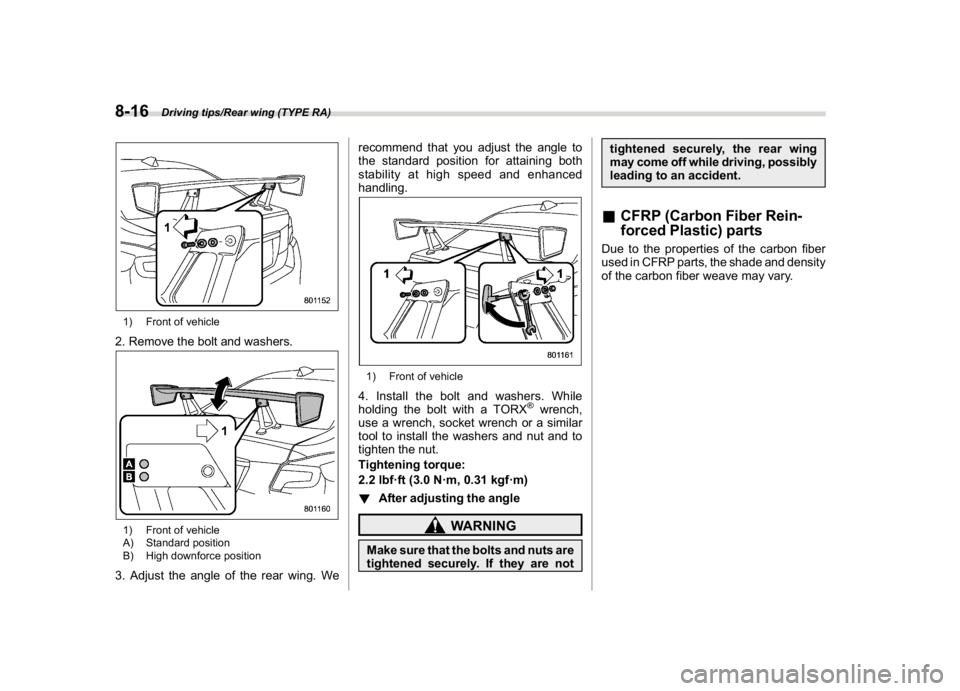
1) Front of vehicle2. Remove the bolt and washers.1) Front of vehicle
A) Standard position
B) High downforce position3. Adjust the angle of the rear wing. Werecommend that you adjust the angle to
the standard position for attaining both
stability at high speed and enhanced
handling.
1) Front of vehicle4. Install the bolt and washers. While
holding the bolt with a TORX
®wrench,
use a wrench, socket wrench or a similar
tool to install the washers and nut and to
tighten the nut.
Tightening torque:
2.2 lbf·ft (3.0 N·m, 0.31 kgf·m)
!After adjusting the angle
WARNING
Make sure that the bolts and nuts are
tightened securely. If they are nottightened securely, the rear wing
may come off while driving, possibly
leading to an accident.
&CFRP (Carbon Fiber Rein-
forced Plastic) partsDue to the properties of the carbon fiber
used in CFRP parts, the shade and density
of the carbon fiber weave may vary.
Driving tips/Rear wing (TYPE RA)
8-16
Page 448 of 578
(465,1)
北米Model "A1700BE-B" EDITED: 2017/ 10/ 11
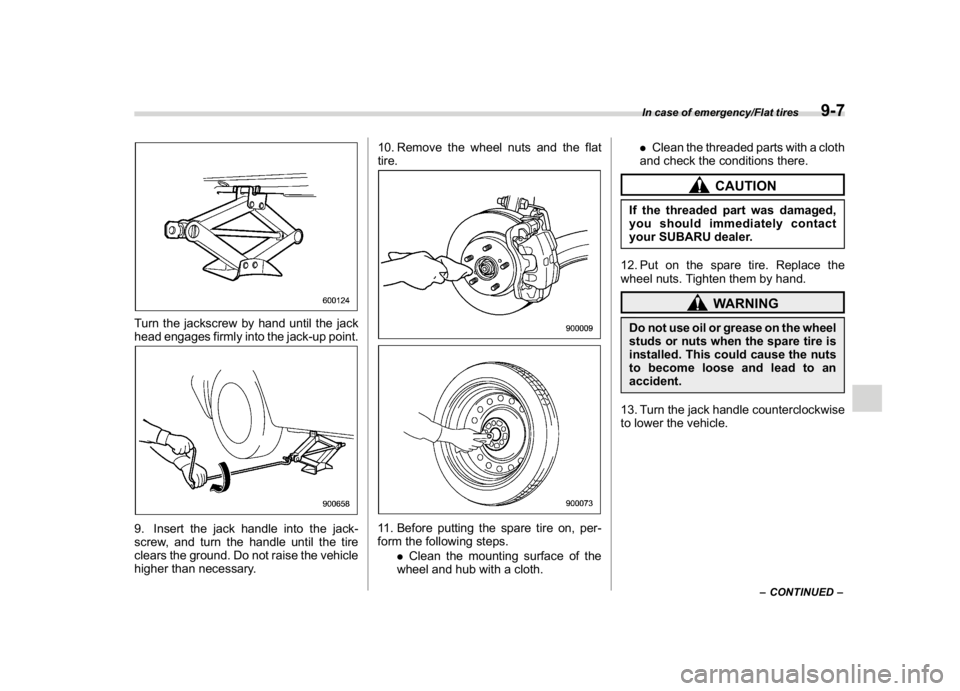
Turn the jackscrew by hand until the jack
head engages firmly into the jack-up point.9. Insert the jack handle into the jack-
screw, and turn the handle until the tire
clears the ground. Do not raise the vehicle
higher than necessary.10. Remove the wheel nuts and the flat
tire.
11. Before putting the spare tire on, per-
form the following steps.
.Clean the mounting surface of the
wheel and hub with a cloth..Clean the threaded parts with a cloth
and check the conditions there.
CAUTION
If the threaded part was damaged,
you should immediately contact
your SUBARU dealer.
12. Put on the spare tire. Replace the
wheel nuts. Tighten them by hand.
WARNING
Do not use oil or grease on the wheel
studs or nuts when the spare tire is
installed. This could cause the nuts
to become loose and lead to an
accident.
13. Turn the jack handle counterclockwise
to lower the vehicle.
–CONTINUED–
In case of emergency/Flat tires
9-7
9
Page 450 of 578
(467,1)
北米Model "A1700BE-B" EDITED: 2017/ 10/ 11
some tires can only be partially sealed or
not sealed at all, and this condition may
cause a loss of tire pressure. A loss of tire
pressure can affect vehicle handling,
leading to the loss of vehicle control.
After sealing the flat tire temporarily,
change the tires with new ones as soon
as possible. We recommend that you have
the sealed tire changed by your nearest
SUBARU dealer. You may reuse the wheel
if the attached sealant is wiped off, but the
valve of the wheel must be replaced with a
new one. If you reuse the wheel without
replacing the valve, air may leak from the
valve.
For tire replacement, refer to“Tire replace-
ment”F11-36.!Safety precautions when sealing flat
tire
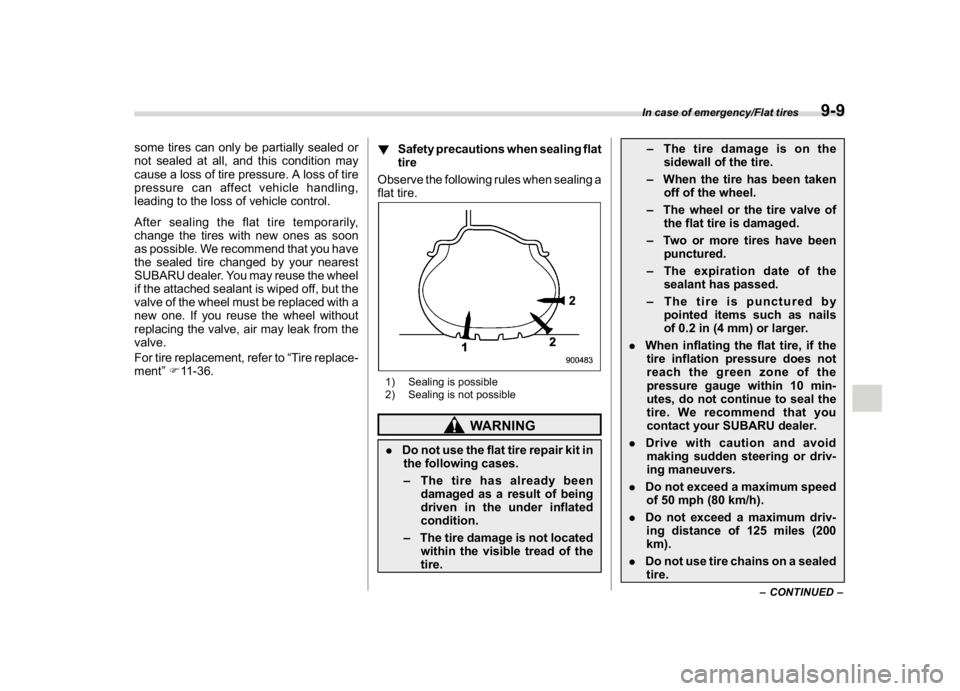
Observe the following rules when sealing a
flat tire.
1) Sealing is possible
2) Sealing is not possible
WARNING
.Do not use the flat tire repair kit in
the following cases.
–The tire has already been
damaged as a result of being
driven in the under inflated
condition.
–The tire damage is not located
within the visible tread of the
tire.–The tire damage is on the
sidewall of the tire.
–When the tire has been taken
off of the wheel.
–The wheel or the tire valve of
the flat tire is damaged.
–Two or more tires have been
punctured.
–The expiration date of the
sealant has passed.
–The tire is punctured by
pointed items such as nails
of 0.2 in (4 mm) or larger.
.When inflating the flat tire, if the
tire inflation pressure does not
reach the green zone of the
pressure gauge within 10 min-
utes, do not continue to seal the
tire. We recommend that you
contact your SUBARU dealer.
.Drive with caution and avoid
making sudden steering or driv-
ing maneuvers.
.Do not exceed a maximum speed
of 50 mph (80 km/h).
.Do not exceed a maximum driv-
ing distance of 125 miles (200
km).
.Do not use tire chains on a sealed
tire.
–CONTINUED–
In case of emergency/Flat tires
9-9
9
Page 451 of 578
(468,1)
北米Model "A1700BE-B" EDITED: 2017/ 10/ 11
.Do not tow a trailer.
.If used for a purpose other than
sealing a flat tire, the flat tire
repair kit may cause a severe
accident or injury due to the fact
that compressed air can act as an
explosive or propellant.
.Safely park your vehicle on the
roadside so that you do not
obstruct the flow of traffic and
so that you are able to seal the flat
tire without being in danger.
.Apply the parking brake, even if
the vehicle is parked on a level
road, to make sure that the vehi-
cle will not move.
.Stop the engine before sealing
the flat tire.
.Turn on the hazard warning
flasher while sealing the flat tire.
.Do not attempt to remove foreign
objects like nails or screws that
have penetrated the tire. Leave
them as they are.
.Never leave the flat tire repair kit
unattended while in use.
.Only one tire can be repaired with
one bottle of sealant.
.The tires can be repaired when
the ambient temperature is228F(308C) or higher.
CAUTION
.Remember that the flat tire repair
kit only provides temporary mo-
bility. Regulations concerning
tire repair after usage of flat tire
repair kit may differ from country
to country. We recommend that
you consult your SUBARU dealer
or tire dealer for advice.
.Store the flat tire repair kit safely
and secure it in the cargo area.
Storing it anywhere in the pas-
senger compartment is not advi-
sable because it could strike an
occupant in the event of a sudden
stop or collision and cause injury.
.Use the flat tire repair kit with
original vehicle tires only.
.Do not keep the air compressor
operating for more than 10 min-
utes, otherwise there is a risk of
overheating.
.The temperature of the air com-
pressor may become high. Be
careful not to burn yourself.
.When raining, take measures to
prevent the air compressor frombeing exposed directly to the
rain. Exposing to rain may cause
a malfunction.
.Do not use air compressors other
than the one in the repair kit.
Using an air compressor other
than the one in the repair kit may
damage the tires.
.Do not disassemble or modify the
air compressor to enable the use
of a power supply or a battery
other than DC12V.
.If a temporary puncture repair is
performed with the repair kit, the
Tire Pressure Monitoring System
(TPMS) may not operate nor-
mally.
In case of emergency/Flat tires
9-10