light SUBARU WRX 2018 Owners Manual
[x] Cancel search | Manufacturer: SUBARU, Model Year: 2018, Model line: WRX, Model: SUBARU WRX 2018Pages: 578, PDF Size: 33.21 MB
Page 409 of 578
(422,1)
北米Model "A1700BE-B" EDITED: 2017/ 10/ 11
rected, and the BSD/RCTA warning
indicator will disappear. However, if
the BSD/RCTA warning indicator
appears for a prolonged period of
time, have the system inspected at a
SUBARU dealer as soon as possible.
.The detectability of the radar sen-
sors is restricted. The BSD/RCTA de-
tection may be impaired and the system
may not operate properly under the
following conditions.
–When the rear bumper around the
radar sensors is distorted
–When ice, snow or mud adheres
to the rear bumper surface around
the radar sensors
–When stickers, etc. are affixed on
the areas of the radar sensors on
the rear bumper
–During adverse weather condi-
tions such as rain, snow or fog
–When driving on wet roads such
as snow-covered roads and through
puddles
.The radar sensors may not detect or
may have difficulty detecting the fol-
lowing vehicles and objects.
–Small motorcycles, bicycles, pe-
destrians, stationary objects on the
road or road side and etc.
–Vehicles with body shapes thatthe radar may not reflect (vehicles
with lower body height such as
sports cars or a trailer with no
cargo)
–Vehicles that are not approaching
your vehicle even though they are in
the detection area (either on a
neighboring lane to the rear or be-
side your vehicle when reversing)
(The system determines the pre-
sence of approaching vehicles
based on data detected by the radar
sensors.)
–Vehicles traveling at significantly
different speeds
–Vehicles driving in parallel at al-
most the same speed as your vehi-
cle for a prolonged time
–Oncoming vehicles
–Vehicles in a lane beyond the
neighboring lane
–Vehicles travelling at a signifi-
cantly lower speed that you are
trying to overtake
.On a road with extremely narrow
lanes, the system may detect vehicles
driving in a lane next to the neighboring
lane.
&BSD/RCTA approach indica-
tor light/warning buzzerWhile the BSD/RCTA is active, the follow-
ing item(s) will operate to alert the driver:
.The BSD/RCTA approach indicator
light (when there are vehicles in the
neighboring lanes).
.The BSD/RCTA approach indicator
light and warning buzzer (when a vehicle
is approaching from the left or right side
while reversing)
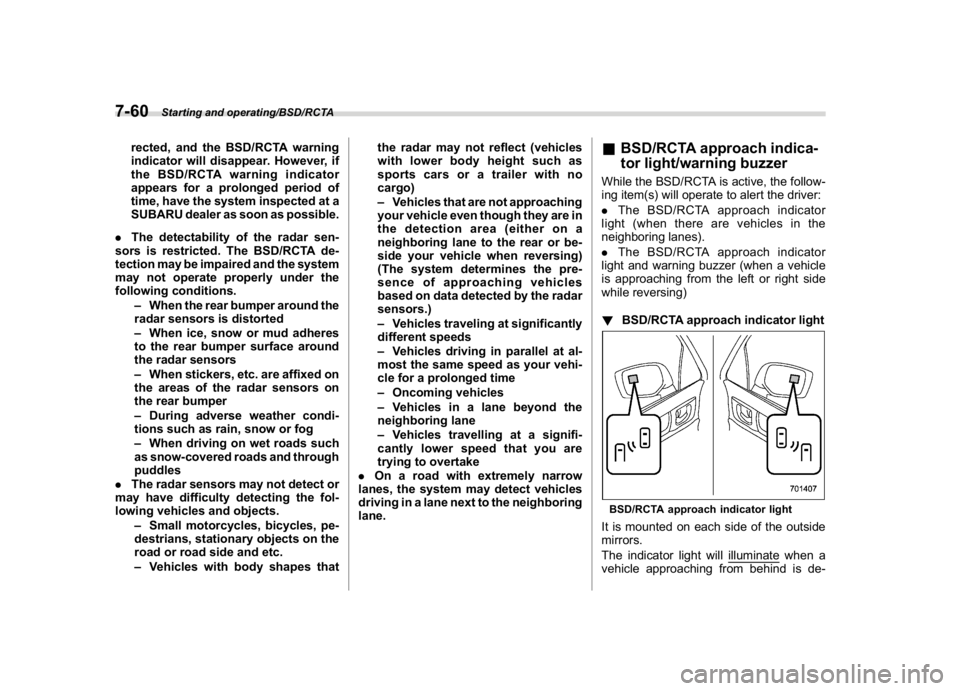
!BSD/RCTA approach indicator lightBSD/RCTA approach indicator lightIt is mounted on each side of the outside
mirrors.
The indicator light will illuminate when a
vehicle approaching from behind is de-
Starting and operating/BSD/RCTA
7-60
Page 410 of 578
(423,1)
北米Model "A1700BE-B" EDITED: 2017/ 10/ 11
tected.
The indicator light will flash to warn the
driver of dangers under the following
conditions.
.While the indicator light is illuminating, if
the turn signal lever is operated toward the
side in which this light turned on
.When reversing the vehicle while the
system detects a vehicle approaching
from either side
!BSD/RCTA approach indicator
light dimming function
When the headlights are on, the bright-
ness of the BSD/RCTA approach indicator
light will be reduced.NOTE.You may have difficulty seeing the
BSD/RCTA approach indicator light
under the following conditions.
–When sunlight shines directly on
it
–When the headlight beams from a
vehicle traveling behind shines di-
rectly on it
.While the illumination brightness
control dial is in the fully upward
position, even if the headlights are
turned on, the brightness of the BSD/
RCTA approach indicator light will not
be reduced. For details about theillumination brightness control dial,
refer to“Illumination brightness con-
trol”F3-71.
!BSD/RCTA approach warning buz-
zer (only when reversing)
A warning buzzer sounds along with
flashing of the BSD/RCTA approach in-
dicator light to warn the driver of dangers.
You can change the setting of the warning
buzzer volume by operating the combina-
tion meter display (color LCD). For details,
refer to“BSD/RCTA”F3-43.
!Safety tips regarding the BSD/RCTA
approach indicator light/warning
buzzer
.In the following cases, operation of the
BSD/RCTA approach indicator light and
the warning buzzer may be delayed or the
system may fail to issue these warnings.
–When a vehicle moves to the neigh-
boring lane from a lane next to the
neighboring lane
–When you are driving on a steep
incline or on repeated sharp uphill and
downhill grades
–When you are going beyond a pass
–When both your vehicle and a
vehicle driving on a neighboring lane
are driving on the far side of each lane.
–When several narrowly-spaced ve-hicles are approaching in a row
–In low radius bends (tight bends or
when making turns at an intersection)
–When there is a difference in height
between your lane and the neighboring
lane
–Immediately after the BSD/RCTA is
activated by pressing the BSD/RCTA
OFF switch
–Immediately after the shift lever/
select lever is shifted to the“R”position
–When extremely heavy cargo is
loaded in the trunk
.During reversing, operation of the BSD/
RCTA approach indicator light and the
warning buzzer may be delayed or the
system may fail to issue these warnings
under the following conditions.
–When backing out of an angled
parking space
–When a large-sized vehicle is
parked next to your vehicle (That
vehicle prevents the propagation of
radar waves.)
–When reversing on sloped roads
–When reversing at a high speed
–CONTINUED–
Starting and operating/BSD/RCTA
7-61
7
Page 411 of 578
(424,1)
北米Model "A1700BE-B" EDITED: 2017/ 10/ 11
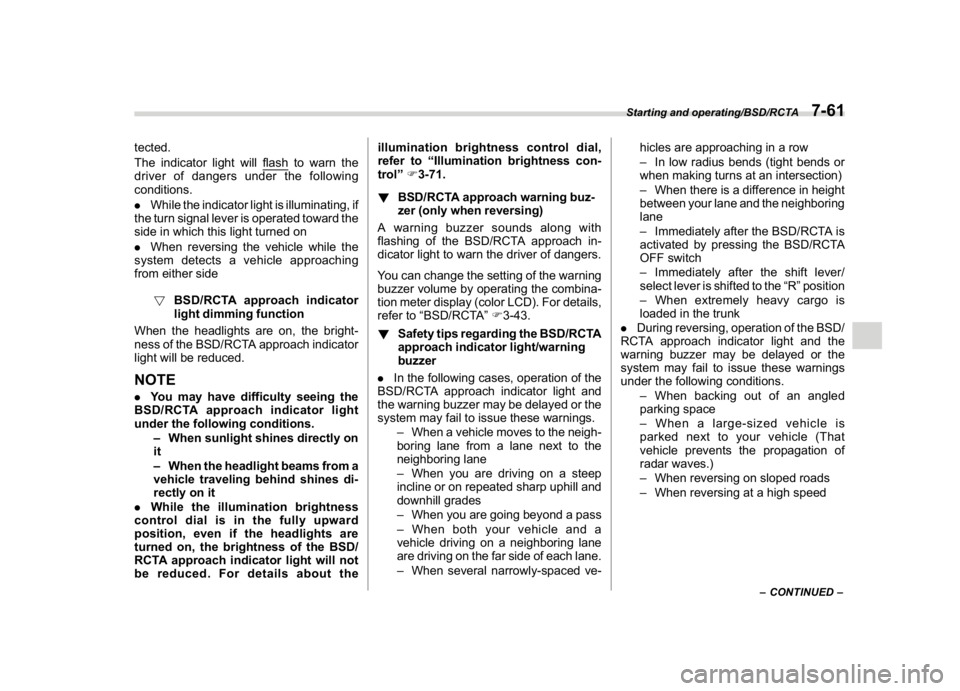
.The BSD/RCTA approach indicator
light may illuminate when driving close to
solid objects on the road or road side (such
as guardrails, tunnels and sidewalls).
.The BSD/RCTA approach indicator
light may flash when turning at an inter-
section in urban areas or multilane inter-
sections.
.The BSD/RCTA approach indicator
light may flash and the warning buzzer
may sound if a building or a wall is in the
reversing direction.
.In the following cases, the system may
detect a vehicle driving two lanes away
from your vehicle.
–When your vehicle drives on the
near side of its lane from the corre-
sponding vehicle
–When the vehicle driving two lanesaway drives on the near side of its lane
from your vehicle
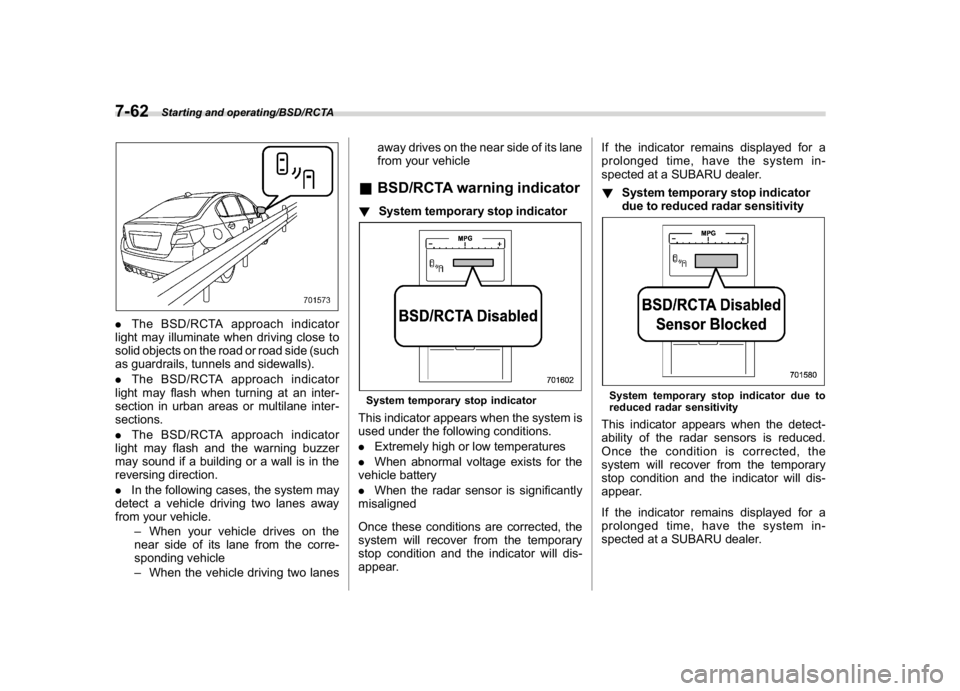
&BSD/RCTA warning indicator!System temporary stop indicatorSystem temporary stop indicatorThis indicator appears when the system is
used under the following conditions.
.Extremely high or low temperatures
.When abnormal voltage exists for the
vehicle battery
.When the radar sensor is significantly
misaligned
Once these conditions are corrected, the
system will recover from the temporary
stop condition and the indicator will dis-
appear.If the indicator remains displayed for a
prolonged time, have the system in-
spected at a SUBARU dealer.
!System temporary stop indicator
due to reduced radar sensitivity
System temporary stop indicator due to
reduced radar sensitivityThis indicator appears when the detect-
ability of the radar sensors is reduced.
Once the condition is corrected, the
system will recover from the temporary
stop condition and the indicator will dis-
appear.
If the indicator remains displayed for a
prolonged time, have the system in-
spected at a SUBARU dealer.
Starting and operating/BSD/RCTA
7-62
Page 412 of 578
(425,1)
北米Model "A1700BE-B" EDITED: 2017/ 10/ 11
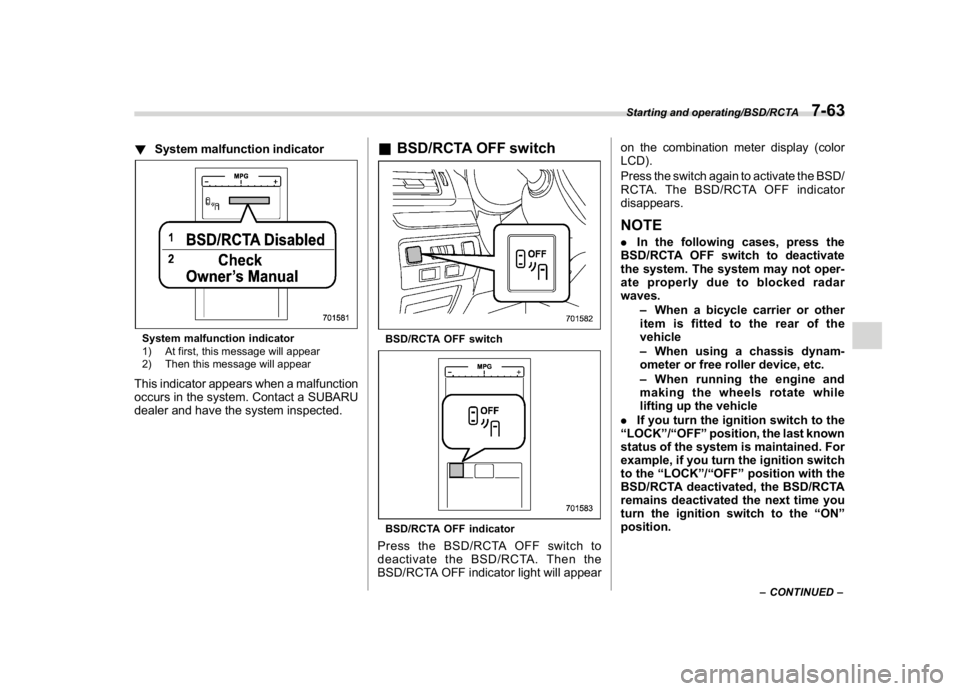
!System malfunction indicatorSystem malfunction indicator
1) At first, this message will appear
2) Then this message will appearThis indicator appears when a malfunction
occurs in the system. Contact a SUBARU
dealer and have the system inspected.
&BSD/RCTA OFF switchBSD/RCTA OFF switchBSD/RCTA OFF indicatorPress the BSD/RCTA OFF switch to
deactivate the BSD/RCTA. Then the
BSD/RCTA OFF indicator light will appearon the combination meter display (color
LCD).
Press the switch again to activate the BSD/
RCTA. The BSD/RCTA OFF indicator
disappears.
NOTE.In the following cases, press the
BSD/RCTA OFF switch to deactivate
the system. The system may not oper-
ate properly due to blocked radar
waves.
–When a bicycle carrier or other
item is fitted to the rear of the
vehicle
–When using a chassis dynam-
ometer or free roller device, etc.
–When running the engine and
making the wheels rotate while
lifting up the vehicle
.If you turn the ignition switch to the
“LOCK”/“OFF”position, the last known
status of the system is maintained. For
example, if you turn the ignition switch
to the“LOCK”/“OFF”position with the
BSD/RCTA deactivated, the BSD/RCTA
remains deactivated the next time you
turn the ignition switch to the“ON”
position.
–CONTINUED–
Starting and operating/BSD/RCTA
7-63
7
Page 418 of 578
(431,1)
北米Model "A1700BE-B" EDITED: 2017/ 10/ 11
Weather conditions
–Extremely high or extremely low
temperatures in which the area near
the sonar sensor becomes too hot
or too cold to operate
–The sonar sensors or the rear
bumper near the sonar sensors is
exposed to heavy rain or a signifi-
cant amount of water
–Fog, snow or sandstorm, etc.
–Air is moving rapidly such as
when a strong wind is blowing
Parts attached to the rear bumper
near the sonar sensor
–Commercial electronic parts (fog
light, fender pole, radio antenna) or
commercial attachment parts (trai-
ler hitch, bicycle carrier, bumper
guard) are attached
–Parts that emit high frequency
sound, such as a horn or speaker,
are attached
Vehicle conditions
–The vehicle is significantly in-
clined
–The ground clearance is signifi-
cantly reduced due to the vehicle’s
loading condition, etc.
–When the sonar sensor is mis-
aligned due to a collision or anaccident
Surrounding environment
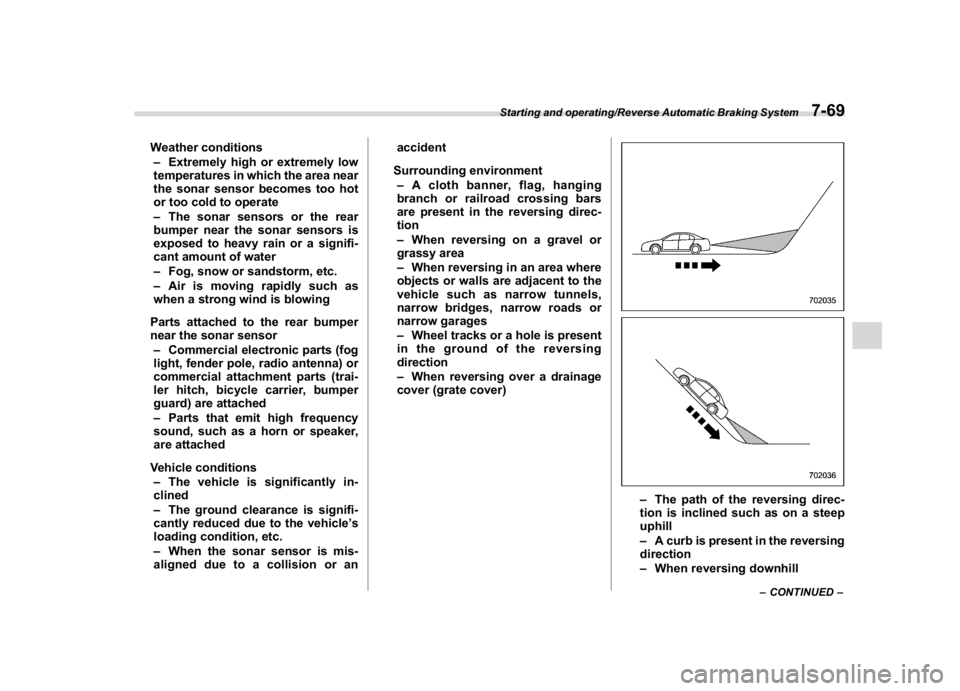
–A cloth banner, flag, hanging
branch or railroad crossing bars
are present in the reversing direc-
tion
–When reversing on a gravel or
grassy area
–When reversing in an area where
objects or walls are adjacent to the
vehicle such as narrow tunnels,
narrow bridges, narrow roads or
narrow garages
–Wheel tracks or a hole is present
in the ground of the reversing
direction
–When reversing over a drainage
cover (grate cover)
–The path of the reversing direc-
tion is inclined such as on a steep
uphill
–A curb is present in the reversing
direction
–When reversing downhill
–CONTINUED–
Starting and operating/Reverse Automatic Braking System
7-69
7
Page 419 of 578
(432,1)
北米Model "A1700BE-B" EDITED: 2017/ 10/ 11
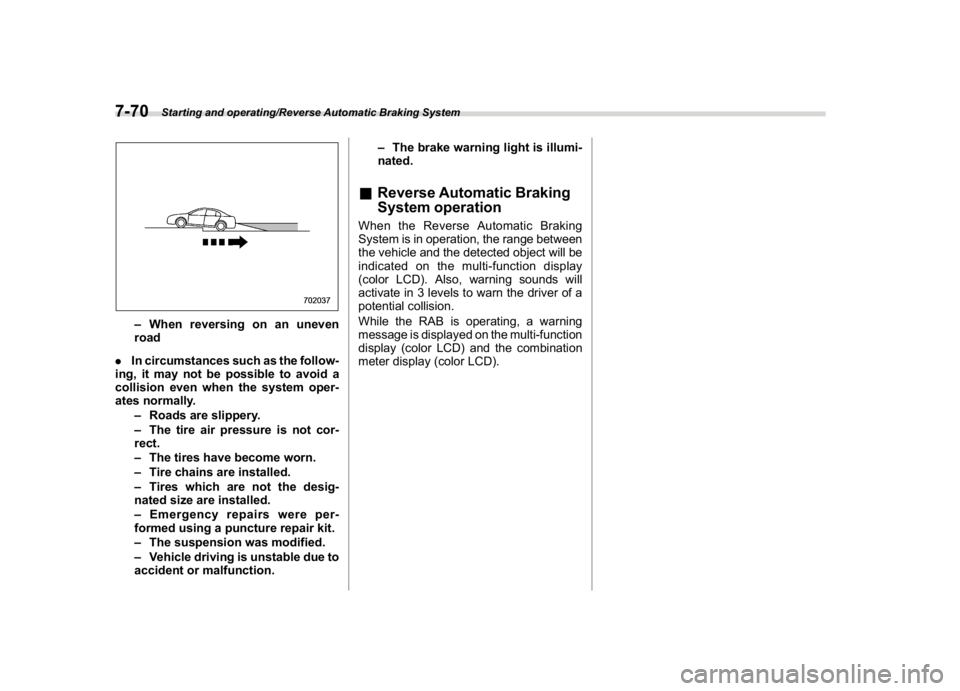
–When reversing on an uneven
road
.In circumstances such as the follow-
ing, it may not be possible to avoid a
collision even when the system oper-
ates normally.
–Roads are slippery.
–The tire air pressure is not cor-
rect.
–The tires have become worn.
–Tire chains are installed.
–Tires which are not the desig-
nated size are installed.
–Emergency repairs were per-
formed using a puncture repair kit.
–The suspension was modified.
–Vehicle driving is unstable due to
accident or malfunction.–The brake warning light is illumi-
nated.
&Reverse Automatic Braking
System operationWhen the Reverse Automatic Braking
System is in operation, the range between
the vehicle and the detected object will be
indicated on the multi-function display
(color LCD). Also, warning sounds will
activate in 3 levels to warn the driver of a
potential collision.
While the RAB is operating, a warning
message is displayed on the multi-function
display (color LCD) and the combination
meter display (color LCD).
Starting and operating/Reverse Automatic Braking System
7-70
Page 435 of 578
(450,1)
北米Model "A1700BE-B" EDITED: 2017/ 10/ 11
tion, brand and load range and you should
never mix radial, belted bias or bias tires
since this may result in dangerous hand-
ling characteristics. When you choose a
tire, make sure that there is enough
clearance between the tire and vehicle
body.
Remember to drive with care at all times
regardless of the type of tires on your
vehicle.&Tire chains
CAUTION
You cannot use tire chains on your
vehicle because of the lack of clear-
ance between the tires and vehicle
body.NOTEEven though you cannot use tire
chains, use of another type of traction
device (such as spring chains) may be
acceptable if use on your vehicle is
recommended by the device manufac-
turer, taking into account tire size and
road conditions. Follow the device
manufacturer’s instructions, especially
regarding maximum vehicle speed.
To help avoid damage to your vehicle,drive slowly, readjust or remove the
device if it is contacting your vehicle,
and do not spin your wheels. Damage
caused to your vehicle by use of a
traction device is not covered under
warranty.
Make certain that any traction device
you use is an SAE class S device, and
use it on the front wheels only. Always
use the utmost care when driving with a
traction device. Overconfidence be-
cause you are using a traction device
could easily lead to a serious accident.
&Rocking the vehicleIf you must rock the vehicle to free it from
snow, sand, or mud, depress the accel-
erator pedal slightly and move the shift
lever/select lever back and forth between
“1”/“D”and“R”repeatedly. Do not race the
engine. For the best possible traction,
avoid spinning the wheels when trying to
free the vehicle.
When the road surface is extremely
slippery, you can obtain better traction by
starting the vehicle with the transmission in
2nd than in 1st (MT models and CVT
models).
If your vehicle is a CVT model, for
information about holding the transmissionin the 2nd position, refer to“Selection of
manual mode”F7-25.
Driving tips/Winter driving
8-10
Page 443 of 578
(460,1)
北米Model "A1700BE-B" EDITED: 2017/ 10/ 11
If you park your vehicle in
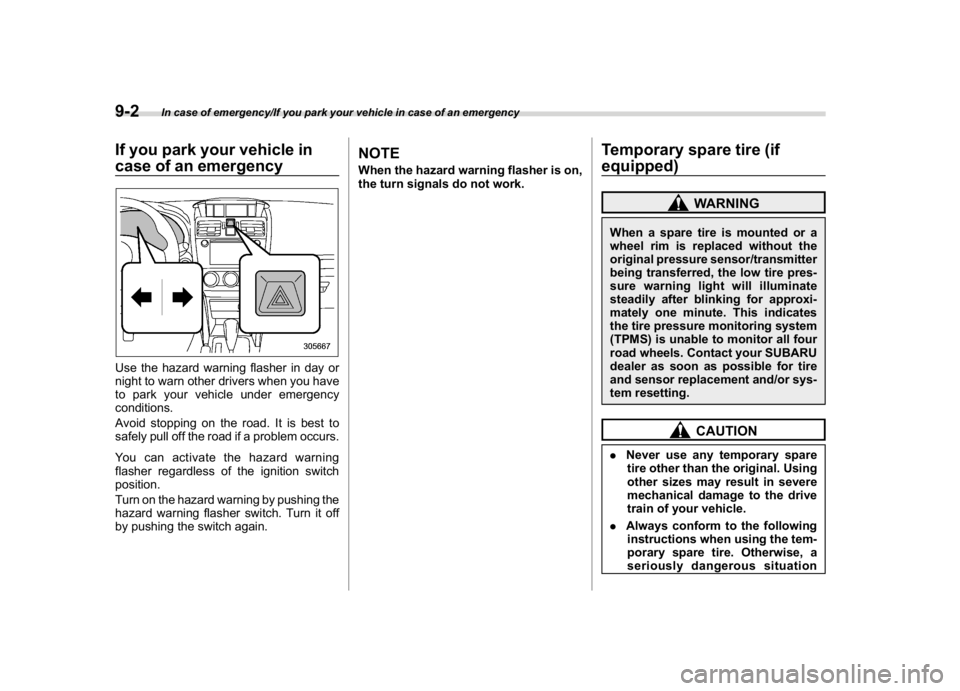
case of an emergencyUse the hazard warning flasher in day or
night to warn other drivers when you have
to park your vehicle under emergency
conditions.
Avoid stopping on the road. It is best to
safely pull off the road if a problem occurs.
You can activate the hazard warning
flasher regardless of the ignition switch
position.
Turn on the hazard warning by pushing the
hazard warning flasher switch. Turn it off
by pushing the switch again.
NOTEWhen the hazard warning flasher is on,
the turn signals do not work.
Temporary spare tire (if
equipped)
WARNING
When a spare tire is mounted or a
wheel rim is replaced without the
original pressure sensor/transmitter
being transferred, the low tire pres-
sure warning light will illuminate
steadily after blinking for approxi-
mately one minute. This indicates
the tire pressure monitoring system
(TPMS) is unable to monitor all four
road wheels. Contact your SUBARU
dealer as soon as possible for tire
and sensor replacement and/or sys-
tem resetting.
CAUTION
.Never use any temporary spare
tire other than the original. Using
other sizes may result in severe
mechanical damage to the drive
train of your vehicle.
.Always conform to the following
instructions when using the tem-
porary spare tire. Otherwise, a
seriously dangerous situation
In case of emergency/If you park your vehicle in case of an emergency
9-2
Page 444 of 578
(461,1)
北米Model "A1700BE-B" EDITED: 2017/ 10/ 11
may occur.
The temporary spare tire is smaller and
lighter than a conventional tire and is
designed for emergency use only. Re-
move the temporary spare tire and re-
install the conventional tire as soon as
possible because the spare tire is de-
signed only for temporary use.
Check the inflation pressure of the tem-
porary spare tire periodically to keep the
tire ready for use. For the correct tire
pressure, refer to“Temporary spare tires”
F12-9.
When using the temporary spare tire, note
the following.
.Drive with caution when temporary
spare tire is fitted. Avoid hard acceleration
and braking, or fast cornering, as control of
the vehicle may be lost.
.Do not exceed 50 mph (80 km/h).
.Do not put a tire chain on the temporary
spare tire. Because of the smaller tire size,
a tire chain will not fit properly.
.Do not use two or more temporary
spare tires at the same time.
.Do not drive over obstacles. This tire
has a smaller diameter, so road clearance
is reduced.
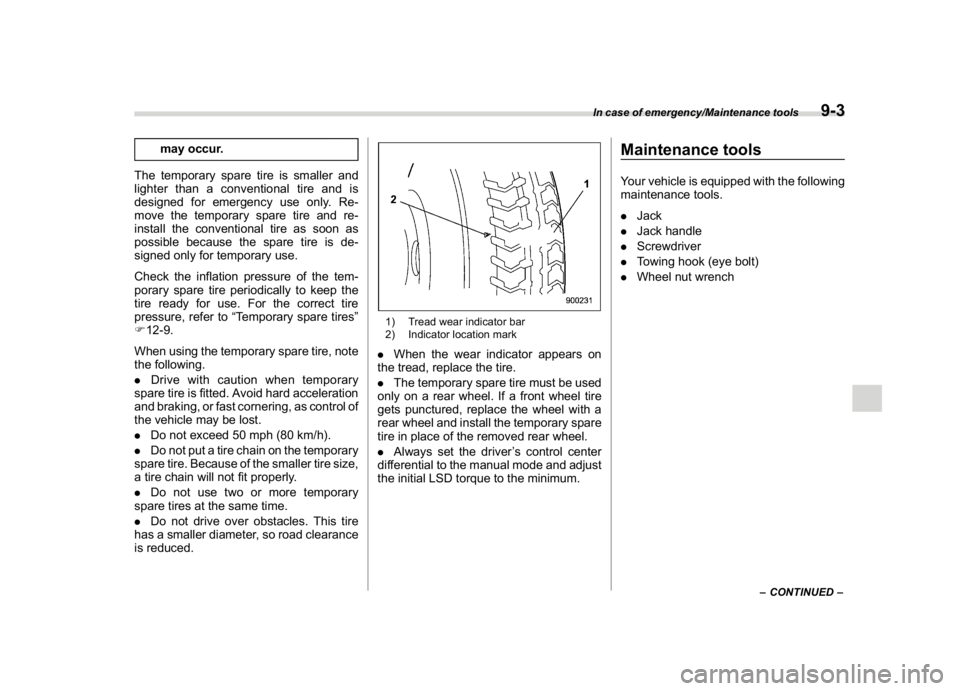
1) Tread wear indicator bar
2) Indicator location mark.When the wear indicator appears on
the tread, replace the tire.
.The temporary spare tire must be used
only on a rear wheel. If a front wheel tire
gets punctured, replace the wheel with a
rear wheel and install the temporary spare
tire in place of the removed rear wheel.
.Always set the driver’s control center
differential to the manual mode and adjust
the initial LSD torque to the minimum.
Maintenance toolsYour vehicle is equipped with the following
maintenance tools.
.Jack
.Jack handle
.Screwdriver
.Towing hook (eye bolt)
.Wheel nut wrench
–CONTINUED–
In case of emergency/Maintenance tools
9-3
9
Page 458 of 578
(475,1)
北米Model "A1700BE-B" EDITED: 2017/ 10/ 11
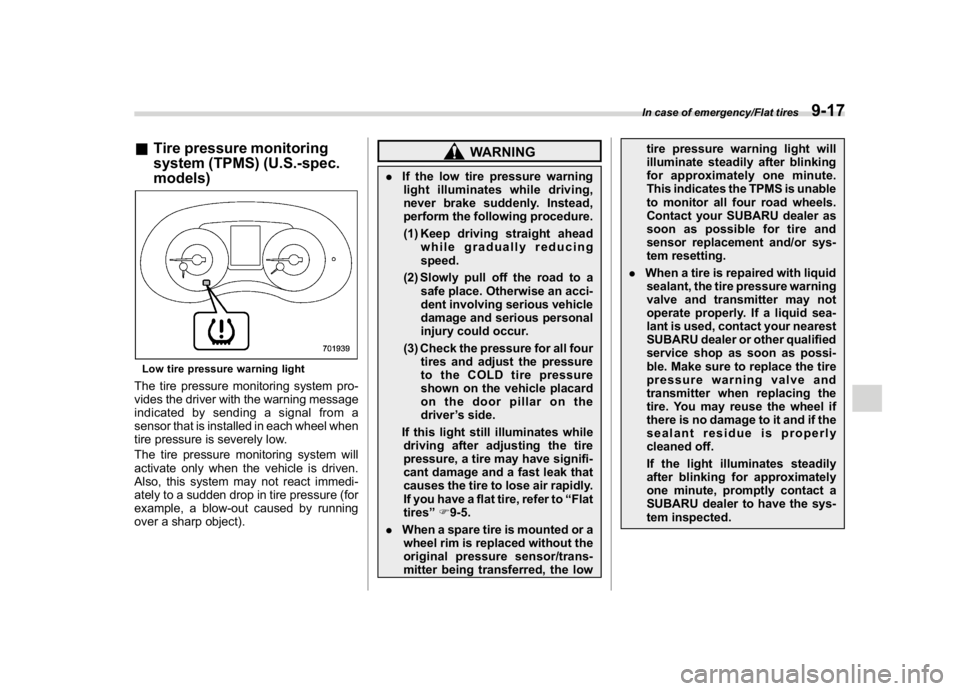
&Tire pressure monitoring
system (TPMS) (U.S.-spec.
models)Low tire pressure warning lightThe tire pressure monitoring system pro-
vides the driver with the warning message
indicated by sending a signal from a
sensor that is installed in each wheel when
tire pressure is severely low.
The tire pressure monitoring system will
activate only when the vehicle is driven.
Also, this system may not react immedi-
ately to a sudden drop in tire pressure (for
example, a blow-out caused by running
over a sharp object).
WARNING
.If the low tire pressure warning
light illuminates while driving,
never brake suddenly. Instead,
perform the following procedure.
(1) Keep driving straight ahead
while gradually reducing
speed.
(2) Slowly pull off the road to a
safe place. Otherwise an acci-
dent involving serious vehicle
damage and serious personal
injury could occur.
(3) Check the pressure for all four
tires and adjust the pressure
to the COLD tire pressure
shown on the vehicle placard
on the door pillar on the
driver’s side.
If this light still illuminates while
driving after adjusting the tire
pressure, a tire may have signifi-
cant damage and a fast leak that
causes the tire to lose air rapidly.
If you have a flat tire, refer to“Flat
tires”F9-5.
.When a spare tire is mounted or a
wheel rim is replaced without the
original pressure sensor/trans-
mitter being transferred, the lowtire pressure warning light will
illuminate steadily after blinking
for approximately one minute.
This indicates the TPMS is unable
to monitor all four road wheels.
Contact your SUBARU dealer as
soon as possible for tire and
sensor replacement and/or sys-
tem resetting.
.When a tire is repaired with liquid
sealant, the tire pressure warning
valve and transmitter may not
operate properly. If a liquid sea-
lant is used, contact your nearest
SUBARU dealer or other qualified
service shop as soon as possi-
ble. Make sure to replace the tire
pressure warning valve and
transmitter when replacing the
tire. You may reuse the wheel if
there is no damage to it and if the
sealant residue is properly
cleaned off.
If the light illuminates steadily
after blinking for approximately
one minute, promptly contact a
SUBARU dealer to have the sys-
tem inspected.
In case of emergency/Flat tires
9-17
9