differential SUBARU WRX 2018 User Guide
[x] Cancel search | Manufacturer: SUBARU, Model Year: 2018, Model line: WRX, Model: SUBARU WRX 2018Pages: 578, PDF Size: 33.21 MB
Page 350 of 578

(363,1)
北米Model "A1700BE-B" EDITED: 2017/ 10/ 11
Fuel..........................................................................7-3
Fuel requirements.................................................. 7-3
Fuel filler lid and cap............................................. 7-5
State emission testing (U.S.only).........................7-7
Preparing to drive...................................................7-8
Starting and stopping theengine..........................7-9
General precautions when starting/stopping
engine................................................................. 7-9
Models without push-button start systems............7-10
Models with push-button start systems ................. 7-11
Remote engine start system (dealer option)...........7-14
Manual transmission............................................7-16
Shifting speeds.....................................................7-17
Driving tips...........................................................7-18
Driver’s Control Center Differential
(C.DIFF/DCCD) (STI)...........................................7-18
To change mode of driver’s control center
differential..........................................................7-19
Auto mode............................................................7-20
Manual mode........................................................7-21
Temporary release................................................7-22
Continuously variable transmission....................7-23
Select lever...........................................................7-24
Selection of manual mode.....................................7-25
Shift lock function.................................................7-27
Driving tips...........................................................7-28
SI-DRIVE (if equipped)..........................................7-28
Intelligent (I) mode................................................7-28
Sport (S) mode.....................................................7-29
Sport Sharp (S#) mode..........................................7-29SI-DRIVE switch....................................................7-30
Limited slip differential (LSD)(STI).....................7-31
Power steering......................................................7-31
STI .......................................................................7-31
Except STI............................................................7-32
Braking..................................................................7-33
Braking tips..........................................................7-33
Brake system.......................................................7-33
Disc brake pad wear warning indicators................7-34
High performance brake system (STI)...................7-34
Red caliper with sports brake pad (if equipped) .... 7-34
ABS (Anti-lock BrakeSystem).............................7-35
ABS self-check.....................................................7-35
ABS warning light.................................................7-35
Electronic Brake Force Distribution (EBD)
system................................................................7-36
Steps to take if EBD system malfunctions .............7-36
Vehicle Dynamics Controlsystem......................7-37
Vehicle Dynamics Control system monitor ............7-39
Vehicle Dynamics Control OFF switch...................7-39
Tire pressure monitoring system (TPMS)
(U.S.-spec. models)...........................................7-40
Parking your vehicle............................................7-42
Parking brake (models without electronic parking
brake system)....................................................7-42
Electronic parking brake (models with electronic
parking brake system).......................................7-43
Parking tips..........................................................7-45
Auto Vehicle Holdfunction..................................7-46
To turn on/off the Auto Vehicle Hold function........7-47
To operate the Auto Vehicle Hold function ............7-48
Starting and operating
7
Page 367 of 578
(380,1)
北米Model "A1700BE-B" EDITED: 2017/ 10/ 11
engine over-revving and this in turn
can result in engine damage.
In addition, sudden application of
engine brakes when the vehicle is
travelling on a slippery surface can
lead to wheel locking; as a conse-
quence, control of the vehicle may
be lost and the risk of an accident
increased.NOTENever exceed the posted speed limit.&Driving tips
NOTEIf the accelerator and brake pedals are
depressed at the same time, driving
torque may be restrained. This is not a
malfunction.
Do not drive with your foot resting on the
clutch pedal and do not use the clutch to
hold your vehicle at a standstill on an
upgrade. Either of those actions may
cause clutch damage.
Do not drive with your hand resting on the
shift lever. This may cause wear on the
transmission components.
When it is necessary to reduce vehicle
speed due to slow traffic, turning corners,
or driving up steep hills, downshift to alower gear before the engine starts to
labor.
On steep downgrades, downshift the
transmission to 5th, 4th, 3rd or 2nd gear
as necessary; this helps to maintain a safe
speed and to extend brake pad life.
In this way, the engine provides a braking
effect. Remember, if you“ride”(over use)
the brakes while descending a hill, they
may overheat and not work properly.
The engine may, on rare occasions, knock
when the vehicle rapidly accelerates or
rapidly pulls away from a standstill. This
phenomenon is not an indication of a
problem in your vehicle.
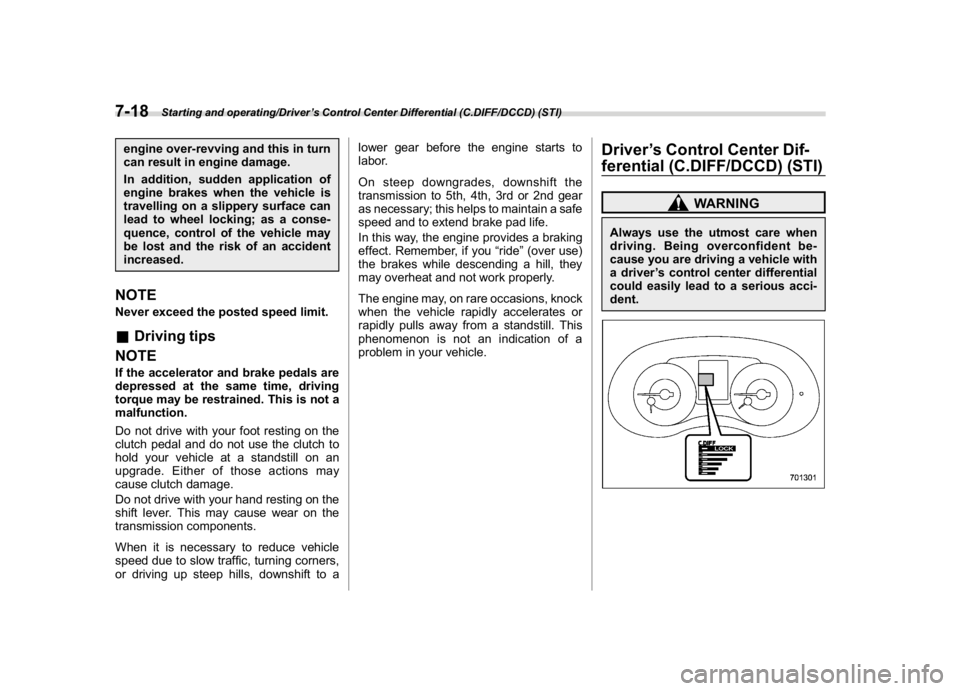
Driver’s Control Center Dif-
ferential (C.DIFF/DCCD) (STI)
WARNING
Always use the utmost care when
driving. Being overconfident be-
cause you are driving a vehicle with
a driver’s control center differential
could easily lead to a serious acci-
dent.
Starting and operating/Driver’s Control Center Differential (C.DIFF/DCCD) (STI)
7-18
Page 368 of 578
(381,1)
北米Model "A1700BE-B" EDITED: 2017/ 10/ 11
CAUTION
.All the indicators will flash in the
event that the driver’scontrol
center differential has a malfunc-
tion. Have the vehicle inspected
by your SUBARU dealer.
.If a malfunction occurs in the
vehicle (for example, when the
rear differential oil temperature
warning light illuminates), all of
the indicators may disappear and
the setting value for the initial
limited slip differential (LSD) tor-
que of the driver’s control center
differential (C.DIFF/DCCD) may
be cancelled. However, it does
not indicate a malfunction of the
C.DIFF/DCCD itself.
The driver’s control center differential
allows you to freely change the degree of
limitation of the differential action (limited
slip differential (LSD) torque) of your
vehicle’s center differential.
By using the center differential control
switch, you can set an initial LSD torque
to match the road surface conditions,
driving conditions and your driving style.The driver’s control center differential has
the following modes.
.Auto mode: the system automatically
adjusts the initial LSD torque.
.Manual mode: you can change to the
desired mode manually by using the
center differential control switch.
NOTEIf you rapidly depress and release the
accelerator pedal while driving at low
speed, you may hear a knocking sound
from the vicinity of the center differen-
tial and rear differential. This sound
occurs because of the structure of the
center differential. It does not indicate a
problem.
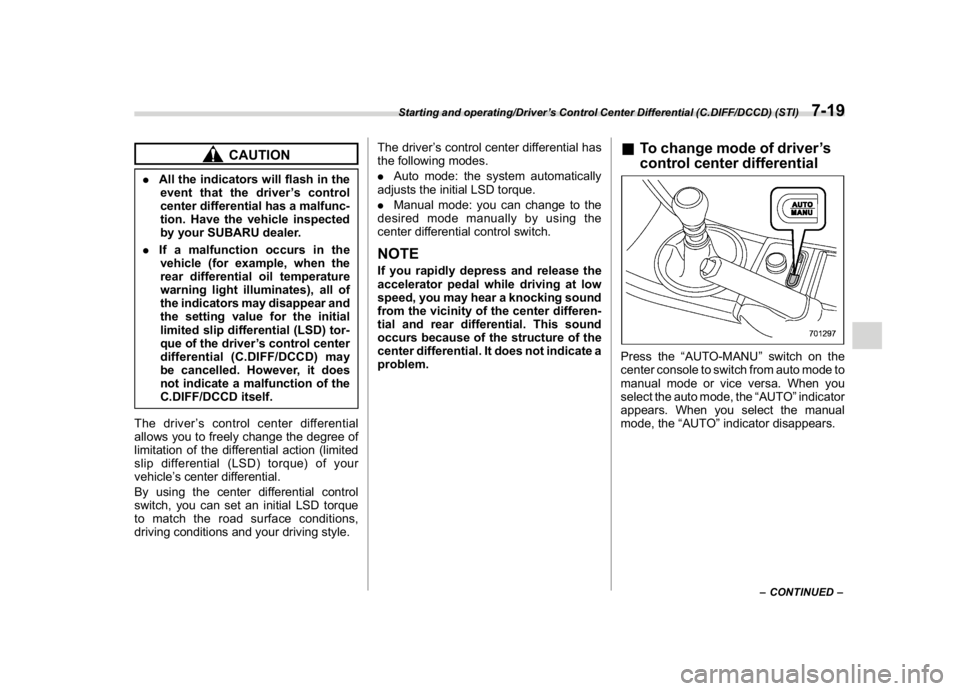
&To change mode of driver’s
control center differentialPress the“AUTO-MANU”switch on the
center console to switch from auto mode to
manual mode or vice versa. When you
select the auto mode, the“AUTO”indicator
appears. When you select the manual
mode, the“AUTO”indicator disappears.
–CONTINUED–
Starting and operating/Driver’s Control Center Differential (C.DIFF/DCCD) (STI)
7-19
7
Page 369 of 578
(382,1)
北米Model "A1700BE-B" EDITED: 2017/ 10/ 11
&Auto modeIn the auto mode, the system estimates the
driving and road conditions using signals
from the wheel speed sensor, throttle
position sensor, steering angle sensor
and brake switch, etc. According to the
result, it electronically and automatically
controls the degree of limitation of the
differential action (LSD torque) to optimize
the differential action of the center differ-
ential. When you turn the ignition switch
ON, the“AUTO”indicator on the combina-
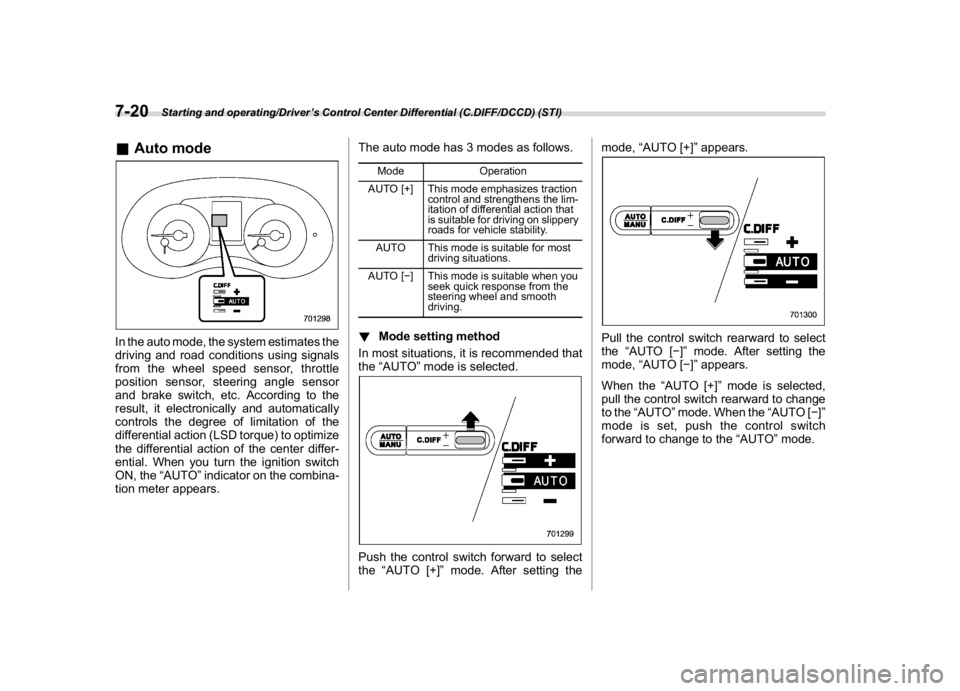
tion meter appears.The auto mode has 3 modes as follows.
Mode Operation
AUTO [+] This mode emphasizes traction
control and strengthens the lim-
itation of differential action that
is suitable for driving on slippery
roads for vehicle stability.
AUTO This mode is suitable for most
driving situations.
AUTO [] This mode is suitable when you
seek quick response from the
steering wheel and smooth
driving.
!Mode setting method
In most situations, it is recommended that
the“AUTO”mode is selected.Push the control switch forward to select
the“AUTO [+]”mode. After setting themode,“AUTO [+]”appears.
Pull the control switch rearward to select
the“AUTO []”mode. After setting the
mode,“AUTO []”appears.
When the“AUTO [+]”mode is selected,
pull the control switch rearward to change
to the“AUTO”mode. When the“AUTO []”
mode is set, push the control switch
forward to change to the“AUTO”mode.
Starting and operating/Driver’s Control Center Differential (C.DIFF/DCCD) (STI)
7-20
Page 370 of 578
(383,1)
北米Model "A1700BE-B" EDITED: 2017/ 10/ 11
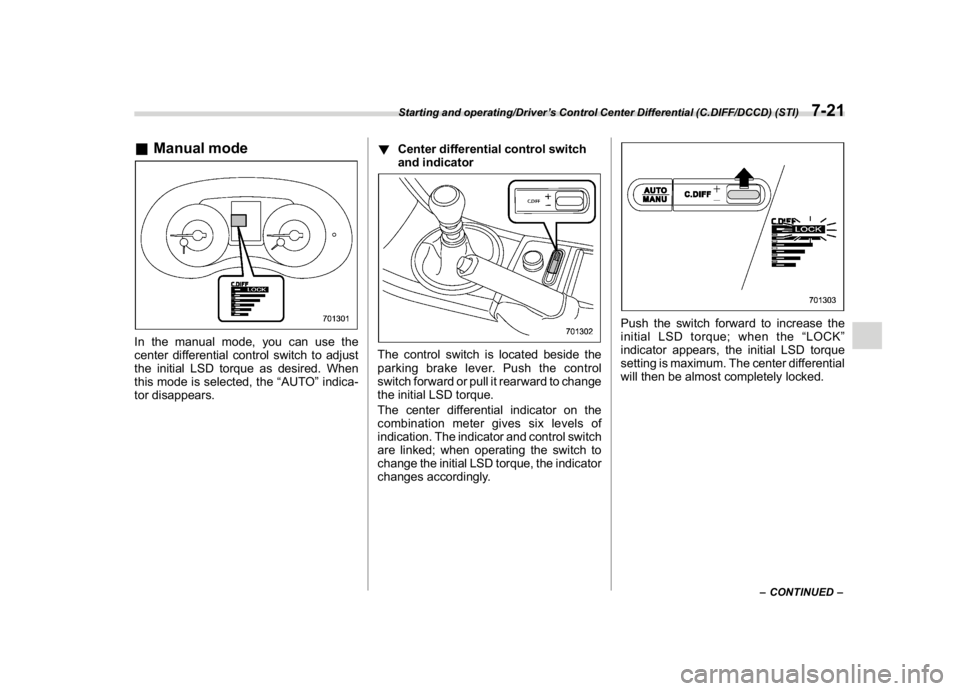
&Manual modeIn the manual mode, you can use the
center differential control switch to adjust
the initial LSD torque as desired. When
this mode is selected, the“AUTO”indica-
tor disappears.!Center differential control switch
and indicator
The control switch is located beside the
parking brake lever. Push the control
switch forward or pull it rearward to change
the initial LSD torque.
The center differential indicator on the
combination meter gives six levels of
indication. The indicator and control switch
are linked; when operating the switch to
change the initial LSD torque, the indicator
changes accordingly.
Push the switch forward to increase the
initial LSD torque; when the“LOCK”
indicator appears, the initial LSD torque
setting is maximum. The center differential
will then be almost completely locked.
–CONTINUED–
Starting and operating/Driver’s Control Center Differential (C.DIFF/DCCD) (STI)
7-21
7
Page 371 of 578
(384,1)
北米Model "A1700BE-B" EDITED: 2017/ 10/ 11
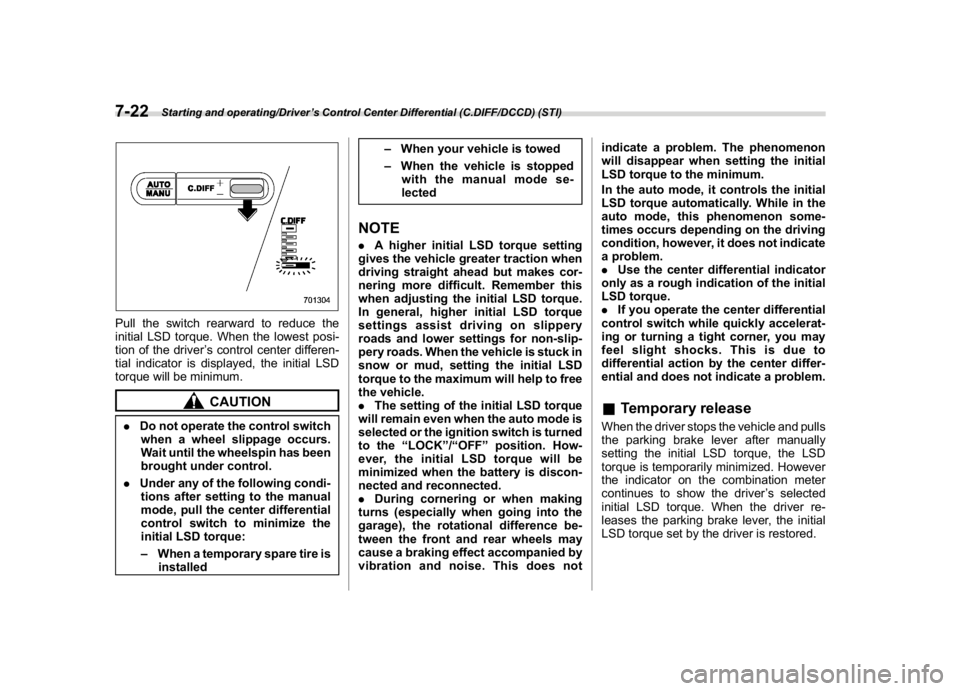
Pull the switch rearward to reduce the
initial LSD torque. When the lowest posi-
tion of the driver’s control center differen-
tial indicator is displayed, the initial LSD
torque will be minimum.
CAUTION
.Do not operate the control switch
when a wheel slippage occurs.
Wait until the wheelspin has been
brought under control.
.Under any of the following condi-
tions after setting to the manual
mode, pull the center differential
control switch to minimize the
initial LSD torque:
–When a temporary spare tire is
installed–When your vehicle is towed
–When the vehicle is stopped
with the manual mode se-
lected
NOTE.A higher initial LSD torque setting
gives the vehicle greater traction when
driving straight ahead but makes cor-
nering more difficult. Remember this
when adjusting the initial LSD torque.
In general, higher initial LSD torque
settings assist driving on slippery
roads and lower settings for non-slip-
pery roads. When the vehicle is stuck in
snow or mud, setting the initial LSD
torque to the maximum will help to free
the vehicle.
.The setting of the initial LSD torque
will remain even when the auto mode is
selected or the ignition switch is turned
to the“LOCK”/“OFF”position. How-
ever, the initial LSD torque will be
minimized when the battery is discon-
nected and reconnected.
.During cornering or when making
turns (especially when going into the
garage), the rotational difference be-
tween the front and rear wheels may
cause a braking effect accompanied by
vibration and noise. This does notindicate a problem. The phenomenon
will disappear when setting the initial
LSD torque to the minimum.
In the auto mode, it controls the initial
LSD torque automatically. While in the
auto mode, this phenomenon some-
times occurs depending on the driving
condition, however, it does not indicate
a problem.
.Use the center differential indicator
only as a rough indication of the initial
LSD torque.
.If you operate the center differential
control switch while quickly accelerat-
ing or turning a tight corner, you may
feel slight shocks. This is due to
differential action by the center differ-
ential and does not indicate a problem.
&Temporary releaseWhen the driver stops the vehicle and pulls
the parking brake lever after manually
setting the initial LSD torque, the LSD
torque is temporarily minimized. However
the indicator on the combination meter
continues to show the driver’s selected
initial LSD torque. When the driver re-
leases the parking brake lever, the initial
LSD torque set by the driver is restored.
Starting and operating/Driver’s Control Center Differential (C.DIFF/DCCD) (STI)
7-22
Page 380 of 578
(393,1)
北米Model "A1700BE-B" EDITED: 2017/ 10/ 11
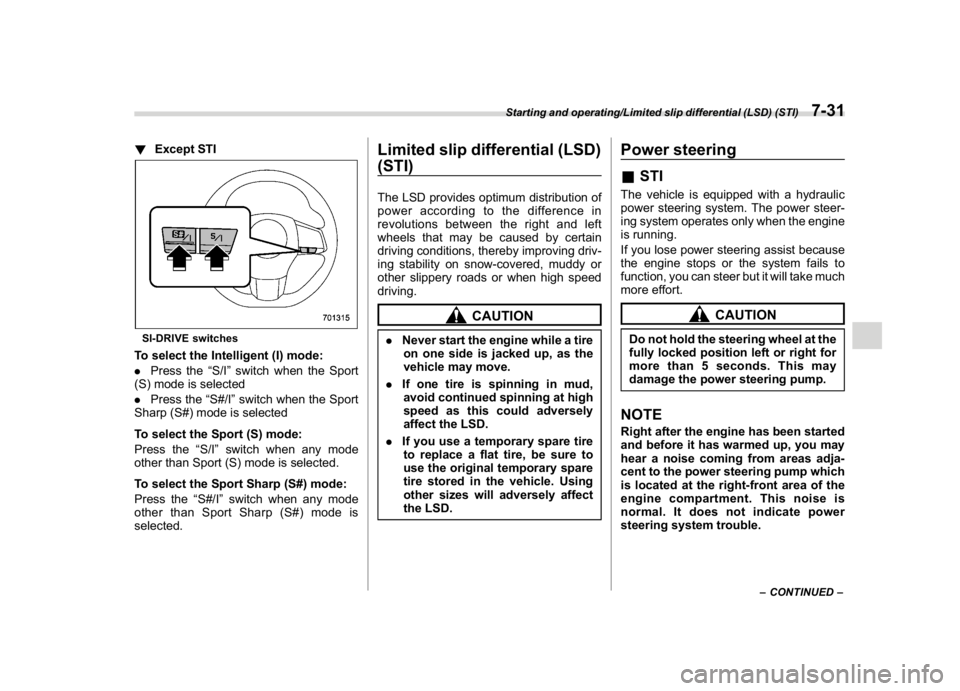
!Except STISI-DRIVE switchesTo select the Intelligent (I) mode:
.Press the“S/I”switch when the Sport
(S) mode is selected
.Press the“S#/I”switch when the Sport
Sharp (S#) mode is selected
To select the Sport (S) mode:
Press the“S/I”switch when any mode
other than Sport (S) mode is selected.
To select the Sport Sharp (S#) mode:
Press the“S#/I”switch when any mode
other than Sport Sharp (S#) mode is
selected.
Limited slip differential (LSD)
(STI)The LSD provides optimum distribution of
power according to the difference in
revolutions between the right and left
wheels that may be caused by certain
driving conditions, thereby improving driv-
ing stability on snow-covered, muddy or
other slippery roads or when high speed
driving.
CAUTION
.Never start the engine while a tire
on one side is jacked up, as the
vehicle may move.
.If one tire is spinning in mud,
avoid continued spinning at high
speed as this could adversely
affect the LSD.
.If you use a temporary spare tire
to replace a flat tire, be sure to
use the original temporary spare
tire stored in the vehicle. Using
other sizes will adversely affect
the LSD.
Power steering&STIThe vehicle is equipped with a hydraulic
power steering system. The power steer-
ing system operates only when the engine
is running.
If you lose power steering assist because
the engine stops or the system fails to
function, you can steer but it will take much
more effort.
CAUTION
Do not hold the steering wheel at the
fully locked position left or right for
more than 5 seconds. This may
damage the power steering pump.NOTERight after the engine has been started
and before it has warmed up, you may
hear a noise coming from areas adja-
cent to the power steering pump which
is located at the right-front area of the
engine compartment. This noise is
normal. It does not indicate power
steering system trouble.
–CONTINUED–
Starting and operating/Limited slip differential (LSD) (STI)
7-31
7
Page 431 of 578

(446,1)
北米Model "A1700BE-B" EDITED: 2017/ 10/ 11
conditions than a two wheel drive vehicle.
There is little difference in handling, how-
ever, during extremely sharp turns or
sudden braking. Therefore, when driving
down a slope or turning corners, be sure to
reduce your speed and maintain an ample
distance from other vehicles.
.Always check the cold tire pressure
before starting to drive. The recommended
tire pressure is provided on the tire
placard, which is located under the door
latch on the driver’s side.
.Frequent driving of an AWD vehicle
under hard-driving conditions such as
steep hills or dusty roads will necessitate
more frequent replacement of the follow-
ing items than that specified in the“War-
ranty and Maintenance Booklet”.
–Engine oil
–Brake fluid
–Rear differential gear oil
–Manual transmission oil (MT mod-
els)
–Continuously variable transmission
fluid (CVT models)
–Front differential gear oil (CVT
models)
.There are some precautions that you
must observe when towing your vehicle.
For detailed information, refer to“Towing”
F9-21.
Driving precautionWater entering the engine air intake or the
exhaust pipe or water splashing onto
electrical parts may damage your vehicle
and may cause it to stall. Never attempt to
drive through rushing water; regardless of
its depth, it can wash away the ground
from under your tires, resulting in possible
loss of traction and even vehicle rollover.
Winter driving&Operation during cold weath-
erCarry some emergency equipment, such
as a window scraper, a bag of sand, flares,
a small shovel and jumper cables.
Check the battery and cables. Cold tem-
peratures reduce battery capacity. The
battery must be in good condition to
provide enough power for cold winter
starts.
It normally takes longer to start the engine
in very cold weather conditions. Use an
engine oil of a proper grade and viscosity
for cold weather. Using heavy summer oil
will make it harder to start the engine.
Keep the door locks from freezing by
squirting them with deicer or glycerin.
Forcing a frozen door open may damage
or separate the rubber weather strips
around the door. If the door is frozen, use
hot water to melt the ice, and afterwards
thoroughly wipe the water away.
Use a windshield washer fluid that con-
tains an antifreeze solution. Do not use
engine antifreeze or other substitutes
because they may damage the paint of
the vehicle.
Driving tips/Driving precaution
8-6
Page 444 of 578

(461,1)
北米Model "A1700BE-B" EDITED: 2017/ 10/ 11
may occur.
The temporary spare tire is smaller and
lighter than a conventional tire and is
designed for emergency use only. Re-
move the temporary spare tire and re-
install the conventional tire as soon as
possible because the spare tire is de-
signed only for temporary use.
Check the inflation pressure of the tem-
porary spare tire periodically to keep the
tire ready for use. For the correct tire
pressure, refer to“Temporary spare tires”
F12-9.
When using the temporary spare tire, note
the following.
.Drive with caution when temporary
spare tire is fitted. Avoid hard acceleration
and braking, or fast cornering, as control of
the vehicle may be lost.
.Do not exceed 50 mph (80 km/h).
.Do not put a tire chain on the temporary
spare tire. Because of the smaller tire size,
a tire chain will not fit properly.
.Do not use two or more temporary
spare tires at the same time.
.Do not drive over obstacles. This tire
has a smaller diameter, so road clearance
is reduced.
1) Tread wear indicator bar
2) Indicator location mark.When the wear indicator appears on
the tread, replace the tire.
.The temporary spare tire must be used
only on a rear wheel. If a front wheel tire
gets punctured, replace the wheel with a
rear wheel and install the temporary spare
tire in place of the removed rear wheel.
.Always set the driver’s control center
differential to the manual mode and adjust
the initial LSD torque to the minimum.
Maintenance toolsYour vehicle is equipped with the following
maintenance tools.
.Jack
.Jack handle
.Screwdriver
.Towing hook (eye bolt)
.Wheel nut wrench
–CONTINUED–
In case of emergency/Maintenance tools
9-3
9
Page 462 of 578
(479,1)
北米Model "A1700BE-B" EDITED: 2017/ 10/ 11
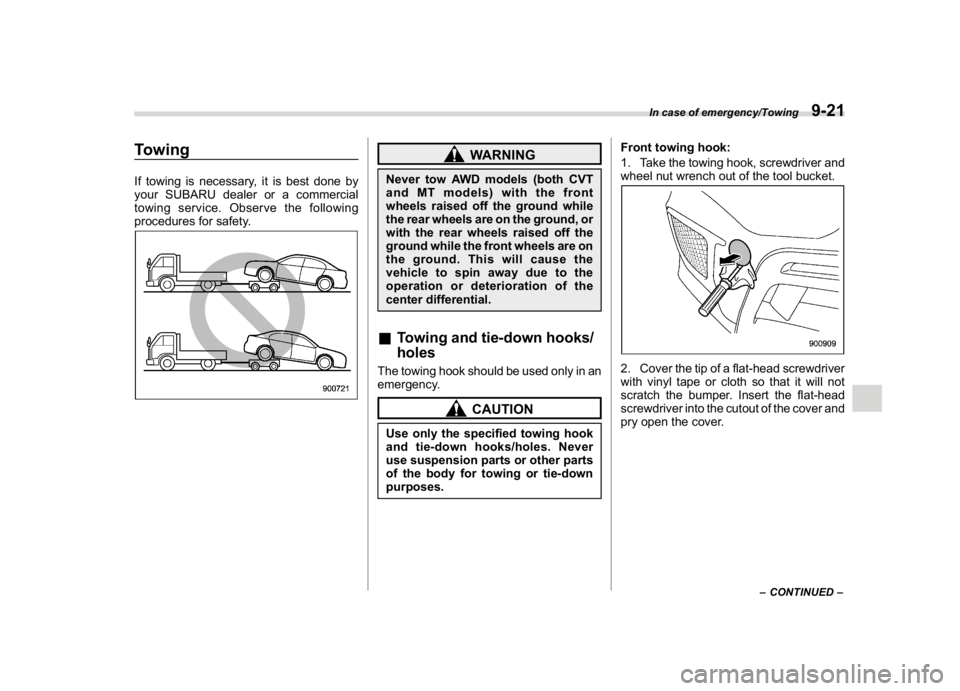
TowingIf towing is necessary, it is best done by
your SUBARU dealer or a commercial
towing service. Observe the following
procedures for safety.
WARNING
Never tow AWD models (both CVT
andMTmodels)withthefront
wheels raised off the ground while
the rear wheels are on the ground, or
with the rear wheels raised off the
ground while the front wheels are on
the ground. This will cause the
vehicle to spin away due to the
operation or deterioration of the
center differential.&Towing and tie-down hooks/
holesThe towing hook should be used only in an
emergency.
CAUTION
Use only the specified towing hook
and tie-down hooks/holes. Never
use suspension parts or other parts
of the body for towing or tie-down
purposes.Front towing hook:
1. Take the towing hook, screwdriver and
wheel nut wrench out of the tool bucket.
2. Cover the tip of a flat-head screwdriver
with vinyl tape or cloth so that it will not
scratch the bumper. Insert the flat-head
screwdriver into the cutout of the cover and
pry open the cover.
–CONTINUED–
In case of emergency/Towing
9-21
9