towing SUBARU WRX 2018 User Guide
[x] Cancel search | Manufacturer: SUBARU, Model Year: 2018, Model line: WRX, Model: SUBARU WRX 2018Pages: 578, PDF Size: 33.21 MB
Page 445 of 578
(462,1)
北米Model "A1700BE-B" EDITED: 2017/ 10/ 11
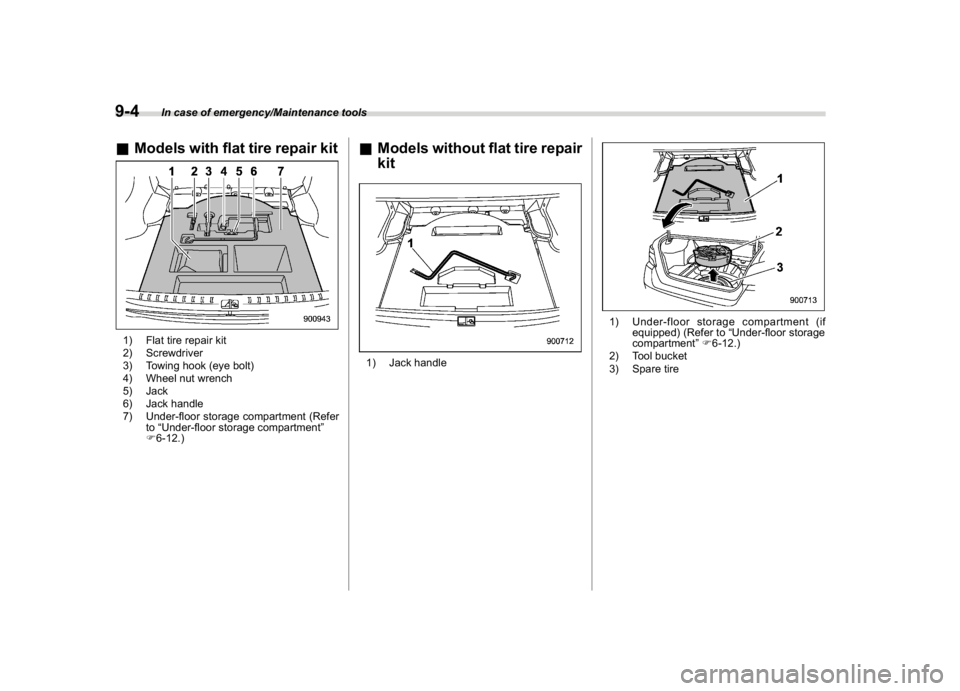
&Models with flat tire repair kit1) Flat tire repair kit
2) Screwdriver
3) Towing hook (eye bolt)
4) Wheel nut wrench
5) Jack
6) Jack handle
7) Under-floor storage compartment (Refer
to“Under-floor storage compartment”
F6-12.)
&Models without flat tire repair
kit1) Jack handle
1) Under-floor storage compartment (if
equipped) (Refer to“Under-floor storage
compartment”F6-12.)
2) Tool bucket
3) Spare tire
In case of emergency/Maintenance tools
9-4
Page 446 of 578
(463,1)
北米Model "A1700BE-B" EDITED: 2017/ 10/ 11
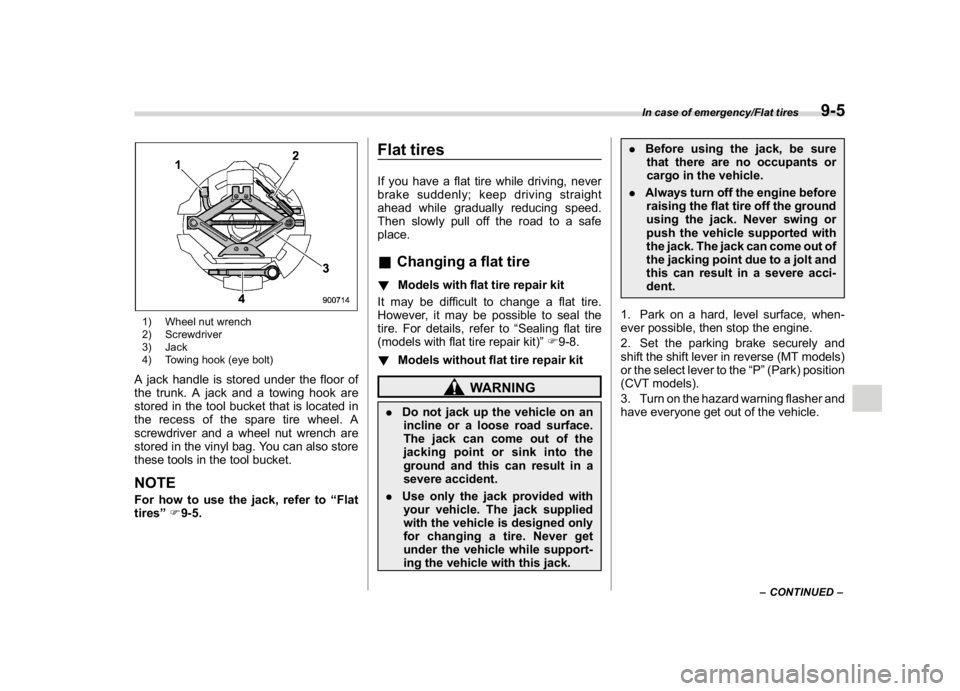
1) Wheel nut wrench
2) Screwdriver
3) Jack
4) Towing hook (eye bolt)A jack handle is stored under the floor of
the trunk. A jack and a towing hook are
stored in the tool bucket that is located in
the recess of the spare tire wheel. A
screwdriver and a wheel nut wrench are
stored in the vinyl bag. You can also store
these tools in the tool bucket.NOTEFor how to use the jack, refer to“Flat
tires”F9-5.
Flat tiresIf you have a flat tire while driving, never
brake suddenly; keep driving straight
ahead while gradually reducing speed.
Then slowly pull off the road to a safe
place.&Changing a flat tire!Models with flat tire repair kit
It may be difficult to change a flat tire.
However, it may be possible to seal the
tire. For details, refer to“Sealing flat tire
(models with flat tire repair kit)”F9-8.
!Models without flat tire repair kit
WARNING
.Do not jack up the vehicle on an
incline or a loose road surface.
The jack can come out of the
jacking point or sink into the
ground and this can result in a
severe accident.
.Use only the jack provided with
your vehicle. The jack supplied
with the vehicle is designed only
for changing a tire. Never get
under the vehicle while support-
ing the vehicle with this jack..Before using the jack, be sure
that there are no occupants or
cargo in the vehicle.
.Always turn off the engine before
raising the flat tire off the ground
using the jack. Never swing or
push the vehicle supported with
the jack. The jack can come out of
the jacking point due to a jolt and
this can result in a severe acci-
dent.
1. Park on a hard, level surface, when-
ever possible, then stop the engine.
2. Set the parking brake securely and
shift the shift lever in reverse (MT models)
or the select lever to the“P”(Park) position
(CVT models).
3. Turn on the hazard warning flasher and
have everyone get out of the vehicle.
–CONTINUED–
In case of emergency/Flat tires
9-5
9
Page 462 of 578
(479,1)
北米Model "A1700BE-B" EDITED: 2017/ 10/ 11
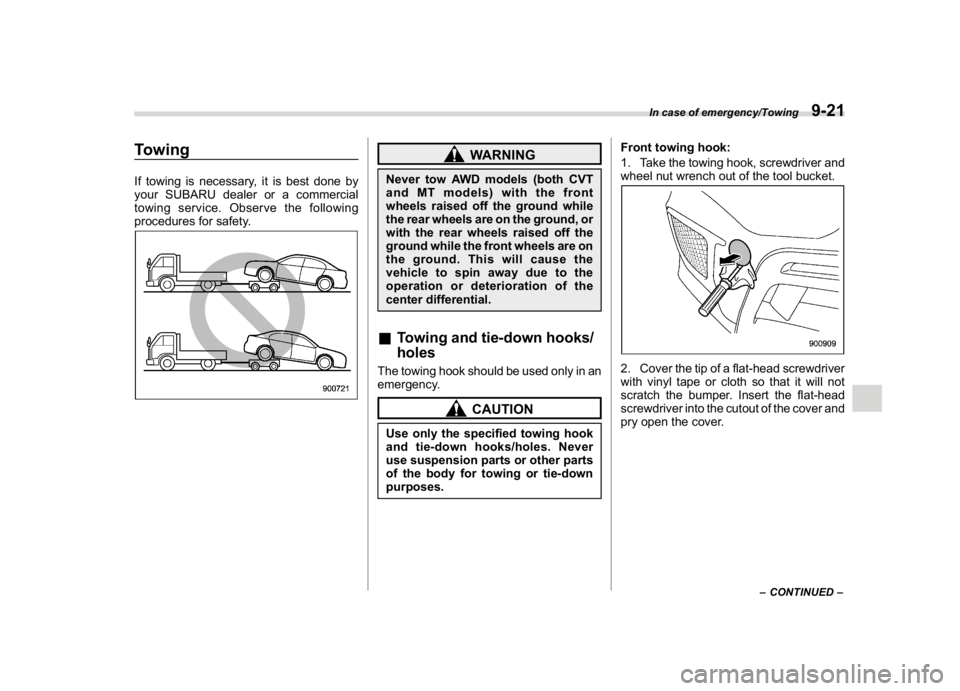
TowingIf towing is necessary, it is best done by
your SUBARU dealer or a commercial
towing service. Observe the following
procedures for safety.
WARNING
Never tow AWD models (both CVT
andMTmodels)withthefront
wheels raised off the ground while
the rear wheels are on the ground, or
with the rear wheels raised off the
ground while the front wheels are on
the ground. This will cause the
vehicle to spin away due to the
operation or deterioration of the
center differential.&Towing and tie-down hooks/
holesThe towing hook should be used only in an
emergency.
CAUTION
Use only the specified towing hook
and tie-down hooks/holes. Never
use suspension parts or other parts
of the body for towing or tie-down
purposes.Front towing hook:
1. Take the towing hook, screwdriver and
wheel nut wrench out of the tool bucket.
2. Cover the tip of a flat-head screwdriver
with vinyl tape or cloth so that it will not
scratch the bumper. Insert the flat-head
screwdriver into the cutout of the cover and
pry open the cover.
–CONTINUED–
In case of emergency/Towing
9-21
9
Page 463 of 578
(480,1)
北米Model "A1700BE-B" EDITED: 2017/ 10/ 11
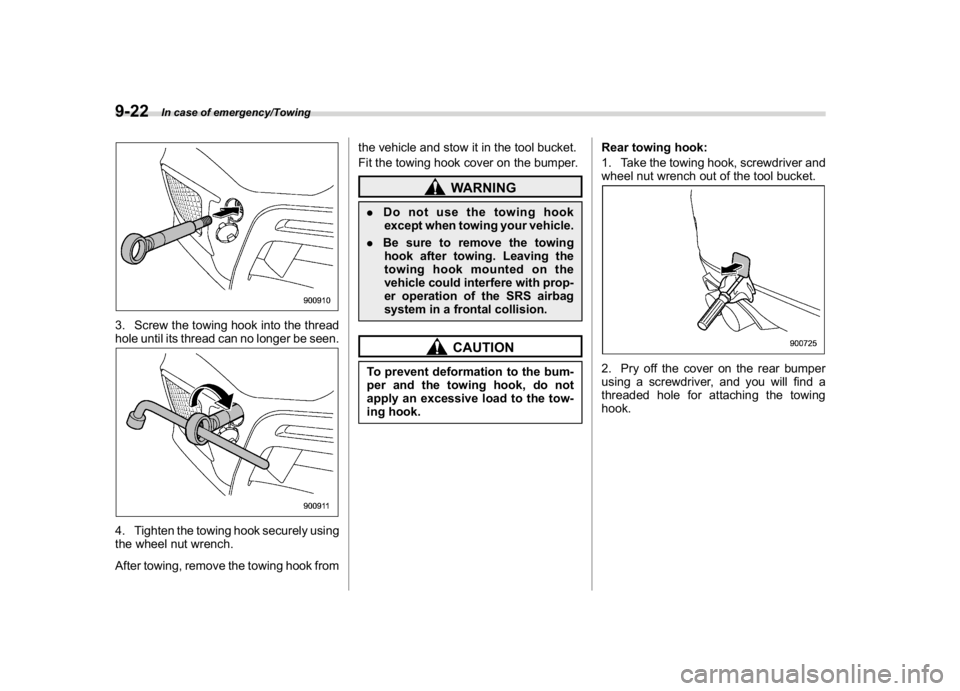
3. Screw the towing hook into the thread
hole until its thread can no longer be seen.4. Tighten the towing hook securely using
the wheel nut wrench.
After towing, remove the towing hook fromthe vehicle and stow it in the tool bucket.
Fit the towing hook cover on the bumper.
WARNING
.Do not use the towing hook
except when towing your vehicle.
.Be sure to remove the towing
hook after towing. Leaving the
towing hook mounted on the
vehicle could interfere with prop-
er operation of the SRS airbag
system in a frontal collision.
CAUTION
To prevent deformation to the bum-
per and the towing hook, do not
apply an excessive load to the tow-
ing hook.Rear towing hook:
1. Take the towing hook, screwdriver and
wheel nut wrench out of the tool bucket.
2. Pry off the cover on the rear bumper
using a screwdriver, and you will find a
threaded hole for attaching the towing
hook.
In case of emergency/Towing
9-22
Page 464 of 578
(481,1)
北米Model "A1700BE-B" EDITED: 2017/ 10/ 11
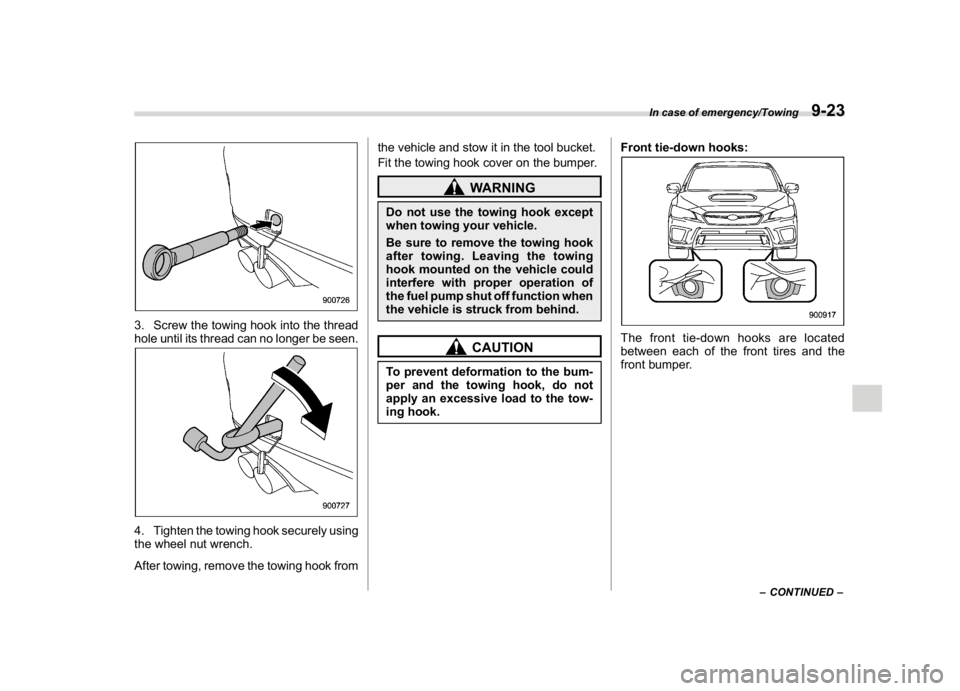
3. Screw the towing hook into the thread
hole until its thread can no longer be seen.4. Tighten the towing hook securely using
the wheel nut wrench.
After towing, remove the towing hook fromthe vehicle and stow it in the tool bucket.
Fit the towing hook cover on the bumper.
WARNING
Do not use the towing hook except
when towing your vehicle.
Be sure to remove the towing hook
after towing. Leaving the towing
hook mounted on the vehicle could
interfere with proper operation of
the fuel pump shut off function when
the vehicle is struck from behind.
CAUTION
To prevent deformation to the bum-
per and the towing hook, do not
apply an excessive load to the tow-
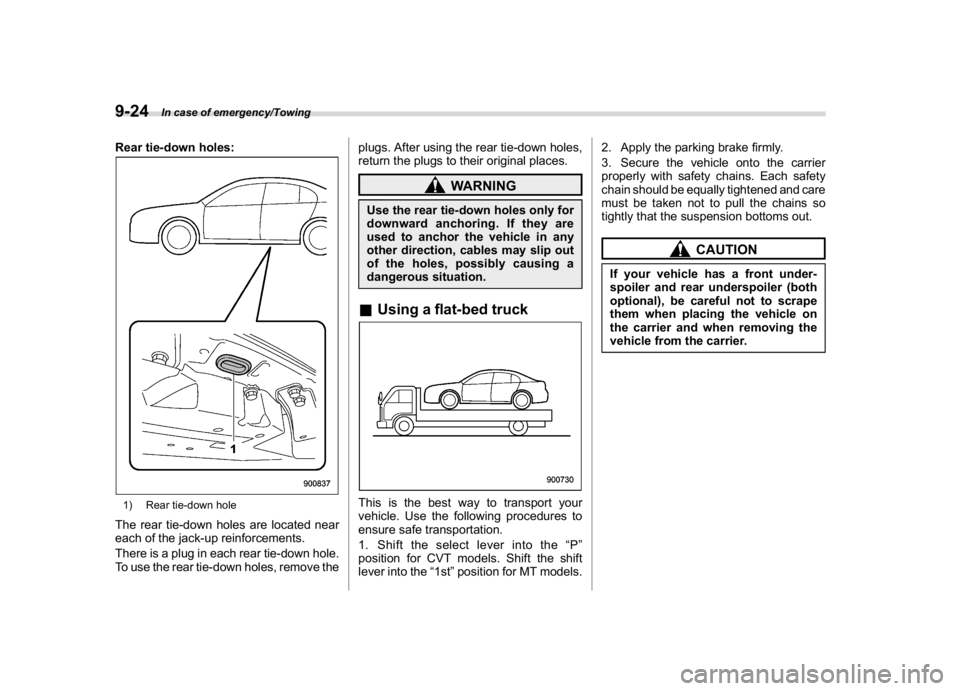
ing hook.Front tie-down hooks:
The front tie-down hooks are located
between each of the front tires and the
front bumper.
–CONTINUED–
In case of emergency/Towing
9-23
9
Page 465 of 578
(482,1)
北米Model "A1700BE-B" EDITED: 2017/ 10/ 11
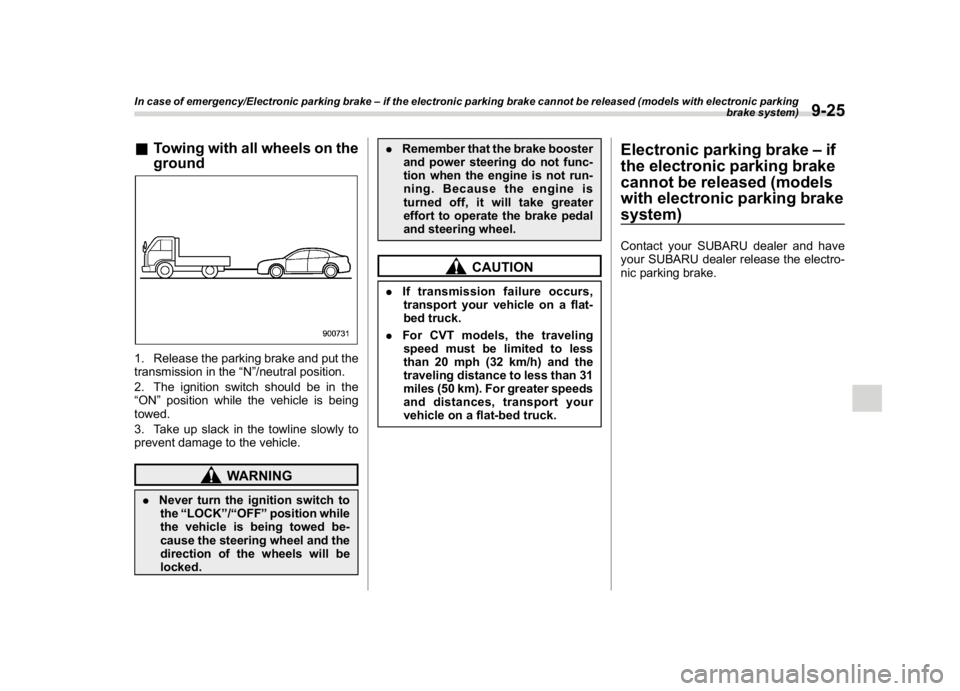
Rear tie-down holes:1) Rear tie-down holeThe rear tie-down holes are located near
each of the jack-up reinforcements.
There is a plug in each rear tie-down hole.
To use the rear tie-down holes, remove theplugs. After using the rear tie-down holes,
return the plugs to their original places.
WARNING
Use the rear tie-down holes only for
downward anchoring. If they are
used to anchor the vehicle in any
other direction, cables may slip out
of the holes, possibly causing a
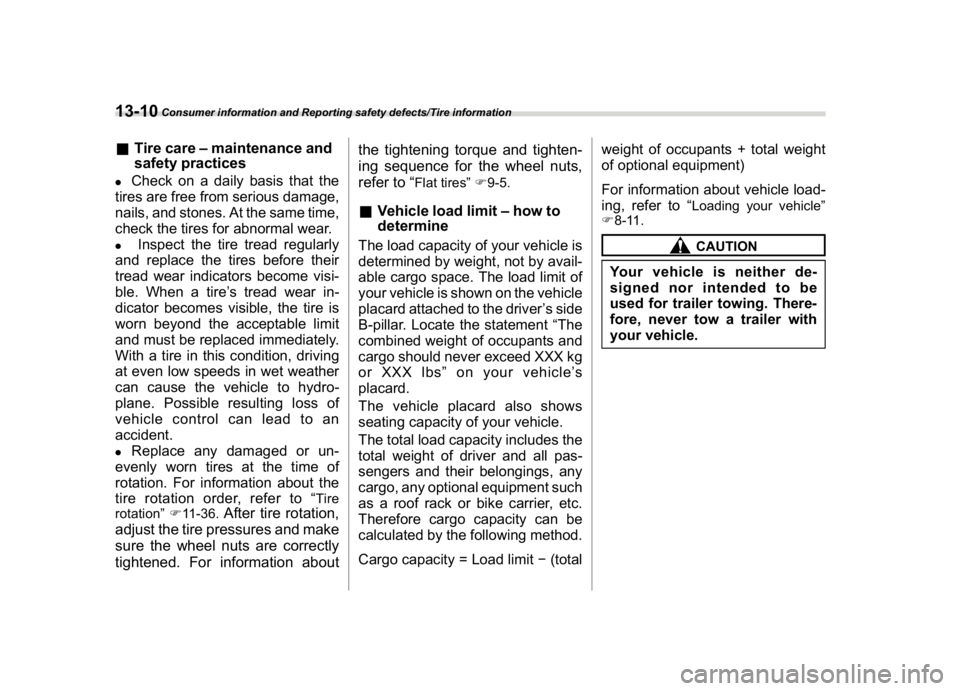
dangerous situation.&Using a flat-bed truckThis is the best way to transport your
vehicle. Use the following procedures to
ensure safe transportation.
1. Shift the select lever into the“P”
position for CVT models. Shift the shift
lever into the“1st”position for MT models.2. Apply the parking brake firmly.
3. Secure the vehicle onto the carrier
properly with safety chains. Each safety
chain should be equally tightened and care
must be taken not to pull the chains so
tightly that the suspension bottoms out.
CAUTION
If your vehicle has a front under-
spoiler and rear underspoiler (both
optional), be careful not to scrape
them when placing the vehicle on
the carrier and when removing the
vehicle from the carrier.
In case of emergency/Towing
9-24
Page 466 of 578
(483,1)
北米Model "A1700BE-B" EDITED: 2017/ 10/ 11
&Towing with all wheels on the
ground1. Release the parking brake and put the
transmission in the“N”/neutral position.
2. The ignition switch should be in the
“ON”position while the vehicle is being
towed.
3. Take up slack in the towline slowly to
prevent damage to the vehicle.
WARNING
.Never turn the ignition switch to
the“LOCK”/“OFF”position while
the vehicle is being towed be-
cause the steering wheel and the
direction of the wheels will be
locked..Remember that the brake booster
and power steering do not func-
tion when the engine is not run-
ning. Because the engine is
turned off, it will take greater
effort to operate the brake pedal
and steering wheel.
CAUTION
.If transmission failure occurs,
transport your vehicle on a flat-
bed truck.
.For CVT models, the traveling
speed must be limited to less
than 20 mph (32 km/h) and the
traveling distance to less than 31
miles (50 km). For greater speeds
and distances, transport your
vehicle on a flat-bed truck.
Electronic parking brake–if
the electronic parking brake
cannot be released (models
with electronic parking brake
system)Contact your SUBARU dealer and have
your SUBARU dealer release the electro-
nic parking brake.
In case of emergency/Electronic parking brake–if the electronic parking brake cannot be released (models with electronic parking
brake system)
9-25
9
Page 557 of 578
(582,1)
北米Model "A1700BE-B" EDITED: 2017/ 10/ 11
&Tire care–maintenance and
safety practices.
Check on a daily basis that the
tires are free from serious damage,
nails, and stones. At the same time,
check the tires for abnormal wear.
.
Inspect the tire tread regularly
and replace the tires before their
tread wear indicators become visi-
ble. When a tire’s tread wear in-
dicator becomes visible, the tire is
worn beyond the acceptable limit
and must be replaced immediately.
With a tire in this condition, driving
at even low speeds in wet weather
can cause the vehicle to hydro-
plane. Possible resulting loss of
vehicle control can lead to an
accident.
.
Replace any damaged or un-
evenly worn tires at the time of
rotation. For information about the
tire rotation order, refer to“
Tire
rotation”F11-36.
After tire rotation,
adjust the tire pressures and make
sure the wheel nuts are correctly
tightened. For information aboutthe tightening torque and tighten-
ing sequence for the wheel nuts,
refer to“
Flat tires”F9-5.
&Vehicle load limit–how to
determineThe load capacity of your vehicle is
determined by weight, not by avail-
able cargo space. The load limit of
your vehicle is shown on the vehicle
placard attached to the driver’s side
B-pillar. Locate the statement“The
combined weight of occupants and
cargo should never exceed XXX kg
or XXX lbs”on your vehicle’s
placard.
The vehicle placard also shows
seating capacity of your vehicle.
The total load capacity includes the
total weight of driver and all pas-
sengers and their belongings, any
cargo, any optional equipment such
as a roof rack or bike carrier, etc.
Therefore cargo capacity can be
calculated by the following method.
Cargo capacity = Load limit(totalweight of occupants + total weight
of optional equipment)
For information about vehicle load-
ing, refer to“
Loading your vehicle”
F8-11.CAUTION
Your vehicle is neither de-
signed nor intended to be
used for trailer towing. There-
fore, never tow a trailer with
your vehicle.
Consumer information and Reporting safety defects/Tire information
13-10
Page 559 of 578
(584,1)
北米Model "A1700BE-B" EDITED: 2017/ 10/ 11
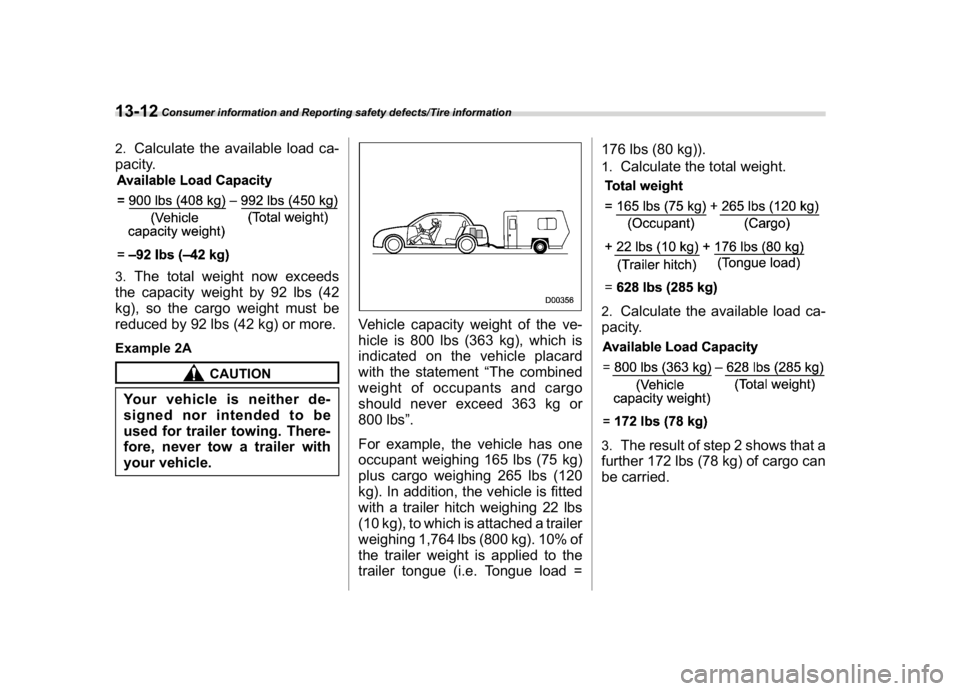
2.
Calculate the available load ca-
pacity.
3.
The total weight now exceeds
the capacity weight by 92 lbs (42
kg), so the cargo weight must be
reduced by 92 lbs (42 kg) or more.
Example 2A
CAUTION
Your vehicle is neither de-
signed nor intended to be
used for trailer towing. There-
fore, never tow a trailer with
your vehicle.
Vehicle capacity weight of the ve-
hicle is 800 lbs (363 kg), which is
indicated on the vehicle placard
with the statement“The combined
weight of occupants and cargo
should never exceed 363 kg or
800 lbs”.
For example, the vehicle has one
occupant weighing 165 lbs (75 kg)
plus cargo weighing 265 lbs (120
kg). In addition, the vehicle is fitted
with a trailer hitch weighing 22 lbs
(10 kg), to which is attached a trailer
weighing 1,764 lbs (800 kg). 10% of
the trailer weight is applied to the
trailer tongue (i.e. Tongue load =176 lbs (80 kg)).
1.
Calculate the total weight.
2.
Calculate the available load ca-
pacity.
3.
The result of step 2 shows that a
further 172 lbs (78 kg) of cargo can
be carried.
Consumer information and Reporting safety defects/Tire information
13-12
Page 560 of 578
(585,1)
北米Model "A1700BE-B" EDITED: 2017/ 10/ 11
Example 2B
CAUTION
Your vehicle is neither de-
signed nor intended to be
used for trailer towing. There-
fore, never tow a trailer with
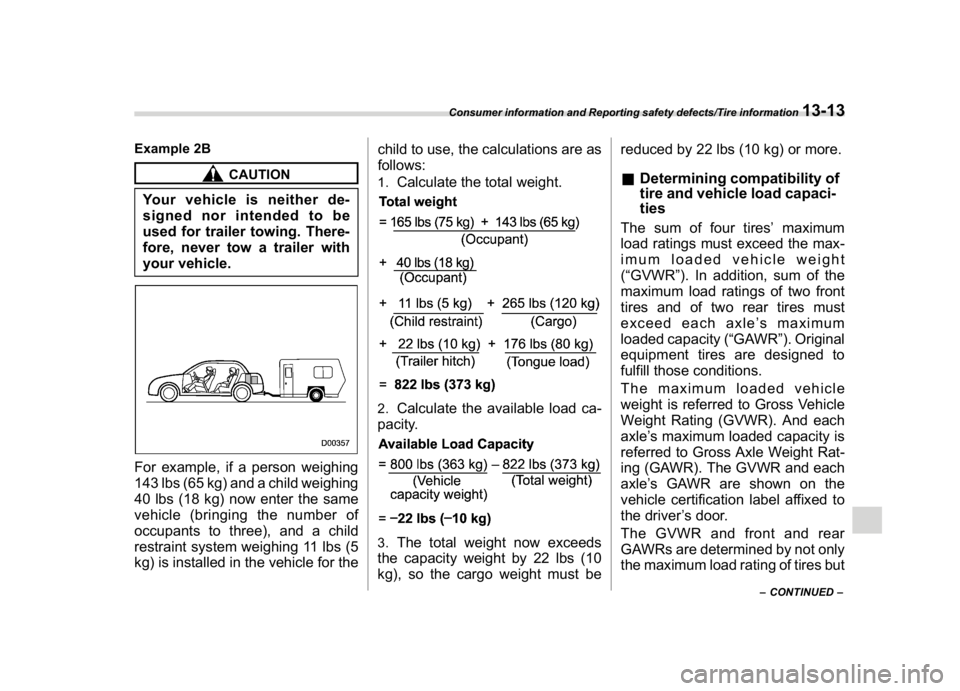
your vehicle.For example, if a person weighing
143 lbs (65 kg) and a child weighing
40 lbs (18 kg) now enter the same
vehicle (bringing the number of
occupants to three), and a child
restraint system weighing 11 lbs (5
kg) is installed in the vehicle for thechild to use, the calculations are as
follows:
1.
Calculate the total weight.
2.
Calculate the available load ca-
pacity.
3.
The total weight now exceeds
the capacity weight by 22 lbs (10
kg), so the cargo weight must bereduced by 22 lbs (10 kg) or more.
&Determining compatibility of
tire and vehicle load capaci-
tiesThe sum of four tires’maximum
load ratings must exceed the max-
imum loaded vehicle weight
(“GVWR”). In addition, sum of the
maximum load ratings of two front
tires and of two rear tires must
exceed each axle’s maximum
loaded capacity (“GAWR”). Original
equipment tires are designed to
fulfill those conditions.
The maximum loaded vehicle
weight is referred to Gross Vehicle
Weight Rating (GVWR). And each
axle’s maximum loaded capacity is
referred to Gross Axle Weight Rat-
ing (GAWR). The GVWR and each
axle’s GAWR are shown on the
vehicle certification label affixed to
the driver’s door.
The GVWR and front and rear
GAWRs are determined by not only
the maximum load rating of tires but
–CONTINUED–
Consumer information and Reporting safety defects/Tire information
13-13
13