Wheels SUBARU WRX 2018 Owner's Manual
[x] Cancel search | Manufacturer: SUBARU, Model Year: 2018, Model line: WRX, Model: SUBARU WRX 2018Pages: 578, PDF Size: 33.21 MB
Page 427 of 578
(442,1)
北米Model "A1700BE-B" EDITED: 2017/ 10/ 11
New vehicle break-in driving–
the first 1,000 miles (1,600 km)The performance and long life of your
vehicle are dependent on how you handle
and care for your vehicle while it is new.
Follow these instructions during the first
1,000 miles (1,600 km):
.Do not race the engine. And do not
allow engine speed to exceed 4,000 rpm
except in an emergency.
.Do not drive at one constant engine or
vehicle speed, either fast or slow.
.Avoid starting suddenly and rapid ac-
celeration, except in an emergency.
.Avoid hard braking, except in an emer-
gency.
The same break-in procedures should be
applied to an overhauled engine, newly
mounted engine or when brake pads or
brake linings are replaced with new ones.
Fuel economy hintsThe following suggestions will help to save
fuel.
.Select the proper gear position for the
speed and road conditions.
.Avoid sudden acceleration or decelera-
tion. Always accelerate gently until you
reach the desired speed. Then try to
maintain that speed for as long as possi-
ble.
.Do not pump the accelerator and avoid
racing the engine.
.Avoid unnecessary engine idling.
.Keep the engine properly tuned.
.Keep the tires inflated to the correct
pressure shown on the tire placard, which
is located under the door latch on the
driver’s side. Low pressure will increase
tire wear and fuel consumption.
.Use the air conditioner only when
necessary.
.Keep the front and rear wheels in
proper alignment.
.Avoid carrying unnecessary luggage or
cargo.
.The indication of the ECO gauge shows
a reference for saving fuel. For details,
refer to“ECO gauge”F3-12.
Engine exhaust gas (carbon
monoxide)
WARNING
.Never inhale engine exhaust gas.
Engine exhaust gas contains
carbon monoxide, a colorless
and odorless gas which is dan-
gerous, or even lethal, if inhaled.
.Always properly maintain the en-
gine exhaust system to prevent
engine exhaust gas from entering
the vehicle.
.Never run the engine in a closed
space, such as a garage, except
for the brief time needed to drive
the vehicle in or out of it.
.Avoid remaining in a parked ve-
hicle for a lengthy time while the
engine is running. If that is un-
avoidable, then use the ventila-
tion fan to force fresh air into the
vehicle.
.Always keep the front ventilator
inlet grille free from snow, leaves
or other obstructions to ensure
that the ventilation system al-
ways works properly.
.If at any time you suspect that
Driving tips/New vehicle break-in driving–the first 1,000 miles (1,600 km)
8-2
Page 430 of 578
(445,1)
北米Model "A1700BE-B" EDITED: 2017/ 10/ 11
Driving tips for AWD models
WARNING
.Always maintain a safe driving
speed according to the road and
weather conditions in order to
avoid having an accident on a
sharp turn, during sudden brak-
ing or under other similar condi-
tions.
.Always use the utmost care in
driving–overconfidence be-
cause you are driving an All-
Wheel Drive vehicle could easily
lead to a serious accident.
.When you replacing or installing
tire(s), all four tires must be the
same for following items.
(a) Size
(b) Circumference
(c) Speed symbol
(d) Load index
(e) Construction
(f) Manufacturer
(g) Brand (tread pattern)
(h) Degrees of wear
For the items (a) to (d), you must
obey the specification that isprinted on the tire placard. The
tire placard is located on the
bottom of driver’s door pillar.
If all of four tires are not the same
for items (a) to (h), there is a
possibility that serious mechan-
ical damage could occur to the
drive train of your car, and affect
the following.
—Ride
—Handling
—Braking
—Speedometer/Odometer
calibration
—Clearance between the body
and tires
It also may be dangerous and
lead to loss of vehicle control,
and it can lead to an accident.
CAUTION
If you use a temporary spare tire to
replace a flat tire, be sure to use the
original temporary spare tire stored
in the vehicle. Using other sizes may
result in severe mechanical damage
to the drive train of your vehicle.
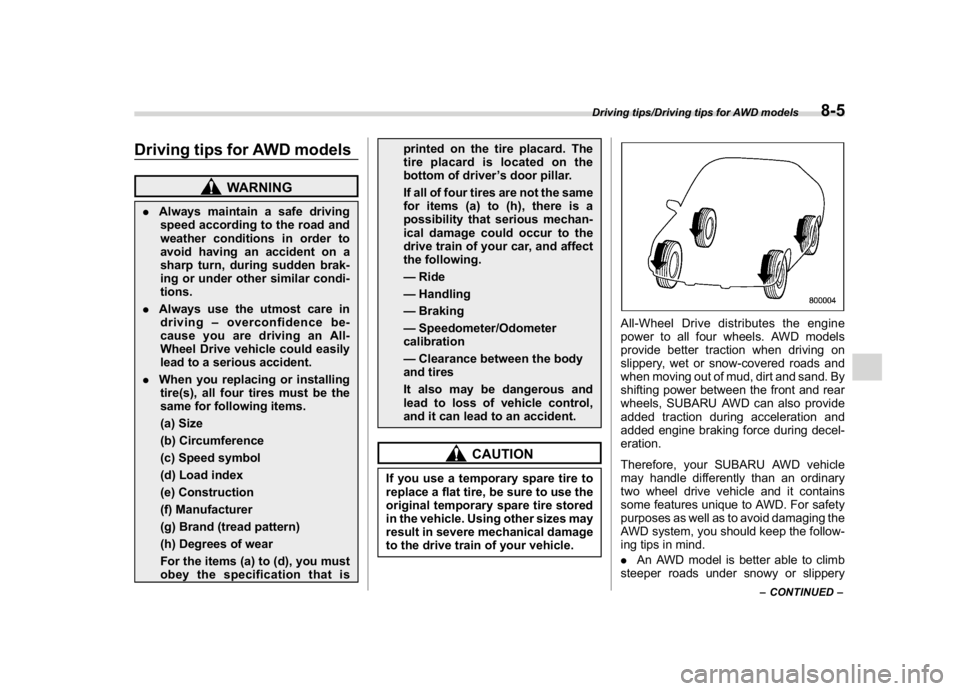
All-Wheel Drive distributes the engine
power to all four wheels. AWD models
provide better traction when driving on
slippery, wet or snow-covered roads and
when moving out of mud, dirt and sand. By
shifting power between the front and rear
wheels, SUBARU AWD can also provide
added traction during acceleration and
added engine braking force during decel-
eration.
Therefore, your SUBARU AWD vehicle
may handle differently than an ordinary
two wheel drive vehicle and it contains
some features unique to AWD. For safety
purposes as well as to avoid damaging the
AWD system, you should keep the follow-
ing tips in mind.
.An AWD model is better able to climb
steeper roads under snowy or slippery
–CONTINUED–
Driving tips/Driving tips for AWD models
8-5
8
Page 433 of 578
(448,1)
北米Model "A1700BE-B" EDITED: 2017/ 10/ 11
–When the vehicle has been left
parked during a snowstorm
Check for snow or ice buildup on
the suspension, disc brakes and
brake hoses underneath the ve-
hicle. If there is caked snow or
ice, remove it, being careful not
to damage the disc brakes and
brake hoses and ABS harness.
When parking for long periods in cold
weather, you should observe the following
tips.
1. For MT models, place the shift lever in
the“1”or“R”position. For CVT models,
place the select lever in the“P”position.
2. Use tire stops under the tires to prevent
the vehicle from moving.
!Refueling in cold weather
To help prevent moisture from forming in
the fuel system and the risk of its freezing,
use of an antifreeze additive in the fuel
tank is recommended during cold weather.
Use only additives that are specifically
designed for this purpose. When an anti-
freeze additive is used, its effect lasts
longer if the tank is refilled whenever the
fuel level reaches half empty.
If your SUBARU is not going to be used for
an extended period, it is best to have thefuel tank filled to capacity.
&Driving on snowy and icy
roadsTo prevent skidding and slipping, avoid
sudden braking, abrupt acceleration, high-
speed driving, and sharp turning when
driving on snowy or icy roads.
Always maintain ample distance between
your vehicle and the vehicle ahead of you
to avoid the need for sudden braking.
To supplement the foot brake, use the
engine brake effectively to control the
vehicle speed. (Shift into a lower gear
when necessary.)
Avoid shifting down abruptly. Such beha-
vior can cause the wheels to lock, possibly
leading to loss of vehicle control.
An anti-lock brake system (ABS) en-
hances your vehicle’s braking perfor-
mance on snowy and icy roads. For
information on braking on slippery sur-
faces, refer to“ABS (Anti-lock Brake
System)”F7-35 and“Vehicle Dynamics
Control system”F7-37.
WARNING
Do not use the cruise control on
slippery roads such as snowy or icy
roads. This may cause loss of vehi-
cle control.
CAUTION
Avoid prolonged continuous driving
in snowstorms. Snow will enter the
engine’sintakesystemandmay
hinder the airflow, which could re-
sult in engine shutdown or even
breakdown.
!Wiper operation when snowing
Before driving in cold weather, make sure
the wiper blade rubbers are not frozen to
the windshield.
If the wiper blade rubbers are frozen to the
windshield, use the defroster and the
temperature set for maximum warmth until
the wiper blade rubbers are completely
thawed. Refer to“Climate control”F4-1.
If your vehicle is equipped with a wiper
deicer, use it. It is helpful to thaw the
windshield wiper blade rubbers. Refer to
“Defogger and deicer”F3-84.
When driving in snow, if frozen snow starts
Driving tips/Winter driving
8-8
Page 435 of 578

(450,1)
北米Model "A1700BE-B" EDITED: 2017/ 10/ 11
tion, brand and load range and you should
never mix radial, belted bias or bias tires
since this may result in dangerous hand-
ling characteristics. When you choose a
tire, make sure that there is enough
clearance between the tire and vehicle
body.
Remember to drive with care at all times
regardless of the type of tires on your
vehicle.&Tire chains
CAUTION
You cannot use tire chains on your
vehicle because of the lack of clear-
ance between the tires and vehicle
body.NOTEEven though you cannot use tire
chains, use of another type of traction
device (such as spring chains) may be
acceptable if use on your vehicle is
recommended by the device manufac-
turer, taking into account tire size and
road conditions. Follow the device
manufacturer’s instructions, especially
regarding maximum vehicle speed.
To help avoid damage to your vehicle,drive slowly, readjust or remove the
device if it is contacting your vehicle,
and do not spin your wheels. Damage
caused to your vehicle by use of a
traction device is not covered under
warranty.
Make certain that any traction device
you use is an SAE class S device, and
use it on the front wheels only. Always
use the utmost care when driving with a
traction device. Overconfidence be-
cause you are using a traction device
could easily lead to a serious accident.
&Rocking the vehicleIf you must rock the vehicle to free it from
snow, sand, or mud, depress the accel-
erator pedal slightly and move the shift
lever/select lever back and forth between
“1”/“D”and“R”repeatedly. Do not race the
engine. For the best possible traction,
avoid spinning the wheels when trying to
free the vehicle.
When the road surface is extremely
slippery, you can obtain better traction by
starting the vehicle with the transmission in
2nd than in 1st (MT models and CVT
models).
If your vehicle is a CVT model, for
information about holding the transmissionin the 2nd position, refer to“Selection of
manual mode”F7-25.
Driving tips/Winter driving
8-10
Page 442 of 578

(459,1)
北米Model "A1700BE-B" EDITED: 2017/ 10/ 11
If you park your vehicle in case of an
emergency............................................................9-2
Temporary spare tire(if equipped)........................9-2
Maintenance tools...................................................9-3
Models with flat tire repair kit................................. 9-4
Models without flat tire repair kit............................ 9-4
Flat tires...................................................................9-5
Changing a flat tire................................................ 9-5
Sealing flat tire (models with flat tire repair kit)...... 9-8
Tire pressure monitoring system (TPMS)
(U.S.-spec. models).............................................9-17
Jump starting........................................................9-18
How to jump start.................................................9-18
Engine overheating...............................................9-20
If steam is coming from the engine
compartment......................................................9-20
If no steam is coming from the engine
compartment......................................................9-20
Towing...................................................................9-21
Towing and tie-down hooks/holes.........................9-21
Using a flat-bed truck...........................................9-24
Towing with all wheels on the ground...................9-25
Electronic parking brake–if the electronic
parking brake cannot be released (models
with electronic parking brakesystem)............9-25
Access key fob–if access key fob does not
operate properly................................................9-26
Locking and unlocking.........................................9-26
Switching power status........................................9-26
Starting engine.....................................................9-27
Moonroof (if equipped)–if the moonroof
does not close...................................................9-28
If your vehicle is involvedin an accident...........9-28
In case of emergency
9
Page 443 of 578
(460,1)
北米Model "A1700BE-B" EDITED: 2017/ 10/ 11
If you park your vehicle in
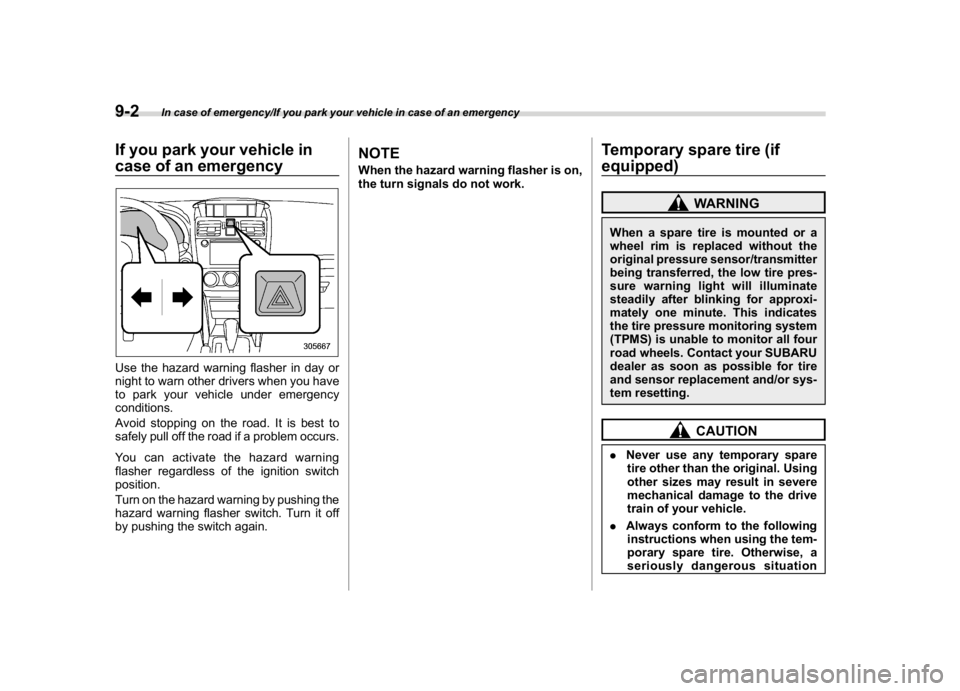
case of an emergencyUse the hazard warning flasher in day or
night to warn other drivers when you have
to park your vehicle under emergency
conditions.
Avoid stopping on the road. It is best to
safely pull off the road if a problem occurs.
You can activate the hazard warning
flasher regardless of the ignition switch
position.
Turn on the hazard warning by pushing the
hazard warning flasher switch. Turn it off
by pushing the switch again.
NOTEWhen the hazard warning flasher is on,
the turn signals do not work.
Temporary spare tire (if
equipped)
WARNING
When a spare tire is mounted or a
wheel rim is replaced without the
original pressure sensor/transmitter
being transferred, the low tire pres-
sure warning light will illuminate
steadily after blinking for approxi-
mately one minute. This indicates
the tire pressure monitoring system
(TPMS) is unable to monitor all four
road wheels. Contact your SUBARU
dealer as soon as possible for tire
and sensor replacement and/or sys-
tem resetting.
CAUTION
.Never use any temporary spare
tire other than the original. Using
other sizes may result in severe
mechanical damage to the drive
train of your vehicle.
.Always conform to the following
instructions when using the tem-
porary spare tire. Otherwise, a
seriously dangerous situation
In case of emergency/If you park your vehicle in case of an emergency
9-2
Page 449 of 578
(466,1)
北米Model "A1700BE-B" EDITED: 2017/ 10/ 11
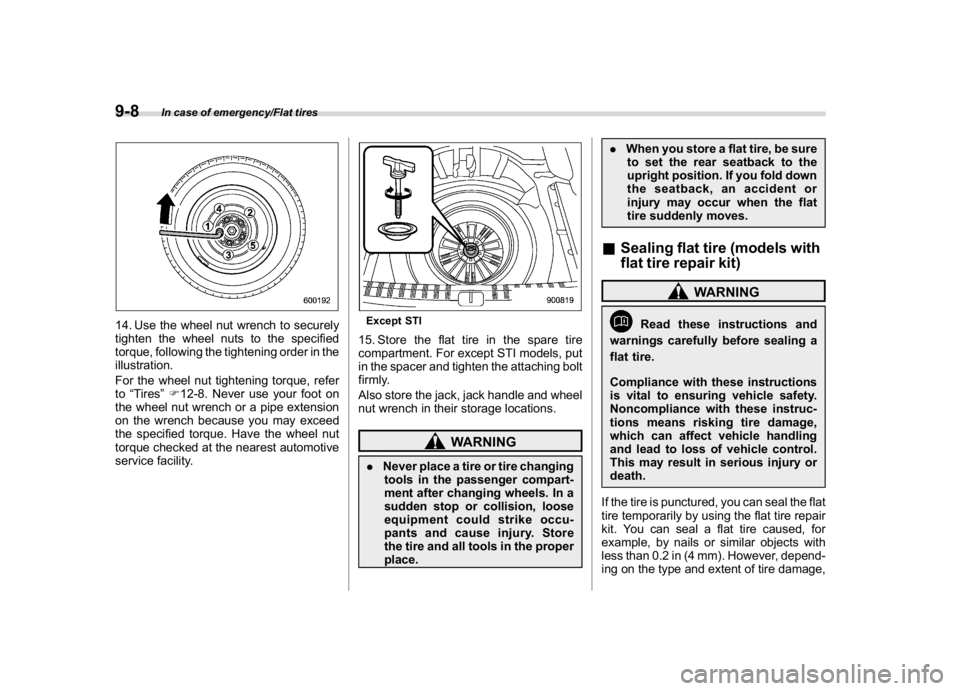
14. Use the wheel nut wrench to securely
tighten the wheel nuts to the specified
torque, following the tightening order in the
illustration.
For the wheel nut tightening torque, refer
to“Tires”F12-8. Never use your foot on
the wheel nut wrench or a pipe extension
on the wrench because you may exceed
the specified torque. Have the wheel nut
torque checked at the nearest automotive
service facility.
Except STI15. Store the flat tire in the spare tire
compartment. For except STI models, put
in the spacer and tighten the attaching bolt
firmly.
Also store the jack, jack handle and wheel
nut wrench in their storage locations.
WARNING
.Never place a tire or tire changing
tools in the passenger compart-
ment after changing wheels. In a
sudden stop or collision, loose
equipment could strike occu-
pants and cause injury. Store
the tire and all tools in the proper
place..When you store a flat tire, be sure
to set the rear seatback to the
upright position. If you fold down
the seatback, an accident or
injury may occur when the flat
tire suddenly moves.
&Sealing flat tire (models with
flat tire repair kit)
WARNING
Read these instructions and
warnings carefully before sealing a
flat tire.
Compliance with these instructions
is vital to ensuring vehicle safety.
Noncompliance with these instruc-
tions means risking tire damage,
which can affect vehicle handling
and lead to loss of vehicle control.
This may result in serious injury or
death.
If the tire is punctured, you can seal the flat
tire temporarily by using the flat tire repair
kit. You can seal a flat tire caused, for
example, by nails or similar objects with
less than 0.2 in (4 mm). However, depend-
ing on the type and extent of tire damage,
In case of emergency/Flat tires
9-8
Page 458 of 578
(475,1)
北米Model "A1700BE-B" EDITED: 2017/ 10/ 11
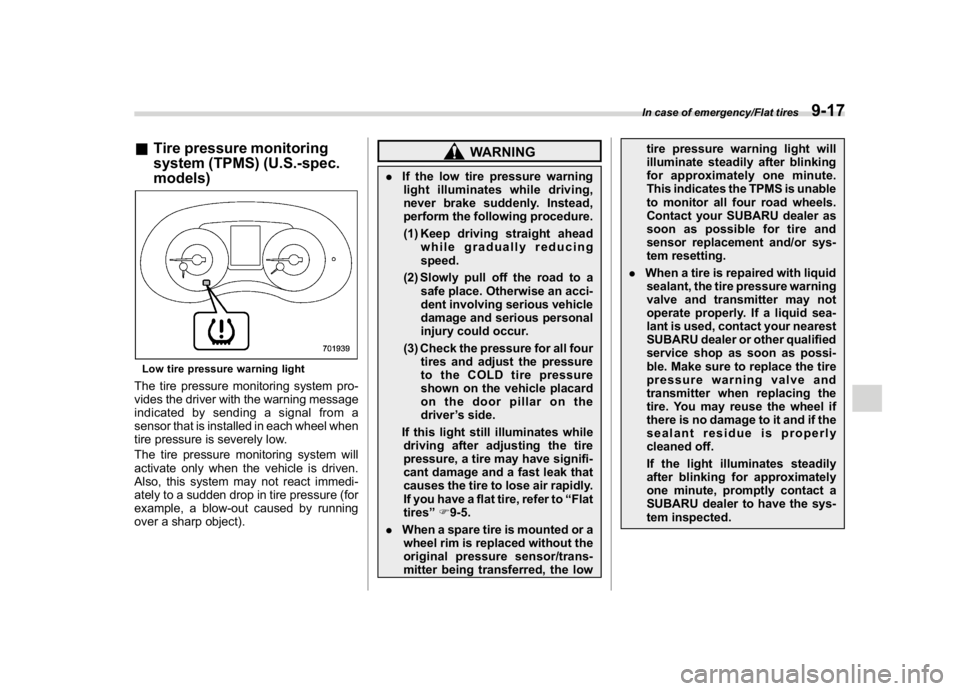
&Tire pressure monitoring
system (TPMS) (U.S.-spec.
models)Low tire pressure warning lightThe tire pressure monitoring system pro-
vides the driver with the warning message
indicated by sending a signal from a
sensor that is installed in each wheel when
tire pressure is severely low.
The tire pressure monitoring system will
activate only when the vehicle is driven.
Also, this system may not react immedi-
ately to a sudden drop in tire pressure (for
example, a blow-out caused by running
over a sharp object).
WARNING
.If the low tire pressure warning
light illuminates while driving,
never brake suddenly. Instead,
perform the following procedure.
(1) Keep driving straight ahead
while gradually reducing
speed.
(2) Slowly pull off the road to a
safe place. Otherwise an acci-
dent involving serious vehicle
damage and serious personal
injury could occur.
(3) Check the pressure for all four
tires and adjust the pressure
to the COLD tire pressure
shown on the vehicle placard
on the door pillar on the
driver’s side.
If this light still illuminates while
driving after adjusting the tire
pressure, a tire may have signifi-
cant damage and a fast leak that
causes the tire to lose air rapidly.
If you have a flat tire, refer to“Flat
tires”F9-5.
.When a spare tire is mounted or a
wheel rim is replaced without the
original pressure sensor/trans-
mitter being transferred, the lowtire pressure warning light will
illuminate steadily after blinking
for approximately one minute.
This indicates the TPMS is unable
to monitor all four road wheels.
Contact your SUBARU dealer as
soon as possible for tire and
sensor replacement and/or sys-
tem resetting.
.When a tire is repaired with liquid
sealant, the tire pressure warning
valve and transmitter may not
operate properly. If a liquid sea-
lant is used, contact your nearest
SUBARU dealer or other qualified
service shop as soon as possi-
ble. Make sure to replace the tire
pressure warning valve and
transmitter when replacing the
tire. You may reuse the wheel if
there is no damage to it and if the
sealant residue is properly
cleaned off.
If the light illuminates steadily
after blinking for approximately
one minute, promptly contact a
SUBARU dealer to have the sys-
tem inspected.
In case of emergency/Flat tires
9-17
9
Page 462 of 578
(479,1)
北米Model "A1700BE-B" EDITED: 2017/ 10/ 11
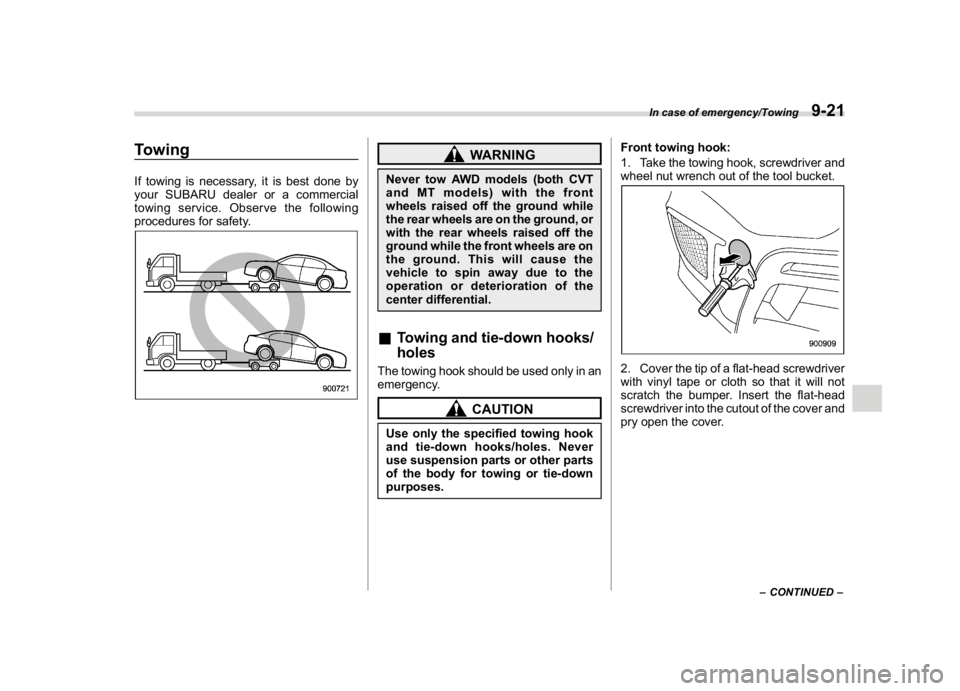
TowingIf towing is necessary, it is best done by
your SUBARU dealer or a commercial
towing service. Observe the following
procedures for safety.
WARNING
Never tow AWD models (both CVT
andMTmodels)withthefront
wheels raised off the ground while
the rear wheels are on the ground, or
with the rear wheels raised off the
ground while the front wheels are on
the ground. This will cause the
vehicle to spin away due to the
operation or deterioration of the
center differential.&Towing and tie-down hooks/
holesThe towing hook should be used only in an
emergency.
CAUTION
Use only the specified towing hook
and tie-down hooks/holes. Never
use suspension parts or other parts
of the body for towing or tie-down
purposes.Front towing hook:
1. Take the towing hook, screwdriver and
wheel nut wrench out of the tool bucket.
2. Cover the tip of a flat-head screwdriver
with vinyl tape or cloth so that it will not
scratch the bumper. Insert the flat-head
screwdriver into the cutout of the cover and
pry open the cover.
–CONTINUED–
In case of emergency/Towing
9-21
9
Page 466 of 578
(483,1)
北米Model "A1700BE-B" EDITED: 2017/ 10/ 11
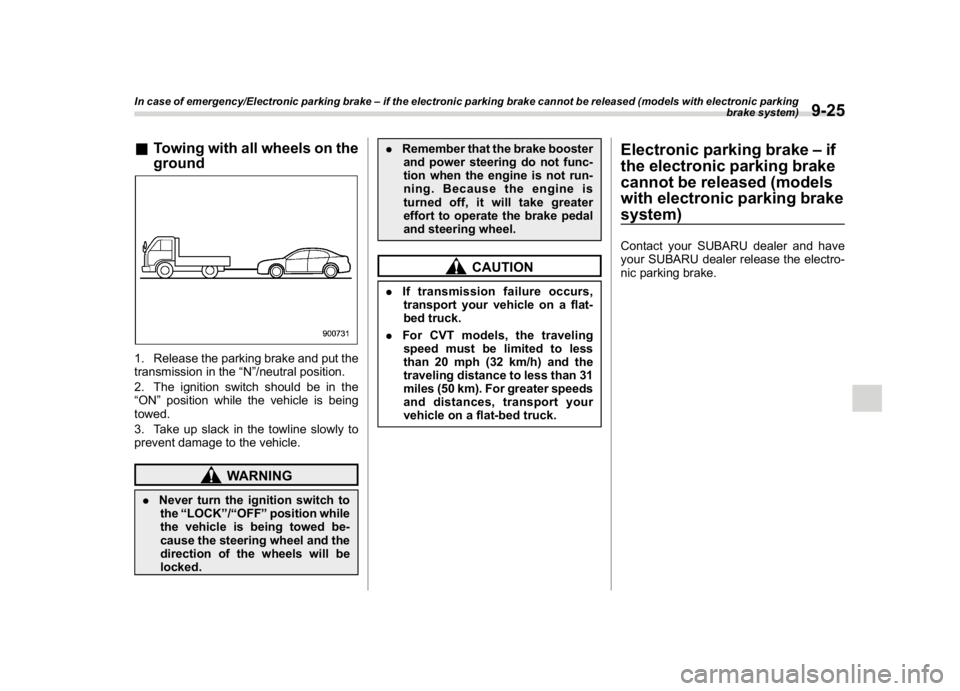
&Towing with all wheels on the
ground1. Release the parking brake and put the
transmission in the“N”/neutral position.
2. The ignition switch should be in the
“ON”position while the vehicle is being
towed.
3. Take up slack in the towline slowly to
prevent damage to the vehicle.
WARNING
.Never turn the ignition switch to
the“LOCK”/“OFF”position while
the vehicle is being towed be-
cause the steering wheel and the
direction of the wheels will be
locked..Remember that the brake booster
and power steering do not func-
tion when the engine is not run-
ning. Because the engine is
turned off, it will take greater
effort to operate the brake pedal
and steering wheel.
CAUTION
.If transmission failure occurs,
transport your vehicle on a flat-
bed truck.
.For CVT models, the traveling
speed must be limited to less
than 20 mph (32 km/h) and the
traveling distance to less than 31
miles (50 km). For greater speeds
and distances, transport your
vehicle on a flat-bed truck.
Electronic parking brake–if
the electronic parking brake
cannot be released (models
with electronic parking brake
system)Contact your SUBARU dealer and have
your SUBARU dealer release the electro-
nic parking brake.
In case of emergency/Electronic parking brake–if the electronic parking brake cannot be released (models with electronic parking
brake system)
9-25
9