maintenance SUBARU WRX 2018 Owner's Manual
[x] Cancel search | Manufacturer: SUBARU, Model Year: 2018, Model line: WRX, Model: SUBARU WRX 2018Pages: 578, PDF Size: 33.21 MB
Page 444 of 578

(461,1)
北米Model "A1700BE-B" EDITED: 2017/ 10/ 11
may occur.
The temporary spare tire is smaller and
lighter than a conventional tire and is
designed for emergency use only. Re-
move the temporary spare tire and re-
install the conventional tire as soon as
possible because the spare tire is de-
signed only for temporary use.
Check the inflation pressure of the tem-
porary spare tire periodically to keep the
tire ready for use. For the correct tire
pressure, refer to“Temporary spare tires”
F12-9.
When using the temporary spare tire, note
the following.
.Drive with caution when temporary
spare tire is fitted. Avoid hard acceleration
and braking, or fast cornering, as control of
the vehicle may be lost.
.Do not exceed 50 mph (80 km/h).
.Do not put a tire chain on the temporary
spare tire. Because of the smaller tire size,
a tire chain will not fit properly.
.Do not use two or more temporary
spare tires at the same time.
.Do not drive over obstacles. This tire
has a smaller diameter, so road clearance
is reduced.
1) Tread wear indicator bar
2) Indicator location mark.When the wear indicator appears on
the tread, replace the tire.
.The temporary spare tire must be used
only on a rear wheel. If a front wheel tire
gets punctured, replace the wheel with a
rear wheel and install the temporary spare
tire in place of the removed rear wheel.
.Always set the driver’s control center
differential to the manual mode and adjust
the initial LSD torque to the minimum.
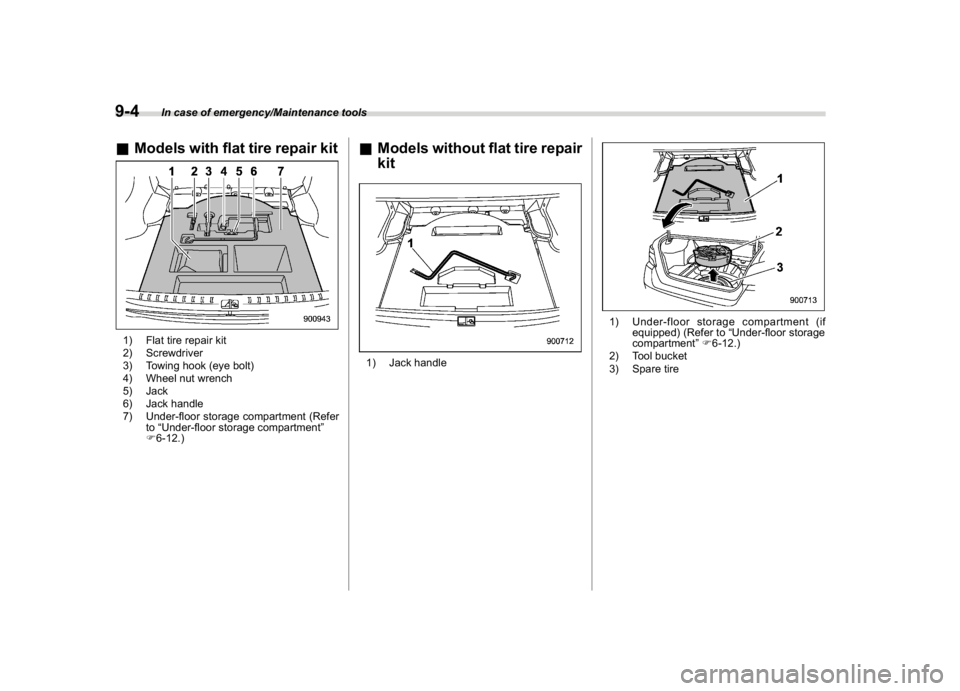
Maintenance toolsYour vehicle is equipped with the following
maintenance tools.
.Jack
.Jack handle
.Screwdriver
.Towing hook (eye bolt)
.Wheel nut wrench
–CONTINUED–
In case of emergency/Maintenance tools
9-3
9
Page 445 of 578
(462,1)
北米Model "A1700BE-B" EDITED: 2017/ 10/ 11
&Models with flat tire repair kit1) Flat tire repair kit
2) Screwdriver
3) Towing hook (eye bolt)
4) Wheel nut wrench
5) Jack
6) Jack handle
7) Under-floor storage compartment (Refer
to“Under-floor storage compartment”
F6-12.)
&Models without flat tire repair
kit1) Jack handle
1) Under-floor storage compartment (if
equipped) (Refer to“Under-floor storage
compartment”F6-12.)
2) Tool bucket
3) Spare tire
In case of emergency/Maintenance tools
9-4
Page 447 of 578
(464,1)
北米Model "A1700BE-B" EDITED: 2017/ 10/ 11
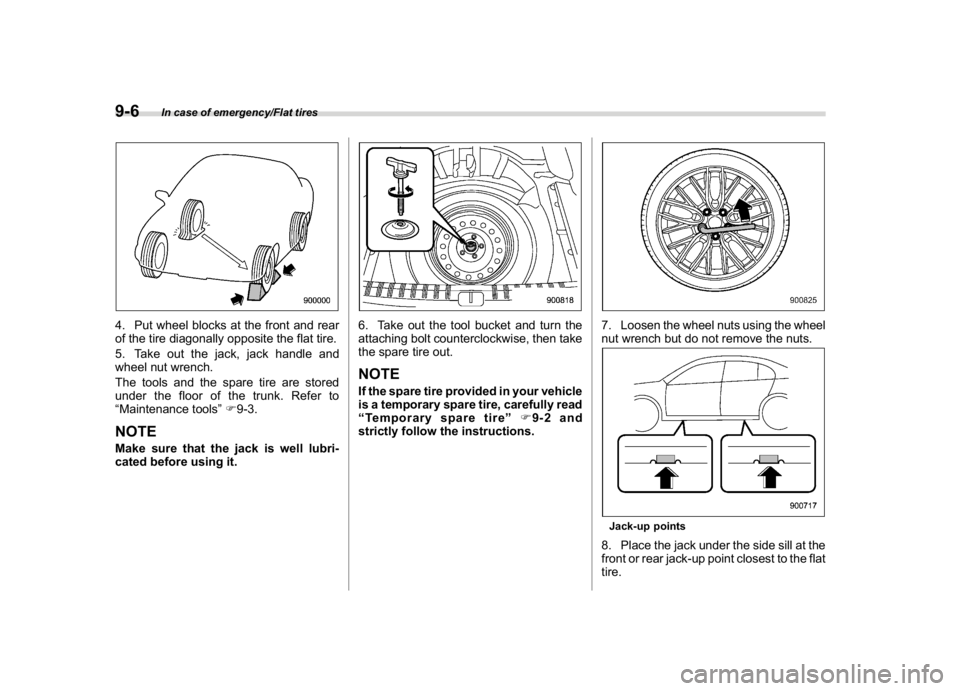
4. Put wheel blocks at the front and rear
of the tire diagonally opposite the flat tire.
5. Take out the jack, jack handle and
wheel nut wrench.
The tools and the spare tire are stored
under the floor of the trunk. Refer to
“Maintenance tools”F9-3.NOTEMake sure that the jack is well lubri-
cated before using it.
6. Take out the tool bucket and turn the
attaching bolt counterclockwise, then take
the spare tire out.NOTEIf the spare tire provided in your vehicle
is a temporary spare tire, carefully read
“Temporary spare tire”F9-2 and
strictly follow the instructions.
7. Loosen the wheel nuts using the wheel
nut wrench but do not remove the nuts.Jack-up points8. Place the jack under the side sill at the
front or rear jack-up point closest to the flat
tire.
In case of emergency/Flat tires
9-6
Page 474 of 578

(493,1)
北米Model "A1700BE-B" EDITED: 2017/ 10/ 11
Corrosion protectionYour SUBARU has been designed and
built to resist corrosion. Special materials
and protective finishes have been used on
most parts of the vehicle to help maintain
fine appearance, strength, and reliable
operation.&Most common causes of cor-
rosionThe most common causes of corrosion
are:
.The accumulation of moisture retaining
dirt and debris in body panel sections,
cavities, and other areas.
.Damage to paint and other protective
coatings caused by gravel and stone chips
or minor accidents.
Corrosion is accelerated on the vehicle
when:
.It is exposed to road salt or dust control
chemicals, or used in coastal areas where
there is more salt in the air, or in areas
where there is considerable industrial
pollution.
.It is driven in areas of high humidity,
especially when temperatures range just
above freezing.
.Dampness in certain parts of thevehicle remains for a long time, even
though other parts of the vehicle may be
dry.
.High temperatures will cause corrosion
to parts of the vehicle which cannot dry
quickly due to lack of proper ventilation.
&To help prevent corrosionWash the vehicle regularly to prevent
corrosion of the body and suspension
components. Also, wash the vehicle
promptly after driving on any of the
following surfaces.
.roads that have been salted to prevent
them from freezing in winter
.mud, sand, or gravel
.coastal roads
After the winter has ended, it is recom-
mended that the underbody be given a
very thorough washing.
Before the beginning of winter, check the
condition of underbody components, such
as the exhaust system, fuel and brake
lines, brake cables, suspension, steering
system, floor pan, and fenders. If any of
them are found to be rusted, they should
be given an appropriate rust prevention
treatment or should be replaced. Contact
your SUBARU dealer to perform this kind
of maintenance and treatment if you needassistance.
Repair chips and scratches in the paint as
soon as you find them.
Check the interior of the vehicle for water
and dirt accumulation under the floor mats
because that could cause corrosion. Oc-
casionally check under the mats to make
sure the area is dry.
Keep your garage dry. Do not park your
vehicle in a damp, poorly ventilated gar-
age. In such a garage, corrosion can be
caused by dampness. If you wash the
vehicle in the garage or put the vehicle into
the garage when wet or covered with
snow, that can cause dampness.
If your vehicle is operated in cold weather
and/or in areas where road salts and other
corrosive materials are used, the door
hinges and locks, and hood latch should
be inspected and lubricated periodically.
Appearance care/Corrosion protection
10-5
10
Page 478 of 578

(499,1)
北米Model "A1700BE-B" EDITED: 2017/ 10/ 11
Maintenance schedule.......................................... 11-3
Maintenance precautions..................................... 11-3
Before checking or servicing in the engine
compartment...................................................... 11-4
When checking or servicing in the engine
compartment...................................................... 11-5
When checking or servicing in the engine
compartment while the engine is running............ 11-5
Maintenance tips................................................... 11-6
Removing and reinstalling clips............................ 11-6
Engine hood.......................................................... 11-9
Engine compartment overview.......................... 11-11
STI...................................................................... 11-11
Except STI.......................................................... 11-12
Engine oil............................................................. 11-13
Engine oil consumption...................................... 11-13
Checking the oil level.......................................... 11-13
Changing the oil and oil filter.............................. 11-15
Recommended grade and viscosity..................... 11-15
Synthetic oil........................................................ 11-16
Cooling system................................................... 11-16
Cooling fan, hose and connections..................... 11-17
Engine coolant.................................................... 11-17
Air cleaner element............................................. 11-18
Replacing the air cleaner element........................ 11-19
Spark plugs......................................................... 11-21
Recommended spark plugs................................. 11-21
Drive belts........................................................... 11-21Manual transmission oil......................................11-22
Recommended grade and viscosity..................... 11-22
Continuously variable transmission fluid..........11-22
Front differential gear oil (CVT models) and
rear differential gear oil....................................11-23
Recommended grade and viscosity..................... 11-23
Power steering fluid (STI)...................................11-23
Checking the fluid level...................................... 11-23
Recommended fluid............................................ 11-24
Brake fluid............................................................11-24
Checking the fluid level...................................... 11-24
Recommended brake fluid.................................. 11-25
Clutch fluid (MT models).....................................11-25
Checking the fluid level...................................... 11-25
Recommended clutch fluid................................. 11-26
Brake booster......................................................11-26
Brake pedal..........................................................11-27
Checking the brake pedal free play..................... 11-27
Checking the brake pedal reserve distance ......... 11-27
Clutch pedal (MT models)...................................11-27
Checking the clutch function .............................. 11-27
Checking the clutch pedal free play.................... 11-28
Hill start assist system.......................................11-28
Replacement of brake pad andlining................11-28
Breaking-in of new brake pads (models with
electronic parking brake system)..................... 11-29
Breaking-in of new brake pads and linings
(models without electronic parking brake
system)........................................................... 11-29
Maintenance and service
11
Page 479 of 578

(500,1)
北米Model "A1700BE-B" EDITED: 2017/ 10/ 11
Parking brake stroke (models without
electronic parking brake system)................... 11-30
Tires and wheels................................................. 11-30
Types of tires...................................................... 11-30
Tire pressure monitoring system (TPMS)
(if equipped)..................................................... 11-30
Tire inspection.................................................... 11-32
Tire pressures and wear...................................... 11-32
Wheel balance.................................................... 11-34
Wear indicators................................................... 11-35
Rotational direction of tires................................. 11-35
Tire rotation........................................................ 11-36
Tire replacement................................................. 11-36
Wheel replacement............................................. 11-37
Alloy wheels........................................................ 11-38
Windshield washer fluid..................................... 11-38
Replacement of wiper blades............................ 11-39
Windshield wiper blade assembly........................ 11-40
Windshield wiper blade rubber............................ 11-40
Battery................................................................. 11-41Fuses....................................................................11-42
Installation of accessories..................................11-44
Replacing bulbs...................................................11-44
Headlights (models with LED headlights)............ 11-44
High beam headlight
(models without LED headlights)..................... 11-44
Low beam headlight*, front side marker light,
parking light* and front turn signal light*......... 11-46
Front turn signal light
(models with LED headlights).......................... 11-48
Front fog light
(models with the LED front fog light)............... 11-48
Front fog light (models without the LED front
fog light) (if equipped)..................................... 11-49
Rear combination lights...................................... 11-49
License plate light.............................................. 11-50
Other bulbs........................................................ 11-51
Replacing battery................................................11-51
Safety precautions.............................................. 11-51
Replacing battery of access key fob................... 11-52
Replacing transmitter battery.............................. 11-53
Maintenance and service
Page 480 of 578
(501,1)
北米Model "A1700BE-B" EDITED: 2017/ 10/ 11
Maintenance scheduleU.S. models
The scheduled maintenance items re-
quired to be serviced at regular intervals
are shown in the“Warranty and Mainte-
nance Booklet”. For details, read the
separate“Warranty and Maintenance
Booklet”.
Canada models
The scheduled maintenance items re-
quired to be serviced at regular intervals
are shown in the“Warranty and Service
Booklet”. For details, read the separate
“Warranty and Service Booklet”.
Other models
Some items of your vehicle are required to
be serviced at scheduled intervals. For
details about your maintenance schedule,
read the separate“Warranty and Main-
tenance Booklet”.NOTEYou can set a reminder to be displayed
when a scheduled maintenance item is
almost due. For details, refer to“Main-
tenance settings”F3-59.
Maintenance precautionsWhen maintenance and service are re-
quired, it is recommended that all work be
done by an authorized SUBARU dealer.
If you perform maintenance and service by
yourself, you should familiarize yourself
with the information provided in this sec-
tion on general maintenance and service
for your SUBARU.
Incorrect or incomplete service could
cause improper or unsafe vehicle opera-
tion. Any problems caused by improper
maintenance and service performed by
you are not eligible for warranty coverage.
WARNING
.Testing of an All-Wheel Drive
model must NEVER be performed
on a single two-wheel dynam-
ometer or similar apparatus. At-
tempting to do so will result in
transmission damage and in un-
controlled vehicle movement and
may cause an accident or injuries
to persons nearby.
.Always select a safe area when
performing maintenance on your
vehicle.
.Always be very careful to avoidinjury when working on the vehi-
cle. Remember that some of the
materials in the vehicle may be
hazardous if improperly used or
handled, for example, battery
acid.
.Your vehicle should only be ser-
viced by persons fully competent
to do so. Serious personal injury
may result to persons not experi-
enced in servicing vehicles.
.Always use the proper tools and
make certain that they are well
maintained.
.Never get under the vehicle sup-
ported only by a jack. Always use
safety stands to support the
vehicle.
.Never keep the engine running in
a poorly ventilated area, such as
a garage or other closed areas.
.Do not smoke or allow open
flames around the fuel or battery.
This will cause a fire.
.Because the fuel system is under
pressure, replacement of the fuel
filter should be performed only
by your SUBARU dealer.
.Wear adequate eye protection to
guard against getting oil or fluids
–CONTINUED–
Maintenance and service/Maintenance schedule
11-3
11
Page 481 of 578
(502,1)
北米Model "A1700BE-B" EDITED: 2017/ 10/ 11
in your eyes. If something does
get in your eyes, thoroughly
wash them out with clean water.
.Do not tamper with the wiring of
the SRS airbag system or seat-
belt pretensioner system, or at-
tempt to take its connectors
apart, as that may activate the
system or it can render it inop-
erative. NEVER use a circuit tes-
ter for this wiring. If your SRS
airbag or seatbelt pretensioner
needs service, consult your near-
est SUBARU dealer.
NOTESUBARU does not endorse the use of
non-SUBARU approved flushing sys-
tems and strongly advises against
performing these services on a
SUBARU vehicle. Non-SUBARU ap-
proved flushing systems use chemi-
cals and/or solvents which have not
been tested or approved by SUBARU.
SUBARU warranties do not cover any
part of the vehicle which is damaged by
adding or applying chemicals and/or
solvents other than those approved or
recommended by SUBARU.
&Before checking or servicing
in the engine compartment
WARNING
.Always stop the engine and apply
the parking brake to prevent the
vehicle from moving.
.Always let the engine cool down.
Engine parts become very hot
when the engine is running and
remain hot for some time after the
engine has stopped.
.Do not spill engine oil, engine
coolant, brake fluid or any other
fluid on hot engine components.
This may cause a fire.
.When the ignition switch is in the
“ON”position, the cooling fan
may operate suddenly even when
the engine is stopped. If your
body or clothes come into con-
tact with a rotating fan, that could
result in serious injury. To avoid
risk of injury, perform the follow-
ing precautions.
–Models with push-button start
system:
Always turn the push-button
ignition switch to the“OFF”
position and confirm that theoperation indicator on the
switch is turned off. Then take
the access key fob out from
the vehicle.
–Models without push-button
start system:
Always remove the key from
the ignition switch.
.Before performing any servicing
on a vehicle equipped with a
remote engine start system (a
dealer option) temporarily place
that system in the service mode
to prevent it from unexpectedly
starting the engine.
Maintenance and service/Maintenance precautions
11-4
Page 482 of 578
(503,1)
北米Model "A1700BE-B" EDITED: 2017/ 10/ 11
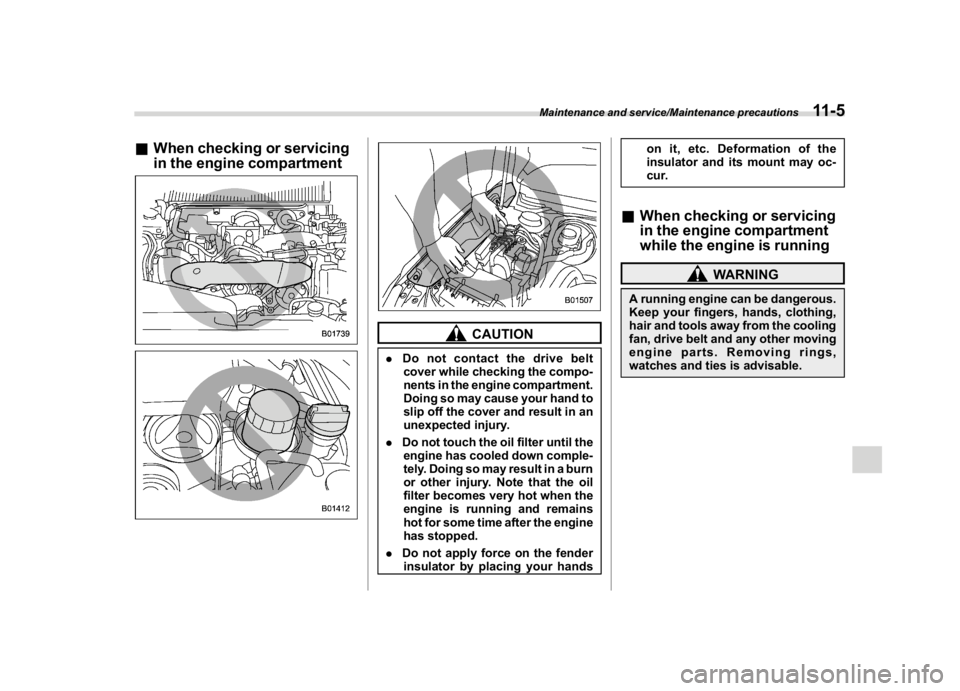
&When checking or servicing
in the engine compartment
CAUTION
.Do not contact the drive belt
cover while checking the compo-
nents in the engine compartment.
Doing so may cause your hand to
slip off the cover and result in an
unexpected injury.
.Do not touch the oil filter until the
engine has cooled down comple-
tely. Doing so may result in a burn
or other injury. Note that the oil
filter becomes very hot when the
engine is running and remains
hot for some time after the engine
has stopped.
.Do not apply force on the fender
insulator by placing your handson it, etc. Deformation of the
insulator and its mount may oc-
cur.
&When checking or servicing
in the engine compartment
while the engine is running
WARNING
A running engine can be dangerous.
Keep your fingers, hands, clothing,
hair and tools away from the cooling
fan, drive belt and any other moving
engine parts. Removing rings,
watches and ties is advisable.
Maintenance and service/Maintenance precautions
11-5
11
Page 483 of 578

(504,1)
北米Model "A1700BE-B" EDITED: 2017/ 10/ 11
Maintenance tipsSome clips and fender linings must be
removed before replacing the air cleaner
elements or specific bulbs.&Removing and reinstalling
clips!Removing clips
There are several types of clips used for
your vehicle.
!Type A clips1. Turn the clips counterclockwise using
a flat-head screwdriver until the center
portion of the clip is raised.
2. Remove the clips with a flat-head
screwdriver using leverage.3. Remove the entire clip by pulling it up.
!Type B clips
!Type C clips
1. Pull out the center portion of the clipusing a flat-head screwdriver as shown in
the illustration.
2. Pull the protruded center portion to
remove the entire body of the clip.
!Type D clips
1. Turn the clip counterclockwise using a
Phillips screwdriver until the center portion
of the clip is raised.
2. Remove the entire clip by pulling it up.
Maintenance and service/Maintenance tips
11-6