tire type SUBARU WRX 2018 Owner's Manual
[x] Cancel search | Manufacturer: SUBARU, Model Year: 2018, Model line: WRX, Model: SUBARU WRX 2018Pages: 578, PDF Size: 33.21 MB
Page 551 of 578
(576,1)
北米Model "A1700BE-B" EDITED: 2017/ 10/ 11
!Maximum load rating
The load rating at the maximum
permissible weight load for this tire.
For example,“MAX. LOAD 580 kg
(1279 LBS) @ 300 kPa (44 PSI)
MAX. PRESS.”
WARNING
Maximum load rating applies
only to the tire, not to the
vehicle. Putting a load rated
tire on any vehicle does not
mean the vehicle can be
loaded up to the tire’s rated
load.!Construction type
Applicable construction of this tire.
For example,“TUBELESS STEEL
BELTED RADIAL”
!Construction
The generic name of each cord
material used in the plies (both
sidewall and tread area) of this tire.
For example,“PLIES: TREAD 2STEEL + 2 POLYESTER SIDE-
WALL 2 POLYESTER”
!Uniform Tire Quality Grading
(UTQG)
For details, refer to“
Uniform tire
quality grading standards”F13-15.
&Recommended tire inflation
pressure!Recommended cold tire infla-
tion pressureFor recommended cold tire inflation
pressure for your vehicle’s tires,
refer to“
Tires”F12-8.
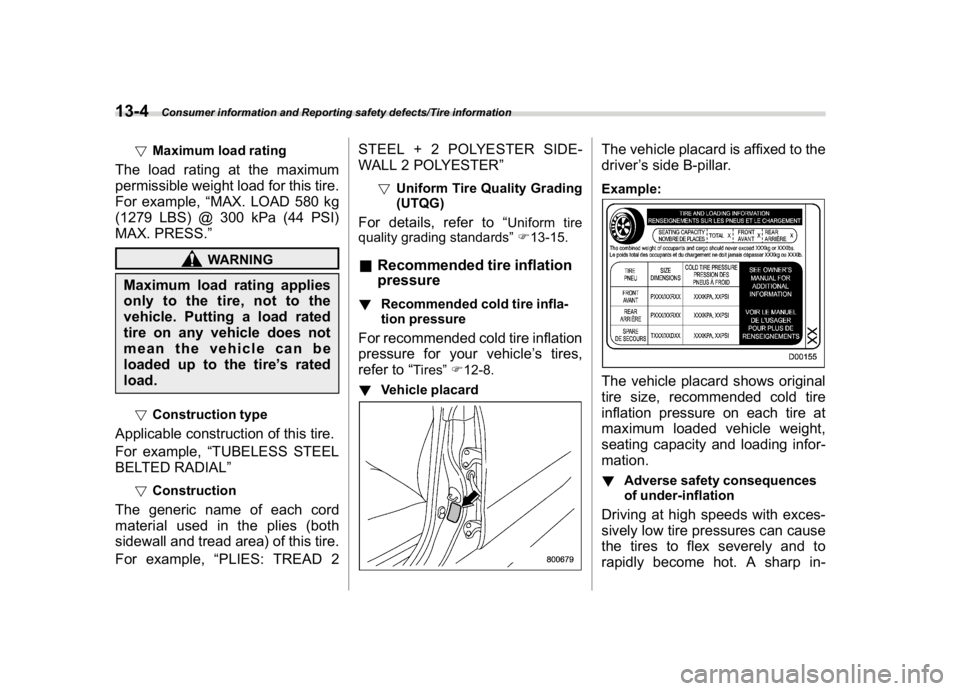
!Vehicle placard
The vehicle placard is affixed to the
driver’s side B-pillar.Example:The vehicle placard shows original
tire size, recommended cold tire
inflation pressure on each tire at
maximum loaded vehicle weight,
seating capacity and loading infor-
mation.!Adverse safety consequences
of under-inflationDriving at high speeds with exces-
sively low tire pressures can cause
the tires to flex severely and to
rapidly become hot. A sharp in-
Consumer information and Reporting safety defects/Tire information
13-4
Page 554 of 578

(579,1)
北米Model "A1700BE-B" EDITED: 2017/ 10/ 11
.
Passenger car tire
A tire intended for use on passen-
ger cars, multipurpose passenger
vehicles, and trucks, that have a
gross vehicle weight rating (GVWR)
of 10,000 lbs (4,535 kg) or less..
Ply
A layer of rubber-coated parallel
cords..
Ply separation
A parting of rubber compound
between adjacent plies..
Pneumatic tire
A mechanical device made of rub-
ber, chemicals, fabric and steel or
other materials, that, when
mounted on an automotive wheel,
provides the traction and contains
the gas or fluid that sustains the
load..
Production options weight
The combined weight of those
installed regular production options
weighing over 5.1 lbs (2.3 kg) in
excess of those standard items
which they replace, not previously
considered in curb weight or acces-sory weight, including heavy duty
brakes, ride levelers, roof rack,
heavy duty battery, and special trim.
.
Radial ply tire
A pneumatic tire in which the ply
cords that extend to the beads are
laid at substantially 90 degrees to
the centerline of the tread..
Recommended inflation pres-
sure
The cold inflation pressure recom-
mended by a vehicle manufacturer..
Reinforced tire
A tire designed to operate at higher
loads and at higher inflation pres-
sures than the corresponding stan-
dard tire..
Rim
A metal support for a tire or a tire
and tube assembly upon which the
tire beads are seated..
Rim diameter
Nominal diameter of the bead seat..
Rim size designation
Rim diameter and width.
.
Rim type designation
The industry of manufacturer’s des-
ignation for a rim by style or code..
Rim width
Nominal distance between rim
flanges..
Section width
The linear distance between the
exteriors of the sidewalls of an
inflated tire, excluding elevations
due to labeling, decoration, or pro-
tective bands..
Sidewall
That portion of a tire between the
tread and bead..
Sidewall separation
The parting of the rubber compound
from the cord material in the side-
wall..
Test rim
The rim on which a tire is fitted for
testing, and it may be any rim listed
as appropriate for use with that tire..
Tread
That portion of a tire that comes into
contact with the road.
–CONTINUED–
Consumer information and Reporting safety defects/Tire information
13-7
13
Page 562 of 578
(587,1)
北米Model "A1700BE-B" EDITED: 2017/ 10/ 11
Uniform tire quality grading
standardsThis information indicates the rela-
tive performance of passenger car
tires in the area of treadwear,
traction, and temperature resis-
tance. This is to aid the consumer
in making an informed choice in the
purchase of tires.
Quality grades can be found where
applicable on the tire sidewall be-
tween tread shoulder and maximum
section width. For example:Treadwear 200 Traction AA Tem-
perature AThe quality grades apply to new
pneumatic tires for use on passen-
ger cars. However, they do not
apply to deep tread, winter type
snow tires, space-saver or tempor-
ary use spare tires, tires with
nominal rim diameters of 12 inches
or less, or to some limited produc-
tion tires.
All passenger car tires must con-form to Federal Safety Require-
ments in addition to these grades.
&TreadwearThe treadwear grade is a compara-
tive rating based on the wear rate of
the tire when tested under con-
trolled conditions on a specified
government test course.
For example, a tire graded 150
would wear one and one-half (1-
1/2) times as well on the govern-
ment course as a tire graded 100.
The relative performance of tires
depends upon the actual conditions
of their use, however, and may
depart significantly from the norm
due to variations in driving habits,
service practices and differences in
road characteristics and climate.&Traction AA, A, B, CThe traction grades, from highest to
lowest, are AA, A, B and C. Those
grades represent the tire’s ability to
stop on wet pavement as measured
under controlled conditions on spe-cified government test surfaces of
asphalt and concrete. A tire marked
C may have poor traction perfor-
mance.
WARNING
The traction grade assigned to
this tire is based on straight-
ahead braking traction tests,
and does not include accelera-
tion, cornering, hydroplaning,
or peak traction characteris-
tics.&Temperature A, B, CThe temperature grades are A (the
highest), B, and C, representing the
tire’s resistance to the generation of
heat and its ability to dissipate heat
when tested under controlled con-
ditions on a specified indoor labora-
tory test wheel. Sustained high
temperature can cause the material
of the tire to degenerate and reduce
tire life, and excessive temperature
can lead to sudden tire failure. The
–CONTINUED–
Consumer information and Reporting safety defects/Uniform tire quality grading standards
13-15
13