tow SUZUKI AERIO 2007 1.G User Guide
[x] Cancel search | Manufacturer: SUZUKI, Model Year: 2007, Model line: AERIO, Model: SUZUKI AERIO 2007 1.GPages: 232, PDF Size: 3.34 MB
Page 44 of 232
Downloaded from www.Manualslib.com manuals search engine 2-31 BEFORE DRIVING
54G27-03E
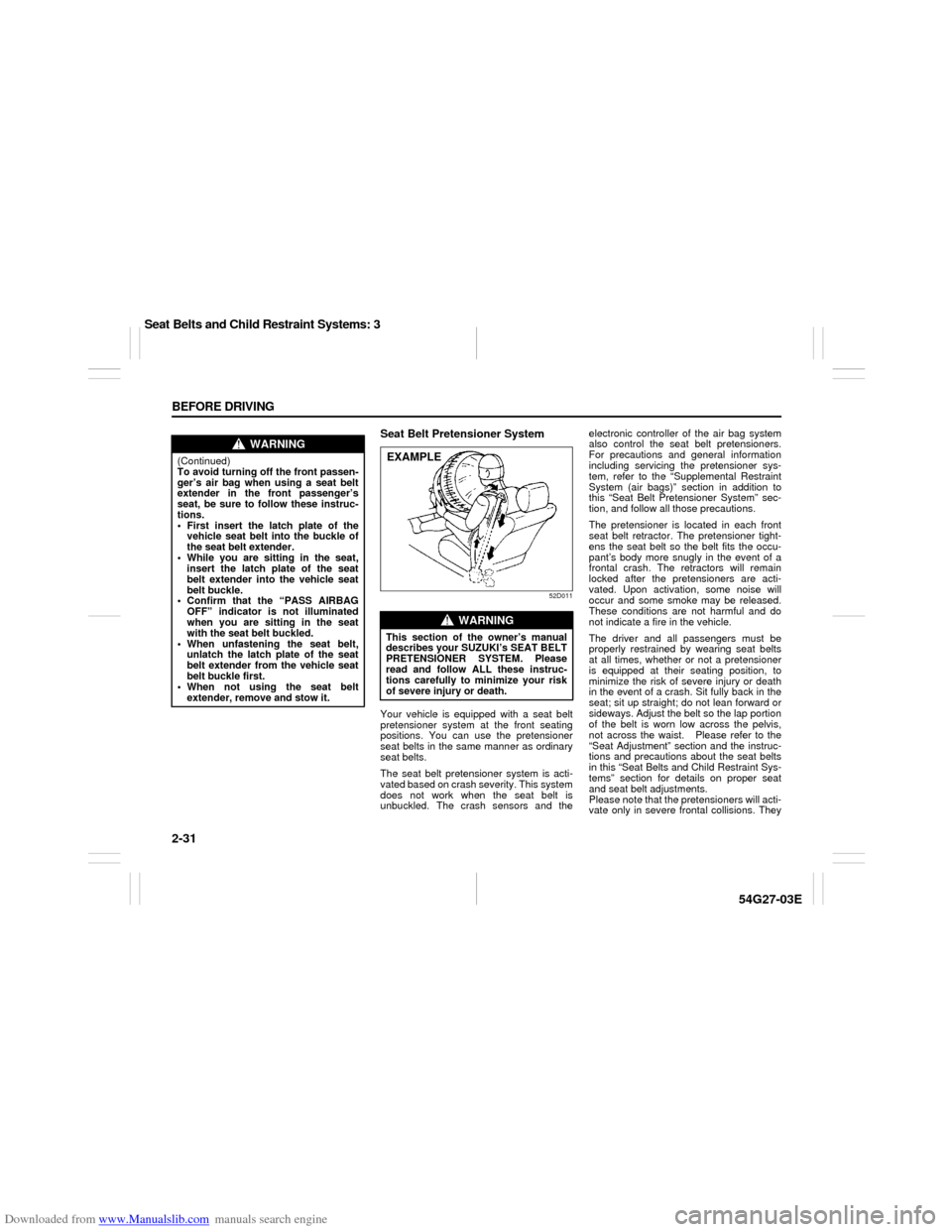
Seat Belt Pretensioner System
52D011
Your vehicle is equipped with a seat belt
pretensioner system at the front seating
positions. You can use the pretensioner
seat belts in the same manner as ordinary
seat belts.
The seat belt pretensioner system is acti-
vated based on crash severity. This system
does not work when the seat belt is
unbuckled. The crash sensors and theelectronic controller of the air bag system
also control the seat belt pretensioners.
For precautions and general information
including servicing the pretensioner sys-
tem, refer to the “Supplemental Restraint
System (air bags)” section in addition to
this “Seat Belt Pretensioner System” sec-
tion, and follow all those precautions.
The pretensioner is located in each front
seat belt retractor. The pretensioner tight-
ens the seat belt so the belt fits the occu-
pant’s body more snugly in the event of a
frontal crash. The retractors will remain
locked after the pretensioners are acti-
vated. Upon activation, some noise will
occur and some smoke may be released.
These conditions are not harmful and do
not indicate a fire in the vehicle.
The driver and all passengers must be
properly restrained by wearing seat belts
at all times, whether or not a pretensioner
is equipped at their seating position, to
minimize the risk of severe injury or death
in the event of a crash. Sit fully back in the
seat; sit up straight; do not lean forward or
sideways. Adjust the belt so the lap portion
of the belt is worn low across the pelvis,
not across the waist. Please refer to the
“Seat Adjustment” section and the instruc-
tions and precautions about the seat belts
in this “Seat Belts and Child Restraint Sys-
tems” section for details on proper seat
and seat belt adjustments.
Please note that the pretensioners will acti-
vate only in severe frontal collisions. They
WARNING
(Continued)
To avoid turning off the front passen-
ger’s air bag when using a seat belt
extender in the front passenger’s
seat, be sure to follow these instruc-
tions.
First insert the latch plate of the
vehicle seat belt into the buckle of
the seat belt extender.
While you are sitting in the seat,
insert the latch plate of the seat
belt extender into the vehicle seat
belt buckle.
Confirm that the “PASS AIRBAG
OFF” indicator is not illuminated
when you are sitting in the seat
with the seat belt buckled.
When unfastening the seat belt,
unlatch the latch plate of the seat
belt extender from the vehicle seat
belt buckle first.
When not using the seat belt
extender, remove and stow it.
WARNING
This section of the owner’s manual
describes your SUZUKI’s SEAT BELT
PRETENSIONER SYSTEM. Please
read and follow ALL these instruc-
tions carefully to minimize your risk
of severe injury or death.EXAMPLE
Seat Belts and Child Restraint Systems: 3
Page 58 of 232
Downloaded from www.Manualslib.com manuals search engine 3-3 STEERING COLUMN CONTROLS
54G27-03E
Lighting/Turn Signal Control
LeverThis control lever is located on the out-
board side of the steering column. Operate
the lever as described below.Lighting Operation
54G030
To turn the lights on or off, twist the knob
on the end of the lever. There are three
positions: in the “OFF” position all lights
are off; in the middle position the front
parking lights, tail-lights, license plate light
and instrument lights are on, but the head-
lights are off; in the third position the head-
lights come on in addition to the other
lights.
54G031
With the headlights on, push the lever for-
ward to switch to the high beams or pull
the lever toward you to switch to the low
beams. When the high beams are on, a
light on the instrument panel will come on.
To momentarily activate the high beams as
a passing signal, pull the lever slightly
toward you and release it when you have
completed the signal.
Daytime Running Light (D.R.L.) Sys-
temThe headlights light, but are dimmer than
the low beam, when the following three
conditions are all met. Also, the D.R.L. indi-
cator light on the instrument panel comes
on.
Conditions for D.R.L. system operation:
1) The engine is running.
2) The parking brake is released.
3) The lighting switch is at either the “OFF”
or the “Middle” position.
NOTE:
Be sure to turn the lighting switch to the
third position at night or at any time of the
day when driving or weather conditions
require the headlights to operate at full
brightness and the taillights to be on.
Lights “On” reminder
A buzzer sounds to remind you to turn off
the lights if they are left on when the igni-
tion key is removed and the driver’s door is
opened.
HIGH
LOW
PASS
Lighting/Turn Signal Control Lever: 8
Page 60 of 232
Downloaded from www.Manualslib.com manuals search engine 3-5 STEERING COLUMN CONTROLS
54G27-03E
Windshield Washer
52D172
To spray windshield washer fluid, pull the
lever toward you. The windshield wipers
will automatically turn on at low speed if
they are not already on and if the “INT”
position is equipped.
Rear Window Wiper/Washer
Switch (if equipped)
54G480
To turn the rear wiper on, twist the rear
wiper switch on the end of the lever for-
ward to the “ON” position. If your vehicle is
equipped the “INT” position, the rear wiper
operates intermittently when you twist the
switch forward to the “INT” position. To turn
the rear wiper off, twist the switch rearward
to the “OFF” position.
With the rear wiper in the “OFF” position,
twist the switch rearward and hold it there
to spray window washer fluid. The wiper
will automatically be on while the switch is
held.
With the rear wiper in the “ON” position,
turn the switch forward and hold it there to
spray window washer fluid.
WARNING
To prevent windshield icing in cold
weather, turn on the defroster to
heat the windshield before and dur-
ing windshield washer use.
Do not use radiator antifreeze in
the windshield washer reservoir. It
can severely impair visibility when
sprayed on the windshield, and can
also damage your vehicle’s paint.EXAMPLE
CAUTION
To help prevent damage to wind-
shield wiper and washer system
components, you should take the fol-
lowing precautions:
Do not continue to hold in the lever
when there is no windshield
washer fluid being sprayed or the
washer motor can be damaged.
Do not attempt to remove dirt from
a dry windshield with the wipers or
you can damage the windshield
and the wiper blades. Always wet
the windshield with washer fluid
before operating the wipers.
Clear ice or packed snow from the
wiper blades before using the wip-
ers.
Check the washer fluid level regu-
larly. Check it often when the
weather is bad.
Only fill the washer fluid reservoir
3/4 full during cold weather to allow
room for expansion if the tempera-
ture falls low enough to freeze the
solution.
EXAMPLE
Windshield Wiper and Washer Lever: 8
Rear Window Wiper/Washer Switch: 8
Page 62 of 232
Downloaded from www.Manualslib.com manuals search engine 3-7 STEERING COLUMN CONTROLS
54G27-03E
52D113
When you push in the “CRUISE ON-OFF”
switch, the system is on and a “CRUISE”
indicator light on the instrument cluster will
be on.
65D474
When the vehicle’s speed is controlled by
the cruise control system, a “SET” indica-
tor light on the instrument cluster will be
on.
52D303
To Set Cruising Speed
Turn on the cruise control system by push-
ing in the “CRUISE ON-OFF” switch.
Accelerate to the desired speed, move the
control lever down in the “SET/COAST”
direction, and then release the lever. Take
your foot off the accelerator pedal and the
set speed will be maintained.
With the cruise control on, you can
increase speed for passing by using the
accelerator pedal. When you take your foot
off the pedal, your vehicle will return to the
set speed.
To Change Cruising Speed
To reset the cruise control to a slower
speed, hold the control lever in the “SET/
COAST” position until the vehicle has
slowed to the desired speed, then releasethe lever. The new speed will be main-
tained.
To reset the cruise control to a faster
speed, use either of the following proce-
dures:
Move the control lever up in the “RES/
ACC” direction and hold it there. Vehicle
speed will steadily increase. When you
release the lever, the new speed will be
maintained.
Accelerate to the desired speed using
the accelerator pedal and move the con-
trol lever down in the “SET/COAST”
direction. When you release the lever,
the new speed will be maintained.
To Cancel
To cancel cruise control operation, use one
of the following procedures:
Slightly depress the brake pedal or pull
the control lever toward you in the “CAN-
CEL” direction. Cruise control operation
will be cancelled until you reset a cruis-
ing speed by moving the control lever in
the “RES/ACC” or the “SET/COAST”
direction.
Push in the “CRUISE ON-OFF” switch.
Cruise control operation will be can-
celled until you turn on the system by
pushing in the “CRUISE ON-OFF” switch
again and reset a cruising speed by
moving the control lever in the “SET/
COAST” direction.
Cruise Control: 7, 8
Page 68 of 232
Downloaded from www.Manualslib.com manuals search engine 4-3 INSTRUMENT PANEL
54G27-03E
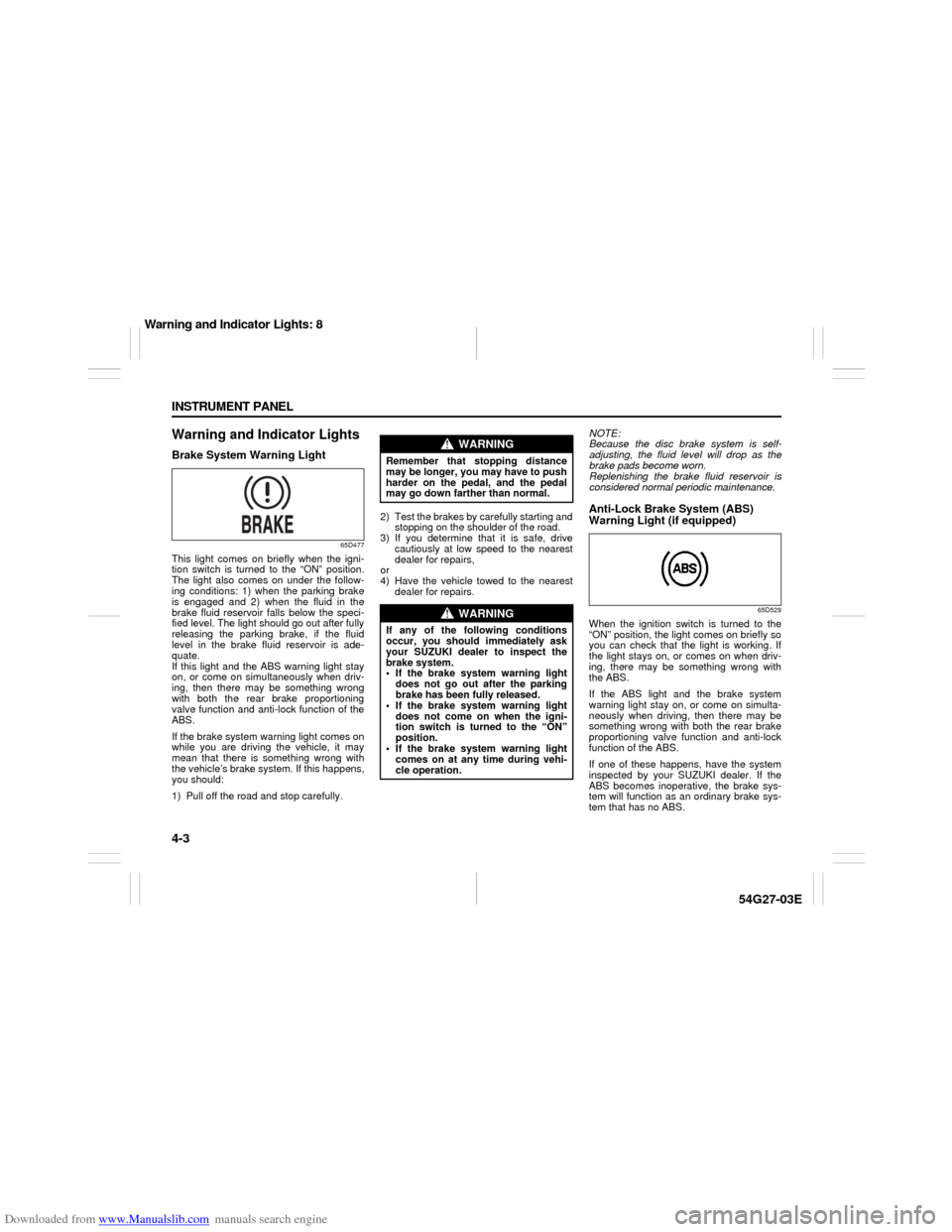
Warning and Indicator LightsBrake System Warning Light
65D477
This light comes on briefly when the igni-
tion switch is turned to the “ON” position.
The light also comes on under the follow-
ing conditions: 1) when the parking brake
is engaged and 2) when the fluid in the
brake fluid reservoir falls below the speci-
fied level. The light should go out after fully
releasing the parking brake, if the fluid
level in the brake fluid reservoir is ade-
quate.
If this light and the ABS warning light stay
on, or come on simultaneously when driv-
ing, then there may be something wrong
with both the rear brake proportioning
valve function and anti-lock function of the
ABS.
If the brake system warning light comes on
while you are driving the vehicle, it may
mean that there is something wrong with
the vehicle’s brake system. If this happens,
you should:
1) Pull off the road and stop carefully.2) Test the brakes by carefully starting and
stopping on the shoulder of the road.
3) If you determine that it is safe, drive
cautiously at low speed to the nearest
dealer for repairs,
or
4) Have the vehicle towed to the nearest
dealer for repairs.NOTE:
Because the disc brake system is self-
adjusting, the fluid level will drop as the
brake pads become worn.
Replenishing the brake fluid reservoir is
considered normal periodic maintenance.
Anti-Lock Brake System (ABS)
Warning Light (if equipped)
65D529
When the ignition switch is turned to the
“ON” position, the light comes on briefly so
you can check that the light is working. If
the light stays on, or comes on when driv-
ing, there may be something wrong with
the ABS.
If the ABS light and the brake system
warning light stay on, or come on simulta-
neously when driving, then there may be
something wrong with both the rear brake
proportioning valve function and anti-lock
function of the ABS.
If one of these happens, have the system
inspected by your SUZUKI dealer. If the
ABS becomes inoperative, the brake sys-
tem will function as an ordinary brake sys-
tem that has no ABS.
WARNING
Remember that stopping distance
may be longer, you may have to push
harder on the pedal, and the pedal
may go down farther than normal.
WARNING
If any of the following conditions
occur, you should immediately ask
your SUZUKI dealer to inspect the
brake system.
If the brake system warning light
does not go out after the parking
brake has been fully released.
If the brake system warning light
does not come on when the igni-
tion switch is turned to the “ON”
position.
If the brake system warning light
comes on at any time during vehi-
cle operation.
Warning and Indicator Lights: 8
Page 121 of 232
Downloaded from www.Manualslib.com manuals search engine 5-6 OTHER CONTROLS AND EQUIPMENT
54G27-03E
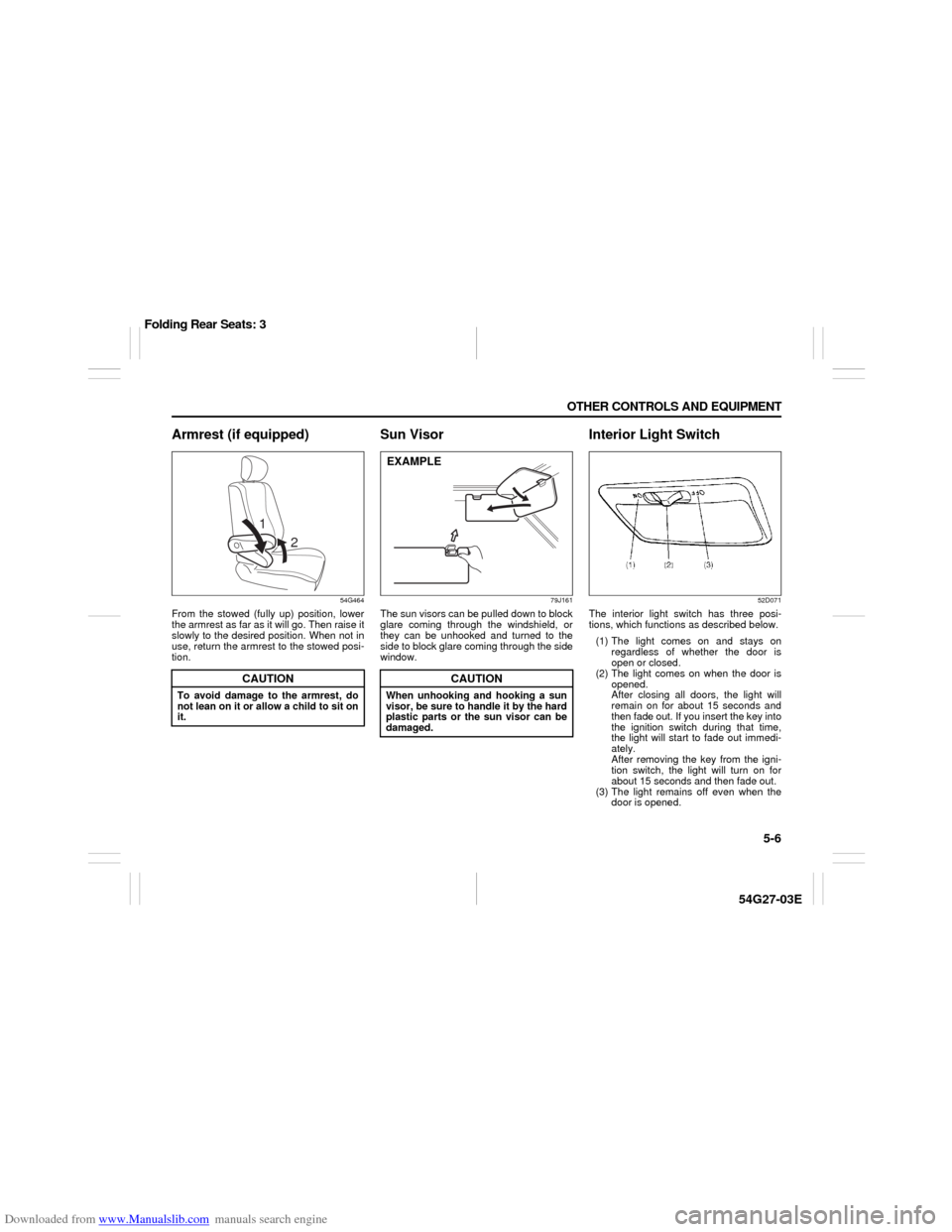
Armrest (if equipped)
54G464
From the stowed (fully up) position, lower
the armrest as far as it will go. Then raise it
slowly to the desired position. When not in
use, return the armrest to the stowed posi-
tion.
Sun Visor
79J161
The sun visors can be pulled down to block
glare coming through the windshield, or
they can be unhooked and turned to the
side to block glare coming through the side
window.
Interior Light Switch
52D071
The interior light switch has three posi-
tions, which functions as described below.
(1) The light comes on and stays on
regardless of whether the door is
open or closed.
(2) The light comes on when the door is
opened.
After closing all doors, the light will
remain on for about 15 seconds and
then fade out. If you insert the key into
the ignition switch during that time,
the light will start to fade out immedi-
ately.
After removing the key from the igni-
tion switch, the light will turn on for
about 15 seconds and then fade out.
(3) The light remains off even when the
door is opened.
CAUTION
To avoid damage to the armrest, do
not lean on it or allow a child to sit on
it.
1
2
CAUTION
When unhooking and hooking a sun
visor, be sure to handle it by the hard
plastic parts or the sun visor can be
damaged.EXAMPLE
Folding Rear Seats: 3
Page 126 of 232
Downloaded from www.Manualslib.com manuals search engine 5-11 OTHER CONTROLS AND EQUIPMENT
54G27-03E
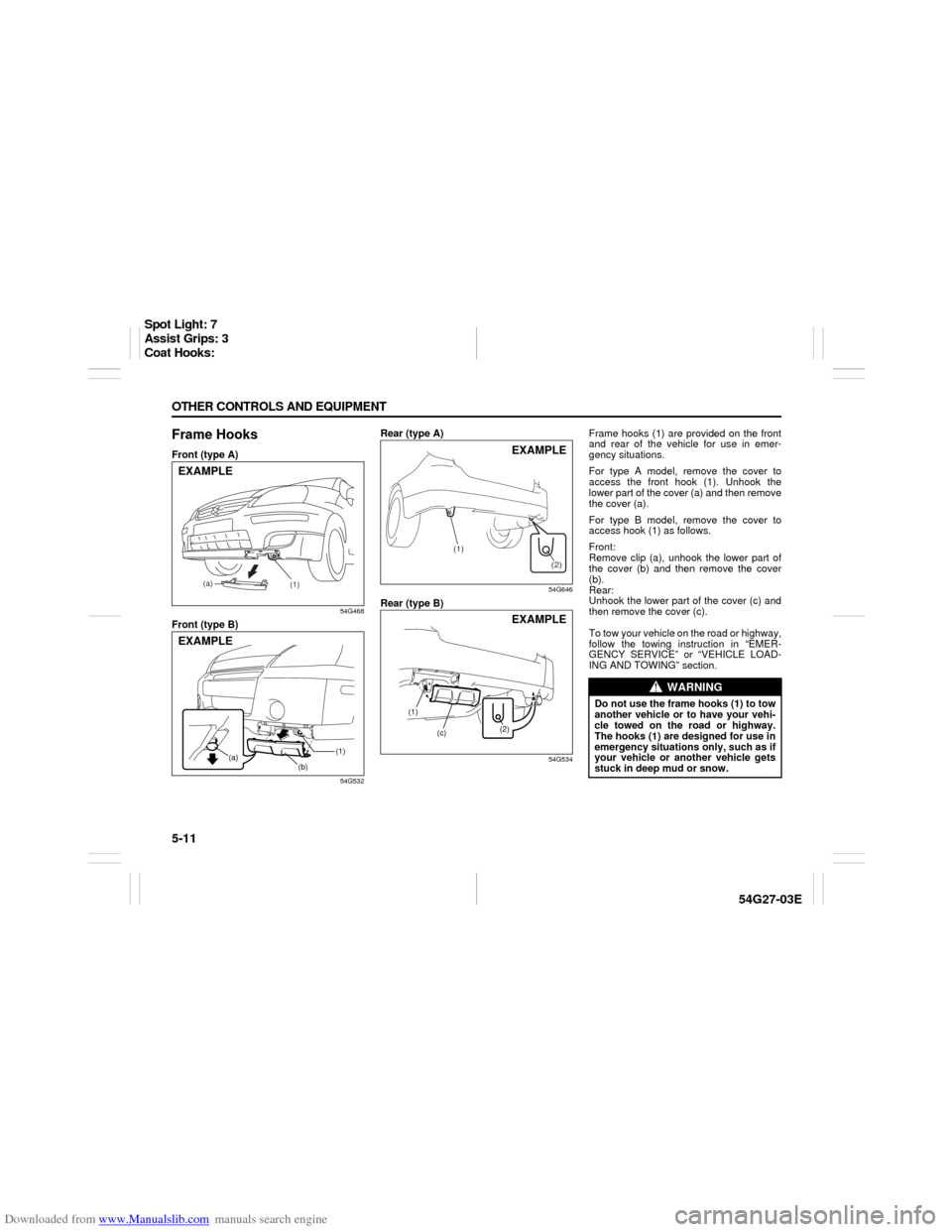
Frame HooksFront (type A)
54G468
Front (type B)
54G532
Rear (type A)
54G646
Rear (type B)
54G534
Frame hooks (1) are provided on the front
and rear of the vehicle for use in emer-
gency situations.
For type A model, remove the cover to
access the front hook (1). Unhook the
lower part of the cover (a) and then remove
the cover (a).
For type B model, remove the cover to
access hook (1) as follows.
Front:
Remove clip (a), unhook the lower part of
the cover (b) and then remove the cover
(b).
Rear:
Unhook the lower part of the cover (c) and
then remove the cover (c).
To tow your vehicle on the road or highway,
follow the towing instruction in “EMER-
GENCY SERVICE” or “VEHICLE LOAD-
ING AND TOWING” section.
(1)
(a)
EXAMPLE
(1)
(a)
(b)
EXAMPLE
(2)
(1)
EXAMPLE
(2) (1)
(c)
EXAMPLE
WARNING
Do not use the frame hooks (1) to tow
another vehicle or to have your vehi-
cle towed on the road or highway.
The hooks (1) are designed for use in
emergency situations only, such as if
your vehicle or another vehicle gets
stuck in deep mud or snow.
Spot Light: 7
Assist Grips: 3
Coat Hooks:
Page 127 of 232
Downloaded from www.Manualslib.com manuals search engine 5-12 OTHER CONTROLS AND EQUIPMENT
54G27-03E
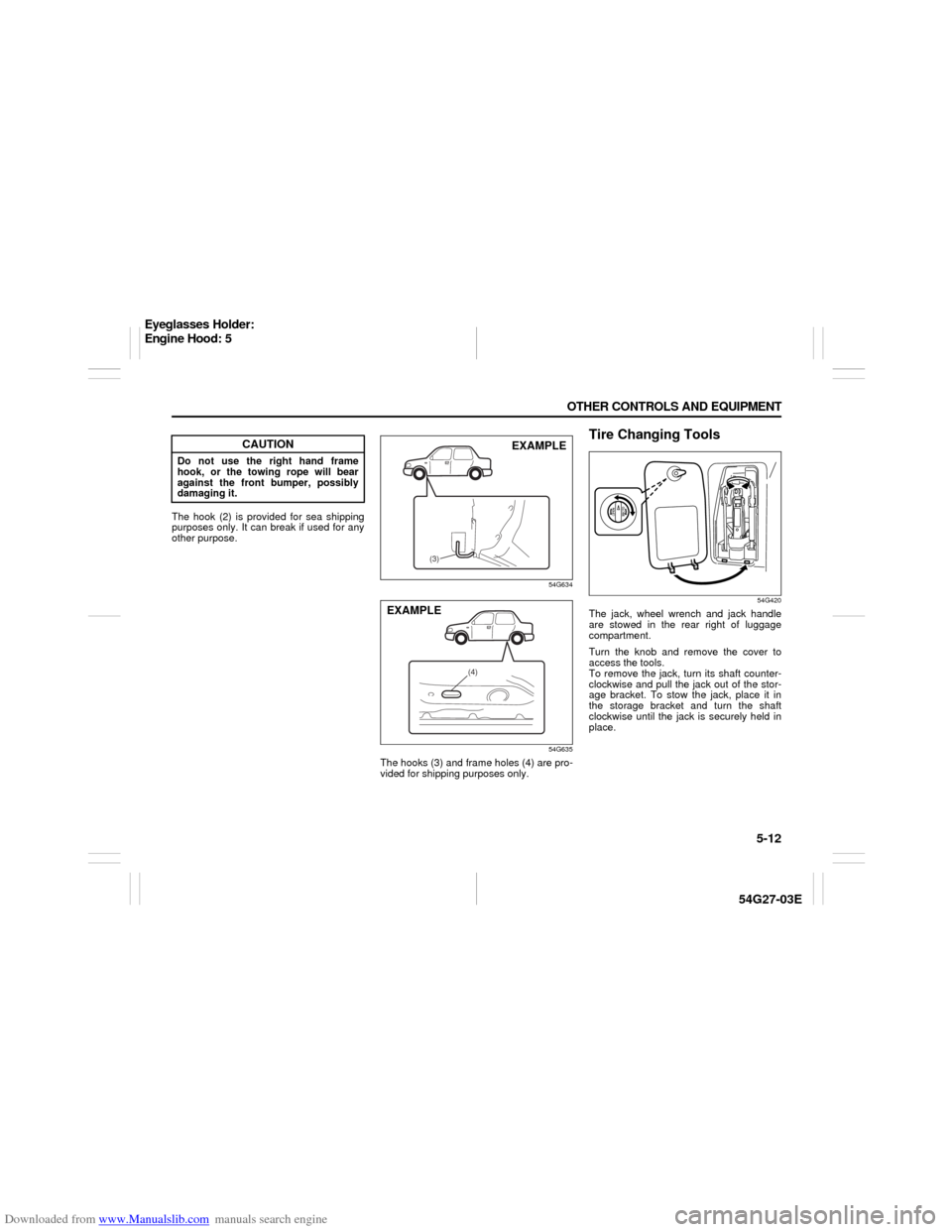
The hook (2) is provided for sea shipping
purposes only. It can break if used for any
other purpose.
54G634
54G635
The hooks (3) and frame holes (4) are pro-
vided for shipping purposes only.
Tire Changing Tools
54G420
The jack, wheel wrench and jack handle
are stowed in the rear right of luggage
compartment.
Turn the knob and remove the cover to
access the tools.
To remove the jack, turn its shaft counter-
clockwise and pull the jack out of the stor-
age bracket. To stow the jack, place it in
the storage bracket and turn the shaft
clockwise until the jack is securely held in
place.
CAUTION
Do not use the right hand frame
hook, or the towing rope will bear
against the front bumper, possibly
damaging it.
(3)
EXAMPLE
(4)
EXAMPLE
Eyeglasses Holder:
Engine Hood: 5
Page 128 of 232
Downloaded from www.Manualslib.com manuals search engine 5-13 OTHER CONTROLS AND EQUIPMENT
54G27-03E
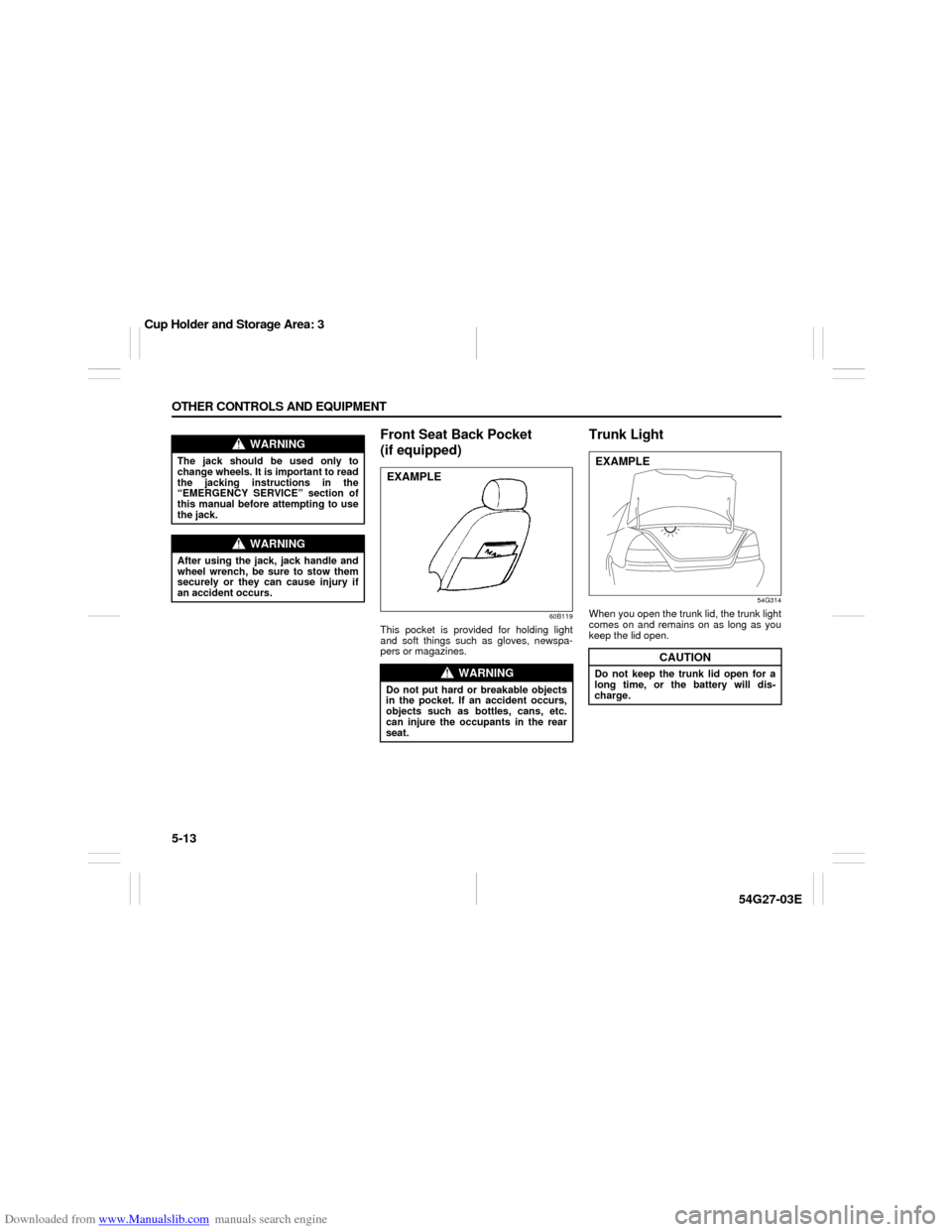
Front Seat Back Pocket
(if equipped)
60B119
This pocket is provided for holding light
and soft things such as gloves, newspa-
pers or magazines.
Trunk Light
54G314
When you open the trunk lid, the trunk light
comes on and remains on as long as you
keep the lid open.
WARNING
The jack should be used only to
change wheels. It is important to read
the jacking instructions in the
“EMERGENCY SERVICE” section of
this manual before attempting to use
the jack.
WARNING
After using the jack, jack handle and
wheel wrench, be sure to stow them
securely or they can cause injury if
an accident occurs.
WARNING
Do not put hard or breakable objects
in the pocket. If an accident occurs,
objects such as bottles, cans, etc.
can injure the occupants in the rear
seat.EXAMPLE
CAUTION
Do not keep the trunk lid open for a
long time, or the battery will dis-
charge.EXAMPLE
Cup Holder and Storage Area: 3
Page 139 of 232
Downloaded from www.Manualslib.com manuals search engine 6-10 OPERATING YOUR VEHICLE
54G27-03E
54G584S
Improving Fuel EconomyThe following instructions will help you
improve fuel economy.
Avoid excessive idling
If you are to wait for more than a minute
while you are parked, stop the engine and
start it again later. When warming up a
cold engine, allow the engine to idle until
the temperature gauge pointer comes up
to the “C” position. In this position, the
engine is sufficiently warm for starting off.
Avoid “jackrabbit” starts
Fast starts away from lights or stop signs
will consume fuel unnecessarily and
shorten engine life. Start off slowly.
Avoid unnecessary stops
Avoid unnecessary deceleration and stop-
ping. Try to maintain a slow, steady speed
whenever possible. Slowing down and then
accelerating again uses more fuel.
Keep a steady cruising speed
Keep as constant a speed as road and traf-
fic conditions will permit.
CAUTION
To minimize the possibility of catalyst
or other vehicle damage:
Maintain the engine in the proper
operating condition.
In the event of an engine malfunc-
tion, particularly one involving
engine misfire or other apparent
loss of performance, have the vehi-
cle serviced promptly.
Do not shut off the engine or inter-
rupt the ignition when the transaxle
is in gear and the vehicle is in
motion.
Do not try to start the engine by
pushing or towing the vehicle or
coasting down a hill.
Do not idle the engine with any
spark plug wires disconnected or
removed, such as during diagnos-
tic testing.
Do not idle the vehicle for pro-
longed periods if idling seems
rough or there are other malfunc-
tions.
Do not allow the fuel tank to get
near the empty level.
WARNING
Be careful where you park and drive;
the catalytic converter and other
exhaust components can get very
hot. As with any vehicle, do not park
or operate this vehicle in areas where
combustible materials such as dry
grass or leaves can come in contact
with a hot exhaust system.
Catalytic Converter: NO
Improving Fuel Economy: NO