towing SUZUKI AERIO 2007 1.G User Guide
[x] Cancel search | Manufacturer: SUZUKI, Model Year: 2007, Model line: AERIO, Model: SUZUKI AERIO 2007 1.GPages: 232, PDF Size: 3.34 MB
Page 151 of 232
Downloaded from www.Manualslib.com manuals search engine 8-4 VEHICLE LOADING AND TOWING
54G27-03E
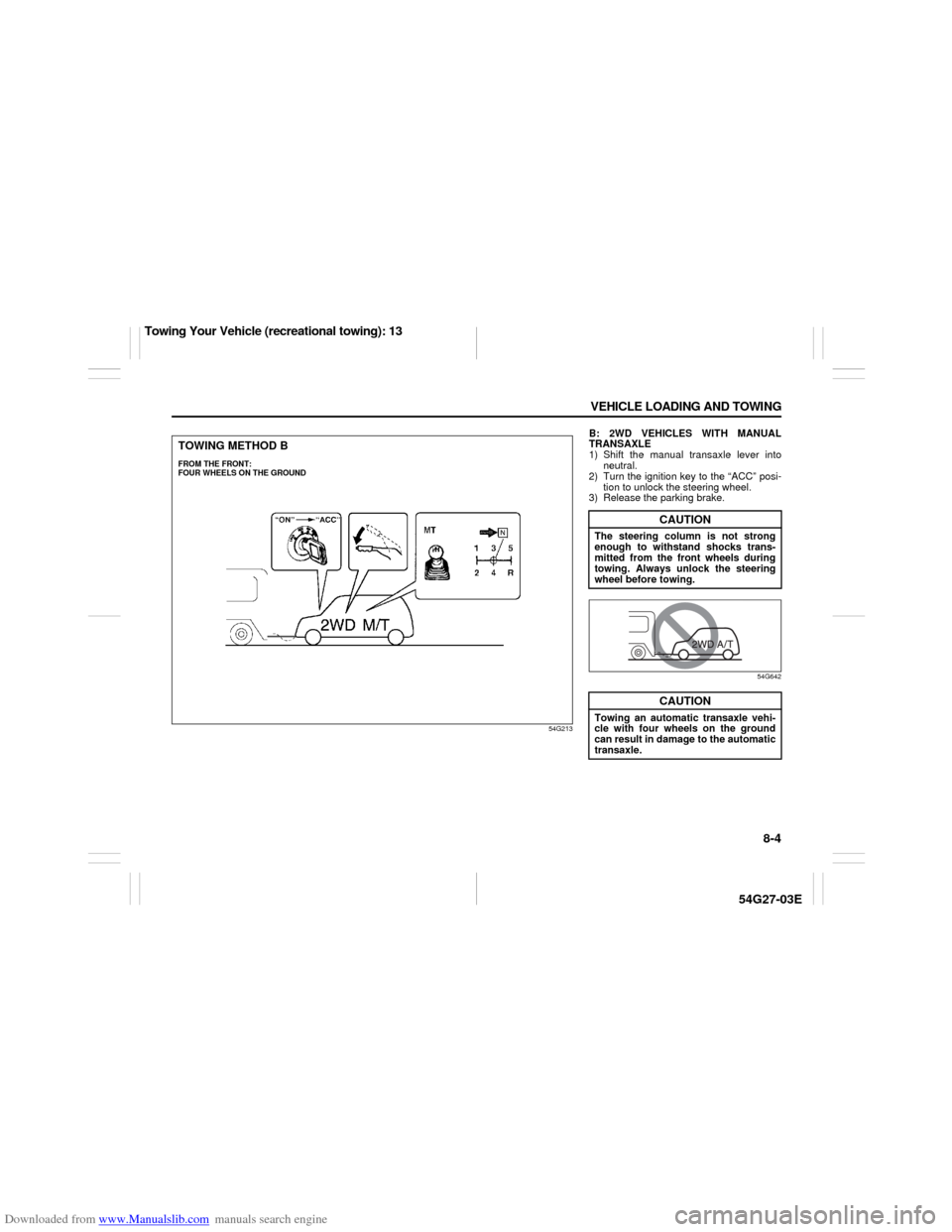
54G213
TOWING METHOD BFROM THE FRONT:
FOUR WHEELS ON THE GROUND
B: 2WD VEHICLES WITH MANUAL
TRANSAXLE
1) Shift the manual transaxle lever into
neutral.
2) Turn the ignition key to the “ACC” posi-
tion to unlock the steering wheel.
3) Release the parking brake.
54G642
CAUTION
The steering column is not strong
enough to withstand shocks trans-
mitted from the front wheels during
towing. Always unlock the steering
wheel before towing.
CAUTION
Towing an automatic transaxle vehi-
cle with four wheels on the ground
can result in damage to the automatic
transaxle.
Towing Your Vehicle (recreational towing): 13
Page 152 of 232

Downloaded from www.Manualslib.com manuals search engine 8-5 VEHICLE LOADING AND TOWING
54G27-03E
MEMO
Page 186 of 232

Downloaded from www.Manualslib.com manuals search engine 9-33 INSPECTION AND MAINTENANCE
54G27-03E
Label. The cargo load capacity can be
determined as described below.
Cargo Load Capacity – Maximum weight
of cargo and luggage that the vehicle can
safely carry. Cargo load capacity is the dif-
ference between the total load capacity of
the vehicle and the total combined weight
of all vehicle occupants. Refer to “Steps for
Determining Correct Load Limit” for details
on how to determine cargo load capacity.
GVWR – Maximum permissible overall
weight of the fully loaded vehicle (including
all the occupants, accessories and cargo
plus the trailer tongue weight if towing a
trailer).
GAWR – (Front and Rear) Maximum per-
missible weight on an individual axle.
Seating Capacity – Maximum number of
occupants the vehicle is designed to carry.
NOTE:
Even though the number of occupants is
within the seating capacity, you still must
make sure that you do not exceed the total
load capacity of the vehicle.
Total Load Capacity – Maximum permissi-
ble weight a vehicle can carry including the
weight of all the occupants, accessories,
cargo, plus trailer tongue weight (if towing
a trailer).
The weight of any accessories already
installed on your vehicle at the time of pur-chase, or that you or the dealer install after
purchase, must be subtracted from the
total load capacity to determine how much
capacity remains available for occupants,
cargo, and trailer tongue weight (if towing
a trailer). Contact your dealer for further
information.
Actual weight of the loaded vehicle and
actual loads at the front and rear axles can
only be determined by weighing the vehi-
cle using a vehicle scale. To measure the
weight and load, try making your vehicle to
a highway weighing station, shipping com-
pany or inspection station for trucks, etc.
Compare these weights to the GVWR and
GAWR (front and rear) listed on the Safety
Certification Label. If the gross vehicle
weight or the load on either axle exceeds
these ratings, you must remove enough
weight to bring the load down to the rated
capacity.
WARNING
Never overload your vehicle. Over-
loading your vehicle can cause dam-
age to your tires and lead to poor
steering and braking which can result
in an accident. The gross vehicle
weight (sum of the weights of the
loaded vehicle, driver and passen-
gers) must never exceed the Gross
Vehicle Weight Rating (GVWR) listed
on the Safety Certification Label. In
addition, never distribute a load so
that the weight on either the front or
rear axle exceeds the Gross Axle
Weight Rating (GAWR) listed on the
Safety Certification Label.
WARNING
Always distribute cargo evenly.
To avoid personal injury or damage
to your vehicle, always secure
cargo to prevent it from shifting if
the vehicle moves suddenly.
Place heavier objects on the floor
and as far forward in the cargo area
as possible. Never pile cargo
higher than the top of the seat-
backs.
Fuses: 7
Page 187 of 232

Downloaded from www.Manualslib.com manuals search engine 9-34 INSPECTION AND MAINTENANCE
54G27-03E
Steps for Determining Correct Load
Limit
1) Locate the statement “The combined
weight of occupants and cargo should
never exceed XXX kg or XXX lbs” on
your vehicle’s placard.
2) Determine the combined weight of the
driver and passengers that will be riding
in your vehicle.
3) Subtract the combined weight of the
driver and passengers from XXX kg or
XXX lbs.
4) The resulting figure equals the avail-
able amount of cargo and luggage load
capacity. For example, if the “XXX”
amount equals 1400 lbs and there will
be five 150 lb passengers in your vehi-
cle, the amount of available cargo and
luggage load capacity is 650 lbs (1400
– 750 (5 x 150) = 650 lbs).
5) Determine the combined weight of lug-
gage and cargo being loaded on the
vehicle. That weight may not safely
exceed the available cargo and lug-
gage load capacity calculated in Step 4.
6) If your vehicle will be towing a trailer,
load from your trailer will be transferred
to your vehicle. Consult this manual to
determine how this reduces the avail-
able cargo and luggage load capacity
of your vehicle.
Vehicle Loading Example
As an example, suppose that the Tire and
Loading Information label on your vehicle
indicates that your vehicle’s total loadcapacity is 950 lbs. If you were to drive
your vehicle with one passenger, and the
total combined weight of you and your pas-
senger was 350 lbs, then the cargo and
luggage capacity of your vehicle would be
600 lbs (950 – 350 = 600 lbs).
If you later added 2 more passengers, hav-
ing a combined weight of 325 lbs, the
cargo and luggage capacity of your vehicle
would be reduced from 600 lbs to 275 lbs
(600 – 325 = 275 lbs). As you can see, as
the number and combined weight of vehi-
cle occupants increase, the vehicle’s cargo
and luggage capacity decreases.
Suppose again, that you were to take a trip
in your vehicle with the same three pas-
sengers described above, and you
decided to tow a trailer having a trailer
tongue weight of 75 lbs. The cargo and
luggage capacity would be reduced again,
to 200 lbs (275 – 75 = 200 lbs).
Determining Compatibility of Tire and
Vehicle Load Limits
The tires on your vehicle, when they are
inflated to the recommended tire inflation
pressure, have a load-carrying capacity
that is greater than the load that will be on
the tires when the vehicle is at its GVWR
or GAWR limit. Never use replacement
tires that have a load-carrying capacity
less than the original tires on your vehicle.
Tire load-carrying capacity information is
molded into the tire sidewall typically
shown as “Max. Load”. Use of replacement
tires with a lower load-carrying capacitythan the original tires, or failure to keep the
tires inflated to recommended tire pres-
sure, may reduce the GVWR or GAWR
limit of your vehicle.
NOTE:
Use of replacement tires with a higher
load-carrying capacity than the original
tires, or using a tire inflation pressure
higher than the recommended tire inflation
pressure, will not increase the GVWR or
GAWR limit of your vehicle.
Headlight Aiming:
Bulb Replacement: 7
Page 197 of 232
Downloaded from www.Manualslib.com manuals search engine EMERGENCY SERVICE
10
54G27-03E
60G411
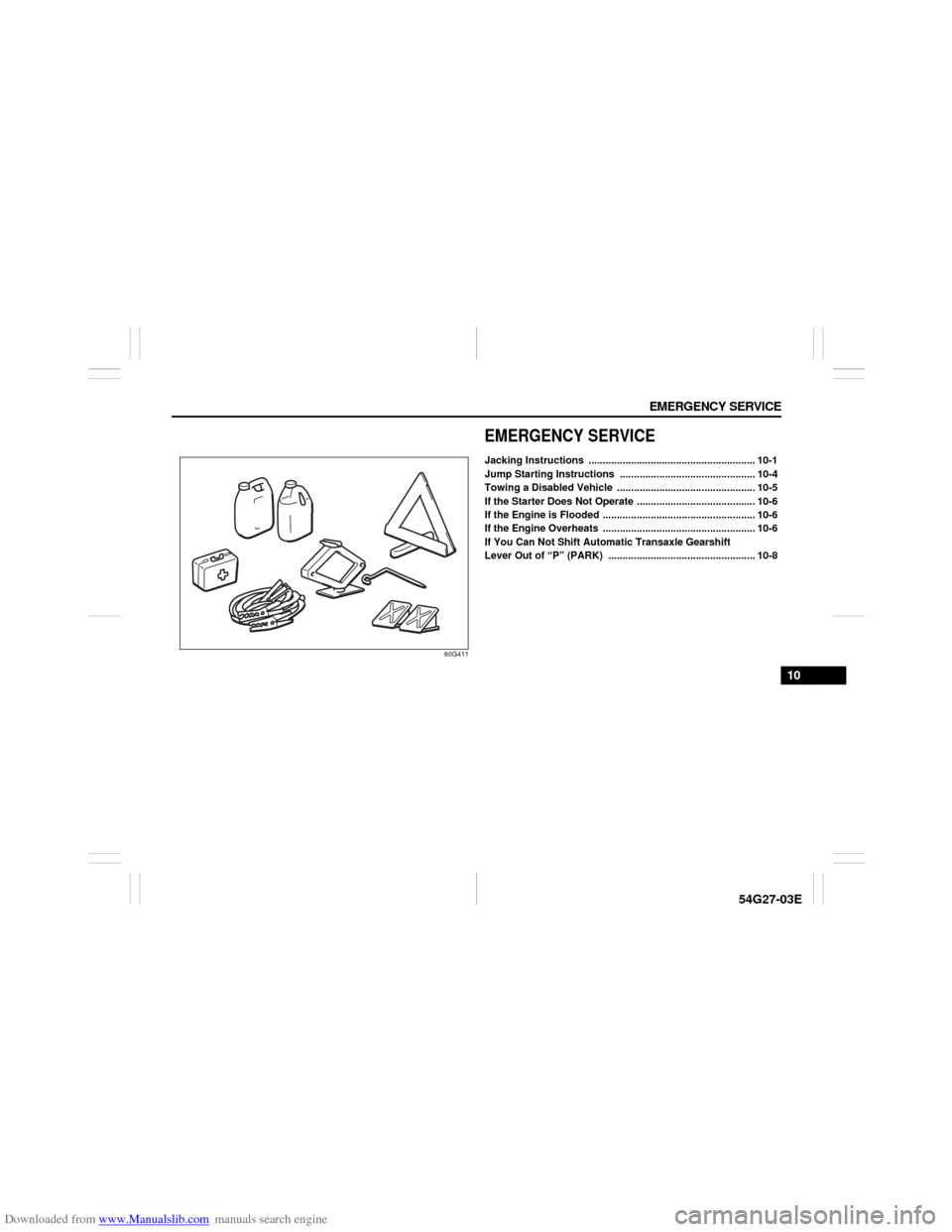
EMERGENCY SERVICEJacking Instructions ........................................................... 10-1
Jump Starting Instructions ................................................ 10-4
Towing a Disabled Vehicle ................................................. 10-5
If the Starter Does Not Operate .......................................... 10-6
If the Engine is Flooded ...................................................... 10-6
If the Engine Overheats ...................................................... 10-6
If You Can Not Shift Automatic Transaxle Gearshift
Lever Out of “P” (PARK) .................................................... 10-8
Page 201 of 232
Downloaded from www.Manualslib.com manuals search engine 10-4 EMERGENCY SERVICE
54G27-03E
54G644
Jump Starting Instructions
When jump starting your vehicle, use
the following procedure:
60A269
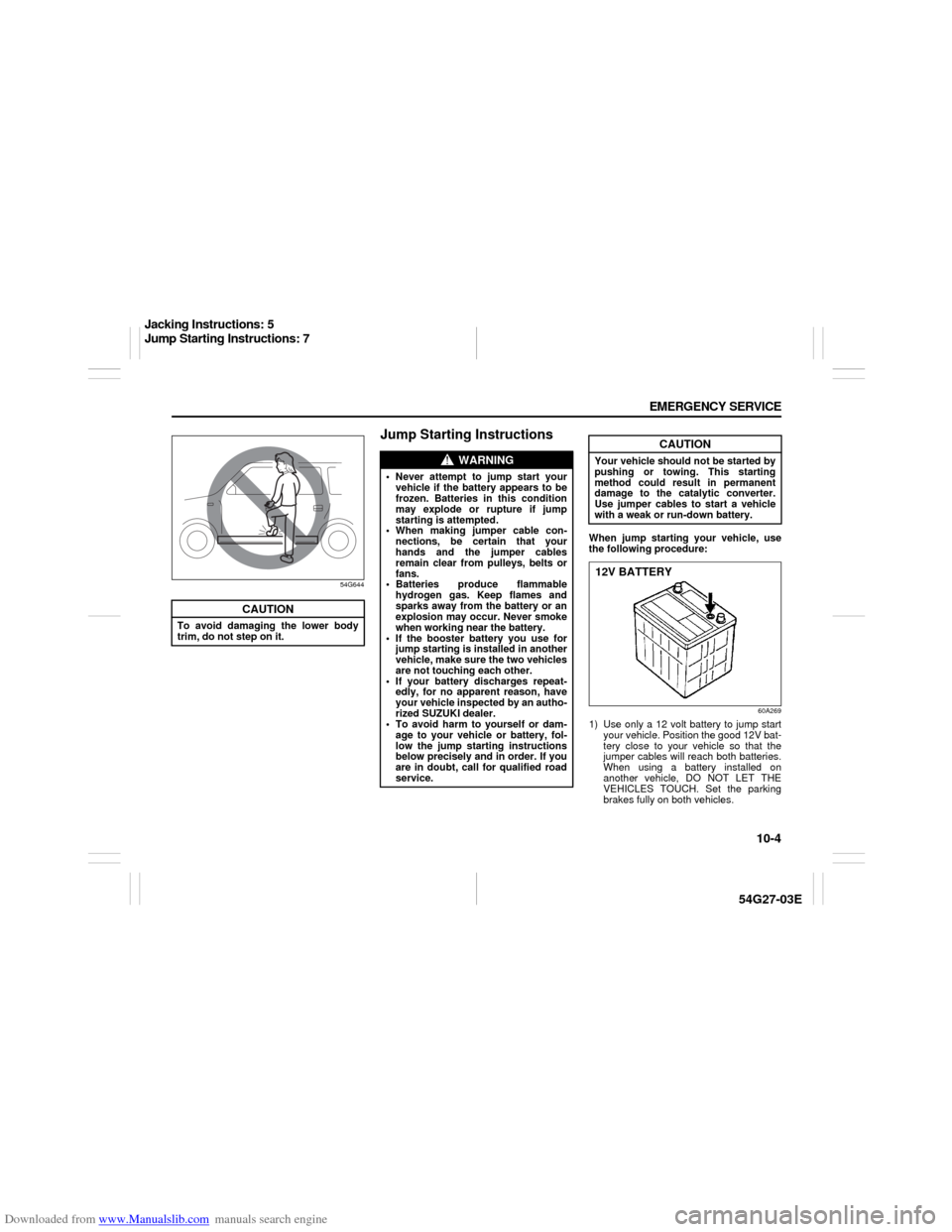
1) Use only a 12 volt battery to jump start
your vehicle. Position the good 12V bat-
tery close to your vehicle so that the
jumper cables will reach both batteries.
When using a battery installed on
another vehicle, DO NOT LET THE
VEHICLES TOUCH. Set the parking
brakes fully on both vehicles.
CAUTION
To avoid damaging the lower body
trim, do not step on it.
WARNING
Never attempt to jump start your
vehicle if the battery appears to be
frozen. Batteries in this condition
may explode or rupture if jump
starting is attempted.
When making jumper cable con-
nections, be certain that your
hands and the jumper cables
remain clear from pulleys, belts or
fans.
Batteries produce flammable
hydrogen gas. Keep flames and
sparks away from the battery or an
explosion may occur. Never smoke
when working near the battery.
If the booster battery you use for
jump starting is installed in another
vehicle, make sure the two vehicles
are not touching each other.
If your battery discharges repeat-
edly, for no apparent reason, have
your vehicle inspected by an autho-
rized SUZUKI dealer.
To avoid harm to yourself or dam-
age to your vehicle or battery, fol-
low the jump starting instructions
below precisely and in order. If you
are in doubt, call for qualified road
service.
CAUTION
Your vehicle should not be started by
pushing or towing. This starting
method could result in permanent
damage to the catalytic converter.
Use jumper cables to start a vehicle
with a weak or run-down battery.12V BATTERY
Jacking Instructions: 5
Jump Starting Instructions: 7
Page 202 of 232
Downloaded from www.Manualslib.com manuals search engine 10-5 EMERGENCY SERVICE
54G27-03E
2) Turn off all vehicle accessories, except
those necessary for safety reasons (for
example, headlights or hazard lights).
54G079
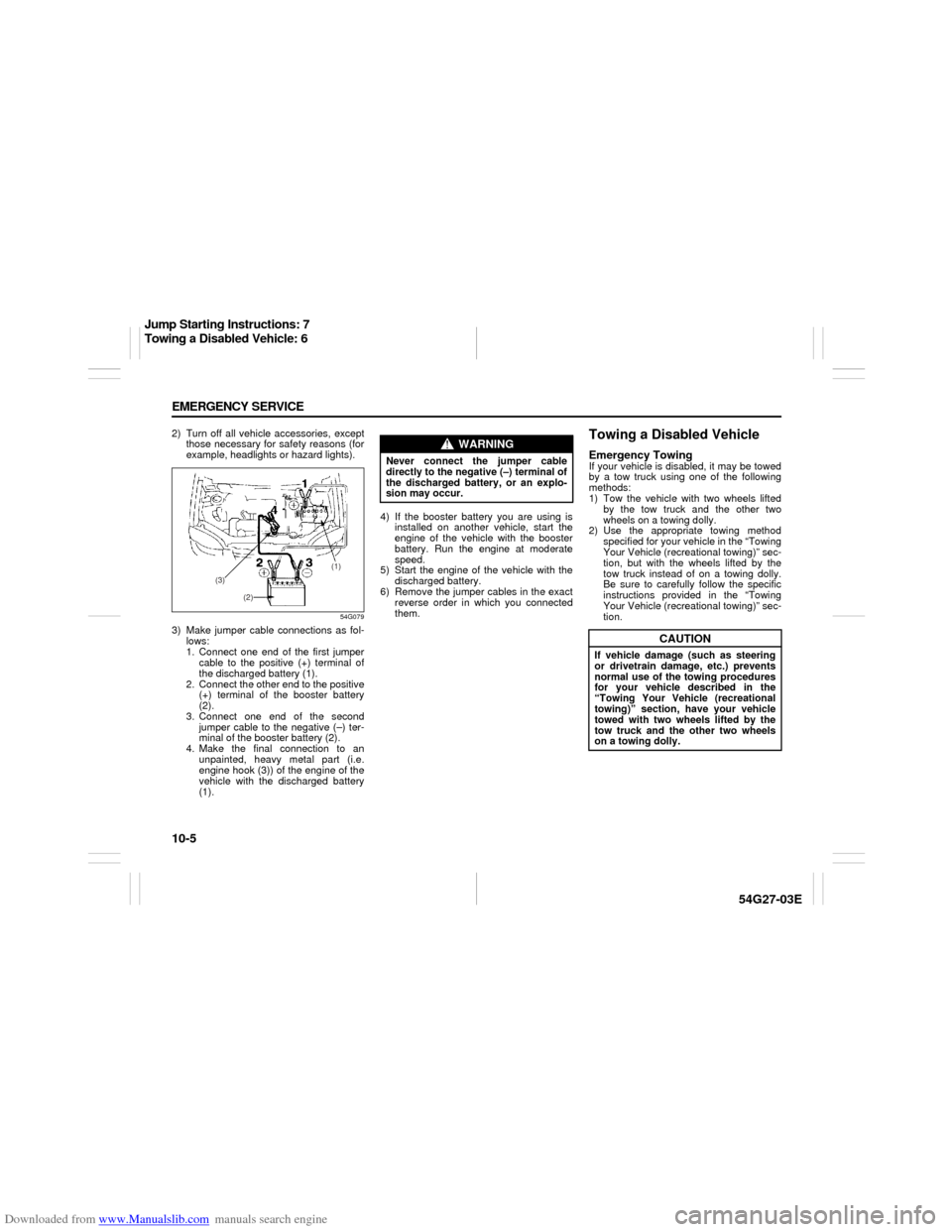
3) Make jumper cable connections as fol-
lows:
1. Connect one end of the first jumper
cable to the positive (+) terminal of
the discharged battery (1).
2. Connect the other end to the positive
(+) terminal of the booster battery
(2).
3. Connect one end of the second
jumper cable to the negative (–) ter-
minal of the booster battery (2).
4. Make the final connection to an
unpainted, heavy metal part (i.e.
engine hook (3)) of the engine of the
vehicle with the discharged battery
(1).4) If the booster battery you are using is
installed on another vehicle, start the
engine of the vehicle with the booster
battery. Run the engine at moderate
speed.
5) Start the engine of the vehicle with the
discharged battery.
6) Remove the jumper cables in the exact
reverse order in which you connected
them.
Towing a Disabled VehicleEmergency TowingIf your vehicle is disabled, it may be towed
by a tow truck using one of the following
methods:
1) Tow the vehicle with two wheels lifted
by the tow truck and the other two
wheels on a towing dolly.
2) Use the appropriate towing method
specified for your vehicle in the “Towing
Your Vehicle (recreational towing)” sec-
tion, but with the wheels lifted by the
tow truck instead of on a towing dolly.
Be sure to carefully follow the specific
instructions provided in the “Towing
Your Vehicle (recreational towing)” sec-
tion.
(1)
(3)
(2)
WARNING
Never connect the jumper cable
directly to the negative (–) terminal of
the discharged battery, or an explo-
sion may occur.
CAUTION
If vehicle damage (such as steering
or drivetrain damage, etc.) prevents
normal use of the towing procedures
for your vehicle described in the
“Towing Your Vehicle (recreational
towing)” section, have your vehicle
towed with two wheels lifted by the
tow truck and the other two wheels
on a towing dolly.
Jump Starting Instructions: 7
Towing a Disabled Vehicle: 6
Page 230 of 232

Downloaded from www.Manualslib.com manuals search engine 15-4 INDEX
54G27-03E
Rear Window Defroster Switch
..........................................4-10
Rear Window Wiper/Washer Switch
..................................3-5
Refill with Oil and Check for Leaks ....................................9-13
Refilling
................................................................................9-12
Remote Audio Controls
.............................................. 3-8
, 4-43
Replace the Oil Filter
...........................................................9-13
Replacement of the transmitter battery
.............................2-4
Reporting Safety Defects
....................................................12-4
SSafety Certification Label
...................................................12-2
Seat Adjustment
..................................................................2-11
Seat Belt Extender ...............................................................2-30
Seat Belt Hanger
..................................................................2-21
Seat Belt Inspection
............................................................2-22
Seat Belt Pretensioner System
..........................................2-31
Seat Belt Reminder
..............................................................2-19
Seat Belts and Child Restraint Systems
...........................2-13
Selection of Coolant
............................................................9-17
Shoulder Anchor Height Adjuster
......................................2-21
Side Door Locks
..................................................................2-1
Snow Tires
...........................................................................9-31
Spark Plugs ..........................................................................9-21
SPECIFICATIONS
................................................................14-1
Specified Fluid
.....................................................................9-16
Specified Gear Oil ................................................................9-14
Specified Oil
.........................................................................9-11
Speedometer ........................................................................4-7
Spot Light
.............................................................................5-7
Starting the Engine
..............................................................6-2
Steering Wheel
.....................................................................9-24
Stowing Rear Center Lap-Shoulder Belt
...........................2-19Sun Visor
............................................................................. 5-6
Supplemental Restraint System (air bags)
....................... 2-32
TTachometer
.......................................................................... 4-9
Temperature Gauge
............................................................ 4-10
Thermometer
....................................................................... 4-13
Tilt Steering Lock Lever
..................................................... 3-6
Tire Chains
.......................................................................... 7-3
Tire Changing Tools
........................................................... 5-12
Tire Inflation Pressure ........................................................ 9-26
Tire Inspection
.................................................................... 9-27
Tire Rotation
........................................................................ 9-29
Tire Sidewall Labeling
........................................................ 9-25
Tire Size
............................................................................... 9-26
Tires
..................................................................................... 9-25
Towing a Disabled Vehicle
................................................. 10-5
Towing Your Vehicle (recreational towing)
...................... 8-2
Trailer Towing
..................................................................... 8-2
Trip meter
............................................................................ 4-7
Troubleshooting
.................................................................. 4-47
Trunk Lid
.............................................................................. 2-7
Trunk Light .......................................................................... 5-13
Turn Signal Indicators
........................................................ 4-6
Turn Signal Operation ........................................................ 3-4
UUniform Tire Quality Grading
............................................. 9-29
Unlatching and Latching Detachable Connector
............. 2-18
Using the Transaxle
............................................................ 6-4
VVehicle Cleaning
................................................................. 11-3
Vehicle Identification Number
........................................... 12-1