belt SUZUKI AERIO 2007 1.G Service Manual
[x] Cancel search | Manufacturer: SUZUKI, Model Year: 2007, Model line: AERIO, Model: SUZUKI AERIO 2007 1.GPages: 232, PDF Size: 3.34 MB
Page 132 of 232
Downloaded from www.Manualslib.com manuals search engine 6-3 OPERATING YOUR VEHICLE
54G27-03E
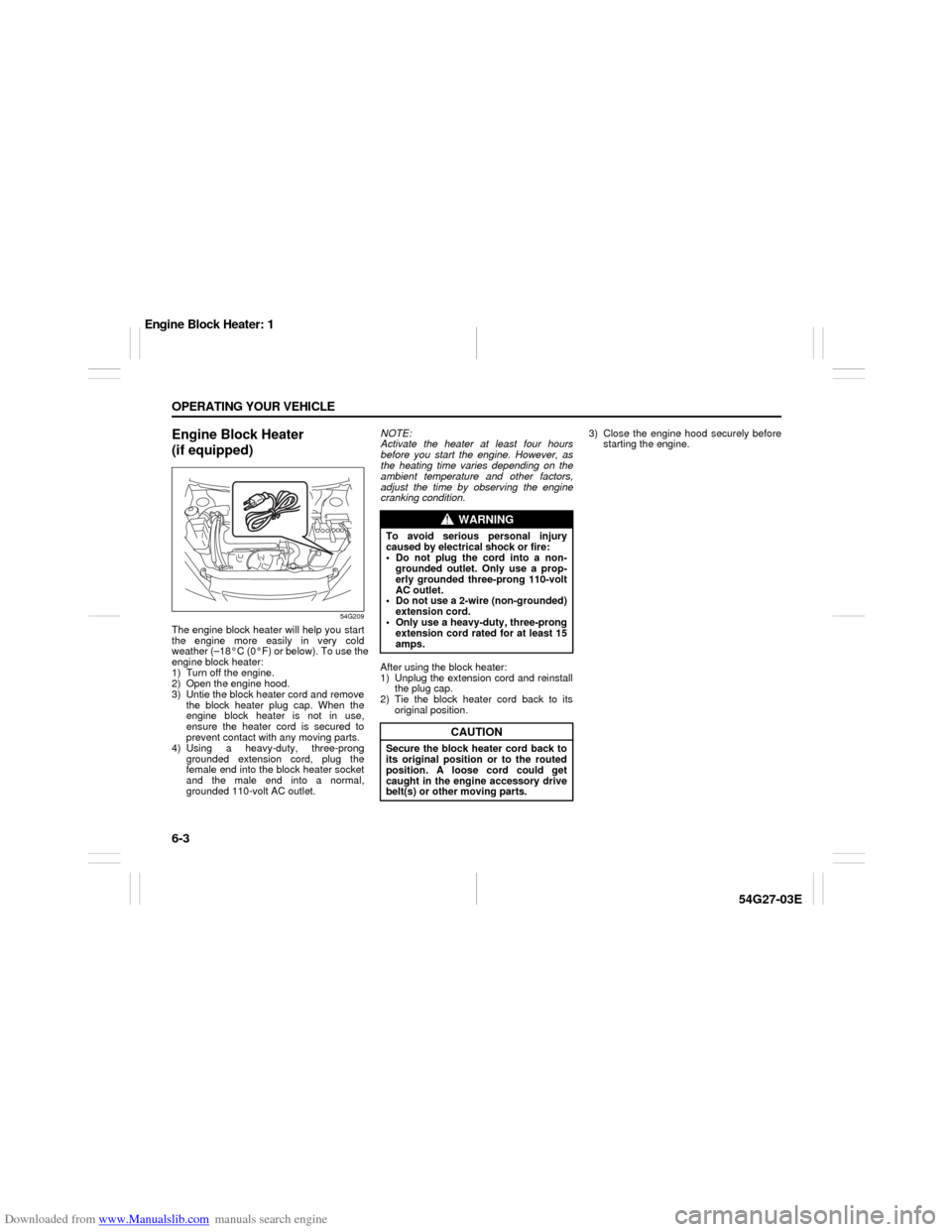
Engine Block Heater
(if equipped)
54G209
The engine block heater will help you start
the engine more easily in very cold
weather (–18°C (0°F) or below). To use the
engine block heater:
1) Turn off the engine.
2) Open the engine hood.
3) Untie the block heater cord and remove
the block heater plug cap. When the
engine block heater is not in use,
ensure the heater cord is secured to
prevent contact with any moving parts.
4) Using a heavy-duty, three-prong
grounded extension cord, plug the
female end into the block heater socket
and the male end into a normal,
grounded 110-volt AC outlet.NOTE:
Activate the heater at least four hours
before you start the engine. However, as
the heating time varies depending on the
ambient temperature and other factors,
adjust the time by observing the engine
cranking condition.
After using the block heater:
1) Unplug the extension cord and reinstall
the plug cap.
2) Tie the block heater cord back to its
original position.3) Close the engine hood securely before
starting the engine.
WARNING
To avoid serious personal injury
caused by electrical shock or fire:
Do not plug the cord into a non-
grounded outlet. Only use a prop-
erly grounded three-prong 110-volt
AC outlet.
Do not use a 2-wire (non-grounded)
extension cord.
Only use a heavy-duty, three-prong
extension cord rated for at least 15
amps.
CAUTION
Secure the block heater cord back to
its original position or to the routed
position. A loose cord could get
caught in the engine accessory drive
belt(s) or other moving parts.
Engine Block Heater: 1
Page 142 of 232
Downloaded from www.Manualslib.com manuals search engine 7-1 DRIVING TIPS
54G27-03E
52D078S
Highway DrivingWhen driving at highway speeds, pay
attention to the following:
Stopping distance progressively
increases with vehicle speed. Apply the
brakes far enough ahead of the stopping
point to allow for the extra stopping dis-
tance.
On rainy days, “Hydroplaning” can occur.
“Hydroplaning” is the loss of direct con-
tact between the road surface and the
vehicle’s tires due to a water film forming
between them. Steering or braking the
vehicle while “Hydroplaning” can be very
difficult, and loss of control can occur.
Keep speed down when the road surface
is wet.
At high speeds, the vehicle may be
affected by side winds. Therefore,
reduce speed and be prepared for unex-
pected buffeting, which can occur at the
exits of tunnels, when passing by a cut of
a hill, or when being overtaken by large
vehicles, etc.
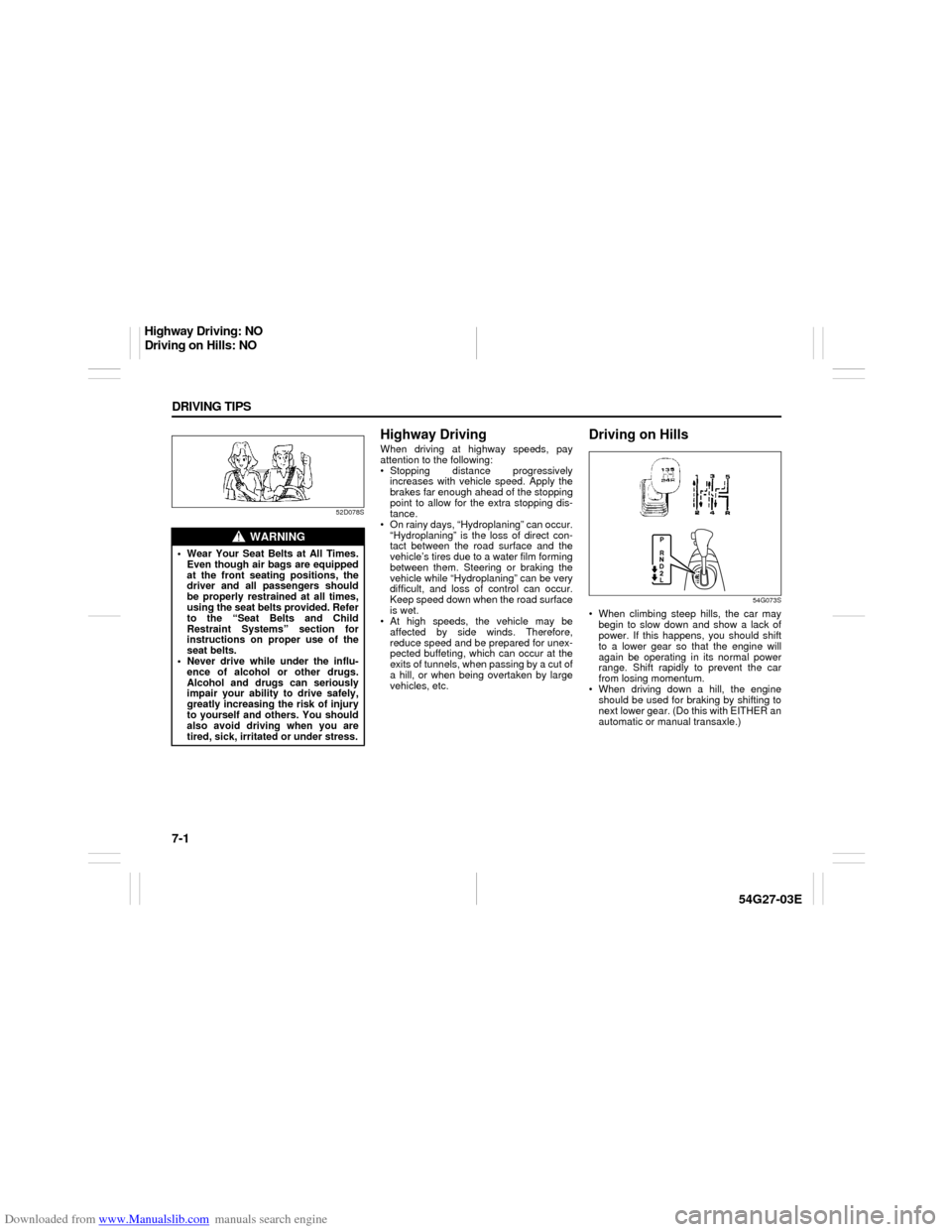
Driving on Hills
54G073S
When climbing steep hills, the car may
begin to slow down and show a lack of
power. If this happens, you should shift
to a lower gear so that the engine will
again be operating in its normal power
range. Shift rapidly to prevent the car
from losing momentum.
When driving down a hill, the engine
should be used for braking by shifting to
next lower gear. (Do this with EITHER an
automatic or manual transaxle.)
WARNING
Wear Your Seat Belts at All Times.
Even though air bags are equipped
at the front seating positions, the
driver and all passengers should
be properly restrained at all times,
using the seat belts provided. Refer
to the “Seat Belts and Child
Restraint Systems” section for
instructions on proper use of the
seat belts.
Never drive while under the influ-
ence of alcohol or other drugs.
Alcohol and drugs can seriously
impair your ability to drive safely,
greatly increasing the risk of injury
to yourself and others. You should
also avoid driving when you are
tired, sick, irritated or under stress.
Highway Driving: NO
Driving on Hills: NO
Page 154 of 232
Downloaded from www.Manualslib.com manuals search engine 9-1 INSPECTION AND MAINTENANCE
54G27-03E
60A187S
WARNING
You should take extreme care when
working on your vehicle to prevent
accidental injury. Here are a few pre-
cautions that you should be espe-
cially careful to observe:
To prevent damage or unintended
inflation of the air bag system, be
sure the battery is disconnected
and the ignition switch has been in
the “LOCK” position for at least 90
seconds before performing any
electrical service work on your
SUZUKI. Do not touch air bag sys-
tem components or wires. The
wires are wrapped with yellow tape
or yellow tubing, and the couplers
are yellow for easy identification.
(Continued)
WARNING
(Continued)
Do not leave the engine running in
garages or other confined areas.
When the engine is running, keep
hands, clothing, tools and other
objects away from the moving fan
and drive belt.
When it is necessary to do service
work with the engine running, make
sure that the parking brake is set
fully and the transaxle is in Neutral
(for manual transaxle vehicles) or
Park (for automatic transaxle vehi-
cles).
Do not touch ignition wires or other
ignition system parts when starting
the engine or when the engine is
running, or you could receive an
electric shock.
Be careful not to touch a hot
engine, exhaust manifold and
pipes, muffler, radiator and water
hoses.
Do not allow smoking, sparks or
flames around gasoline or the bat-
tery. Flammable fumes are present.
Do not get under your vehicle if it is
supported only with the portable
jack provided in your vehicle.
(Continued)
WARNING
(Continued)
Be careful not to cause accidental
short circuits between the positive
and negative battery terminals.
Keep used oil, engine coolant and
other fluids away from children and
pets. Dispose of used fluids prop-
erly; never pour them on the
ground, into sewers, etc.
Page 156 of 232
Downloaded from www.Manualslib.com manuals search engine 9-3 INSPECTION AND MAINTENANCE
54G27-03E
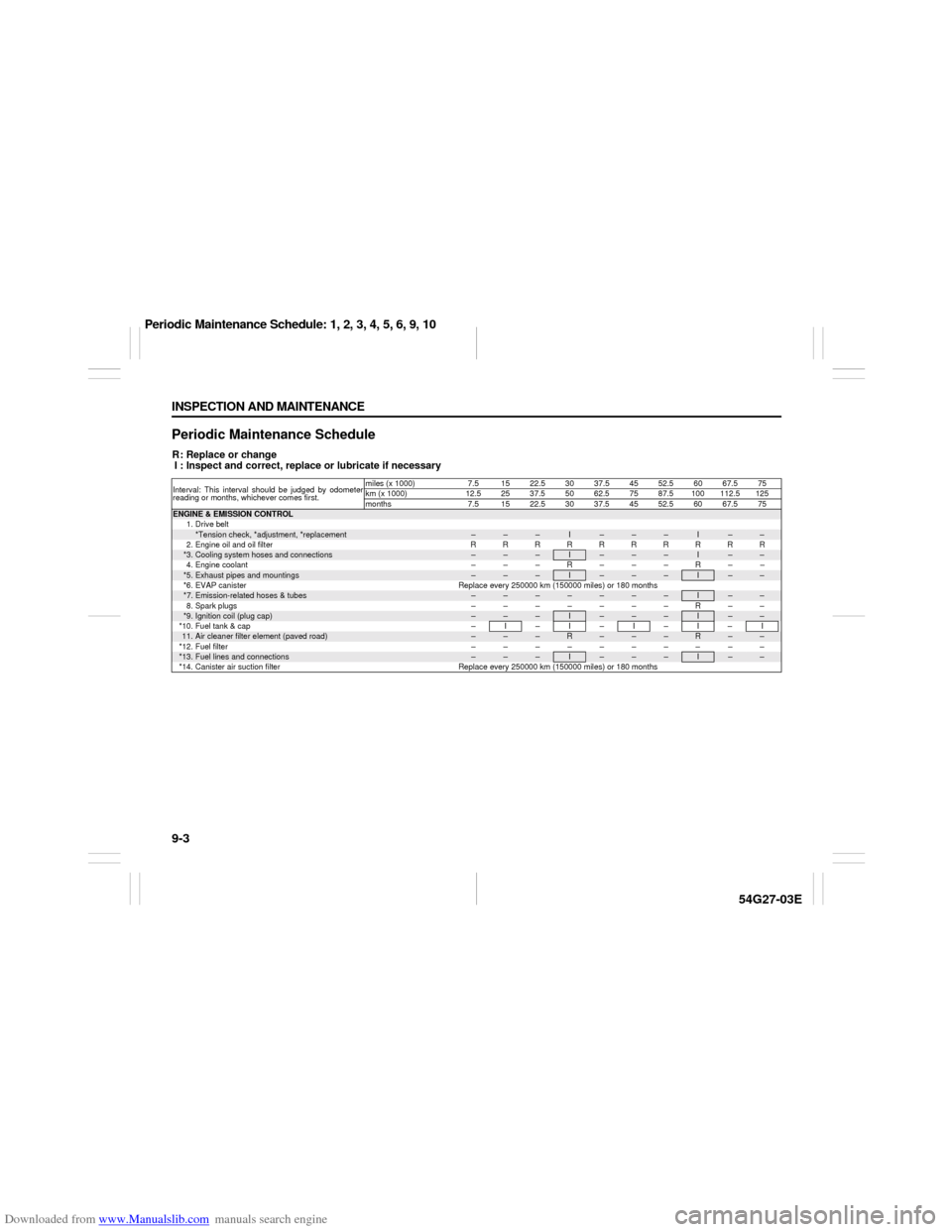
Periodic Maintenance ScheduleR: Replace or change
I : Inspect and correct, replace or lubricate if necessaryInterval: This interval should be judged by odometer
reading or months, whichever comes first.miles (x 1000) 7.5 15 22.5 30 37.5 45 52.5 60 67.5 75
km (x 1000) 12.5 25 37.5 50 62.5 75 87.5 100 112.5 125
months 7.5 1522.53037.54552.56067.575ENGINE & EMISSION CONTROL
1. Drive belt
*Tension check, *adjustment, *replacement
–
–
–
I
–
–
–
I
–
–
2. Engine oil and oil filter R R R R R R R R R R*3.
Cooling system hoses and connections
–
–
–
I
–
–
–
I
–
–
4. Engine coolant – – – R – – – R – –*5.
Exhaust pipes and mountings
–
–
–
I
–
–
–
I
–
–
*6. EVAP canister Replace every 250000 km (150000 miles) or 180 months*7.
Emission-related hoses & tubes
–
–
–
–
–
–
–
I
–
–
8. Spark plugs – – – – – – – R – –*9.
Ignition coil (plug cap)
–
–
–
I
–
–
–
I
–
–
*10.Fuel tank & cap –I–I–I–I–I11.
Air cleaner filter element (paved road)
–
–
–
R
–
–
–
R
–
–
*12.Fuel filter ––––––––––*13.
Fuel lines and connections
–
–
–
I
–
–
–
I
–
–
*14. Canister air suction filter Replace every 250000 km (150000 miles) or 180 months
Periodic Maintenance Schedule: 1, 2, 3, 4, 5, 6, 9, 10
Page 157 of 232
Downloaded from www.Manualslib.com manuals search engine 9-4 INSPECTION AND MAINTENANCE
54G27-03E
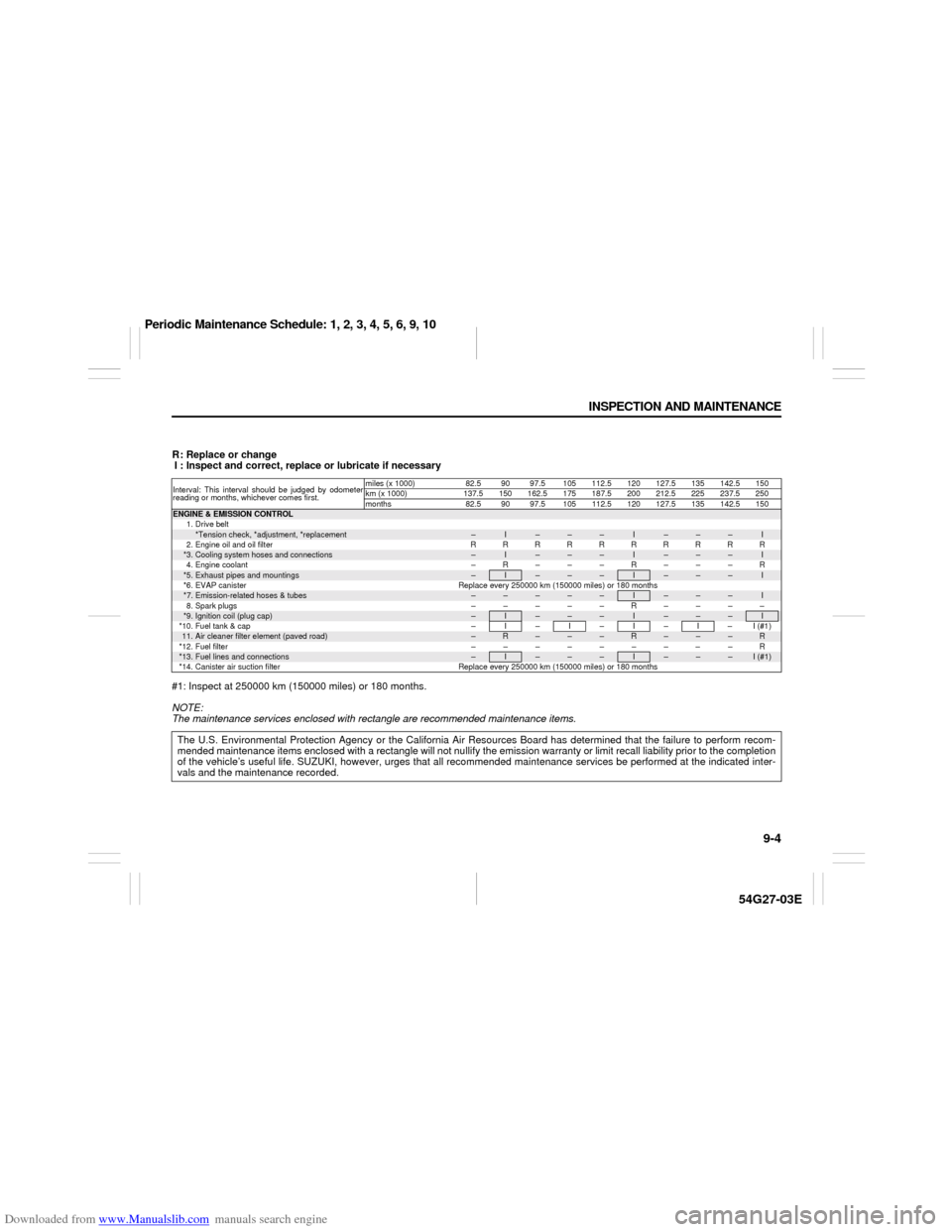
R: Replace or change
I : Inspect and correct, replace or lubricate if necessary
#1: Inspect at 250000 km (150000 miles) or 180 months.
NOTE:
The maintenance services enclosed with rectangle are recommended maintenance items.Interval: This interval should be judged by odometer
reading or months, whichever comes first.miles (x 1000) 82.5 90 97.5 105 112.5 120 127.5 135 142.5 150
km (x 1000) 137.5 150 162.5 175 187.5 200 212.5 225 237.5 250
months 82.5 90 97.5 105 112.5 120 127.5 135 142.5 150ENGINE & EMISSION CONTROL
1. Drive belt
*Tension check, *adjustment, *replacement
–
I
–
–
–
I
–
–
–
I
2. Engine oil and oil filter R R R R R R R R R R*3.
Cooling system hoses and connections
–
I
–
–
–
I
–
–
–
I
4. Engine coolant – R – – – R – – – R*5.
Exhaust pipes and mountings
–
I
–
–
–
I
–
–
–
I
*6. EVAP canister Replace every 250000 km (150000 miles) or 180 months*7.
Emission-related hoses & tubes
–
–
–
–
–
I
–
–
–
I
8. Spark plugs – – – – – R – – – –*9.
Ignition coil (plug cap)
–
I
–
–
–
I
–
–
–
I
*10.Fuel tank & cap –I–I–I–I–I (#1)11.
Air cleaner filter element (paved road)
–
R
–
–
–
R
–
–
–
R
*12.Fuel filter –––––––––R*13.
Fuel lines and connections
–
I
–
–
–
I
–
–
–
I (#1)
*14. Canister air suction filter Replace every 250000 km (150000 miles) or 180 monthsThe U.S. Environmental Protection Agency or the California Air Resources Board has determined that the failure to perform recom-
mended maintenance items enclosed with a rectangle will not nullify the emission warranty or limit recall liability prior to the completion
of the vehicle’s useful life. SUZUKI, however, urges that all recommended maintenance services be performed at the indicated inter-
vals and the maintenance recorded.
Periodic Maintenance Schedule: 1, 2, 3, 4, 5, 6, 9, 10
Page 160 of 232
Downloaded from www.Manualslib.com manuals search engine 9-7 INSPECTION AND MAINTENANCE
54G27-03E
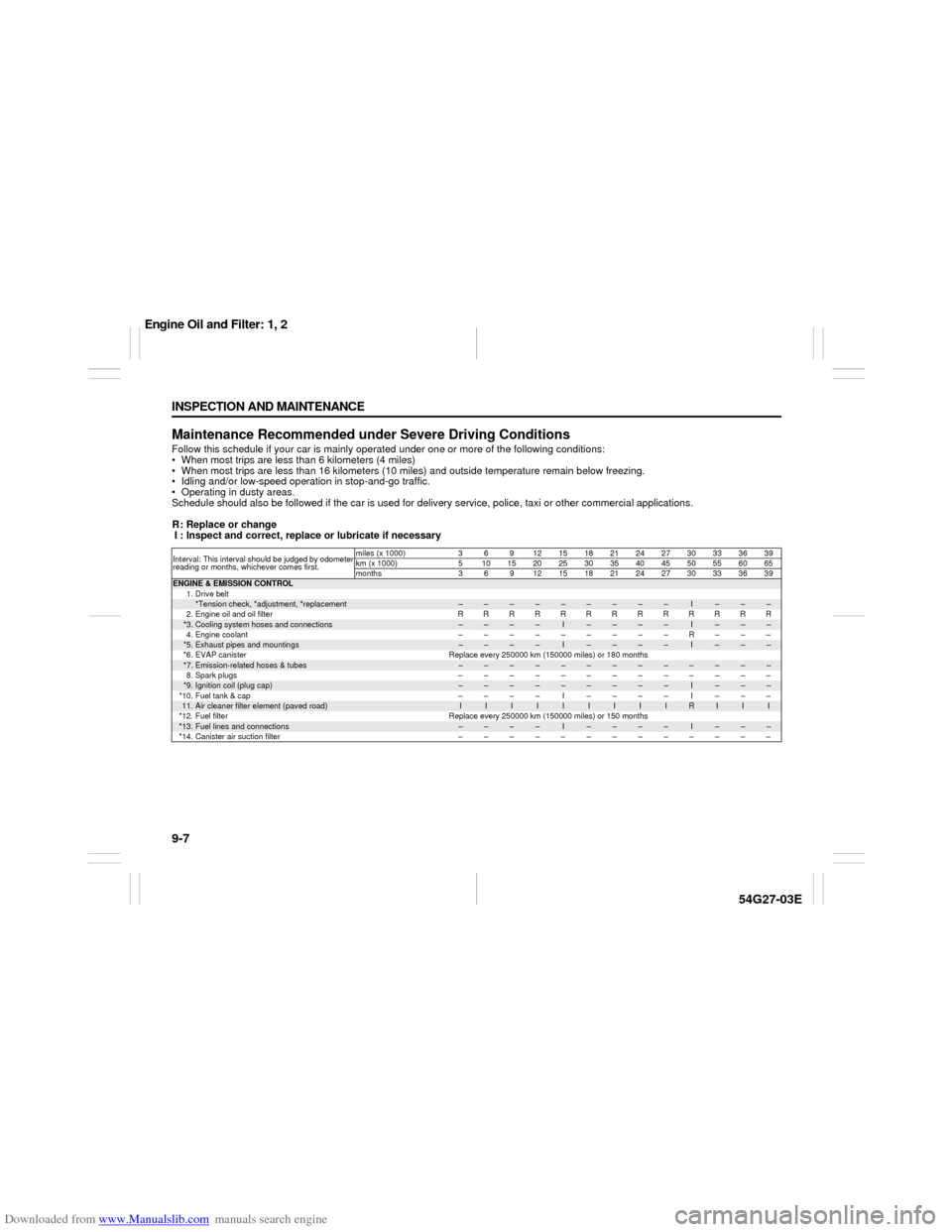
Maintenance Recommended under Severe Driving ConditionsFollow this schedule if your car is mainly operated under one or more of the following conditions:
When most trips are less than 6 kilometers (4 miles)
When most trips are less than 16 kilometers (10 miles) and outside temperature remain below freezing.
Idling and/or low-speed operation in stop-and-go traffic.
Operating in dusty areas.
Schedule should also be followed if the car is used for delivery service, police, taxi or other commercial applications.
R: Replace or change
I : Inspect and correct, replace or lubricate if necessaryInterval: This interval should be judged by odometer
reading or months, whichever comes first.miles (x 1000) 3 6 9 12 15 18 21 24 27 30 33 36 39
km (x 1000) 5 101520253035404550556065
months 3 6 9 12 15 18 21 24 27 30 33 36 39ENGINE & EMISSION CONTROL
1. Drive belt
*Tension check, *adjustment, *replacement
–
–
–
–
–
–
–
–
–
I
–
–
–
2.Engine oil and oil filter RRRRRRRRRRRRR
*3.
Cooling system hoses and connections
–
–
–
–
I
–
–
–
–
I
–
–
–
4.Engine coolant –––––––––R–––
*5.
Exhaust pipes and mountings
–
–
–
–
I
–
–
–
–
I
–
–
–
*6. EVAP canister Replace every 250000 km (150000 miles) or 180 months
*7.
Emission-related hoses & tubes
–
–
–
–
–
–
–
–
–
–
–
–
–
8.Spark plugs –––––––––––––
*9.
Ignition coil (plug cap)
–
–
–
–
–
–
–
–
–
I
–
–
–
*10.Fuel tank & cap –––– I –––– I –––
11.
Air cleaner filter element (paved road)
I
I
I
I
I
I
I
I
I
R
I
I
I
*12. Fuel filter Replace every 250000 km (150000 miles) or 150 months
*13.
Fuel lines and connections
–
–
–
–
I
–
–
–
–
I
–
–
–
*14.Canister air suction filter –––––––––––––
Engine Oil and Filter: 1, 2
Page 161 of 232
Downloaded from www.Manualslib.com manuals search engine 9-8 INSPECTION AND MAINTENANCE
54G27-03E
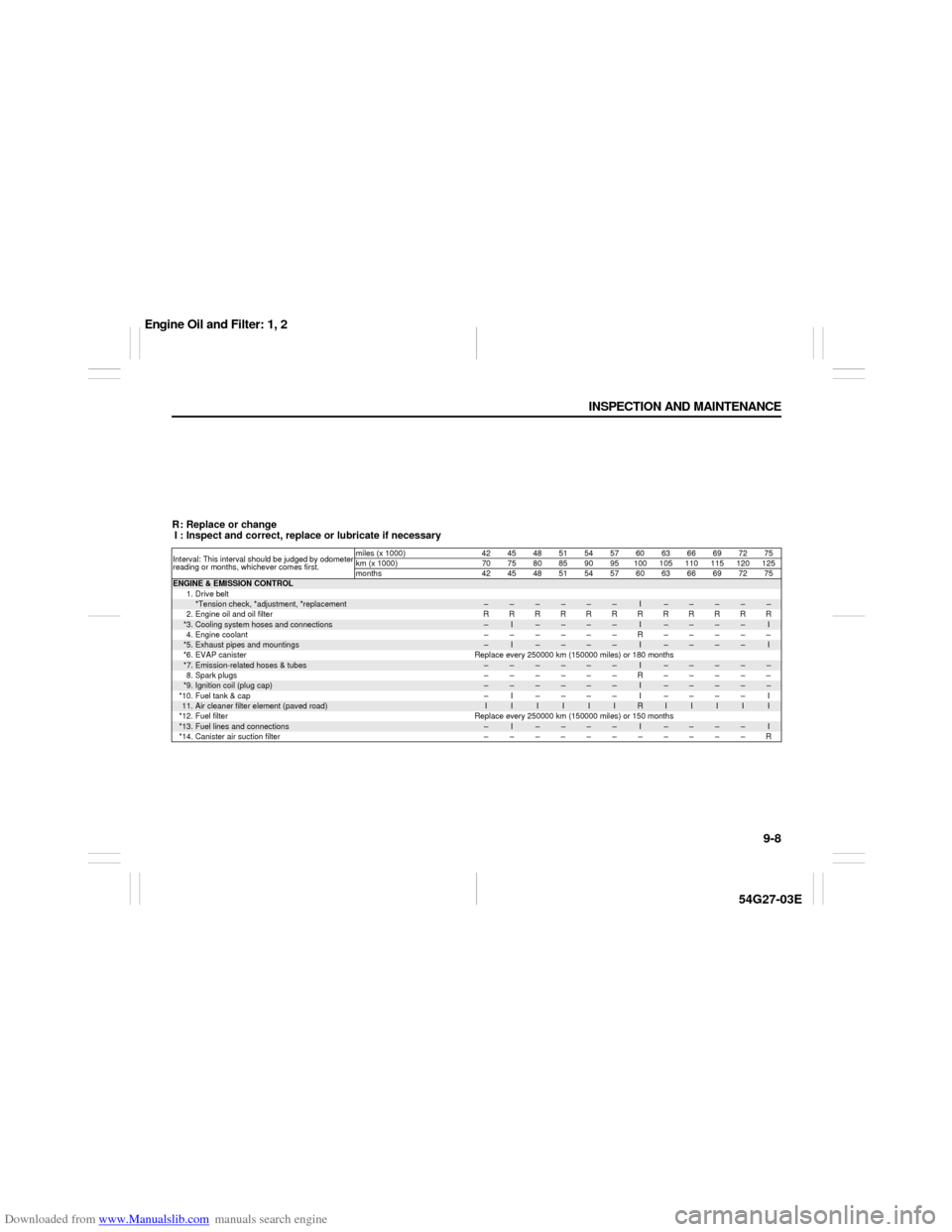
R: Replace or change
I : Inspect and correct, replace or lubricate if necessaryInterval: This interval should be judged by odometer
reading or months, whichever comes first.miles (x 1000) 42 45 48 51 54 57 60 63 66 69 72 75
km (x 1000) 70 75 80 85 90 95 100 105 110 115 120 125
months 42 45 48 51 54 57 60 63 66 69 72 75ENGINE & EMISSION CONTROL
1. Drive belt
*Tension check, *adjustment, *replacement
–
–
–
–
–
–
I
–
–
–
–
–
2.Engine oil and oil filter RRRRRRRRRRRR
*3.
Cooling system hoses and connections
–
I
–
–
–
–
I
–
–
–
–
I
4.Engine coolant ––––––R–––––
*5.
Exhaust pipes and mountings
–
I
–
–
–
–
I
–
–
–
–
I
*6. EVAP canister Replace every 250000 km (150000 miles) or 180 months
*7.
Emission-related hoses & tubes
–
–
–
–
–
–
I
–
–
–
–
–
8.Spark plugs ––––––R–––––
*9.
Ignition coil (plug cap)
–
–
–
–
–
–
I
–
–
–
–
–
*10.Fuel tank & cap – I –––– I –––– I
11.
Air cleaner filter element (paved road)
I
I
I
I
I
I
R
I
I
I
I
I
*12. Fuel filter Replace every 250000 km (150000 miles) or 150 months
*13.
Fuel lines and connections
–
I
–
–
–
–
I
–
–
–
–
I
*14.Canister air suction filter –––––––––––R
Engine Oil and Filter: 1, 2
Page 179 of 232
Downloaded from www.Manualslib.com manuals search engine 9-26 INSPECTION AND MAINTENANCE
54G27-03E
of cord and number of plies in the
sidewall and under the tread.
I. Load Index and Speed Rating
The two- or three-digit number is the
tire’s load index, the maximum load a
tire can carry at the speed indicated
by its speed symbol at the maximum
inflation pressure. The higher the
number is, the greater the load carry-
ing capacity. The letter symbol
denotes the speed at which a tire is
designed to be driven for extended
periods of time. (Ratings are listed
below.)
*The letters ZR may be used on tires with a
maximum speed capability over 149 mph
and will always be used on tires with a
maximum speed capability over 186 mph.J. M+S Marking
This marking indicates the tire has
some mud and snow capabilities and
is designed for all-season use.
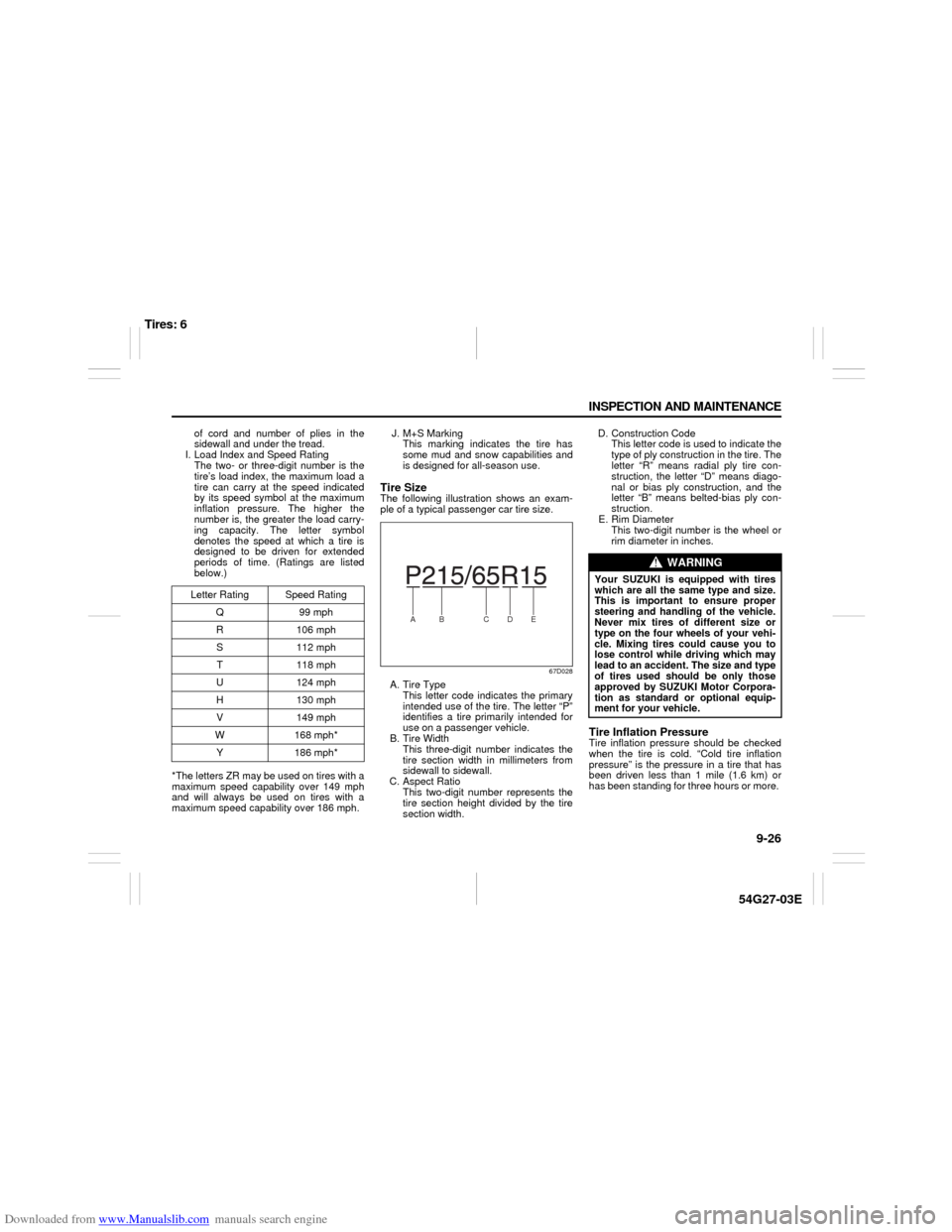
Tire SizeThe following illustration shows an exam-
ple of a typical passenger car tire size.
67D028
A. Tire Type
This letter code indicates the primary
intended use of the tire. The letter “P”
identifies a tire primarily intended for
use on a passenger vehicle.
B. Tire Width
This three-digit number indicates the
tire section width in millimeters from
sidewall to sidewall.
C. Aspect Ratio
This two-digit number represents the
tire section height divided by the tire
section width.D. Construction Code
This letter code is used to indicate the
type of ply construction in the tire. The
letter “R” means radial ply tire con-
struction, the letter “D” means diago-
nal or bias ply construction, and the
letter “B” means belted-bias ply con-
struction.
E. Rim Diameter
This two-digit number is the wheel or
rim diameter in inches.
Tire Inflation PressureTire inflation pressure should be checked
when the tire is cold. “Cold tire inflation
pressure” is the pressure in a tire that has
been driven less than 1 mile (1.6 km) or
has been standing for three hours or more. Letter Rating Speed Rating
Q 99 mph
R106 mph
S112 mph
T118 mph
U124 mph
H130 mph
V149 mph
W 168 mph*
Y 186 mph*
A
B
C
D
E
WARNING
Your SUZUKI is equipped with tires
which are all the same type and size.
This is important to ensure proper
steering and handling of the vehicle.
Never mix tires of different size or
type on the four wheels of your vehi-
cle. Mixing tires could cause you to
lose control while driving which may
lead to an accident. The size and type
of tires used should be only those
approved by SUZUKI Motor Corpora-
tion as standard or optional equip-
ment for your vehicle.
Tires: 6
Page 201 of 232
Downloaded from www.Manualslib.com manuals search engine 10-4 EMERGENCY SERVICE
54G27-03E
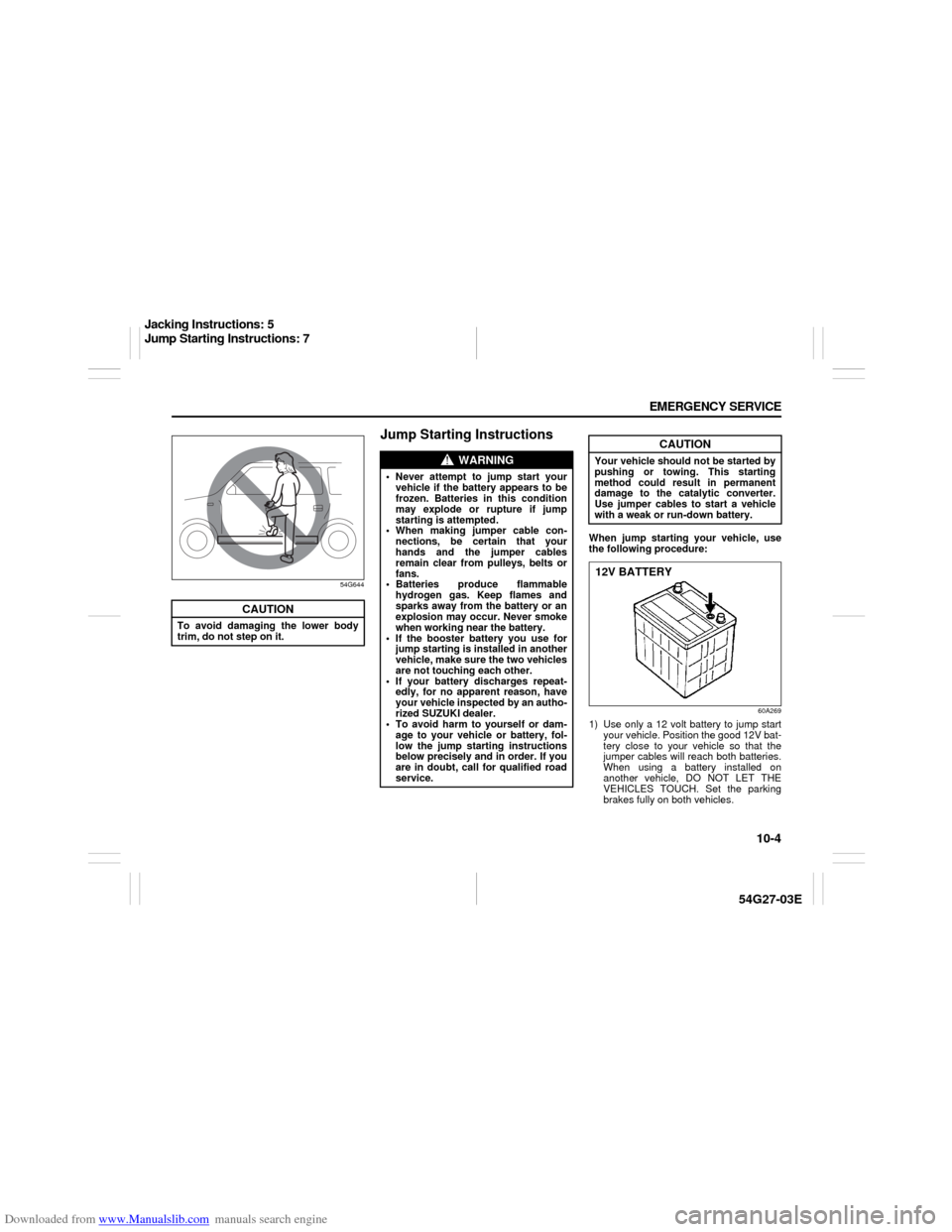
54G644
Jump Starting Instructions
When jump starting your vehicle, use
the following procedure:
60A269
1) Use only a 12 volt battery to jump start
your vehicle. Position the good 12V bat-
tery close to your vehicle so that the
jumper cables will reach both batteries.
When using a battery installed on
another vehicle, DO NOT LET THE
VEHICLES TOUCH. Set the parking
brakes fully on both vehicles.
CAUTION
To avoid damaging the lower body
trim, do not step on it.
WARNING
Never attempt to jump start your
vehicle if the battery appears to be
frozen. Batteries in this condition
may explode or rupture if jump
starting is attempted.
When making jumper cable con-
nections, be certain that your
hands and the jumper cables
remain clear from pulleys, belts or
fans.
Batteries produce flammable
hydrogen gas. Keep flames and
sparks away from the battery or an
explosion may occur. Never smoke
when working near the battery.
If the booster battery you use for
jump starting is installed in another
vehicle, make sure the two vehicles
are not touching each other.
If your battery discharges repeat-
edly, for no apparent reason, have
your vehicle inspected by an autho-
rized SUZUKI dealer.
To avoid harm to yourself or dam-
age to your vehicle or battery, fol-
low the jump starting instructions
below precisely and in order. If you
are in doubt, call for qualified road
service.
CAUTION
Your vehicle should not be started by
pushing or towing. This starting
method could result in permanent
damage to the catalytic converter.
Use jumper cables to start a vehicle
with a weak or run-down battery.12V BATTERY
Jacking Instructions: 5
Jump Starting Instructions: 7
Page 204 of 232
Downloaded from www.Manualslib.com manuals search engine 10-7 EMERGENCY SERVICE
54G27-03E
If the temperature indication does not
return to the normal condition:
1) Turn off the engine and check that the
water pump belt and pulleys are not
damaged or slipping. If any abnormality
is found, correct it.
2) Check the coolant level in the reservoir.
If it is found to be lower than the “LOW”
line, look for leaks at the radiator, water
pump and radiator and heater hoses. If
you locate any leaks that may have
caused the overheating, do not run the
engine until these problems have been
corrected.
3) If you do not find a leak, carefully add
coolant to the reservoir and then the
radiator, if necessary. (Refer to “Engine
Coolant” in the “INSPECTION AND
MAINTENANCE” section.)
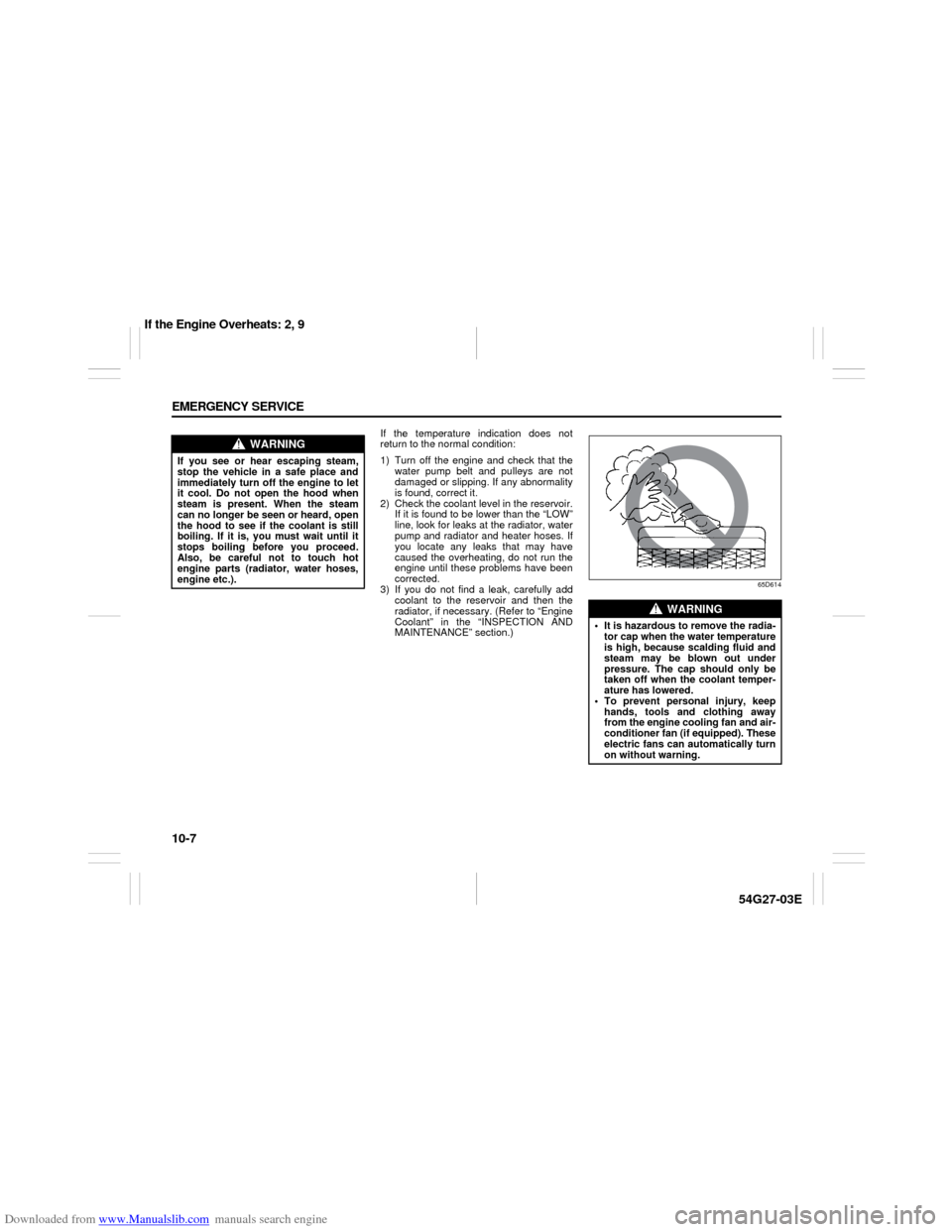
65D614
WARNING
If you see or hear escaping steam,
stop the vehicle in a safe place and
immediately turn off the engine to let
it cool. Do not open the hood when
steam is present. When the steam
can no longer be seen or heard, open
the hood to see if the coolant is still
boiling. If it is, you must wait until it
stops boiling before you proceed.
Also, be careful not to touch hot
engine parts (radiator, water hoses,
engine etc.).
WARNING
It is hazardous to remove the radia-
tor cap when the water temperature
is high, because scalding fluid and
steam may be blown out under
pressure. The cap should only be
taken off when the coolant temper-
ature has lowered.
To prevent personal injury, keep
hands, tools and clothing away
from the engine cooling fan and air-
conditioner fan (if equipped). These
electric fans can automatically turn
on without warning.
If the Engine Overheats: 2, 9