air condition SUZUKI ALTO 2014 User Guide
[x] Cancel search | Manufacturer: SUZUKI, Model Year: 2014, Model line: ALTO, Model: SUZUKI ALTO 2014Pages: 139, PDF Size: 2.22 MB
Page 85 of 139
86
76G-74E
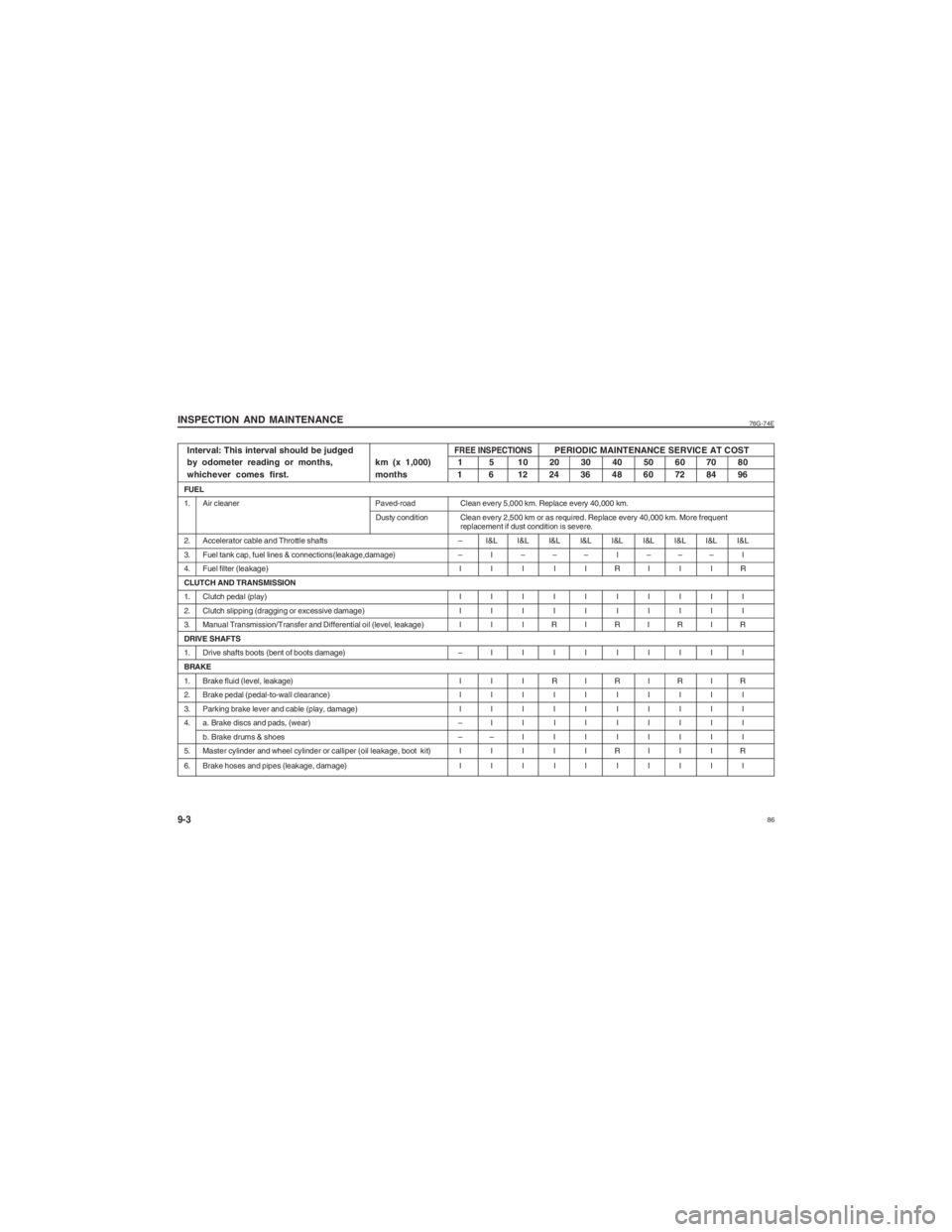
INSPECTION AND MAINTENANCE9-3Interval: This interval should be judged
FREE INSPECTIONS
PERIODIC MAINTENANCE SERVICE AT COST
by odometer reading or months, km (x 1,000) 1 5 10 20 30 40 50 60 70 80
whichever comes first. months 1 6 12 24 36 48 60 72 84 96
FUEL
1. Air cleaner Paved-roadClean every 5,000 km. Replace every 40,000 km.
Dusty condition Clean every 2,500 km or as required. Replace every 40,000 km. More frequ\
ent replacement if dust condition is severe.
2. Accelerator cable and Throttle shafts – I&L I&L I&L I&L I&L I&L I&L I&L I&L
3. Fuel tank cap, fuel lines & connections(leakage,damage) – I – – – I – – – I
4. Fuel filter (leakage) I I I I I R I I I R
CLUTCH AND TRANSMISSION
1. Clutch pedal (play) I I I I I I I I I I
2. Clutch slipping (dragging or excessive damage) I I I I I I I I I I
3. Manual Transmission/Transfer and Differential oil (level, leakage) I I I R I R I R I R
DRIVE SHAFTS
1. Drive shafts boots (bent of boots damage) – I I I I I I I I I
BRAKE
1. Brake fluid (level, leakage) I I I R I R I R I R
2. Brake pedal (pedal-to-wall clearance) I I I I I I I I I I
3. Parking brake lever and cable (play, damage) I I I I I I I I I I
4. a. Brake discs and pads, (wear) – I I I I I I I I I
b. Brake drums & shoes – – I I I I I I I I
5. Master cylinder and wheel cylinder or calliper (oil leakage, boot kit)\
I I I I I R I I I R
6. Brake hoses and pipes (leakage, damage) I I I I I I I I I I
Page 87 of 139
88
76G-74E
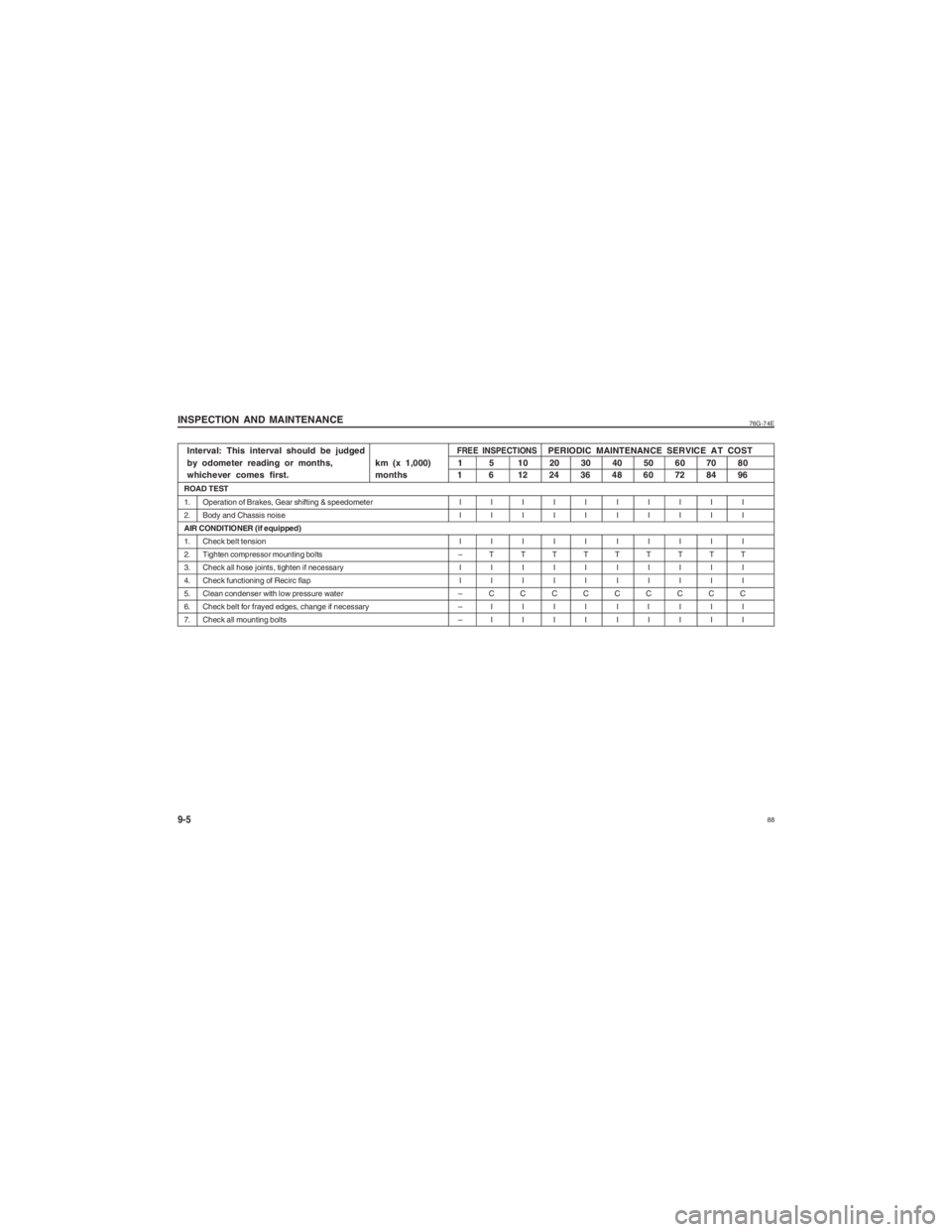
INSPECTION AND MAINTENANCE9-5Interval: This interval should be judged
FREE INSPECTIONS
PERIODIC MAINTENANCE SERVICE AT COST
by odometer reading or months, km (x 1,000) 1 5 10 20 30 40 50 60 70 80
whichever comes first. months 1 6 12 24 36 48 60 72 84 96
ROAD TEST
1. Operation of Brakes, Gear shifting & speedometer I I I I I I I I I I
2. Body and Chassis noise I I I I I I I I I I
AIR CONDITIONER (if equipped)
1. Check belt tension I I I I I I I I I I
2. Tighten compressor mounting bolts – T T T T T T T T T
3. Check all hose joints, tighten if necessary I I I I I I I I I I
4. Check functioning of Recirc flap I I I I I I I I I I
5. Clean condenser with low pressure water – C C C C C C C C C
6. Check belt for frayed edges, change if necessary – I I I I I I I I I
7. Check all mounting bolts – I I I I I I I I I
Page 92 of 139
9376G-74E
INSPECTION AND MAINTENANCE
9-10
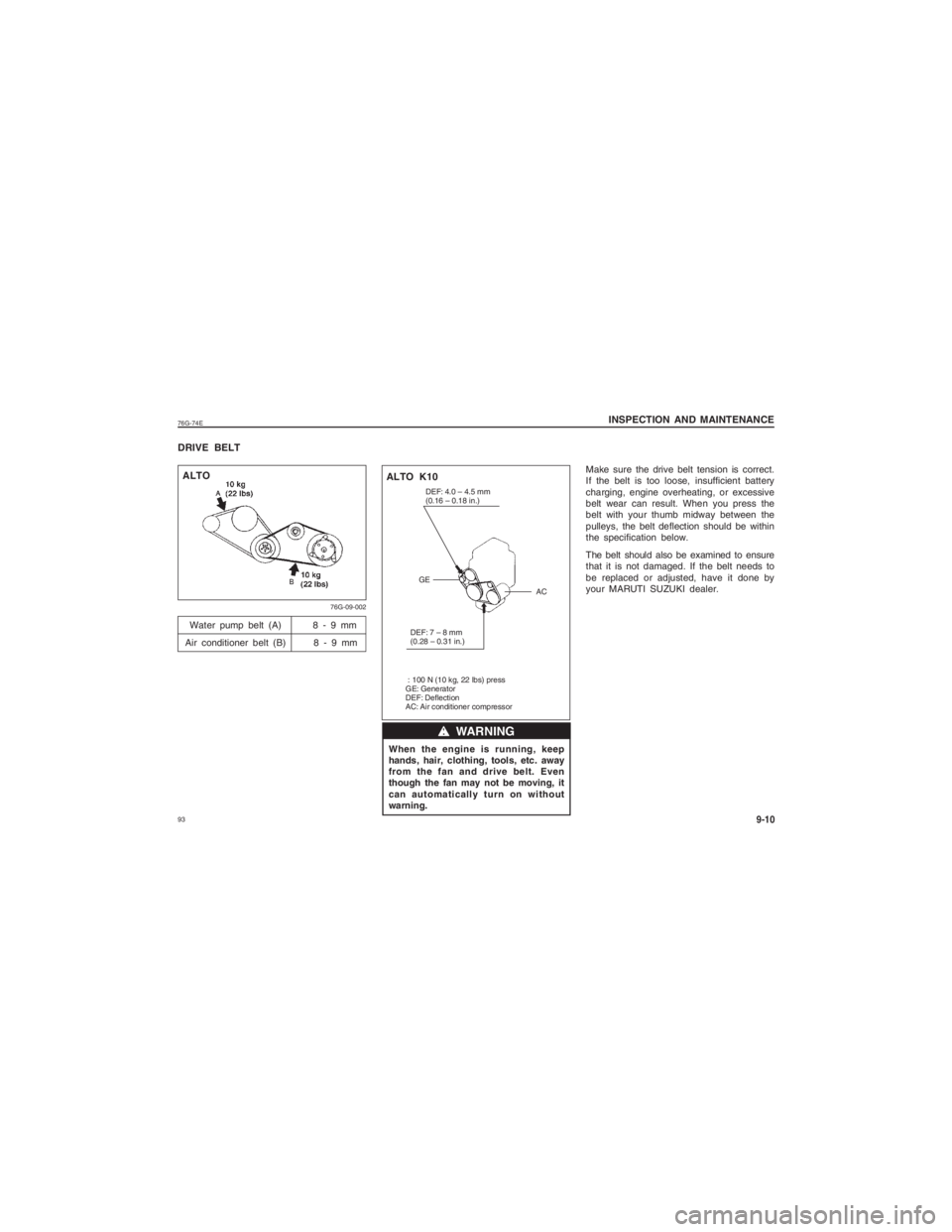
DRIVE BELT
When the engine is running, keep
hands, hair, clothing, tools, etc. away
from the fan and drive belt. Even
though the fan may not be moving, it
can automatically turn on without
warning.
Water pump belt (A) 8 - 9 mm
Air conditioner belt (B) 8 - 9 mm
ww ww
w WARNING
76G-09-002
Make sure the drive belt tension is correct.
If the belt is too loose, insufficient battery
charging, engine overheating, or excessive
belt wear can result. When you press the
belt with your thumb midway between the
pulleys, the belt deflection should be within
the specification below.
The belt should also be examined to ensure
that it is not damaged. If the belt needs to
be replaced or adjusted, have it done by
your MARUTI SUZUKI dealer.
DEF: 4.0 – 4.5 mm
(0.16 – 0.18 in.)
DEF: 7 – 8 mm
(0.28 – 0.31 in.)
: 100 N (10 kg, 22 lbs) press
GE: Generator
DEF: Deflection
AC: Air conditioner compressor GE
AC
ALTO K10
ALTO
Page 101 of 139
102
76G-74E
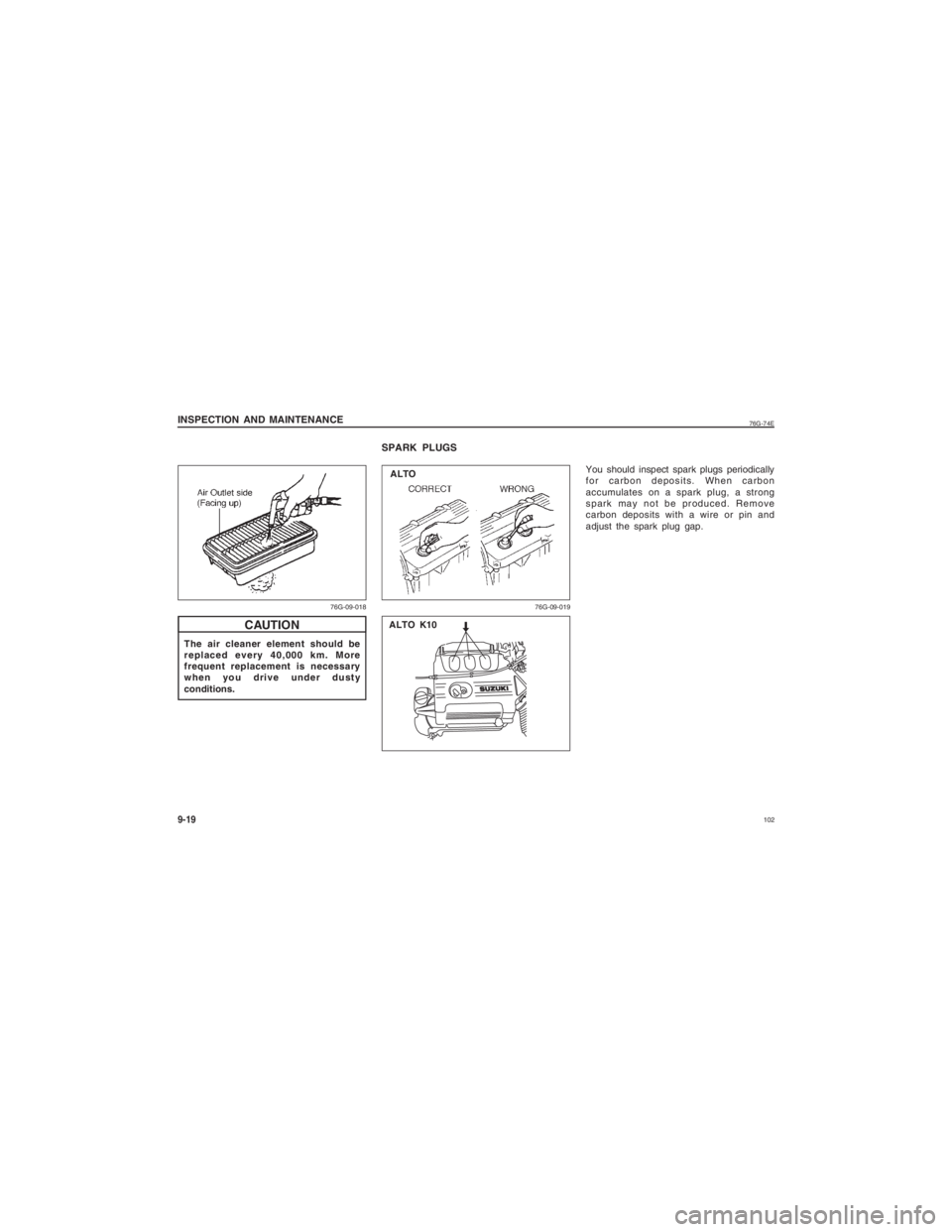
The air cleaner element should be
replaced every 40,000 km. More
frequent replacement is necessary
when you drive under dusty
conditions.
CAUTION
SPARK PLUGS
You should inspect spark plugs periodically
for carbon deposits. When carbon
accumulates on a spark plug, a strong
spark may not be produced. Remove
carbon deposits with a wire or pin and
adjust the spark plug gap.
76G-09-01876G-09-019
ALTO K10
INSPECTION AND MAINTENANCE9-19
ALTO
Page 111 of 139
112
76G-74E
INSPECTION AND MAINTENANCE9-29To avoid harm to yourself or damage
to your vehicle or battery, follow the
jump starting instructions in the
EMERGENCY SERVICE section of this
manual if it is necessary to jump start
your vehicle.
The level of the battery solution must be
kept between the “MAX” and the “MIN” level
lines at all times. If the level is found to be
below the “MIN” level line, add distilled
water to the “MAX” level line. You should
periodically check the battery, battery
terminals, and battery hold-down bracket for
corrosion. Remove corrosion using a stiff
brush and ammonia mixed with water, or
baking soda mixed with water. After
removing corrosion, rinse with clean water.
If your vehicle is not going to be driven for
a month or longer, disconnect the cable from
the negative terminal of the battery to help
prevent discharge.
ww ww
w WARNING
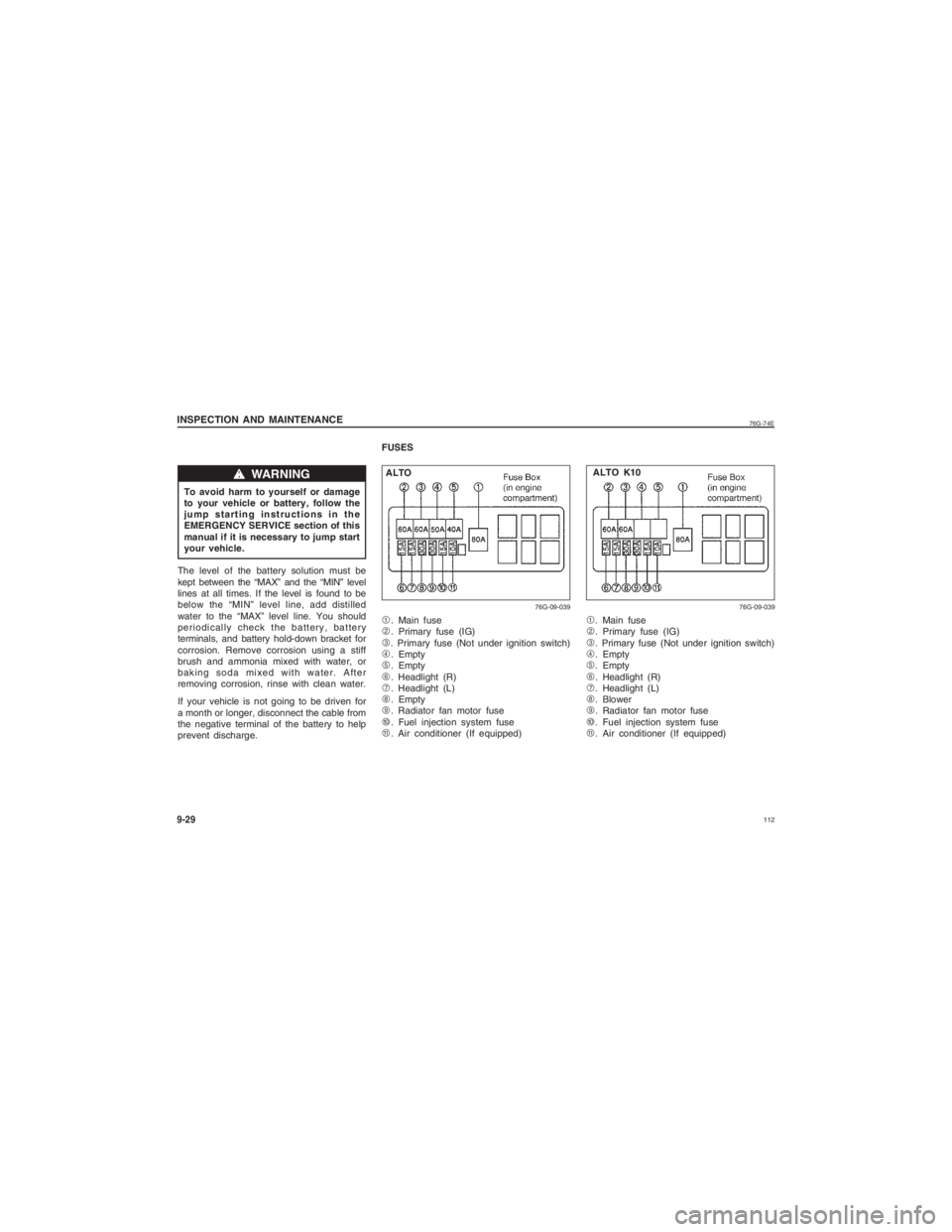
FUSES
1 . Main fuse
2 . Primary fuse (IG)
3 . Primary fuse (Not under ignition switch)
4 . Empty
5 . Empty
6 . Headlight (R)
7 . Headlight (L)
8 . Empty
9 . Radiator fan motor fuse
0 . Fuel injection system fuse
c . Air conditioner (If equipped)
76G-09-039
1. Main fuse
2 . Primary fuse (IG)
3 . Primary fuse (Not under ignition switch)
4 . Empty
5 . Empty
6 . Headlight (R)
7 . Headlight (L)
8 . Blower
9 . Radiator fan motor fuse
0 . Fuel injection system fuse
c . Air conditioner (If equipped)
76G-09-039
ALTO ALTO K10
Page 125 of 139
126
76G-74E
engine until these problems have been
corrected.
3) If you do not find a leak, carefully add coolant to the reservoir and then the
radiator, if necessary. (Refer to “ENGINE
COOLANT” in the “INSPECTION AND
MAINTENANCE” section.)
It is dangerous to remove the radiator
cap when the water temperature is
high, because scalding fluid and
steam may be blown out under
pressure. The cap should only be
taken off when the coolant
temperature has lowered.
To help prevent personal injury, keep
hands, tools and clothing away from
the engine cooling fan and air-
conditioner fan (if equipped). These
electric fans can automatically turn on
without warning.
EMERGENCY SERVICE10-5
ww ww
w WARNINGww
ww
w WARNING
1) Turn off the air conditioner, if equipped.
2) Take the vehicle to a safe place and
park.
3) Let the engine run at normal idle speed for a few minutes until engine coolant
temperature warning light goes off.
If you see or hear escaping steam,
stop the vehicle in a safe place and
immediately turn off the engine to let
it cool. Do not open the bonnet when
steam is present. When the steam can
no longer be seen or heard, open the
hood to see if the coolant is still
boiling. If it is, you must wait until it
stops boiling before you proceed.
If the engine coolant temperature warning
light does not goes off:
1) Turn off the engine and check that the water pump belt and pulleys are not
damaged or slipping. If any abnormality
is found, correct it.
2) Check the coolant level in the reservoir. If it is found to be lower than the “LOW”
line, look for leaks at the radiator, water
pump, and radiator and heater hoses. If
you locate any leaks that may have
caused the overheating, do not run the
ww ww
w WARNING
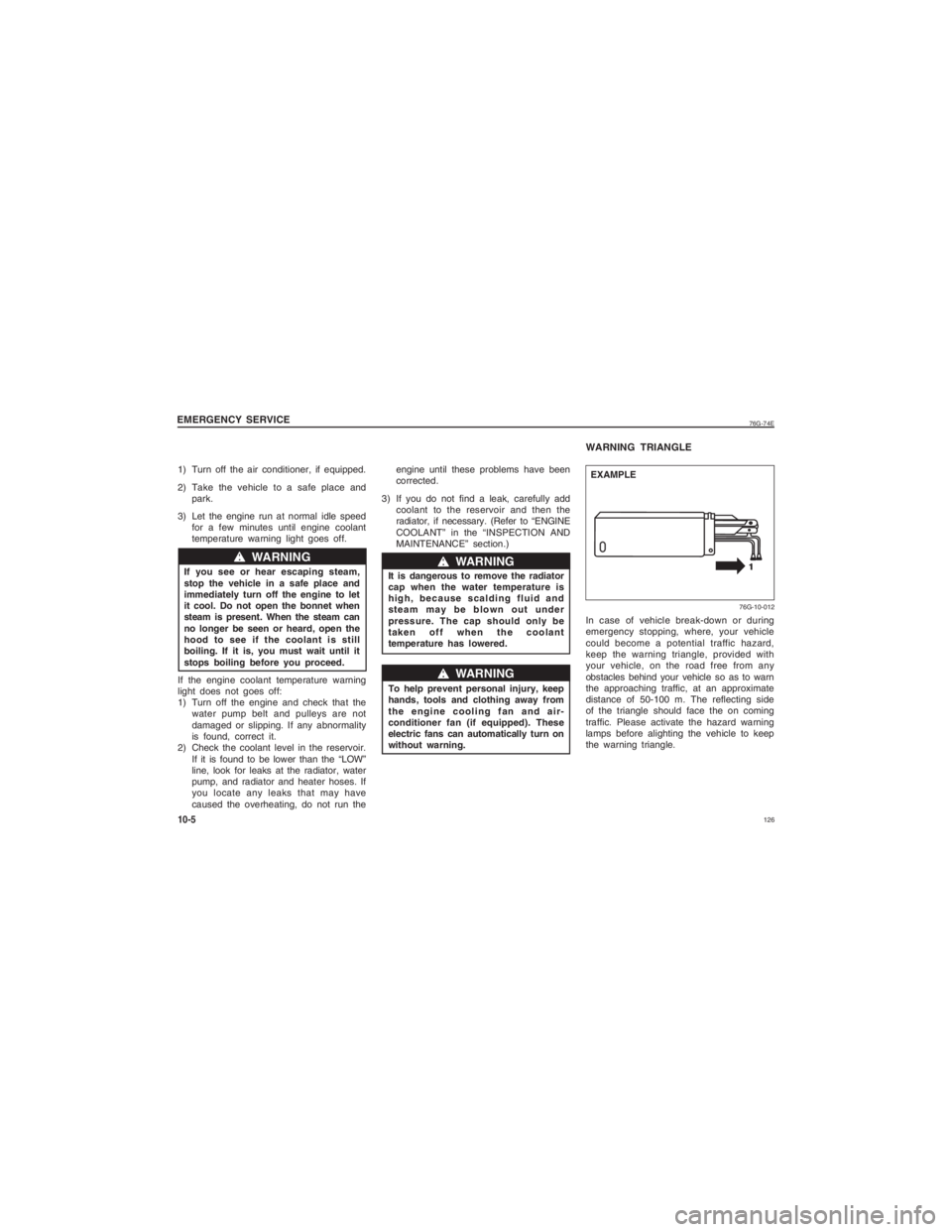
WARNING TRIANGLEIn case of vehicle break-down or during
emergency stopping, where, your vehicle
could become a potential traffic hazard,
keep the warning triangle, provided with
your vehicle, on the road free from any
obstacles behind your vehicle so as to warn
the approaching traffic, at an approximate
distance of 50-100 m. The reflecting side
of the triangle should face the on coming
traffic. Please activate the hazard warning
lamps before alighting the vehicle to keep
the warning triangle.
176G-10-012
EXAMPLE
Page 129 of 139
130
76G-74E
CORROSION PREVENTION
the vehicle which are not well ventilated
to permit quick drying.
This information illustrates the necessity of
keeping your vehicle (particularly the
underbody) as clean and dry as possible.
It is equally important to repair any damage
to the paint or protective coatings as soon
as possible.
How to Help Prevent Corrosion
Wash your vehicle frequently
The best way to preserve the finish on your
vehicle and to help avoid corrosion is to
keep it clean with frequent washing.
Wash your vehicle regularly during the
winter and immediately after the winter.
Keep your vehicle, particularly the
underside, as clean and dry as possible.
If you frequently drive on salted roads, your
vehicle should be washed at least once a
month during the winter. If you live near the
ocean, your vehicle should be washed at
least once a month throughout the year.
For washing instructions, refer to the
“VEHICLE CLEANING” section.
Remove foreign material deposits
Foreign material such as salts, chemicals,
road oil or tar, tree sap, bird droppings and
industrial fall-out may damage the finish of
your vehicle if it is left on painted surfaces.
Remove these types of deposits as quickly as possible. If these deposits are difficult to
wash off, an additional cleaner may be
required. Be sure that any cleaner you use
is not harmful to painted surfaces and is
specifically intended for your purposes.
Follow the manufacturer’s directions when
using these special cleaners.
Repair finish damage
Carefully examine your vehicle for damage
to the painted surfaces. Should you find any
chips or scratches in the paint, touch them
up immediately to prevent corrosion from
starting. If the chips or scratches have gone
through to the bare metal, have a qualified
body shop make the repair.
Keep Passenger and luggage
compartments clean.
Moisture, dirt or mud can accumulate under
the floor mats and may cause corrosion.
Occasionally, check under these mats to
ensure that this area is clean and dry. More
frequent checks are necessary if the vehicle
is used off road or in wet weather.
Certain cargos such as chemicals, fertilizers,
cleaners, salts, etc., are extremely corrosive
by nature. These products should be
transported in sealed containers. If a spill
or leak does occur, clean and dry the area
immediately.
It is important to take good care of your
vehicle to protect it from corrosion.
Listed below are instructions for how to
maintain your vehicle to prevent corrosion.
Please read and follow these instructions
carefully.
Important Information About Corrosion
Common causes of corrosion
1) Accumulation of road salt, dirt, moisture,
or chemicals in hard to reach areas of
the vehicle underbody or frame.
2) Chipping, scratches and any damage to treated or painted metal surfaces
resulting from minor accidents or
abrasion by stones and gravel.
Environmental conditions which
accelerate corrosion
1) Road salt, dust control chemicals, sea air or industrial pollution will all
accelerate the corrosion of metal.
2) High humidity will increase the rate of corrosion particularly when the
temperature range is just above the
freezing point.
3) Moisture in certain areas of a vehicle for an extended period of time may promote
corrosion even though other body
sections may be completely dry.
4) High temperatures will cause an
accelerated rate of corrosion to parts of
BODY WORK CARE11-1