belt SUZUKI ALTO 2014 User Guide
[x] Cancel search | Manufacturer: SUZUKI, Model Year: 2014, Model line: ALTO, Model: SUZUKI ALTO 2014Pages: 139, PDF Size: 2.22 MB
Page 77 of 139
78
76G-74E
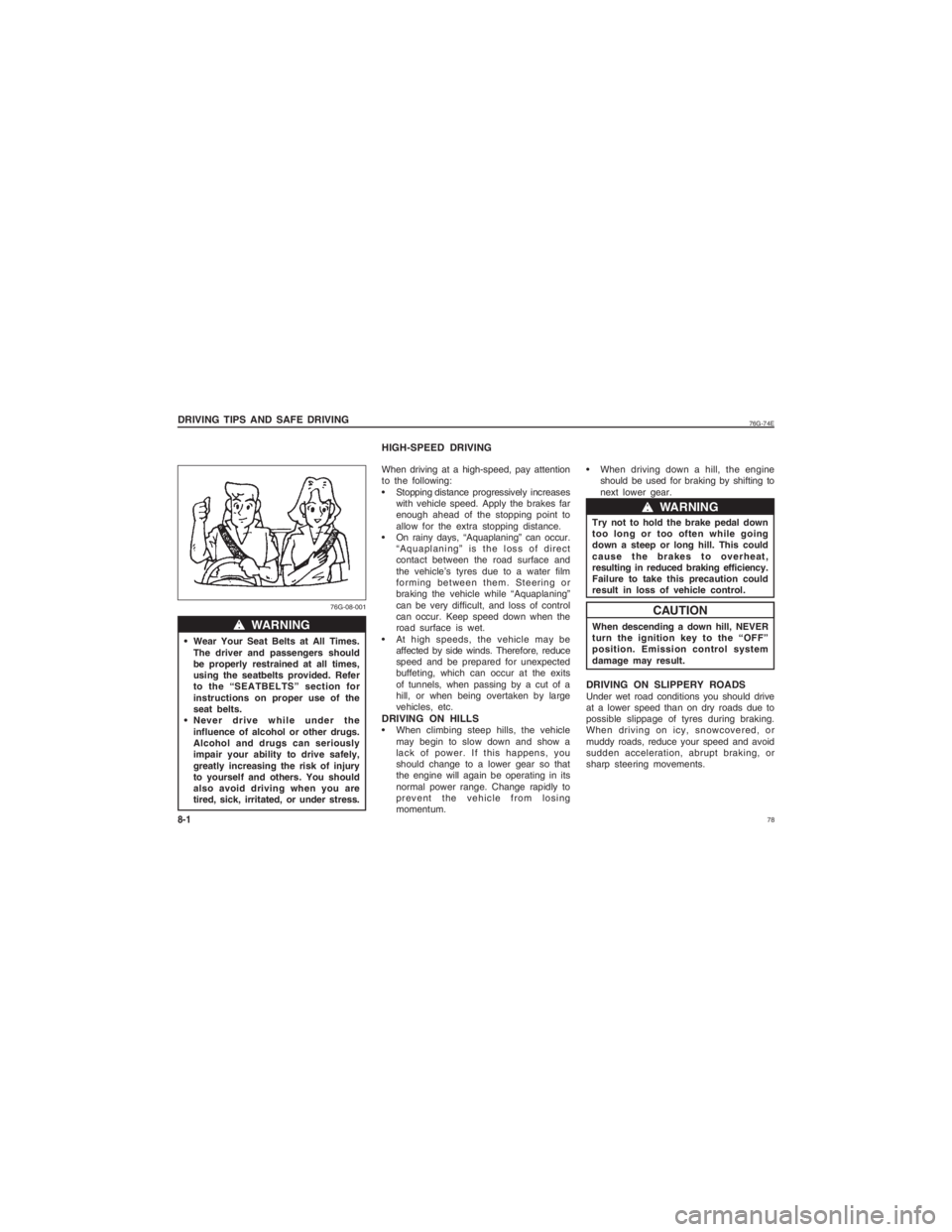
Wear Your Seat Belts at All Times.The driver and passengers should
be properly restrained at all times,
using the seatbelts provided. Refer
to the “SEATBELTS” section for
instructions on proper use of the
seat belts.
Never drive while under the
influence of alcohol or other drugs.
Alcohol and drugs can seriously
impair your ability to drive safely,
greatly increasing the risk of injury
to yourself and others. You should
also avoid driving when you are
tired, sick, irritated, or under stress.
HIGH-SPEED DRIVING
When driving down a hill, the engine should be used for braking by shifting to
next lower gear.
Try not to hold the brake pedal down
too long or too often while going
down a steep or long hill. This could
cause the brakes to overheat,
resulting in reduced braking efficiency.
Failure to take this precaution could
result in loss of vehicle control.
When descending a down hill, NEVER
turn the ignition key to the “OFF”
position. Emission control system
damage may result.DRIVING ON SLIPPERY ROADSUnder wet road conditions you should drive
at a lower speed than on dry roads due to
possible slippage of tyres during braking.
When driving on icy, snowcovered, or
muddy roads, reduce your speed and avoid
sudden acceleration, abrupt braking, or
sharp steering movements.
When driving at a high-speed, pay attention
to the following:
Stopping distance progressively increases
with vehicle speed. Apply the brakes far
enough ahead of the stopping point to
allow for the extra stopping distance.
On rainy days, “Aquaplaning” can occur. “Aquaplaning” is the loss of direct
contact between the road surface and
the vehicle’s tyres due to a water film
forming between them. Steering or
braking the vehicle while “Aquaplaning”
can be very difficult, and loss of control
can occur. Keep speed down when the
road surface is wet.
At high speeds, the vehicle may be affected by side winds. Therefore, reduce
speed and be prepared for unexpected
buffeting, which can occur at the exits
of tunnels, when passing by a cut of a
hill, or when being overtaken by large
vehicles, etc.
DRIVING ON HILLS When climbing steep hills, the vehiclemay begin to slow down and show a
lack of power. If this happens, you
should change to a lower gear so that
the engine will again be operating in its
normal power range. Change rapidly to
prevent the vehicle from losing
momentum.
ww ww
w WARNING
ww
ww
w WARNINGCAUTION
8-1DRIVING TIPS AND SAFE DRIVING
76G-08-001
Page 82 of 139

8376G-74E
INSPECTION AND MAINTENANCE
9
INSPECTION AND MAINTENANCE
Periodic Maintenance Schedule ........................................................................\
. 9-1
Alto ........................................................................\
..................................... 9-2
Alto K-10 ........................................................................\
............................ 9-6
Drive Belt ........................................................................\
.................................... 9-10
Engine Oil and Filter ........................................................................\
.................. 9-11
Gear Oil ........................................................................\
....................................... 9-14
Engine Coolant ........................................................................\
........................... 9-15
Windscreen Washer Fluid ........................................................................\
......... 9-18
Air Cleaner ........................................................................\
.................................. 9-18
Spark Plugs ........................................................................\
................................ 9-19
Fuel Filter Replacement ........................................................................\
............ 9-21
Brakes ........................................................................\
......................................... 9-21
Parking Brake ........................................................................\
............................. 9-23
Steering ........................................................................\
.............................. ......... 9-23
Clutch Pedal ........................................................................\
............................... 9-24
Tyres ........................................................................\
.......................................... 9-24
Tubeless Tyre (if equipped) ........................................................................\
...... 9-27
Battery ........................................................................\
......................................... 9-28
Fuses ........................................................................\
.......................................... 9-29
Bulb Replacement ........................................................................\
...................... 9-32
Wiper Blades ........................................................................\
.............................. 9-35
Page 83 of 139
84
76G-74E
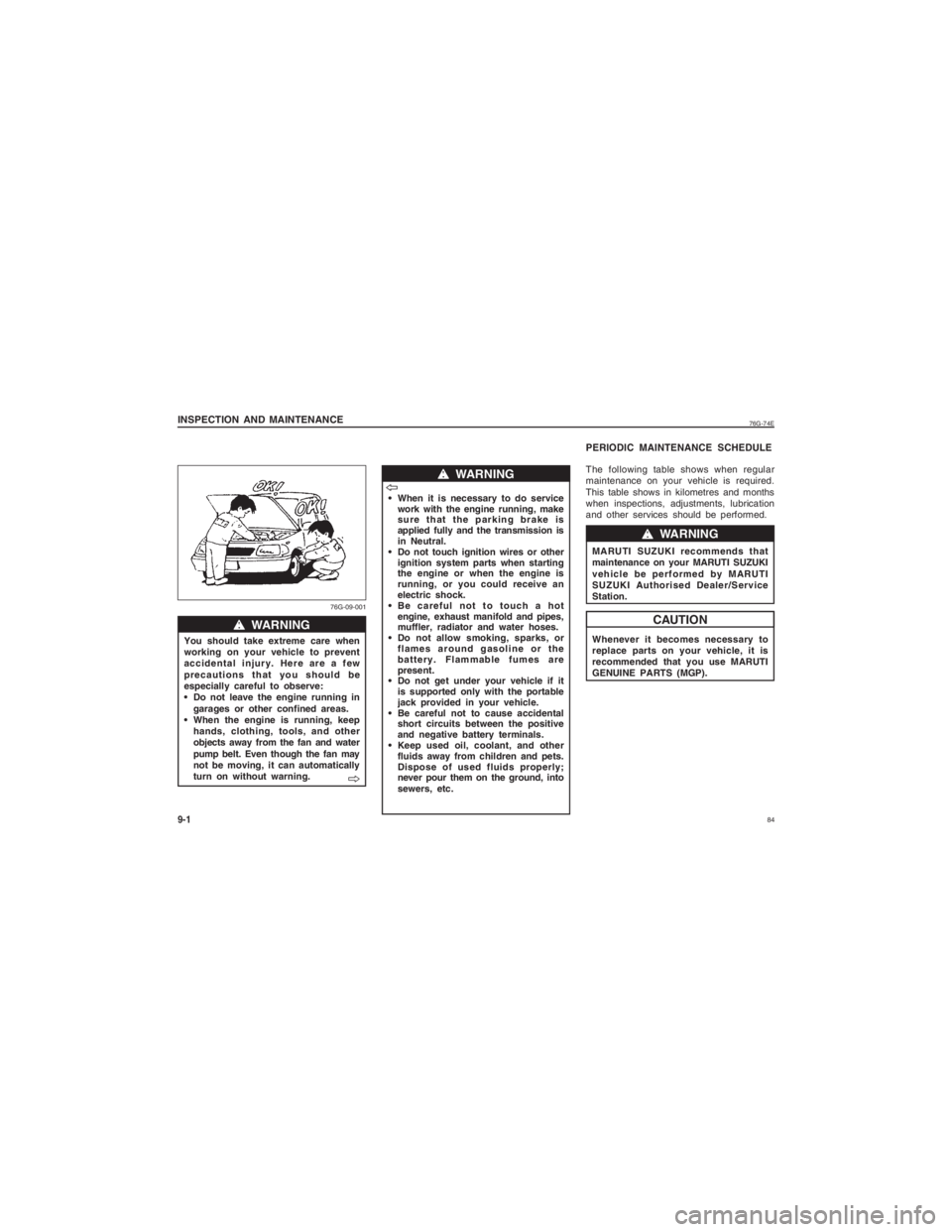
You should take extreme care when
working on your vehicle to prevent
accidental injury. Here are a few
precautions that you should be
especially careful to observe:
Do not leave the engine running ingarages or other confined areas.
When the engine is running, keep hands, clothing, tools, and other
objects away from the fan and water
pump belt. Even though the fan may
not be moving, it can automatically
turn on without warning. When it is necessary to do service
work with the engine running, make
sure that the parking brake is
applied fully and the transmission is
in Neutral.
Do not touch ignition wires or other
ignition system parts when starting
the engine or when the engine is
running, or you could receive an
electric shock.
Be careful not to touch a hot engine, exhaust manifold and pipes,
muffler, radiator and water hoses.
Do not allow smoking, sparks, or flames around gasoline or the
battery. Flammable fumes are
present.
Do not get under your vehicle if it is supported only with the portable
jack provided in your vehicle.
Be careful not to cause accidental short circuits between the positive
and negative battery terminals.
Keep used oil, coolant, and other
fluids away from children and pets.
Dispose of used fluids properly;
never pour them on the ground, into
sewers, etc.INSPECTION AND MAINTENANCE9-1
ww ww
w WARNING
ww
ww
w WARNING
VV
VV
V
VV
VV
V
PERIODIC MAINTENANCE SCHEDULEThe following table shows when regular
maintenance on your vehicle is required.
This table shows in kilometres and months
when inspections, adjustments, lubrication
and other services should be performed.
MARUTI SUZUKI recommends that
maintenance on your MARUTI SUZUKI
vehicle be performed by MARUTI
SUZUKI Authorised Dealer/Service
Station.
Whenever it becomes necessary to
replace parts on your vehicle, it is
recommended that you use MARUTI
GENUINE PARTS (MGP).
ww ww
w WARNINGCAUTION
76G-09-001
Page 84 of 139
8576G-74E
INSPECTION AND MAINTENANCE
9-2
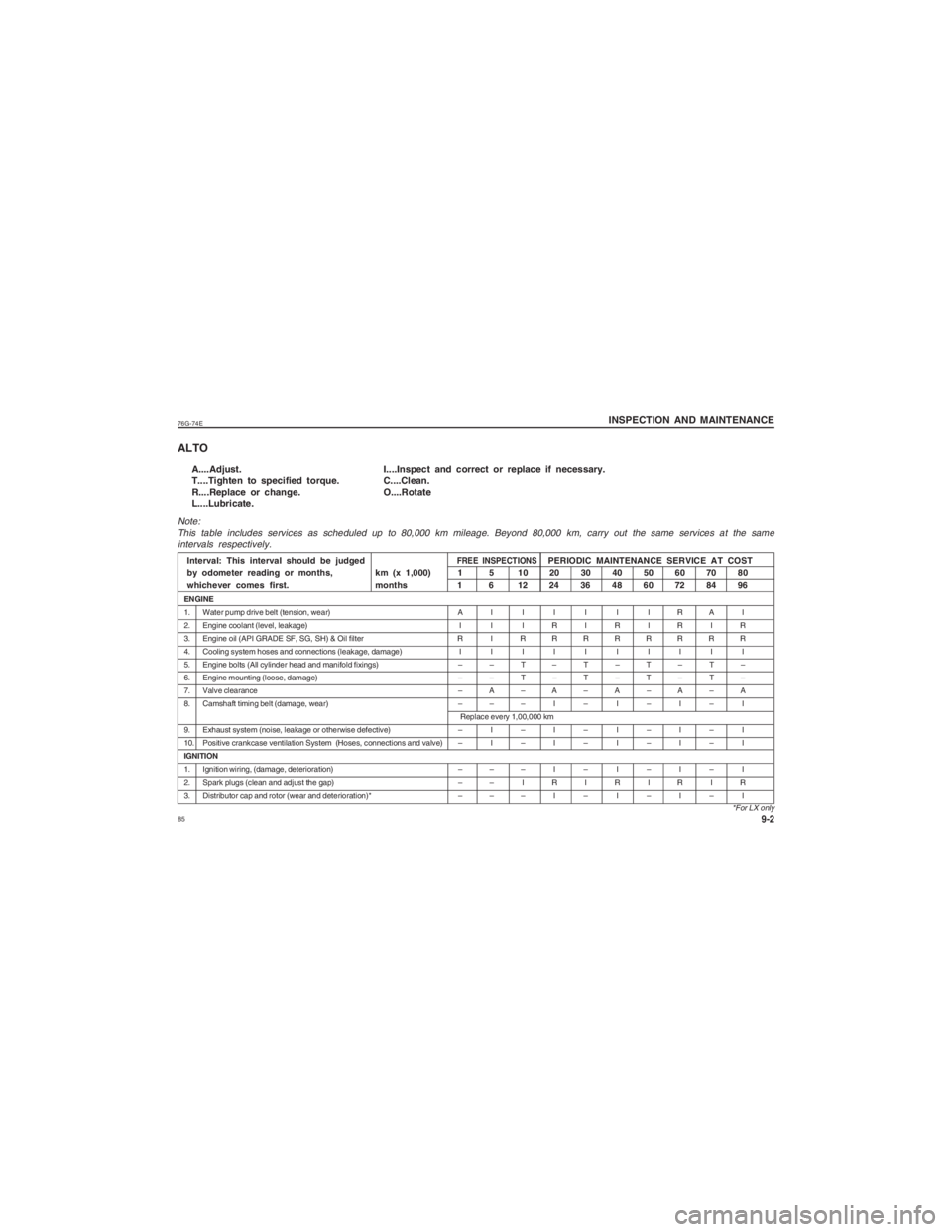
A....Adjust. I....Inspect and correct or replace if necessary.
T....Tighten to specified torque. C....Clean.
R....Replace or change. O....Rotate
L....Lubricate.
Note:
This table includes services as scheduled up to 80,000 km mileage. Beyon\
d 80,000 km, carry out the same services at the sameintervals respectively.Interval: This interval should be judged
FREE INSPECTIONS
PERIODIC MAINTENANCE SERVICE AT COST
by odometer reading or months, km (x 1,000) 1 5 10 20 30 40 50 60 70 80
whichever comes first. months 1 6 12 24 36 48 60 72 84 96
ENGINE
1. Water pump drive belt (tension, wear) A I I I I I I R A I
2. Engine coolant (level, leakage) I I I R I R I R I R
3. Engine oil (API GRADE SF, SG, SH) & Oil filter R I R R R R R R R R
4. Cooling system hoses and connections (leakage, damage) I I I I I I I I I I
5. Engine bolts (All cylinder head and manifold fixings) – – T – T – T – T –
6. Engine mounting (loose, damage) – – T – T – T – T –
7. Valve clearance – A – A – A – A – A
8. Camshaft timing belt (damage, wear) – – – I – I – I – I
Replace every 1,00,000 km
9. Exhaust system (noise, leakage or otherwise defective) – I – I – I – I – I
10. Positive crankcase ventilation System (Hoses, connections and valve) – I – I – I – I – I
IGNITION
1. Ignition wiring, (damage, deterioration) – – – I – I – I – I
2. Spark plugs (clean and adjust the gap) – – I R I R I R I R
3. Distributor cap and rotor (wear and deterioration)* – – – I – I – I – I
*For LX only
ALTO
Page 87 of 139
88
76G-74E
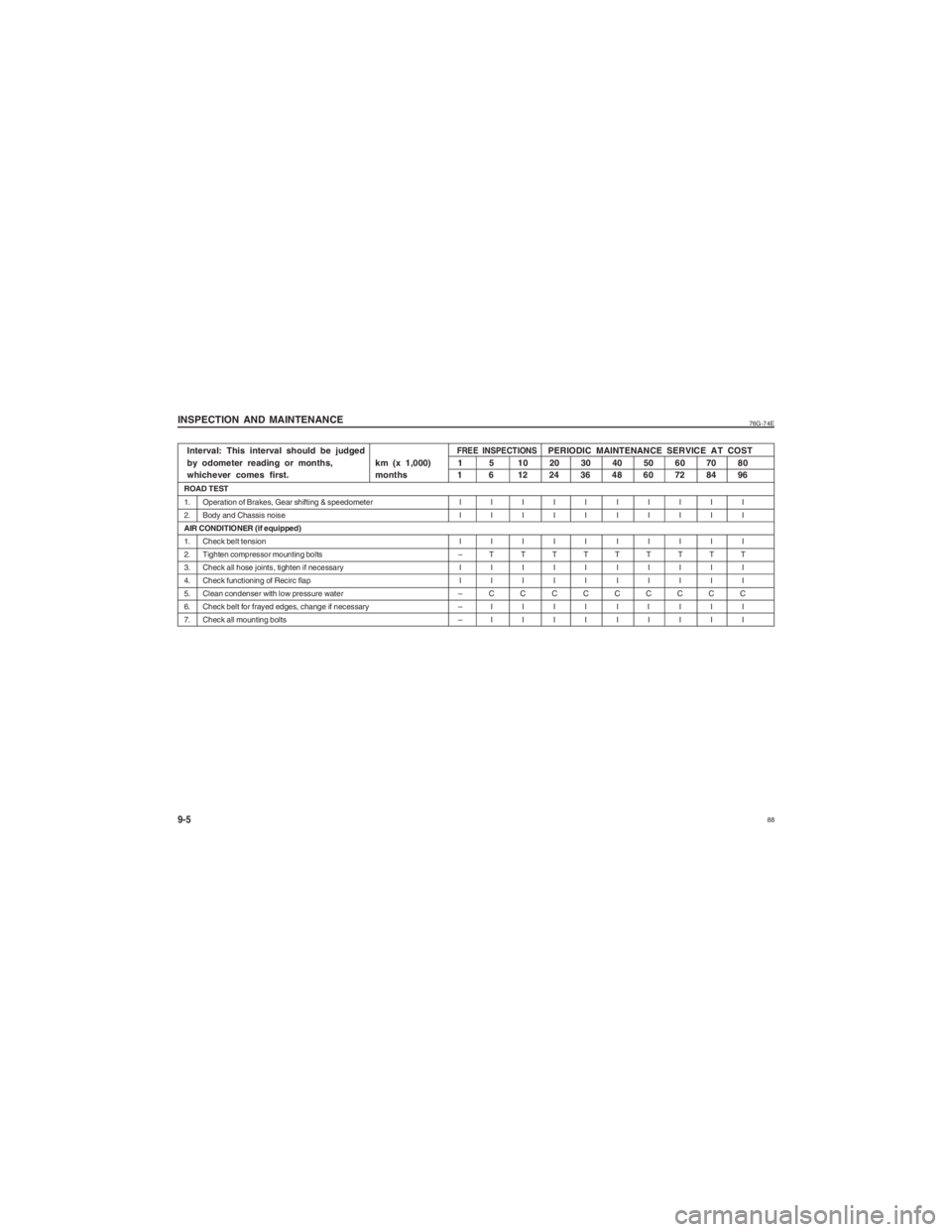
INSPECTION AND MAINTENANCE9-5Interval: This interval should be judged
FREE INSPECTIONS
PERIODIC MAINTENANCE SERVICE AT COST
by odometer reading or months, km (x 1,000) 1 5 10 20 30 40 50 60 70 80
whichever comes first. months 1 6 12 24 36 48 60 72 84 96
ROAD TEST
1. Operation of Brakes, Gear shifting & speedometer I I I I I I I I I I
2. Body and Chassis noise I I I I I I I I I I
AIR CONDITIONER (if equipped)
1. Check belt tension I I I I I I I I I I
2. Tighten compressor mounting bolts – T T T T T T T T T
3. Check all hose joints, tighten if necessary I I I I I I I I I I
4. Check functioning of Recirc flap I I I I I I I I I I
5. Clean condenser with low pressure water – C C C C C C C C C
6. Check belt for frayed edges, change if necessary – I I I I I I I I I
7. Check all mounting bolts – I I I I I I I I I
Page 92 of 139
9376G-74E
INSPECTION AND MAINTENANCE
9-10
DRIVE BELT
When the engine is running, keep
hands, hair, clothing, tools, etc. away
from the fan and drive belt. Even
though the fan may not be moving, it
can automatically turn on without
warning.
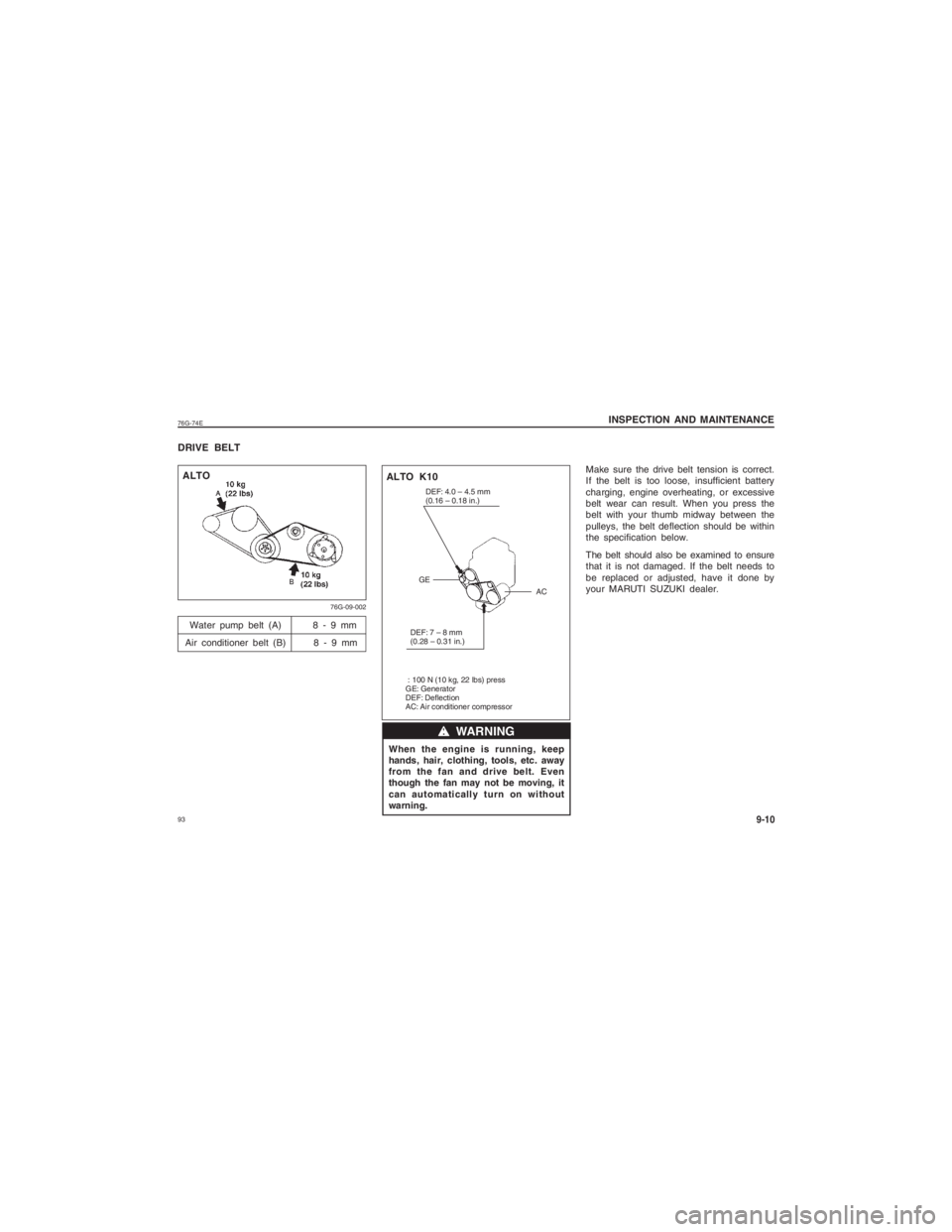
Water pump belt (A) 8 - 9 mm
Air conditioner belt (B) 8 - 9 mm
ww ww
w WARNING
76G-09-002
Make sure the drive belt tension is correct.
If the belt is too loose, insufficient battery
charging, engine overheating, or excessive
belt wear can result. When you press the
belt with your thumb midway between the
pulleys, the belt deflection should be within
the specification below.
The belt should also be examined to ensure
that it is not damaged. If the belt needs to
be replaced or adjusted, have it done by
your MARUTI SUZUKI dealer.
DEF: 4.0 – 4.5 mm
(0.16 – 0.18 in.)
DEF: 7 – 8 mm
(0.28 – 0.31 in.)
: 100 N (10 kg, 22 lbs) press
GE: Generator
DEF: Deflection
AC: Air conditioner compressor GE
AC
ALTO K10
ALTO
Page 122 of 139
12376G-74E
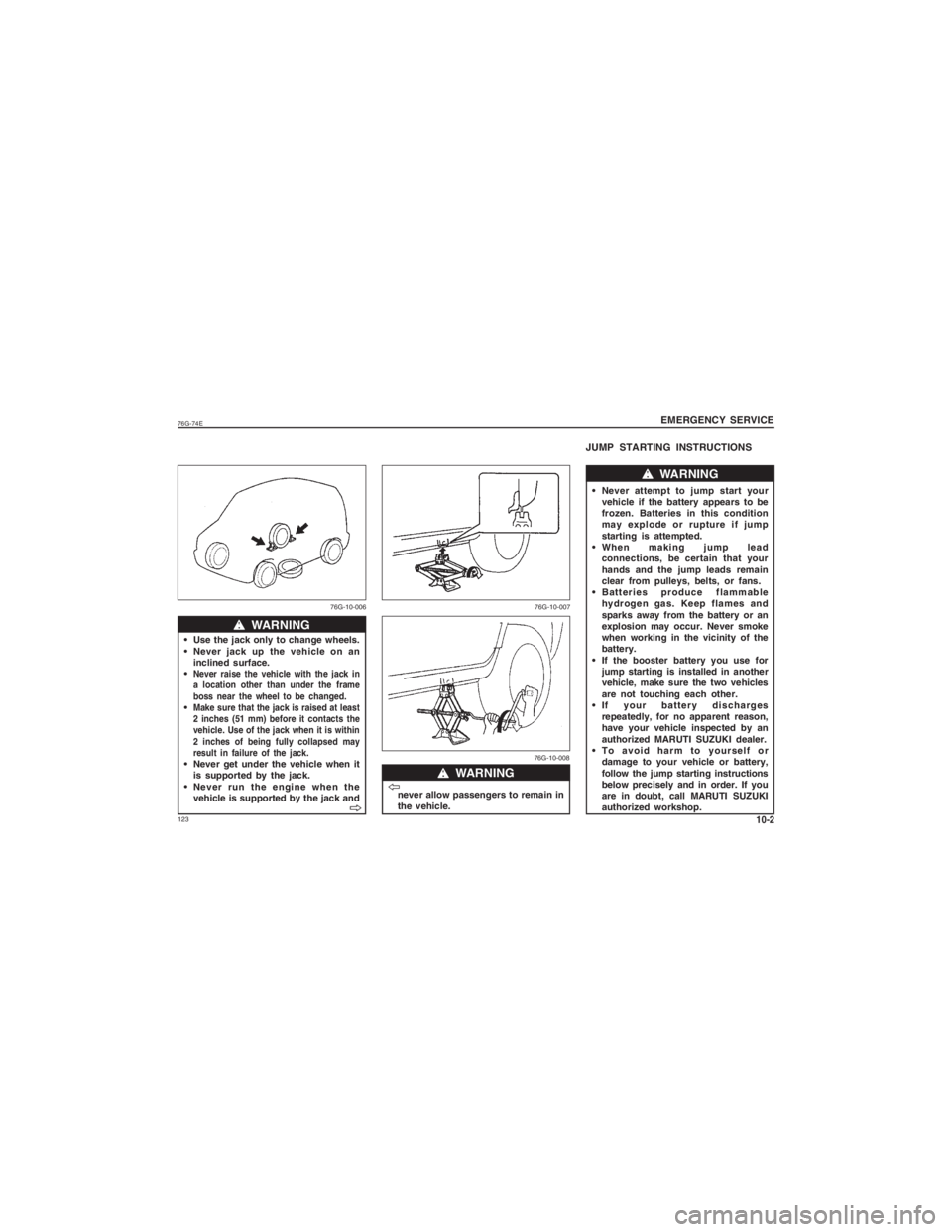
never allow passengers to remain in
the vehicle.
JUMP STARTING INSTRUCTIONS Never attempt to jump start yourvehicle if the battery appears to be
frozen. Batteries in this condition
may explode or rupture if jump
starting is attempted.
When making jump lead connections, be certain that your
hands and the jump leads remain
clear from pulleys, belts, or fans.
Batteries produce flammable hydrogen gas. Keep flames and
sparks away from the battery or an
explosion may occur. Never smoke
when working in the vicinity of the
battery.
If the booster battery you use for jump starting is installed in another
vehicle, make sure the two vehicles
are not touching each other.
If your battery discharges repeatedly, for no apparent reason,
have your vehicle inspected by an
authorized MARUTI SUZUKI dealer.
To avoid harm to yourself or damage to your vehicle or battery,
follow the jump starting instructions
below precisely and in order. If you
are in doubt, call MARUTI SUZUKI
authorized workshop.
ww ww
w WARNING
ww
ww
w WARNING
EMERGENCY SERVICE
10-2
VV
VV
V
Use the jack only to change wheels.
Never jack up the vehicle on an
inclined surface.
Never raise the vehicle with the jack in
a location other than under the frame
boss near the wheel to be changed.Make sure that the jack is raised at least
2 inches (51 mm) before it contacts the
vehicle. Use of the jack when it is within
2 inches of being fully collapsed may
result in failure of the jack. Never get under the vehicle when it is supported by the jack.
Never run the engine when the vehicle is supported by the jack and
ww ww
w WARNING
VV
VV
V
76G-10-006 76G-10-007
76G-10-008
Page 125 of 139
126
76G-74E
engine until these problems have been
corrected.
3) If you do not find a leak, carefully add coolant to the reservoir and then the
radiator, if necessary. (Refer to “ENGINE
COOLANT” in the “INSPECTION AND
MAINTENANCE” section.)
It is dangerous to remove the radiator
cap when the water temperature is
high, because scalding fluid and
steam may be blown out under
pressure. The cap should only be
taken off when the coolant
temperature has lowered.
To help prevent personal injury, keep
hands, tools and clothing away from
the engine cooling fan and air-
conditioner fan (if equipped). These
electric fans can automatically turn on
without warning.
EMERGENCY SERVICE10-5
ww ww
w WARNINGww
ww
w WARNING
1) Turn off the air conditioner, if equipped.
2) Take the vehicle to a safe place and
park.
3) Let the engine run at normal idle speed for a few minutes until engine coolant
temperature warning light goes off.
If you see or hear escaping steam,
stop the vehicle in a safe place and
immediately turn off the engine to let
it cool. Do not open the bonnet when
steam is present. When the steam can
no longer be seen or heard, open the
hood to see if the coolant is still
boiling. If it is, you must wait until it
stops boiling before you proceed.
If the engine coolant temperature warning
light does not goes off:
1) Turn off the engine and check that the water pump belt and pulleys are not
damaged or slipping. If any abnormality
is found, correct it.
2) Check the coolant level in the reservoir. If it is found to be lower than the “LOW”
line, look for leaks at the radiator, water
pump, and radiator and heater hoses. If
you locate any leaks that may have
caused the overheating, do not run the
ww ww
w WARNING
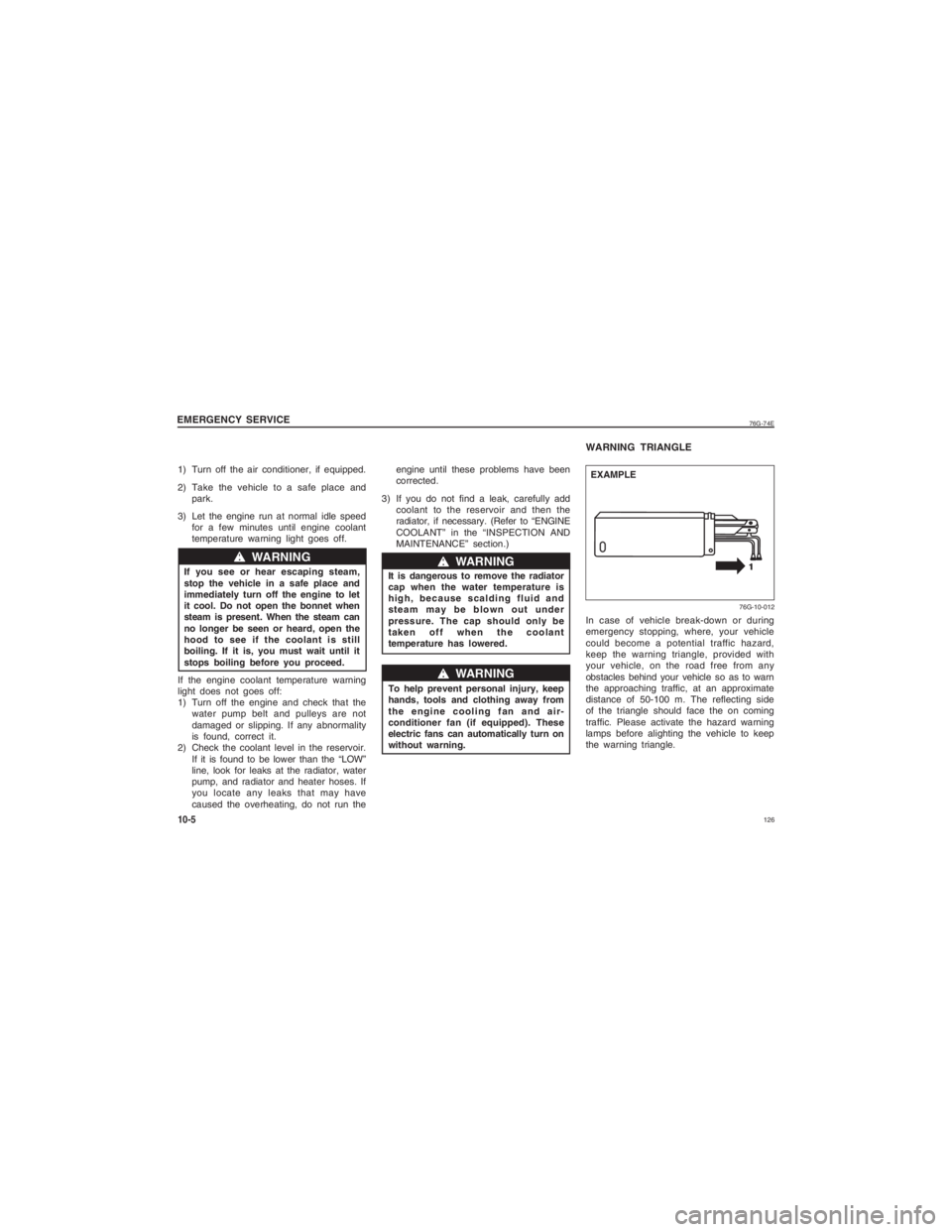
WARNING TRIANGLEIn case of vehicle break-down or during
emergency stopping, where, your vehicle
could become a potential traffic hazard,
keep the warning triangle, provided with
your vehicle, on the road free from any
obstacles behind your vehicle so as to warn
the approaching traffic, at an approximate
distance of 50-100 m. The reflecting side
of the triangle should face the on coming
traffic. Please activate the hazard warning
lamps before alighting the vehicle to keep
the warning triangle.
176G-10-012
EXAMPLE
Page 130 of 139
13176G-74EStore your vehicle in a dry, well-
ventilated area.
Do not park your vehicle in a damp, poorly
ventilated area. If you often wash your
vehicle in the garage or if you frequently
drive it in when wet, your garage may be
damp. The high humidity in the garage may
cause or accelerate corrosion. A wet vehicle
may corrode even in a heated garage if the
ventilation is poor.Do not apply additional undercoating
or rust preventive coating on or
around exhaust system components
such as the exhaust pipes, etc. A fire
could be started if the undercoating
substance becomes overheated.
Cover your vehicle
If you cannot regularly park your vehicle in
a garage, we recommend you use a vehicle
cover.
VEHICLE CLEANING
cleaner for tougher stains. If you use a
fabric cleaner, carefully follow the
manufacturer’s instructions and precautions.
Seat Belts
Clean seat belts with a mild soap and
water. Do not use bleach or dye on the
belts. They may weaken the fabric in the
belts.
Vinyl floor mats
Ordinary dirt can be removed from vinyl with
water or mild soap. Use a brush to help
loosen dirt. After the dirt is loosened, rinse
the mat thoroughly with water and dry it in
the shade.
Carpets
Remove dirt and soil as much as possible
with a vacuum cleaner. Using a mild soap
solution, rub stained areas with a clean
damp cloth. To remove soap, rub the areas
again with a cloth dampened with water.
Repeat this until the stain is removed, or
use a commercial carpet cleaner for tougher
stains. If you use a carpet cleaner, carefully
follow the manufacturer’s instructions and
precautions.
ww ww
w WARNING
When cleaning the interior or exterior
of the vehicle, NEVER USE flammable
solvents such as lacquer thinners,
petrol, benzene or cleaning materials
such as bleach or strong household
detergents. The materials could cause
personal injury or damage to the
vehicle.
Cleaning the Interior
Vinyl upholstery
Prepare a solution of soap or mild detergent
mixed with warm water. Apply the solution
to the vinyl with a sponge or soft cloth and
let it soak for a few minutes to loosen dirt.
Rub the surface with a clean, damp cloth
to remove dirt and the soap solution. If
some dirt still remains on the surface,
repeat this procedure.
Fabric upholstery
Remove loose dirt with a vacuum cleaner.
Using a mild soap solution, rub stained
areas with a clean damp cloth. To remove
soap, rub the areas again with a cloth
dampened with water. Repeat this until the
stain is removed, or use a commercial fabric
ww ww
w WARNING
BODY WORK CARE
11-2