Tire SUZUKI ALTO 2014 Owners Manual
[x] Cancel search | Manufacturer: SUZUKI, Model Year: 2014, Model line: ALTO, Model: SUZUKI ALTO 2014Pages: 139, PDF Size: 2.22 MB
Page 8 of 139
8
59K,76G,844-74E
adjusted or repaired by other than an Maruti Suzuki
authorised dealer/service station.
(k) any vehicle which has been used for purposes other than what it was designed for.
(l) any damage or deterioration caused by industrial pollution and bird droppings.
(m) insignificant defects which do not affect the function of the vehicle including without limitation, sound, vibration and fluid
seep.
(n) any natural wear and tear including without limitation, aging etc.
(o) Installation and usage of Domestic LPG Gas/LPG cylinder.
For Maruti Suzuki Air-Conditioned Vehicles (p) V-belts, hoses and gas leaks.
(5) Extent of Warranty: This warranty is the entire written warranty given by MarutiSuzuki for Maruti Suzuki vehicles and no dealer or its or his
agent or employee is authorised to extend or enlarge this
warranty and no dealer or its or his agent or employee is
authorised to make any oral warranty on Maruti Suzuki behalf.
Maruti Suzuki reserves the right to add any improvements or change the design of any model at any time with no obligation
to make the same changes on units previously sold.
(6) Warranty Service: To obtain warranty service, the complete vehicle must bepresented at the owner’s expenses to any authorised Maruti
Suzuki dealer. (7) Owner’s Warranty Responsibilities:
It is responsibility of each owner to:
(a) make certain that the warranty registration/PDI card wascompleted at the time of delivery of the vehicle;
(b) have performed, at his own expenses, by an Maruti Suzuki authorised dealer/service station all the service inspections
specified in the Maruti Suzuki “Owner’s Manual and Service
Booklet” and maintain adequate proof that such service
inspections have been performed.
(c) make certain that the Maruti Suzuki authorised dealer/ servise station performing the service inspection has
certified the work on the “Maintenance Service Record”
page in the “Owner’s Manual and Service Booklet” and
(d) present the Maruti Suzuki “Owner’s Manual and Service Booklet” to the authorised Maruti Suzuki dealer whenever
requesting service inspections or warranty service.
If the “Owner’s Manual and Service Booklet” should be lost or
destroyed the owner should consult the authorised Maruti Suzuki
dealer from whom the vehicle was purchased for instructions
concerning replacement of the “Owner’s Manual and Service
Booklet”.
(8) Disclaimer of Consequential Damage: Maruti Suzuki assumes no responsibility for loss of vehicle, loss
of time, inconvenience or any other indirect incidental or
consequential damage resulting from the vehicle not being
available to the owner because of any defect covered by this
warranty.
(9) Change of Owner Even if ownership of the vehicle changes, the remaining
warranty period is effective for the new owner.
WARRANTY POLICY
2-2
Page 9 of 139
 only in four metropo")
959K,76G,844-74E
Maruti Suzuki offers the Emission Warranty on all Maruti Suzuki vehicles\
(apart from the Regular warranty and will run parallelto the regular product warranty) only in four metropolitan cities (New Delhi, Kolkata, Mumbai and Chennai) with effect from
July 1st, 2001.
Terms:
The Emission Warranty will be applicable for 80,000 kms or 3 years (Which ever comes earlier) from the date of delivery to
the first owner. The remaining warranty terms will be valid in case of a\
ny change in ownership provided the production of all
valid document.
Conditions:1. Under Emission Warranty, Warranty claims will be admitted for a prima fa\
cie examination, in case vehicle fails to meet to the Emission Standard as specified in sub rule (2) of rule no. 115 of Cent\
ral Motor Vehicles Rules (CMVR), 1989.
2. The warranty claims will only be accepted after examination carried out \
by Maruti Suzuki or it's dealer which leads to firm c onclusions
that the
a) Original settings have not been tempered in any case.
b) Part (as given in Annexure-A) has a manufacturing defect.
c) Vehicle is unable to meet the Emission Standards (as given in 1.), ins\
pite of the vehicle having been maintained and used in accordance with the instructions as specified in Owner's Manual and S\
ervice Booklet and the used fuel and different oils
(Engine oil, Transmission oil, Brake oil etc.) are also as per specifi\
cation.
3. The method of examination for deciding the warranty of the parts will be\
at the sole discretion of Maruti Suzuki and it's dea ler
and results of the examination will be final and binding. If after exami\
nation, the warrantable condition is not established, M aruti
Suzuki and it's dealer has the right to charge all, or part of the cost \
of such examination.
4. Under Emission Warranty, the parts (as given in Annexure-A) will be ch\
anged free of cost, but the consumables will be charged as per actual.
5. If the part covered under Emission Warranty or the associated parts, are\
not independently replaceable, on account of these b eing
integral parts a complete assembly, Maruti Suzuki and it's dealer will h\
ave the sole discretion to replace entire assembly or b y
using some of the parts of the system through suitable repair or modific\
ations.
EMISSION WARRANTY
2-3
Page 24 of 139
2576G-74E
BEFORE DRIVING
3-12
Never use the same seat belt onmore than one occupant and never
attach a seat belt over an infant or
child being held on an occupant’s
lap. Such seat belt use could cause
serious injury in the event of an
accident.
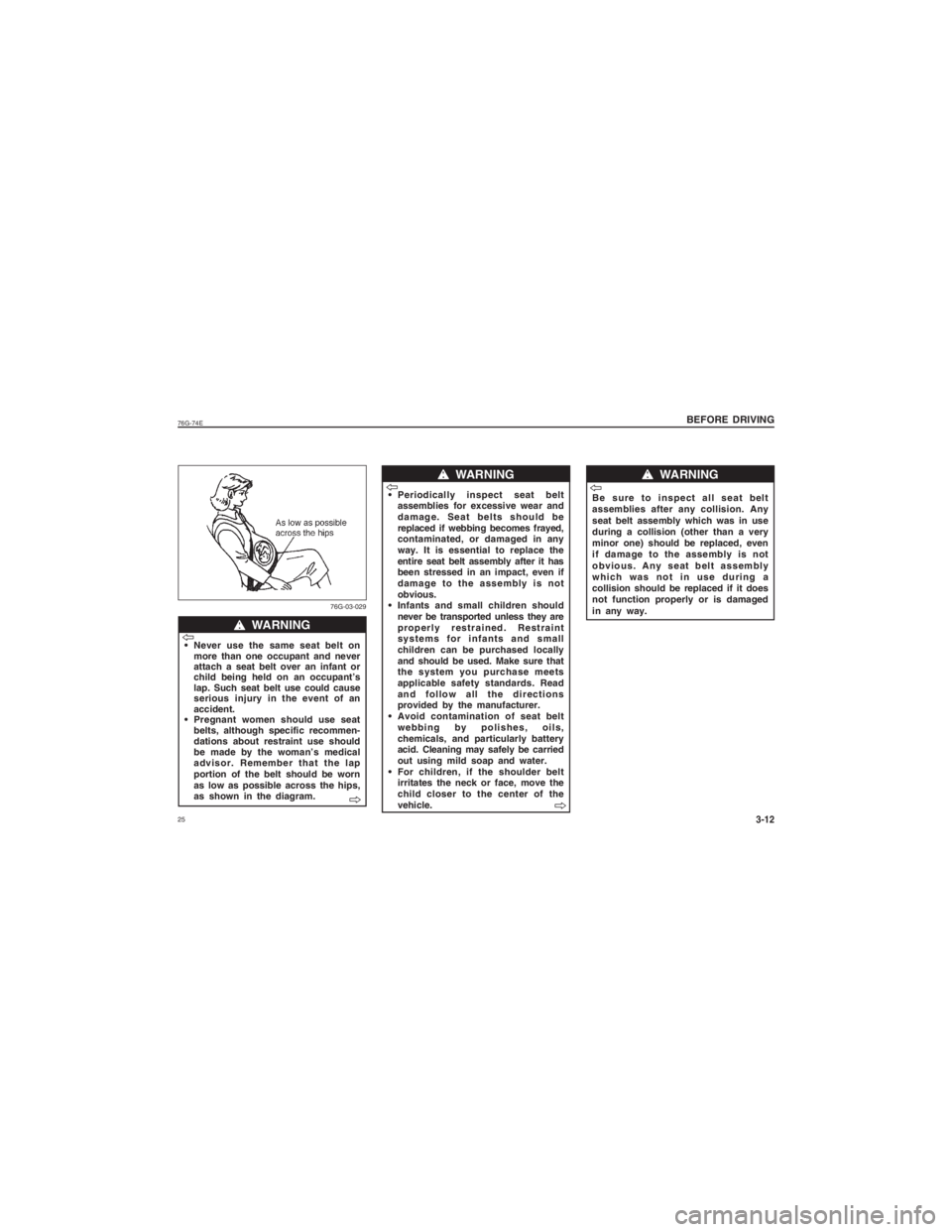
Pregnant women should use seat belts, although specific recommen-
dations about restraint use should
be made by the woman’s medical
advisor. Remember that the lap
portion of the belt should be worn
as low as possible across the hips,
as shown in the diagram.
ww ww
w WARNING
VV
VV
V
VV
VV
V
76G-03-029
Periodically inspect seat belt
assemblies for excessive wear and
damage. Seat belts should be
replaced if webbing becomes frayed,
contaminated, or damaged in any
way. It is essential to replace the
entire seat belt assembly after it has
been stressed in an impact, even if
damage to the assembly is not
obvious.
Infants and small children should never be transported unless they are
properly restrained. Restraint
systems for infants and small
children can be purchased locally
and should be used. Make sure that
the system you purchase meets
applicable safety standards. Read
and follow all the directions
provided by the manufacturer.
Avoid contamination of seat belt webbing by polishes, oils,
chemicals, and particularly battery
acid. Cleaning may safely be carried
out using mild soap and water.
For children, if the shoulder belt irritates the neck or face, move the
child closer to the center of the
vehicle.
ww ww
w WARNING
VV
VV
V
VV
VV
V
Be sure to inspect all seat belt
assemblies after any collision. Any
seat belt assembly which was in use
during a collision (other than a very
minor one) should be replaced, even
if damage to the assembly is not
obvious. Any seat belt assembly
which was not in use during a
collision should be replaced if it does
not function properly or is damaged
in any way.
ww ww
w WARNING
VV
VV
V
Page 77 of 139
78
76G-74E
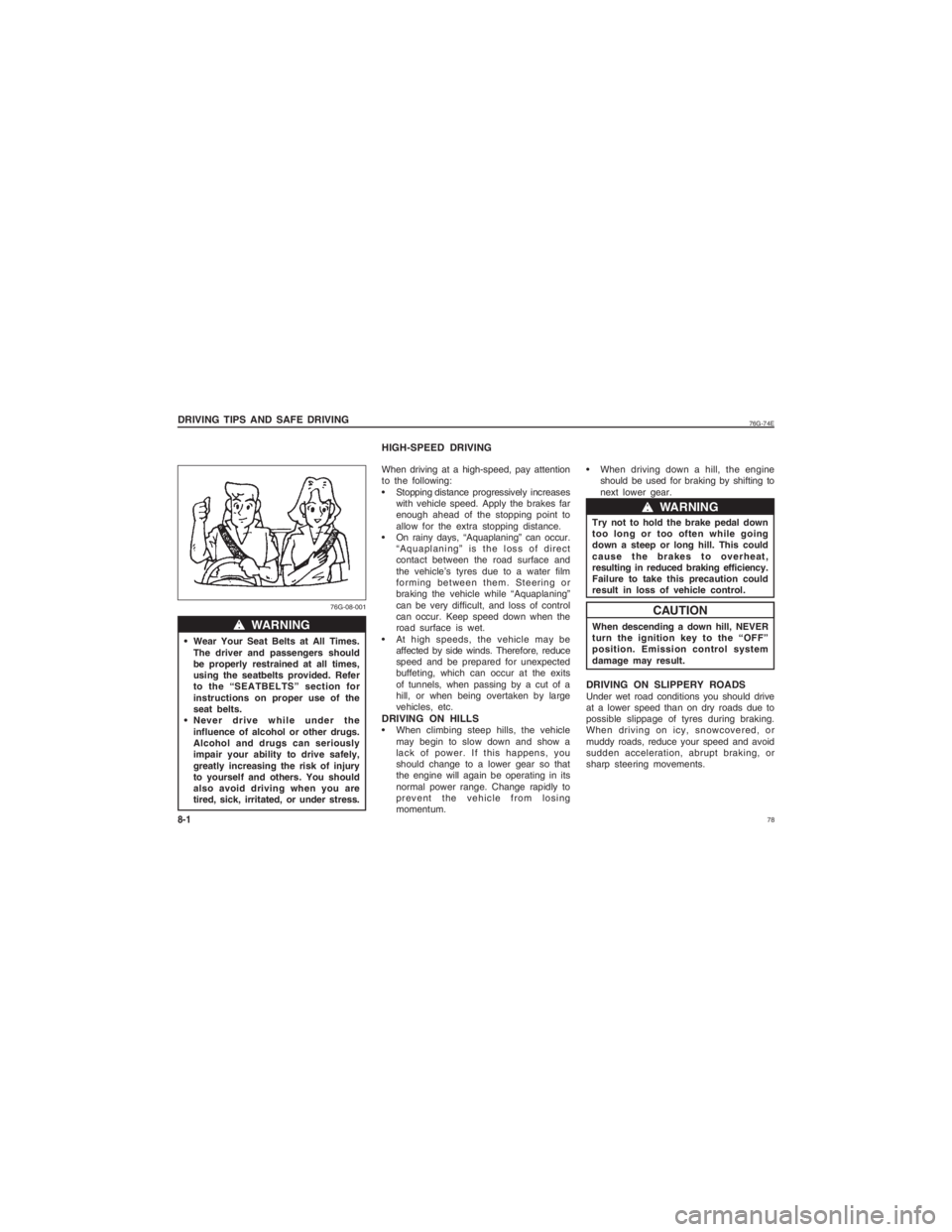
Wear Your Seat Belts at All Times.The driver and passengers should
be properly restrained at all times,
using the seatbelts provided. Refer
to the “SEATBELTS” section for
instructions on proper use of the
seat belts.
Never drive while under the
influence of alcohol or other drugs.
Alcohol and drugs can seriously
impair your ability to drive safely,
greatly increasing the risk of injury
to yourself and others. You should
also avoid driving when you are
tired, sick, irritated, or under stress.
HIGH-SPEED DRIVING
When driving down a hill, the engine should be used for braking by shifting to
next lower gear.
Try not to hold the brake pedal down
too long or too often while going
down a steep or long hill. This could
cause the brakes to overheat,
resulting in reduced braking efficiency.
Failure to take this precaution could
result in loss of vehicle control.
When descending a down hill, NEVER
turn the ignition key to the “OFF”
position. Emission control system
damage may result.DRIVING ON SLIPPERY ROADSUnder wet road conditions you should drive
at a lower speed than on dry roads due to
possible slippage of tyres during braking.
When driving on icy, snowcovered, or
muddy roads, reduce your speed and avoid
sudden acceleration, abrupt braking, or
sharp steering movements.
When driving at a high-speed, pay attention
to the following:
Stopping distance progressively increases
with vehicle speed. Apply the brakes far
enough ahead of the stopping point to
allow for the extra stopping distance.
On rainy days, “Aquaplaning” can occur. “Aquaplaning” is the loss of direct
contact between the road surface and
the vehicle’s tyres due to a water film
forming between them. Steering or
braking the vehicle while “Aquaplaning”
can be very difficult, and loss of control
can occur. Keep speed down when the
road surface is wet.
At high speeds, the vehicle may be affected by side winds. Therefore, reduce
speed and be prepared for unexpected
buffeting, which can occur at the exits
of tunnels, when passing by a cut of a
hill, or when being overtaken by large
vehicles, etc.
DRIVING ON HILLS When climbing steep hills, the vehiclemay begin to slow down and show a
lack of power. If this happens, you
should change to a lower gear so that
the engine will again be operating in its
normal power range. Change rapidly to
prevent the vehicle from losing
momentum.
ww ww
w WARNING
ww
ww
w WARNINGCAUTION
8-1DRIVING TIPS AND SAFE DRIVING
76G-08-001
Page 80 of 139
8176G-74E
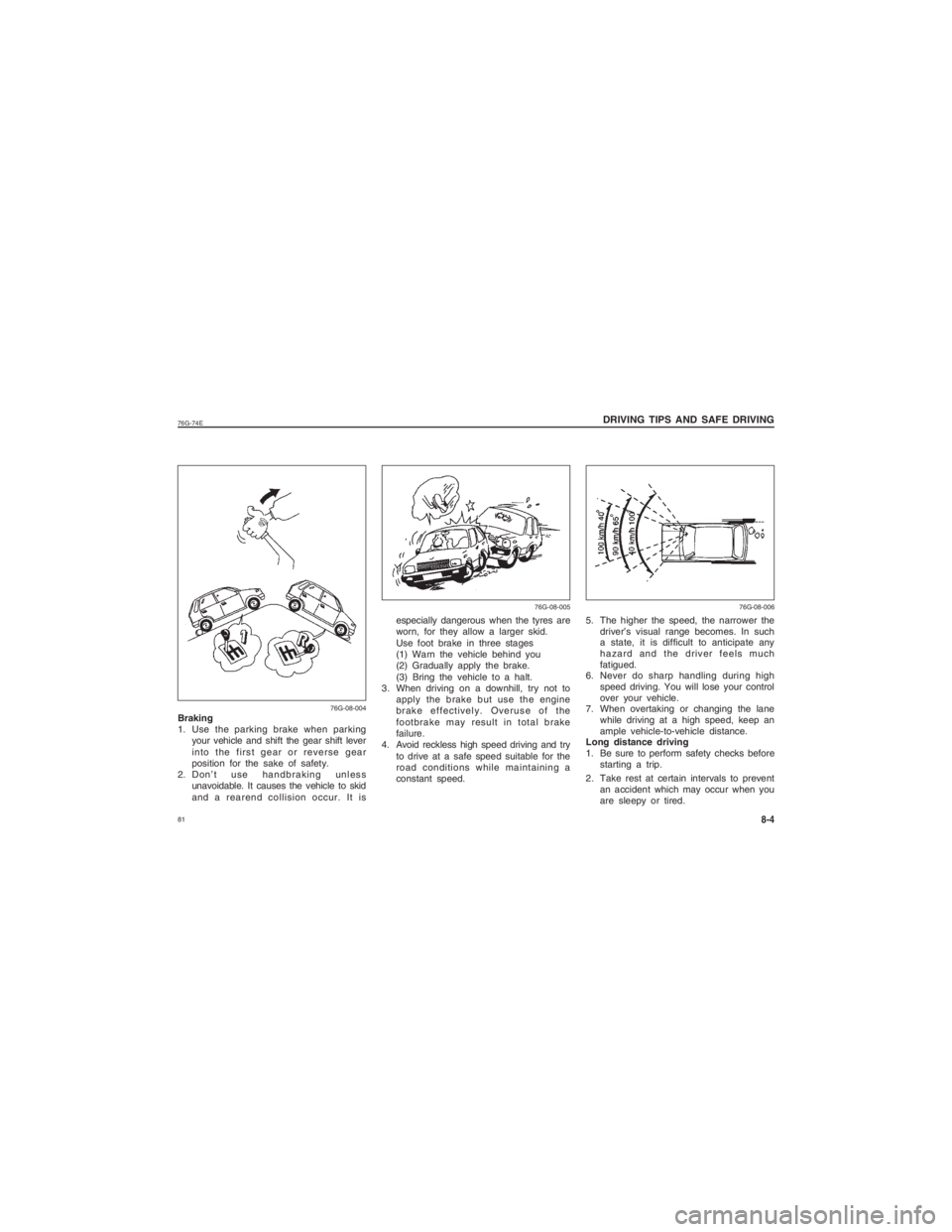
especially dangerous when the tyres are
worn, for they allow a larger skid.
Use foot brake in three stages
(1) Warn the vehicle behind you
(2) Gradually apply the brake.
(3) Bring the vehicle to a halt.
3. When driving on a downhill, try not to apply the brake but use the engine
brake effectively. Overuse of the
footbrake may result in total brake
failure.
4. Avoid reckless high speed driving and try
to drive at a safe speed suitable for the
road conditions while maintaining a
constant speed. 5. The higher the speed, the narrower the
driver’s visual range becomes. In such
a state, it is difficult to anticipate any
hazard and the driver feels much
fatigued.
6. Never do sharp handling during high
speed driving. You will lose your control
over your vehicle.
7. When overtaking or changing the lane
while driving at a high speed, keep an
ample vehicle-to-vehicle distance.
Long distance driving
1. Be sure to perform safety checks before
starting a trip.
2. Take rest at certain intervals to prevent an accident which may occur when you
are sleepy or tired.
Braking
1. Use the parking brake when parking
your vehicle and shift the gear shift lever
into the first gear or reverse gear
position for the sake of safety.
2. Don’t use handbraking unless unavoidable. It causes the vehicle to skid
and a rearend collision occur. It is
8-4
DRIVING TIPS AND SAFE DRIVING
76G-08-004 76G-08-005 76G-08-006
Page 131 of 139
132
76G-74E
Cleaning the ExteriorIt is important that your vehicle be
kept clean and free from dirt. Failure
to keep your vehicle clean may result
in fading of the paint or corrosion to
various parts of the vehicle body.
Washing
Never attempt to wash and wax your vehicle with the engine running.
When cleaning the underside of the
body and fender, where there may
be sharp-edged parts, you should
wear gloves and a longsleeved shirt
to protect your hands and arms
from being cut.
After washing your vehicle, carefully test the brakes before driving to
make sure they have maintained
their normal effectiveness. When washing the vehicle, follow the
instructions below:
1) Flush the underside of body and wheel
housings with pressurized water to
remove mud and debris. Use plenty of
water.
When washing the vehicle, avoid
directing steam or hot water of more
than 80
0C (176
0F) on plastic parts.
2) Remove dirt and mud from the body exterior with running water. You may use
a soft sponge or brush. Do not use hard
materials which can scratch the paint.
3) Wash the entire exterior with a mild
detergent or car wash soap using a
sponge or soft cloth. The sponge or
cloth should be frequently soaked in the
soap solution.
When using a commercial car wash
product, observe the cautions
specified by the manufacturer. Never
use strong household detergents or
soaps.
BODY WORK CARE11-3
ww ww
w WARNING
CAUTION
4) Once the dirt has been completely
removed, rinse off the detergent with
running water.
5) After rinsing, wipe off the vehicle body with a wet chamois or cloth and allow
it to dry in the shade.
6) Check carefully for damage to painted surfaces. If there is any damage,
“Touchup” the damage following the
procedure below:
a) Clean all damaged spots and allow them to dry.
b) Stir the paint and “touchup” the damaged spots lightly using a small
brush.
c) Allow the paint to dry completely.
Waxing
After washing the vehicle, waxing and
polishing are recommended to further
protect and beautify the paint.
Only use waxes and polishes of good quality.
When using waxes and polishes, observe the precautions specified by the
manufacturers.
CAUTION
CAUTION